Showing posts with label English in India. Show all posts

4 January 2024

Book Review: Anuja Chauhan's 'Club You To Death'

Decided to update the blog in the new year, with pieces I've written in the interim. This is a book review I did for Scroll in 2021 and hadn't put up here. Some of you might still find it of interest, especially since ACP Bhavani Singh's career continues with Anuja Chauhan's more recent book, The Fast and the Dead (Oct 2023).

                                                                                   -----

Anuja Chauhan’s new novel may be a whodunnit, but its people are its pleasure, as usual

In ‘Club You To Death’, the popular writer with a perfect ear for conversation uses crime as a vehicle to portray the ‘beautiful people’ of Delhi society.

Early in Those Pricey Thakur Girls, Anuja Chauhan’s thoroughly enjoyable novel set in 1980s Delhi, there’s a scene where the retired Justice LN Thakur and family pile into the khandaani Ambassador to see off their daughter Debjani aka Dabbu for her first day as a newsreader at DeshDarpan (an obvious fictional stand-in for Doordarshan). Chauhan’s latest book, set in present-day Delhi, opens with a charming display of similar familial intimacy, squabbling but deeply affectionate: the retired Brigadier Balbir Dogra and family, four generations “stuffed into a rattling, eight-year-old Maruti Swift”, head off to play Tambola.

The similarities don’t end there. In Thakur Girls, Debjani’s glamorous job (DD newsreaders were then the acme of fashion) had the family dhobi excited to iron her sari and the Bengali Market chaatwala refusing to charge for golguppas because he had seen “Baby” on TV. In Club You To Death, the fetching young lawyer Akash “Kashi” Dogra is flaunted proudly as a customer by his Nizamuddin street barber, plays cards with the drivers parked under his house and chats affably about politics with old security guards who call him Kashi Baba.

The feudal quotient is a smidgeon less – it is 2021, after all – and Chauhan has moved a teeny tiny bit leftward in the transition from Hailey Road to Nizamuddin, making her new protagonist a jhuggi-defending lawyer. But Kashi enjoys much the same cosy relationship with the world as Dabbu did. He’s just woke enough to express some discomfort with it.

The privileged insiders

With his rented shared barsati and JNU-trained activist-architect girlfriend, Kashi Dogra may think he’s stepped away from privilege. And maybe he has travelled some distance from studying at the Doon School and dating a rich industrialist’s daughter. But Chauhan is too smart a writer to let even her likeable hero rest on such self-congratulatory laurels. When Kashi judges someone for having made up a new name and identity, Chauhan is quick to have another character reflect privately “that it is only people with great privilege who can afford to think like this”.

In this obliviousness, ironically, Kashi is following in his father’s footsteps. Brigadier Dogra belongs to that class of people that’s more than comfortably off, with their children attending the best schools (often the same schools they themselves went to), swinging the best jobs (sporting the old school tie does no harm) and generally getting a much better shot at success than 99% of the rest of the population. But they remain convinced they’re not the elite, because – as Brigadier Dogra splutters “Elite people go to five-stars and seven-stars”.

The Dogras? They go to the club.

Anuja Chauhan’s heroes and heroines have always come from the tiny sub-section of India that’s privileged enough to measure its privilege in memberships rather than money. So it’s perfectly fitting that her new novel is set in an institution emblematic of that class: a club that sounds a lot like the Delhi Gymkhana, dealing with a political milieu that sounds a lot like the present.

Speaking the language

As always, Chauhan knows her characters inside-out, turning out pitch-perfect comic set-pieces where pretty much everyone comes in for some needling, from pompous military heroes to poor little rich girls from The Vasant Valley School. But almost everyone also gets a degree of understanding. It helps that Chauhan is adept at dialogue, rendering each character in a suitably Englished version of their specific Hindi-mixed lingo, endowed with just a little extra colour and cusswords.

“It’s my own fault! I was the one who had bete-ka-bukhaar, and kept hankering for a son in spite of having such lovely daughters!” says a posh Punjabi mother berating her loser of a son. “I wanted to tell him ki listen, behenchod, we have a huge-ass CSR wing and we do a lot!” rants an heiress defending herself against the charge of being rich and oblivious. “Banerjee, apne saand ko baandh [Tie up that bull of yours],” says the friendly male who’s text-warning a woman about her boyfriend’s seductive ex.

Ever the old advertising hand, Chauhan constantly ups the linguistic absurdity quotient in delicious little ways: old Brigadier Dogra insisting on calling his wife Mala-D; a line of sculpted semi-precious stone lingams being called Shiv-Bling, or a potential scandal involving an army hero getting hashtagged as “Fauji nikla Mauji! Hawji Hawji!”

The perfect outsider
In a gleeful departure from her previous work, though, Club You To Death serves up murder as the main course – of course, with a breathy little romance to make the medicine go down. The setting offers plenty of scope for political intrigue, classist snark and just plain gossip, and Chauhan sets to work with relish, plotting the crime onto all its possible social and cultural axes. For starters, the murder is committed on the day of the club elections, one of those sorts of events that occupies mindspace in a proportion inversely related to the power at stake.

The rival candidates, both insiders, seem equally keen on winning. But could either – the retired military hero or the classy female entrepreneur – really want the job enough to kill for it? Or is the murderer just trying to pin the blame on one of them?

Second, there’s the victim, with his own secrets. Was the dead Zumba instructor a self-made Robin Hood, or a devious social climber? Was he playing his rich clients, or were they playing him?

And finally, there’s the wider socio-political context: such unsavoury news doesn’t bode well for a club already in the bad books of Delhi’s new rulers (not least for its connections to the old ones). As new rivalries and old secrets tumble out of the DTC closet, the citadel of Lutyens’ Delhi privilege begins to seem rather doddering and vulnerable. It’s a clever trick – especially when we wonder if it’s just true.

Either way, having crafted this perfect insider atmosphere, Chauhan places the case (and us) in the hands of the perfect outsider. A policeman who’s upper caste and English-speaking but not quite Club Class, ACP Bhavani Singh is somehow observant enough to imagine other people’s compulsions, be they of caste, class, gender or something else. Instead of the Singham-variety cop “who makes the criminals piss their pants”, Bhavani makes “all the crooks leap up grinning, and ask him how his granddaughters are.”

Stolidly incorruptible, staunchly non-violent and persuasively gender-sensitive, the old Delhi Police officer feels even more like a form of wish-fulfilment than Chauhan’s dishy romantic heroes. So, of course, we dearly want to believe he might exist. Much of the pleasure of Club You To Death comes from watching the amicable old policeman piece the case together quietly, his “little grey cells” keen enough not to draw attention to himself.

Under the radar, as Chauhan well knows, is the best way to fly.

Published in Scroll, 10 April 2021.

28 June 2020

The smells of others

My Mirror column:

Nicholas Kharkongor's Delhi-set dramedy Axone traces some of the fault lines that mark the urban Indian melting pot.


Growing up between cultures, I learnt long ago that smell was most people’s strongest, most intimate sense – and thus the one that lent itself most easily to kneejerk reactions, especially with relation to food. Members of my family’s staunchly vegetarian side, North Indian Jains of the not-even-egg variety, have sat me down as a child to tell me how difficult they found it to keep their own food down while having their nostrils assailed by the fried fish smells wafting down from a tenant’s house.

Nicholas Kharkongor’s film Axone, recently released on an online platform, is named for the strong-smelling fermented soya bean paste that forms a necessary ingredient in many traditional northeastern dishes. Often spelled akhuni, axone has a distinctive smell that you can’t ignore – which makes it a useful metaphorical marker of difference. And differences that cannot be ignored make for a strange but potent cocktail of attraction and repulsion.

That mixture of attraction and repulsion appears sharply in the film, in the alternately lascivious and judgemental gaze that Delhi folk turn upon the young northeasterners in their midst – being judged by the women for wearing ‘Western’ clothes and having boyfriends, while being the object of the men’s unsolicited attentions. But that attraction and repulsion also plays out, perhaps unintendedly, in Axone’s own cinematic form. The film plays out the food/smell motif against a tenant-landlord scenario in one of those urban villages in Delhi that thrum with the sounds of many languages, focusing on a group of friends from the Northeast who have to make an akhuni-flavoured pork curry for a last-minute wedding feast. That food-and-wedding narrative, though, feels like a mere sweetener, an attractive hook on which to hang a script full of bitter – abeit necessary – pills. Kharkongor's central concern is the racism, sexual predatoriness and aggression that migrants from the Northeast are forced to suffer in Delhi (and most other Indian cities). But what he does is to take that disturbing narrative and plonk it down in a Delhi-set middle class comedy that has become a Bollywood subgenre from Do Dooni Chaar and Vicky Donor to Queen to Badhaai Ho.

So alongside the central group of friends, we get a fairly detailed glimpse of the landlord's family: the hard-nosed landlady (Dolly Ahluwalia doing a version of her alcohol-swigging Punjabi grandmother from Vicky Donor), her layabout son-in-law (Vinay Pathak) and her overenthusiastic grandson, the curly-haired Shiv (Rohan Joshi). Shiv's multiple machinations and largely well-meaning mistakes form some of the film's warmer bits of comedy, but his father and grandmother's characters feel derivative and ungrounded. Still, there is something to be said for the fact that the homogenous lower-middle-class Punjabi milieu, a staple of so many previous Delhi films, has finally been extended to a whistle-stop tour of the very real admixture of so many Delhi neighbourhoods like Humayunpur, where locals rent out parts of their properties to people from across India and beyond.

Axone gently impresses upon us that everyone judges each other, using community and skin colour and language to make easy categorisations. If the Hindi-speaking landlords claim not to be able to tell northeastern faces apart, or remember their names, then the Nepali girl, too, can't get her head around her African neighbour's name – and the African neighbour, in turn, makes an assumption about her based on her looks. And the whole group of northeastern friends keep their distance from the landlord’s son, whose interest in them is very much a curious fascination with the coolness their clothes, their English-speaking-ness, their music represent for him.

Kharkongor’s real sympathies, though, lie with Chanbi, Upasana, Zorem and Bendang (played by Lin Laishram, Sayani Gupta, Tenzing Dalha and Lanuakum Ao), each of whom is dealing with their own troubles. Even here, however, his script constantly points out how their relationships with each other, and with themselves, are inflected by the politics of identity and belonging. These include some small observations that shape the plot – like the perceived difference between being Nepali and being northeastern, and other observations that don’t quite go the distance – like the fake American accent or the Bollywood lyrics that are needed to get by in a world in which those languages have bigger markets. But whether it be the northeastern man who feels emasculated by racist North Indian violence, or the northeastern woman exhausted by nonstop sexual slurs and harassment, Axone brings home the trauma and injustice of the migrant northeastern experience as perhaps no Hindi film has before.

Published in Mumbai Mirror, 21 Jun 2020.

8 September 2019

Abhishek Majumdar: Theatre Interview

A two-part interview with the multi-talented Abhishek Majumdar, published on Firstpost in August:

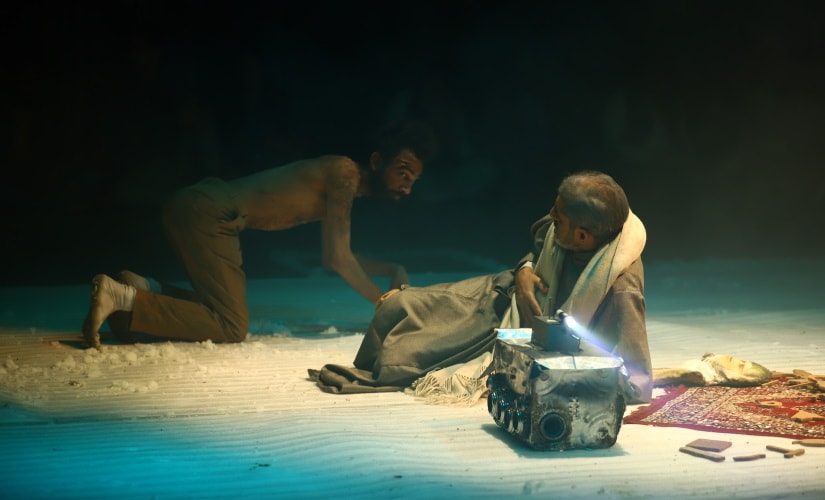
At 38, Abhishek Majumdar is one of India's most exciting playwright-directors. An alumnus of the London International School of Performing Arts (LISPA), Majumdar grew up in a Bengali family in Delhi. For the last decade he has been based out of Bengaluru. The Indian Ensemble, which he co-founded in 2009 and ran until 2018 with his friend and colleague Sandeep Shikhar, has produced some of the most interesting Indian plays of recent years: the Kashmir trilogy of Rizwan, Djinns of Eidgah and Gasha, the 10th century philosophical-political drama Muktidham, and the Allahabad-set Kaumudi, which is both a tribute to Mohan Rakesh and a complex engagement with the epic heroes Ekalavya and Abhimanyu.

His plays have been published by Oberon Press, UK, and translated into multiple languages from Marathi to Czech. His play Djinns of Eidgah was staged by Jaipur's Jawahar Kala Kendra this January and at Mumbai's Prithvi Theatre earlier in August. Another production of Djinns by the Bread Theatre and Film Company of Cambridge is currently being staged at the Edinburgh Fringe until 18 August.

In this interview, he speaks about theatrical form and content, the politics of language in India, and his many interests beyond the stage.

Muktidham, written and directed by Majumdar
The first time I heard of your work wasn't a play; it was at Lekhana, in Bengaluru in 2013/14, where you read a Hindi short story. Do you still write short stories, or things other than plays?
I do, but I don't share them with the world. They're not necessarily about personal subjects, but the act of writing a short story is for me very personal. I like to keep it for my friends and family. I have consciously never published my stories. I compose music sometimes, for other people, for other plays, sometimes for professional musicians. I also paint a little bit. That helps me in scenography, but mainly I paint for myself.
Coming back to the short stories, there is a series called Lakdi ke Makaan, which I have been working on, about women who live in the villages of Shimla (my aunt lives in Shimla). Someday it might become a monologue by an actor. But right now only about 10 people in this world know that I write stories.

Your short stories are in Hindi, but would it be true to say that you wrote plays in English earlier, and now write plays in Hindi?
I write in three languages: Bangla, Hindi and English. My first play, an adaptation of Sunil Gangopadhyay's novel Pratidwandi, was in Bangla. Later I wrote Dweepa in Bangla, but it has only been performed in Kannada.

I'm currently writing an adaptation of Shakuntalam, that's in Hindi. I recently wrote a satire about Communist history, which hasn't been produced as yet, called Dialectical Materialism Aur Anya Vilupt Jaanwar. That's in Hindi, although it starts in Calcutta at the time of collapse of the Berlin Wall, and then goes back to Karl Marx and Adam Smith at the Garden of Eden. I'm still working on that play, but strangely it's been translated into Czech and won an award in Prague. [laughs]

Translations of my plays are happening/have happened into Gujarati, Kannada, Marathi, French. Rizvan got translated from Urdu to Bangla, because there is a show in Bangladesh.

All my work internationally is in English. I write those plays in English whose natural language would not be Hindi or Bangla. So for example, Pah-la, which was staged at the Royal Court Theatre in London last year, is set in Tibet; that I wrote in English. I have another recent play, Batin, set in Medina on the two nights between the Prophet's death and his burial. It's about what happens when the word of God is not understood by everyone in the same way. The natural language of Batin would be Arabic. So that's in English. An early play of mine, Harlesden High Street, was in English. But now I don't produce any work in India in English.

So there has been a move towards Hindi?
Directorially, yes. Five years ago our company did make work in English. I consciously stopped. For two reasons. One, English is the only language in India where knowing the language is enough. In any other language, you also have to know how to act. Frankly, I find far fewer options for actors in English than in Hindi or Bangla or Kannada.
Secondly, an Indian audience watches Hindi or Bangla theatre differently than English. Their bodies change. Because theatre is fundamentally a community thing, you watch it with people. And when you get the third layer of the language — the language that you may have not gone to school in, but the language in which you make fun of people — that is the right language for that stage.
For example, if you read [Girish] Karnad in Hindi, that works much better than reading it in English (though some of the English translations are fantastic).
In India, my rehearsal room is also much more alive when I'm rehearsing in an Indian language. I am directing a play in New York in English, but there my actors' natural language is English. The contract of language is three-way: between the maker, the actor who is performing and the audience. [The play] has to be in the most suitable language for all three, not just for one.

Have you directed a play in a language you don't understand?
Yes, Kannada, which I follow, but don't speak. And I've done a play in London 10 years ago, which was seven vignettes: one in Hebrew, one in Cantonese, one in Arabic...

And that wasn't a problem?
No. Direction-wise, then it was less of a problem. Perhaps now it would be more of a problem. I was a drama school student then, more interested in form. Now I've gotten more interested in meaning.

Tell me more about your interest in form.
Essentially, a play is composing form over time. It's a bit like the work of an architect. One is always thinking about structure. And I've been an avid mathematics student, interested in pattern, shape, geometry, topography. Every play is a problem with multiple solutions.


Give me an example?
I'll give you two examples. For Muktidham, the problem was how do you write a play which from inside is European, but from outside is in the Indian epic format. Structurally, it's not a Greek play with three acts and five plot points; it is cyclical, there is a sense of elaboration. But the scene-work inside the play is not in the epic format: nothing is sung, for instance.

What is very Kathakali about it is that from the interval to the next scene, there is a big jump. We believe that time lapse for two reasons. One, because we believe there is a wall — the wall behind which the Buddhist king is standing. We never see it, but we believe it, and so we assume a certain urgency to everything else. Which is a very Kathakali thing to do. You know — “Duryodhana is coming”, but the scene only has Draupadi and the brothers. The other thing is that although you move forward in time, but the eclipse is stuck. It's nothing, really, it's one profab light on a disc! But it allows us, I think, to continuously imagine suffocation.
In Kaumudi, the challenge I set myself was linguistic: to write a play which used both the language of Aashaadh Ka Ek Din and Adhe Adhure [two classic Mohan Rakesh plays, one set in the time of Kalidasa, one in the 20th century]. So there is the play, and there is the play within the play. And there's a third language the characters use when they are playful, which is similar to Pandavani.

So each of your plays is a research project. Literary, anthropological, historical.
Yes. But art is about memory. It's about how you remember your research. That's the difference between researching and writing a paper, and researching and writing a play. A play has to go through oneself.  It can't be just your thesis — it's got to be your observation of life, your sense of taste, your politics, what you want to say.
But for me, if something doesn't have a hard problem to solve, it doesn't interest me. I can watch plays which are not very complex, I can watch anything live. But to work on an idea for two years of my life, it has to be intellectually complex.
PART II 

Is there one idea that each play starts with?
The theatre is all about confluence. For an idea to become a play, seemingly different things must stick together. Like in Kaumudi, you have a father and son, who mirror Ekalavya and Abhimanyu. The father is going blind, and there is a theatre inside a theatre. These could be four different plays. But I am fond of density, that's my thing. Though that is also one of the criticisms of my plays.

 Playwright-director Abhishek Majumdar on theatre as confluence, its future in India, and directing a film
Abhishek Majumdar

Density leads us nicely to my next question. You work in Hindi, in a moment when there's increasing criticism of the elitism of English. But you also work in theatre. Do you ever think about reaching out to larger audiences?
I have a lot of confidence in the theatre. If a play is worth anything, it will outlive at least one generation. And over time, plays have large audiences with a much deeper level of engagement. So I think the idea of audience is a more complex matrix than just the number of people right now — it's also about density, how many, where. 
The paradox of our time is that in this political moment, you want to make work because it feels urgent. Which is of course necessary, in the face of what is going on. But at the same time there are so many philosophical problems in the humanities and sciences which are completely worth looking at. Is an entire generation of artists only going to look at Hindutva? Maybe it has to, but we also need deviations.
Having said that, I make theatre because I like every dimension of it. I love the craft of it, the art of it, the coming together of people to do it it, the teams that we build, having that audience live, reaching out, going to small towns, going to big cities. While closing Muktidham, we had a moment where Sandeep Shikhar's daughter Sanchi, who I have seen being being born, was sharing a room with Ram Kissar, who does our make-up, who has worked with BV Karanth since he was 20. This is possible in the theatre, because of the nature of its form. It's not like everybody has to be trained in one dance form. It is rough, rugged, it is mixed, it reflects the streets of your town. The street has an old man and a young woman, so the green room must have that. And that is for me the reaching out of the theatre.

But are you often accosted by the question of whether you want to direct a film? Or turn your plays into films?
Suman Mukhopadhay, I call him Lal Da, has won a major award to make a film out of Djinns of Eidgah. I am not a big fan of cinema, though I will direct a film at some point. What I am interested in is directing concerts. I grew up travelling a lot with Indian Ocean, and that gave me the idea that there is a dramaturgy to concerts. A couple of bands have asked me. Susmit [Sen] also asked, but I've looked up to him for so many years, I can't direct him! He will have no problem, but I will have a problem. But now I'm thinking of a concert of sound designers, as opposed to musicians.
Djinns of Eidgah, by Abhishek Majumdar
A still from Majumdar's Djinns of Eidgah

Would you write the music for such a concert yourself?
Some of it. Right now I compose mostly for plays. I took music for granted, because I grew up with Hindustani music classes in my house, and my mother playing the piano every evening and singing Rabindrasangeet. I can use Bengali notation, Swaralipi, which is often used on the piano.

How do you see the state of theatre in India? Are there exciting things happening?
I think art and science need a lot more government support. These things are important for human beings to exist, and they can't be market driven. This emphasis on the commercial, treating ticket sales as the parameter of existence, as if without it you're not speaking to the people: that's a cop-out for not thinking deeply about what the human race needs.
Individually a lot of exciting stuff is happening, from solo performances to technological things. What in Europe is called 'site-specific theatre' has been happening in India in Prahallada Naatak for a thousand years. Going to the proscenium is a new thing for us. But now, the urban Indian is coming back from the West with the idea that only what's being made there is work.
As a person who teaches in a university, I straddle some of these worlds. For the last five years, I teach playwriting at the NYU campus in Abu Dhabi for a semester every year. I have never had two students in the same class from the same country.

How many students in a class?
Eight to eleven, from India, but also Jordan, Palestine, Latin America, the African countries. And the challenge is that they all need to find specific solutions to their postcolonial situations. We are much closer in the arts and sciences to Bangladesh or Algeria than to New York or London. But we have started thinking of the world as a ladder. That's not helpful at all. Yes, there are great things to learn from a cultural exchange of that sort. But just as the first world person is always operating out of a particular context, it is also important for us to operate out of our context.
I was telling a student the other day that if you want to know where you are making art, you have to ask yourself two questions. One, if about 10 to 12 percent of a country's GDP is spent on arts, then public support for the arts in say, Germany, is about 300 percent that of India. Second, you need to be conscious of historical imperative. It is lowest on Broadway, in New York, which is farthest from colonisation. You can make anything, it basically has to sell tickets. And it is highest in the Gaza strip, because right now, as you're making that play, you are colonised.
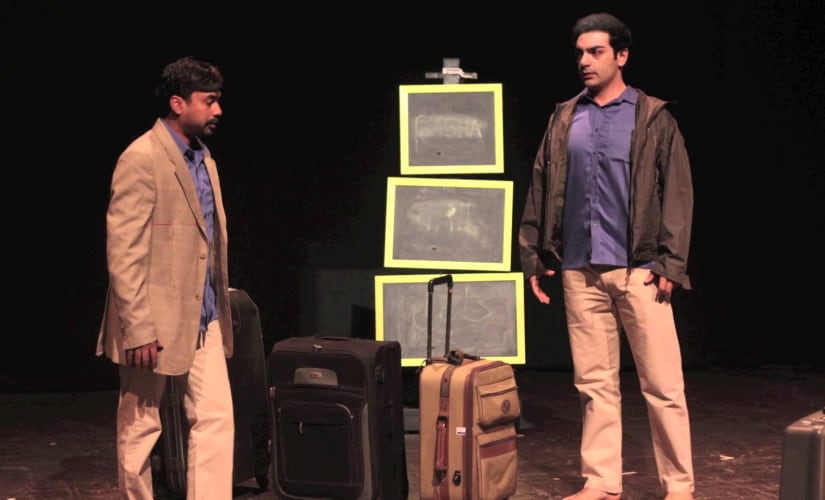
Gasha1 825
A still from Gasha, written by Irawati Karnik and directed by Abhishek Majumdar

Why is your idea of historical imperative limited to the experience of colonisation?
Yes, I'm being simplistic, in order to find an axis that works globally. There are other axes not directly related to colonisation. Within India, how many plays do we see with lower caste women as characters? Nothing, compared to the many with upper caste men.

You mentioned that developing a Dalit dramaturgy is one of the things you're excited about.
Yes. After we moved on from Indian Ensemble, Sandeep Shikhar and I started a new theatre company along with  Vivek Madan. It's called the Bhasha Centre, and our main focus are at the moment is to work with Dalit texts and Dalit writers, from Daya Pawar and Limhale on Dalit aesthetics to published Dalit autobiographies and the work of lok shahirs. It might not be a literature that already exists. We're collaborating on a version of Kisaan that will open at Prithvi Theatre in March 2020. Iravati Karnik is writing it, drawing on Prithiviraj Kapoor's original play Kisaan together with Daya Pawar's Baluta.

Any other ongoing projects you'd like to flag?
There's Tathagat, a street play we did in collaboration with Jan Natya Manch, which played in Mumbai from 9 to 14 August. There's a version of Eidgah ke Jinnat with Jawahar Kala Kendra, Jaipur, with many Rajasthani actors. Djinns of Eidgah is also being staged at the Edinburgh Fringe Festival this month, by Ananya Mishra and the Bread Theatre Company, formed by a lot of non-white Cambridge University students.

As someone who works in London and New York as well as in Bengaluru and Bangladesh, it is important to me to know how much time I work where. I am not making work in England in order to give up my work in India; that's not going to happen. But last year we were touring in Uttar Pradesh and sleeping in trains, and just after that I spent a month in New York. And that is absolutely fine in the theatre. But as time gets limited, it becomes important to choose, to measure.
I like that we have come back to the mathematics. Thank you, Abhishek.

Published in Firstpost in two parts, 19 and 20 August 2019.

24 June 2019

Grave New World

My Mirror column

The new webseries Leila is uneven in its language, its storytelling and its politics, but it offers plenty to think about. 

(Second of a two-part column)


In Prayaag Akbar’s 2017 book Leila, which is in English, the use of Hindustani words is limited but specific: the unconscious use of the appellations “Abbu” and “Ammi” nearly gets Riz and his brother Naaz caught as being from ‘the wrong sector’. In the Netflix show, Shalini meets Riz’s parents and calls them Abbu and Ammi – but the subtitles flatten the words into “Dad” and “Mom”. Other world-building coinages by Akbar – the thuggish army of Repeaters, or the hierarchical division of society into Categories 1-5 – are allowed to remain in the show’s English subtitles, but necessarily translated into Hindi in the spoken version, sometimes losing specificity and power – eg “Paltan” for the Repeaters – and sometimes gaining it: “Panchakarmi” has far greater punch than Category 5.


There are other times when the Hindi dialogue is as nuanced as it is possible to be, delineating minute shades of meaning that then amplify the narrative. One instance not present in the book is when Shalini (Huma Qureshi) happens to witness the police raiding a professor’s study. “Yahan toh Sen wali kitaab bhi hai,” one cop announces triumphantly to his senior. 

“Politics? Aap politics sikhaate hain?” the senior cop demands of the professor. “Sikhata nahi, padhaata hoon,” he replies sharply. That almost pedantic distinction, even on the verge of being arrested, fits the character’s academic persona. But that difference between “sikhana” and “padhaana” also makes a subtle point about this anti-intellectual universe, in which politics can only be understood as a skill – not as a subject of study. And as is already becoming true in our present, it is not a skill that the establishment wishes students to have.

There is another funny detail in the scene. The nameplate outside H. No. 1/20, a mid-sized bungalow of the sort that a Delhi University professor might currently occupy, says “Dr. Nakul Chaubey, MA, M.Phil, PhD”. Given that a PhD implies having all the previous degrees, the nameplate’s recitation of degrees might be intended as humour. But it might also be read as signifying a world in which even visitors to an academic’s house are not assumed to know what a PhD is. As many degrees as possible must be listed on an intellectual’s door, and even that listing is not sufficient armour against the barbarians at the gates. As we – and Shalini – watch in silent horror, the knot of heckling protestors shouting “Nakul Chaubey murdabad” swiftly becomes a lynch mob kicking and punching the unarmed white-bearded man, now fallen to the ground.

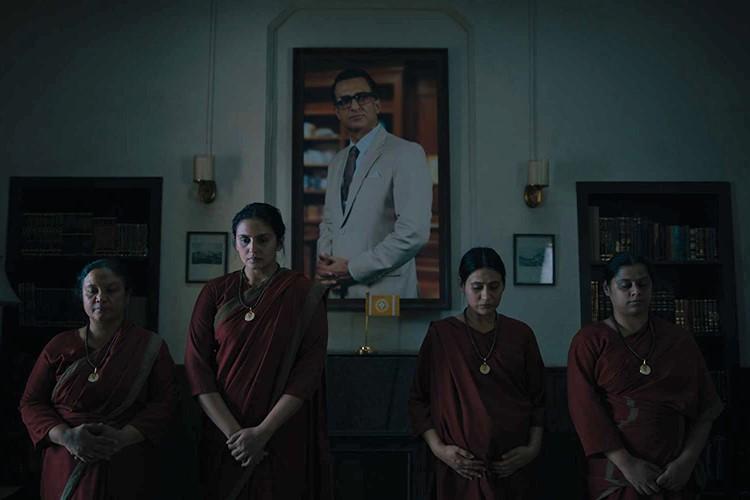
The targeting of intellectuals in a Hindutva-driven dystopia has appeared in a previous Netflix India original series, Ghoul (2018), whose writer-director Patrick Graham shares writing credits on Leila with Urmi Juvekar and Suhani Kanwar. In Ghoul, that aspect is more frontally addressed: the protagonist Nida Rahim (Radhika Apte) is the daughter of a retired academic called Shahnawaz Rahim (SM Zaheer). Nida is part of an anti-terrorist force, and much of the narrative tension emerges out of the father and daughter’s starkly different positions on the state’s role in citizens’ lives.

The elder Rahim’s criticism of an authoritarian government is seen by his daughter as seditious. Father and daughter are both Muslim, but the daughter has internalised that second-class status as involving a greater need to prove her loyalty to the state.

That idea of a generational shift is also a shaping influence in Leila, which contains several scenes involving the brainwashing of children – and the attempted reformation of adults – by the new state of Aryavarta.

The show’s vision of Aryavarta feels almost programmatic in its symbolic combining of historical Fascism (a two finger ‘Jai Aryavarta’ salute, for instance) with a recognisable version of the Indian present (a leader called Joshiji whose name appears on every broadcast and every poster). Schoolchildren recite “Aryavarta is my mother” while doing martial exercises; babies are addicted to animated videos about Junior Joshi, whose heroic exploits evoke Bal Narendra.

More disturbing is the use, in the episodes directed by Mehta, of variations on existing Hindu rituals – rolling on the floor, for instance, or the marriage of a woman to a dog – as punishments imposed on women who break the rules of Aryavarta. In times like ours, it seems to me more necessary than ever to distinguish our criticism of the socio-political vision of Hindutva from what feels like a too-easy mockery of Hindu practice. To imagine existing religious practices as future forms of social torture is to display a lack of both imagination and empathy.


Leila also occasionally suffers from feeling like an Indian version of The Handmaid’s Tale, the web adaptation of Margaret Atwood’s novel. Akbar’s novel did contain the core idea of a regime that slut-shames and drugs recalcitrant women into submission, but the Netflix version has replaced the workaday dullness of Shalini’s office-cleaning and one-room-kitchen-attached-bath with a dark, shared dormitory for women who must undergo various forms of abasement, including bathing in dirty water, polishing shoes and being guarded by eunuchs. It also seems to adopt wholesale from Atwood the vision of categories of women dressed in different colours who serve different roles in society (the handmaids, the Marthas and the Wives). 

Still, these categories do provide the show’s most fertile ground for self-examination by the class of Indians likely to be watching Leila. I was excited by the show’s foregrounding of what is a more subterranean strain in the novel, the mistress-maid reversal. But the execution of that reversal, crunched into two years instead of the novel’s sixteen, is too quick to be credible. It allows for no interiority on the parts of either mistresses or maids. And if Shalini doesn’t see how her unearned privilege is part of what has led her world to this point, how will we?

Published in Mumbai Mirror, 23 June 2019. (The first part is here.)

25 March 2019

Heading to the Wedding

My Mirror column:

The new series Made in Heaven is a meaty addition to a genre that has captured our imagination for the last two decades: the big fat Indian shadi. (First of a two-part column)


As I succumbed to social media peer pressure and binge-watched the new web series Made in Heaven this week, I started to wonder when weddings in our movies went from being the all's-well-that-ends-well freeze-frame at the end of all the drama to becoming the locus of the drama. 

The original moment of change, it seems to me, might have been Monsoon Wedding. Mira Nair's 2001 film used an upper middle class Delhi wedding as the setting for a social and familial unravelling. Nair and her screenwriter Sabrina Dhawan unveiled the deep, dark secrets of the Indian family with a frankness that felt shocking at the time – but managed to use the glitter, the banter, the infectious energy of the North Indian wedding as the perfect foil for all the intense stuff.

In retrospect, Monsoon Wedding was the sophisticated prototype of something that would define our era. Among South Asians, a daughter's wedding had always been something to spend on. But a decade after liberalisation, the country's burgeoning middle classes suddenly had more money to spend – and were increasingly unabashed about being seen to spend it. The big fat Indian shadi and the high-gloss, exportable version of Hindi cinema that we call Bollywood arrived in the world more or less together, film and life cross-fertilising each other. Kabhi Khushi Kabhi Gham released the same year – 2001. Through the 2000s, aided by Karan Johar and others, the shadi became an essential part of Bollywood – and Bollywood became essential to the shadi. Across regional/linguistic boundaries, in India and in the desi diaspora, a with-it wedding now had to have a choreographed Bollywood sangeet. Across national boundaries, too, the newly performative Bollywood-style wedding established itself as a hegemonic cultural export – as a graduate student in New York in 2004 or so, I had the enjoyably surreal experience of watching my university's Pakistani Students Association stage a Bollywood-style faux-wedding as their big cultural event of the year.

Nearly a decade after Monsoon Wedding, in 2010, came another era-defining wedding movie: Band Baaja Baraat (BBB). Written by Habib Faisal and directed by Maneesh Sharma, BBB was also set in Delhi, but with a much more expansive socio-economic canvas than Monsoon Wedding's elite, English-speaking South Delhi family. BBB opened with Bittoo Sharma and Shruti Kakkar (Ranveer Singh and Anushka Sharma) meeting at a wedding, as so many Hindi movie couples have from Chandni to Saathiya – but then cleverly subverted expectations until at least halfway through, by making them partners not in love but in business. A wedding planning business, to be precise, which let Bittoo and Shruti – and their audience – work their way through a series of different Delhi milieus.

Made in Heaven (MIH) – conceptualised by Zoya Akhtar and Reema Kagti and co-written by Alankrita Shrivastava of Lipstick Under My Burkha fame – often feels a cleverly reworked combination of Monsoon Wedding and Band Baaja Baraat (BBB), expanded to series length and set in the present. As in BBB, the protagonists run a wedding planning business, and each wedding they organise gives us a ringside view of a particular Delhi social setting.

Only Tara Khanna and Karan Mehra (Sobhita Dhulipala and Arjun Mathur) move in more moneyed circles than Bittoo and Shruti. And consequently, so do the couples whose weddings they organise. The poshest echelon of golf-playing industrialists and their rummy-playing bitchy wives are straight out of Akhtar's 2015 film Dil Dhadakne Do (DDD), as are the Punjabi-speaking business families one notch down, whom the top tier fraternises with but also scorns. And as in DDD, these jokes at the expense of non-English speakers – a rich aunty saying “twat” instead of “tweet” – often feel like a stretch. Sometimes it’s the placement that's off. I'm not saying the Delhi rich don't mispronounce English words, they do – but if your daughter's marrying their son, you don't correct their pronunciation.

There are other glitches that show up the lack of Delhi detailing by a team of Bombay people who can't be bothered to go beyond visual and class clichés. Sure, this is fiction – but if you're going to say a character lives in Dwarka, then don't show her getting off in Sheikh Sarai, at the other end of Delhi. And definitely don't show her in a home that isn't a DDA flat. Don't give us a Delhi-based character who describes himself on his website as a “Mughal historian” and then responds with baffled surprise to the existence of a late Mughal haveli. Don't bung in a troupe of hijras from a “Fateh Baba Ki Dargah” when there isn't one in the city. As a Delhi person, I rate MIH sadly low on the authenticity scale – a matter I bring up only because every second episode seems to end on a platitude about Delhi delivered by Shashank Arora's video-camera-wielding Kabir – apparently Akhtar's human replacement for Pluto the dog, who delivered them in DDD.

But then what makes Made in Heaven worth watching isn't Delhi. If BBB acquired some cool in 2010 from not making its central pair start romancing immediately, MIH is immeasurably cooler because the couple at its centre are not a romantic couple at all.

The second and concluding part of this column is here.

Published in Mumbai Mirror, 17 Mar 2019.

2 March 2019

Singing from the soul?

My Mirror column:

Gully Boy movingly fictionalises the lives of two real-life Mumbai rappers, but its insistence on authenticity masks as many contradictions as its characters 


In the opening scene of Gully Boy, the film’s protagonist Muraad (Ranveer Singh) is roped into stealing a car by his friend Moeen. It’s clear that Muraad isn’t too comfortable doing this, and yet he goes along for the ride, literally. The scene manages to do several things with superb economy. It marks, first and foremost, the thin line between the legal and illegal that these young men must straddle, a lakshman rekha where the temptations of stepping over are much greater than any benefits that might accrue from staying within. It also returns us to the risky lives of poor young Muslim men in Mumbai, exactly thirty years after Saeed Mirza’s Salim Langde Pe Mat Ro (1989), evoking an updated version of that youthful urban swag but avoiding the sense of real danger. Specifically, though, Zoya Akhtar’s achievement in the scene is to show us what really matters to Muraad: when the stolen car’s stereo starts playing some generic rap, he mocks the lyrics showing off girls and gaadis. Whoever listens to such “nakli rap” must be a “nakli aadmi”, the boys giggle, and in their heads the stealing of the car is now more than ok.

Given that Akhtar’s consummately crafted film is, after all, an appropriation of the lives and work of real-life Mumbai rappers Naezy and Divine, there is something audacious about Gully Boy’s frontal claim to authenticity. The unspoken message, in this scene and throughout the film, is that Muraad is asli, the real thingSome of the most affecting lines in the film are built to bolster this truth-claim: “Teri kahani tere ko nahi bolni toh main kae ko boloon? (If you don’t want to tell your story, why should I tell it?)” MC Sher asks Muraad when he says he’s afraid to actually perform the poem he has written. Or later, before a crucial rap battle, when Muraad seems dejected by his poverty and what he sees as his lack of exposure, Sher tells him, “Tere paas kya hai tu woh dekh (What you have, you look at that)”.

Of course, this is tied to the idea of hip-hop as an autobiographical form, whose discomfiting of its audience draws on the authentic experience and unexpurgated language of African Americans from inner city backgrounds. As Sher tells Muraad in response to his “Comfortable nahi hoon main (I’m not comfortable)”, “Bhai duniya mein sab comfortable hote toh rap kaun banata? (If everyone in the world was comfortable, who would make rap?)”.

And yet Gully Boy itself shows us otherwise. Rap, like any other art form trying to succeed under conditions of late capitalism, must become comfortable receiving the patronage of the comfortably-off. So while the film shows how rap is enabled by the democratising possibilities of the internet, it also acknowledges that the music industry continues to have gatekeepers. Money matters, as does the influence of what Moeen once cuttingly refers to as “the English-talking gang”. A crucial character here is Sky (Kalki Koechlin), who is Indian but studies music in the US, with enough university funding to enable a posher studio set-up than anything Muraad and Sher can imagine. 

There is some symbolic power that Indian rappers can draw from hiphop’s international linkages. But while the film invites us to smirk along with Muraad when he shocks an American tourist by coolly reciting lyrics by the famous rapper on the tourist’s T-shirt, the fact is that Muraad actually lives in a Dharavi jhuggi that’s on the American’s Mumbai slum tour.

But what the film also offers is a clear-eyed vision of how no-one can be a single “asli” self, simply because social and economic and cultural pressures force most of us into inhabiting multiple universes. Muraad must cover over his distaste for his chauffeur father’s decision to marry a much younger second wife, literally playing his own soundtrack on his headphones to block out the traditional shehnai music whose maudlinness feels like a comment on his mother’s (Amruta Subhash) misery. Muraad’s long-time girlfriend Safina (Alia Bhatt) might want to be her authentic self with her loving but conservative father and mother, but she knows that telling them the truth about her desires will only result in them being scotched. So she keeps Muraad’s number on her phone labelled as “Mrs Ahmad” and uses the excuse of imaginary medical deliveries to sneak out and meet him.

Safina and Muraad’s perfectly choreographed romantic assignations, clandestinely conducted in the city’s most public places – trains, buses, bridges – are among the film’s unerring joys. As is the emotional landscape of their relationship, especially in the tear-inducing moment where Muraad explains her shaping influence on him to Sky: “Safina ke bina meri jindagi aisi jaise bachpan ke bina hi bada ho gaya (My life without Safina would be as if I’d just grown up without a childhood).”

Safina is both the aspiring doctor for whom career comes first and the girlfriend reckless enough to risk a police case to keep her man; the headscarf-wearing Muslim daughter and the girl rubbing rouge onto her cheeks on a railway platform. Muraad moves from being the white-shirted employee who must keep his mouth shut to the fit guy with two top buttons open, pouring his angst into a microphone. Like many films about artistic aspiration, Gully Boy seems certain that only one of these selves is the real one, the one worth celebrating. But perhaps it is the very fact of acknowledging multiple selves that keeps us asli

30 October 2018

60 years of RK Narayan’s The Guide: A tale ahead of its time

My piece for the Hindustan Times:

Sixty years ago, RK Narayan published his remarkable novel, The Guide. The celebrated screen version is known for its unconventional heroine, but she is nowhere as radical as the book’s Rosie; the hero too is more Dev Anand than he is Raju Guide


In her 2014 book-length interview with Waheeda Rehman, the journalist Nasreen Munni Kabir asked the actress which of her characters was closest to her real self. “I think I am most like Rosie,” said Rehman. As every Hindi film fan probably knows, Rehman was referring to the remarkable role she played in the 1965 classic Guide. By the standards of popular Hindi cinema, Rosie was triply unusual: a woman who walks out of an unhappy marriage, begins a romantic relationship with a man who isn’t her husband, and simultaneously embarks on a successful career as a dancer. She would be an unusual Hindi film heroine even today.
But the Rosie who made it to the Hindi film screen was nowhere near as radical as the original Rosie – the Rosie created by RK Narayan, in his novel The Guide, published 60 years ago in 1958.
Narayan was already an established author when he wrote The Guide. It was his thirteenth book and eighth novel. Like all Narayan’s novels, beginning with the delightful Swami and Friends in 1935, it unfolded in Malgudi, the sleepy South Indian town that Narayan had dreamt up as a setting for his fiction. The book’s protagonist, Raju, grows up on the town’s periphery, the son of a small shopkeeper who makes a living selling tobacco, paan and peppermints to peasants and bullock-cart drivers. Then the railway station is built opposite, and Raju’s father gets a shop there. Young Raju stops going to school to run the station shop.
“I began to be called Railway Raju. Perfect strangers, having heard of my name, began to ask for me when their train arrived,” writes Narayan. This is neither an evil man, nor a particularly good one, only a man who accepts the opportunities that come to him. People ask him questions, and he can never bring himself to say, “I don’t know.” His flaws are simply the flip side of his talents. From being the go-to man at the station, it takes but a step to become a guide to the sights – and as Narayan gently suggests, just one more to become a guide to the spirit.

Raju’s childhood and youth don’t appear in the film. Part of the reason lay in popular cinema’s need to be larger than life. All the small town specificity of Malgudi was erased. The station with its “noon train from Madras and the evening one from Trichy”, the crumbling caves with their unstudied rock paintings, the nearby Mempi Hills topped by a glass-fronted bungalow from which wild game could be observed (a location in which much of the book’s romance unfolds) – these were replaced by a tableaux of pan-Indian locations from Udaipur to Elephanta.
But it wasn’t only the locations, the scale and the general tenor that shifted from page to screen. It was the characters themselves. And yet, in his 2007 autobiography, when Anand describes first reading The Guide, he thought Raju so “extraordinary” that he immediately decided this was the story he wanted for his international collaboration.
So what happened? What was so special about Rosie and Raju as Narayan imagined them, and why did they have to change so much on screen? Reading the book, I had an epiphany: Raju’s life encompasses the four normative stages of Hindu life, varnashrama dharma – but in adulterated form. For Raju, brahmacharya, the student stage, unfolds not in school but on the street. He embarks on grihastha, the householder stage, with another man’s wife. His ‘vanaprastha’, the departure to the forest, is forced upon him by prison – and then, by a series of misunderstandings, he finds himself propelled towards moksha, salvation. It is a remarkable structure, of a piece with Narayan’s view of the world: thoughtful, even philosophical, but underpinned by a sense of the human comedy.
Narayan’s character had chutzpah, but he had his awkward moments. But the film was a star vehicle for Dev Anand, and its hero had to be more Dev Anand than Raju. So Anand’s Raju Guide has no self-doubt. He is never worried about the hairiness of his chest. He never wonders if he could be bold enough to woo Rosie. It is in relation to Rosie that he is most transformed – because Rosie herself has changed.
Narayan’s Rosie is no sophisticate, but her ambition is never in doubt. Nor is the carnality of Raju’s interest in her, or her reciprocation of it. The novel has none of the high-mindedness that Hindi cinema forced upon its heroes and heroines, so Raju can tell us the truth: he is attracted to Rosie; his support of her dance begins because it is the clue to her affections.
“I told her at the first opportunity what a great dancer she was and how she fostered our cultural traditions, and it pleased her... Anyone likes to hear flattering sentiments, and more than others, I suppose, dancers.” And later, “Her art and her husband could not find a place in her thoughts at the same time; one drove the other out.”
The book’s Rosie is full of plans; Raju need only support them. But Vijay Anand’s film, keenly aware of his conservative audience, turns his Rosie into a bundle of nerves who tries three times to commit suicide, only to be saved each time by Raju, and berated: “Tumhari haalat aaj yeh isliye hai ki tumne apni haalat se baghaavat karna nahi seekha.
Yet in order for Waheeda’s Rosie to leave her husband without being judged, the boring archaeologist of Narayan’s book has to become unmitigatedly evil. So the film’s Marco is callous as well as impotent, while also mysteriously managing to frequent sex workers. And even after she leaves Marco, Waheeda is shown studiously maintaining a separate bedroom from Raju. Romance was allowed, but sex could not be suggested until marriage. And despite exhorting women to envisage a life without marriage (“Aadmi ghar nahi basaata toh kya ghar basaane ka koi aur tareeka nahi?” Raju once yells at Rosie), the cinematic Rosie’s first impulse when asked to marry Raju is to offer to give up her growing career.
The other sociological element that makes both book and film fascinating is that Rosie is a devadasi by birth, and her reclaiming of dance in a new secular public form formed a fictional counterpart to the actual national reclaiming of Bharatnatyam. Here, too, the film has Marco insult dance, while Raju delivers a lecture on how artists are no longer bhaands.

At one level, the film externalises what is immanent in the book into explicitly pro-woman and anti-caste messaging. But unlike in the book, its agent has to be Raju. Sixty years after she was created, perhaps it is time for Narayan’s original Rosie to rise from the ashes.
Published in Hindustan Times, 28 Oct 2018.

Note: A previous piece on how The Guide came to be put on screen, and why RK Narayan was not happy.

3 May 2018

Educational Hiccups

My Mirror column:

Hichki talks of schools being places of learning not just for students, but for teachers and parents as well. This is a lesson we aren’t ready to accept in practice.


Schools are revealing places. They are institutionalised locales in which a modern-day society passes down the norms and values it wishes its younger generations to absorb. The task of socialising children into adulthood, which in smaller-scale pre-modern social units was carried out by the family and the community, is something that now takes place in the structured but often more anonymous setting of the school.

Some of this is at the formal, pedagogical level – through textbooks, syllabi, rules of eligibility for students and codes of conduct binding on both teachers and students. At the more informal level, the classroom is a social laboratory: a place in which the biases, hierarchies and faultlines that exist in the adult world outside can either be allowed to perpetuate themselves unhindered, or be called out for their divisiveness and illogicality.


The recent Hichki, starring Rani Mukherjee as a teacher who attempts to do the latter, is a somewhat unusual film for Bollywood. Popular Hindi cinema has traditionally dealt with social questions by telling a story about how they impinge on one particular individual, the heroine or hero, while Hichki, set in a fictitious 'posh' Mumbai school called St. Notker's, places a class full of teenagers centrestage, allowing a fine ensemble cast to get its space in the sun.

There have, of course, been precedents for this sort of narrative: as far back as the team of convicts in V Shantaram's Do Aankhen Barah Haath (1957) and as recent as the women's hockey team in Chak De India. Like Hichki, those films balance the screen-time afforded to the group with an equal focus on a guru-like protagonist who has made their progress a personal goal – Shantaram as the reform-oriented prison warden, or Shahrukh Khan as the national hockey coach. And the guru has problems of his own: if Chak De's Kabir Khan had an unjust corruption charge hanging over his head, Mukherjee's character Naina Mathur is an overqualified teacher who's been rejected by every school she's applied at because she has Tourette's Syndrome: an untreatable condition that results in her making involuntary disruptive sounds during many of her social interactions: sounds that most people find impossible to get beyond.

When Naina finally lands a job, it's because no-one else wants it. The Hindi-speaking working class teens she is brought in to instruct are not the usual St. Notker's kids. They are government school kids who've been admitted to the private elite school under legal duress when the government school was shut and its land turned into a playground for the St. Notker's (the metaphorical implications of this plotline are astounding). Described alternately as “bastiwale bachche” and “municipal garbage”, Hichki's “Class 9F” is a broadstrokes fictional stand-in for the real life underprivileged kids brought into elite schools across the country by the Right to Education Act of 2009, which ensures that a specific number of seats in government-aided private schools are left open for children from a lower income bracket.

The 'F for Failure' implication in the name 9F is a little sledgehammer, as is much of the film. But Hichki is a rare attempt in popular cinema to engage with a legislation that needs a great deal of political will to implement – but that might determine whether our best-equipped schools are going to be part of the social revolutions we need, or only zealously guard their privilege (like Neeraj Kabi does as the dedicated but classist teacher in Hichki).


If one way to think of mainstream Hindi cinema is as a barometer of the popular, then Hichki has an uncanny finger on the pulse of the nation: the film released on March 23, 2018, featuring a leaked exam paper as part of the climactic plot, and by end-March, a national scandal had erupted around the leaking of the CBSE's Class X Maths and Economics papers.


Finally, I have nothing against a script that wants to educate Indian audiences about a little-understood condition that probably afflicts a huge number of people. But it's worth pointing out that the equivalence the film suggests – between Naina's physical disability and the socio-economic disability that 9F students are battling – is one more example of the class-based spoonfeeding Bollywood now does so much of. I think here of two fine films that have dealt with class in the schoolroom – Stanley ka Dabba and Hindi Medium. Stanley is based on the subliminal premise that the sympathy of a middle-class, primarily English-speaking audience can only be gained by a child character who goes to a good convent and recites English poems: only then might we care if he turns out to be a child labourer. In Hindi Medium, we apparently need Irrfan Khan and his upper middle class family to playact at poverty as our route to Deepak Dobriyal's real travails and hopes for his child's education.


It appears then that for Indian multiplex audiences, even the poor child seeking an education becomes worth assisting only when some upper middle class person makes it a life goal.


10 July 2017

Bombay Confidential


In a murder mystery set in the film industry 40 years ago, the crime writer HRF Keating tapped into our preoccupation with tinsel town.


Fiction writers are strange creatures. The British crime writer HRF Keating famously did not visit India until he had written nine books featuring the Maharashtrian policeman Ganesh Ghote. Keating didn’t originally intend to stay with Ghote longer than a a couple of books. His first Ghote mystery, The Perfect Murder (1964), won him a gold dagger for fiction from the Crime Writers' Association and commercial success (especially in America). In response to readers’ demands, he obliged, writing nine Ghote novels by 1974, becoming anointed India expert of sorts. 

In 1976, with his tenth book featuring the Bombay-based detective, Keating finally took the plunge into what might be the city's most obvious real-life locale for intrigue – the film industry. Forty years down, Filmi, Filmi, Inspector Ghote's take on Bombay's commercial cinema in the 1970s is perhaps more interesting for Indian readers than it was then. Especially if we treat it not as some sort of documentary evidence of what the industry was like, but of what about this world -- and our relationship with it – seems to have struck a Western outsider.

Keating won points from me with his very first paragraph: “The Deputy Commissioner was reading a filmi magazine. There was no mistaking it. Inspector Ghote had come hurrying into his big airy office in response to a crisp summons on the intercom and he had caught him in the act.”


The scene is set consummately, establishing Ghote's position in the Crime Branch bureaucracy – as well as Hindi cinema's position in the Indian cultural universe. I gesture to the crucial fact that Hindi cinema was, for the ’70s Indian elite, still very much a guilty pleasure — a low-brow taste that many partook of, but that anyone in any position of seriousness preferred not to be seen indulging in publicly. (For years, even filmmakers working on the edges of commercial Hindi cinema made such tongue-in-cheek references to its popularity – Hrishikesh Mukherjee's Guddi, which cast Jaya Bhaduri as a teenager besotted with the iconic Dharmendra (playing himself), was a dissection of the Indian public's besottedness with popular cinema. A film like Sai Paranjpye's Chashme Buddoor parodied Hindi movie romance both in letter and spirit. Guddi, if I remember right, also actually begins by gently mocking a figure of authority – a school teacher – for being immersed in a film magazine.)


The book's plot has Ghote called in to investigate the mysterious death of an ace actor during the shooting of a Hindi film adaptation of Macbeth (something that took another thirty years to happen in reality: Vishal Bhardwaj's Maqbool). Ghote's character may be a bit off sociologically, but in his disavowal of any knowledge of Hindi cinema and his simultaneous desire to claim familiarity with Macbeth, I think Keating cottons onto something about the split cultural self of the Indian elite. Popular Bombay cinema in the '70s – and its most famous denizens – had a great deal of money and influence and a hold on millions of people, but our Anglophone elite only thirty years after independence was reluctant to grant it any cultural capital.


The book is also interesting as a portrait of a pre-liberalisation economy, in which of course the film world is a shaping influence and participant. We hear of the parallel black money economy in which everyone receives shadow payments, we hear familiar terms like Dearness Allowance and Vigilance and we also hear of how the secret desires of a pre-liberalisation elite are catered to — the importing of cosmetics, “foreign television sets and watches with digital face”, the making of blue films on the sly in Bombay, the smuggling out of the films and the smuggling in of the girls in them.


Keating gets many details right – some extras are described as Ghati women, there is a “tall Pathan chowkidar”. Still he falters often when it comes to words and names. The murdered actor is called Dhartiraj, a rendition of Prithviraj that feels terribly unidiomatic; the Macbeth film, in a rather obvious inspiration from
Akira Kurosawa's Throne of Blood, is titled ‘Khoon ka Gaddi’ when it should grammatically be ‘Khoon ki Gaddi’; his use of phrases like “Choop chaap” and “Ek dum” can seem colonial and bizarrely dated. But Keating is clearly interested in linguistic specificity – from the very first paragraph he refers often and without annotation to the “filmi duniya”; he revels in using Indian words like raddiwallah and crorepati; he devotes a section to explaining “chumchas”. And all through, he renders dialogue in an excessive but heartfelt Indian English: “Wining and dining, booted and suited,” “Madam, if you are wanting to see me, I am altogether at your...”, or “But, excuse me, to make a film in bits and pieces only, is that truly possible?”


But to return, in conclusion, to Ghote: whether he is meeting Seth Chagan Lal, the beady-eyed moneybags with threats as cold as his cash, the swaggering Ravi Kumar or the almond-eyed screen goddess Nilima, Ghote finds himself unable to behave authoritatively. It is as if, in his unbidden transformation from stern law enforcer to obliging supplicant, he embodies our relationship to the filmi duniya. However much we might scorn the silver screen, it taps into some part of us that's secretly helpless.