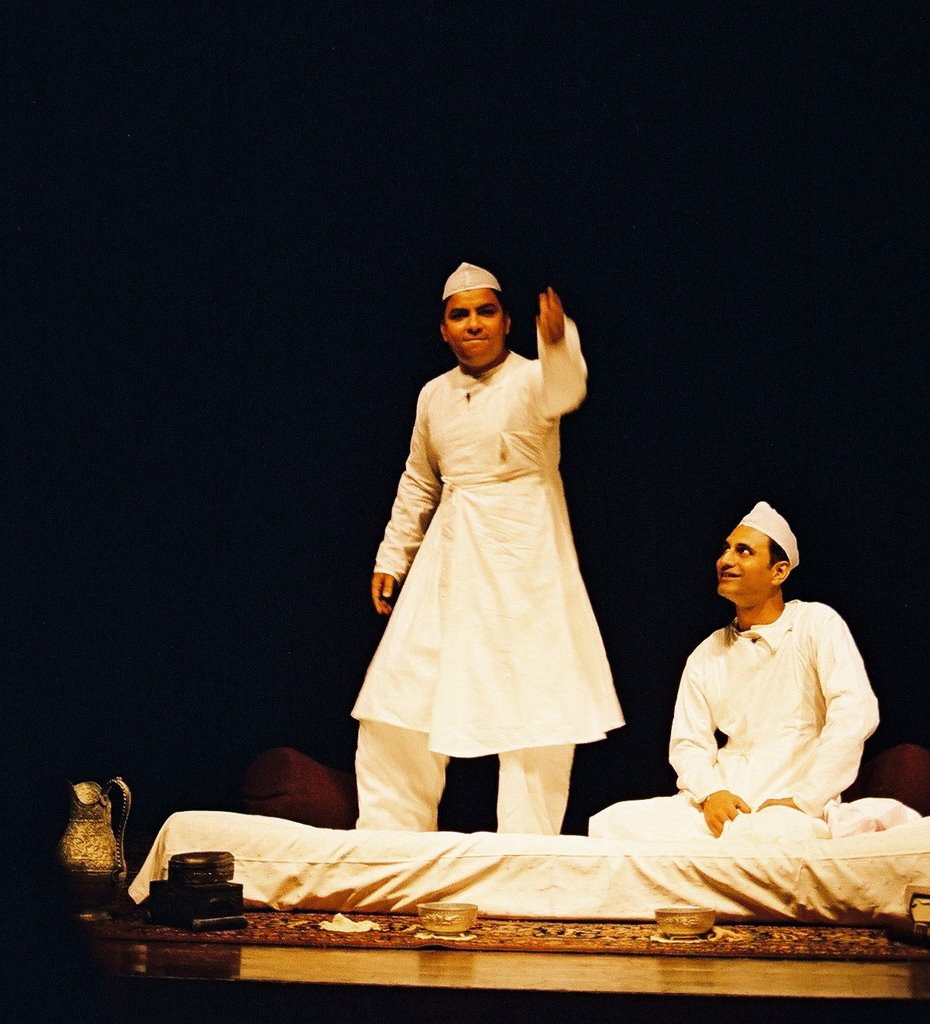
This month's Post Facto column, for the Sunday Guardian:
Last weekend, Jashn-e-Rekhta, a "celebration of Urdu", unfolded at the India International Centre (IIC) in Delhi. The two days of festivities — and it really did feel festive — included at least two plays, a mushaira, qawwali, ghazals, dastangoi, recitation, and a host of lively discussions about Urdu's past and present, from detective fiction to the internet.
Now Delhi is blessed with an abundance of cultural activity, of which qawwalis and ghazals often form a part — privately-funded events like Muzaffar Ali's Jahan-e-Khusrau, dedicated to "sufi music", or the Agha Khan Foundation's Jashn-e-Khusrau, actually dedicated to Amir Khusrau. The Delhi government also pays official homage to Urdu: the Urdu Academy's drama festival at Shri Ram Centre, the annual Republic Day mushaira at the Red Fort (meant to evoke the memory of Bahadur Shah Zafar's Lal Qila mushairas) and the qawwali at Jahaz Mahal in Mehrauli that brings the state-sponsored part of Phoolwalon ki Sair to a close. So what made Jashn-e-Rekhta special?
Organised by entrepreneur Sanjiv Saraf, the man behind Rekhta.org, the festival was as different from sarkari Urdu events as the stylish, effortlessly trilingual poetry website is from the Urdu Academy's. The Rekhta team produced a tapestry of remarkably high quality, with no whiff of patronage being dispensed. There were no technical glitches or interminable chief guest speeches. And by locating itself in the IIC, genteel silver-haired cultural heart of New Delhi, the organisers announced their affinity to a Nehruvian ethos as invested in secular modernity as traditional roots.
And yet, as the few people I did know kept saying to each other in delighted surprise, it wasn't an audience of "IIC regulars". Of course, it was a middle/ upper middle class audience (unlike the wider demographic Phoolwalon ki Sair attracts), but it included young and old, grungy and normcore and exquisitely turned out. That mix, and the general excited hulchul, lent a magnificent vibrancy to the proceedings. The buzz only grew when Mahmood Farooqi began to intersperse his and Darain Shahidi's brilliant dastangoi performance with non-diegetic jokes, taking arch cognisance of Manish Sisodia, Delhi's current Deputy CM, who had queued up for his first dastan.
As for the programming, while hats were doffed to some expected icons (a musical tribute to Begum Akhtar, a dramatic one to Manto and a conversational one to Krishan Chander), the audience seemed as large and as rapt for SR Faruqi's delightfully meandering chat about the ghazal as for Nandita Das and Irshad Kamil disagreeing on the quality of today's film lyrics. The huge presence of Pakistanis -- writers, poets, critics, translators, performers -- was remarkable. More remarkably, I didn't hear anyone introduced as Pakistani, or even addressed in that sugary DD anchor sort of way as "our guests from across the border". If you knew who Intizar Hussain was, you already knew he migrated to Pakistan in 1947. With less famous people — Ali Akbar Natiq, whose Urdu short stories have just been translated into English, or Ali Madeeh Hashmi, who's done the translation, or the writer and critic Asif Farrukhi, or several of the poets at the mushaira — one had no idea that they were "guests from across the border", until a reference to Karachi or Dawn clicked into place.
The language, it was clear, really does bind us. And whether it was Intizar Hussain speaking of how he came to write jataka tales, or Mahmood Farooqui's rendition of Vijay Dan Detha's Rajasthani folktale "Chouboli" as the evening's dastan, there is no doubt that this language is as deeply and widely subcontinental as anything we have.
But while there was plenty to celebrate, let's not be coy about facts. One: like most Urdu events I've seen, the stage was dominated by men, mostly men above a certain age. The (all-male) mushaira placed this upfront: the oldest poet was 88, the youngest 65. Only eight women appeared over two days: two as musicians, and two others in connection with literary great men — Baran Farooqi was in conversation with her father SR Faruqi; Salma Siddiqui appeared as "the wife of the legendary Urdu fiction writer Krishan Chander". I was just feeling somewhat gratified that at least the most active question-askers were women, when from the impressively poetry-literate men behind me rose the loud murmur: "Uff, phir wahi feminism".
An Urdu literary festival also makes visible the undeniable tragedy of Urdu in India, that those who speak the language well enough to take the stage are almost invariably Muslims. As for reading and writing it, well, there are no Krishen Chanders left.
The identification of Urdu with Muslims is a self-fulfilling prophesy. But surely it must mean something that there is still a Delhi audience excited enough by Urdu to make the IIC burst at the seams, for two days? Perhaps Urdu remains a constituency coveted by both community and capital. I recently read a fun piece by Aneela Zeb Babar (who is, among other things, a Pakistani living in Delhi), mocking the attempted takeover of Urdu by the Modi sarkar and Tata Sky alike, via Salim Khan (who inaugurated Modi's Urdu website last May), and Javed Akhtar (who is now "Active" on Sky).
There is already one irate blogpost complaining that Jashn-e-Rekhta's signage and scheduling were in Roman. I get it. But when my free booklet of shers turned out to be in Urdu script, I considered leaving it behind. No script should be left behind. But with Urdu, we risk throwing out the baby with the bathwater. (And perhaps here Urdu shares a quandary with Hindi: the Roman script has made swift inroads, aided by an army called Microsoft.)
If, on one hand, the Urdu script is taught only in madarsas, on the other hand, we see the massive popularity of Zee's Zindagi channel, launched in India last summer with a bouquet of Pakistani TV serials. No literature festival, however seductive, can escape (or answer) the nagging question of "fast food" oral consumption versus the actual labour of reading. But for people like me, who cannot read Urdu, but follow enough of a dastan performance to remain enthralled (as Danish Hussain quipped, "Is there anyone here who claims to understand 100% of every Hollywood film they see?"), the spoken word may offer a path back to a language we must not leave behind.