Showing posts with label Britain. Show all posts

3 November 2024

Warp & Weft of History: Mishal Husain's Broken Threads

I read the BBC presenter's Mishal Husain's family history and then interviewed her about it for this India Today piece:

British journalist 
Mishal Husain’s Broken Threads: My Family from Empire to Independence is a rare mix of research and storytelling, making it a great read for anyone who wants to understand the history of South Asia’s present.


Mishal Husain’s Broken Threads begins with the actual frayed threads of a sari from her grandparents’ wedding. A cousin uses its brocade border on a shawl, and gives it to Husain as a wedding present. Beyond this, though, the book contains surprisingly few object histories, for a family memoir in an age of Instagrammable nostalgia. It quickly becomes clear that Husain, a well-known BBC journalist, wasn’t just looking for a place to inscribe her own memories. She had access to her grandparents’ memories: “I had the books written by one grandparent (Shahid), an unpublished memoir left by another (Mumtaz), some audio tapes recording my grandmother Tahirah, and a 97-year-old sibling of Mary’s to talk to,” Husain says in an email interview. The book’s structure stemmed from this: Chapters 1-4 are devoted, in succession, to her grandparents Mary, Mumtaz, Shahid and Tahirah. 

But the real achievement of Broken Threads lies in contextualising each grandparent’s individual trajectory. “I realised early on that I needed to begin a few decades before, going back into the 19th century and the period before and after 1857,” says Husain. “I turned it into history as well as memoir because I didn’t feel I could understand these individuals without understanding their times.” We hear about Mary’s childhood, for instance, only after Husain has described the arrival of Europeans in India. But instead of a generic history of the East India Company, Husain focuses on what is relevant to explain Mary Quinn, daughter of Mariamma and Francis Quinn: the relationships between Indian women and European men which led to the emergence of the Anglo-Indian community. 

She does something similar with each grandparent, tapping into histories of communities, professions, ways of being. Writing about her grandfathers Mumtaz and Shahid enables her — and us — to dive into the modern South Asian histories of medicine and the army. As context for her grandmother Tahirah, who grew up in Aligarh, Husain provides a deft account of Syed Ahmad Khan and his awakening to the need for Western education for Muslims, who after 1857 had fallen into a state of nostalgia for the past and resistance to the future. 

What brings all these threads together is the British colonial frame. As Husain puts it, she “felt the environment into which Shahid, Tahirah, Mumtaz and Mary were born, between 1911 and 1922, had been shaped by prior events and the entrenchment of British power”. “They grew up seeing New Delhi being built as a grand capital...and I don’t think they envisaged that era ending in their lifetimes,” she tells india today. This may have been particularly true of Shahid, “who had a ringside seat to the circle of power in Delhi for the 18-month run-up to Independence and who wrote about that period, making clear his dim view of Lord Mountbatten.” There is something deeply tragic about this portrait of her grandparents as part of a colonial elite in a united South Asia, who didn’t feel at home anywhere after Independence and Partition. 

Husain seems to share Shahid’s sense of disappointment. “As a journalist working primarily on the UK,” she says, writing Broken Threads made her return often to “a dispiriting reality: how did a nation with such an established democracy, developed institutions, and a system of checks and balances, not do better in its ending of Empire?” 

That the book is written for a British audience is apparent in both the language — a great-grandmother’s “white dupatta scarf ”— and references —“Babur, a near contemporary of Henry VIII”. And yet, the rare mix of research and storytelling makes this a great read for anyone who wants to understand the history of South Asia’s present. The political divides of the 1930s and ’40s emerge more intimately than in most academic histories: Nehru and Jinnah being disturbed by Gandhi’s use of religious symbolism, or Mohammad Ali Jauhar, of Khilafat Movement fame, saying, “Nationalism divides, but faith binds.” 

It is disturbing to see the present-day resonances, Husain agrees, “in how much of what drove decision-making in 1947 — or has happened since — remains, whether it’s the insecurity minority communities can experience, or the role of the military in governance.” But I felt also a great distance from the past, in ordinary people’s identification with something greater than the self. When Shahid is en route to England for military training, his cousin Shaukat writes to him: “Remember that this poor, disorganised, half-fed country is your native land.... Bring back to its shores the accumulated experience of other people.” I do not know if many ordinary South Asians today feel such idealism.

Published in India Today magazine, 4 Nov 2024 edition, in print. Also online here.

10 December 2020

Shelf Life: Stitching the Past into the Future

 My Shelf Life column for November 2020:

What wartime women's fashion can tell us about the world
 
                  Christian Dior's 'New Look' was a massive departure from the clothes women wore in war-torn Europe
 
Elizabeth Gilbert's chatty doorstopper of a novel, City of Girls (2019), begins in the summer of 1940, when the narrator arrives in New York, “nineteen years old and an idiot”. Vivian Morris has just dropped out of Vassar College, judging as dull both the revolutionary young women in “serious black trousers” and the academic girls in shapeless wool skirts “that looked as if they had been constructed out of old sweaters”. While she knows nothing about the world, she knows clothes. And what makes the fashionable teenaged protagonist of 1940 different from one in 2020 is this: Vivian doesn't only wear cool clothes, she can make them.

Trained to sew by an exacting grandmother, Gilbert’s excitable heroine soon finds herself designing costumes the doddering theatre owned by her aunt Peg. It is wartime, and the Lily Playhouse is barely kept afloat by formulaic musicals: there’s really no budget for clothes. But the actors constantly need new outfits, so Vivian learns to improvise. She scours New York's cheaper garment districts and discovers the used clothes shops on Ninth Avenue, becoming a regular at a grand old shop called Lowtsky’s, owned by a Jewish family ejected from eastern Europe.


Vivian becomes adept at digging ancient dresses out of discount bins and transforming them into spectacular customised creations. From showgirls like her friend Celia, she moves on to designing for Edna Parker Watson, grand dame of British theatre stranded in New York by the war. 


Gilbert's narratorial preferences can try one’s patience, like addressing her novel to a young woman whose connection to Vivian is kept deliberately mysterious, to anticlimactic effect. But I enjoyed Gilbert’s enjoyment of fashion, a topic she addresses first with girly excitement and then subversive pleasure. The subversion begins with Edna who, though on first names with French couturier Coco Chanel, is no handmaiden to fashion. Her advice on how to dress—“if you dress too much in the style of the moment, it makes you look like a nervous person”, or “I want brilliant dresses, my dear, but I don't want the dress to be the star of the show”—is really advice on how to live.


But the book’s real subversion of fashion comes in 1950, when Vivian’s friend Marjorie Lowtksy, sharp young heir to the Lowtsky Emporium, comes up with a plan to cater to the post-war marriage boom. “[We] both know that the old silk and satin is better than anything that's being imported...” says Marjorie. “I can find old silk and satin all over town–hell, I can even buy it in bulk from France, they’re selling everything right now, they’re so hungry over there–and you can use that material to make gowns that are finer than anything at Bonwit Teller.” 


The USP? Their dresses “wouldn't be industry; they would be custom tailored”.

Vivian and Marjorie's business makes them rich.

The same era seen from across the Atlantic, in Eric Newby's drily hilarious memoir Something Wholesale: My Life and Times in the Rag Trade (1962) reveals a much more damaged continent. The family firm of Lane and Newby, begun by the writer’s father in the 1890s, is somehow carrying on against a backdrop of bombed-out cities and drastic rationing. Even the upper workrooms of its grand old London offices, writes Newby with brilliant British understatement, “went up in smoke in 1944”.

In some deep metaphorical way, the firm’s continuance into a post-war world now rests increasingly on an army of “outworkers”, elderly women in the suburbs. Meanwhile, their buyers still make orders conditional on unprofitable “Specials”: customised versions for women too misshapen or too snooty to wear the standard designs.

Like Europe itself, the continent's fashion business feels like a creaky old warhorse that can't figure out the new world. “Evening dresses, like the gatherings at which they were intended to be worn, were dispirited”, writes Newby. “[T]he world of fashion had ground to a standstill”. Young Newby tries to come up with new designs on his own. But just after he places his orders, in March 1947, the French designer Christian Dior shows the insanely feminine excesses of his new collection: what would make history as the New Look.


But at that moment, Newby’s creaking world isn’t quite ready. “It was thought to be absurd... a last despairing death-kick by Paris which was no longer to be the centre of the fashion world.” British wholesaler manufacturers, “[h]alf-throttled by clothes rationing”, and too afraid to implement Dior’s radical changes, just make what they have been making for seven years “with a slightly longer skirt”. Of course, nothing sells. The glossies for 1947 are filled with suggestions for women readers with wartime budget constraints, on how to drastically cut and reshape their old clothes.


European fashion, led by Dior’s bold move, slowly begins to recover. But where Europe can only move on by cutting away from its past, America—at least in Gilbert's telling—is already making money off it: repackaging the dead European past as nostalgia. The difference between alteration tailor and vintage couture is writ large onto the history of the world.

Published in The Voice of Fashion, 19 Nov 2020.

5 September 2020

Shelf Life: Run of the Mill

The July edition of my 'Shelf Life' column on clothes viewed through the prism of literature, for the website 'The Voice of Fashion':

A reading of literary works set in and around the Industrial Revolution which remain relevant today, showing that no technological innovation is by itself any guarantee of social betterment

 Power loom weaving in a cotton mill in Lancashire England, ca. 1835. Engraving with modern watercolour. (Shutterstock)

As any school textbook will tell you, the Industrial Revolution began in Britain in the mid-1700s. Production became increasingly mechanised, accelerating a process of economic change that altered the very character of society. What the textbooks don't stress enough is how much of the technological innovation that drove the Industrial Revolution was in textiles. John Kay's flying shuttle, patented 1733, allowed wider cloth to be woven faster. The greater demand for yarn was met by James Hargreaves's 1764 spinning jenny, where one person could work many spindles, and Richard Arkwright’s 1769 water frame, with spindles operated by water rather than manually. Both were supplanted by Samuel Crompton's 1779 spinning mule, which spun thread strong enough for Britain to finally start producing cheap calico cloth. Then came Edmund Cartwright's vertical power loom in 1785.

Combined with Britain's colonial status, these innovations meant that by the 1830s, 85 per cent of the world's raw cotton was being processed in the mills of Lancashire. Manchester and the surrounding mill towns began to draw researchers and writers concerned about the new working class. Benjamin Disraeli, later Britain's Prime Minister, wrote a novel called Sybil, or the Two Nations (1845), in which an upper class character travels to the industrial north to see working class conditions. The popular Victorian novelist Elizabeth Gaskell set her first book Mary Barton (1848) in Manchester: a romance between her working class heroine and a mill-owner's son. In Gaskell's North and South (1854), we see workers’ troubles and early strikes through the eyes of a heroine who clashes with a cotton mill owner, only to eventually marry him.

Real-life romance in the mill town could sometimes expand on the novelist's imagination.

Friedrich Engels, born into a German textile dynasty that had made its fortune from linen yard bleaching, mechanised lace-making and silk ribbon manufacture, came to Manchester because his father had a thread factory there. Expected to learn the textile business, Engels instead produced The Condition of the Working Class in England (1845), establishing in horrific detail how early industrialisation had actually worsened workers' lives. Low wages and terrible living conditions led to much higher mortality from disease in Manchester than in the surrounding countryside. Karl Marx's reading of the book helped forge the intellectual partnership of a lifetime – and Marx and Engels' critique of capitalism.

But Manchester is also where Engels forged a long-term partnership with Mary Burns, then a worker in his father's factory. Rachel Holmes' delightful 2014 biography of Marx's daughter, the feminist and trade unionist Eleanor Marx, describes Mary Burns' role in Engels' life as “directive and Socratic”: “Engels took Mary to bed; Mary took Engels to the tenements and to the heart of the Irish immigrant community of Manchester... [explaining] the conditions of factory and domestic workers.”

Among the sharpest fictional takes on the textile industry came almost a century later, in 1951, when Roger MacDougall's superb play, The Man in the White Suit, was turned into a Ealing Studio comedy by his cousin Alexander McKendrick. Starring the great British actor Alec Guinness, The Man in the White Suit is a cynical comedy, with its cynicism extending all the way across capitalist society.

The film opens with a younger textile mill owner called Michael Corland romancing Daphne, the daughter of an older and richer mill owner called Birnley, with purely monetary desires. Guinness plays Sidney Stratton, a misunderstood scientific genius who takes yard jobs in one textile mill after another so that he can stealthily use the labs. When Sidney devises an artificial fabric that will last forever and repels dirt, Daphne convinces her father to test it. But when word gets out, the mill-owners gang up to prevent what they see as a calamity for business. “The spinning jenny and the mechanical loom increased output,” says one captain of industry. “This'll finish it!”

Sidney somehow escapes their clutches and is trying to reach the newspapers, but is stopped by his old worker friends: the unions, too, are dead against a fabric whose production has an inbuilt time limit. Even these socialist workers, aware enough to describe themselves as “flotsam floating on the high tide of profit”, cannot actually imagine a world beyond the short-term goals of capitalist production. If obsolescence is not built into the things workers produce, then things will last forever; demand will dry up – and so will jobs.

A still from The Man in the White Suit, an Ealing Studio adaptation of Roger MacDougall's play

The Man in the White Suit is even more relevant today, when late capitalism's need to artificially inflate demand ensures greater inbuilt obsolescence. It is more so because technological innovation is constantly being thrown at us as a panacea, without enough attention paid to the politics that surrounds that technology: think, in post-2014 India, of the discourse around the digital, in relation to demonetisation, lockdown relief or Covid-tracking apps.

Just as with the textile industry at the beginning of the Industrial Revolution, technological innovation is not by itself any guarantee of social betterment. Who has access to that technology, who controls it, and to whose benefit – that is what determines whether it is good for the human race: whether, in fact, technology will mean progress.

Published on The Voice of Fashion, 16 July 2020.

24 March 2020

Not Just Company Ltd.

A piece I did for India Today in February:

Indian art created for the East India Company is a revelation in both content and style.


By the late 18th century, Indian artists found it increasingly difficult to earn a living from the declining centres of the Mughal court or its successors. Meanwhile, they began receiving commissions from patrons affiliated to the East India Company. The art these painters created for expatriates has never received its due.

As the sun set on the British empire, these were no longer displayed proudly in the UK, nor studied much in a newly independent India. In 2014, when art historian B.N. Goswamy picked out 101 images for his Spirit of Indian Painting, only one was a Company commission.

The very name ‘Company School’ betrays its emphasis on the colonial patrons “while excluding any reference (even geographical) to the artists who created beautiful works of art”, notes art historian Henry Noltie, whose essay on 18th and early 19th century Indian botanical drawings is part of a superb new volume called Forgotten Masters: Indian Painting for the East India Company, published alongside the first exhibition of Company-commissioned Indian art, on at the Wallace Collection in London till April 19, 2020. The show and the book have both been put together by author and historian William Dalrymple, whose interest in early colonialism has sustained a literary career, from White Mughals (2002) to his most recent, The Anarchy (2019). 


Sumptuously produced yet scholarly, Forgotten Masters features a hundred masterworks by artists like Bhawani Das, Sita Ram, Shaikh Zain ud-Din of Patna, Shaikh Amir of Karraya, Yellapah of Vellore, and Ghulam Ali Khan of Delhi. As the names show, ‘Company School’ artists were from different communities and may have trained in the Mughal, Maratha, Pahari, Punjabi, Tamil or Telugu traditions. Their subjects, too, were varied—botany, architecture, but also daily life, festivals, modes of transport and, crucially, ordinary people.

The Impey Children in Their Nursery,
by Shaikh Zain ud-din, C 1780 (Courtesy: Private Collection)

Since previous Indian courtly art was dominated by rulers, durbars and deities, Mildred Archer argues that this documentation of the Indian natural and social world “democratised Indian painting”. Many ordinary Indians appear, from dancing girls to servants of the new colonial household, palanquin bearers, the huge staff assembled for ‘The Impey Children in their Nursery’, or Shaikh Amir’s portraits of Indian grooms with the sahib’s dogs, horses and children. Nature had interested some Indian rulers, like Jahangir, but none appointed artists to document a personal zoo, as Justice Elijah and Lady Impey did in Calcutta. These gorgeous botanically accurate renditions of yams, palms or other plants by Manu Lall, Vishnupersaud and others; Shaikh Zain ud-Din’s birds or Haludar’s studies of macaques, gibbons or sloth bears for the surgeon Francis Buchanan-Hamilton, were new for India. 

Unlike the thick jewelled tones and decorative settings prized by Mughal and other Indian traditions, these images of soldiers, pujaris or city panoramas were often watercolours on white laid paper from England, with the surrounding area left empty. 

Cheetah, by Shaikh Zain ud-Din, for the Impey Album.

In Forgotten Masters, we see the European patron’s eyes turning the Indian miniaturist’s brush to the service of architectural and anthropological precision, for a brief glorious period before photography made these skills superfluous. These works should be celebrated as Indian, but also serve as a reminder that modernity in India began as colonial modernity.

Published in India Today, 28 Feb 2020.

10 December 2019

Learning of love

My Mirror column:

From Francois Truffaut’s Les Mistons to Shlok Sharma’s Haraamkhor, what propels so many writers and filmmakers to turn the child’s gaze upon adults in the throes of desire?


“Jouve’s sister was unbearably beautiful,” begins the voiceover of François Truffaut’s Les Mistons (The Brats), as Bernadette Lafont cycles through the historic streets of De Nimes – her slim, leggy frame suspended effortlessly over her bicycle, her skirt billowing in the breeze, such a vision of lightness that she seems barely to touch the ground. What we watch is five boys watching this young woman. The eponymous “brats” of the film’s title follow Bernadette everywhere, first with their eyes and then by actually stalking her, alone or with her lover Gerard.
 
Truffaut, a film critic who had made his first short Une Visite in 1954, thought of Les Mistons (1957) as his “first real film”. Certainly, it already contains many themes he would continue to explore over his cinematic career – women as objects of desire that seem to mystify men, a certain realist poetry of everyday life, the unexpected rupture presented by death. What interests me most, though, is the theme of adult behaviour – in particular, sexual passion or what Truffaut's narrator calls amour – as seen through the eyes of children. The boys in the film are arrested by this young woman’s beauty, transfixed by the stirrings of a desire they do not even understand, and irritated by the fact of the lovers without quite knowing why.
 
When she leaves her bicycle to swim in a shaded grove, they gather round to sniff it like little puppies, one of them even delivering a slow-motion kiss on the seat where her posterior has recently rested. Categorised only as “unbearable”, the one-sided attraction they feel mutates into something else: “Too young to love Bernadette, we decided to hate and torment her.”
 
The child on the cusp of adolescence becoming smitten for the first time has been the subject of many books and films over the years. In LP Hartley’s 1953 classic The Go-Between, which Joseph Losey made into a famous 1971 film starring Julie Christie, the young narrator Leo recalls the shaping summer of his childhood in which he first felt attraction. “My sister is very beautiful,” his friend Marcus tells him one day, and after that, “for a time my idea of [Marian] as a person was confused and even eclipsed by the abstract idea of beauty that she represented.” Once Leo helps Marian dry her hair, and Hartley describes the immersiveness of the experience evocatively: “I was the bathing suit on which her hair was spread: I was her drying hair, I was the wind that dried it.”

When Marian embarks on a secret, torrid, socially unsuitable affair with a local farmer called Ted Burgess, Leo finds himself turned into their messenger. The child enables the adult relationship. But jealous, torn between his desire to please Marian and his own inarticulate feeling for her, and childishly blind to what is really at stake, he is also the one that brings it to its tragic end.
 
The Go-Between, with its sun-kissed sexual innocence and stark coming of age, is likely to have been among the inspirations for Atonement, Ian McEwan’s wonderful novel, which was adapted into the Joe Wright film. Like Leo, the 13-year-old Briony is responsible for the betrayal that drives apart the two adults she is close to, based on her childish misunderstanding of a charged sexual moment she witnesses between the socially transgressive lovers.
 
Paresh Kamdar’s under-watched, atmospheric film Khargosh (2009) has a very similar story to The Go-Between. The child protagonist Bantu becomes a go-between for his older friend Avneesh, and slowly finds himself enraptured by the girl Avneesh is besotted with, whom the film nicknames Mrityu (Death).
 
More recently, we have had Shlok Sharma’s Haraamkhor, whose take on exploratory sexual urges is several shades darker, and perhaps more layered than any of these other films. For one, Haraamkhor contains two levels of watching and watchers. An adolescent schoolgirl (superbly played by Shweta Tripathi) in a dusty North Indian town becomes morbidly attracted to her maths tuition teacher (a scarily believable Nawazuddin Siddiqui) after she spies on him having sex with his wife. But the 15-year-old Sandhya has her own set of stalkers: two younger boys in the same tuition class, one of whom thinks he is in love with her. The film steers us between these different gazes, refusing to let us rest easy. One moment, we wait with baited breath with Sandhya in an abortion clinic – but then almost immediately find ourselves confronted by her childish exuberance as she licks an ice-cream and ribs her lover-teacher-exploiter about what he’s going to tell his wife. We begin by giggling as the two boys hatch plans for Sandhya to see Kamal naked, because if a man and a woman see each other naked, “toh unki shaadi pakki”. But as the film draws to its denouement, the dusty haze and windmills gather into a terrible, tragic downpour, childish naivete leading somehow inexorably into life-altering errors.

Perhaps, in the end, that is what makes the child’s-eye view so terrifying. Examined through the frank gazes of children, the lives of adults don’t seem that foolproof any more.

Published in Mumbai Mirror, 8 Dec 2019

7 May 2019

The life therapeutic

My Mirror column:

A new webseries called 
Sex Education offers a rare mixture of insight, humour and warmth on sex and its many minefields. It’s about British teens, but might work well for a lot of us.


An indie publisher recently spoke at the launch of a book called Why Read? about how her father's exhortation to read and “try everything” led to her borrowing Erica Jong's 1970s novel Fear of Flying from his bookshelf and trying to make sense of its era-defining portrait of angst-ridden female sexuality, at age 12. She had me smiling in recognition. Different book(s), same story.

Reading as a way for young people learn about sex has only amplified in scope in the post-internet era, though massively supplemented and likely often superseded by a visual media explosion that we couldn't have dreamt of growing up in the '90s. While mainstream television (not just in India) remains somewhat coy about sex and sexuality, basing its self-censorship on the somewhat fictive vision of the family audience, the internet now offers wide-open access to just about Everything You Always Wanted To Know About Sex (But Were Afraid To Ask). If you have a few minutes alone with a data-enabled mobile phone, you can now ask Google.
 
While this easy, anonymous access to sexual – both information and imagery – is a vast improvement on the secret economy of traded porn mags/videos that once undergirded school life (with very few girls ever seeing any of it), even contemporary young people could do with some curation of what's out there. Because there's plenty, and the democracy of plenty necessarily means contradiction and confusion. Not to mention the fact that most sex-related content is porn, and most of that porn is meant for the bulk of existing consumers, i.e. straight men, and that the set parameters of mainstream straight-man porn seem to limit the possibilities of sex more than open them up.

It is into this eager but utterly confused universe that Netflix dropped, earlier this year, the first season of a series called Sex Education, created by the playwright Laurie Nunn. A comedy about horny teenagers, packed with high school stereotypes – the nerdy boy, the rich clique, the overachieving headboy, the slutty girl – may seem like a predictable sort of place for predictable sort of raunch. But Nunn does several truly sharp, fun things. For one, she gives us American high school stock characters but from very British family backgrounds, including a repressed, disciplinarian headmaster. Second, all the stereotypes are undercut – or perhaps I should say layered by the addition of unexpected details: the girl known for promiscuity likes sex but also likes 19th century feminist writers, the overachieving headboy is on anxiety medication, the girl who's always got a boyfriend doesn't actually have any idea what she likes in bed.
 
Nunn also scores by making her primary character not just a nerdy boy who's still a virgin, but a nerdy boy whose lack of sexual experience in practice is compensated for by his seemingly instinctive grasp of sex – in theory. The 'therapy business' is orchestrated by 'slutty' smart girl Maeve Wiley, who happens to witness the protagonist Otis give a male schoolmate sex-related advice – and then learns, on the female grapevine, that the advice worked.
 
Nunn's character arcs and subplots display a markedly rare and genuine ability to see the many things sex can be to different people, or to the same person at different times: clandestine but exciting, boring but display-worthy, a desperate object of desire or a source of terrible anxiety, obligatory or shocking or just overhyped.

Apart from the warmth and humour (and when it chooses that register, sexiness), what I think I really enjoyed about the show was its ability to both take therapy’s insights seriously and simultaneously make fun of it a little, see its blind spots. 
 
Otis turns himself into the school's secret sex therapist, using a certain kind of formal language that he's absorbed from living with his (actually qualified) sex therapist mother Jean. The show treads a fun line, between showing Jean’s self-consciously verbose therapist persona as funny and her analytic work as actually valuable. And what we see Otis do repeatedly is to run with his instinct – about relationships, selfhood, identity and shame – sometimes goofing up, but revealing his own vulnerabilities and thus, perhaps, coming across as a warmer, nicer, more identifiable therapist than the therapist.


19 March 2018

Coffee Break: thoughts on Stuart Freedman's pictures of Indian Coffee Houses

The Palaces of Memory: Tales from the Indian Coffee House is Stuart Freedman's visual journey of urban India.


The Indian Coffee House, Kollam (now closed), 2013

When Stuart Freedman first arrived in Delhi in the mid-90s, it felt overwhelming. "I'd been to Pakistan, I'd been at the siege of Kabul, but India was something else," laughs the British photographer, now a veteran of many visits. "When I needed a break from the relentless push and pull of the city, I'd go to the Coffee House and be quiet. It was a refuge." But it wasn't till about 2010 that he picked up his camera inside one of them. Soon after, on assignments in Jaipur and Kolkata, he ended up photographing the Indian Coffee Houses there. "Then I knew it was a book," says Freedman, in Delhi for the Indian launch of his photo-exhibition and accompanying book, The Palaces of Memory: Tales from the Indian Coffee House (Tasveer/ Dauble, 2017).

If you grew up in urban India before liberalisation, the Coffee House, or at least the idea of it, is likely to have been part of your coming of age. Set up by the British government in the 1930s as a response to the Depression-era decline in coffee exports, the India(n) Coffee House chain did much more than create a local demand for the beverage. Its outposts across India became places where middle-class people met, to drink coffee, yes, but also to discuss politics and poetry and the day's gossip, to meet classmates after class or colleagues after work, or to conduct a romantic rendezvous in a place that offered anonymity but also safety. In short, to do all those things that not many places in the 20th century Indian city yet enabled, and to do so in a public place, inexpensively.

Yet, while the Coffee House experience captured something of modern western urbanity, it also represented India's unabashed, wholehearted claiming of it. Here, we produced our own version of modernity: where the coffee came in white ceramic cups (with saucers) but the kettles were aluminium; where you might cut up a mutton cutlet with a knife and fork but happily eat sambar-vada with your hands. Palaces of Memory does the much-needed job of making us look afresh at these remarkable places in our midst, their unpretentious formica tables and faded Gandhi-Nehru images offering a magical window into a vanished past. As the post-liberalisation city around it grows ever more brash and shiny, the more the Coffee House seems like a holdout: the last surviving outpost of what Amit Chaudhuri's 'Prologue' calls a "deliberately, almost jealously protected austerity".

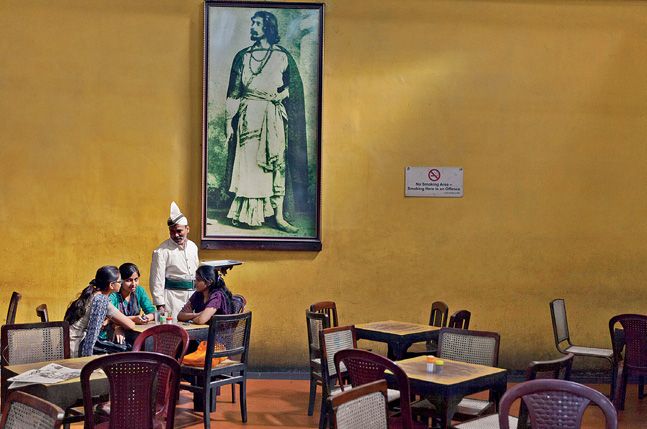
A waiter serves schoolgirls beneath a portrait of Rabindranath Tagore in the Indian Coffee House, Kolkata, 2013

Freedman's images do not shy away from this plainness, or signs of age: the peeling walls, the fraying pockets of uniforms, the blackened switchboards, table legs balanced in empty Amul cheese tins. But his gaze is affectionate, forgiving, even celebratory. Even a fly sitting in a bowl of sugar seems innocuous, yet another visitor to the Coffee House who hasn't been turned away. "I'm not romantic about India, the nonsense about elephants and maharajas. But there is a romance about what the Coffee Houses allow people to do. You can sit all afternoon with a cup of coffee and no one's going to tell you to leave," Freedman says. "I'm from Hackney, from a working class background. The Coffee House became this kind of translation device for me because I saw the same people there as in the cafes at home."

Of course, Coffee Houses are not all the same. "South Indian ones have much more substantial food," says Freedman. And one Coffee House might cater to different constituencies: retired old men, college students, middle-aged couples or a family on a ritual outing, young lovebirds. But what all these people are likely to have in common is that they are lower middle class.

Men sit and talk in the Indian Coffee House, Baba Kharak Singh Marg, New Delhi, 2010

Freedman is clearly drawn to places that democratise leisure. If England's greasy spoon cafes summon up an era of post-war rationing that he didn't quite witness, his book on another dying British institution, the Eel, Pie and Mash shop, "is really about [his] past" and "that section of London's working class that feels dislocated". He has also photographed the cafes of Cairo "as a way to examine the Egyptian revolution". Does he see Indian Coffee Houses as resisting the neoliberal economy? "Modern cities privatise space," Freedman agrees. "Places where people gather and are not monetised like Starbucks are places where people discuss. And discussion is dangerous to the state. Indira Gandhi knew this; she closed the Coffee House during Emergency, saying it was seditious."

Indian Coffee House, Chandigarh, India, 2013

What also makes the Indian Coffee Houses unique is that they are worker-run. In the 1950s, after the Coffee Board decided to privatise 43 outlets and fired many employees, the workers formed cooperative societies and persuaded the management to let them run the outlets.

Freedman's many superb portraits of waiters and kitchen staff are testament to the wonderful sense of ownership that pervades the Coffee Houses as a result. In one image in Palaces, a frail old man in a dhoti sits with his back to a man in collared shirt and trousers. As they raise their identical cups of coffee to their lips, one has the sense of a world in perfect balance, something sadly missing in the world outside.

28 November 2016

The Trappings of Technology


My Mirror column:

Two great films about unemployed men and machines confront us with the alienations of our time.


A white British man sits in front of a computer. Even as he strives to keep his attention focused and his eyes from glazing over, the desktop gets hunghangs . The online form he's been trying for ages to fill is now suspended in the ether — information refusing to flow either this way or that. When the 59-year-old Dan demands to know what's happened, the younger black man who's been helping him out tells him the screen is frozen. “It's frozen?” yells Dan in frustration. “Well, can you defrost it?”

A wave of laughter runs through the packed hall at Panjim's Kala Academy as the scene above unfolds as part of the International Film Festival of India's screening of Ken Loach's brilliant new film I, Daniel Blake last on Friday evening. But it is nervous laughter. As I giggle with the rest of the IFFI audience, I wonder if the edge of discomfort is created by the incongruous use of the word 'defrost'. What are we to make of it, this 20th century technological moment that is now completely embedded in our language — and yet already feels near-obsolescent when used to refer to the cool new machines of our era?


That vast empty space that lies between refrigeration technology and the internet — the old machine age and the new — was also made starkly visible in an Indian film I watched a couple of weeks ago at a much smaller film festival up in Dharamshala: Mangesh Joshi's absolutely marvellous debut feature, Lathe Joshi


Like the eponymous Daniel Blake (played by the wonderfully restrained British actor Dave Johns), Lathe Joshi is a man being robbed of a living, a person in the present being forcibly relegated to the past. If Loach's protagonist is a joiner without a job (“I'm a carpenter. Much more dangerous,” he tells a child who asks if he's a pirate), Mangesh Joshi's hapless hero is a lathe machine worker who cannot bring himself to tell his family that he no longer has a factory to go to. Chittaranjan Giri is simply superb as the grave-eyed man for whom a machine has shaped not just his life but his very identity: “Is it 'Lathe' Joshi?” asks his aged ex-employer much to Joshi's delight, when asked whether he can be visited on his sick-bed.


But even Joshi's world is divided into machines that love him back and machines that don't. Like Blake, whose confusion at the dehumanising technology of the ironically-named British 'welfare' state is as strong as his connection to his old box of “good quality hand tools”, Joshi must deal not just with machines in the domestic sphere, but with the new sort of industrial machine: one that has replaced him instead of functioning as his ally. Loach's film gives a greater degree of loving attention to the artisanal, moving between an angry, argumentative register and an immersive happy one. I, Daniel Blake, like its protagonist, is insistent on showing us how the handwritten CV, the hand-turned wooden toy, and hand-crafted electrical repairs can still give human beings perfect service and plenty of individually-tailored joy, if only we weren't being forcibly tunnelled into the airless crevices of a bureaucratic tech-spertise state.

Given the atomised, anonymised dystopia of the British present, perhaps Loach's evocation of an unblemished lost alternative is unavoidable. The Marathi film, on the other hand, must engage more complicatedly with the improvements still being brought about by the everyday incorporation of technology into our lives. The arrival of a mixer-grinder can still raise the efficiency of an Indian woman's life by several notches; the connectivity of mobile phones, computers and cars is able to produce a standard of convenience and comfort that isn't just glamorous.

But in kinship with another recent film, Ruchika Oberoi's Island City, Mangesh Joshi's film forces us to think about where we might be headed. The dying factory owner that Lathe Joshi goes to meet is quietly cognizant of his fate as a human being in the present era: “I am alive, only thanks to these machines,” he says resignedly. Finally, the grandmother's chanting machine and the internet pooja may seem funny, but they are incredible examples of how technology has inserted itself into the spaces between our supposed inner selves and our notion of the divine. Our spiritual happiness, too, is now beholden to technology.

Published in Mumbai Mirror, 27th Nov 2016.

14 November 2016

Found in Adaptation

My Mirror column: 

Sometimes what makes a narrative gripping is not what you don’t know, but what you do.

Basil Dearden's All Night Long (1962) is a finely calibrated adaptation of Othello 

A few weeks ago in these pages, I wrote about the Ramayana as ur-text, looking at how the filmmaker Altaf Majid combined documentation and enactment to explore the possibilities of the Karbi version of the epic. If the Karbi telling, Sabin Alun, meaning 'the song of Sabin' (Surpanakha), allowed new insight into the Ramayana, Majid's staging of parts of it — with modern-day actors playing a modern-day Karbi version of Ram, Lakshman, Sita and Ravan — was yet another glimpse into the inner life of the text.

Stories are strange things. The element of surprise we so value in the modern-day narrative is often the very thing that is missing from repeated renditions of any ur-text — and yet we are absolutely gripped by the story. Knowing what will happen liberates us from the tense prediction of plot. It means that we watch for the how, rather than for the what or when of it. Apart from all our traditional performances — Kathakali, Yakshagana, Ramleela, Alha-Udal — we, in India did this for years with mainstream Hindi cinema (even as smartalecky Anglophone folk felt superior by ‘predicting’ what would happen in films that were essentially variations on the same story, once you knew the genre).

Last month, at the India International Centre's annual cultural festival, cinematic variations on another sort of ur-text were screened: the plays of William Shakespeare. At one level, adapting King Lear or Macbeth could be perceived as being different from adapting the Ramayana or the Odyssey because the original text exists only in one accepted final form, and thus departures from it are more rigidly circumscribed – or at least must be more obviously authorly. Sometimes close adaptations, especially those that decide to use Shakespeare's own words, can seem to lack newness. Among the films I watched at the IIC was a Roman Polanski-directed 1971 Macbeth, which seemed to me to stick very close to the grain of Shakespeare's play in terms of the language, the approximation of milieu and the emotional register — the craven ambition and bloody intrigue and high dudgeon of it.

Reading about the film later, though, I discovered that Polanski had started work on the film soon after the Manson family's murder of his then wife Sharon Tate and several of their friends in Polanski's Beverley Hills home in August 1969, and that Pauline Kael, among other film critics, believed that the murder of Macduff's family in the film was a deliberately lurid take on that. The scenes with the witches, too, though they seemed to me exactly the sort of subversive outcasts that I imagined when I first read the Macbeth story in high school, might be seen as hallucinatory in a way that might easily be read as born of the psychedelic 1960s as likely lived by the filmmaker and his crew.


The IIC also screened Kurosawa's unfailingly chilling Throne of Blood version of Macbeth, and Grigory Kozintsev's 1964 Russian version of Hamlet, whose grand, craggy grey cliffs and general sense of desolation remain with me though I watched it nearly two decades ago. But the most unusual and interesting film of the lot was Basil Dearden's All Night Long (1962): Othello set in a 1960s London that is all rain-streaked streets and jazz, with Delia 'Desdemona' Lane being a white jazz singer who has abandoned the stage for a marriage to the loving but broodily possessive Aurelius Rex (the Moorish Othello here can actually be played by a Black actor, Paul Harris – rather than, say, 1951's Orson Welles in blackface).

Lest you imagine something smoky and seductive, let me say that this is a very British film in some ways – barring Johnny's (Iago) white-hot rage at the end, the characters project a strange wholesomeness even when they are devastated: something that can only be explained by the national stereotype of emotional reserve.

But Dearden has several other things going for him. Setting the film in that time and place allows him to delve into such twentieth-century inventions as psychoanalysis, or a very early instance of exploring recording technology as a falsifying mechanism that masquerades perfectly as truth. Dearden has the lazy English self-mockery of the moment down pat: a baffled young woman arrives at the cavernous Warehouse and asks why it's all the way out here. Comes the reply: “Haven't you heard, honey? Jazz is noisy. You can't have it in Mayfair.” There is also the beautifully lit double-level set of the jazz club, with its winding central staircase for melancholy romance, and closeted back terraces for secret intrigue and pot-smoking. Political correctness isn't a problem: “Jazz is appreciated by three groups: Negroes, adolescents and intellectuals,” runs one dialogue.


The film's biggest freebie is Dave Brubeck and Charlie Mingus appearing and playing themselves. With such atmosphere for the asking, it's amazing how tensely we still wait for the plot to unfold. It's definitely the how, not the what that matters.


Published in Mumbai Mirror, 13 Nov 2016.

1 November 2016

DJs, poets, dramatic desi loves

My Mirror column:

Ae Dil Hai Mushkil falls flat when it aims for high romance. So do any of our old languages of love survive?


In many ways, Ae Dil Hai Mushkil is a fairly standard-issue Karan Johar movie. First, it is a soppy romance about people who’re confused between love and friendship (and trying hard to sacrifice their feelings for the blissfully unknowing beloved) -- think back to Kajol and Shah Rukh Khan in Kuch Kuch Hota Hai, or Saif Ali Khan, Preity Zinta and SRK in Kal Ho Na Ho. Second, it contains that classic K-Jo cocktail of oblivious upper-class-ness and self-conscious Indian-ness that emerges in full measure only when the protagonists are ‘abroad’. The first purpose served by this is in the aesthetic-emotional register: supremely well-off, well-dressed desis get to play out their overheated romances in picturesque cold countries. The second purpose is what we might as well call political: it is no accident that Johar has been among Bollywood’s pioneers of desi coolth, given his originary adeptness at turning not just firang locations but firangs themselves into mere backdrops for our Empire-writes-back moments.

Nowadays, Johar seems to have stopped enjoying making British characters stand for the Indian national anthem, and no longer even seems to get off having rude Hindi remarks made in front of foreigners who can’t understand them (admittedly, Kajol managed to make this reverse racism seem very funny in Kabhi Khushi Kabhi Gham). What ADHM offers instead, is a breezy world-is-our-oyster feel, in which South Asians on private jet vacations can bump into [also South Asian] ex-boyfriends DJ-ing at French discotheques (And just in case you were wondering about such prosaic things as visas, the film throws in two separate mentions of characters having British passports.) The resultant air of bonhomie is aided by the Empire choosing, whenever in doubt, to sing back: the oddly patriotic pleasure of watching white people sway to Hindi/Punjabi songs is amplified particularly in ADHM by having Parisians galvanised by the corny energy of Mohammad Rafi’s 1967 chartbuster An Evening in Paris.

Most of Johar’s romantic messaging is pretty spelt out in the film: such as Alizeh’s rather programmatic declaration, “Pyaar mein junoon hai, dosti mein sukoon hai (Love has madness, friendship has peace)or her insistent idea (pretty much taken from Imtiaz Ali’s Rockstar) that only a broken heart can produce good art. Or the film’s avowed thesis, that unrequited love can be more powerful than a relationship: “you have full control over it... because you don’t have to share it with anyone”. How much any of these statements affects you depends partly on your mood at the moment you watch it spoken on screen, partly on who speaks it (Ranbir does best), and partly on your general propensity for dramebaaz mohabbat.

But it is more interesting to read 
Ae Dil Hai Mushkil for the things it does not spell out. 
Many of those filter through to us via language. The film seems, for instance, an expression of Johar’s desire to unite two very different landscapes of romance that I will go out on a limb and suggest he personally inhabits: the thumping rhythms of smoky nightclubs on the one hand, and the mellifluous Urdu that was for years the language of high romance in Hindi films. The film’s dialogue (by Johar and his long-time collaborator Niranjan Iyengar) moves constantly between a conversational Hindi peppered with English words — eg. “Tum mujhe seriously nahi le rahi, lekin yeh mera God’s gift hai” — and a high-faluting Urdu/Hindustani that is largely expressed in dubious ‘philosophical’ statements that neither Anushka Sharma nor Aishwarya Rai can carry off.

Rai, in particular, is saddled with the impossible task of playing what Johar in all seriousness calls a ‘shaaira’. The Urdu word for poetess is one I last heard in the 1994 film Muhafiz, in which too it was used as a self-descriptor – but it came accompanied by the devastating force of Shabana Azmi’s hauteur and pronunciation, and the context was mid-twentieth century Delhi. Having Rai, in a white airport lounge somewhere between London and Vienna, introduce herself as “Main shaaira hoon” elicits a hilarious but apt response from Kapoor’s Ayaan, who assumes that Shaaira is her name. “Main shaaira hoon, mera naam Saba hai,” says Rai, her eyes glinting dangerously.

The moment is, sadly, one of the very few in which the film takes on board the hilarious unbelievability of this uber-posh, uber-glamorous Vienna-based character being an Urdu poet. But at least Saba is meant to be a poet. For Alizeh, a hyperactive London-based dilettante recovering from her break-up with a Sufiyana DJ, the Urdu she speaks makes even less sense. The only way we can make sense of Alizeh’s language (and her 80s film obsession and her kurta-clad entry into clubs) is if we replace her supposed Lucknow origins with Lahore. Given just how much political fracas has been caused by the mere presence of a Pakistani actor (Fawad Khan in a thankless role as the DJ), I suppose it is not surprising that Johar decided to keep Alizeh’s real origins — like her legs —covered up.


Published in Mumbai Mirror, 30th Oct 2016.

7 January 2016

The Time of Our Lives

My Mirror column for Dec 20:

45 Years is a steely drama about ageing and coupledom; a beautifully crafted meditation on the fickleness of time.


The subject of Andrew Haigh's film 45 Years is, unsurprisingly, the passage of time. Starring Charlotte Rampling and Tom Courtenay as an ageing British couple called Kate and Geoff Mercer, Haigh's quietly stunning film takes us through the week before they are due to celebrate their 45th wedding anniversary. The somewhat odd choice of anniversary they'll be commemorating is explained by Kate (with characteristic Rampling frostiness) when the event organiser insists on asking: Geoff had to have a bypass surgery just before their 40th.

This time, Geoff is fully recovered, and the week ought to involve only the merest of preparty stress: finalising the menu, planning a music playlist and shopping for a dress. Instead, a letter arrives for Geoff from the Swiss authorities, informing him that the body of his then-girlfriend Katya has been discovered perfectly preserved in an icy crevasse in the Alps, in the place where she fell to her death five decades ago.

Of course, it's a disturbing revelation. But what is more disturbing by far is Geoff's reaction. He starts smoking again (the couple is meant to have quit a while back). He's irritable at the thought of going to a long-planned reunion with old factory mates. He sits around the house playing songs he hasn't heard in years. He climbs into the attic in the middle of the night to look for old pictures of Katya.

And suddenly, just like that, this long-gone figure - a woman who was dead before he met his wife of 45 years - has returned to haunt their present, and somehow alter the quality of their past.

The premise bears some resemblance to another much-loved British classic: Rebecca, Daphne Du Maurier's chilling tale of a much younger woman similarly haunted by the imagined memory of her husband's old love. But the fear that creeps up on you in Rebecca draws on the timidity and inexperience of its deliberately unnamed heroine, as well as the evocative ghostliness of the grand British manor she must strive - unsuccessfully - to make a home in. Manderley is already a place haunted by history. 45 Years, on the other hand, gives us amuch older protagonist, as self-assured as can be: the seemingly stronger half of a long-married couple - left-wing, childless, retired, leading a quietly comfortable country life, with a succession of dogs for company.

Haigh evokes the shadowy presence of this other woman through many means: there is the somewhat obvious use of the similarity in names: Katya and Kate, and the metaphor of the attic - a hidden, draughty space at the top of the house which holds its secrets. But the milieu has nothing ghostly about it, and so the shivery, goosebumpy quality of the film is produced almost entirely by the performances.

And what performances they are. Rampling is, as always, an absolute pleasure to watch, here exchanging her trademark icy hauteur for a vulnerability that is all the more affecting for being covered by a veneer of dignified reserve. Much of the film's emotional heft lies in what is not spoken - from that early moment when Rampling rises from the sofa precisely at the moment she knows her husband is going to reach for her hand, to the tightly-coiled tension of the last party scene. The acuity of Courtenay's performance was a surprise to me: he plays Geoff as someone unhappily cognisant that he might be on his way to becoming a muddled old man. He knows age and illness has taken its toll, and he was prepared for a quiet last innings - until the arrival of the letter seems to change something in him. "She'll look like she did in 1962 - and I'll look... like this!" he announces with something like disgust.

I must admit I was glad that this nostalgic evocation of physical youth, this sudden revelation that one's body is not the perfectly wrought thing it once was, comes, in Haigh's film, from the man, not the woman. (Especially since so much of the conversation around Charlotte Rampling, even at 69, seems to centre on how amazing she looks. It is as if no matter what her achievements as an actress, the thing that we must all find interesting about her is how attractively she's aged.)

The film is strewn with references to time and history, and yet it constantly undercuts the idea of commemoration. "This really is a great venue for such an event - so full of history," says the smarmy organiser, alluding to the fact that the building is where the Trafalgar Ball was held. He is soon cut down to size by Kate's retort: "Wasn't Nelson killed?"

A chance meeting with some family friends at an eatery leads to a viewing of pictures of their grandchildren, and a half-wistful realisation that they themselves have not many pictures to mark the passage of the years. And yet, as Kate says in a dialogue that seems to speak sharply to us in the unselfconscious selfie generation: "I guess we didn't see the point of taking pictures of ourselves. It seemed vain."

But what makes Haigh's film so powerful is that it manages to show us a couple basking in the quiet glow of a shared past - and then demonstrate how long a shadow a single event can cast upon it. It is as superb a meditation on the fickleness of time as you could imagine.

27 November 2015

The Karma Chameleon: Saeed Jaffrey

My Mumbai Mirror column last week:

Saeed Jaffrey was that rare actor who could fit in seemingly anywhere -- and yet carved out a very specific niche for himself.


There are few actors in the annals of cinema who have straddled such different worlds as Saeed Jaffrey -- American theatre, British sitcoms, Indian art cinema and the commercial Bombay potboiler. Crucial to Jaffrey's chameleon-like ability to switch between these industries was his ability to sound both authentically British and authentically Indian. Language was key. 

A young Jaffrey was initiated simultaneously into acting and British-accented English at boarding schools in Mussoorie in the 1940s. He credited his refined Urdu to his time at Aligarh Muslim University, where he earned a BA and MA in history. In 1951, Jaffrey began his actual acting career by founding a theatre repertory company called Unity Theatre in Delhi.

The first production, a Jean Cocteau play, had Saeed in the lead opposite a young actress called Madhur Bahadur, with whom he promptly fell "madly in love". Madhur (later to become famous as an Indian cookery expert) left to study at the Royal Academy of Dramatic Arts, and Saeed followed. His first stint abroad was in the US, where he studied Speech and Drama at the Catholic University. Madhur married Saeed, and the couple spent the late 1950s between Washington DC and New York doing plays, working with Lee Strasberg's Acting Studio, while surviving off public relations and radio jobs, with everything from the New York Times' radio channel and the Government of India's Tourist Office. 

It was only in the mid-60s, after his marriage ended, that Jaffrey moved to London. There he remained for the rest of his life, moving gradually from theatre into cinema. Being a brown man in a largely white acting scene, it made complete (if depressing) sense that many of Jaffrey's early roles in English films had him playing servant, or at least second fiddle to the film's protagonists. Meanwhile, in Hindi cinema, his combination of mellifluous Urdu and BBC English lent itself to aristocratic -- or at least upper class -- characters. 

So, for instance, one of Jaffrey's first big international roles was in John Huston's adaptation of Kipling's colonial fantasy, The Man Who Would Be King, where he starred (alongside such grandees as Michael Caine and Sean Connery) as Gurkha soldier Billy Fish, who becomes the primary interpreter between the British soldiers and the Afghan villagers with his ungrammatical pidgin English. 

His start in the Indian film industry could not have been more different. In Satyajit Ray's Shatranj ke Khiladi (1978), Jaffrey played a leisure-loving noblemen of the Awadh court. The film is set in the period of Nawab Wajid Ali Shah, when the Lucknow court was seen as the acme of culture, and Jaffrey's mellifluous Urdu was integral to his deliciously circumspect turn as Mir Raushan Ali: a man happy to turn a blind eye to his wife's amorous adventures, matters of state, and even matters of death, so long as he is free to carry on what has become to him the real business of life —the eating of paan, and the playing of chess. 

Jaffrey's networks were wide by now, and he earned the rewards. Getting to know Richard Attenborough, who played General Outram in Shatranj Ke Khiladi, landed him a role as Sardar Patel in the Oscar-winning Gandhi. His friendship with Ismail Merchant and James Ivory, who in fact met through the Jaffreys in New York, led to several roles in their films. 

Indian audiences began to recognise him after blockbusters like Raj Kapoor's last film Ram Teri Ganga Maili (1985), where he played Rajiv Kapoor's Kunj Mausa with an entertaining touch of camp. But my most enduring memory of Jaffrey in a commercial Hindi film is his performance as the khaandaani raees industrialist Mehra in Indra Kumar's 1990 hit Dil. The film's romantic track between Aamir Khan and Madhuri Dixit plays alongside a comic-dramatic track between their fathers played by Anupam Kher and Saeed Jaffrey. 

Kher is a small-time trader in recycled goods called Hazariprasad, who cons the super-rich Mehra (Jaffrey) into having his daughter marry Hazariprasad's son. Mehra's chief characteristic is immeasurable wealth, and so Jaffrey's 'entry' has him emerge from a chauffeur-driven car, surrounded by a posse of suits he is waving aside. "Pachaas lakh? Pachaas lakh is nothing... ", switching to English to achieve the desired dismissive effect: "It's peanuts. Do you know peanuts?" "Yes, sir, moongphali... " comes the baffled reply. There is something brilliantly believable about Jaffrey's presentation of self as both cultured old wealth and snazzily up-to-date. The pipe-smoking goes hand-in-hand with lavish temple donations and the morning run on the beach, with his executives panting alongside. 

While he may seem carelessly collegial over a shared bottle of whiskey at the club, Mehra is nothing if not conscious of status. The discovery that his prospective samdhi is a 'mere' kabaadiya is met by a brutal public put-down that almost turns him into the villain. This is followed by a Jaffrey not many had seen until then: a crazed patriarch with bloodshot eyes and a loaded gun. 

But the collegial air was one that Jaffrey drew on often. One of the best-known of these performances was as Delhi businessman Suri in Shekhar Kapur's first film Masoom (1980). As Naseeruddin Shah's close friend, Suri is emotionally unhelpful but warmly garrulous, most memorable for breaking into 'Huzoor Is Kadar Toh Na Itraa Ke Chaliye' at a Delhi house party. I've never seen anyone do a drunken-ghazal-duet better. 

His other classic 'Delhi' performance, of course, was Sai Paranjpye's Chashme Buddoor (1981), in which he played the friendly neighbourhood paanwaala to a trio of aspiring young Romeos, doling out cigarettes and romantic encouragement with equal joie de vivre. Jaffrey brought to Lallan Miyan his trademark linguistic brio, managing to be both lungi-clad and urbane at the same time.

As in all of Jaffrey's performances, he brought a puckish, comic touch to his more melancholy roles (think of Shatranj Ke Khiladi) and a raffishness to his comedy. But urbanity was perhaps Jaffrey's strongest suit, and he could achieve it in each milieu you set him in.
Published in Mumbai Mirror.