Showing posts with label Meena Kumari. Show all posts

29 January 2019

Book Review: Urdu Memoirs

A short book review published in India Today:


Yeh Un DinoƱ Ki Baat Hai: Urdu Memoirs of Cinema Legends by Yasir Abbasi; Bloomsbury India; Rs 699; 448 pages

Here's a bit of film trivia: which Indian actor (other than Rajinikanth) worked as a bus conductor? Would it help to tell you he was originally called Badruddin Qazi? Or that he landed his first major role because Balraj Sahni suggested he enter Guru Dutt's office pretending to be drunk? Or (last clue) that his inebriated act was such a hit that he later named himself after a popular whiskey brand?

Yes, it's Johnny Walker.
Yeh Un Dinon Ki Baat Hai: Urdu Memoirs of Cinema Legends is full of such tales. Editor-translator Yasir Abbasi's excavation of old Urdu film magazines lays out a new matrix of origin myths, loving details and vicious gossip involving not just actors, but directors, writers, singers and lyricists from what used to be called Hindi cinema.
Some get to tell their own stories, which means elisions and self-aggrandisements or, at least, careful public presentations of the self. Johnny Walker is keen to establish that he's really a teetotaller. Writing in Shama magazine in 1981, the 1940s star Veena lists the many famous films she almost did: Anmol Ghadi, Udan Khatola, Mughal-e-Azam, Jogan, Mother India, even an abandoned early version of Mahal. Dharmendra mentions a close "friendship" with Meena Kumari, but completely avoids his role in ending it: "it never occurred to me back then that one day she... let's just leave it at that."
Others are described by friends and admirers, or by writers who happen to be friends and admirers. So the brothers Ganguly (Ashok Kumar and Kishore Kumar) get a tribute from the actor Iftekhar, Hindi cinema's once-perpetual police officer. The composer Naushad tells of the director K. Asif's grand ways, including the tale of how Bade Ghulam Ali Khan was persuaded to be Tansen's voice in Mughal-e-Azam. Dialogue writer and playwright Javed Siddiqui has a charming fanboyish piece about working with Satyajit Ray on Shatranj ke Khilari. K.A. Abbas writes with acuity about Raj Kapoor, for whom he wrote many films: "If he loves just himself, then why do all of us still love him? Well, that's because there's something else that he places even before himself -- his work, his art."
The crisscrossing narratives sometimes produce a Rashomon effect. Eg: Dharmendra's coy elision is matter-of-factly undercut by Nargis, who frankly appraises Meena Kumari's passion for him and her heartbreak when he left. Whether reading that piece, or Ismat Chughtai on the singing star Suraiya, or the memoirs by Nadira, Shyama or Meena Shorey, it's clear that the Hindi film industry awarded its actresses particularly lonely, difficult lives.
I have many quibbles with his translation, but Abbasi has done film buffs a service.

20 November 2017

Familial Fault Lines

My Mirror column:

Arshad Khan’s documentary memoir Abu bravely opens up a personal and familial history, touching on issues of cultural alienation, religion and sexuality.


"Migration is the hardest thing in the world. That, and coming out.” So says Montreal-based filmmaker Arshad Khan in the voice-over for his remarkably courageous autobiographical documentary Abu, which was screened yesterday as part of the sixth edition of the Dharamshala International Film Festival (DIFF). The 81-minute film, whose title is simply the Urdu word for father, is Khan’s attempt to grapple with his complex relationship with his late father: a Pakistani Muslim man who migrated to Canada in the 1980s and never really came to terms with his son being gay.

Abu’s unexpurgated deep dive into difficult issues draws on an astounding archive of VHS home videos taken during family gatherings in Pakistan, placing those grainy recordings of picnics and parties and weddings in conjunction with more recent iPhone and Flip-cam footage, as well as interviews that Khan shot with his mother, father and elder sister. “My family happens to be obscenely well documented. My father loved photography and he loved technology and documentation. We have photos from as far back as the 1930s,” Khan said in his statement to DIFF. This intensely personal — and often just intense — real-life footage is interspersed with other kinds of audio-visual material that leavens it with a much-needed playfulness, even humour. So, for instance, the religious certitude of his father’s dream — in which the old gentleman learns that he must visit the Al Aqsa mosque in Jerusalem and make a Hajj pilgrimage to Mecca before his death, which the dream prophesied would happen at 3am — acquires a totally different register when Khan turns the dream’s constituents into a cheerful animated sequence.

At other times in the film, we move seamlessly from Khan’s recounting of some fraught personal moment into a classic Hindi film song. For members of Abu’s subcontinental audience, at least, these are transitions that provide momentary relief from documentary realism (as we allow ourselves the guilty pleasure of humming along with Dev Anand and Waheeda Rehman in Guide) – while also enabling that familiar amplification of emotion that popular Hindi cinema has always offered space for. The lyrics of the Guide song “Aaj phir jeene ki tamanna hai, aaj phir marne ka irada hai [Today I wish to live again, today I’ve decided to die again]” do assume new meaning when placed in the midst of a voice-over-led documentary about a gay man who’s describing the terrible self-hate he underwent for years as a teenager and young adult in Canada.

Watching Abu, I was reminded of a film made by another Pakistani Muslim man about another Pakistani Muslim migrant father: Ayub Khan-Din’s East is East. First performed as a play in 1996, East is East became a hugely successful 1999 feature film, with the late Om Puri putting in a spectacular turn as the baffled, angry, violent George Khan. Like the real-life Arshad, who wants nothing more desperately than to fit into the largely-white Canadian universe into which migration has catapulted him, George Khan’s British-born children – the product of George’s relationship with his British wife Ella – resent their father’s insistence on trying to make them fit his notion of good Pakistanis.

Although East is East is set in England in the early 1970s, and Abu unfolds in Pakistan and Canada from the 1980s to the 2000s, it is remarkable how similar the themes are. The fictional George presses his reluctant children to attend namaz at the local mosque, practically kidnaps his youngest son into a circumcision and tries his hardest to marry his elder sons off to suitable Pakistani girls without once conferring with them: one of them, Nazeer, abandons his bride on the wedding day and is later revealed to be living with his male partner. Arshad’s father, in a different time and country, responds to his suspicions about his son’s sexuality by turning rides in the family car into forced listening sessions for Islamic discourses about the evils of homosexuality, in which gay sex is only a step away from paedophilia, and not that distant from bestiality.

Unlike George Khan, though, religion seems to have given Arshad Khan’s parents a real sense of support, as economic migrants adrift in a culturally alien milieu. Meanwhile Arshad himself seems to have some fondness for the world his parents left behind. Unlike George’s daughter Mina (the stellar Archie Panjabi), whose rendition of 'Inhi Logon Ne' with a floor wiper and a dupatta is entirely comic, a subversive send-up of the Meena Kumari performance, Arshad’s incorporation of Pakeezah footage comes with fond nostalgic memories of his mother secretly dancing to Pakeezah songs on the record player – and footage of her actually dancing in a family gathering.

But the thing that makes Abu, like East is East, truly significant is an ability to see beyond simple ideas of villains and victims. These are parental figures that may seem cold-hearted and cruel to their children, but what these films so heartbreakingly make us see is that they are themselves vulnerable.


Published in Mumbai Mirror, Sun 5 Nov, 2017.

24 October 2013

Tragedy in two acts: Meena Kumari

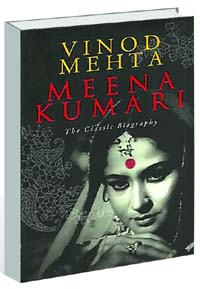
Vinod Mehta's republished biography turns the spotlight back on Meena Kumari.
Meena Kumari in Aarti, 1962.
Meena Kumari died of liver cirrhosis in March 1972. She was 39. A month or so later, Luis Vaz of Jaico Publishing called a young Bombay copywriter whose self-published book Bombay: A Private View had seen some success. Would he be interested in writing a biography of the woman universally acknowledged as Hindi cinema's greatest tragedienne?
In a memoir published 39 years later, the copywriter described that moment of decision: “Why not, I thought. And with the bravado of a 30-year-old who knew next to nothing about Hindi cinema, I launched into the project.” 
That 30-year-old was Vinod Mehta, and the biography he produced in October 1972 was pronounced “the most sympathetic, comprehensive and readable book on Meena Kumari” by the great writer-director KA Abbas. But after that first flush of critical acclaim, the book went out of print. And so it remained for decades, until Mehta's mention of it in his journalistic memoir Lucknow Boy (2011) aroused current-day curiosity.
Meena Kumari: The Classic Biography
HarperCollins, Rs. 350
 
Republished by HarperCollins this September, the biography is a remarkable creature. It bears witness not just to the incredibly filmi life of one of India’s most beloved actresses, but also to a past Bombay film world as observed by an outspoken young outsider. Mehta had watched some Hindi films growing up, but he was no starry-eyed fan. Hollywood impressed him more. One of the reasons he took on the project was that he’d read somewhere that Meena Kumari had identified with Marilyn Monroe, and her husband Kamal Amrohi with Arthur Miller. 
But what he really wanted was to place in her context the lower middle class Muslim girl who had become, like others of her ilk, a golden goose for her family, and to write about what kind of place India was in the ’70s. “I am often sounding off, and I enjoyed that,” Mehta told Time Out. That youthful pleasure is apparent in the summary dismissals that pepper the book. “For sheer vulgarity, dandyism, shallowness, squalor and dishonesty, the Bombay film world is hard to beat,” (p. 149), or “I can never understand how anyone who has the temerity to call himself an artiste… can find the time and mental apparatus to handle and organise the tortuous deceits necessary for hoarding hot money” (p. 185). “At that time it was fashionable to look down on Bombay cinema, not like now,” Mehta laughed. “And at that age I had an ego the size of a football.” But with zero journalistic experience or connections, it couldn’t have been easy to meet with Hindi film biggies? “Some of them were real prima donnas,” agreed Mehta. “What helped me was I had long hair; I used to wear a white raw silk coat and a tie and I had a bit of a British accent still. These film stars were quite flattered that a London-returned chap had come to see them. I quickly sensed that, and I exploited it.”
Whatever his reservations about the ’70s film world, Mehta has no doubt that it's a much worse place now. “I didn’t find the bitchiness that seems to exist today between [heroines]. There was space for everybody, and respect. Nargis spoke so well of Meena Kumari. And it was all extremely courteous – aapaapaap. I didn’t hear a single disparaging remark, not even from Amrohi [her ex-husband],” he said. There were, of course, those who refused to meet him, like her old love Dharmendra, and those, like Gulzar, who gave away nothing even when they did. The legendary lyricist-filmmaker, whom Mehta describes as “a cunning, urbane and sane man”, was bequeathed Meena’s diaries, and back in 1972, he scared Mehta by implying that he was writing a biography of her, too. But no biography ever emerged, and barring a small fraction of her poems, published as Tanha Chaand, Gulzar has kept Meena Kumari’s writing hidden away from the public eye, much to the disappointment of her fans (there are even those who suspect publishing her writing would reveal its influence on his own).
Mehta has no such illusions: he concedes that she may have been a third rate poet, more in love with the idea of poetry than adept at the craft. But, he writes, in a profession where most people “read nothing more taxing than Cine Advance”, that she was “able to put pen to paper… deserves a thirty-one-gun salute.” Mehta’s book is a combination of exuberant excess and judiciousness. He spends a whole chapter on whether she was a uniformly great actress, or only fitfully so. He evokes in loving period detail the stages of her relationship with Amrohi: the famous marathon telephoning, the silly but revealing quarrels over bassi roti, and the more serious ones over who entered Meena's make-up room, which eventually led to the break-up of their marriage. He evaluates her relationships with her family, and concludes that if she was exploited, it was because she chose not to cut herself off from people she felt she needed.
Mehta's recreation of the internal life of the woman he calls “my heroine” may seem rather imaginative to some, but he believes he was a model of restraint. “I didn’t find the nymphomaniac claim to be true,” said Mehta. “But she was quite promiscuous. Younger men, like Dharmendra or Sawan Kumar Tak, attached themselves to her and got breaks. And she almost certainly slept with all the top heroes.” He didn't put that in the book? “But that was standard. Kishore Sharma (married to Meena's sister Madhu) took me to this room with mirrors on the ceiling and said he was servicing her there. But he was such a shady character that I didn’t believe him,” said Mehta. On the other hand, he got fascinating details from her secretary, driver, doctor and three different make-up women: “people who had no axe to grind”.
The  book has brought offers to write about other film stars. “But present-day stars will accept only hagiography. Their PR people will give you a crore or two, but they want to vet your manuscript,” Mehta said. In any case, he hasn’t seen a complete Hindi film for 30 years. “These films of globalised youth, I find them completely artificial. I don't find becoming a famous rock star very interesting. Maybe I'm just too old.”
Published in Time Out Delhi, Oct 2013.