Showing posts with label fantasy fiction. Show all posts

6 June 2015

Book Review: Red riding hoods

A new book review, for India Today:

Bengal becomes a protectorate of China in Shovon Chowdhury's splendid satire, with its recognisable absurdities stretched to their logical limits


Murder With Bengali Characteristics
By Shovon Chowdhury
Aleph, 204pp, Rs. 395
On the morning after I finished Shovon Chowdhury's second book, I had to run an errand in Delhi's Nehru Place. As I walked through, the stall-owners were setting up their displays of pen drives and mobile phone covers from giant cardboard cartons held together by layers of melting brown sticky tape. I saw a young salesman hawking his wares: "Software, Software! Windows, Windows!" In Asia's largest IT market, the E-Future beckons from every signboard -- if one can just avoid the piles of garbage, the attendant flies and the puddles slowly streaking their way across the vitrified pavements.
It felt like I had just seen the world through Shovon Chowdhury's eyes.
Chowdhury's first book, The Competent Authority (2013), was stunning dystopian fiction, expertly plonking us down in a future so ludicrous and yet so perfectly recognisable as a version of the present that one doesn't know whether to laugh or cry. (One laughs. Crying would be too draining.) It is circa 2033. Having bombed Bombay and large parts of India, the Chinese run Bengal as a protectorate, maintaining friendly relations with the Maoists who control much of what remains of the subcontinent. The police are now openly hireable. The prime minister, a rather recognisable woman "related to a long line of PMs", is the TV-friendly figurehead of the Indian government. But the army and any remaining government functions are actually controlled by an anonymous bureaucrat called the Competent Authority. "It was a temporary arrangement. Normal service would be resumed as soon as reconstruction was complete. But the contractors were very incompetent. He had expected far more progress in the last ten years."
In Chowdhury's post-nuclear New New Delhi, only the hardiest Bungalowpur ladies now risk radiation hazards to hunt for bargains in the once-central shopping hub of the Dead Circle. The privatisation of medical services has reached its acme: the rich now buy their private doctors straight from Slaves R Us, and any new body parts they need from the Bank of Bodies (BoB). In Delhi, the BoB's Medical Military Commandos harvest these from 'donors' in Shanti Nagar, a semi-independent neighbourhood that had "sprung up on the outskirts of the city around 10 years ago, soon after the Chinese nuked New Delhi, after the Dalai Lama was reincarnated on Indian soil and the prime minister had publicly fed the child a small piece of dhokla with peppermint chutney".
Having launched us into this universe with a fabulous plot involving two small boys and the BoB, Chowdhury breezed through 450 pages with ceaseless wry humour, a string of memorable characters, and some remarkably moving episodes of time travel in the opposite direction.
At 200-odd pages, Murder with Bengali Characteristics is much slimmer, and the plot slightly less multi-pronged. It is set in the Bengal Protectorate, where a minor character from the previous book -- mining magnate and Bungalowpur resident Sanjeev Verma -- has arrived for a crucial strategy meeting with his business partner, Agarwal. Like before, this is a world perfectly realised in its details. A hapless Chinese governor rules under the expertly befuddling advice of his executive assistant Ganguly, the Party has returned to power if not hegemony (the influential mass leader Pishi has been put in a mental institution as an opponent of the Party), and Lalbazar Police Station is home to a contingent of Chinese-born police  officers, including our primary protagonist Inspector An Li.
Like Delhi in the previous book, this is a Bengal with its recognisable absurdities stretched to their logical limits. The waiters in Park Street's OlyPub are now in their nineties ("The unions were strong here"); the Party boys miss the old days so much that they have weekly exhibition matches in physical and verbal violence, acting both as themselves and as the late Opposition; and membership of the Calcutta Club continues to play a disproportionate role in influencing public events.
Of course, not everything is logical: most delightfully mad is the vision of Indian IFCL cricketers being pushed to unprecedented levels of fitness by merciless Chinese coaches ("There were rumours of the death penalty for failure"); the ancient ex-Party boss Bijli Bose being "regenerated from some DNA found on a whiskey glass"; and an episode involving a talking cat.
I have to confess that while I enjoyed this book thoroughly, I found myself less than moved by its central narrative premise. This might be for the terribly prosaic reason that the hard-boiled detective at its heart is rather too hard-boiled, and dare I say it, impermeably Chinese.
Chowdhury's scathing humour, though, has lost none of its bite. Here is Agarwal, admiring Ganguly in a silent stream-of-consciousness: "Such judgment. They didn't manufacture officers like him any more. Most of them were very low quality people. All they wanted was flats, premium SUVs and American passports for their children. The Chinese ruling classes were very similar. It was true what his guru-ji said. They were all becoming one." This is a brilliant writer who can transport us to an effortlessly imagined future and make it a mirror for the present we can't bear to look in the face. I'm waiting for the next Delhi instalment.

Published in India Today. 

20 November 2012

Post Facto: Keys to another world

My column for the Sunday Guardian this fortnight.

A large part of my adult life has been spent inside books. There are books I read too fast because I want to know what happens, and so must read a second time to savour all I missed. There are books I hate from page one, but read all the way through, sometimes because it's work (one cannot review half a book) and sometimes just out of masochism. There are books abandoned midway, which look at me accusingly as they sink to the bottom of a pile. There are books I refer to for facts magisterially marshalled, and books I turn to for analytical clarity. The best books are ways to enter the world afresh.

But there are times when what you want is not to find a different route into the world, but to leave it behind entirely. Fantasy and science fiction are increasingly popular genres in writing for adults. But the books of my childhood provide a dual escape: a temporary reprieve from the adult world, and in the case of three of my most favourite children's books — an entry into a parallel universe.


In the first of these, that parallel universe is an entirely domestic one, imagined to exist under the floorboards. Mary Norton's fertile imagination created a world of little people — six-inch-high creatures who looked and behaved like minature versions of ourselves, but lived by 'borrowing' from us all the little things that disappear so mysteriously from every home: "Safety pins, for instance... And all the other things we keep on buying. Again and again and again. Like pencils and matchboxes and sealing wax and hairpins and drawing pins and thimbles..." The Borrowers, as Norton named them, first appeared in print in 1952, and were such a success that she continued to create new adventures for her chosen fictional family — Homily, Pod and their daughter Arietty — for the next 30 years.

{
The books of my childhood provide a dual escape: a temporary reprieve from the adult world, and in the case of three of my most favourite children’s books – an entry into a parallel universe
Much of the delight of the Borrowers' universe is in seeing familiar household things in a new light: a cogwheel becomes a fireplace, a wristwatch is a clock, a matchbox a chest of drawers, a single chess-piece provides both a pedestal for a dining table and a knight's 'bust', which "lent that air to the room which only statuary can give." The other pleasure of this world is to experience, vicariously through the Borrowers, a life which involves precision and danger in equal measure, a world in which innovation is not a luxury but a need, and in which the everyday act of survival has the thrill of constant adventure.

The thrill is also enhanced by juxtaposition: the Borrowers, by their very nature, live in houses where no new things happen, where the humans live to a routine. "Routine is their safeguard," says old Mrs. May, who first tells Kate about them. "They must know which rooms are to be used and when. They do not stay in houses where there are careless people, or unruly children, or certain household pets."

The key to another kind of parallel universe is magic. Of all the many stories about magical creatures and magical worlds that I have ever read, I think E. Nesbit's The Enchanted Castle is the most wondrous. The children in it move constantly in and out of a magic universe — but not in the predictable manner of, say, Enid Blyton's The Magic Faraway Tree, in which a trip to the Enchanted Forest guarantees access to a magical world, but the everyday, regulated life of the nursery remains unaffected. In Nesbit's 1907 book, magic turns the everyday world topsy-turvy in a way that can be both frightening and marvelous: a girl disappears, statues talk, a whole secret world comes to life at night where there is nothing but lifeless stone in the day. Nesbit credits the power of the imagination in some far deeper way than most books — magic itself, she suggests, is a matter of belief. If you believe a ring will make you invisible, it will. If you believe it'll make things come to life, it will. But if you say it won't, it won't.

The last book — Tom's Midnight Garden — uses a third route to enter an alternative world: time. Philippa Pearce's 1958 tale -- of a boy stuck alone at an aunt and uncle's place for the summer — uses an old grandfather clock as the bridge between the regular world and a past one. When the clock strikes thirteen, late every night, Tom finds he can open an old rusty door and go into a garden that seems not to be there during the day. And there, in that world of the midnight garden, he forges a bond with a girl named Hattie — a bond that feels stronger than almost anything in the world of the day. But Pearce is not really interested in old-style magic. At the end of the book, she gives us an explanation that hovers on the edges of the psychological. But her vision of the garden — a place so intensely remembered that it manages to communicate to someone else — remains a haunting ode to the power of memory and dreams.

Published in the Sunday Guardian.

30 September 2008

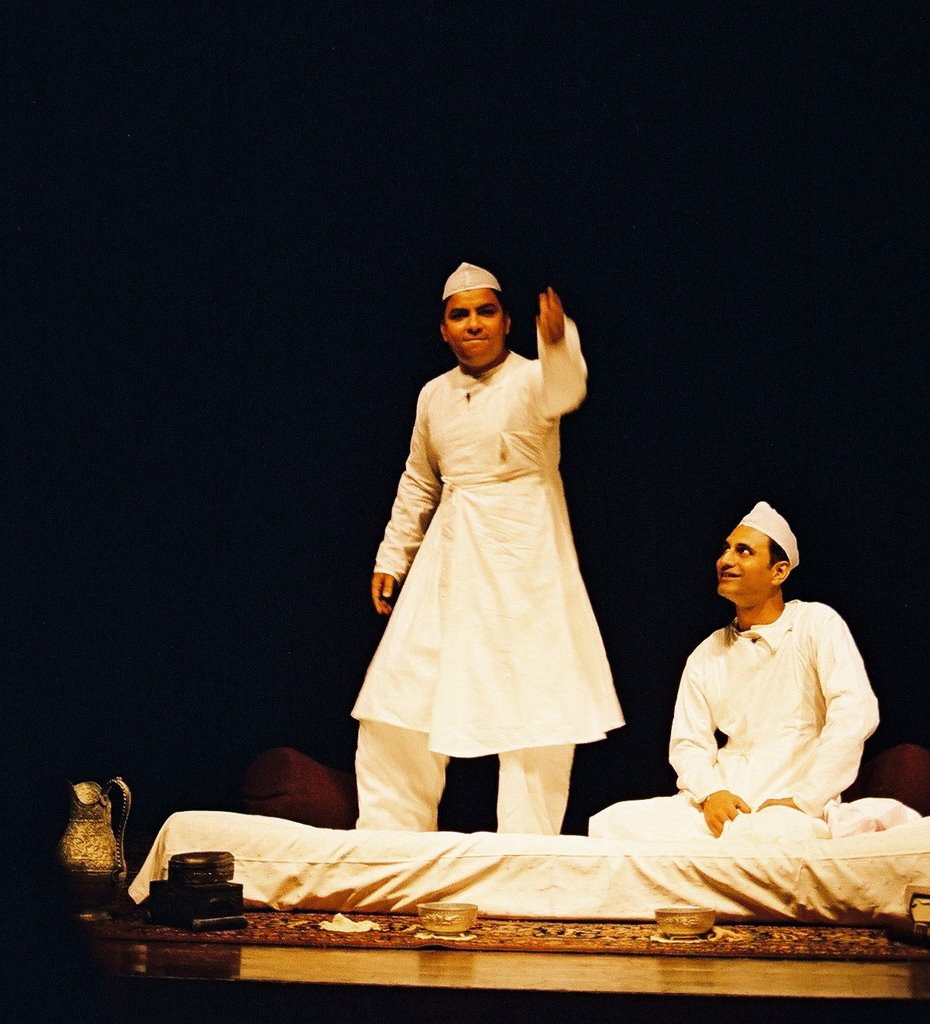
Sea of Stories: Dastangoi in Delhi

A theatre preview piece for Time Out Delhi:

Audiences aren't flocking to watch dastangoi just because it's a lost art. It's supremely entertaining as well.

Photograph: Abhinandita Mathur
Mahmood Farooqui’s first exposure to dastans was through his father, who often told him to read the single volume of the Dastan-e-Amir Hamza which they had at home “to improve his Urdu”. Farooqui was arrested by the fluidity and beauty of the language and by the richly-peopled world of the dastans, where Amir Hamza (uncle of the Prophet Mohammad) sets out to conquer evil, having adventures involving demons, magical beings and tricksters of all sorts on the way – but neither he nor his father imagined that the lost art of dastangoi would be revived in performance by Mahmood himself. “It started when I got an Independent Fellowship from Sarai, a research initiative at the Centre for the Study of Developing Societies (CSDS), to study the Dastan-e-Amir Hamza. The Urdu version printed in the 1890s, is in 46 volumes, and the only person who has the complete collection is the Urdu scholar SR Farooqui, who happens to be my uncle,” said Mahmood. “But it was a research project. In fact, in March 2005, I was planning a lecture based on my research at the India International Centre, when the IIC people said, why don’t you do a lec-dem? It struck me that the best way of demonstrating the power of the form was to actually perform the dastans. The text demanded to be read aloud.”

Farooqui had little to go by, because almost nothing is known about the conditions in which traditional dastangos showcased their art. It is possible that they had musical accompaniment, and also that large illustrated panels were held up behind the dastango, but what they wore, whether they sat or stood or moved about is unknown. But that first performance at the IIC, which Farooqui did in collaboration with his friend Himanshu Tyagi, was a great success. “It was an invited audience, so there were a lot of Urduwallas, but also regular IIC types and people from Sarai. We weren’t expecting much, but there was a lot of wah-wahi, people were very forthcoming with feedback, and the IIC invited us back to its festival later that year,” Farooqui reminisced. After Tyagi moved to Mumbai in early 2005, Farooqui found a new partner in Danish Husain.

“I remembered Danish from Habib Tanvir’s play Agra Bazar,” said Farooqui. Husain, on the other hand, remembered watching Farooqui and Tyagi perform in Dehra Dun in October 2005. “I was awestruck by the form,” he said, “but when Mahmood asked me to perform with him, I was unsure that I had the capability.” He was persuaded, however, and the duo did their first show together in March 2006. “Traditionally, the dastango performed alone, but I think the idea of two performers is a coup. It breaks the monotony for the audience, and it helps the actors – the moment one is tired, the other steps in,” said Husain.
“And we complement each other: one man is frail and elegant, the other is rotund and rustic. Mahmood is more poetic, eloquent. I’m more rough, more theatrical, like a bhaand. This doesn’t mean that I can’t recite poetry, or that Mahmood can’t be funny, but that’s how things tend to get divided.”

The Farooqui-Husain team has now done at least 30 shows together, mostly performing sections from a single chapter of the Dastan-e-Amir Hamza called the “Tilism-e-Hoshruba”. “The title has been translated as “An Enchantment that Steals Away the Senses”, but tilism is virtually untranslatable. It can mean an enchantment, a magical effect, but also an alternative world created by that effect,” said Farooqui. Tilism, however, is only of the four elements of the traditional dastan: the others are razm (warfare), bazm (the world of music, dancing and seduction) and aiyyari (trickery or disguise). Fantasy is thus an integral part of the tales, but they’re also an incredible fund of realistic depictions of Indian life. Magical forests coexist with cities afflicted by famine and fire, shape-shifters walk cheek-by-jowl with miserly banias and flirtatious women.

Has the fantastical quality of the tales made them difficult to appreciate for contemporary urban audiences? Or do people in Delhi and Lahore and Mumbai approach dastangoi through a nostalgic lens – assuming that one can be nostalgic for something one has never known? “Well, certainly there is some nostalgia about two men in Lucknawi attire sitting with a masnad and telling stories in Urdu. I’m uncomfortable with that, but I also know that people’s enjoyment doesn’t rest on nostalgia. Nostalgia may keep them there for 10 minutes, but after that they’re getting into the stories. And if the story is working for you, if it has enough to keep you entertained, it is connected to your world, it has become contemporary,” Farooqui said. “I have felt some pressure to contemporanize the dastans. And yes, these are magical stories, you could go anywhere, you could be in Bushland and in Baghdad at the same time. But if people enjoy, say, classical music today, then it is already contemporary, it doesn’t need to be ‘updated’.”

Though happy with the reaction they’ve got so far, Farooqui is clear that dastans have it in them to go much further. “They straddle the elite and the popular, they invoke Islamicness in a very secular mould, one purely driven towards entertainment. I would like to take the form beyond theatre-going audiences.”

(Time Out Delhi, Sep 2007)