Showing posts with label agriculture. Show all posts

5 April 2021

Book Review: What would human history look like if told through our relationships with animals?

Simon Barnes’s ‘The History of the World in 100 Animals’ is a unique way of looking back – and around.

What would human history look like if told through our relationships with  animals?If you have the slightest curiosity about the millions of species with which we share the planet, Simon Barnes’s delightful new book will satisfy and whet it in equal measure. Picking out a hundred from these millions (a selection that ranges from gorillas to earthworms), Barnes provides a crisp, evocative history of each creature – and even better, of humanity’s relationship to it: real and symbolic.

Lions, for instance, have been part of human life from the dawn of our species, he writes, drawing evocatively on a pair of footprints from Tanzania’s Laetoli Gorge, possibly made by some adult hominid parent escorting a child to safety some 3.6 million years ago.

If the lion is our most ancient enemy, it is also humanity’s most admired symbol of masculine courage. Courageous warriors and kings have long been compared to lions, but have also spent a lot of time killing them. Lion-hunting became a mark of human courage, of our conquest of nature – and as we devised better and better weapons, while also just wiping out their natural habitat, lions began to disappear from more and more parts of the world. “The retreat of lions is the story of the advance of humanity,” writes Barnes, and it doesn’t seem an exaggeration.

If lions exemplify our changing relationship with the wildest part of nature – ie, fear, conquest and now increasingly expiation, then the house cat might be seen as the embodiment of its opposite – the domestication of the natural world. Barnes makes the commonsensical argument that as human societies became settled and agricultural, cats kept rodents from the stores of grain – but having once been a cat owner, he also brings in the ineffable pleasure humans derive from scratching a cat between the ears and having it purr in contentment. Cats were useful, yes, but they were also company. “Thus human civilisation advanced to the sound of the purring cat.”

Occasionally Eurocentric

Some of Barnes’s choices of species are more particular, connected to a specific discovery or episode in human history. For example, an early chapter is devoted to the existence of four different kinds of mockingbirds in the Galapagos Islands, apparently crucial in nudging Charles Darwin towards the world-changing argument about evolution that he eventually published in On the Origin of Species (1859). Another dips into the incredible and tragic history of the American bison, succinctly explaining both how that single species helped sustain Native American civilisation and how its near-total extermination was crucial to the founding of the settler-colonial economy that formed modern USA. Yet another takes on the Oriental rat flea, responsible for several world-historical outbreaks of bubonic plague.

But this is among many instances where Barnes comes across as rather obviously Eurocentric. The Justinian Plague of the sixth century AD, named for the Byzantine emperor Justinian I, and the heavily mythologised Black Death of medieval Europe get vastly greater attention from him than the much more recent Third Plague Pandemic, which he merely describes as having “killed 12 million people in India and China” between the 1850s and 1960. This seems particularly strange for a book published in the midst of Covid-19. 

Even a cursory reading of Wikipedia reveals the Third Plague Pandemic to be a world-historical outbreak in more ways than one – starting in a poor mining community in Yunnan in the 1850s, reaching cities like Canton and Hong Kong in the late 19th century, and travelling from those port cities via the trade routes to India, where British colonial regulations to control the plague – widely seen as repressive and culturally intrusive – became the focus of nationalist agitation and violence.

Barnes’s chapter on cattle, while it does a fine job of pointing out how deeply many human cultures identify beef-eating as the embodiment of plenty, wraps up the Hindu exception in a single sentence about McDonald’s not serving beefburgers in India. His chapter on the pig feels like a cursory dip rather than the immersive essay owed to an animal so painstakingly forbidden and deeply abhorred by several world religions. But for Barnes, even the Revolt of 1857 having been triggered by the use of pig and beef fat on cartridges elicits only wry British understatement: “The strength of feeling about pork is startling”. He mentions the pig toilet in India, but only Goa, not the North-East.

Perhaps it’s only to be expected. The gaps in Barnes’s exposure can sometimes unwittingly reduce vast swathes of humanity into insignificance in his version of “the World”, but he does vastly better than most Western authors might. He plays to his strengths – and as a well-read, well-travelled ex-journalist (he was Chief Sports Writer at The Times until 2014), those are many.

The author of fourteen books, Barnes has a great eye and ear for detail, and his understanding of the natural world draws on the best of English literature, from John Donne on the elephant (“The only harmless great thing”) to Coleridge on the albatross, from Kipling on cats to Orwell on pigs. And his book does range far and wide, his choices unaffected by the size of the animal, the extent of its terrain, or the length of time it influenced the course of human history.

Myths and reality

Sometimes a category is supremely general, as in the chapter on cattle. Sometimes it is necessarily specific: he has individual chapters on the house fly, the tstese fly and the fruit fly, as well as on the pigeon/dove, the (extinct) passenger pigeon and the pink pigeon. Either way, Barnes is always good for peeling away the pervasive myths with which humans like to surround the animal species.

He tells us, for instance, that the insatiable flesh-eating piranha is a myth – more remarkably, a myth invented by Amazonian locals in 1913 for the benefit of the then-American President Theodore Roosevelt, who had arrived there on a hunting expedition. The locals apparently filled a netted-off stretch of river with piranhas left unfed for weeks, creating a stressed, hungry, overcrowded population of piranhas that then obligingly devoured a cow lowered into the water, to Roosevelt’s everlasting awe.

A lifelong hunter, Theodore “Teddy” Roosevelt was also responsible for a reverse sort of mythmaking – the fantasy figure of the cuddly, cute, quasi-human bear. In 1902, he refused to shoot a black bear already cornered by dogs and beaten with clubs. The incident became a Washington Post cartoon, with Roosevelt portrayed as a “hunter of mercy”, writes Barnes, and a subsequently smaller and cuter version of the bear then became enshrined in the children’s toy we call a teddy bear.

But what brings the book alive is not Barnes’s ability to cheerily condense reams of information, note the inevitable ironies of our mythical versions of most animals, patiently address persistent factual misconceptions, or sound the alarm, yet again, about the need for humans to recognise how we’re endangering other species and thus potentially destroying the planet. It is the enchantment he clearly experiences in the presence of the natural world, not just in flesh and blood (as when instinctively standing stock-still when confronted by a lion he had woken up by mistake in the African jungle), but also in the mind. 

In the midst of a chapter on the nightingale, for instance, we suddenly hear about him hearing the wind whistle through two hollow bones on a breezy day in Zambia and feeling like he had invented music “or at least recapitulated that moment in human history, quite by chance.” There is clearly much about our relationship to animals that we need to fix pronto – but magic always works better than mourning.

Published in Scroll, 20 Feb 2021. 


10 November 2020

Art For the Binge-Watcher

A quick wrap of the current art scene for India Today magazine:

Virtual platforms are breaking the barriers of social distancing with new ways of exhibiting art

'The Half Of It', a painting from Nityan Unnikrishnan's upcoming solo show, It Is Getting Louder,
opening on Nov 13, 2020 at Chatterjee and Lal Gallery, Mumbai

You might think that visual artists have had it better than most during the Covid-propelled lockdown, and you would be right. Most artists work alone, and display only needs to shift from the clean white 3D cube of the art gallery to the 2D rectangle of the digital screen. So even as the lockdown left a series of shuttered shows in its wake, many galleries rose to the challenge. One exciting development has been In Touch, a digital platform created collaboratively by galleries across India (Artintouch.in/).


Edition 4 of In Touch, which runs till November 10, includes Rustom Siodia’s little-seen 1920s and ’30s watercolours on the Chatterjee and Lal site, Kanu Gandhi’s astonishingly intimate photographs of the Mahatma on PhotoInk, Dhruvi Acharya’s arresting pandemic-inspired work at Nature Morte, and Buddhadev Mukherjee’s marvellously humorous human figures, playful studies in scale, at Mirchandani + Steinruecke. Chemould Prescott Road is showing Lavanya Mani’s ‘Game of Chance’, mixing science with miracles and omens in a manner perfect for a pandemic year. In ‘Miraculous Sights 2’, a town floats into the sea aboard a ship, which itself hovers over the scaly back of a submarine creature. In the hypnotic ‘Portents’, a gigantic red flower opens a bleeding glass eye to a world buffeted by strange animal-headed comets.

In Touch’s on-screen display is effective: you can see a chosen artwork as it might look on a wall (with a virtual chair for scale) and zoom in. I wish, though, that more galleries had done what Gallery Espace has with Manjunath Kamath’s dream-like pastiches, to identify sections of each work for higher-resolution reproduction. It feels like a privilege to have his strange, vivid imagination enlargeable on one’s private screen: a pile of books in flames as an elephant grazes placidly in a field outside, a television splashing into a bathtub, an angel approaching a Mumbai taxi, or a giraffe a buffet.

Others, too, have made efforts online. The Kiran Nadar Museum of Art has a superb virtual tour. Kolkata’s CIMA has a new website. The uncertainty of recent months seems to have pushed the artistic process into the foreground. Mumbai’s Tarq Gallery is presenting Garima Gupta’s notes and sketches from the Southeast Asian wildlife trade, “unarchived fragments of a conflict that is pushing us into a war with the very world we inhabit”. Nature Morte offers up a downloadable colouring book by Acharya, while Kolkata’s Emami Gallery has devised a virtual flipbook. The flipbook is a great format both for Prasanta Sahu’s Suburban Shadows (see below) and Aroh, a group show that came out of Emami’s open call for lockdown work by young artists (I particularly liked Arindam Sinha’s ‘Marking’, Arpita Akhanda’s ‘Hung Up On the Past’ and Jahnavi Khemka’s ‘Lockdown 1’). Finally, the digital crossing of geographical limits allowed us to view, sitting in India, 35 sketches from the late great modernist Ram Kumar’s 1960s and ’70s notebooks on Art Basel’s Online Viewing Rooms.

But while the hushed silences and ‘no touching’ rules of the gallery may feel only a step away from the literal untouchability of a virtual display, an aura still clings to the work of art in the era of digital reproduction. Three of the five shows to look out for this month, at DAG and Art Heritage Galleries in Delhi, and at Chatterjee and Lal in Mumbai, are open for offline visitors.

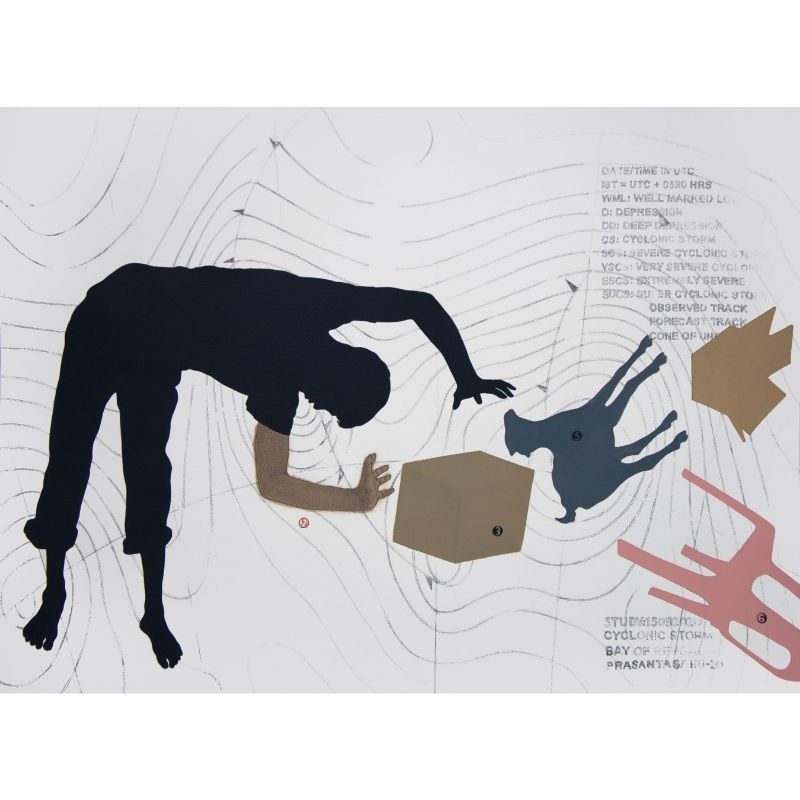
From Prasanta Sahu's ongoing show 'Suburban Shadows', online on the website of Emami Art Gallery, Kolkata

ART RESTART: Five art events to keep an eye out for

Nityan Unnikrishnan’s solo show It is Getting Louder, showing at Mumbai’s Chatterjee and Lal gallery from November 13 to January 2, feels very much like India right now. The acrylic images on khadi spill over with people: reading, eating, dreaming, waiting. The other set of the images, graphite on muslin or bamboo fibre paper, are abstract, filled with black and white forms which could be anything: masts, mountains, plants, porcupines. All that unites them is their jaggedness.

Art Heritage Gallery, Delhi, together with Kolkata’s Seagull Foundation, is showing The Self Portrait, a show of early and rare woodblock prints, sketches and watercolours by the late K.G. Subramanyan, who died in 2016, aged 92. They aren’t all depictions of the artist: watch out for ‘Jangpura Women’ (1950), and many striking untitled linocuts and litho prints of seated women. Open by appointment till December 15.

DAG’s The World Will Go On, on view online since October 25, will be open to visitors at The Claridges, Delhi, between November 2 and 12. Highlights include a 1980 Raza, an M.F. Husain Hanuman, Nandalal Bose’s ‘Diwali’, and one of Krishen Khanna’s bandwalla images.

Prasanta Sahu’s Suburban Shadows, on the Emami Gallery website till November 30, visibilises the links between rural and urban through his studies of food and farming: a lettuce in a shopping cart, vegetables sprouting from human limbs, a bhindi as skeleton, shadows of the labouring body.

Five Million Incidents, a set of public art interventions funded by the Goethe Institute, has been reconceptualised in digital form. Visit Goethe.de/ins/in/en/ver.cfm to join the imaginary chatroom of Ranjana Dave’s Age Sex Location, add to Sultana Zana’s Fieldness, a collaborative digital archive of time spent in nature in the city, or log in to play Shraddha Borawake’s virtual game Chaat Meets... A New World Order on November 7.

 Published in India Today magazine, 8 Nov 2020. (Two separate links)

3 November 2019

The Pearly Gates

My Mirror column:

An octogenarian Uttarakhandi farmer offers up an unusual model of the good life in an inspiring new documentary called Moti Bagh.

 
“In two minds am I this year,
To till or keep fallow my soil?”

The old man's tinny voice wafts out over a visual of his feet, loose inside his dusty leather shoes. A mynah hops alongside, perhaps waiting for the insects that will be dislodged as two brown cows drag the wooden plough through the field that Vidyadutt Sharma is clearly not leaving fallow. 

“Almost seven times a day/ the monkeys my fields do visit,
And the wild boars—they at night are my visitors.
Crows, parrots and their kin my fruits enjoy,
While jackals and porcupines await their turn.”

Back under the wooden roof of his own balcony, Sharma, 83, ends his little self-composed ditty, his hands performing a little hopeless flourish to go with the words:
“These animals it is beyond me to understand --
Earlier 50-50 was the arrangement,
But this year a full share they want.”

Then the camera pans out into the valley, and a langur turns to look at us from a distant treetop, its fur brilliantly white against the hillside's verdant green. Between the song, the cows, the mynah and the langur, we instantly get a sense of a universe shared with other creatures, of what it might be like to live off the land in Pauri, a district in the hill state of Uttarakhand.

Nirmal Chander's 59.23 minute documentary Moti Bagh, in which this scene appears, has been described as being about the struggle of a farmer in a remote Indian village. That isn't untrue, but neither does it do justice to Moti Bagh, which is as gentle, quirky and determined as its octogenarian protagonist. Vidyadutt Sharma, who happens to be Chander's uncle, first began to farm the consolidated farm for which the film is named in 1966. He had had other jobs – as a survey expert in the Uttar Pradesh government (a position from which he resigned at age 28), and later as the manager of a government school in Mundeshwar, during which time he went on a hunger strike to pressure the government into keeping its word on granting it high school status (It is now an inter-college.)

Sharma's educational and professional background might be considered by most people to be at odds with his choice of vocation: farming. But in many ways, that is what Moti Bagh is about: one man's realization that getting a formal education need not automatically translate to an office job. For Sharma, nurturing the land is both philosophy and praxis. “Bade bade granth likhna bahut aasaan hai, lekin tamaatar ka daana uga ke dikhaye koi (It's easy to write big books, but let's see someone grow a tomato seed),” he says. Sharma's dry wit somehow cohabits perfectly with his deep sense of belief. “Physical work has a special importance,” he says later, while carrying a pitcher of water up to his house. “Even if you don't get tangible results from it at the end of the day, you're sure to get a deep sleep!”

Chander's film is an affectionate portrait of Sharma as well as a cinematic glimpse of the socio- economic context of Pauri which makes him such an outlier. That context is the large-scale migration out of Uttarakhand – especially of educated upper castes -- into urban areas in the plains, leaving thousands of villages empty and much fertile land uncultivated. “The new generation is afraid of physical labour. They want to live purely off intellectual labour,” says Sharma. And earlier, perspicaciously, “The producer has become a consumer. We shall suffer the consequences of that...”

Nepali migrants, like Ram Singh and his family who work on Sharma's land, have replaced local farmers as agricultural labour, and the film points to the resulting tensions: jealousy and discrimination from locals, and the instability of devoting their lives to a land that they might well be ejected from.

Moti Bagh won first prize for Best Long Documentary at the International Documentary and Short Film Festival of Kerala (shared with Pankaj Rishi Kumar's Janani's Juliet), and the filmmakers have been claiming that this counts as a "nomination to the Oscars". The film recently received media attention because the Uttarakhand Chief Minister mentioned this with pride -- which is interesting not just because it is untrue, but also because the film is, as much as anything, an indictment of political corruption and the lack of political will (on such matters as forest fires, government school closures and land consolidation, which Sharma argues would help farmers to cultivate more efficiently and to stave off animal depredations).

Watching Vidyadutt Sharma shooing monkeys away from his orchards, I was reminded of another old man in total synch with a difficult environment: the crabby old shepherd of the atmospheric fiction feature The Gold-Laden Sheep and the Sacred Mountain (2018). Moti Bagh also brings to mind another film funded by PSBT: Rintu Thomas and Sushmit Ghosh's deeply inspiring 2012 documentary Timbakt. Timbaktu is a farming collective in Anantapur, Andhra Pradesh, which has weaned a large area away from chemical pesticides and mono-cropping into sustainable, organic agriculture, thus also helping restore the surrounding forest. (Timbaktu is available on Youtube.)

At the end of the documentary, Chander asks Sharma a grave question: what will become of Moti Bagh once he is gone. “That's not for me to worry about!” says Sharma, starting to laugh delightedly. “Let others worry about that!” Unlike Timbaktu, Moti Bagh isn't a movement. But sometimes all it takes to start one is one man with an infectious grin – and a willingness to be the odd one out.  


24 June 2019

Book Review: Heat (Vekkai)

I reviewed a modern Tamil classic now in English translation, for Scroll.
Poomani's vivid 1982 novel Heat, translated by N. Kalyan Raman, is about a boy on the run, and the gap between law and justice. 
Poomani, the name by which generations of Tamil readers have known the writer P Manickavasagam, published Vekkai in 1982. It was his second novel, unfolding in a subaltern rural Tamil landscape, like his first, Piragu.The two books together established Poomani, then in his mid-thirties, as a new star in the Tamil literary firmament.

A thirtieth anniversary edition of Vekkai was brought out in 2012, acknowledging its status as a modernist Tamil classic. In 2014, Poomani won the Sahitya Akademi award for his magnum opus Angyadi, a historical novel set in the late 19th century (for which he researched the Nadar community in Madurai and Tirunelveli with the aid of a two-year grant from the India Foundation for the Arts).
Despite Poomani’s undisputed stature in the Tamil world of letters, it has taken nearly four decades since his literary debut for his first two novels to be available in English. An English translation of Piragu is being brought out later in 2019 by Chennai-based Emerald Publishers, while Vekkai was recently published as Heat, in N Kalyan Raman’s spare yet vivid translation.
Here is how Heat opens:
“Chidambaram had only planned to hack off the man’s right arm.
He was aiming for the shoulder, but instead the sickle had sliced through the upper arm, its sharp tip entering the ribs. The severed arm had dropped near his feet. He kicked it away, grabbed the sickle and fled. As he ran, he heard the man’s scream rise and fade like the final cry of a goat in a butcher’s yard.”
It is a grisly way to begin a tale. But it does not quite portend the tone of what is to come. Little about Poomani’s novel is predictable. Neither his characters nor the events he describes have predetermined outlines that might be fillable with a broad brush. People, relationships, histories are built up slowly, with small, deftly drawn strokes that make for the finest sort of shading. So the 15-year-old protagonist may have killed a man, but he is not a killer.
Chidambaram’s father Paramasivam, whom he calls Ayya, may lose control of himself whenever he drinks, but that does not tar him as an alcoholic. The narrative may begin with a murder, but it is neither a mystery or a thriller or a police procedural. Much of Heat unfolds in flashback, and read backwards, it might be seen as a revenge saga: I’m waiting to see if this is how it will be interpreted by Tamil film director Vetri Maaran, of AadukalamVisaranai and Vada Chennai fame, who is adapting it into a film.
The nuance I flag seems to me crucial not just to Poomani’s storytelling, but to his worldview. For instance, Chidambaram is indeed a fugitive: he is running from the law. But what the book reveals, over conversations present and past, is that it is not so easy to slot him under that common phrase: a “fugitive from justice”. Poomani is centrally concerned with the difference between law and justice. The enmity between our protagonists and the murdered man, Vadakkuraan, stems from Vadakkuraan’s avaricious desire for their land, and the cycle of violence he starts. The law, it seems, will never punish him – so Chidambaram decides to.
We have, of course, developed an extended tradition of popular cinema in India that is concerned with this gap between the legal and the moral – in Hindi cinema, for instance, that trajectory has only grown sharper from Awaara (1951) to Deewar (1975) to Raman Raghav (2016). I imagine Vekkai,published in1982, was an early fictional instance of such open criticism of the police. “[E]very policeman is allowed to keep a weapon tucked behind his arse and one more in front, long with a round club in his hand,” complains Paramasivam to his brother-in-law. “But we are not allowed to carry weapons... if we do the same thing, it’s a crime.”
At another point, he warns Chidambaram to beware police corruption, based on class and caste loyalties and actual bribes, “The police may not come after us today. But if our enemy gives them money, they’ll come running like hound dogs. So many atrocities take place in our courts. The law is what the rich people lay down.”
Poomani doesn’t wish to make this about caste, but he makes it clear enough that the systemic violence stems from the astounding inequity at the foundation of our social structure. Families like Chidambaram’s are resisting a long history of socio-economic oppression. A third of the way through the novel, we realise that the father, Paramasivam, committed a crime that sent him to jail in his youth – and that, too, was in retaliation for unwarranted, long-term oppression. “The rich guys couldn’t stomach the fact that we were farming our own piece of land.”
The novel also details other forms of informal justice, which might use the law strategically – “A good man from that village gave evidence” – or remain outside it entirely, like the cotton-thieving ganglord Muthaiah, whose men “will never step inside land that belongs to a poor man”, and who is a respected mediator of local disputes.
The other way in which to read Heat is as a palpably experiential journey into the Tamil countryside. This is a world in which cash crops like cotton and sorghum are beginning to be grown, and a ginning factory figures prominently, but which is also still brimful of wild plants and trees and animals whose ways a fifteen year old boy knows well enough to live off: the sour-bitter taste of a guduchi vine, the joys of cactus fruit, a rabbit killed by a vulture. And these are supplemented by cultivated pickings: sugarcane, sweet tubers left buried in a field, padaneer collected in toddy tappers’ pots which the boy climbs for.
And yet, even as a fugitive, Chidambaram is never purely utilitarian. Whether it is making a garland of kurandi flowers to put around the neck of a temple horse, crafting a hammock out of roots and palm leaf mats, or just admiring the skill of men hunting and skinning a snake, he wanders through his ordinary world with an unerring eye for its beauty. Seeing through his eyes might make you see it, too.
Published in Scroll, 22 Jun 2019.

2 March 2019

A Dormant Volcano


Mrinal Sen's Chorus, 25 years after it was made, is a chilling reminder of how long India has spent making strides in the fake solutions department -- while letting the real problems fester.


Utpal Dutt in a still from Chorus 


Between 1970 and 1973, the late Mrinal Sen made three explicitly political films that together came to be known as the Calcutta Trilogy. Speaking to his biographer Dipankar Mukhopadhyay, Sen later said, “After Bhuvan Shome I found the smell of gunpowder in Calcutta's air something I could neither dismiss nor avoid.” InterviewCalcutta 71 and Padatik were almost documentary in their realism, with the Naxal-riven Calcutta of the 1970s brought to the screen with real footage of bomb blasts, firings and demonstrations.

Chorus, too, was concerned with the state of the nation, but it took a different aesthetic tack. Right from the opening scene, when Robi Ghosh appeared seated on a high white throne amid a circle of white-clad sages, it was clear that Sen had made a conscious departure from his previous work. Then Ghosh, already a recognisable comedian, broke into a kirtan, a Vaishnava-style devotional song, its deceptively genial rhythms carrying a chillingly sardonic message. “Once upon a time a king sat in his court and said to his wise men, show me a land where there is no want. Replied the pandits promptly, if there were no want, then there would be no God.” The song ends with the darkest line, “Abhaab rochen jini, tini shoktimaan [He who creates want, is the powerful one]”.

From this profound and cynical vision of religion and religiosity, we descend to another fictional milieu – a grand palace with a revolving surveillance camera atop it, within which a suited-booted man is handling two telephones in order to keep the crowd at the gates under control. As happens often in the Calcutta Trilogy films, words flash upon the screen. “SITUATIONS VACANT. USE PRESCRIBED FORMS TO APPLY. FORMS RS. 2”. 

Back inside the building, we hear the cigarette-holding executive in a tie and shirtsleeves calmly order large numbers of extra forms to be printed, “Accha, chakri dite na paren, form to dite paren [Accha, you may not have jobs to give, but you can give forms]... And we're earning money from them anyway.” Cut to Utpal Dutt, playing a senior bureaucrat in a Mrinal Sen film for the second time after Bhuvan Shome, though the tenor of the role could not be more different. He seems urbane and benevolent, even reasonable, until he is informed that the crowd is getting restive. Then the camera captures his shrieking transformation in ruthless close-up: “What is security doing? Control!” We hear the sound of marching boots in the distance, an effect that recurs through the film as a symbol of state repression.

Then we see a serpentine queue, in a white expanse outside what looks a lot like the Reserve Bank of India building, with a disembodied voice on the megaphone announcing that the counter will only open at the allocated time of 10am. A wave of disappointment runs through the queue. The murmurs are followed by a sarcastic commenter singling out an oldish gentleman for having lined up. The jostling spirals out of control. Grenades are thrown. The old man falls, his glasses crashing to the floor. The word “Attention” repeats on the megaphone, sounding more and more like “Tension”.

A journalist has appeared to capture the chaos, clicking away, even climbing up and down for better angles. What Sen produces here is an early cinematic indictment of the news media. The journalist witnesses the scene, never intervening. When a man in the queue asks if all law and order has been abandoned in the country, he replies casually: “There's a war on. How can there be law and order? This isn't a game of cricket, is it?”

He does record three different characters at the scene – the old man, a young rural man, and a young college-going woman -- whom the film then follows into the arenas of their individual lives, adapting the documentary form interestingly. The film has other threads running in parallel, all a little surreal. In one, a crafty village pradhan called Chhana Mondol manages to hide his corruption and his rice-smuggling from the powers-that-be, and tells his beholden job-seeking nephew to literally go underground. In another, a millworker called Mukherjee becomes a traitor to his union, drunkenly declaring that it is his administration now.

Meanwhile, having received 30,000 applications for 100 vacancies, the bureaucrats holed up in their fortress start to imagine a countrywide conspiracy to overthrow them. Utpal Dutt's character calls in the police, who randomly start to harass 150 of the job applicants. “We are seated on a volcano. We must do something to survive. But we need some kind of excuse, a provocation.” Dutt yells. “Why the hell don't they provoke us?”

The inspirations for Chorus were many, including an actual queue of over a thousand people Sen witnessed in Dalhousie Square in Calcutta. Sen's fantasy of a tyrannical state disconnected from a jobless people left even his regular audiences baffled, though it won several National Awards and prizes at Moscow and Berlin. In a truly remarkable instance of life imitating art, the Emergency was declared less than a year after Chorus released.

Sen was prescient. But nothing ended with the Emergency. Twenty-five years later, our queues of job seekers remain as desperate. Only the megaphones have grown louder.  

Published in Mumbai Mirror, 17 Feb 2019

24 October 2016

Ram, Lokhon, Sinta. And Sabin.

My Mumbai Mirror column:

Altaf Mazid’s film on the Karbi version of the epic underlines why we need all our many Ramayanas.


It’s not yet Diwali, and the Ramayana season this year already feels more disturbing than festive. First, the Shiv Sena successfully prevented actor Nawazuddin Siddiqui from acting in the annual Ramlila in his hometown Budhana (which is in Uttar Pradesh’s Muzaffarnagar, a district that was torn apart by Hindu-Muslim riots in 2013). So what if Siddiqui is the town’s most famous export by far and actually wants to return to fulfil a childhood dream? No Muslim had ever acted in the Budhana Ramlila, said the Shiv Sainiks, and there was no way they’d let one start now.

Then, timing it carefully to coincide with Dussehra, the Modi government announced a Ramayana museum with a Rs.151 crore budget. Part of a projected Ramayana tourism circuit, the museum - to be built in Ayodhya – clearly targets the BJP’s Hindutva voters in UP: building a Ram Mandir at the site where the Sangh Parivar demolished the Babri Masjid in 1992 has been part of the BJP’s manifesto for years. While a Ramayana Museum is a wonderful idea in itself, the present project — to be carried out in UP’s most politically sensitive town, in an election year, by a pernicious and culturally insecure government — does not inspire confidence as being anything but a sop to Ram temple enthusiasts.

The Ramayana museum I’d love would be one that lets us marvel at how communities across our vast and varied subcontinent have made the epic their own. Such a museum is unlikely to get built in the near future — but it would have benefited greatly from the knowledge and enthusiasms of Altaf Mazid, the Assamese filmmaker, critic and restorer who died in April this year.

I say this because I recently watched Mazid’s striking 50-minute film Sabin Alun (titled ‘The Broken Song’ in English), about how the Ramayana story is told and lived by the Karbis, an ethnic group in the hill areas of Assam. Although screened as ‘documentary’ (at the 2016 Mumbai International Film Festival and at Delhi’s Open Frame festival organised by the Public Service Broadcasting Trust which also funded the film), Sabin Alun refuses to fit into a pre-established genre. It rolls around playfully between ethnography and storytelling; between serious-minded, unadorned documentation of the epic and a tongue-in-cheek contemporary staging (in which the geeky Ram keeps adjusting his spectacles while the dark-suited Rabon drives Sinta off in a big black car).

Mazid’s film assumes — correctly — that we know the epic inside out. He does not so much describe the Karbi version as draw us into it, demonstrating with quiet beauty and unspoken ease how a story can be entirely retold while still remaining recognizable as the same story. The extent of reimagining is apparent from the very name — of the Karbi story as well as the film. Sabin Alun means ‘Song of Sabin’, and Sabin is what the Karbis call Surpanakha, Ravan’s sister.

It seems both marvellous and fitting that Surpanakha, as Sabin, comes to occupy centre space in the Karbi narrative — rather than being stuck on the periphery as the snub-nosed, dark-skinned villainess so horribly rebuffed by Lakshman that the episode is what triggers Ravan’s revenge, the abduction of Sita. Marvellous, because to those of us raised on upper-caste Hindu tellings of the Ramayana, there is still a shock when we’re made to see the tale from the other side, to perceive our fair-skinned heroes as the arrogant, marauding, misogynist outsiders they are in Sabin’s forest home. Fitting, because as a Karbi woman explains, “Sabin has her nose chopped off, and there is no mention of Sabin. So it is ‘Song of Sabin’.”

Even more than Sabin, it is Sinta
 — the Karbi Sita — who demands our attention. Of course, there are many other Sitas stronger than the prettily useless version thrust upon us by Tulsidas and Ramanand Sagar — in the Oriya 15th century Vilanka Ramayana, based on the older Adbhuta Ramayana, Sita is the one who finally kills Ravana, having assumed the form of Kali, but lets the world believe that Rama did the deed.

But Sabin Alun gives us a truly earthy Sita (though ironically Sinta is not found in a furrow, but in an egg). In the song sung in the film, we hear Sinta ask her mother for a knife. “And holding it in her hands... Sinta while on a tour... Felled trees big and small... So mighty was she.” Mazid maps these words onto a staging: a modern-day Karbi woman riding angrily off on a tractor. Later, he reiterates the epic’s agricultural basis among the Karbis, by asking an interviewee why Ram, Lokhon and Sinta had to go into the forest. She responds without a moment’s thought: they had to take up farming, and there were no fields like there are now. “So they went to clear the forest... and then they stayed to supervise the farming.”

Perhaps the finest moment of revelation for me, though, was the quietest: an old lady sings of how Lokhon refused to leave Sita when she bade him go to Ram’s rescue. “I am not going, my brother is not dying,” proclaims Lokhon. But Sita is not one to give up so easily. “Oh Lokhon, if you do not go,” she says, “You want to marry me. And this is what you have in your mind.”

The line is delivered in the same drone-like monotone as everything before and after it, and one can only wonder why it is such a shock. It is, after all, a perfectly imaginable dynamic to emerge between a woman and her attractive (temporarily single) brother-in-law. Or perhaps it is too imaginable? There is probably a reason why a man’s relationship with his saali (wife’s younger sister) and a woman’s with her devar (husband’s younger brother) are categorised as ‘joking relationships’ across North India. It takes the matter-of-fact frankness of the Karbi telling to let us see this aspect of the Sita-Lakshman relationship that we have suppressed for years.


Published in Mumbai Mirror, 23rd Oct 2016.

25 April 2014

Post Facto - The Long Dark Tea-time of the Indian Soul

Vintage tea ad suggests tea instead of alcohol.
From my Sunday Guardian column:
Do you drink tea? If you're Indian and your answer is no, you're probably (a) from one of those lucky parts of the country that grows coffee; (b) ridiculously young, with enough spare cash for the coffee chains; (c) a champion of milk who thinks tea is an artificial stimulant (and makes you dark); or (d) a freak healthy type who favours aloe vera juice or something equally odd.
Because despite Montek Singh Ahluwalia failing to declare tea our national drink in 2012 (apparently the coffee manufacturers objected), India is the world's largest tea-drinking nation. It was also the largest tea-producing one, until China recently outstripped us. Though that is perhaps as it should be: it was to break the Chinese monopoly on tea production that the British, already becoming a country of tea-drinkers, first introduced the plant on a commercial scale in Assam (and later North Bengal and the Western Ghats). Remarkably for something first grown here in the 1820s, and initially intended only for export, tea is today our most consumed beverage. An ORG study in 2012 said 83% Indian households drink tea. According to the Cambridge World History of Food, 70% of India's immense crop is now consumed locally, with Indians averaging half a cup of tea daily on per capita basis.
The half-cup of tea might just be an Indian speciality, anointed in some parts of the country with its own memorable name: cutting chai. Elsewhere in India, that three-sips-worth of hot, sweet, concentrated brown liquid might not have a name, but it's the usual amount — unlike the British working class, which drinks its tea in a large mug, most of India favours the small glass tumbler.
"Tea is Swadeshi." 
Poster made for the Indian Tea Market 
Expansion Board, 1947.

The brown sahibs who first learnt to drink tea from colonial Englishmen adopted the upper class ceremony. The cost of full-leaf tea and its accoutrements kept tea out of reach for much of the populace — all Lipton print advertisements as late as the 1940s show a proper bone china tea service. The democratisation of tea in India only really dates to the mid-20th century, when aggressive marketing achieved the symbolic transition from "imperial brew" to "swadeshi", and the Crushed, Torn and Curled (CTC) technology made it possible to make more cups of strong tea from less leaf.
The late Rituparno Ghosh, adapting Tagore's novel Chokher Bali to the screen, had much fun with the depiction of tea-drinking as a memsahebi innovation. Aishwarya Rai's young widow Binodini intrigues and then woos the household's more conservative older women — with tea. The cleverness of Ghosh's touch lay in evoking the sensuous pleasure of an elaborate afternoon tea ritual, associating it with the guilty secret it was for a 19th century Hindu widow to enjoy anything at all.
Today depriving someone of tea might be popularly understood as something of a human rights violation. In September 2013, when a sub-inspector in Kolhapur arrested a man called Vijay Patil for "drinking tea in a suspicious manner", the Bombay High Court, was not impressed. Mr Justice Gautam Patel's ruling, as reported in the media, was a marvellously eloquent paean to tea: "We were unaware that the law required anyone to give an explanation for having tea, whether in the morning, noon or night. One might take tea in a variety of ways, not all of them always elegant or delicate, some of them perhaps even noisy. But we know of no way to drink tea 'suspiciously'."
Jyoti Dogra's brilliant solo theatre performance Notes on Chai, which I recently watched in Delhi, is ostensibly about that "variety of ways" in which we might take our tea. Dogra has suggested in interviews that tea was a way of approaching the everyday; that differences in tea-drinking habits are indicative of class, cultural origins, social status. And it is true that Dogra's character sketches — the old Punjabi lady so endearingly proud of her Lahore college degree who will endure no water in her tea; the government clerk for whom tea-break means stopping mid-sentence, like an automaton; the woman who insists on pressing Malaysian green tea and favours upon a reluctant acquaintance — are about those things.
But Dogra does herself injustice. The people she brings to life do mention tea. Sometimes they return to tea over and over. But their talk is not really of tea. It is of time, and of the self. For the old person with not much to do, tea is a filler of time. For the body looping through unalterable cycles of work, it is "me-time" that makes the daily grind bearable. And yet it is a ritual pause, as sharply demarcated and routinised as labour. For the woman whose life is lived at the "suggestions" of her father and husband, to drink her morning cup of tea in the balcony — and to refuse to wake her husband until she's finished — is her single act of everyday resistance. "Mujhe subah ki chai milti hai balkoney mein, toh phir main sab kucch lightly leti hoon." Tea is the assurance that things are running as they always do. But just below the surface of Dogra's performance is a profound, disturbing unease: will things never run any other way? Does tea simmer so we stay calm?
Published in the Sunday Guardian, 20th April, 2014.

3 April 2012

Ramkinkar Baij: The World according to a Cat Lover

The fate of both peasants and animals in Ramkinkar Baij’s art is a record of change in a post-industrial world.


Walking through the seemingly interminable galleries that house the Ramkinkar Baij retrospective, I overhear a conversation between two stylishly turned out women who appear to have made a Thursday afternoon trip to the NGMA gift shop and walked into the exhibition as an afterthought. “No, no, this can’t still be the same artist,” says Woman 1, puzzled. “Arrey, but see his name is here, Ram Kinkar. Same guy who has done those sculptures, yaar,” says Lady 2. “But these watercolours of his are very pretty,” says the first lady in some surprise.

For the unwarned visitor, Ramkinkar Baij’s oeuvre is indeed bafflingly uncategorisable. He sculpted, he painted, he sketched. He worked in watercolour, in oils and in pen and ink. Also in bronze, terracotta, plaster of paris and what looks like rough-hewn stone but turns out to be concrete. He was famous for throwing cement mortar and laterite pebbles directly onto a frame, creating larger-than-life sculptures so huge, so rugged that they seem almost like natural occurrences—but he also did delicate little sketches, barely a few centimetres square. If you happen to walk around with a canon of Western art in your head, you will find Baij images that look distinctly Cubist and others whose round fleshy bodies might remind you of Matisse. There are rooms full of paintings that could be called ‘pretty’, and other rooms that provide a glimpse of his more elemental work, usually in sculpture.

The changeability of his ouevre seems to echo the changeability of the man himself—at least as far as he is revealed to us in photographic portraits. There is the iconic image where he looks rather wildly out of the frame, his curly hair dishevelled, his torso bare—but there is also the gentle, almost drowsy old man of the (also iconic) image, ever so softly petting a cat on his lap. In an early photograph, we see him in Shillong with Binodini—his muse and long-time companion—almost foppish in a white kurta-pajama, a pristine shawl draped over his shoulders, hand perched on his hip in an attitude of studied insouciance. In others, we see a rather different Ramkinkar: clad in bush shirt and trousers, a deliberate departure, one presumes, from the kurtas, pajamas, dhotis that were de rigueur at Santiniketan. Then, in an image where he poses next to one of his more abstract sculptures, Speed, the plain, practical, artist-at-work quality of the shirt-and-trousers is all but erased by the flamboyant addition of sunglasses—and quite brilliantly, a conical straw hat. It is as if Ramkinkar assembled a ‘modern’ look, a half-joking challenge to anyone who might slot him as a peasant—and then, chuckling to himself, added the Chinese rice farmer hat.

The playful deliberateness of that Chinese straw hat—which he actually used quite often, whether he was wearing trousers and a shirt and teaching students at Visva Bharati, or wandering lungi-clad through the villages around Santiniketan, finding new things to make art out of—is of a piece with Ramkinkar’s approach to his art.

So, for example, in the footage he shot for a documentary about Ramkinkar, another great Bengali maverick modernist, the filmmaker Ritwik Ghatak, quizzes the artist about his famed sculpture Mill Call. Among the six gigantic outdoor pieces on the Visva Bharati University campus, Mill Call consists of two adult figures taking a giant stride forward, their muscular bodies stretched to capacity. But even as they seem to move ahead, with a child following close on their heels, one of them turns back, looking at something that’s flying out behind them. “What’s going on here, Kinkar da?” asks Ghatak. “These are coolies, they work in the rice mill,” says Ramkinkar. “They have heard the whistle and are running to work. But they have to go so early that their clothes aren’t dry yet. They dry their clothes while running to the mill.”

Looking at a massive photographic reproduction of Mill Call earlier at the NGMA (the original sculpture is immovable), I had seen those powerful arms held aloft and imagined them to be holding weapons, or tools of trade. To be told that they are clothes drying in the breeze is to suddenly encounter Baij’s incongruous laughter.

And yet Mill Call (1956), like its predecessor Santhal Family (1938), derives its iconicity precisely from Baij’s clear-eyed representation of a social transformation: of the local Santhal tribals from forest gatherers and agriculturists to factory hands. If the Santhal family is migrating with all its meagre belongings (and dog), the explanation Ramkinkar gave to Ghatak suggests that Mill Call, rather than being simply another innately heroic socialist image of the worker, stems from a recognition of how the rhythms of human life are irrevocably altered by industrial time. At one level it is a straightforward image about capitalism’s takeover of everyday time; at another, it is about hurtling into the future even as you look back at the past—blown irresistibly forward by the storm of progress, like Paul Klee’s Angel of History.

And it is not just the experience of time that is transformed with modernity, Ramkinkar seems to say, it is the human body, and sometimes, our way of seeing itself. With The Harvester (1943), he created a labouring body that was almost machine-like in its angularity and power. The natural gesture—of lifting up the scythe and bending backward to gain maximum momentum—is crystallised into an idealised form that is nearly abstract. In the painting Palm Grove (1960), he takes the bottom section of a grove of palm trees and creates from the criss-crossing trunks a vivid, almost geometrical image. Then there is his thoroughly abstract depiction of Spring, as also his two 1969 paintings At the Foot of the Arakan Hills and Atomica, which seem to owe a little too much to the style and imagery of Picasso’s Guernica.

And yet, the same Ramkinkar has also left behind a vast collection of paintings and sketches which seem very much to be drawn from life: deft little landscapes and portraits, in which we get a clear sense of light and colour and movement, bodies, gaits, even expressions. How are these seemingly contradictory styles to be explained? This “oscillating between representation and abstraction,” says Professor A Ramachandran on one of the exhibition’s explanatory plaques, “has been the characteristic of Kinkar da’s works.”

Certainly Ramkinkar’s early watercolours, starting in the 1940s, seem much less preoccupied with being conceptual than representational. His sense of colour is instinctive and always vivid, if often slapdash; his fluid, quick-drawn lines never fail to evoke a posture, a gesture, though also—almost unfailingly—a mood. Girls walking up a mountain path in Kullu, the only splash of red in a blue-green landscape, effortlessly communicate cheerfulness. His yellow-ghomta’d Standing Woman, one hand with palm open, almost in supplication, the other bent at an impossible angle, as if about to open the door and retreat out of our sight, seems uncomfortable, fretful.

Several other portraits are what might be called ethnographic, where the individual subject seems subsumed into a regional—and physical—type. Bhutia (1949), for example, is the very image of stolidity: a grizzled man swaddled in a coat or maybe two, his feet planted deliberately on the ground like tree trunks, as if he might keel over under his own weight. In stark contrast is Assam Tribesman (1950), a figure Ramkinkar chooses to etch in profile: his long lithe legs exposed under a colourful upper garment, the very picture of grace.

The largest group of works in this retrospective probably comprises Ramkinkar’s depictions of birds and animals. The relatively few sculpted creatures do not seem to aim for realism: like Horse, a wonderful piece in plaster where two human figures seem attached to the horse, so that all three together come across as a single living being, or the almost cartoonish, yet affectingly tender, terracotta Dog. The most famous of Ramkinkar’s sculpted animals are at the exhibition only in photographs, and these, too, in different ways, are not quite lifelike. The first of these is the massive dog that accompanies his Santhal family on their travels: an open-mouthed, snouty creature whose presence lends Ramkinkar’s vision of migration a mythical dimension—one thinks of Yudhishtira and the dog at the end of the Mahabharata. The second is his buffaloes, sculpted for a fountain outside a Santiniketan girls’ hostel. At first glance, the two animals at the base of the fountain seem like normal buffaloes, wallowing in shallow water, chewing the cud. The swishing tails of buffaloes shooing away flies on a hot summer day, are a common enough sight in India. But Ramkinkar’s playful gaze has turned them into fishtails. So the creatures we see are like hybrids out of Abol-Tabol—if Sukumar Ray imagined a half-duck-half-porcupine, haansh-jaru, these could be half-buffalo-half-fish, mosh-maachh.

But many more of Ramkinkar’s animals and birds are watercolours or pen-and-ink studies, and these are almost always ‘realistic’ renderings. Domesticated animals appear consistently: dogs, cats, horses, donkeys , pigs and most frequently cattle. A cow turning its head, a calf tied to a stake, buffaloes with people on their backs, bullocks ploughing a field: these are unsentimental portraits, the animals seem merely part of a rural landscape: creatures that are of interest only because they are integral to a peasant economy, not individuals in their own right. Then suddenly, amid all these working beasts, a gesture brings you up short: a woman in a field, petting a cow.

In a marvellous essay called ‘Why Look at Animals’, John Berger has written of how the advent of modernity has transformed our relationship with animals. The internal combustion engine displaced draught animals in streets and factories, while expanding cities transformed more and more of the surrounding countryside into suburbs ‘where field animals, wild or domesticated, became rare’. As animals disappear from daily life, they become less and less real to us; they are no longer creatures whose otherness we recognise. Families of all classes earlier kept animals because they served a domestic purpose—guard dogs, hunting dogs, mice-killing cats, and so on, but as Berger points out, ‘the practice of keeping animals regardless of their usefulness, the keeping, exactly, of pets… is a modern innovation’. As pets, deprived of almost all other animal contact, they necessarily become ‘creatures of their owners’ way of life’. And the zoo, where most of us must now go to observe wild animals, exists as a monument to the impossibility of any real encounter between animals and us.

R Siva Kumar has suggested that Ramkinkar saw animals through the intimate but unsentimental eyes of a peasant, whose ‘interaction with the animal world is more constant, he not only knows his animals better, but also experiences them as sentient beings without the least amount of romanticism’. But to me, Ramkinkar’s lifelong preoccupation with animals seems to stand on the threshold, forming a cusp between that older peasant world and an emerging modern world of pets and zoos. On the one hand he captured with lucidity the unremarkable sight of pigs and dogs and cattle wandering freely through his beloved Santhal villages; on the other, on a trip to Baroda, he seems to have spent most of his time in the zoo, sketching lions and monkeys and the hulking immobility of baboons. Most revealing of all are Ramkinkar’s many sketches of cats and kittens: Cat Family, Three Kittens, Three Cats. Unlike any of his other animals, they have personalities. In one famous image called Artist and his Models (Kittens), a lithograph from 1968, several large, unruly kittens with big expressive faces play a game of rough-and-tumble, dwarfing the artist, a rather crazed-looking black figure without a face. They have exaggerated facial expressions, almost like the anthropomorphic features of cartoon animals. They seem, in other words, like pets.

Towards the end of his magisterial essay, John Berger writes: ‘The marginalisation of animals is today being followed by the marginalisation and disposal of the only class who, throughout history, has remained familiar with animals and maintained the wisdom which accompanies that familiarity: the middle and small peasant.’ The fate of both animals and peasants in the art of Ramkinkar Baij is a record of the same inevitable trajectory—of disappearance and co-option in a post-industrial universe.

Published in Open magazine.