Showing posts with label Dev Anand. Show all posts

25 October 2020

The doctor as sufferer

My Mirror column, sixth in my series on films about doctors:

Based on AJ Cronin’s famous 1937 novel The Citadel, Vijay Anand’s medical melodrama Tere Mere Sapne (1971) casts doctors as the ailing ones

Like several of the films I've written about in recent weeks, Vijay Anand’s Tere Mere Sapne (1971) had as its protagonist not a doctor, but the medical profession itself. And thus, perhaps necessarily, several doctors. The director's brother Dev Anand may have supplied the film's star quotient (as the rather unimaginatively named hero Dr Anand), but within the film's opening ten minutes we meet three other doctors. These are the characters that actually give us the lay of the land

First up is Dr Anand's medical batchmate, who delivers the first line of dialogue in the film: “Jise tum aadarsh kehte ho, usse main paagalpan kehta hoon [What you call principle, I call madness].” He suggests establishing a moneymaking practice in the city together, but the idealistic Anand mocks him for being a businessman instead of a doctor - and leaves for a remote mining village. The second doctor we meet is the ageing Dr Prasad (the marvellous Mahesh Kaul), employed by the mining company for 35 years, but now so ill that he hires younger doctors as ‘assistants’ to work in his stead - while his paranoid wife attempts to keep his illness a secret. The third doctor is also interesting: Dr Prasad’s other assistant, one Dr Jagannath Kothari, played by Vijay Anand himself. A gynaecologist with a fancy degree from London, Jagan now spends most of his waking hours drinking himself into a stupor.

What is common to these very different characters – and what eventually comes to drive our hero as well – is money, or the lack of it. The idealists are led by the old Dr Prasad, who has spent a lifetime in the service of poor mine workers, but without being able to realise his dream of improving the medical facilities in the area. The unruly-haired Dr Jagan, meanwhile, is only on his way to middle age, but already embittered by the bureaucratic and other restrictions that kept a young doctor from rising in a socialist India [these are complaints about the system that continued to appear in later films I’ve written about, like Bemisaal (1981) and Ek Doctor Ki Maut (1989)]. Our hero arrives in the village full of reformist zeal, initially even managing to rouse Jagan out of his alcoholic self-pity - but his honesty and hard work are of no avail either in his career, or when he finds himself up in court against a powerful rich man.

Thus the corruption of the system – and we’re talking 50 years ago – is blamed for Dr Anand’s moral decline. Which is how the film leads us back to the first doctor it showed us, the one who has no compunctions about using his qualifications as a way to mint money. In the second half, it is his network of fashionable city doctors catering to the rich and famous that an angry Dev Anand becomes part of. “Aaj tak mere aadarsh hi meri daulat thhe, lekin aaj se daulat hi mera aadarsh ban jayegi [Till today my principles were my wealth, from now on wealth will be my principle],” he announces to his increasingly distressed wife Nisha (Mumtaz).

There are many things that relegate this film to its time: the paternalistic take on mine workers as easily misguided/corrupted; the dismissal of the village midwife as necessarily knowing less about delivering a baby than any doctor – even one not trained in gynaecology; the portrayal of Dr Prasad as the generous, open-hearted idealist at the mercy of a small-minded, penny-pinching wife.

But despite these, within its melodramatic dialogue-baazi, something still rings true. And again, as in Anuradha, which I wrote about last week, it is only a doctor who can manage to get through to another doctor. This is true of the pre-climactic scenes, featuring Dr Anand’s restoration to the milk of human kindness. But Tere Mere Sapne’s most moving scene might be between the ailing Dr Prasad and Jagan, his black sheep doctor employee. “Does such a capable doctor not recognise his own symptoms?” asks Jagan. And when the old man says he does, but has decided to wait for death, Jagan’s response is: “Yeh ek mareez baat kar raha hai, doctor nahi. [This is a patient speaking, not a doctor.]” This exhorting of the doctor to a special status recurs through the film, as for instance when a famous actress (Hema Malini in a fetching part) tells Dev Anand to cheer up because “if a doctor speaks like this, what will the patient do?”

The doctor in Hindi cinema, it seems, must not only carry the god-like mantle of giver of life, but hide his own emotional travails. The mantle is a veil.

Published in Mumbai Mirror, 25 Oct 2020.

30 October 2018

60 years of RK Narayan’s The Guide: A tale ahead of its time

My piece for the Hindustan Times:

Sixty years ago, RK Narayan published his remarkable novel, The Guide. The celebrated screen version is known for its unconventional heroine, but she is nowhere as radical as the book’s Rosie; the hero too is more Dev Anand than he is Raju Guide


In her 2014 book-length interview with Waheeda Rehman, the journalist Nasreen Munni Kabir asked the actress which of her characters was closest to her real self. “I think I am most like Rosie,” said Rehman. As every Hindi film fan probably knows, Rehman was referring to the remarkable role she played in the 1965 classic Guide. By the standards of popular Hindi cinema, Rosie was triply unusual: a woman who walks out of an unhappy marriage, begins a romantic relationship with a man who isn’t her husband, and simultaneously embarks on a successful career as a dancer. She would be an unusual Hindi film heroine even today.
But the Rosie who made it to the Hindi film screen was nowhere near as radical as the original Rosie – the Rosie created by RK Narayan, in his novel The Guide, published 60 years ago in 1958.
Narayan was already an established author when he wrote The Guide. It was his thirteenth book and eighth novel. Like all Narayan’s novels, beginning with the delightful Swami and Friends in 1935, it unfolded in Malgudi, the sleepy South Indian town that Narayan had dreamt up as a setting for his fiction. The book’s protagonist, Raju, grows up on the town’s periphery, the son of a small shopkeeper who makes a living selling tobacco, paan and peppermints to peasants and bullock-cart drivers. Then the railway station is built opposite, and Raju’s father gets a shop there. Young Raju stops going to school to run the station shop.
“I began to be called Railway Raju. Perfect strangers, having heard of my name, began to ask for me when their train arrived,” writes Narayan. This is neither an evil man, nor a particularly good one, only a man who accepts the opportunities that come to him. People ask him questions, and he can never bring himself to say, “I don’t know.” His flaws are simply the flip side of his talents. From being the go-to man at the station, it takes but a step to become a guide to the sights – and as Narayan gently suggests, just one more to become a guide to the spirit.

Raju’s childhood and youth don’t appear in the film. Part of the reason lay in popular cinema’s need to be larger than life. All the small town specificity of Malgudi was erased. The station with its “noon train from Madras and the evening one from Trichy”, the crumbling caves with their unstudied rock paintings, the nearby Mempi Hills topped by a glass-fronted bungalow from which wild game could be observed (a location in which much of the book’s romance unfolds) – these were replaced by a tableaux of pan-Indian locations from Udaipur to Elephanta.
But it wasn’t only the locations, the scale and the general tenor that shifted from page to screen. It was the characters themselves. And yet, in his 2007 autobiography, when Anand describes first reading The Guide, he thought Raju so “extraordinary” that he immediately decided this was the story he wanted for his international collaboration.
So what happened? What was so special about Rosie and Raju as Narayan imagined them, and why did they have to change so much on screen? Reading the book, I had an epiphany: Raju’s life encompasses the four normative stages of Hindu life, varnashrama dharma – but in adulterated form. For Raju, brahmacharya, the student stage, unfolds not in school but on the street. He embarks on grihastha, the householder stage, with another man’s wife. His ‘vanaprastha’, the departure to the forest, is forced upon him by prison – and then, by a series of misunderstandings, he finds himself propelled towards moksha, salvation. It is a remarkable structure, of a piece with Narayan’s view of the world: thoughtful, even philosophical, but underpinned by a sense of the human comedy.
Narayan’s character had chutzpah, but he had his awkward moments. But the film was a star vehicle for Dev Anand, and its hero had to be more Dev Anand than Raju. So Anand’s Raju Guide has no self-doubt. He is never worried about the hairiness of his chest. He never wonders if he could be bold enough to woo Rosie. It is in relation to Rosie that he is most transformed – because Rosie herself has changed.
Narayan’s Rosie is no sophisticate, but her ambition is never in doubt. Nor is the carnality of Raju’s interest in her, or her reciprocation of it. The novel has none of the high-mindedness that Hindi cinema forced upon its heroes and heroines, so Raju can tell us the truth: he is attracted to Rosie; his support of her dance begins because it is the clue to her affections.
“I told her at the first opportunity what a great dancer she was and how she fostered our cultural traditions, and it pleased her... Anyone likes to hear flattering sentiments, and more than others, I suppose, dancers.” And later, “Her art and her husband could not find a place in her thoughts at the same time; one drove the other out.”
The book’s Rosie is full of plans; Raju need only support them. But Vijay Anand’s film, keenly aware of his conservative audience, turns his Rosie into a bundle of nerves who tries three times to commit suicide, only to be saved each time by Raju, and berated: “Tumhari haalat aaj yeh isliye hai ki tumne apni haalat se baghaavat karna nahi seekha.
Yet in order for Waheeda’s Rosie to leave her husband without being judged, the boring archaeologist of Narayan’s book has to become unmitigatedly evil. So the film’s Marco is callous as well as impotent, while also mysteriously managing to frequent sex workers. And even after she leaves Marco, Waheeda is shown studiously maintaining a separate bedroom from Raju. Romance was allowed, but sex could not be suggested until marriage. And despite exhorting women to envisage a life without marriage (“Aadmi ghar nahi basaata toh kya ghar basaane ka koi aur tareeka nahi?” Raju once yells at Rosie), the cinematic Rosie’s first impulse when asked to marry Raju is to offer to give up her growing career.
The other sociological element that makes both book and film fascinating is that Rosie is a devadasi by birth, and her reclaiming of dance in a new secular public form formed a fictional counterpart to the actual national reclaiming of Bharatnatyam. Here, too, the film has Marco insult dance, while Raju delivers a lecture on how artists are no longer bhaands.

At one level, the film externalises what is immanent in the book into explicitly pro-woman and anti-caste messaging. But unlike in the book, its agent has to be Raju. Sixty years after she was created, perhaps it is time for Narayan’s original Rosie to rise from the ashes.
Published in Hindustan Times, 28 Oct 2018.

Note: A previous piece on how The Guide came to be put on screen, and why RK Narayan was not happy.

16 October 2018

A brief guide to Guide

My Mirror column:

60 years ago, RK Narayan wrote a novel that became a Hindi film classic. But he was not happy. Ahead of his 112th birth anniversary, let’s ask why that might have been.


Most readers of this column have probably seen the 1965
GuideDev Anand plays a dapper tour guide who falls for an unhappily married Waheeda Rehman. But this Hindi film classic was based on an even earlier literary classic: RK Narayan’s 1958 novel The Guide.


The film retains most elements of Narayan’s narrative, and yet it is almost unrecognisable. For instance, the Waheeda we first meet in the film is a sad lady in a big car; all we know is that she’s the hero’s love interest. In the book, Rosie has more scope for surprise: because we learn about her slowly, she comes into her own in remarkable ways.


Reading
The Guide, one can see why Dev Anand, who set things in motion by reading the book in London, was entranced. Railway Raju, as his character is called in the book, is a disarming layabout who runs a shop at Malgudi Station, but soon finds himself in demand as a tour guide. He falls for Rosie and helps launch her as a dancer before landing in jail, and eventually being anointed a saint.


The novel is already a fifth of the way through when Raju says: “There was a girl who had come all the way from Madras and who asked the moment she set foot in Malgudi, ‘Can you show me a cobra — a king cobra it must be —which can dance to the music of a flute?’” Within four pages, the resourceful Raju fulfils this whimsical
farmaaish, and the two are face to face with the snake. “The whole thing repelled me, but it seemed to fascinate the girl...” writes Narayan. “She stretched out her arm slightly and swayed it in imitation of the movement; she swayed her whole body to the rhythm — for just a second, but that was sufficient to tell me what she was, the greatest dancer of the century.”


In Vijay Anand’s Guide, this half-a-page encounter between the cobra and Rosie (for that, of course, is who she is) became the sequence described on YouTube as “Serpent dance by Waheedaji”. Like the men in the scene, two generations of Hindi film viewers have gaped admiringly as Waheeda Rehman turns from primly elegant memsahib into a woman seemingly possessed by the sapera’s flute. Things delicately suggested in the novel — Rosie’s dancing talent, her repressed passion, the snake as sexual symbol — become full-blown in the film. The heroine’s suppressed erotic energy is channelled into the popularly understood naagin theme.

Otherwise, too, the sequence is emblematic of how the English novel was altered to make the popular Hindi film. What in Narayan’s tragicomic description was a forlorn place — bare-bodied children gaping at the arriving car, the poor snake charmer wearing nothing but a turban and “a pair of drawers” — gets amped up into Hindi cinema's familiar ‘tribal’ setting: thatched huts around a convenient circular clearing, with a ghaghra-choli-clad dancer present so that the heroine can join in.


An English version was also made, with the famous novelist Pearl S. Buck collaborating on the script with director Tad Danielewski, and the Indian cast speaking in English. (Buck apparently helped Rehman with her English.) RK Narayan described his brush with cinema in an essay called 'Misguided Guide'. The tone is characteristically mild, but the sarcasm is palpable. Danielewski and his crew requested the writer to show them the locations that had inspired his book. After the tour, however, Narayan was informed that the film was now to be shot a thousand miles away, in Udaipur and Jaipur. He tried to suggest that Malgudi, the imaginary South Indian small town in which he had set all his novels, was nothing like those places. His brother RK Laxman, the cartoonist, tried to suggest that real, filmable monuments on screen would undercut Raju’s character, since his talent was conjuring up historical grandeur out of nothing.


But the filmmakers would have none of this. “We are out to expand the notion of Malgudi,” they told a nonplussed Narayan. “Malgudi will be where we place it, in Kashmir, Rajasthan, Bombay, Delhi, even Ceylon.” In the Hindi film, this national tableaux idea gets underlined when Dev Anand's Raju takes groups across Rajasthan, speaking Punjabi to the Punjabis, Gujarati to the Gujaratis — and of course,
farraatedaar English to the British.


The English film version is hard to find. Though screened at Cannes in 2007, I've never seen it, nor met anyone who has. But a contemporary review by New York Times critic Bosley Crowther suggests why it sank in America. “The script is sluggish and uncertain, and Mr. Anand, who seems throughout to be modeling his style of acting on one of the more romantic Hollywood stars, bouncing about in boyish fashion and wearing his hat on the back of his pompadoured hair, is stumped by the staggering requirement of acting the weird, ironic twist,” wrote Crowther. “He leaves us feeling that we, as well as the people of this poverty-stricken area, have been hoaxed.” The externalised quality of Hindi film emotion clearly did not translate for an American audience.


What is remarkable, though, is that the American critic found the film authentic precisely for the “Indian scenes” that Narayan had so cringed at: “a succession of colorful views of sightseeing spots, busy cities, temples, dusty landscapes and crowds”. As Railway Raju says: “One thing I learnt in my career as a tourist guide was that no two persons were interested in the same thing.” Our satisfaction depends, I suppose, on what we most wish to see.

27 August 2018

The Sharpshooter

My Mirror column:

Ismat Chughtai
 would have turned 107 on August 21. Who was she and why should she be the subject of a column on cinema?


The Urdu writer Ismat Chughtai (right) in a still from Shyam Benegal's 1857-set drama, Junoon (1978). Also seen: Jennifer Kendal Kapoor (left) & a very young Nafisa Ali

It was in 1942 that Ismat Chughtai wrote what still remains her most talked-about story. ‘Lihaaf’ (The Quilt) first came out in an Urdu journal called Adab-e-Lateef and then in a collection of Ismat’s short stories published by Shahid Ahmed Dehlvi.

In December 1944, Ismat and her literary contemporary Saadat Hasan Manto were charged with obscenity. The second and definitive hearing in the case took place in Lahore in November 1946. Here is Ismat, in her autobiography Kaghazi Hai Pairahan, recounting with not a little relish how the case fell apart in the courtroom:


The witnesses who had turned up to prove “Lihaaf” obscene were thrown into confusion by my lawyer... After a good deal of reflection one of them said: “This phrase ‘… drawing lovers’ is obscene.”


“Which word is obscene, ‘draw’ or ‘lover’?” The lawyer asked.


“Lover,” replied the witness a little hesitantly.

“My lord, the word ‘lover’ has been used by great poets most liberally. It is also used in naats, poems written in praise of the Prophet. God-fearing people have accorded it a very high status.” “But it’s objectionable for girls to draw lovers to themselves,” said the witness. “Why?” “Because… because it’s objectionable for good girls to do so.”

“And if the girls are not good, then it is not objectionable?”

“Mmm… no.”

“My client must have referred to the girls who were not good. Yes madam, do you mean here that bad girls draw lovers?”

“Yes.”

“Well, this may not be obscene. But it is reprehensible for an educated lady from a decent family to write about them.” the witness thundered.

“Censure it as much as you want. But it does not come within the purview of law.”


The issue lost much of its steam thereafter, writes Ismat. The implied sexual relationship between an aristocratic woman and her devoted maid which made 'Lihaaf' so controversial in its time still remains a hot-button topic. Abhishek Chaubey’s Dedh Ishqiya (2014) made a sidelong reference to Chughtai’s story while depicting the bond between Begum Para (Madhuri Dixit) and her maid Muniya (Huma Qureshi). A proper film adaptation by Rahat Kazmi is also in production, starring Tannishtha Chatterjee.

The division of the world into good girls and bad girls had always been of abiding interest to Ismat. The ninth of ten children, she grew up learning to ride and shoot and climb trees alongside her six brothers and three sisters. Her father, a deputy collector in places like Agra and Aligarh, was a remarkable man who gave all his children an education and the freedom to speak of anything under the sun. In a 1972 interview, Ismat attributed her early success as a writer to her frankness, and that frankness to her upbringing. “We were all frank, my father, my brothers, all of us. We never used to sit in separate groups, women in one place, men in another... We were all considered bold, rude and quarrelsome,” she told the Mahfil interviewer.


But her autobiography makes clear that her forthrightness was highly unusual for a young woman, getting her “bashed up often for telling the truth”. “Purdah had already been imposed on me, but my tongue was a naked sword,” she writes. Here is an example of Ismat’s sword, piercing through the hypocritical veil of 'decency': “The apparently shy and respectable girls... allowed themselves to be grabbed, hugged and kissed in bathrooms and in dark corners by young men who were related to their families. Such girls were considered modest.”


Ismat’s first visit to Bombay was as an inspector of municipal schools. She took the opportunity to reconnect with Shahid Latif, whom she had met in Aligarh and who worked in Bombay Talkies. Upon her urging, he took her to watch a film being shot. The lure of the cinema was a powerful one, and Ismat soon began writing scripts for films. Her first script — Ziddi — was bought by Ashok Kumar, then helping to run Bombay Talkies, for the highly impressive sum of Rs 20,000. To offer a comparison, Ismat tells us the heroine Kamini Kaushal, then already a star, was signed on for Rs 20,000, while Dev Anand — for whom this was one of his first roles — got Rs 6,000.

Between the late 1940s and late 1950s, Ismat went on to write scripts for many other films in Bombay. Of these, Aarzoo, Sheesha, Buzdil
, Fareb, Darwaza, Lal Rukh, Society and Sone ki Chidiya were all produced and directed by Shahid Latif, who was by then her husband. But while some of these (Buzdil, Aarzoo and Sone ke Chidiya) were both commercial and critical successes, it is clear that Ismat's screenplays were necessarily a toned-down version of her literary self. (Asked by the 1972 Mahfil interviewer if there was “any adverse effect on writers who get involved in film writing”, Ismat burst out, “how can I say anything against films because it's through films that we’ve been fed!”)
The one film through which one can experience the unexpurgated Ismat is MS Sathyu's Garm Hava, whose portrait of a Muslim family remains the most nuanced cinematic depiction we have of the effects of Partition.

But Ismat also wrote about the film world. Her novel Ajeeb Aadmi ('A Very Strange Man') is about the talented director-producer Dharamdev, his Bengali wife Mangala who is a talented playback singer, and his affair with the actress Zarina which ends up devastating all their lives. The central characters were entirely recognisable, embedded though they were in a sharply realised fiction that shows exactly how power works in the film industry. They remain recognisable today, even though two of the three are long dead. Perhaps some day soon, someone will make the film, and Ismat’s naked sword will again shine in use.


Published in Mumbai Mirror, 26 Aug 2018.

15 August 2017

The Life Poetic

My Mirror column:

The 1957 classic Paying Guest still feels young as it turns 60. But there are things in its frothy shairana universe that now seem almost worthy.


There's a delicious little scene in Paying Guest when the penurious tenant Ramesh (Dev Anand) has returned home to pursue his newly-minted courtship with Shanti (Nutan), who also happens to be the daughter of his landlord. For several seconds, they look deep into each other's eyes, each uttering the other's name in typically soulful lover-ly fashion. "Shanti." "Ramesh." "Shanti?" "Ramesh?" But Ramesh wants more than sweet nothings. "Bolo?" he urges. At which Shanti flutters her eyelashes and says — in the same dulcet tones as before — "Kiraye ke paise laaye? [Did you bring the rent money?]" "Kaisi gair-shairaana baatein karti ho! [What unpoetic things you speak of!]" responds Ramesh, pretending to go off in a huff.
The scene doesn't do very much by way of plot, but it is typical of the sort of bantering courtship, of romance between witty equals, that makes the film such fun. Very little that is gair-shairana -or gair-shararati - is allowed in the Paying Guest universe. The delightful 1957 film was directed by Subodh Mukerji, but its spirit was the product of Nasir Hussain's penmanship. Hussain, for whom this was the second collaboration with good friend Mukerji (the first being Munimji, 1955) - produced with the script and dialogue here a perfect balance between banter and poetry, between sharpness and sweetness. It was this lightness of register would go on to characterise his films as director, starting with Tumsa Nahin Dekha, his directorial debut, which also released in 1957.

Akshay Manwani, in his detailed and thoughtful book on Nasir Hussain's cinema, suggests that it was Husain's writing that allowed Dev Anand to metamorphose into the witty, flirtatious, charming trickster figure that became almost his signature in the latter part of his career. Some of Anand's earlier 1950s films - the noirish ones like Baazi, Jaal, Taxi Driver and House No. 44 -had lent him "a certain brazenness", but as "a man of the streets, a survivor who is at home in the urban underbelly." It was Hussain - with his scripts for Munimji and Paying Guest and later Jab Pyaar Kisise Hota Hai (1961), which he directed as well - who set him free to play the fun-loving young man, dashing and quick-witted and happy to turn his energies to romancing the heroine with an enviable lightness. Manwani goes further, citing the writer and lyricist Javed Akhtar to argue that Husain was responsible for Hindi cinema's departure from the melancholy or dramatic protagonist to the carefree, urbane, contemporary hero (embodied first by Dev Anand and then by Shammi Kapoor from Tumsa Nahi Dekha onwards).

The marvellous silliness of Dev Anand in disguise as an old man - something Husain and Mukerji had had him do with great success in the more intricately plotted Munimji a couple of years before - is one of the harmless pleasures of Paying Guest. Ramesh is a lawyer, with not very much work on his hands but with the gift of the gab, and Anand proves surprisingly good at delivering Husain's witty repartee and make-believe tales, both as the youthful Ramesh and in the doddering Mirza Wajahat avatar which enables him to successfully rent a room from Shanti's watchful father. In the context of Lipstick Under My Burkha's marshalling of our squeamish response to an older woman romancing a young man, one must note that Paying Guest is probably one of the earliest Hindi films to establish the trope of the hero, ostensibly desexualised by age, flirting with the young heroine; here for instance Anand-as-Mirza-Sahab constantly calls Nutan "Aziza" [dear], telling her father that the house feels like his sasural, and pretending to rescue her from the attentions of his own younger avatar.

Watching Paying Guest in 2017, exactly sixty years after it was made, one notes many other things with a sense of wonder and not a little sorrow. There is, first and foremost, the fact that a young professional with a Hindu name thinks nothing of first renting a room in the house of an old Muslim gentleman (where a Hindu father and daughter have been tenants for decades). And when, for the purposes of romantic plot, he needs to dress up as an old man, his first recourse is to conjure up another old Muslim gent. To take a room in the house of Babu Digambarnath, his most innocuous disguise is as Mirza Wajahat.

The second setpiece I enjoyed thoroughly was a public 'debate' between Shanti and her college classmate Chanchal (Shubha Khote), on the subject of whether love or money is more essential to the success of a marriage. Conducted in a combination of prose, recitation and sung couplets, the linguistic pleasures of the debate are really those of baitbaazi - a traditional form of poetic competition that was part of Urdu literary life.

This is, it should be noted, a film set in Lucknow, where Mukerji and Husain had both studied. Perhaps the particular history of that city was responsible for some of the ease of these characterisations - a world of lawyers and students who whether they were Hindu or Muslim, shareef tenants or shareef landlords, men or women, could partake of Urdu repartee. But the film was a hit, and not only in the shairana world of Lucknow. In the India of 1957, it seems, there was nothing here to remark on.


Published in Mumbai Mirror, 7 Aug 2017.

12 June 2016

Book Review: Modern love, ’50s style

Published in BL Ink:
What was Hindi cinema’s ‘Golden Age’ all about? A new book wants us to take off our nation-focused spectacles and open our eyes to how the ’50s Bombay film world shaped the modern Indian idea of romance.
Film scholar Aarti Wani shows how the public conversation around star pairs shaped our response to their onscreen romances. Seen here are Guru Dutt and Waheeda Rehman, with colleagues Dev Anand and Raj Khosla
(The Hindu archives)
The Hindi cinema of the 1950s has received so much attention, both scholarly and popular, that it seems an over-ploughed field. But film scholar Aarti Wani has written a book that casts fresh light on this familiar terrain. Rather than looking again at the ways in which 1950s cinema spoke to — and of — India’s new nationhood, Wani examines the models it constructed of romance. In fact, she argues, “the category of the national”, while explicating several aspects of post-Independence Hindi cinema, such as the creation of a national geography through travel and landscape, or of a moral economy based on a certain portrait of tradition, has failed to “account for the 1950s films’ overarching investment in romantic love.”
Wani’s principal argument is that love and romance were Hindi cinema’s fantasy of the modern in the ’50s. She starts with an obvious but important point — while romance was the ubiquitous narrative content of ’50s cinema, there was very little space for romantic love in the lived experiences of most Indians who watched these films. Of course, such an imbalance has existed with regard to literary depictions of love long before cinema. Sudipta Kaviraj has suggested that novelistic depictions of love “create an impression of commonplaceness of such action and behaviour”, whereas in fact, love relationships continued to be extremely rare in the society that was being described in these novels.
This modernity was signalled, among other things, by the fact that in contrast to films from later decades, ’50s Hindi films were marked by the relative absence of family. Most ’50s heroes had no father or mother, that is, no parental family. And most ’50s heroines, Wani argues, either had non-oppositional, even supportive, families, or they were shown with villainous fathers/father-figures from whom they needed to be rescued. Films like AwaaraDevdas and Mughal-e-Azam are exceptions. Very few ’50s film protagonists lived in joint families — thus freed from the “crippling family ties that would thwart romantic aspirations in real life”.
This cinematic vision of romantic love, Wani’s argument continues, was entwined with the experience of urban modernity; the city functioning as a site of “unexpected meetings and romantic encounters between strangers”. In contrast to love affairs in rural settings, which often had tragic ends — Arzoo(1950), Deedar (1951) or Devdas (1955) — the urban fabric seemed to allow for young men and women to choose and court potential partners. The primary locale for these filmi encounters, of course, was Mumbai (though Calcutta did feature in films like Pyaasa and Howrah Bridge).
The urban modern was closely tied to spatial exploration. Pointing to the many romantic connections made aboard trains, in taxis and buses, and in garages, Wani makes a rather lovely point: that romance in the ’50s film did not need transportation to an exotic or foreign location — “the dream remained eminently quotidian”. Of course, women and men — even those on the silver screen — did not have equal access to these city spaces, especially in a host of films that played up a noirish iconography, in which gambling, bank heists, thefts, kidnapping and even murders were deployed as sources of excitement. Still, Wani analyses some very interesting films — like 1958’s Solva Saal, starring Waheeda Rehman, and 1957’s Gateway of India, featuring Madhubala — in which the frisson is produced by the female protagonist’s adventurous, even dangerous, brush with diverse spaces in the city.
The other female figure identified with the cosmopolitan spaces of the city is, of course, the club singer/dancer. Wani notes that the role of the vamp/gangster’s moll in ’50s films was not reserved for particular actresses as it later became. The actress singing in a club might be the leading lady of that film — think Madhubala in Howrah Bridge — Geeta Bali, Sheila Ramani and Shakila all had roles that spilled across these boundaries.
Madhubala as a nightclub singer in Howrah Bridge (1958) was the film's heroine
Perhaps the most remarkable reworking of the split between the ‘heroine’ and the ‘other woman’ is in Pyaasa. Guru Dutt crafts a melancholic critique of the city as a calculating, inhospitable place based on the opposition between two female figures. But here the prostitute Gulabo (Rehman) is the true romantic, an appreciator of poetry, while the college-educated bourgeois woman (Mala Sinha’s Meena) is the faithless, money-minded one. (In a related aside, Wani points to the rising anxiety about women marrying for status rather than love, a fear expressed in mid-’50s films like Mr and Mrs 55 and Paying Guest.)
Wani’s next section, about the role of the song in the creation of a modern Indian romantic sensibility, is the book’s weakest. Several classic songs — ‘Yeh raat yeh chandni’ from Jaal, ‘Dum bhar jo udhar moonh phere’ from Awaara, ‘Do ghadi woh jo paas aa baithe’ from Gateway of India — are analysed in detail, and these analyses are usually interesting, if long-winded in a predictable academic way. Wani spends several pages, for example, on the framing of the Christian Maria in the Jaal song, and while I found fascinating the antecedents she claims for this character (in Ramamoorthy’s analysis of the interracial ’30s ‘Modern Girl’), I was often stopped in my tracks by sentences like “The spectacle of nature that frames the drama of this seduction marks Maria’s sexuality as natural” or “Maria’s performance, her expression, gestures and movement, along with the black and white mise-en-scene of the night saturated by the insistent sounds of the song give spatiality to desire that is cinematically spectacular and provides parallel moments of pleasure and identification”.
The rest of this section makes a shifting set of arguments about how space is used in the ’50s film song. Among Wani’s most specific claims is that duets were very rarely sung in a closed room (“which in fact offers a spatial setting for its possible consummation”). More broadly, she argues that romantic songs made for a fantasy in which the ‘public’ sphere could be occupied “for non-public, personal ends”. Moving onto songs of sorrow, she seeks to map songs sung by the heroine onto closed spaces and those by the hero onto open spaces — “a river bank, a sea shore, on a bench in a park, or on a rooftop”. I was less persuaded by Wani’s claims about how sound spills out of “the edges of the frame”, making songs in general a way of destabilising our perception and experience. Her conclusion seems particularly strange, using as it does a quotation on Hollywood “producing a new common sense about how love looked and what was required to overcome the manifold dangers that threatened it” to make her point about the film song. None of this is wrong, but it feels terribly unspecific. Perhaps the problem is songs are too slippery to stay put in neat analytic boxes — Wani herself goes from categorising the song as “a conduit of narrative meaning” to something that stakes claims “in excess of what the narrative allows”.
The final third of the book is where Wani abandons her laboured shot-by-shot analytic technique for a lively weaving together of film texts with journalistic and anecdotal texts about stars who had attained cinematic and public status as romantic pairs. Drawing on Neepa Majumdar’s pathbreaking work Wanted Cultured Ladies Only (2009), which locates the phenomenon of stardom in ’40s India within the context of a deep social ambivalence about cinema, Wani scrutinises how Bombay film stars in the ’50s were anointed as experts on love and romance — being asked to write articles and answer readers’ questions.
Returning to her framing argument about the rarity of love relationships in Indian society at the time, she suggests that stars began to be seen as authorities on the subject both because they performed love on screen and because they were among the very few people with any real-life experience of love affairs. Wani’s study of 1950s film journalism in English, Hindi and Marathi is attentive to detail, distinguishing between the different registers — sympathetic, gossipy, or judgemental — in which the stars’ love lives were produced as artefacts for public consumption.
Finally, Wani zooms in on the four legendary star-pairs of the decade — Guru Dutt-Waheeda Rehman, Nargis-Raj Kapoor, Dev Anand-Suraiya and Dilip Kumar-Madhubala. Her mapping of the contours of their real-life affairs onto some of their famous cinematic romances produces some of the most fascinating readings of these films. In moving beyond the official narrative on screen to the unofficial knowledge of stars’ lives which, without a doubt, informs the way we watch films, Wani offers an immensely productive lens with which to look at Hindi cinema. Work on Chiranjeevi and his fans, by SV Srinivas, offered a complex and thoughtful reading of film texts in the light of stardom and fan-expectations. Wani’s work is an allied but original project.
Despite its sometimes meandering and repetitive prose, Fantasy of Modernity is a thoughtful and enjoyable book, which contains several careful readings of films and offers a persuasive way of looking at both ’50s cinema and 20th century Indian ideas of romance. The many typographical errors — misspelled proper names, like ‘Ashish Nandi’ instead of ‘Ashis Nandy’, or ‘Chidanand Dasgupta’ instead of ‘Chidananda’, recurring errors like “libratory”, and completely erratic Romanising of Hindi lyrics (what should be spelt ‘anbujh’ is instead spelt, on the same page, alternately as ‘anbooz’ and ‘anbhujh’) — are extremely unfortunate distractions from an otherwise rich and immersive read.
Published in the Hindu Business Line, 11 June 2016.

4 March 2014

Picture This: A Long Shot on Delhi

Householders and house-owners in 1963 Delhi. My BLink column from last Saturday:
A still from Tere Ghar ke Saamne
Growing up, I often wondered what it was like to see Hindi films as a Bombay person. To have roads and landmarks you knew be part of an on-screen iconography seemed immeasurably glamorous. So I’ve enjoyed watching my own city, Delhi, begin to find its place in the cinematic sun. Sure, the road to filmi fashionableness has been paved with the tediously same-old Old Delhis and distressingly prettified college campuses. But there have also been gems like Do Dooni CharVicky Donor and Band Baaja Baraat, and at the top of the heap, Dibakar Banerjee’s Khosla ka Ghosla and Oye Lucky Lucky Oye.
Delhi in film is a subject for a much longer piece. Recently, though, I watched two Delhi films from long before they became a vogue — and was struck by how their Delhis of half a century ago still resonate today. Merchant-Ivory’s The Householder and Vijay Anand’s Tere Ghar ke Saamne, both released in 1963, and are preoccupied with homes. But how differently!
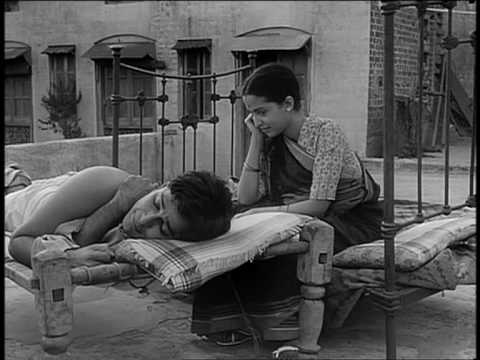
The Householder opens with a glorious long shot: an Old Delhi terrace, smoke rising from somewhere, the sound of the azaan emanating from the striped dome of the Ghata Masjid. Cut to a close-up of the two figures: Prem (Shashi Kapoor), asleep on a charpai, is gently woken by his pert-nosed young wife Indu (Leela Naidu). This is a world in which the prospect of attending a wedding in Mehrauli makes Indu sit up. “We will sit in a bus and go,” she says with childlike joy, before her brow furrows in contemplation of which of her two good saris she will wear. Prem is a lecturer at a small college, and much of the film — based on Ruth Prawer Jhabvala’s novel — revolves around his anxieties about making a living.
A still from The Householder
The dialogue dwells continually on money, the naming of sums echoing the way Prem must count every rupee. His monthly salary is ₹180, his rent ₹60 and repairing the ceiling fan will cost a princely ₹10. Eventually Prem gathers the courage to appeal for a raise, but he is shooed away by his principal’s shrewish wife. When he begs his landlord (Pinchoo Kapoor) to reduce his rent, the alcoholic Sehgal reads his petition, only to break into a bizarre drunken soliloquy. “The cost of living has gone up terribly. Sixty rupees for a bottle of whiskey!” And as poor baffled Prem looks on, Sehgal continues as if in a trance: “Sugar one rupee a seer, rice one for a seer, oranges three rupees a dozen, apples four rupees a pound...”
Tere Ghar ke Saamne talks money, too. And if Sehgal’s spending the whole of Prem’s rent on a bottle of Vat 69 seemed ironic, TGKS evokes a world even farther from the lowly lecturer’s. The film opens at a government auction for “Dehli ki behtereen locality ka behtareen plot”. Lala Jagannath (Om Prakash) outbids Seth Karamchand (Harindranath Chattopadhyay) on a highly valued front-wala plot. But the pugnacious Karamchand, not to be outdone, returns to bid the same amount on the lesser-valued back plot. As he announces to his appalled wife, “Shaan bhi koi cheez hoti hai (there is such a thing as grandeur).”
The level of irrationality is as high as the stakes. When Dev Anand (playing the foreign-returned architect Rakesh) asks about the adjoining plot, Nutan (playing Karamchand’s daughter Sulekha) wrinkles her nose in disgust. “Don’t talk about that.” “But why?” “Because it’s cheaper than ours. Theirs is two lakh, and ours two lakh one thousand!”
Yet Tere Ghar ke Saamne was one of 1963’s biggest hits, its effervescent comedy of manners and still memorable songs making it the year’s sixth highest grossing Hindi film. And The Householder, despite its affecting subject, flawless photography by Subrata Mitra (Satyajit Ray’s longtime collaborator) and a final cut apparently by Ray himself, never transcends its stilted characters and caricatured subplots. And it doesn’t help that everyone speaks in English, with no attention to inflections of class.
The Householder, even at its best, has a stodgy, one-note quality. TGKS seems to invite multiple readings. When Prem and Indu get off their bus amidst the ruins of Mehrauli, Prem remarks with pleasure on how quiet it is. But it is only an instant before his brain begins to count paisas again: “I’m sure rents are low (here). It would be economical for us.” Meanwhile, when Rakesh and Sulekha in Tere Ghar ke Saamne whiz past the same Mehrauli ruins in a car, they arrive in a village home. Rakesh offers to pay for the home-cooked meal, the old woman refuses. It’s a cue for him to applaud the non-money-mindedness of the poor as against the unprincipled avarice of the rich — before leaving money “for the oil that burns in the diya she lights for God”. The possibility of cloyingness is averted a minute later, when Sulekha rejects his proposal and a miffed Rakesh declares he will be waiting for the ₹5 he’s just spent on her roti — the money-mindedness of the rich has just been brilliantly, ever-so-lightly underlined.
The song-less film whose characters reminisce about watching Hindi films is the one that got reviewed in the New York Times. The mainstream hit was seen as mere fluff. But somehow the film about elite houseowners tells us more things about ourselves than the one about the sad householder.

31 July 2012

Fan Club Deptt: Waheeda’s elegance transcended Bombay cinema, now charms Delhi

From my Sunday Guardian column.

One correction before we begin," announced Mukul Kesavan to a packed house at the India Habitat Centre. "Waheedaji is not 'one of the best' actresses we've had in Hindi cinema — she is the best actress we've had."

The orange curtains of the Stein Auditorium had just gone up, and a visibly excited Kesavan — columnist, writer and a history professor at Jamia — was about to begin his conversation with the actress Waheeda Rehman. It was the inaugural evening of the seventh edition of the Habitat Film Festival, which included a retrospective of films of the 70-something Rehman who had already been described that evening (by a 70-something IHC director RMS Liberhan) as "the ultimate symbol of grace and beauty".

Rehman has always tended to evoke superlatives; she is clearly used to them. Whether it's the virtual certificate from Amitabh Bachchan, who has always said she's his favourite actress, or the usually sharp Kesavan, who gushed at the privilege of speaking to her ("Like most of you in the audience, this is something we would fight to do..."), she accepts the praise with her quiet grace — somehow neither embarrassed nor coy.

Perhaps some of the chief guest's innate tehzeeb has rubbed off on the Delhi audience that evening — there are no ushers or 'Reserved' signs, but an informal self-censorship of the anonymously civilised leaves the front row free for assorted dignitaries. By the time the crowd has settled in, the first seat on the right contains a bespectacled Sharmila Tagore, so unostentatiously dressed that the lady to my left feels the need to confirm with me who she is. When Liberhan insists on mentioning Tagore in his welcome address, I see the actress spread out her right hand in a helpless gesture. The auditorium breaks into applause.

It's that sort of evening. Kesavan, whose writing and public appearances are always in English, declares that with the permission of the audience, he is going to conduct this conversation "in Hindi" or "at least in a sort of khichdi". One of his first questions to Rehman is about language, too: she grew up in Madras, but the language spoken at home: was it Urdu? It was Urdu, she says. (It is fascinating how Kesavan refers to the language he is speaking as 'Hindi' and the language in which Rehman responds as 'Urdu'.)

Her fluency in what was still the language of Hindi cinema seems to have been crucial to Rehman's career. It was why Guru Dutt, stumbling upon a function in Hyderabad celebrating a Telugu film called Rojulu Maraayi, became interested in casting the lovely-looking girl who'd done a much-talked about folk dance number for it. The daughter of a district commissioner who had grown up in south India — and most unusually for a Muslim girl in the '50s , learnt Bharatanatyam — Rehman says she forgot about her meeting with Dutt until a few months later when she received a message saying that he had asked her to come to Bombay.

"Mere walid sahab ka intehkaal ho gaya thha," says Rehman, remembering both her own excitement and her mother's fears about sending her to a strange city. But she finally went, and Dutt told her she would star in CID, opposite the already iconic Dev Anand. The 17-year-old Rehman couldn't believe her luck. Fans of Bombay cinema have never got over theirs.

Right from those early years, Rehman alternated with great success between the tragic intensity of films like Pyaasa (1957), Kaagaz ke Phool (1959) and later Chaudhvin ka Chand (1961) and more lighthearted romantic ones opposite Dev Anand — CID (1956), Raj Khosla's Solva Saal (1958), which contains Hai apna dil toh awara, and Kala Bazar (1960) — or Sunil Dutt (Ek Phool Chaar Kaante, 1960). By 1965, Rehman had even starred in a Satyajit Ray film (Abhijaan, 1962). She was confident enough to take on the unconventional character of Rosie in Guide (1965) – a devadasi's daughter, a married woman who falls in love with a guide and sets out to fulfill her dreams as a dancer.

R.K. Narayan, whose celebrated novel Guide drew on, later wrote a hilariously scathing piece about how the filmmakers rejected all the real locations he showed them (which, as he points out, would have been free) in favour of expensive sets created in Rajasthan, and how the performances of his small-town "exponent of the strictly classical tradition of... Bharatanatyam" became "an extravaganza in delirious, fruity colours and costumes".

Watching Guide today, there is no getting away from its posturing and corniness and desire for spectacle. Dev Anand, as always, walks some line between ridiculous and devotion-worthy that only a Bombay star could have figured out, and Rehman's passionate dances are Hindi movie classics precisely because they are no Bharatanatyam pieces. And yet there is something true that emerges from all this. That something even Narayan recognised when he apparently said to Rehman, "I saw my Rosie in you."

We see her still.