Showing posts with label ghosts. Show all posts

28 February 2021

Good girls, bad ghosts and goddesses

My Mumbai Mirror column

Bulbbul reworks ideas from several Bengali film classics to craft a superhuman response to women's depressingly human troubles.


When Anvita Dutt's Bulbbul came out last July, several critics applauded producer Anushka Sharma and her brother Karnesh for their trilogy of films placing the ghost story in the service of feminist goals. The first of these, Anshai Lal's Phillauri (2017), featured Sharma as an early 20th century ghost who haunts the present in the hope of being recognised as the author of Punjabi poems that everyone thought were written by her male lover. The second, Prosit Roy's Pari (2018), with a plot featuring the impregnation of women by spirits called ifrits, and the murder of the resultant half-demonic children by vigilantes, was an allegorical response to the violence of rape and forced abortion. Both were interesting ideas, but neither was executed to any real degree of competence.

Bulbbul, set in late 19th century Bengal, might be the best realised of the three. The film is named for its protagonist, who is named for the chirpy, red-tufted bird (usually spelled bulbul, without the extra 'b'). It is no coincidence that Bulbbul is a child bride who metamorphoses from climbing trees to being the senior daughter-in-law of an oppressively grand zamindar family -- and then, in her magical afterlife, to climbing trees again.


Visually rich, almost to the point of excess, the film alternates between a glowing, blood-red enchanted forest (a bit foreign-looking, of which more later) and a gloomy, minimally styled zamindar mansion which Dutt chooses to keep underpopulated – no children, practically no servants.


While riding the global wave of 21st century Gothic popular culture, the film is dense with Indian literary and cinematic references which are ultimately also sociological. For instance, the theme of the Indian wife's relationship with a young brother-in-law, often easier to talk to than an older, forbiddingly grave husband, has been with us long enough to be enshrined in our jokes and popular culture; a common consequence of the patriarchal system of adult men marrying virginal girls. That intimate devar-bhabhi dynamic was perhaps most vividly captured in Tagore's 1901 novella Nashto Nir (The Broken Nest), possibly based on Tagore's own early life, which Satyajit Ray transposed onto the screen in Charulata. The Soumitra Chatterjee-Madhabi Mukherjee relationship in Charulata is echoed here by Bulbbul and her brother-in-law Satya, going from hide and seek to writerly collaboration. What the sister-in-law Binodini tells Bulbbul's husband Indranil bitchily is not untrue: Bulbbul and Satya have grown up together, and are close in a way that Bulbbul and Indranil can never be. Meanwhile Binodini herself -- married off to Indranil's halfwit brother Mahendra, but in a sexual arrangement with Indranil -- is eventually widowed, in another Tagorean reference: The duplicitous, unfulfilled widow Binodini of Chokher Bali.


But Bulbbul also reminded me, complicatedly, of another Ray film. Devi (1960), adapted from Prabhat Mukhopadhyaya's story The Goddess, also centres on a child bride who may or may not have acquired power over life and death. The 17-year-old Doyamoyee (played by Sharmila Tagore under Ray's magisterial direction), beloved of her twenty-something college-going husband (Soumitra), but also a favourite of her deeply religious father-in-law, suddenly finds herself anointed as an avatar of Goddess Durga, after the father-in-law sees her thus in a dream.


Bulbbul, set in the same Shakta Bengali milieu, where female energy is worshipped as Durga and Kali, draws on that association. Mahendra's murder on Durga Puja explicitly suggests that Bulbbul's first effective use of her shakti is tied to the mother goddess. The film's iconography, too, partially echoes the familiar Durga-Kali one: Long, open tresses and an enigmatic smile. “Not a churail, but a devi,” says Dr Sudip, and the film's dead men had all been abusive, thus flipping our perception of Bulbbul's power from possible evil to a form of violent justice.


Watching Devi again, though, I was struck by how deeply Ray investigates the power of belief, especially the young woman's own conflicted sense of self. Perhaps the most complex scene in this regard is the one where Doya refuses to run away when she has a chance, because she has half-begun to believe in the divinity thrust upon her. And yet, even in this belief, her primary response is fear – any power she has is not in her control. “Ebhaabe choley gele tomaar jyano omongol hoye? [What if leaving this way brings you bad luck?],” she asks her husband, terrified.


The husband understands and takes her back, raging later to his professor in Calcutta, that “she is only 17”. He is a sympathetic character, and yet – he is an adult married to a teenager who just happens to have come of age sexually. In one of Devi's most moving moments, Doya clings to her little nephew when he is placed in her lap after ages – she accepts the task of curing him as a young woman who misses a child, but she is judged as a goddess.


I recently re-watched Pedro Almodovar's 2006 masterpiece Volver, also about women, male sexual violence and the possibility of a female ghost returning to finish incomplete business on earth (‘Volver’ means 'return' in Spanish). But Volver's sensibility is very different from Devi or Bulbbul; some of its magnificent easy charm lies in the idea of a ghost who bakes, helps out who hairdressing and cares for the sick and aged – as women do. 


Earlier in Volver, the heroine is in the middle of hiding one horrible man's dead body when another man spies an incriminating spot of blood on her neck. “Oh, women's troubles,” she says, waving him away. As long as men are the prime cause of women's troubles, I thought to myself, there will be blood.


Published in Mumbai Mirror, 28 Feb 2021

Earlier in Volver, the heroine is in the middle of hiding on

Read more at:
https://mumbaimirror.indiatimes.com/opinion/columnists/trisha-gupta/good-girls-bad-ghosts-and-goddesses/articleshow/81251984.cms??utm_source=contentofinterest&utm_medium=text&utm_campaign=cppst

8 January 2020

The ghosts among us

My Mumbai Mirror column:

A new anthology film about the supernatural is a mixed bag, but it does try to point Hindi film horror in consciously critical directions.

A still from Dibakar Banerjee's segment in the new anthology film Ghost Stories.
After first coming together to pay homage to the cinema in Bombay Talkies (2013), and the self-explanatorily titled Lust Stories (2018), the once-unlikely foursome of Zoya Akhtar, Anurag Kashyap, Dibakar Banerjee and Karan Johar are back with a new anthology film: Ghost Stories.

The films vary widely, not just in setting and tone, but in quality. Anurag Kashyap's contribution, starring an awkwardly gangly sari-clad Sobhita Dhulipala as a woman who is both an expectant mother and a surrogate maternal figure to her little nephew, didn't work for me at all (spoilers ahead) despite the effectiveness of the scowling child. The possibility of an uncanny relationship between external visual depictions and real-life transformations – think everything from Oscar Wilde's The Picture of Dorian Gray to MR James 1904 classic ghost story 'The Mezzotint' – has always fascinated me, and it is of course also the basis of certain long-held ideas of magic, such as voodoo. So Kashyap's use of the child's drawing, his repeated scratching-out, and his apparently innate sense of his own power, was for me the most gripping part of the story. But the film stirs in all sorts of other elements – nightmares, superstitions, silent men, shouting mothers, half-human states, crows' eggs, and a whole room full of creepy dolls. If all these ingredients were meant to be a recipe for chills, the dilution leaves us baffled and lukewarm.

Zoya Akhtar's film wins big by casting the brilliant Surekha Sikri as a bedridden old lady attended on by a lackadaisical young replacement nurse (Jahnvi Kapoor). As always with Akhtar's films (including her segment about a maid and her master in Lust Stories), there is an attentiveness to space: the multiple empty rooms that the youthful Sameera dashes through with a token agarbatti, the echoing sound of children's laughter from the stairwell when she answers the doorbell to find no-one there. It's a talent particularly useful in crafting fear, if Akhtar were interested. But she isn't, not really.

What she seems keen on is a juxtaposition of youth and age, sharpness and shutdown– and things aren't as simple as they seem. Sameera's briskness as she cleans up Mrs. Malik is matched by her frequent distractedness. Mrs. Malik, meanwhile, drifts in and out of consciousness, but recites from Wordsworth's apposite 'Intimations of Immortality' with tinny perfection: “Turn wheresoe'er I may,/ By night or day./ The things which I have seen I now can see no more.” And knows more about the fruitlessness of waiting for someone than Sameera can.

Genre fiction and film – especially of the scary variety – has long been a vehicle for social commentary. The man-made monster at the centre of the still-popular Frankenstein – a book first published anonymously by a ridiculously young Mary Shelley in 1818 – is an early (and eerily prescient) warning against technological intervention in human life. Twentieth century horror, especially the zombie movie, has been powerfully shaped by George Romero's cult classic The Night of the Living Dead (1968), the first of his triad of 'Dead' films: Dawn of the Dead, set in a shopping mall, and Day of the Dead (1985). Romero onwards, the slow-moving, cannibalistic zombie – a creature whose bite turns the bitten person into a zombie herself -- has more often than not been a powerful metaphor for the horrific things that ail society: racial prejudice, consumerism, militarism, classism. That tradition continues down to Jordan Peele's Us (2019).

Karan Johar's film isn't scary, despite his newly-married heroine walking us endlessly through the candle-lit expanse of her husband's family mansion (going for a cross between K3G and Trikaal) in search of a ghostly grandmother. The only effective presence is that of the forbidding housekeeper Shanti, who guards Dadi's room in a manner clearly inspired by Mrs. Danvers' guarding of Rebecca's in the Du Maurier novel (and Hitchcock film). Johar has moments that invite critical examination: such as the friend who declares the family as “totally legit” based on “community mein izzat” and “thriving business”, forcing us to think about how such an aura of social legitimacy survives the violence pushed under the floorboards. (But you'd do better to watch Parasites.)

There is, happily, a zombie film in the quartet. It is Dibakar Banerjee's, and perhaps unsurprisingly, it is the sharpest of the four – politically, but also in filmmaking terms. Sukant Goel plays a bored, exhausted sarkari official who arrives in a remote village to report on a government school – to find a ravaged, half-burnt settlement where the only living humans appear to be two children. The zombies from the bigger village have eaten everyone from the smaller village, and will eat everyone except those who turn on their own kind. If you speak up, you attract the attention of the creatures. If you join the feasting, you will save your skin – but be blinded for life. Watch it -- and try not to be blind.

4 October 2019

The dream machine

My Mirror column:
In Buddhadev Dasgupta’s thought-provoking new film, a
 man obsessed with a plane starts talking to ghosts, making one think of another machine-loving madman in Ritwik Ghatak’s 1957 classic, Ajantrik


In Buddhadev Dasgupta's evocative new film Urojahaj (The Flight), a motor mechanic called Bachhu Mondol (Chandan Roy Sanyal) discovers an old plane abandoned in a forest near his village, and becomes obsessed with the idea of making it fly. He spends hours with the plane, repairing and repainting and dreaming. And most of all, talking to ghosts – the only other human beings to frequent the clearing where it lies hidden.


When it turns out to be a Japanese fighter plane that may have crashed there during the Second World War, one of the ghosts asks Bachhu, does he intend to go to war with the plane?

“I'm rebuilding this plane. I'm making it a new thing. It won’t remember killing people, or war,” says Bachhu immediately.

“Then what will it remember?” asks the she-ghost.

“The sky,” says Bachhu.

The mechanic’s idea of the plane as having a memory – and also being able to forget – is one of the gorgeously poetic ways in which the filmmaker conveys to us that at least for Bachhu, the machine is half-human. There are many other occasions in Urojahaj when the plane’s power over Bachhu is coded this way. “You’re dressing up the plane so much,” another ghost giggles. “Are you going to marry it?” Decrepit though it is, the machine has so completely captured Bachhu’s attention that even his wife starts to wonder if it is her soutan, the rival love of her husband’s life. Bachhu keeps assuring her of his love, but she is not convinced. “You don’t love me any more, else why would you go to the plane every night?” she asks him. And later, “What does the plane give you that I don’t?”

Urojahaj (2018) is Dasgupta's 17th feature film, the latest in a long and distinguished career that has established him as one of India’s internationally known auteurs, his films regularly screened and awarded at top-tier festivals like Venice and Cannes. Sadly, we live in a country in which films like Dasgupta’s barely make it to cinemas. But Urojahaj is a film well worth your time, and worth thinking about at many levels.

For one, the depth of Bachhu’s preoccupation with the plane instantly brings to mind another film about a man’s attachment to a machine directed by a Bengali filmmaker: Ritwik Ghatak's Ajantrik, made an astounding six decades ago. Released in 1957, Ajantrik was the second film made by Ghatak, maverick member of the trio of great Bengali auteurs along with Satyajit Ray and Mrinal Sen. Known in the West alternately as The Mechanical Man and The Pathetic Fallacy, the film starred the well-known Bengali actor Kali Banerjee as a taxi driver who treats his dilapidated Chevrolet jalopy more lovingly than a human companion. Banerjee’s Bimal names the car Jagaddal, and talks to it at opportune moments.

“Thirsty, Jagaddal? Yes, you're panting, wait,” he might say, pouring water into the radiator on a hot day. Or “Sorry, Jagaddal, you'll have to make do with patches for now. I’ll buy you a shiny new hood when I’ve saved some money, I promise.”

Friends and acquaintances snigger about Bimal's excessive attachment to the car – “Private matter? Is the car your lady?” – but he is unperturbed, even turning up in a starched white dhuti-panjabi the day he decides to get Jaggadal photographed. But having shown us Bimal dressed as a coy bridegroom, Ghatak joyfully juggles the car’s imagined gender and age. “Amar Jagaddal baagher bachcha (My Jagaddal is a tiger cub),” announces Bimal proudly in the very next scene. “They envy him, naturally. What young man wouldn’t envy an old man with such stamina?” Soon enough, we also see Jagaddal's number plate, which reads ‘BRO 117’.

In contrast to Urojahaj’s fairly even fable-like quality, Ajantrik alternates between physical comedy, meditative observation and a surprising emotional heft. There is early laughter when Jagaddal splutters and bubbles and honks in response to Bimal, making the film a precursor of such Hollywood creations as Herbie, the Volkswagen Beetle of The Love Bug (1968). But for the lonely Bimal, Jagaddal is his most constant companion, about whom he is quite openly sentimental. “He earns me two rupees a day, no matter what. He’s been with me since my mother died,” he tells the little boy who works in the garage.

On another level, Bimal’s trips with Jagaddal are a way for us to travel through rural Chhotanagpur, a 1950s landscape in which female faces are disproportionately limited to line-drawn advertisements for Baidyanath and Dabur Amla Kesh Tel. It is no wonder that a bejewelled Bengali bride who boards the taxi draws Bimal’s attention. He does not chastise her even when she switches from a romantic, almost aesthetic appreciation of the ruin – how lovely the sky looks through a hole in Jagaddal’s canopy – to a pragmatic, modernist disdain for it: “What a rotten car!”

Ghatak may seem merely to be gesturing to what Urojahaj makes explicit: that a man’s attentions cannot be successfully divided between a machine and a woman. But perhaps there is much more there.

(To be continued next week)

Published in Mumbai Mirror, 8 Sep 2019.

8 September 2018

A sympathetic spirit

My Mirror column:

Do the men haunted by a female ghost learn any lessons in Amar Kaushik’s affable small-town comedy?


One, don’t leave the house alone, especially after dark. Two, if you absolutely must go somewhere, find a group to go with: there might be some safety in numbers. Three, if you encounter an attractive personage of the opposite sex, assume the worst. The more charm the person displays, the more dulcet the tones in which they approach you, the more determined you must be to avoid their advances. Grit your teeth and keep walking — for if you so much as turn around and look at them, your very life is on the line.

These instructions, given to young men in the fictionalised town of Chanderi in the new horror comedy Stree, will seem powerfully familiar to young women in real towns across India. Only here, it is men who must lock themselves into their houses, bidding their wives goodbye as they leave for the sandhya aarti at the temple ghat with a plaintive, “Come back home early, I feel scared.” Director Amar Kaushik and scriptwriters Raj Nidimoru and Krishna DK seem to thoroughly enjoy the role reversal. And so, I’ll wager, will most women — even though these instructions are only applicable for four days in the year, during the annual puja, when the town is said to be visited by a female spirit who preys exclusively on men.


The female ghost (or she-demon) who lures men in with her seductive charm only to reveal her true horrific form later, is a ubiquitous figure in sex-segregated societies that are also profoundly patriarchal. The cupboard of Indian folk belief is crammed unsurprisingly full of monstrous female creatures with highly specific attributes: the chudail, the rakshasi, the petni, the shakhchunni, the pishachini, the yakshi, to name just a few. At least some of the sharpness of Stree is that it takes this premise, so familiar to us as to be completely unremarkable, and turns it — partially — on its head.

The film is based on a clever but simple idea, and its viewing pleasures are simple, too. The first of them is that the particular ghost of Amar Kaushik’s film bears the generic name ‘Stree’: The Woman. This stroke of genius enables some of the best lines in the film, because all references to the scary lady in question can also be heard as statements about women in general. So that Pankaj Tripathi — in top form as Rudra Bhaiya, the town’s bookish authority on all things — has plenty of occasion to advise his quaking townsmen on “Asli stree se bachne ke asal upaay (Real ways to escape the real woman)”. No man, Rudra Bhaiya tells our ‘unspoilt’ bachelor heroes in one hilarious scene, can resist the voice of The Woman — by which he also implies any woman — calling out his name more than twice in a row, in a “swapnasundari” sort of voice. “‘Lag ja gale ki phir yeh haseen raat ho na ho’ waala bhaav aayega,” he warns them, in a nice little in-joke about the 1967 ghostly mystery film Woh Kaun Thi in which that song is sung.


But while never denying this world’s predictable gendered norms (“Suhaag raat ke baad hi fight shuru hoti hai”), Stree tries to stretch its audience in directions empathetic to women. One of these involves the ghost’s reasons for ghosting: she was a tawaif robbed of her one chance at love, on her suhaag raat.


There is something quite charming about the fact that the film’s hero Vicky (played with his usual flair by the brilliant Rajkummar Rao) is a tailor. He may believe that he hasn’t been put on earth to loosen blouses and shorten petticoats, but he has magic in his hands — his father, watching him at the sewing machine, sees in him nothing less than the perfection of Shiv Bhagwan. But it is significant, too, that Vicky is a ladies’ tailor — and a self-proclaimed ‘modern’ one. In the one scene in which we see Vicky interact with an older woman customer, he encourages her, with just the right touch of flirtatious appreciation, to get a slightly deeper neck for her sari blouse. (We have had another tailor-as-sensitive-hero for the modern Indian woman in the recent Hindi film past: Irffan Khan’s character in the Delhi-set Hindi Medium, who managed to marry ‘up’ into the somewhat English-speaking classes by virtue of his open-mindedness about women’s clothes — and thus, bodies and minds.)


Unlike its ghostly star attraction, however, this is not a film interested in floating several inches above the ground —it wants to remain rooted in its milieu. It is keen to suggest that the vrats and pujas on one hand, and all manner of black magic on the other, can happily co-exist in the same world with ‘azaad’ women — and azaad views about women. They may still be suspicious of the girls that rupture their bromances, and puzzle over whether “friendship” is code for sex — but in Amar Kaushik’s affectionately hopeful vision, the boys of Chanderi are on their way to a brave new world — and not just by means of the Ludo apps on their mobile phones.

30 May 2016

Inside, Outside

My Mirror column on Phobia:

Pawan Kripalani's smart new horror movie goes the psychological route, but stops a bit short of its political possibilities.


Pawan Kripalani's new film, Phobia, casts the talented Radhika Apte as a young woman who develops a psychological condition called agoraphobia, finding it harder and harder to leave the confines of her home. 

When we first meet Apte's character, an artist called Mehak, she is the centre of attention. A show of her art work has just opened at a gallery, and she is surrounded by friends and acquaintances, chatting and telling ghost stories and generally being the cynosure of all eyes. Within the blink of an eye, though, the mood has changed. Mehak looks into the distance, thinks she sees something strange, then realizes what she 'saw' is no longer there. She is disoriented enough to leave her own opening night abruptly. But worse is to come. 

After having dropped off her friend and admirer Shaan (Satyajit Mishra), she dozes off in the cab, and (in a clear reference to the Uber rape case of December 2014), comes to only to find the taxi driver in the back seat, trying to force himself on her. The film does not dwell on the incident, except to make clear that this attempted rape forms the trigger for Mehak's ailment: her increasingly irrational fear of the outside world. 

A female character's descent into madness has been the subject of a lot of powerful films, from Gaslight to Repulsion to Black Swan, to John Cassavetes' astounding A Woman Under the Influence and Todd Haynes' disturbing Safe. Like several of these films, Phobia suggests that its protagonist's affliction has something of a sexual undertow. But for some reason, Kripalani doesn't put this aspect of things in the spotlight. 

What we get instead is a true-blue scary movie, which has the tropes of a traditional horror flick -- spooky spiders, eerily silent cats, bathtubs and broken mirrors, lamps that crackle and drains that make strange sounds. Phobia is an effective piece of apartment horror. 

Mehak's growing irrational behaviour starts to create problems for her family, and she temporarily shifts out of the house she shares with her sister and little nephew into a Malad apartment owned by Shaan's friend. The place is furnished but empty, since the tenant, a girl called Jiah, has seemingly skipped town, leaving all her belongings behind. In classic horror movie fashion, Mehak starts to see and hear things in the flat, while reading Jiah's (conveniently detailed) diary and gradually becoming convinced that Jiah is dead and her unhappy spirit is wandering around. The agoraphobia now becomes merely a plot device to keep Mehak indoors. 

Having started off in an art gallery, Phobia then shifts to the interior of a moving taxi, followed by an open road, and finally the interiors of two successive houses, from which Mehak's (and the film's) only forays into the outside are virtual. 'Agora' is the Greek term for marketplace, and agoraphobia means 'fear of public spaces'. 

But it was fascinating to me that the 'virtual therapy' device through which a therapist twice tries to get a panic-stricken Mehak to 'pretend-travel' beyond the four walls of her house takes her, both times, into a virtual mall—as if shopping is necessarily therapeutic for women. Of course, the mall is also an increasingly popular setting for horror films (Kripalani's own previous outing was called Darr at the Mall). The director--whose first film was Ragini MMS — also expertly uses CCTV footage to add to the ever-present question: did it happen or did she imagine it? 

Phobia does many interesting things, and does most of them well. The camerawork and editing keep you on your toes, and the actors -- not just Apte, but also Satyadeep Mishra and Yashaswini Dayama as Mehak's cheeky young neighbour Nikki -- are very good. But as I started looking up agoraphobia, I began to wonder why a film that had decided to take this as its premise didn't do more with it. Because it turns out, the ailment affects many more women than men. 

In the United States, 90% of those with severe agoraphobia are women, and 70% of those with mild symptoms are women, too. Women agoraphobes are twice as likely to experience general anxiety, and three times as likely to have panic attacks. The figures are similar for other countries. Feminist approaches to agoraphobia suggest that the disease needs to be seen in a social context: the fact that women are socialised to think of public spaces as threatening, and often learn to police their own behaviour in public, placing restrictions on their own mobility out of a fear of men. 

The converse of a fear of the outdoors is, of course, a greater attachment to and identification with the home than displayed by most men. The scholars Gelfond (1991) and Fodor (1992) have argued that it might be worthwhile to look at agoraphobic women as representing one end of a continuum -- i.e., as sharing many forms of behaviour with large sections of the adult female population. In being unable to claim her rightful place in public space, Seidenberg and De Crow (1983) have suggested, the agoraphobic woman is a "living and acting metaphor, making a statement, registering a protest, effecting a sit-in strike". 

Phobia could certainly have been a more chilling indictment.

Published in Mumbai Mirror, 29 May 2016

27 March 2016

When the Spirit Moves You

My Mumbai Mirror column today:

Fifty years after Bimal Roy's death, his gorgeously-filmed Madhumati still haunts Hindi cinema.


Simultaneously derided and applauded as Bimal Roy's most commercially successful film, Madhumati (1958) has a plot that combines two of Hindi cinema's most abidingly popular narratives. The first of these is the educated city-dwelling babu falling in love with a simple village girl (an early example of that storyline was Raj Kapoor's 1949 hit Barsaat, written by Ramanand Sagar). The second is reincarnation: a plot theme which Madhumati is said to have inaugurated in Hindi cinema - though Kamal Amrohi's Mahal, which released the same year as Barsaat, also had the hero arriving in an old house for the first time and coming to believe that he is the reincarnation of someone who had once been associated with the place in a previous life. 

Bimal Roy certainly took some inspiration from Mahal, but Madhumati - based on a script written by, of all people, Ritwik Ghatak - is much more comfortable with the reincarnation theme than Mahal was, not shying away from it in favour of scientific explanations. The ghost here really exists. 

Roy shoots the house with painterly ghostliness -- the doors that seem to swing open by themselves, the slowly swaying chandelier, the shadow of the old chowkidar's stooping frame as he climbs the stairs is grotesquely enlarged. 

Paintings - present and absent - are in fact a crucial element of Madhumati's realisation of the unseen. The first thing that Dilip Kumar says on entering the empty haveli is "Wasn't there a painting hanging on the wall here?" Later, like with Ashok Kumar in Mahal, it is a painting that helps brings the past back to him. Unlike in Mahal, though, the painting is not of our hero, but by him. I'll come back later to why this seems of some consequence. 

Ghatak's script echoes what I once described (in a 2011 essay called 'Tagore for Beginners') as a classic Tagore narrative, and what might be a classic Bengali one: the urban young man who arrives at a small provincial outpost, his head full of a modernity that seems to cut him off from his surroundings. In Tapan Sinha's 1960 film version of one of Tagore's most famous ghost stories, Khudito Pashan (The Hunger of Stones), for instance, Soumitra Chatterjee plays a young revenue collector in a remote area who is ostensibly too rational to listen to the locals, and ends up being haunted by a beautiful phantom. 

A man becoming besotted with a spirit is perhaps one of the oldest ghost story tropes, extending across the world to Japan—I'm thinking of one of my favourite supernatural films, Kenji Mizoguchi's marvellous The Tale of Ugetsu

But Madhumati is not set in a timeless past. Between Ghatak and Roy, it is not surprising that the script features quite a specific politico-historical structure: a tribal hill milieu in which we're told that a rebellion against the feudal-capitalist landlords has been crushed brutally in the past. The decadent, exploitative zamindar at the top of the social hierarchy is challenged by the educated young Nehruvian socialist hero. The young hero works for the zamindar's timber company and thus represents the same extractive interests, but his relationship to the locals is one of attempted egalitarianism. 

In Madhumati this relationship between the new, modernising world and the old one is not one of proselytisation. Instead it's in what I'm going to call the 'Discovery of India' mode: conjuring up an urban, rational viewer only to let the hero experience the inescapable sweep of the land that surrounds him: through its natural beauty, its music and dance, its beliefs. 

The Dilip Kumar we meet first is a typical shehri babu: hurrying his hapless chauffeur along the rain-lashed mountain road, acting irritable when a landslide blocks the path, and only very reluctantly walking up to the old haveli to take shelter. But once inside, this city-slicker who was least interested in anything except reaching his destination, finds himself gripped by the old house. The house seems to pause time, and allow us to enter another time. 

The Dilip Kumar of that previous time is a much more open, curious sort. He arrives in the same hills walking, not being driven. As he pauses to take in the sights and sounds, so do we. Painting emerges as his way of documenting this world: he draws the trees and plants and hills, but also the merry-go-round at the local mela. Finally he requests a sitting with local belle -- and it is while painting her that love happens. 

The painting reappears in the narrative after Madhu has disappeared: the image is now a ghostly surrogate for the missing girl, even seeming to come alive with jealous rage when her lover is distracted from the thought of her. It is also a form of evidence on whose basis Dilip Kumar persuades a real-life double of Vyjayanthimala -- a modern young woman called Madhavi who is coincidentally holidaying in the region - to enact the part of Madhu, prompting the murderer (a superbly effective Pran) to confess. (That particular part of the plot was used without credit in Farah Khan's Om Shanti Om, leading to Bimal Roy's daughter Rinki Bhattacharya filing a complaint). 

Unlike, say, Hitchcock's Vertigo, where the hero's obsession with a face is such that he manages to fall 'in love' with a different person bearing the same features, Madhumati suggests a more binding union of souls. The sophisticated "Miss Madhavi" may reproduce Madhu's seductive 'Bichhua' in a proscenium performance of "Santhal dance" for "poor schoolchildren", but she cannot embody the untainted folk spirit.


Published in Mumbai Mirror, 27 Mar 2016.

1 June 2014

Haunted by Homelessness


When it comes to city housing, Hindi films have often painted a bleak picture, and CityLights is as dark as they come. But now even our fantasies only promise homes for the rich.

Hansal Mehta's CityLights returns us to what used to be a persistent theme of Bombay cinema: the search for a home in the city. An authorised adaptation of last year's British-Filipino film Metro ManilaCityLights brings its protagonists - Deepak (Rajkummar Rao), his wife Rakhi (Patralekha) and their daughter Mahi - from a Rajasthan village to big, bad Mumbai. (In what is one of the first signs of the hoariness of the plot, Deepak is escaping the clutches of a moneylender.) Within hours of arrival in the metropolis, they have been tricked out of their savings by the promise of a home. 

The enormity of that first betrayal is depicted in an early scene that is bleak, and powerful. Rakhi has already started cleaning the empty flat as her own when the construction workers return. There is an unspoken, brutal marshalling of class here: seeing a woman squatting on the floor with a jhadoo, the city workers assume she is a hired cleaning woman. Because of course no-one who looks like a bai can possibly be at home in this relatively comfortable space. Bai, tum ghar jao, they say to the baffled Rakhi, who continues to sweep at first. Then, as realization dawns on her (and them), she roots herself to the floor. It is a harrowing moment of cinema: the frail young woman clinging literally and metaphorically to the ground beneath her feet, as the men try their best to drag her out of the flat.


Rakhi is removed, of course, and when we next see the family, it has floated into that vast amorphous population of the urban homeless. They move from pavement to pavement for a few days, until a bar dancer helps arrange temporary shelter in a half-constructed multi-storeyed building. "When this flat is ready, it'll go for three crores!" declares the tout with that strange pride in something he will never own. Then he pockets a hundred rupees a night to let the family sleep on the bare floor, amid the exposed bricks and beams and dangerous open parapets.


The shadowy spaces of the half-constructed building are a favourite locale for Bombay cinema: most often as the site of action sequences, or a villain's den. CityLights is perhaps the first film to use the space as ironic shelter for the homeless, the city view spread out below less grandly picturesque than cruelly anonymous.


Watching CityLights reminded me of Gharonda (The Nest, 1977), about another young couple's ill-fated striving for a home. Though of course that unusual Gulzar screenplay -- directed by Bhimsain -- was about middle class office-goers: people who did not have ready cash, but could conceivably save up for it. And Gharonda's protagonists do try, working overtime at odd jobs. Sudeep (Amol Palekar) puts up film posters at night, Chhaya (Zarina Wahab) takes on a modelling assignment. But the Rs. 5000 down payment they need to book an LIG flat -- via a munshi known to Sudeep's roommate - is too large to generate so quickly. Sudeep's monthly salary is only 600. So they borrow money to pay the munshi, and in the lovely song 'Do Deewane Sheher Mein', fill the half-done building with their dreams of domestic bliss.


But a house in Bombay is no place for dreaming. It is a matter of life and death. The munshi disappears with the money; Sudeep's roommate commits suicide; Sudeep himself, broken by the turn of events, turns bitter and desperate. And as in CityLights nearly four decades later, acts of desperation only drag you further into the quagmire. Sudeep ends Gharonda as a ghost of his former self - walking away into the horizon, dwarfed by the tall buildings of Bombay.


Amol Palekar as Sudeep in Gharonda
Abandoned buildings were also the scene of a very different sort of film about homelessness and injustice, earlier this summer. All across Mumbai, according to the Amitabh-Bachchan-starrer Bhootnath Returns, are apartment buildings on whom work has stopped because they are haunted. They are haunted by the ghosts of those whose lives were lost in their construction - from engineers who fell to their deaths to displaced jhuggi dwellers. The good ghost Bhootnath (Bachchan) combines forces with a little boy from Dharavi (Partho) to get these hapless souls justice, so that they go peacefully into the next world and our ghostbusters can get paid by the building mafia.

Once upon a time, mainstream Bombay cinema sold a dream - the dream of the poor boy who would grow up to be Amitabh Bachchan, and buy the building for which his mother had once broken stones as a labourer. Sometimes that dream was a mass one, as in the marvellous scene in Coolie when Bachchan smashes the villain's chandelier as he says, to give every coolie's house a light like that one. The middle class film in the same period - even a film as sensitive as Gharonda - simply did not encompass the labouring classes in its imagination. The one time that manual labourers appear in Gharonda, they pause their work obligingly to turn into a gigglingly indulgent audience for the middle class couple's song of home ownership. (It is another matter that the song's desires remain unfulfilled).


In 2014, Bollywood has offered us two visions. On the one hand, the darkly cynical denouement of CityLights, in which we learn that there is no such thing as a free gift - or a free home. On the other, a feel-good tale in which Bachchan -- now a ghost of his former self -- gives corrupt officials lessons in citizenry. But to what end? So that the work of building houses for the rich can continue. For the rest, a home in the city is no longer even held out as fantasy.

Published in Mumbai Mirror.

30 December 2013

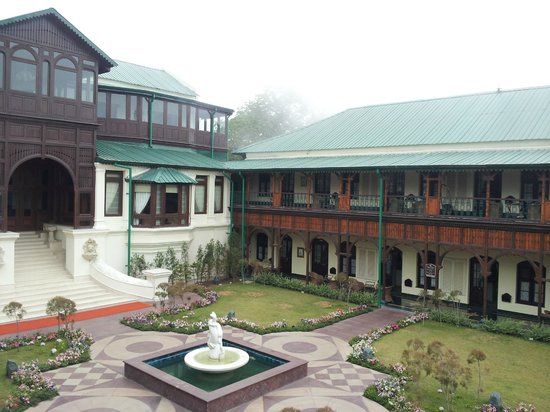
Spirit of Place: a grand old hotel rises from the ashes

The refurbished Hotel Savoy offers an atmospheric window into Mussoorie. My article for Outlook Traveller magazine.

The Savoy at night. Photo: Puneet Paliwal.

I had been to Mussoorie twice before. But this time, instead of coming to an end at Library Chowk, the Mall seemed to lead further up the hill, into the mist. A steep driveway curved into the massive grounds of what could well have been a castle. The taxi driver looked a bit sceptical when Puneet, the photographer, and I said this was indeed our hotel. One couldn’t really blame him. With the Savoy’s fairy-tale turrets as backdrop, we looked even scruffier than we were.

It remained a slight concern throughout the trip, this business of living up to the Savoy. Even freshly bathed (under a superbly luxurious shower), I never quite felt I could match up to what these corridors have been used to. After all, this isn’t just any old hotel. From 1902, when a Lucknow-based barrister called Cecil D. Lincoln decided to pull down the old Mussoorie School and build a massive English Gothic structure in its place, the Savoy has been the hotel of choice for a succession of Indian and international grandees. The Princess of Wales, later Queen Mary, attended a garden party in the Savoy grounds in 1906. Later, the hotel played host to several other royals: Haile Selassie, emperor of Ethiopia and Prince Norodom Sihanouk of Cambodia. The Gaekwads of Baroda and the Wodeyars of Mysore were known to take over entire blocks for the summer (the Gaekwad ladies were ardent tennis players, apparently, and would insist on the block adjoining the courts).

The grande dame of Urdu writing, Qurratulain Hyder, spent a lot of her childhood in Mussoorie, seeing the British hill station through what was probably its biggest historical transition—Indian independence. “Throughout the day English sahibs, memsahibs, and their baba log cross the bridge on mules and horses or riding in rickshaws and dandis. In the evening, the same bridge becomes the site of milling crowds of Indians,” begins Hyder’s story ‘Beyond the Fog’. Of course, the Savoy remained preserved from any milling crowds until much later. Its Indian guests were either maharajas and maharanis, or taluqdars, or Anglophiles of the Nehru-Gandhi variety. Like his father Motilal, Jawaharlal Nehru stayed here, as did Indira Gandhi and, later, Rajiv Gandhi.

And yet, the Savoy isn’t quite the daunting place you think it might be. That might have much to do with Mussoorie itself. Unlike a Shimla, where the official presence of colonial government meant that Appearances had to be Maintained, Mussoorie-Landour was always an unstuffy place. Reputed as a place for romantic assignations, Mussoorie was all about being British without the stiff upper lip. And the Savoy was at the centre of the party. Travel writer Lowell Thomas, in 
India: Land of the Black Pagoda (1930), described the Savoy’s (in)famous Separation Bell: “There is a hotel in Mussoorie where they ring a bell just before dawn so that the pious may say their prayers and the impious get back to their own beds.” As Hyder’s short story has it: “In the ballroom of the Savoy the Anglo-Indian crooner and his band will soon start ‘Enjoy yourself, it’s later than you think.’”


Senior journalist Saeed Naqvi recently reminisced about having gone to Mussoorie as a schoolboy, in a gang of four that included Vinod Mehta. The young men from Lucknow saved up money to stay in a cheap hotel so that they could wear their ill-fitting suits and “peep into the grandest dining hall in the Empire.” But the Savoy’s glory days ended at least thirty years ago. Looking at the sheer scale of the property, it is easy to imagine how a place like this could have gone to seed. In fact, one doesn’t need to imagine it. One can see it.

On our second morning, Puneet and I took our post-breakfast coffee out into an open area adjoining the Grand Dining Room (it is now officially called that, while the hotel is officially called ‘Fortune The Savoy’). We’d spent a few minutes pleasurably looking out over the small-town business of Mussoorie far down below when we both realised that to our left was a wall, and behind that wall was a half broken-down building—with a turret exactly like the ones above us. “There’s another wing!” said Puneet. 

After lunch, a member of the invariably friendly Savoy staff took us round to the unrestored wing. Piles of old furniture lie around: a lovely large dresser, a nice little table (missing a leg), several broken chairs, even an old post box. The buildings are in absolute disrepair, seemingly without electricity. It was day, but as we climbed up the creaky wooden stairs, we could barely see where our feet were going. It felt a little like a re-run of R.L. Stevenson’s famous scene in Kidnapped: the next step, I was sure, was going to be into thin air. Thankfully, that didn’t happen. Stepping out into a kind of gallery, we found we were above the old ballroom. One of the oldest photographs of the Savoy still in circulation is of an after-party image of this very same room filled with people in masquerade, the women’s ‘fancy dress’ costumes for New Year’s Eve unable to quite disguise their 20s flapper aesthetic. The grand old wooden floor still exists, but apart from that there is little sign of the room’s original avatar. A mammoth Santa Claus sprawls lopsidedly over one wall, from a children’s Christmas party before the property last changed hands. A badminton net is strung across the centre of the room: the staff currently use it to entertain themselves on a free afternoon.

Standing in the overhanging gallery, I first ask about the Savoy ghosts. Like Mussoorie itself, the hotel has long had a reputation for haunters. The most famous of these is Lady Frances Garnett-Orme, a 49-year-old spiritualist who was found dead in her room at the Savoy in 1910. The cause of death was poisoning, but the poisoner was never caught. But the technique—adding bromides to the lady’s own bottle of medicine to cause the strychnine already in it to sink to the bottom, where it was consumed by the victim herself in one single lethal dose—was so convolutedly foolproof that Rudyard Kipling apparently wrote to Arthur Conan Doyle, suggesting that he incorporate it in a story. He didn’t, but Agatha Christie did. In The Mysterious Affair at Styles, Christie had her English country-house murder of one Lady Inglethorpe achieved by the same method, to be solved by Hercule Poirot in his first-ever fictional appearance.

Lady Garnett-Orme, according to media sources as varied as Aaj Tak and NatGeo Traveller, still wanders the corridors, sometimes offering a blank stare, and sometimes singing softly. The Savoy staffer I asked said he hadn’t seen her. But he had once spied a couple of ghostly children. On the other hand, none of the spooks had made an appearance of late, he said, and anyway the management had forbidden all talk of ghosts. “There are no spirits,” was the hotel’s official policy.

Later, wandering through the premises, abutting the main wing, I found what looked like a little Sufi shrine, complete with a green silk chadar. “Who is buried here? Is it a saint?” I asked a passing kitchen helper. “No, no, it’s for Sai Baba. And he’s not buried here. This is to stave off the spirits.”

                                                                          ***

Photo: Puneet Paliwal
Much of Mussoorie’s early British spirit is to be found in its graveyards. Landour, where most of these “villages of silence” are, is less than half an hour up from Mussoorie: but the trees feel mossier, the mist thicker. The cemetery on Camel’s Back Road is locked and deserted, and the other cemetery on Landour’s Upper Mall is guarded by a chowkidar and his host of dogs. But the Savoy’s Siddharth Nautiyal, who has driven us there, grew up in Mussoorie and has a friend on literally every street corner. The chowkidar is slowly but surely wooed; he even lets in Puneet and his camera. By the time we return after seeing the graves of the Alters—Tom and Stephen Alter’s father and uncle—Siddharth and the chowkidar have found a village connection. Next up is the Mussoorie Library, where again we only manage entry because of a special request made to Mussoorie chronicler Ganesh Saili. The library is a massive, many-roomed structure that occupies pride of place at the Gandhi Bazaar end of the Mall, off-limits to everyone except its seventy members, and there’s a Mussoorie residence requirement for membership ever since an “Angrez” flew out with some ten precious books. The deep red doors lead into a musty high-ceilinged space, where the old glass-fronted bookshelves reveal carefully arranged collections of history and literature dominated by titles from at least fifty years ago: Nelson’s History of the War (in 25 volumes), The Rise of Rail Power in War and Conquest 1833-1914 by E.A. Pratt. The Nobel laureate Pearl S. Buck, who once stayed at the Savoy and is listed on a plaque at the hotel’s wood-panelled Writers’ Bar, is represented by her China books, of course—but also by East Wind: West Wind, which appears to be a royal Rajasthani romance.

We returned to the hotel, exhausted. After choosing Col. Skinner’s Fish and Chips (over the Bycullah Club Koftah Curry) in the admirably restored Grand Dining Room, I retired for a nap in my rather stately Suite, all blue and white and gold. When I woke up, it was around a quarter to five, and the Mussoorie mist had come calling. Wispy fingers of cottonwool had wrapped themselves round the green turrets, and were slowly descending to stretch across my balcony, forming themselves into a woolly white canopy. In the paved courtyard below, the fountain began to play. As I watched, the misty twilight dissolved into slate-gray night. Down in the Beer Garden, still slushy from the rain, two ancient mossy deodars stood mute witness to the proceedings, as they have done for the last hundred years or more. The spirit of the Svoy does live on. Enjoy yourself, it’s later than you think.


***
                                                                             

The information

Getting there
Mussoorie is around 32km from Dehradun Railway Station and 55km from Jolly Grant Airport. The best overnight train is the New Delhi-Dehradun AC Express, which leaves New Delhi at midnight and reaches Dehradun at 5.40am the next day. The Dehradun Shatabdi is another option.

The Savoy
The Savoy (+91-135-2637000, is located at the Library end of the Mall Road. It has 50 rooms available in three categories: Savoy Chambers, Fortune Exclusive Rooms and Fortune Suites. All rooms open out onto the large front balcony, but the small individual wooden sit-outs at the back have better views. Weekday packages range from Rs 8,499 to Rs 14,999 per night (plus taxes). Weekend packages range from Rs 10,499 to Rs 16,4999 per night (plus taxes). Breakfast is complimentary. The Savoy Christmas package (2 nights, 3 days) starts at Rs 26,555. The New Year’s Eve package (2 nights, 3 days) starts at Rs 41,999.

What to see & do
The walk from Library Bazaar up to the Savoy is short but steep, and goes past the Savoy Post Office—this is probably the only hotel in the world to have its own post office. Mussoorie is very much a walking town. You can amble down the Mall, eating momos, buying woollen socks at streetside stalls and stopping off at the Aquarium. You can also take a long and pleasant walk down the Camel’s Back Road: look out for the point from which you can see the rock shaped like a camel’s hump that gives the road its name.

Mussoorie’s two other old colonial hotels still exist, but barely: the Hakman’s Grand Hotel on the Mall has gone to seed, while the Charleville Hotel in Happy Valley has become the Lal Bahadur Shastri National Academy, where Indian civil servants are trained. In Landour, inspect St Paul’s Church, where Jim Corbett’s parents were married, and the cemeteries. Look out for the houses of Landour’s famous residents: the writer Ruskin Bond, the actor Victor Banerjee, Tom Alter and Vishal Bhardwaj. It is traditional to buy jam from Prakash Brothers at Sisters Bazaar, and stop for waffles at Char Dukaan. For great Tibetan food in cheery surroundings, try Doma’s Inn (Ivy Cottage Landour Cantt, 0135-2634873). For a posher (very good) meal, stop by the restored Rokeby Manor hotel.