An essay I wrote for the Indian Quarterly:
How Indian filmmakers depict servants is a comment on their masters.
In a 1939 essay, George Orwell accused Charles Dickens in particular and English fiction in general of not representing the working classes, except “as objects of pity or as comic relief”. In what may now be read as a rather limiting leftwing critical move, Orwell’s dissatisfaction with Dickens was that his novels had too few autonomous working-class characters and too many servants.
This may well have been the case. But, as the literary historian Bruce Robbins suggests in The Servant’s Hand: English Fiction from Below, what the novel does by focusing on domestic servants rather than independent proletarians is to “[cast] its lot with rhetoric rather than with realism”. Taking the rhetorical seriously “makes room in political discourse for ‘unrealistic’ visions or fictions of shared social fate”. The servant as a literary figure, Robbins argues, exists not to provide a sense of the lived experience of domestic service, but to proffer verbal entertainment, act as [comic] instruments in complicating or resolving the action, and be a foil to or parody of the master or mistress who remains the protagonist.
Popular Indian cinema may seem a long way away from 19th-century English fiction. And the greatest part of that distance lies in the fact that we, the viewers and creators of these Indian fictions, still live in a world populated by real-life servants. Yet a discussion of the figure of the servant in Indian films would benefit from Robbins’ analytic. It is easy enough to criticise our popular cinema for its non-authentic depictions of working-class characters in general and servants in particular, and several commentators have done so over the years (I think here of a particularly grim 1987 Manushi essay by Madhu Kishwar and Ruth Vanita called “The Labouring Woman in Hindi Films”). But if when reading the novels of say, PG Wodehouse, we do not subject the relationship between masters and servants to a literal sort of sociological or political scrutiny, why do we feel the need to do so when watching the films of Tapan Sinha or V Shantaram or Gulzar? And instead of training our guns on the absences, what would happen if we looked carefully at the way servants do appear in our films? If the servant of popular Hindi cinema is a type, what purpose does that type serve for its viewers?
The most frequently seen servant in popular Indian cinema is perhaps the old family retainer: usually an ageing man who has brought up the youthful hero. The servant provides his young master with freshly cooked food and an orderly home, taking care of him as a woman would. And yet the servant’s masculinity allows him access to spaces that a genteel wife or mother would not have. Think of one sort of classic Indian hero, the melancholic drunk destroyed by gham-e-dil, exemplified by the figure of Devdas, who first appeared in Sarat Chandra Chattopadhyay’s 1917 novel and then in numerous film versions in different Indian languages, until 2013. In Bimal Roy’s 1955 film, when the family wishes to fetch Dilip Kumar’s Devdas back from Chandramukhi’s kotha, it deploys the servant Dharamdas (Nasir Hussain). A stern Dharamdas marshals the full force of his adopted family’s respectable status against the apologetic Chandramukhi. But it takes Devdas’s mere appearance at the top of the stairs to melt Dharamdas into a puddle of emotion: now it is Devdas who produces angry masculinity and Dharamdas who pleads with him to come home—like a woman.

Dilip Kumar and Nasir Hussain in Devdas, 1955 | Credit: Shemaroo Youtube Channel
Of course, it is only a woman of the same class as the hero who can actually exert any authority over him. She is often thus distinguished from the devoted manservant of so many films in which the Devdasian hero is intransigent and solitary—think of old Gopi Kaka in Hrishikesh Mukherjee’s Mili (1975), who must suffer the alcoholic tantrums of a depressed Shekhar (Amitabh Bachchan). Here the turning point in the relationship between Mili and Shekhar is when—unlike the long-suffering Gopi Kaka—she refuses to indulge his bad behaviour. The drunk Shekhar stares at her, stunned, and then calls out to Gopi: “Bahut dinon baad daant padi hai. Mazaa aa gaya.”

Mili, 1975 | Credit: Shemaroo Youtube Channel
That the servant can stand in for a nurturing female presence in the lives of our heroes points us in two possible ideological directions. On the one hand, that housework, carried out either by the women of the family or by servants, is beneath the dignity of the middle-class male. Manual labour threatens class, while the serving of others threatens masculinity. Sociologist Raka Ray has written of how the male servant who must perforce cook and clean and handle women’s clothes in his employer’s household will not perform these tasks in his own home if there are female relatives at hand. The other register in which popular cinema wants us to think about domestic service undercuts the brutal class and gender hierarchy suggested by the first. Servants, in this reading, are valuable less for their physical efforts, than for their emotional labour. In film after film, the loyal servant stands in for an absent wife or mother: cleaning, cooking, caring for children or old people, and keeping communication channels open among members of the household. In a film like Phani Majumdar’s Oonche Log (1965), where the household is all-male, Kumud Tripathi’s marvellous Jumman Miyan serves precisely such a role. Based on K Balachander’s Tamil play Major Chandrakant, Oonche Log uses the blind patriarch Ashok Kumar’s administering of physical punishment to Jumman Miyan to debate the transition from a feudal order to a contractual one, in which the servant ought not to be subject to the master’s jurisdiction. But what if he appears to be happier with it than with “blind” legal justice?
***
The shift from the feudal milieu, where the servant was a sort of lower order of kin, to the modern world, in which service was contractual and impermanent, gave rise to several anxieties. The anxiety also produced its own fantasy solution: the cinematic servant who appears at a moment of crisis and proceeds to untangle the household’s knotted relationships, as for instance in Tapan Sinha’s 1966 classic Galpa Holeo Satyi (the title means “Truth, Even If Fiction”). Like PL Travers’ magical London nanny Mary Poppins, the mysteriously smiling Dhananjoy (played by the great comic actor Robi Ghosh) has an unmistakably superhuman aura. Arriving at their doorstep one misty morning, he already knows each member of the Calcutta joint family he has decided to serve. Much physical comedy derives from Dhananjoy carrying out the most laborious tasks in the twinkling of an eye: folding up a mosquito net into a tiny rectangle, producing steaming cups of tea before they can be asked for, noting a slippery patch in the courtyard and scrubbing it miraculously clean in minutes.
What’s fascinating about Sinha’s script is that the ridiculously amiable Dhananjoy offers a corrective to both the sorts of domestic labour to which the family previously had access—the paid labour of servants, and the unpaid labour of the household’s women. The servants who precede Dhananjoy are not necessarily bad workers, but no longer the loyal feudal retainers of old, they insist on negotiating certain basic working conditions and a salary. When the film opens, one frustrated manservant has just left, and Sinha suggests that the sole maid who remains might be overworked and underpaid. But her wounded protestations are cast in a comic register, in what is clearly a Bengali take on Shylock’s speech from The Merchant of Venice: “Aamra-o manush. Aamaader shorire-o tomader moto rokto aachhe. Aamra shojjyo korbo na.” (We are people, too. Our bodies also contain the same blood as yours. We will not bear it.)
This being Bengal in the 1960s, the suggestion that housemaids be included in a leftwing coalition of workers was conceivable, if laughable. Class as a form of social solidarity could at least be spoken of. But that Shylockian evocation of shared blood offers a glimmer of that which could not be spoken: caste. Caste also makes a hit-and-miss appearance when the family’s eldest daughter-in-law explains why there is no one to clean the dangerous slippery patch—because the house isn’t open to Mathors, members of a caste that has traditionally done cleaning work but whose presence is, ironically, “polluting”.
Caste, of course, is the invisible underbelly of all questions of labour in the subcontinent, since the defining characteristic of upper-caste masculinity is the non-performance of manual labour. But Sinha does not wish to go there. The middle-class “babus” of his filmic household, even if they have nothing else to do, can never be expected to help with the housework. As Raka Ray wrote in a 2000 essay: “If they are successful, they are professionals and if unsuccessful, clerks, but bhadralok never work with their hands.” So the ideal servant—going about his tasks with tireless enthusiasm, running things on a tiny budget, producing vegetarian kababs that taste “as good as meat”—is a way of showing up the household’s women. Even if the doddering grandfather’s request for his morning chyawanprash is first made to the eldest son, it’s really the daughters-in-law who must be taught that labour is salvation. (“Kaaj manei mukti, mukti manei kaaj,” pronounces Dhananjoy, apparently citing Vivekananda.)
Both in Galpa and Bawarchi, Hrishikesh Mukherjee’s 1972 Hindi adaptation, the humour foregrounded the perceived problem of finding (and keeping) servants in a post-feudal world. Both films have a subplot that casts new servants as potential thieves, playing on a new urban fear of anonymity and crime. But the important subtext is an anxiety about the new middle-class city woman, who far from being the epitome of seva (service), cannot even be counted on to do the housework. The grandfather in Bawarchi makes a memorable cross-linguistic wisecrack about how bahus are now “daughters-in-law”, and who wants to deal with the law early in the morning?
In V Shantaram’s Teen Batti Char Raasta (1953), a Bombay household is falling apart because: each bahu from a different region clings haughtily to her culture and cuisine, and to the bourgeois status that prevents her from doing domestic work. That the men do no chores is a given. A bright-eyed young woman called Shyama impresses the family with her multilingualism and is hired instantly as their domestic help. Meanwhile Suresh (Karan Dewan), an artist and scholar and the family’s sole unmarried son, is in love with Shyama’s singing voice, without knowing who she is in “real life”. In an apt metaphor, the perfect servant who unites the linguistically disparate family also sings on All India Radio—the voice of the nation!
Shyama’s voice is also symbolic of her inner self, and the romantic plot centres on her worry that Suresh’s love could never extend outwards to her external persona because she is a servant, and because her skin is dark (the director’s third wife Sandhya Shantaram played the role in blackface). But though Shyama may not see herself as deserving of a man’s love, she expects basic courtesy. When an obnoxious female guest remarks on her skin colour and the bahus refuse to come to her defence, Shyama responds angrily, willing to lose her job over her dignity. Eventually, of course, after some comic drama, everyone comes around to the marriage.
The thoughtful bourgeois man who chooses to marry the servant woman appears, at first glance, to be radically breaking the class barrier. But, if one looks closely, it seems clear that she represents not her class, but simply a more domestic, service-oriented femininity. Shyama’s indispensability to the household is demonstrated by juxtaposing her willingness and capacity for hard work with the lazy wilfulness of the household’s middle class bahus. At least Shyama isn’t docile. A much clearer use of the female servant character as a way to indict upper-class femininity is found in Ismail Memon’s 1979 film Nauker. “Modern” womanhood is here picked on for lacking traditional domestic skills and the cheerfully self-abnegating disposition that inclines one to motherhood.
Shop-owner Amar (Sanjeev Kumar) is a widower with a little daughter called Aarti. Urged to marry again, he visits a well-off family with two possible candidates. Amar decides that the sisters—who have not been asked if they want to compete for a husband—must be further tricked into revealing their “true” selves, by being introduced to his servant Dayal (the comedian Mehmood) masquerading as Amar, while Amar watches from the sidelines, as Dayal. But while pretending to be a servant, Amar ends up spending time with the family’s maid Geeta (Jaya Bhaduri). Unlike wilful modern girls, she is gentle and good-tempered and goes out of her way to keep little Aarti entertained. Amar likes Geeta, too, but it takes a well-timed revelation about Geeta’s real parentage to make an inconceivable marriage possible.
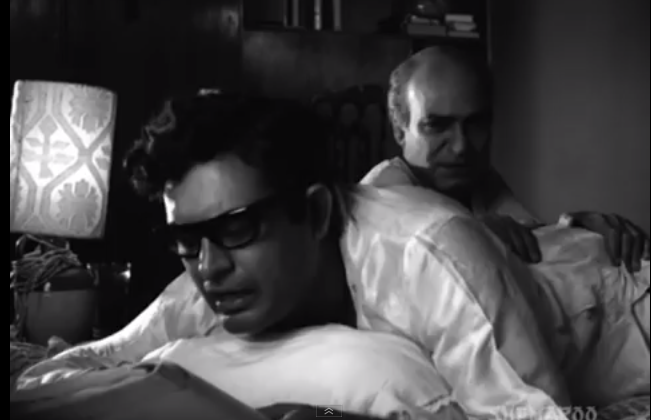 |
| AK Hangal and Sanjeev Kumar in Anubhav, 1971. |
In our more “realistic” films, too, the figure of the servant has often served as a mirror in which the middle-class woman might re-examine herself. Basu Bhattacharya’s marital romance Anubhav (1971) revolves around the wife’s belated recognition that her editor husband spends more time with the servant than with her. It is old Hari (AK Hangal) who gets Amar (Sanjeev Kumar) up in the morning, draws the curtains, makes him breakfast, puts on his coat and gives him a massage late at night. One morning after their seventh wedding anniversary, a distraught Mita (Tanuja) fires all her liveried staff, including Hari. The old retainer’s teary refusal to leave, however, moves her, and Hari stays on as her ally rather than rival. As Mita struggles to go from being Amar’s party hostess to partner, Hari marks the shift by calling her Bahu instead of Memsaab. The servant who had been nearly relegated to contractual status reclaims his position as representative of the absent extended family. The modern English-speaking wife, previously alienated from her wifeliness, achieves it through the intimacy of labour.
***
Another kind of middle-class woman’s mirror image was the mistreated maid. In Mahesh Bhatt’s Arth (1982), for instance, Rohini Hattangadi plays Pooja’s (Shabana Azmi) part-time help, each witnessing the other’s marital troubles. Pooja’s slow waking to courage, her separation from her two-timing husband and her decision to live on her own, is applauded by the maid. And when, in a final plot twist, the maid kills off her own alcoholic, two-timing husband, it is Pooja who adopts her maid’s daughter. The maid—whom Pooja, revealingly, only ever addresses by the generic title of “Bai”—makes a silent exit from the film, leaving the middle-class heroine with the makings of a family, and a virtuous sense of sisterhood.

Shabana Azmi and Deepti Naval in Kamla, 1984. Credit SM Ausaja.
Jagmohan Mundhra’s 1984 Kamla (based on a remarkable script by the playwright Vijay Tendulkar) drew a more provocative parallel between maid and mistress. The film’s titular protagonist is a young tribal woman bought for a pittance by a famed Delhi journalist (Marc Zuber) who wants to make “the country” realise that “the price of a woman is less than that of a pair of bullocks”. The childlike, timid Kamla (Deepti Naval) assumes she has been bought as a second “wife”. In the film’s most memorable scene, she plans how she and the journalist’s wife will divide up the services they provide to the man. Sarita, the educated, gracious, middle-class wife (Shabana Azmi) is bemused at first, but then has a revelation: she is no equal partner in her marriage. She may not have been literally bought, but she is certainly kept.
Kamla’s obvious enslavement shines a light on the less obvious chains that bind Sarita, and marital sex being brought into the equation makes this film radical even in 2017. Of course, Kamla herself vanishes from the ashram she’s packed off to, and then from the film. Like most cinematic servants, Kamla is really just a sign: a device to aid middle-class Sarita and the film’s middle-class female viewers in the examination of their own lives.
There have been other common fates for our filmic servants. Faux-kinship, for instance, lent itself nicely to the servant-as-comic-relief track. This was as true for Oonche Log’s Jumman Miyan in 1965 as for the twin Deven Vermas in Gulzar’s Angoor (1982) and Laxmikant Berde, playing Man Friday to Salman Khan in the defining sanskaari film families of a decade later, Maine Pyar Kiya (1989) and Hum Aapke Hain Koun (1994). Meanwhile the tragic Dai Ma of Shammi Kapoor vintage occasionally resurfaces as farce, in films like 2012’s Bol Bachchan, where three old ladies pretending to be Abhishek Bachchan’s mother are labelled Ma, Dai Ma and—in mindboggling bad taste—Bai Ma.
Barring such blink-and-miss appearances, servants practically disappeared from our films from the late 1990s. This was perhaps because family films were increasingly set in a Western location, while non-family films, whether straining for a dystopian urbanism or romantic coolth, had no room for servants. An exception is the put-upon servant who responds with spite or violence. Beginning with Mundu in Deepa Mehta’s Fire (1996), this trajectory has more recently led us to the overwrought Delhi in a Day (2011) and the underrated Barah Aana (2009), in which a driver and a security guard kidnap their nasty female employer. The most chilling example in this genre—because its fiction makes a claim to facthood—is Meghna Gulzar’s Talvar (2015), which all but insists that the servants (gossipy, intoxicated, sexual in their viewing of the 13-year-old Arushi Talwar character) are the real-life murderers.
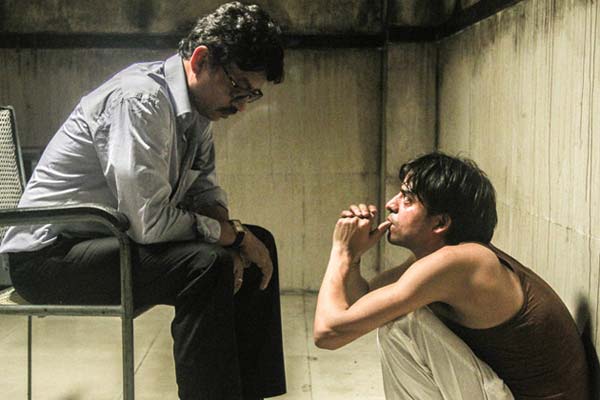 |
| A still from Talvar, 2015. |
This April, Noor, based on a Karachi-set novel about a rookie journalist, handed Sonakshi Sinha a role dependent on class-based obliviousness towards the woman who runs her household. Malti’s name may be on her lips all day, but the film’s titular journalist is so incapable of visualising her maid’s vulnerability that she endangers her life. We are living in a very different era from that of Kamla and Arth and Nauker. The maid may be “connected” to us on Facebook or Skype but she is too distant from us in the imagination to even be our mirror.
This essay was published in Jul-Sep ’17 issue of The Indian Quarterly.


