My Sunday Guardian column this fortnight:
|
Showing posts with label Mahmood Farooqui. Show all posts
Showing posts with label Mahmood Farooqui. Show all posts
30 July 2013
Post Facto - Habib Tanvir’s Naya Theatre: Newness arising from the old


30 September 2008
Sea of Stories: Dastangoi in Delhi
A theatre preview piece for Time Out Delhi:
Audiences aren't flocking to watch dastangoi just because it's a lost art. It's supremely entertaining as well.
Mahmood Farooqui’s first exposure to dastans was through his father, who often told him to read the single volume of the Dastan-e-Amir Hamza which they had at home “to improve his Urdu”. Farooqui was arrested by the fluidity and beauty of the language and by the richly-peopled world of the dastans, where Amir Hamza (uncle of the Prophet Mohammad) sets out to conquer evil, having adventures involving demons, magical beings and tricksters of all sorts on the way – but neither he nor his father imagined that the lost art of dastangoi would be revived in performance by Mahmood himself. “It started when I got an Independent Fellowship from Sarai, a research initiative at the Centre for the Study of Developing Societies (CSDS), to study the Dastan-e-Amir Hamza. The Urdu version printed in the 1890s, is in 46 volumes, and the only person who has the complete collection is the Urdu scholar SR Farooqui, who happens to be my uncle,” said Mahmood. “But it was a research project. In fact, in March 2005, I was planning a lecture based on my research at the India International Centre, when the IIC people said, why don’t you do a lec-dem? It struck me that the best way of demonstrating the power of the form was to actually perform the dastans. The text demanded to be read aloud.”
Farooqui had little to go by, because almost nothing is known about the conditions in which traditional dastangos showcased their art. It is possible that they had musical accompaniment, and also that large illustrated panels were held up behind the dastango, but what they wore, whether they sat or stood or moved about is unknown. But that first performance at the IIC, which Farooqui did in collaboration with his friend Himanshu Tyagi, was a great success. “It was an invited audience, so there were a lot of Urduwallas, but also regular IIC types and people from Sarai. We weren’t expecting much, but there was a lot of wah-wahi, people were very forthcoming with feedback, and the IIC invited us back to its festival later that year,” Farooqui reminisced. After Tyagi moved to Mumbai in early 2005, Farooqui found a new partner in Danish Husain.
“I remembered Danish from Habib Tanvir’s play Agra Bazar,” said Farooqui. Husain, on the other hand, remembered watching Farooqui and Tyagi perform in Dehra Dun in October 2005. “I was awestruck by the form,” he said, “but when Mahmood asked me to perform with him, I was unsure that I had the capability.” He was persuaded, however, and the duo did their first show together in March 2006. “Traditionally, the dastango performed alone, but I think the idea of two performers is a coup. It breaks the monotony for the audience, and it helps the actors – the moment one is tired, the other steps in,” said Husain.
“And we complement each other: one man is frail and elegant, the other is rotund and rustic. Mahmood is more poetic, eloquent. I’m more rough, more theatrical, like a bhaand. This doesn’t mean that I can’t recite poetry, or that Mahmood can’t be funny, but that’s how things tend to get divided.”
The Farooqui-Husain team has now done at least 30 shows together, mostly performing sections from a single chapter of the Dastan-e-Amir Hamza called the “Tilism-e-Hoshruba”. “The title has been translated as “An Enchantment that Steals Away the Senses”, but tilism is virtually untranslatable. It can mean an enchantment, a magical effect, but also an alternative world created by that effect,” said Farooqui. Tilism, however, is only of the four elements of the traditional dastan: the others are razm (warfare), bazm (the world of music, dancing and seduction) and aiyyari (trickery or disguise). Fantasy is thus an integral part of the tales, but they’re also an incredible fund of realistic depictions of Indian life. Magical forests coexist with cities afflicted by famine and fire, shape-shifters walk cheek-by-jowl with miserly banias and flirtatious women.
Has the fantastical quality of the tales made them difficult to appreciate for contemporary urban audiences? Or do people in Delhi and Lahore and Mumbai approach dastangoi through a nostalgic lens – assuming that one can be nostalgic for something one has never known? “Well, certainly there is some nostalgia about two men in Lucknawi attire sitting with a masnad and telling stories in Urdu. I’m uncomfortable with that, but I also know that people’s enjoyment doesn’t rest on nostalgia. Nostalgia may keep them there for 10 minutes, but after that they’re getting into the stories. And if the story is working for you, if it has enough to keep you entertained, it is connected to your world, it has become contemporary,” Farooqui said. “I have felt some pressure to contemporanize the dastans. And yes, these are magical stories, you could go anywhere, you could be in Bushland and in Baghdad at the same time. But if people enjoy, say, classical music today, then it is already contemporary, it doesn’t need to be ‘updated’.”
Though happy with the reaction they’ve got so far, Farooqui is clear that dastans have it in them to go much further. “They straddle the elite and the popular, they invoke Islamicness in a very secular mould, one purely driven towards entertainment. I would like to take the form beyond theatre-going audiences.”
(Time Out Delhi, Sep 2007)
Audiences aren't flocking to watch dastangoi just because it's a lost art. It's supremely entertaining as well.
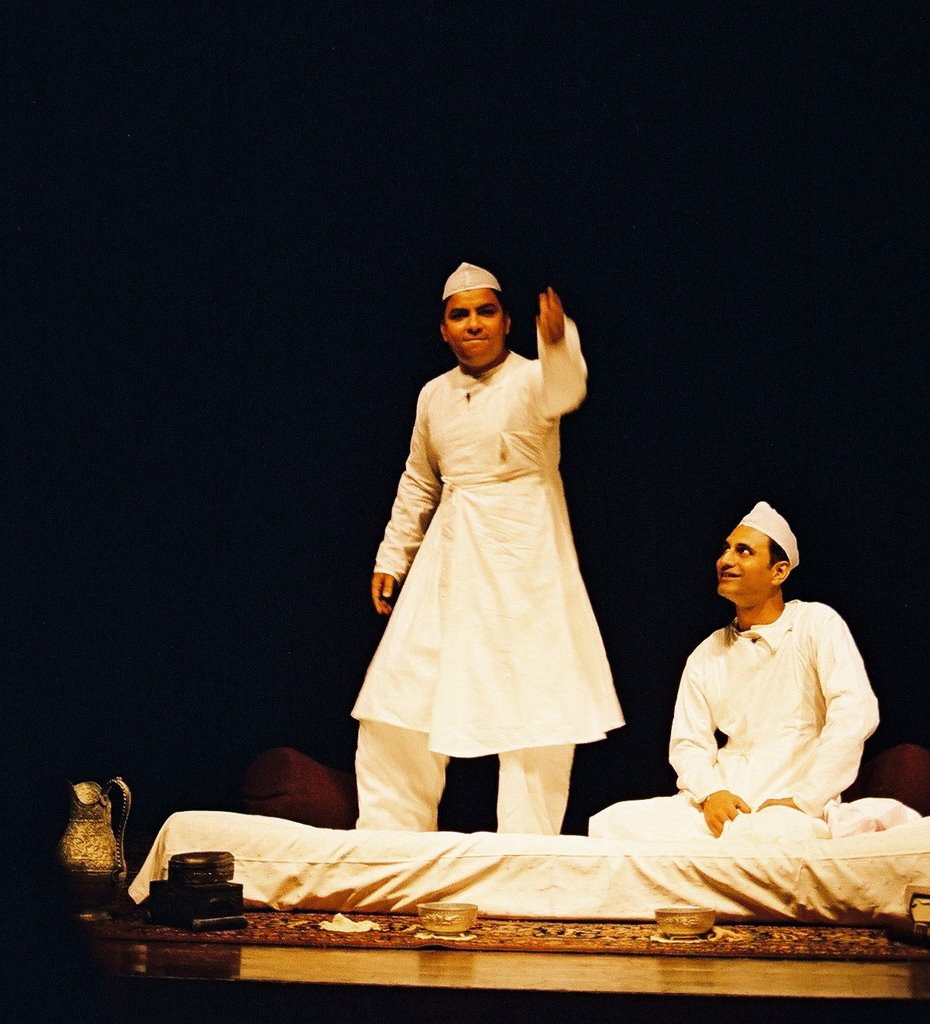 |
Photograph: Abhinandita Mathur
|
Farooqui had little to go by, because almost nothing is known about the conditions in which traditional dastangos showcased their art. It is possible that they had musical accompaniment, and also that large illustrated panels were held up behind the dastango, but what they wore, whether they sat or stood or moved about is unknown. But that first performance at the IIC, which Farooqui did in collaboration with his friend Himanshu Tyagi, was a great success. “It was an invited audience, so there were a lot of Urduwallas, but also regular IIC types and people from Sarai. We weren’t expecting much, but there was a lot of wah-wahi, people were very forthcoming with feedback, and the IIC invited us back to its festival later that year,” Farooqui reminisced. After Tyagi moved to Mumbai in early 2005, Farooqui found a new partner in Danish Husain.
“I remembered Danish from Habib Tanvir’s play Agra Bazar,” said Farooqui. Husain, on the other hand, remembered watching Farooqui and Tyagi perform in Dehra Dun in October 2005. “I was awestruck by the form,” he said, “but when Mahmood asked me to perform with him, I was unsure that I had the capability.” He was persuaded, however, and the duo did their first show together in March 2006. “Traditionally, the dastango performed alone, but I think the idea of two performers is a coup. It breaks the monotony for the audience, and it helps the actors – the moment one is tired, the other steps in,” said Husain.
“And we complement each other: one man is frail and elegant, the other is rotund and rustic. Mahmood is more poetic, eloquent. I’m more rough, more theatrical, like a bhaand. This doesn’t mean that I can’t recite poetry, or that Mahmood can’t be funny, but that’s how things tend to get divided.”
The Farooqui-Husain team has now done at least 30 shows together, mostly performing sections from a single chapter of the Dastan-e-Amir Hamza called the “Tilism-e-Hoshruba”. “The title has been translated as “An Enchantment that Steals Away the Senses”, but tilism is virtually untranslatable. It can mean an enchantment, a magical effect, but also an alternative world created by that effect,” said Farooqui. Tilism, however, is only of the four elements of the traditional dastan: the others are razm (warfare), bazm (the world of music, dancing and seduction) and aiyyari (trickery or disguise). Fantasy is thus an integral part of the tales, but they’re also an incredible fund of realistic depictions of Indian life. Magical forests coexist with cities afflicted by famine and fire, shape-shifters walk cheek-by-jowl with miserly banias and flirtatious women.
Has the fantastical quality of the tales made them difficult to appreciate for contemporary urban audiences? Or do people in Delhi and Lahore and Mumbai approach dastangoi through a nostalgic lens – assuming that one can be nostalgic for something one has never known? “Well, certainly there is some nostalgia about two men in Lucknawi attire sitting with a masnad and telling stories in Urdu. I’m uncomfortable with that, but I also know that people’s enjoyment doesn’t rest on nostalgia. Nostalgia may keep them there for 10 minutes, but after that they’re getting into the stories. And if the story is working for you, if it has enough to keep you entertained, it is connected to your world, it has become contemporary,” Farooqui said. “I have felt some pressure to contemporanize the dastans. And yes, these are magical stories, you could go anywhere, you could be in Bushland and in Baghdad at the same time. But if people enjoy, say, classical music today, then it is already contemporary, it doesn’t need to be ‘updated’.”
Though happy with the reaction they’ve got so far, Farooqui is clear that dastans have it in them to go much further. “They straddle the elite and the popular, they invoke Islamicness in a very secular mould, one purely driven towards entertainment. I would like to take the form beyond theatre-going audiences.”
(Time Out Delhi, Sep 2007)
Subscribe to:
Posts (Atom)