Showing posts with label Shelf Life. Show all posts

10 December 2020

Shelf Life: Stitching the Past into the Future

 My Shelf Life column for November 2020:

What wartime women's fashion can tell us about the world
 
                  Christian Dior's 'New Look' was a massive departure from the clothes women wore in war-torn Europe
 
Elizabeth Gilbert's chatty doorstopper of a novel, City of Girls (2019), begins in the summer of 1940, when the narrator arrives in New York, “nineteen years old and an idiot”. Vivian Morris has just dropped out of Vassar College, judging as dull both the revolutionary young women in “serious black trousers” and the academic girls in shapeless wool skirts “that looked as if they had been constructed out of old sweaters”. While she knows nothing about the world, she knows clothes. And what makes the fashionable teenaged protagonist of 1940 different from one in 2020 is this: Vivian doesn't only wear cool clothes, she can make them.

Trained to sew by an exacting grandmother, Gilbert’s excitable heroine soon finds herself designing costumes the doddering theatre owned by her aunt Peg. It is wartime, and the Lily Playhouse is barely kept afloat by formulaic musicals: there’s really no budget for clothes. But the actors constantly need new outfits, so Vivian learns to improvise. She scours New York's cheaper garment districts and discovers the used clothes shops on Ninth Avenue, becoming a regular at a grand old shop called Lowtsky’s, owned by a Jewish family ejected from eastern Europe.


Vivian becomes adept at digging ancient dresses out of discount bins and transforming them into spectacular customised creations. From showgirls like her friend Celia, she moves on to designing for Edna Parker Watson, grand dame of British theatre stranded in New York by the war. 


Gilbert's narratorial preferences can try one’s patience, like addressing her novel to a young woman whose connection to Vivian is kept deliberately mysterious, to anticlimactic effect. But I enjoyed Gilbert’s enjoyment of fashion, a topic she addresses first with girly excitement and then subversive pleasure. The subversion begins with Edna who, though on first names with French couturier Coco Chanel, is no handmaiden to fashion. Her advice on how to dress—“if you dress too much in the style of the moment, it makes you look like a nervous person”, or “I want brilliant dresses, my dear, but I don't want the dress to be the star of the show”—is really advice on how to live.


But the book’s real subversion of fashion comes in 1950, when Vivian’s friend Marjorie Lowtksy, sharp young heir to the Lowtsky Emporium, comes up with a plan to cater to the post-war marriage boom. “[We] both know that the old silk and satin is better than anything that's being imported...” says Marjorie. “I can find old silk and satin all over town–hell, I can even buy it in bulk from France, they’re selling everything right now, they’re so hungry over there–and you can use that material to make gowns that are finer than anything at Bonwit Teller.” 


The USP? Their dresses “wouldn't be industry; they would be custom tailored”.

Vivian and Marjorie's business makes them rich.

The same era seen from across the Atlantic, in Eric Newby's drily hilarious memoir Something Wholesale: My Life and Times in the Rag Trade (1962) reveals a much more damaged continent. The family firm of Lane and Newby, begun by the writer’s father in the 1890s, is somehow carrying on against a backdrop of bombed-out cities and drastic rationing. Even the upper workrooms of its grand old London offices, writes Newby with brilliant British understatement, “went up in smoke in 1944”.

In some deep metaphorical way, the firm’s continuance into a post-war world now rests increasingly on an army of “outworkers”, elderly women in the suburbs. Meanwhile, their buyers still make orders conditional on unprofitable “Specials”: customised versions for women too misshapen or too snooty to wear the standard designs.

Like Europe itself, the continent's fashion business feels like a creaky old warhorse that can't figure out the new world. “Evening dresses, like the gatherings at which they were intended to be worn, were dispirited”, writes Newby. “[T]he world of fashion had ground to a standstill”. Young Newby tries to come up with new designs on his own. But just after he places his orders, in March 1947, the French designer Christian Dior shows the insanely feminine excesses of his new collection: what would make history as the New Look.


But at that moment, Newby’s creaking world isn’t quite ready. “It was thought to be absurd... a last despairing death-kick by Paris which was no longer to be the centre of the fashion world.” British wholesaler manufacturers, “[h]alf-throttled by clothes rationing”, and too afraid to implement Dior’s radical changes, just make what they have been making for seven years “with a slightly longer skirt”. Of course, nothing sells. The glossies for 1947 are filled with suggestions for women readers with wartime budget constraints, on how to drastically cut and reshape their old clothes.


European fashion, led by Dior’s bold move, slowly begins to recover. But where Europe can only move on by cutting away from its past, America—at least in Gilbert's telling—is already making money off it: repackaging the dead European past as nostalgia. The difference between alteration tailor and vintage couture is writ large onto the history of the world.

Published in The Voice of Fashion, 19 Nov 2020.

6 September 2020

Shelf Life: Do Clothes Make the Woman?

The August edition of my column for The Voice of Fashion, on clothes seen through the prism of literature:

A story from Nisha Susan’s The Women Who Forgot to Invent Facebook and Other Stories casts clothes as signifiers of selfhood

All the world's a stage, but not all men and women are players. Meena, Annie and Nayantara – the self-declared “goddesses” of Nisha Susan's story 'The Trinity' – clearly are. Susan's deftly-drawn Kochi undergrads are all crackling confidence, their position atop the social pyramid propped up by each other's presence. Even before their 'fusion dance' choreographies start to win gold medals and glory, the trio is already living out their lives before an imagined applauding public. “In college, when the three of us walked in, I used to feel like we were in those campus film-like slow motion scenes,” says the story's narrator Nayantara. “Not like the fat twenty-five year-old heroines in Malayalam campus films, but Hindi film heroines.”

Costuming, of course, is crucial to a successful performance – and the trinity is always ahead of the curve, not part of the herd: “We were thin and tall before anyone else was thin and tall... We had good sunglasses, not those big, ugly Gulf-return ones. We wore ghagras at weddings before anyone else did. We draped dupattas over our elbows casually, even though our arms ached by the end of the day.” Sometimes their clothes stage liberatory forms of public disguise. On a trip to Thiruvananthapuram, they walk around “pretending to be NRI Malayalis who did not understand Malayalam”, their tight jeans and sunglasses a license to do things that local girls might attract censure for, like inspecting the city's famously naked giant mermaid statue. At other times, they design costumes for an actual stage – on the same Thiruvananthapuram trip, their combining of sleeveless sari blouses and salwars with tightly draped dupattas electrifies and scandalises the Malayali youth fest audience. (“Malayalis have this thing about 'sleeveless'. Sleeveless means bad girl. Usha Uthup-voice bad girl. Never mind that stomach and back and breasts are showing when you wear a regular sari blouse.”)

'The Trinity' is part of The Women Who Forgot to Invent Facebook and Other Stories (Westland, 2020), Susan's debut collection. The book's unifying thematic premise is India's digital landscape: it couldn't be more contemporary. But reading it made me think of a story from 132 years ago: Rudyard Kipling's 'A Second-Rate Woman', first published in 1888, and reissued most recently in a selection of Kipling stories named for a recurring character, Lessons for Mrs. Hauksbee (Speaking Tiger, 2017). Mrs. Hauksbee is the toast of colonial Simla (or Shimla), her very name a suggestive nod to her eagle eye and her queen-bee-like talent for gathering the young and bright around her. 

In this particular story, Mrs. Hauksbee is preoccupied with a recently-arrived Mrs. Delville, who is drawing disproportionate male attention in Simla society. This is grossly unfair, says Mrs. H, because Mrs D always looks like she “stood in middle of the room while her ayah – no, her husband – it must have been a man – threw her clothes at her”. “To dress as an example and stumbling block for half Simla... and then to find this Person... draws the eyes of men,” she rages, “It's almost enough to make one discard clothing.” So “disgustingly badly dressed” is Mrs. D, that Mrs. H labels her the Dowd – and the man paying court to her the Dancing Master. Back to Susan's opening paragraph: “We used to have names for everyone, and everyone had names for us.”

That bitchily competitive fashion-first vibe, the ruthless gaze the cool girls turn upon uncool ones, has apparently been around forever – and isn't going anywhere. Mrs. D's bonnet is terrible, her Terai sunhat has elastic under her chin, and “if she ever darkened these doors, I should put on this robe... to show her what a morning wrapper ought to be,” says Mrs. H to her friend Mrs. Mallowe. Whether the stage is the stiflingly small British circuit of 1880s Simla – the Mall, Library, horse rides to Jakko (Jhakhoo), dances at the Viceregal Lodge – or the equally tiny Indian college fest scene circa 2000, it seems that clothes remain our top signifiers of selfhood. When Mrs. M ventures timidly, “Do you suppose that the Delville woman has humour?”, Mrs. H scoffs at the possibility: “Her dress betrays her. How can a Thing who wears her supplĂ©ment under her left arm have any notion of the fitness of things – much less their folly?” I thought of the goddesses with dupattas over their aching arms.

A vintage image of Lower Bazaar, Simla (Shimla).


When persona is crafted from clothes, getting them wrong makes one non grata. In both stories, though, it is the sharp dressers that get it wrong. The Dowd turns out far stauncher than Mrs. Hauksbee imagines, telling men off and saving babies, provoking Mrs. H to declare, “I love that woman in-spite of her clothes.” Meanwhile the goddesses conducting feisty sex lives on the internet – without getting caught on camera like their silly college-mates – abruptly become arranged-marriage wives. Perhaps clothes can only tell you so much. 

And yet sometimes they catch up with our inner selves, when we are not looking. We used to call girls with white lace hankies Kerchief Kumaris, says Nayantara at the start of 'The Trinity'. When, she wonders, did she start carrying one?

Published in The Voice of Fashion, 27 Aug 2020

5 September 2020

Shelf Life: Run of the Mill

The July edition of my 'Shelf Life' column on clothes viewed through the prism of literature, for the website 'The Voice of Fashion':

A reading of literary works set in and around the Industrial Revolution which remain relevant today, showing that no technological innovation is by itself any guarantee of social betterment

 Power loom weaving in a cotton mill in Lancashire England, ca. 1835. Engraving with modern watercolour. (Shutterstock)

As any school textbook will tell you, the Industrial Revolution began in Britain in the mid-1700s. Production became increasingly mechanised, accelerating a process of economic change that altered the very character of society. What the textbooks don't stress enough is how much of the technological innovation that drove the Industrial Revolution was in textiles. John Kay's flying shuttle, patented 1733, allowed wider cloth to be woven faster. The greater demand for yarn was met by James Hargreaves's 1764 spinning jenny, where one person could work many spindles, and Richard Arkwright’s 1769 water frame, with spindles operated by water rather than manually. Both were supplanted by Samuel Crompton's 1779 spinning mule, which spun thread strong enough for Britain to finally start producing cheap calico cloth. Then came Edmund Cartwright's vertical power loom in 1785.

Combined with Britain's colonial status, these innovations meant that by the 1830s, 85 per cent of the world's raw cotton was being processed in the mills of Lancashire. Manchester and the surrounding mill towns began to draw researchers and writers concerned about the new working class. Benjamin Disraeli, later Britain's Prime Minister, wrote a novel called Sybil, or the Two Nations (1845), in which an upper class character travels to the industrial north to see working class conditions. The popular Victorian novelist Elizabeth Gaskell set her first book Mary Barton (1848) in Manchester: a romance between her working class heroine and a mill-owner's son. In Gaskell's North and South (1854), we see workers’ troubles and early strikes through the eyes of a heroine who clashes with a cotton mill owner, only to eventually marry him.

Real-life romance in the mill town could sometimes expand on the novelist's imagination.

Friedrich Engels, born into a German textile dynasty that had made its fortune from linen yard bleaching, mechanised lace-making and silk ribbon manufacture, came to Manchester because his father had a thread factory there. Expected to learn the textile business, Engels instead produced The Condition of the Working Class in England (1845), establishing in horrific detail how early industrialisation had actually worsened workers' lives. Low wages and terrible living conditions led to much higher mortality from disease in Manchester than in the surrounding countryside. Karl Marx's reading of the book helped forge the intellectual partnership of a lifetime – and Marx and Engels' critique of capitalism.

But Manchester is also where Engels forged a long-term partnership with Mary Burns, then a worker in his father's factory. Rachel Holmes' delightful 2014 biography of Marx's daughter, the feminist and trade unionist Eleanor Marx, describes Mary Burns' role in Engels' life as “directive and Socratic”: “Engels took Mary to bed; Mary took Engels to the tenements and to the heart of the Irish immigrant community of Manchester... [explaining] the conditions of factory and domestic workers.”

Among the sharpest fictional takes on the textile industry came almost a century later, in 1951, when Roger MacDougall's superb play, The Man in the White Suit, was turned into a Ealing Studio comedy by his cousin Alexander McKendrick. Starring the great British actor Alec Guinness, The Man in the White Suit is a cynical comedy, with its cynicism extending all the way across capitalist society.

The film opens with a younger textile mill owner called Michael Corland romancing Daphne, the daughter of an older and richer mill owner called Birnley, with purely monetary desires. Guinness plays Sidney Stratton, a misunderstood scientific genius who takes yard jobs in one textile mill after another so that he can stealthily use the labs. When Sidney devises an artificial fabric that will last forever and repels dirt, Daphne convinces her father to test it. But when word gets out, the mill-owners gang up to prevent what they see as a calamity for business. “The spinning jenny and the mechanical loom increased output,” says one captain of industry. “This'll finish it!”

Sidney somehow escapes their clutches and is trying to reach the newspapers, but is stopped by his old worker friends: the unions, too, are dead against a fabric whose production has an inbuilt time limit. Even these socialist workers, aware enough to describe themselves as “flotsam floating on the high tide of profit”, cannot actually imagine a world beyond the short-term goals of capitalist production. If obsolescence is not built into the things workers produce, then things will last forever; demand will dry up – and so will jobs.

A still from The Man in the White Suit, an Ealing Studio adaptation of Roger MacDougall's play

The Man in the White Suit is even more relevant today, when late capitalism's need to artificially inflate demand ensures greater inbuilt obsolescence. It is more so because technological innovation is constantly being thrown at us as a panacea, without enough attention paid to the politics that surrounds that technology: think, in post-2014 India, of the discourse around the digital, in relation to demonetisation, lockdown relief or Covid-tracking apps.

Just as with the textile industry at the beginning of the Industrial Revolution, technological innovation is not by itself any guarantee of social betterment. Who has access to that technology, who controls it, and to whose benefit – that is what determines whether it is good for the human race: whether, in fact, technology will mean progress.

Published on The Voice of Fashion, 16 July 2020.

28 June 2020

Shelf Life: High Heels, Parkar-Polka and Other Dressing Dilemmas

My Shelf Life column for June 2020:

Clothes mark the lines between modest and modish in theatre actor Vandana Mishra’s memoir, translated from Marathi by Jerry Pinto

Thespian Vandana Mishra, nĂ©e Sushila Lotlikar, was born on January 26, 1927, years before her birthday became known as India's Republic Day. Some of the loveliest parts of her vivid memoir, I, the Salt Doll, unfold in a time before that – her 1930s childhood in a chawl, her initiation into 1940s Bombay theatre. In her recounting, from the very start, her life seems like a stream flowing alongside many others, into the vast sea that was India.

The Mumbai of Mishra’s childhood held open the doors to that India, in all its glorious variety. And clothes were crucial to parsing that city. The Parsi ladies little Sushila admired in their “georgette saris and blouses without sleeves”, were clearly marked off from her teachers at the Lamington Road Municipality Boys and Girls School, who all wore nine-yard sarees – but “differently from the Saraswats”. Dr. Saibai Ranade, her mother's gynaecologist employer, wears the more modern five-yard sari, always in pastel shades: yellow, blue or pink. The girls wore frocks when very young, but shifted to “parkar-polka: a blouse and long skirt” in the fifth standard. Girls' clothes changed again at puberty: “By the time a girl was 14 or 15, she would move from parkar-polka and would be swaddled in saris forever after.”

Clothes in Mishra’s telling always mark the categories people are born into – gender, age, caste, community. But they must not mark you, the individual. If anything, they are a way of not standing out. Her municipal school has no uniform, but she says that “you couldn't tell the rich kids from the poor ones”. There is remembered beauty in the collective sight of clothing: the chawl's young women dancing in their parkar-polkas are like “a series of yellow, green and jamun-purple fountains...” But individual clothing is rarely mentioned. If it is, it must have a purpose beyond vanity. Her Aai's (Marathi for mother) silk sari is worn for ritual purity. Young Sushila's own outfits get mentioned only when marking a first: her first parkar-polka, “Dharwadi khunn with a broad border”, and her first sari, “pink with a green border”, bought for two rupees.

Two rupees was standard for an ordinary (cotton) saree, as against fourteen for a long-lasting “but flashy” georgette one. Flashiness was a constant danger—one that the middle-class girl-child internalised early. Sushila once tells a classmate's mother she is wearing too much powder. She gets slapped for rudeness, but the school's Pathan guard comes to her rescue. That moral front against make-up, in which little Sushila and the Pathan are on the same side, is a funny story. But it presages the book's repeated emphasis on modesty, on not dressing up, not attracting attention. It is boundary work that only gets exacerbated when the middle-class Marathi girl finds herself in a space meant for professionally dressing up: the theatre. 

Mishra came from a Konkani family of Saraswat Brahmins. When she was two, her accountant father died suddenly. Sushila's Aai – clearly a remarkable woman – refused to stay in the village, shave her head or stop educating her daughters. The family returned to Bombay. Aai did a midwifery course, and began educating three children on her nurse's salary. Then tragedy struck again: a horrible acid attack which kept Aai three months in hospital. Once home, she needed care. With her elder sister in Pune training to be a nurse, and her elder brother about to matriculate, it was Sushila who left school.

There is a powerful simplicity to the way Mishra describes these momentous events. One wonders if there was an equal simplicity to life itself. During her Aai's recovery, for instance, neighbours simply take over the family's upkeep, like others did when her father died. The family then scrapes by on savings, until an opportunity knocks: the chance to join Parshwanath Altekar's Little Theatre Group, at ₹30 a month.

Within months, on Nov 1, 1942, Sushila was asked to fill in for an actress who had stalked out, and found herself in a Mama Warerkar play. She was a hit, and soon became an actress of some repute on the Gujarati stage, and later, in the city's Marwadi theatre.

Suddenly, she is accosted everywhere: an admiring tailor offers to make her four blouses for free; a shoe-man offers her sandals. These are good working men. But there is also the local lech-cum-astrologer who offers to build her career, wooing her with an “expensive sari”. In the narrative of middle-class self-preservation, Sushila must throw that 'gift' in his face. She does.

But the real turnaround comes when she begins to wear high-heeled sandals “which made a tick-tock sound”. The chawl's caretaker tells her mother she is “walking around with a lot of pride”. Her mother warns her, she switches to Kolhapuri slippers, and simplicity is enforced.

In Krishna Sobti's autobiographical Hindi novel A Gujarat Here, A Gujarat There, another young middle-class woman born in the 1920s is forced to abandon her education midway. Sobti's narrator recalls quarrelling with her hostel roommate over her high-heeled sandals “clacking about at night”. But in the book's last scene, as she walks to a job interview, it is “the click of her heels” on the asphalt that bolsters her confidence. Sometimes it is nice to feel like you stand out.

This column was first published in The Voice of Fashion, 18 Jun 2020.

21 May 2020

Shelf Life: The Hand-Me-Downs

My Shelf Life column for May 2020.

Other people’s clothes can be prickly things, fulfilling neither the wearer’s desire nor the giver’s expectation of gratitude.

In Vinod Kumar Shukla's magnificent 1979 novel Naukar ki Kameez, a low-level desk employee in a government office is forced to do duty at the big boss's home. In his spare, masterful style, Shukla condenses his narrator's class-ridden predicament into a single object: a shirt. The sahib's first servant, we are told, wore ill-fitting clothes, obviously belonging to someone larger than him. So a thick white shirt was stitched for him. But the servant didn't last. His replacement, too, was fired soon. The shirt, like the position, now lies empty, awaiting someone who can fit into it. “Naukar ki kameez ek saancha tha, jisse adarsh naukaron ki pehchaan hoti,” writes Shukla: 'The servant's shirt was a mould, which would help identify the ideal servant'.

In an unsettling episode, Shukla's naive young narrator Santu is tricked into visiting the big boss's home, and physically held down until his own “bush-shirt” has been exchanged for the servant's waiting white kameez. Forced to wear it home, Santu returns the next day in his own clothes. When made to take his boss's wife shopping or conduct other semi-domestic duties, he goes along reluctantly. He doesn't see how else to keep his job. His resistance condenses into not wearing the servant's shirt.

The attempt to preserve one's self while being compelled to wear someone else's clothes is also the theme of the Hyderabadi writer Wajida Tabassum's famous story 'Utran' ('Cast-Offs'), translated by Sayeeda S. Hameed and Sughra Mehdi for Parwaaz, a now-classic volume of Urdu short stories by women. 'Utran' features a servant, too – but Chamki is the epitome of insubordination from the very first scene in which we meet her, as a seven-year-old who wants to exchange dupattas with her much richer playmate and 'become sisters'.
Her mother Anna Bi is wet-nurse to an aristocratic family, and so Chamki receives all of Shahzadi Pasha's innumerable cast-offs. But where Shahzadi's hand-me-downs leave Anna Bi thrilled and grateful, the one-way traffic only makes Chamki angrier: “Ammini! I am prettier than Bi Pasha. Then why doesn't she wear my cast-offs?”

 It is no surprise that the single saffron-coloured outfit that the mistress has tailored for Chamki, though it is of cheaper material than Shahzadi would ever wear, becomes the girl's favourite. Those clothes “elevate her to the heavens”, giving her a heady confidence that leads to the story's denouement.

And yet, there can also be confidence in wearing someone's old clothes. Upendranath Ashk's 1961 Hindi story 'The Ambassador' demonstrates this perfectly. It begins with a man arriving at the narrator's well-appointed bungalow in “a dirty shirt with no buttons, a loose coat full of holes, baggy trousers patched and torn, and boots that seemed worn down by centuries of use.” The houseboy is chasing the stranger away when he stretches out his hand, says “Hello, Bakshi” and advises the narrator, in perfect English, to fire his impolite servant.

By the end of Ashk's tale, the narrator's old roommate – for that is who he is – has eaten a sumptuous meal, wiped his dirty hands on his tattered clothes and demanded a set of clean old ones. As he walks away with them thrown casually over his arm, the narrator is struck that he hasn't even said 'thank you'.

Is this what makes old clothes so fraught? Those who receive them might use them, they might even be glad to have them. But the giver's demand for gratitude, wanting to be thanked for a 'gift' that the receiver knows to be mere surplus: that can cause heartburn.

And yet, clothes are often so powerfully desired that someone else's clothes can also become fetishised, objects of illicit passion. In Saadat Hasan Manto's story 'Kali Shalwar', a prostitute down on her luck tells her new lover that she really wants a new black shalwar for Muharram. When he actually brings her one, Sultana is very happy. It is just like the satin one her friend Anwari recently got made. Then she realises it is the same one.

Published in 1942 in the Lahore-based journal Adab-i-Latif, its frank portrayal of the margins of polite society got it banned for obscenity. But in fact the story displays Manto's characteristic combination of deceptively casual plotting and rare emotional subtlety.

If coveting a black shalwar brings Sultana quiet sorrow, coveting a dead sister's wedding trousseau brings grand gothic tragedy in Henry James' 1868 story 'The Romance of Certain Old Clothes'. Two New England sisters find themselves, as the daughters of 19th century gentry apparently often did, vying for the same man. One marries him, but dies soon after giving birth. The second, Rosalind, promptly inveigles herself into the widower's life, becoming the new Mrs. Lloyd. It is interesting that James seems to judge her less for wanting her dead sister's husband than for desiring her locked-away wardrobe. Of course, like a good gothic tale, when Rosalind opens the forbidden trunk, her sister's spirit finds a way to punish her. 

Aspiring for more can seem ungrateful. The sahib of Shukla's novel knew what he was doing: scotching desire. “I would never give my own shirt to the servant,” he tells his head clerk. “The tastes we know, they should never know. If they do, they will be ungrateful.”

Seen through the eyes of those who rule, even old clothes can disrupt status quo.

Published in The Voice of Fashion, 21 May 2020.

"You Maid Me Better"

Forgot to put this up earlier: my Shelf Life column for April. (Shelf Life is a monthly column I write for the website 'The Voice of Fashion', on clothes seen through the prism of literature.)

Doris Lessing, who debuted with the great novel The Grass is Singing
As the national COVID-19 lockdown enters its third week, privileged Indians are being forced to acknowledge how many of our comforts are enabled by the labour of those we euphemistically call 'help'. Servants are the invisible glue that keeps the Indian family together, taking up the physical and emotional burdens of domesticity that most middle class men dump so blithely on their wives. But if dependence is one aspect of our unacknowledged relationships with servants, the other is intimacy.

In 1765, British judge Sir William Blackstone listed the master-servant relationship as the first of three “great relations of private life” (the other two were between husband and wife, and parent and child). He saw something many are still loath to admit. The greater the ubiquity of domestic staff, the more the social distance between employers and servants is policed. In her wonderfully readable Servants: A Downstairs View of Twentieth Century Britain, Lucy Lethbridge remarks on the separation of social spaces enforced by the British aristocracy, “whose most intimate secrets, paradoxically, had long been shared with the valet or the ladies' maid who undressed and bathed them”.

Clothes have been central to this relationship. For centuries, the personal servant took care of the employer's clothes, laid out their outfits – and often actually dressed them. The servant's role in the master's or mistress's toilette has been at the centre of many literary depictions. One such relationship is between PG Wodehouse's bumbling young aristocrat Bertie Wooster and Jeeves, his valet. Jeeves rules Bertie's wardrobe with an iron hand, perpetually giving away clothes that he thinks inappropriate for a true scion of the upper classes, scotching Bertie's attempts at fashion. Under Jeeves' stiff upper lip lie unutterable depths of emotion: Bertie's one-time decision to grow a moustache creates a rift between him and Jeeves that feels almost lover-like.

That “almost” ripens to fullness in Sarah Waters' marvellous thriller Fingersmith (2002), in which a petty thief sets herself up as ladies' maid to an heiress. The orphaned Sue Trinder is a perfect Dickensian character. Her version of Fagin is called Gentleman, a trickster swell who teaches her the ins and outs of clothes she has never had occasion to wear. Beginning with the delicious double entendres of Gentleman's first lesson (“Are you ready for it now, miss? Do you like it drawn tight?...Oh! Forgive me if I pinch.”), Waters imbues the Victorian lady's wardrobe with frisson. The layers of garments are secret links between mistress and maid: the chemise, camisole, corset, the stays that hold the body close, while the nine-hoop crinoline floats, unwitting, above it all. Sure enough, Sue's pleasure in the keeping of Maud's gowns and silken petticoats blooms slowly into a sensual attachment to the keeping of Maud herself—a secret love that will not be suppressed.

Sue's relationship with Maud's clothes reminded me of the chilling scene in Daphne Du Maurier's iconic 1938 novel Rebecca, when the housekeeper Mrs. Danvers insists on making the book's unnamed young heroine caress the late Rebecca's nightgown, laid out on her bed as if she might walk in any minute. “'Feel it, hold it,' [Mrs. Danvers] said, 'how soft and light it is, isn't it? I haven't washed it since she wore it for the last time... I did everything for her, you know... We tried maid after maid but not one of them suited. “You maid me better than anyone, Danny,” she used to say. “I won't have anyone but you.’”

The fictional Rebecca's inability to find a single maid that “suited” was probably Mrs. Danvers' wishful imagination, but it may have also reflected an upper class predicament that grew more widespread, as the First World War and then the Second altered the social aspirations of the working class in Europe. In the colonies, of course, there was an inexhaustible supply of cheap labour only too grateful to find work in the white man's household. The friction in the early years of empire resulted from attempts to train domestic staff across the vast gulf not just of class, but of cultural knowledge–and racial suspicion. Emma Roberts was likely fairly representative of the colonial memsahib in India when she complained in 1835 that native ayahs did not take the “slightest pains to make themselves acquainted with the mysteries of the European toilette; they dress their ladies all awry, and martyrdom is endured whenever they take a pin in hand: they have no notion of lacing, buttoning, or hook-and-eyeing...”That clueless privileged voice, complaining of the 'uncultured' servant, can still be heard all around us.

But a class of colonial servants was gradually trained, and as Lethbridge points out, the domestic life of the British in India grew to levels of display unmatched in world history. In the more remote outposts, in Africa for instance, English-style formalities could be impossibly tough to keep up. Among the great depictions of such fraught intimacy between black servant and white mistress is in Doris Lessing's stunning debut novel The Grass is Singing (1950). Towards the end, a white visitor is shocked to find the native servant Moses buttoning up his mistress Mary's dress. He attempts to joke about it, telling Mary about an empress of Russia who “thought so little of her slaves, as human beings, that she used to undress in front of them”. Lessing is astute as always, commenting: “It was from this point of view that he chose to see the affair; the other was too difficult for him.”

Anthropologist Raka Ray's fieldwork in Kolkata poses a similar question: how do people reconcile having male servants with a highly sex-segregated society like India's? Male servants walk in and out of bedrooms, are present at intimate moments when other men wouldn't be and handle women's clothes. One elderly lady says to Ray, “A servant isn't really a man; a servant is a servant.”

Among the subtlest fictional portrayals of this space of unsettling intimacy is Manto's short story 'Blouse'. When Shakeela Bibi flings off her vest for the teenaged Momin to take to the shop, he finds himself rubbing it between his fingers. “[I]t was soft as a kitten”, “the smell of her body still resided in it”, and “all this was very pleasing to him,” writes Manto. Shakeela's newly stitched purple satin blouse triggers a dreamscape whose eroticism is not even part of Momin's conscious mind. The deputy saab's wife and daughters remain oblivious, like saabs and memsaabs too often are: “Who could play that much attention to the lives of servants? They covered all of life's journeys on foot, from infancy to old age, and those around them never knew anything of it.”

As our unacknowledged intimates, servants have too long been treated as shock absorbers for our inner lives, our troubles. It is high time we recognise that they have their own.

17 February 2020

The Art of Dress in Isherwood's Berlin

My Shelf Life column for the website The Voice of Fashion looks at literature through the prism of clothes. 

This month, it's about people living on the edge in a city turning Nazi: Germany at the end of the Weimar era in Christopher Isherwood's much-adapted Goodbye to Berlin.


“I am a camera with its shutter open, quite passive, recording, not thinking. Recording the man shaving at the window opposite and the woman in the kimono washing her hair. Some day, all this will have to be developed, carefully printed, fixed.”

So wrote Christopher Isherwood in 'A Berlin Diary (Autumn 1930)' -- the first of the six interlinked stories that made up his 1935 book Goodbye to Berlin, a brilliant document of a city turning Nazi, a world changing shape before one's eyes.

Isherwood was both stylist and storyteller, gifted with an authorial voice that convinced you that things happened exactly as he wrote them, even as he categorically forbade readers from assuming that his sparkling characters were “libellously exact portraits of living persons”. Whether Sally Bowles and her many friends and lovers ever walked the decadent streets of 1930s Berlin, Isherwood's “camera” kept them running in readers' minds long after. Over the next several decades, as Goodbye to Berlin was adapted first into a play called I Am A Camera, then into a Broadway musical, and later the brilliant 1972 Bob Fosse film Cabaret, they shapeshifted, acquiring new nationalities, sometimes new names and new emotional lives.

Sally Bowles, for instance, went from being the 19-year-old daughter of a Lancashire mill owner who sings at an arty bar called The Lady Windermere to an older American cabaret dancer with daddy issues (the father who's “practically an ambassador” never actually shows up). Sally's rich lover, who in the original story was an American called Clive became, in Bob Fosse's film, a married German called Maximilian. The book's narrator, Chris, became Brian in the film, his relationship with Sally going from platonic to not.

Christopher Isherwood (centre) with the poets WH Auden (left) and Stephen Spender (right)
Among the things that stayed constant, though, was the crucial role of clothes. In what might now be seen as a predictable trait for a gay man, Isherwood paid attention to what people wore. And his characters dressed well for members of a 1930s demimonde. Or perhaps precisely for that reason. So we meet Sally first “in black silk, with a cape over her shoulders and a little cap like a pageboy's stuck jauntily on one side of her head”: befittingly theatrical, aided by cherry lips and emerald green nail polish. Meanwhile Sally and Chris's common friend Fritz Wendel has a “usual coffee party costume” that evokes summer even when it is cold and grey: “thick white yachting sweater and very light blue flannel trousers”.

Clothes are the first external sign of the self in this world – and looking respectable can take you a long way. For Frl. Schroeder, the landlady of Chris's lodging house, that means having her “flowered dressing gown pinned ingeniously together, so that not an inch of bodice or petticoat is to be seen”. For Chris, it is keeping his overcoat on because it hides the stain on his trousers. In Cabaret, Fritz surreptitiously pulls his coat-sleeve down to cover his frayed cuffs.

More than most people, Sally Bowles understands the value of looking fine. She constantly performs an exaggerated femininity – at the club, but also in life. And yet under all the high drama lies a childish make-believe, and you realise that her primary performance is for herself. She paints her toenails because it makes her feel sensual. During one of her frequent break-ups, she and Chris spend a lot of time sitting on benches. People stare at Sally “in her canary yellow beret and shabby fur coat, like the skin of a mangy old dog”, while she only thrills to the thought of “what they'd say if they knew that we two old people were to be the most marvelous novelist and the greatest actress in the world.”

Michael York as the English protagonist Brian with Liza Minnelli as Sally Bowles in Bob Fosse's Cabaret (1972)
When she takes up with Clive, Sally accepts as gifts four pairs of shoes and two hats. And when Clive wants to get Chris a gift, she persuades him that six silk shirts would be better than a gold cigarette case. “Yours are in such a state,” she tells Chris with her usual cheerful brutality. In the book, these items of clothing are all that the two supposed gold-diggers get out of Clive – and 50 marks to be saved towards new nightdresses. The film makes everything more outrĂ©. Sally's rich lover Max actually gives the narrator that gold cigarette case – and lends him fancy clothes.

In Isherwood's last piece in the book, an ex-lodger called Fraulein Kost returns to visit the landlady in a fur coat and genuine snakeskin shoes, gaining Frl. Schroeder's grudging but real respect, despite her knowledge of her profession: “Well, well, I bet she earned them!... That's the one kind of business that still goes well, nowadays...”. In the film, it is Sally who acquires a new fur coat from Max – only to have to later sell it for an abortion.

Meanwhile, beyond Isherwood's charmed circle, other people are changing their clothes. Groups of young men in brown shirts and armed men in S.A. black uniforms have begun to attack solitary passers-by perceived as Communists. In one description that should resonate perfectly with present-day India, a young man is lynched and his eye poked out while dozens of people look on, and heavily armed policemen, “hands on their revolver belts...magnificently disregard the whole affair”.

On the eve of his return to England, the winter of 1933, Isherwood hears Frl. Schroeder talking reverently of 'Der Fuhrer' to the porter's wife. She voted communist last November, but she would probably hotly deny it. She is merely acclimatising herself, writes Isherwood, “like an animal which changes its coat for the winter.” Isherwood doesn't say it, but those animals are preparing for a long hibernation.

Published in The Voice of Fashion, 15 February 2020.

13 December 2019

The Catholic Dress: Bombay to Goa and Back

My Shelf Life column for TVOF:
 

The dress-wearing Catholic girl was an object of Indian male fantasy, but as Jane Borges’ Bombay BalchĂŁo makes clear, the reality was more complex than the stereotype


At the beginning of her just-published debut novel Bombay BalchĂŁo, the Mumbai-based journalist Jane Borges sets us down in the Catholic neighbourhood of Cavel on Christmas Eve 1945. Before we hear the midnight mass, we hear of Karen Coutinho, whose tailor Francis (“from John D'Souza and Sons”) has made her “a long yellow silk gown, which swept the road as she walked to church”, and of her husband Alfred, who is glad that his wife’s gold lace mantilla covers her “heavily powdered face and the crimson lips she had painted with cheap lipstick”. And we hear, almost simultaneously, of the Hindus on Dr D' Lima Street who “sneakily peered from the gaps between the iron rods of their windows, gawking at the dressy Christian women”. 

Borges doesn't dwell on her wartime setting, but a 2017 piece on 'aunty chic' by Cheryl-Ann Coutto published on Scroll points out that knee-length skirts were a wartime trend for economic reasons. “There was rationing, food coupons, there was less food, less cloth and so the hemlines too were shortish,” an 80-year-old Elettra Gomes tells Coutto. “Then after the war ended, Christian Dior came out with calf-length swirling full skirts and tiny cinched waists [this lavish, ultra-feminine aesthetic... became known as the New Look]”.

But even if the length of Karen Coutinho's gown could have been seen as a legitimate post-war luxury, Bombay BalchĂŁo makes it clear that she was up against other forms of moral censure: such as the local Hindu patriarch accusing Christians of having “sold their souls to the gori chamdi” (white skin) by dressing like Europeans--at a time when the Gandhian campaign for Khadi was at its acme.

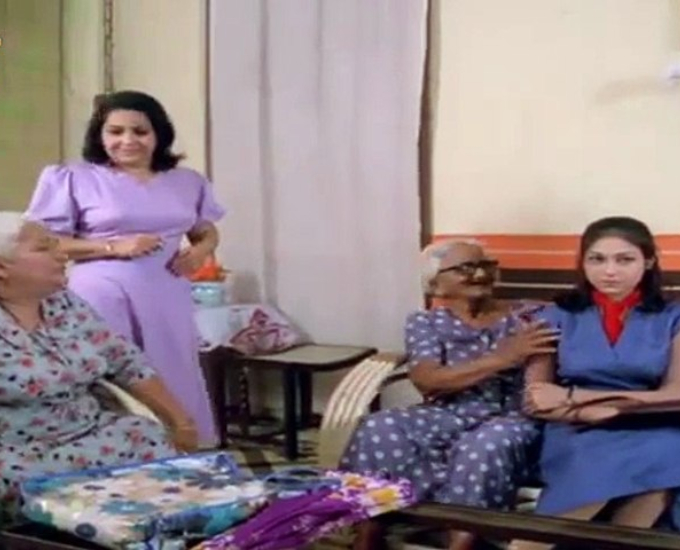
A still from the film Baaton Baaton Mein.

The real source of censure, however, lay far deeper than nationalism or economy. Bombay's Catholic women – whether the East Indians, as the original Catholic inhabitants of Bombay and Salcette called themselves, or the Goans who came to the city later–were invariably marked by the wearing of dresses. 
 
By exposing the legs to view, and simply by fitting around the female upper body, the dress seems to have sparked the sexual imaginations of generations of Indian men whose own wives and daughters were never without the protective drape of the pallu or the dupatta. Borges writes, “In the darkness, numbed by furious lovemaking, (the Hindu man) would latch on to his wife's waist, and in between suckling her breasts ask if she would wear one of those dresses, just for him. She would agree coyly, but as an afterthought dredge up the same feeling her husband had exposed in front of the family when he saw the Christian women strut on the roads.” That particular Hindu male fantasy made its way firmly into Hindi cinema via such depictions of Catholic girlhood as Raj Kapoor's Bobby and Basu Chatterjee's Baaton Baaton Mein, and lasted well into the 1980s, when Salman Khan made that 'secret' dress-wearing request of his long-haired, 'traditionally Indian' heroine Bhagyashree in the epoch-defining Maine Pyar Kiya (1989).

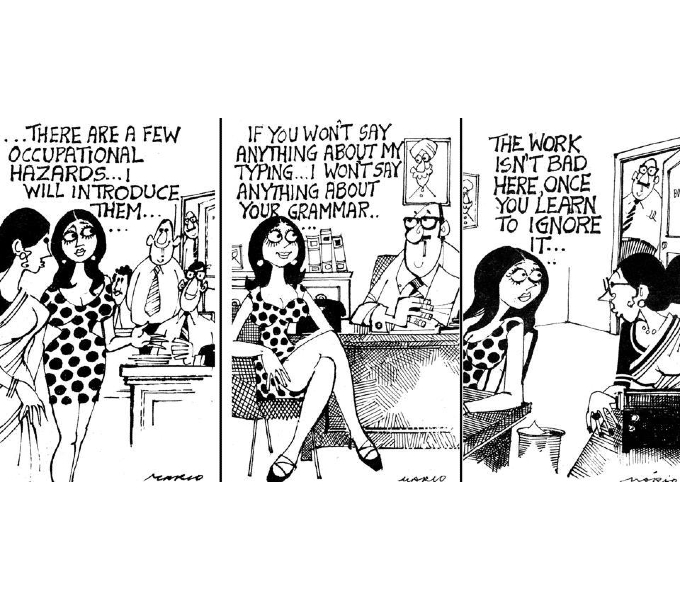
“For repressed Maharashtrians and Indians like me, Jesus Christ, this was where heaven began!” declared the late Kiran Nagarkar in Paromita Vohra's charming short film Where’s Sandra?, which addresses the precise question of what the office-going Bandra girl represented to the rest of the city. One of the real 'Sandras from Bandra' that Vohra tracks down makes the crucial point that the Christian girl was the object of Indian male fantasy also because women from most other urban Indian communities weren't allowed to go out to work. The Christian secretary in the form-fitting dress became embedded in the collective Indian psyche, with even such pillars of the Goan community as cartoonist Mario Miranda essentially reinforcing the stereotype with his polka-dotted Miss Fonseca.
The dress-wearing Goan Christian secretary was immortalised by cartoonist Mario Miranda in the busty figure of Miss Fonseca.

Of course, the stereotype of the Christian girl as open in her morals didn't quite fit the facts. Bombay Balchao is full of Catholic boys bemoaning their fate while the Catholic girls they're dating scratch them for trying to sneak a kiss. In Vohra's film, too, the late poet and professor Eunice D'Souza argues with efficiency that the Christian family and school-going milieu could be as orthodox as the non-Christian ones, policing female sexuality with just as much middle class paranoia. Dress-wearing was no marker of (im)morality. 

Not all Christians wore dresses, either. For instance, the Portuguese insistence “that converts adapt to the European style of dressing” led to such innovations as the pano bhaju, which Borges calls a “middle ground” created by orthodox Brahmin women. Now 'traditional' when dancing to sad Konkani love songs called mando, this particular Goan Christian outfit consists of a sarong-like lower garment (pano), worn with a loose gold-embroidered blouse (bhaju) and a stole called the tuvalo. The hybridity is India at its best: the pano draws on the South Indian lungi/mundu/veshti, the bhaju is Portuguese, while the gold thread work owes something to the Mughals. 

One of the pleasures of Borges' book is its mini-ethnography of Bombay's different Christian communities. The Goans and East Indians express disdain for the Mangaloreans as calculating, not so comfortable with English, not good dancers or good at Western music. The Mangaloreans, meanwhile, saw the Goan absorption of Westernised mores as a cop-out, too easy a surrender to their colonial masters. Mangalorean rebelliousness, not surprisingly, was expressed most vividly in their women's clothes: the community may have converted to Christianity, but the women still wore their heavily embroidered sarees and jasmine venis (floral garlands) in their buns – rather than floral dresses and bouffants.

Beyond Bombay, too, the dress-clad Christian working girl was the focus of Hindu male anxiety: think of the Anglo-Indian Edith, who becomes the heroine Arati's office colleague and then friend in Satyajit Ray's Mahanagar. For the two Calcutta women, lipstick marks a bond between them. For the Hindu husband waiting edgily at home, the same lipstick becomes emblematic of the 'corruption' of his wife. Clearly, as non-Christian women ventured tentatively into the workforce, the dress-wearing Christian girl was now a terrible threat. For on what women wear, as always, the whole burden of civilisation comes to rest. 

Thankfully, as Vohra suggests, Sandra the stereotypical good-time girl doesn't have a reason to exist anymore. Because we all a have a bit of Sandra in us now. Something to think about each time you wear a dress – and can even let the camera see you in it, unlike Bhagyashree.


13 November 2019

From Tejimola to Cinderella

My 'Shelf Life' column for November:

Clothes that fit and people that don't: reading Aruni Kashyap’s retelling of a classic Assamese folktale


In Aruni Kashyap's story 'Skylark Girl', part of his recently published collection His Father's Disease, a young Assamese man is invited to an international conference at a Delhi-based university. There are other writers there from the Northeast, but Sanjib gets the feeling that they already know their way around—they know each other's names, the editor of the journal, how to negotiate the Mexican items at the conference lunch.

Kashyap weaves Sanjib's experience in and out of the story he has submitted to the conference: a retelling of the Assamese folktale 'Tejimola'. There is no obvious overlap between Tejimola and Sanjib. Her tragedy is of a different order from his discomfort at the conference. And yet, if you read carefully, clothing is crucial to both narratives: clothing as identity. So Sanjib notes how the young men on campus turn up in shorts and the women wear their cotton saris “as if they were in bed till a moment ago”. They are the epitome of ease, while he feels “like that classmate who came to school with long nails and smelly clothes and got bullied”. Sanjib's sense of impostor syndrome is reiterated in a scene from his past that he has turned into a visual metaphor: his only visit to a well-off girlfriend's house, where his tattered chappals seemed to “permanently taint” the gleaming marble floor.

Meanwhile, Tejimola's mother dies in childbirth, and the baby girl is saved and raised by the midwife Aghuni. But then one day Aghuni dies. Soon after, Tejimola's father—a silk merchant called Dhaniram Saud—sets off on a long journey, leaving her at the mercy of her stepmother Romola. Romola has waited a long time for this moment. When Tejimola wants to attend her friend Sokhi's wedding, her stepmother takes out a particularly fine mekhela-sador, “an expensive golden muga-silk dress from Sualkuchi”.

Tejimola is very surprised, because she hasn't known her stepmother to be so generous—especially when she has only asked for“good cotton”. But she accepts, doesn't think too much about it, and sets off with the clothes in a jute satchel. Unbeknownst to her, though, the stepmother has slipped in a piece of burning charcoal and a little rat. By the time the girl reaches her destination, the clothes are half-burnt and rat-eaten. Sure enough, upon her return home, the stepmother uses the ruined mekhela-sador as an excuse to put her to work grinding rice. And then, in one of those scenes of horrific graphic violence that punctuate folktales, she crushes the trusting Tejimola to death with the rice grinder, one limb at a time. 

Buried in the backyard of her own home, the young girl's body sprouts into a gourd-bearing creeper. When a beggar woman tries to pick a gourd, the plant sings out in Tejimola's voice. The stepmother chops it down in fury, but its remains grow into a plum tree—in Kashyap's version, an elephant lime plant. Uprooted and thrown in the river, Tejimola's next incarnation is as a water lily. When her returning father encounters the lily's lament, he coaxes her: “If you are my Tejimola, be a mynah and eat the betel from my hand.”

In Kashyap's telling, the mynah is a skylark and the coaxing is an order. When he returns home, the father takes “a long piece of red-bordered sador”, walks up to the skylark's cage and says, “My daughter, now I command you to take your real form and wear this.”

There is a core idea Kashyap seems to be juggling, of clothes being a good fit—and consequently perhaps clothes as the means that reveal when things are not a good fit. When Sanjib tells his posh girlfriend that his school uniform khaki trousers were the only ones he had before moving to Guwahati, she says “it sounded like a fable”. And in Sanjib's retelling of the classic folktale, the stepmother's too-fine mekhela-sador is a trick, one which Tejimola should have recognised as being too good to be true. She doesn't. She suffers. And she returns to human form by wearing the clothes brought for her by her father.

To fit the clothes you wear is to know who you are. The motif is not uncommon to the folktale. The French Cinderella is identified by her foot fitting the glass slipper. In his pioneering anthology Folktales From India (1991), the legendary scholar-translator AK Ramanujan points out that tales of the Cinderella cycle are told from China to South America, with a central female character being found and lost and found again.

In another Assamese folktale, that of Teja and Teji, the evil stepmother turns Teji into a mynah, dresses her own daughter in Teji's clothes and sends her to the king instead of his wife. “When the stepsister sat at the loom and made a show of weaving, the mynah cried: Whose cloth is it? Who weaves it? She breaks the threads and leaves them knotted.” The king finally notices—a little late, like most men. Like Tejimola's father, he enables the mynah to return to human form, and all is happy again. The story is steeped so deep in the fabric of Assam that the heroine is identified not by the clothes she wears, but the cloth she weaves.

15 October 2019

The Silk Route Between the Covers

My 'Shelf Life' column for October:

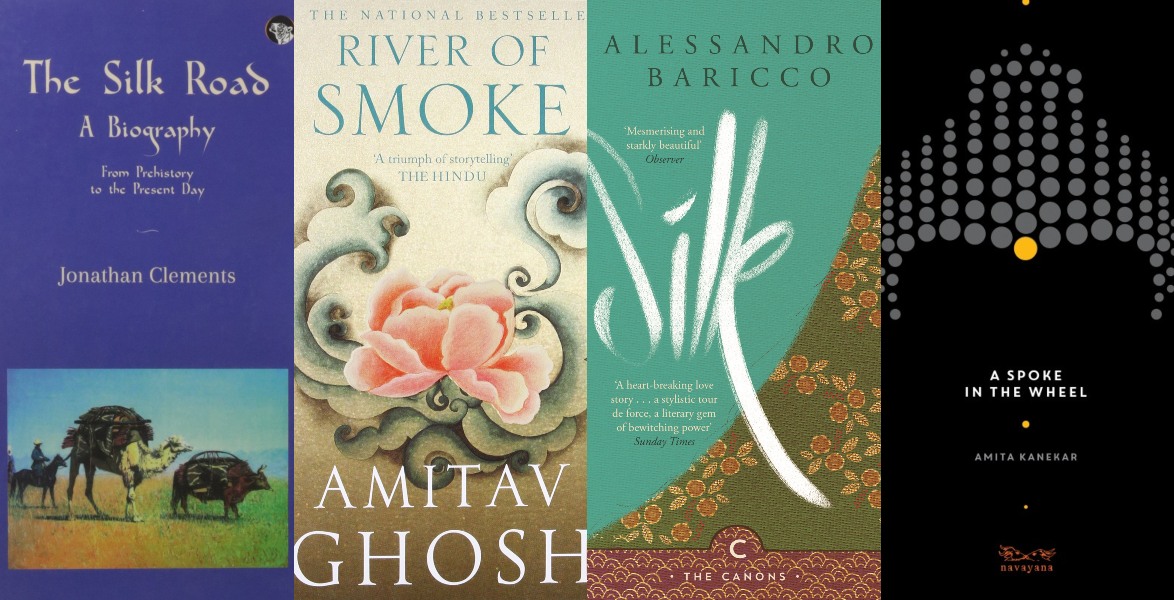
The unreal lustre of silk has long been the stuff of fantasy, in life and in fiction, from Alessandro Baricco’s Silk to Amitav Ghosh's River of Smoke


Cloth has been among the most ubiquitous items of exchange in the history of human civilisation—but silk is the only cloth to have had a trade route named for it. The legendary Silk Road was, of course, neither singular nor physical. It was more a name for a network, a direction in which goods travelled between China and the Mediterranean, with Xi’an and Samarkand as nodes. Jonathan Clements, in his book The Silk Road: A Biography (2016), points out that all manner of objects—gemstones, glass, tulips, spices, slaves—were traded on the route, but the commodity most likely to travel the entire length from East to West, was silk. The reason was its value in the West, but also its portability and durability. 

The moth called Bombyx mori was first cultivated in China, where the first evidence of silk goes as far back as 3000 BC. During the Han dynasty, silk became a form of currency in China. Arriving in the Central Asian steppes and deserts as bribes, gifts, soldiers’ salaries or just in lieu of cash, bolts of silk often carried on westwards, with tribesmen using them as payment for livestock or luxuries. Soon silk began to appear in the ancient Graeco-Roman world (332 BC -395 AD). But it was not common, and the fabric’s marvellous quality of light and shade, of movement, could alarm those who saw it for the first time. As late as 53 BC, Roman soldiers were so unnerved by the sight of the shimmering silken banners carried by the Parthian troops at the Battle of Carrhae that they took to their heels. 

By the 3rd century AD, it had become the cloth of kings. The Roman Emperor Heliogabalus, who reigned 218-222, reportedly wore nothing but silk. In Amita Kanekar’s superb fictional reimagining of the time of Ashoka, A Spoke in the Wheel (2015), all bhikkhus (monk) wear brown robes, as ordained by the Buddha. But those worn by the Thera of the Sanchi Stupa, made from “this amazing cloth from the lands of Chin”, mark him out as the first among equals. 

The Thera’s robes, like the Parthian banners, “looked alive”: “the same saffron-brown colour shimmered in the lamplight, making dark gold and orange pools that continuously changed shape and direction”. By the early centuries AD, Korea, Japan and India had also begun to practise sericulture. Silk appears twice more in Kanekar’s novel, both times more local. Once “pieces of stiff, shiny material” are hidden in a monk’s mattress, inscribed with a message in the Kharosthi script from Taxila. Another time, a conquered people forced to shift south from eastern India sport lengths of rough-textured golden mugga, “woven long ago on home-made bamboo looms and reserved for special occasions – for wild silkworms with their shining cocoons were not to be found in the Vindhyas, Bhima insisted.”

But even as silk earned the favour of the rich and powerful, it scandalised others. The Roman writer Seneca was appalled by the “glass togas” on sale: “I see silken clothes, if one can call them clothes at all, that in no degree afford protection either to the body or to the modesty of the wearer, and clad in which, no woman could honestly swear she is not naked.” 

Centuries later, when the Europeans had started to produce it, the sheen, softness and smooth drape of Eastern silk still retained an erotic charge. In Alessandro Baricco’s novel Silk (1996), translated from the Italian by Ann Goldstein, a 32-year-old French merchant travels to Japan to acquire silkworm eggs that have been spared from the damaging effects of a PĂ©brine epidemic. It is 1861, and it takes him three months. “How is the end of the world?” asks his associate Baldabiou. “Invisible,” responds HervĂ© Joncour. 

For his wife HĂ©lène, Joncour brings back a silk tunic that she, “out of modesty, never wore”: “If you held it between your fingers, it was like grasping nothing.” Published in 1997, silk in Baricco’s novel is very much part of an erotic European fantasy of the East—but self-consciously so. In the house of Hara Kei, the Japanese lord who privately agrees to sell him the eggs, he is bathed daily by three old women whose hands are “gnarled, but very tight”, who dry him off with “warm silk cloths”. On his last day there, they are replaced by “the lightness of a silk veil” and unseen hands that caress his skin, “not the old hand of an old woman”. Joncour spends his life in the grip of those hands—never realizing the flesh-and-blood HĂ©lène's rĂ´le in stoking that fantasy.

In Amitav Ghosh's River of Smoke (2011), another mid-19th century merchant travels halfway across the world and brings back silk for his wife. Shireenbai does wear the pale brocaded China silk as a sari, and even the scarlet Jinliang slippers. Like the unhappy HĂ©lène, though, Shireen knows that her opium-trading Parsi husband's heart lies in the East, even when he is in Bombay. 

But unlike Joncour's Japanese memory, the woman Bahram Modi becomes attached to in Canton is the opposite of ethereal. Chi-mei is warm, domestic, comfortable, she wears cotton not silk. She, not Shireen, bears him a son. And even in Bahram’s last pipe-dream, her fingers on his chest are rough and callused—as if to say that this Canton life has always been his real one. 

Silk’s very luxuriousness makes it a permanent figment of the imagination. Reality, it seems, feels rougher.

Published in The Voice of Fashion, 9 Oct 2019.

8 September 2019

Out of the Closet with Kitty and Nan


The third instalment of my TVOF column Shelf Life, in which I look at literature through the prism of clothing, is about a book I have loved for twenty years:

In the 19th-century London of Sarah Waters’ Tipping the Velvet, clothes can help keep secrets—or reveal new selves. What looks like display might well be a disguise.

“All the world’s a stage, and all the men and women merely players,” runs the famous speech in As You Like It. It is fitting that history's most famous playwright made the theatre a metaphor for the unfolding of human life. But the stage can also be the perfect literary take-off point for stories of self-transformation—and the first step in becoming something—or someone—else is to dress the part. Sarah Waters' extraordinary first novel Tipping the Velvet, published 20 years ago and set in the Britain of the 1880s, begins on the music hall stage. That is where, in the Canterbury Palace of Varieties, the entranced Nancy Astley first sets her eyes upon Kitty Butler.

At first glance, Miss Butler is a girl dressed up to look like a posh young man: in a gentleman's suit, tailored to her size and lined at the cuffs with bright silk, with a white bow tie at her collar and a top hat on her head. But as Nancy's hungry gaze takes in more detail, she realises that though Kitty strides and sings like a boy, and stands with her hands “thrust carelessly into her trouser pockets”, her slender frame is unmistakably rounded “at the bosom, the stomach and the hips, in a way no real boy's ever was”.

What makes Kitty attractive is her changeability: now she seems like an exceptionally pretty boy, and now a slender, boyish girl. And much of that sense of changeability—for Kitty, and later for Nancy—is achieved in the novel through clothes.


Clothes are crucial, too, to the unlikely relationship that springs up between the upcoming music hall star and the Whitstable oyster girl. The adoring Nan begins to visit Kitty in her dressing room, folding up her stage clothes with quivering fingers, secretly pressing to her cheek “the starched linen of her shirt, the silk of the waistcoat and the stockings, the wool of the jacket and the trousers” —receiving from the clothes an erotic charge that their wearer has not yet acknowledged. Soon, the growing familiarity with the costumes becomes the route to intimacy with the person: Nan becomes Kitty's dresser, and her companion in London.


It is after this that the novel really comes into its own, laying out in scintillating narrative a world of performance, both off-stage and on it. Hoping to distinguish Kitty from a rising tide of male impersonators, her agent tells Kitty and Nan that they must “go about the city and study the men”, so that her act can broaden into a host of different male guises, each with its own song—and crucially, its own costume: “What think you of a policeman's jacket? Or a sailor's blouse? ... all that handsome gentlemen's toggery that languishes, at this very minute, at the bottom of some costumier's hamper, waiting, simply waiting for Kitty Butler to step inside it and lend it life!”

The Pleasures of Dressing Up

A still from the miniseries adaptation of the novel
But Kitty is not the only one to experience the magical power of clothes; the book's real heroine is waiting in the wings. On their first Christmas, Kitty gives the normally drably dressed Nan a “long, slim evening dress of deepest blue”, which Nan thinks far too fine for her. At Kitty's insistence, she wears it to dinner, only to find herself attracting more male flirtation than she ever has—followed by Kitty's inchoate jealousy, which finally lights the spark that turns them into lovers.

“The dress was so transforming that it was practically a disguise,” writes Waters in that passage, presaging Nan's future. For she will soon join Kitty on stage, their double act rising to top billing.

Among the book's most perceptive moments is the one where the shy, reluctant Nan realises that performing gives her pleasure. From that on-stage frisson “in the wearing of handsome suits, the singing of ribald songs” to recognising that the thrill of “display and disguise” only becomes more acute if the performance is live, off-stage—that is the journey that transports Nan first into London's lewd side-streets, then into its upper crust lesbian boudoirs, and finally into feminist-socialist circles. 


Kitty had resisted the pull of her masculine clothing, trying almost obsessively to keep her stage persona apart from her ordinary life. But the inner and the outer cannot be delinked so easily. Kitty’s fear of public censure (for being seen as a “tom”, a lesbian) is also a fear of her inner self.


Nan, in contrast, seems to revel in the inner possibilities opened up by changing her external appearance. And those possibilities—like her costumes—are unendingly changeable. Dressing as a boy in real life begins as a strategy for safety, but it is risk that keeps her hooked.   

Clothes are, in many ways, the driving force of Waters' narrative of sexual selfhood. New costumes seem to propel Nan into new selves. And yet somehow, simultaneously, it is she who animates them, her very physicality altering with each new avatar. Perhaps that, then, is the ultimate power of clothes: they can turn all of us into shapeshifters, performing ever-new roles on a real-life stage. If we can just enjoy the performance, it might no longer feel like one.