Showing posts with label memoir. Show all posts

3 November 2024

Warp & Weft of History: Mishal Husain's Broken Threads

I read the BBC presenter's Mishal Husain's family history and then interviewed her about it for this India Today piece:

British journalist 
Mishal Husain’s Broken Threads: My Family from Empire to Independence is a rare mix of research and storytelling, making it a great read for anyone who wants to understand the history of South Asia’s present.


Mishal Husain’s Broken Threads begins with the actual frayed threads of a sari from her grandparents’ wedding. A cousin uses its brocade border on a shawl, and gives it to Husain as a wedding present. Beyond this, though, the book contains surprisingly few object histories, for a family memoir in an age of Instagrammable nostalgia. It quickly becomes clear that Husain, a well-known BBC journalist, wasn’t just looking for a place to inscribe her own memories. She had access to her grandparents’ memories: “I had the books written by one grandparent (Shahid), an unpublished memoir left by another (Mumtaz), some audio tapes recording my grandmother Tahirah, and a 97-year-old sibling of Mary’s to talk to,” Husain says in an email interview. The book’s structure stemmed from this: Chapters 1-4 are devoted, in succession, to her grandparents Mary, Mumtaz, Shahid and Tahirah. 

But the real achievement of Broken Threads lies in contextualising each grandparent’s individual trajectory. “I realised early on that I needed to begin a few decades before, going back into the 19th century and the period before and after 1857,” says Husain. “I turned it into history as well as memoir because I didn’t feel I could understand these individuals without understanding their times.” We hear about Mary’s childhood, for instance, only after Husain has described the arrival of Europeans in India. But instead of a generic history of the East India Company, Husain focuses on what is relevant to explain Mary Quinn, daughter of Mariamma and Francis Quinn: the relationships between Indian women and European men which led to the emergence of the Anglo-Indian community. 

She does something similar with each grandparent, tapping into histories of communities, professions, ways of being. Writing about her grandfathers Mumtaz and Shahid enables her — and us — to dive into the modern South Asian histories of medicine and the army. As context for her grandmother Tahirah, who grew up in Aligarh, Husain provides a deft account of Syed Ahmad Khan and his awakening to the need for Western education for Muslims, who after 1857 had fallen into a state of nostalgia for the past and resistance to the future. 

What brings all these threads together is the British colonial frame. As Husain puts it, she “felt the environment into which Shahid, Tahirah, Mumtaz and Mary were born, between 1911 and 1922, had been shaped by prior events and the entrenchment of British power”. “They grew up seeing New Delhi being built as a grand capital...and I don’t think they envisaged that era ending in their lifetimes,” she tells india today. This may have been particularly true of Shahid, “who had a ringside seat to the circle of power in Delhi for the 18-month run-up to Independence and who wrote about that period, making clear his dim view of Lord Mountbatten.” There is something deeply tragic about this portrait of her grandparents as part of a colonial elite in a united South Asia, who didn’t feel at home anywhere after Independence and Partition. 

Husain seems to share Shahid’s sense of disappointment. “As a journalist working primarily on the UK,” she says, writing Broken Threads made her return often to “a dispiriting reality: how did a nation with such an established democracy, developed institutions, and a system of checks and balances, not do better in its ending of Empire?” 

That the book is written for a British audience is apparent in both the language — a great-grandmother’s “white dupatta scarf ”— and references —“Babur, a near contemporary of Henry VIII”. And yet, the rare mix of research and storytelling makes this a great read for anyone who wants to understand the history of South Asia’s present. The political divides of the 1930s and ’40s emerge more intimately than in most academic histories: Nehru and Jinnah being disturbed by Gandhi’s use of religious symbolism, or Mohammad Ali Jauhar, of Khilafat Movement fame, saying, “Nationalism divides, but faith binds.” 

It is disturbing to see the present-day resonances, Husain agrees, “in how much of what drove decision-making in 1947 — or has happened since — remains, whether it’s the insecurity minority communities can experience, or the role of the military in governance.” But I felt also a great distance from the past, in ordinary people’s identification with something greater than the self. When Shahid is en route to England for military training, his cousin Shaukat writes to him: “Remember that this poor, disorganised, half-fed country is your native land.... Bring back to its shores the accumulated experience of other people.” I do not know if many ordinary South Asians today feel such idealism.

Published in India Today magazine, 4 Nov 2024 edition, in print. Also online here.

20 February 2021

Book Review: Archaeology and the Public Purpose

A special book about a special man. My review for Scroll.

This study of archaeologist MN Deshpande’s work highlights the integrity and zeal of a true scholar
Archaeology and the Public Purpose: Writings on and by MN Deshpande
by Nayanjot Lahiri. Oxford University Press, 2020.


Before anything else, a personal disclaimer, or rather, a claim: I briefly had the pleasure of knowing MN Deshpande. I met him not in the capacity of archaeologist and scholar, but as my school friend Mita’s grandfather, calling him Azoba as she did.

As Class XI students at Delhi’s Sardar Patel Vidyalaya, Mita and I often came back from school together to the Deshpande home. I was already interested in history, and although Madhusudan Narhar Deshpande was not the sort of grandfather to lecture teenagers floating around the house, I remember wonderful occasional conversations with him about ancient India. 

After one such chat, Azoba lent me his copy of Heinrich Zimmer’s Myths and Symbols in Indian Art and Civilization. A classic of Indology, it was the perfect book to give an aesthetically and literarily-inclined history student at Delhi University, which I was to become soon after. I did not become a historian, but the book has remained in my bookshelf, its front page stamped with “MN Deshpande, Retired Director General of Archaeology”.

Heinrich Zimmer had held the Chair in Indian Philology at the University of Heidelberg in Germany from 1924 to 1938, but was forced to leave because of his criticism of Hitler. He moved first to Oxford and then to the USA. Soon after his arrival in New York, though, Zimmer died suddenly of pneumonia. Myths and Symbols is a collection of the lectures Zimmer delivered to his Columbia University students in the winter of 1941, posthumously compiled and published by Joseph Campbell in 1946 – the year the young Madhusudan became an Assistant Superintendent in the Archaeological Survey of India (ASI), where he would serve his entire career, eventually retiring as Director General in 1978.

Deshpande was born exactly a century ago, in 1920, and historian Nayanjot Lahiri’s six essays in Archaeology and the Public Purpose do a stellar job of placing his career in context.

Since the early 2000s, historians have begun to engage with the history of Indian archaeology. Upinder Singh’s fine 2004 volume The Discovery of Ancient India, for instance, traces the establishment of the ASI as well as the individual contributions of archaeologists like Alexander Cunningham, JDM Beglar and James Burgess. 

Tapati Guha Thakurta’s Monuments, Objects, Histories: Institutions of Art in Colonial and Postcolonial India, also published in 2004, moves expertly between the colonial and postcolonial periods, and between institutional and individual histories. There are portraits of early Indian archaeological scholars like Rajendralal Mitra and Rakhaldas Banerjee, while other chapters explore moments when ancient Indian art and archaeology have emerged as crucial basis of flashpoints in our contemporary cultural politics: MF Husain’s depictions of Hindu goddesses, for instance, or the Babri Masjid-Ram Janmabhoomi dispute, which hinged on archaeology.

But little has been written about Indian archaeology after independence. Recent Indian history is often a tricky project for historians, partly because sources are often scattered and hard to pin down. So it is fitting that Lahiri’s work on Deshpande emerges, at least partially, from her discovery of an archive.

Early career

The scholar-archaeologist’s family had preserved his personal papers, including personal diaries, notebooks, files, photographs (many of them not in the ASI archives) and professional writing (much of it previously unpublished). Lahiri adds her own research, archival and secondary, including things gleaned from her exchanges with family members, to paint a portrait of Deshpande as a member of a generation that came of age with Indian independence – personally as well as professionally.

The sole exception in a family of Maharashtrian doctors, he was raised by a father who had given up his government job in response to a call from Lokamanya Tilak. Having become a staunch Congressman, Deshpande’s father attended the 1936 Congress session at Faizpur, taking the sixteen-year-old Madhusudan along, though it was some 500 km from their home town Rahimatpur. It was on the same trip that father and son made an excursus to see the famous Ajanta caves – on which Deshpande would come to be an expert.

The search for academic excellence led young Madhusudan to Pune for the later years of schooling, and then to Fergusson College, renowned for language studies. But having started out as a traditional language-based scholar, specifically a Jainologist specialising in an ancient Prakrit language called Ardhamagadhi, how did Deshpande enter the relatively lesser-known field of archaeology?

Again, Lahiri’s answer to that question traverses the academic, institutional and social history of an era: the setting up of Deccan College as part of Pune’s educational renaissance; HD Sankalia’s rise to being the head of its archaeology department; Deshpande’s move to Deccan College coinciding with a two-month field training school in Taxila in 1944, devised by newly appointed ASI chief Mortimer Wheeler to address India’s scarcity of archaeological staff; Sankalia responding to Wheeler’s call by sending his best students to Taxila. Deshpande went too, becoming part of what was to become the defining cohort of post-independence South Asian archaeology.

He did return to Deccan College, but only to find that a Phd had been submitted on a topic very similar to his own, the scholar having remained under the radar because he was in jail (one assumes, though Lahiri doesn’t go into it, that this was one of many promising young Indians imprisoned during the Quit India agitation of 1942 – my mother’s father BM Singhi topped Banaras Hindu University’s Hindi MA exams from jail). Deshpande’s academic ambitions in Jain studies thus dampened, he took Sankalia’s advice and accepted one of the new ASI scholarships offered by Wheeler.

Multifaceted work

Lahiri’s biographical history of Deshpande and his cohort is full of details that offer unexpected pathways into the present. She reproduces, for instance, Wheeler’s Note to the Standing Committee on Education, in which he argues brilliantly and vociferously for an improvement in research on Indian heritage, rather than a “faint and usually sentimental consciousness that this great inheritance exists”.

Advertisement

“[W]ithout a high standard of research at the back of it all, even the most general education will fall short of its goal,” predicts Wheeler. He adds a great metaphor that new India’s research-scorning new technocratic elite might benefit from hearing: a country’s ability to conduct high quality research, he writes, is like its ability to produce a Rolls Royce: it helps maintain “the standard of the less intricate piece of machinery with which most of us have to be content.”

Deshpande himself did not become a university-based teacher-researcher, but his academic interests – in the caves of the Western Deccan, in Prakrit inscriptions, and in the relationship between archaeology, ethnography and history – remained. But this volume’s rarity lies in capturing the enormously multi-faceted work of the practicing public archaeologist in the second half of the 20th century: someone who “conserved monuments, undertook fieldwork, managed museums, dealt with infractions of laws relating to antiquities and protected sites, spearheaded new legislation as also replied to the stream of questions relating to archaeology raised in every parliament session”.

Deshpande’s career ranged from excavations at remote field sites – he writes of working with his mentor Sankalia on “the banks of the Sabarmati in Gujarat and in the river valleys of the Malaprabha and Ghatprabha in Karnataka” – to supervising the conservation of protected monuments, a task that involves a great deal of science, from structural engineering to acoustics to chemistry.

Highlights from Deshpande’s career include executing a conservation plan for the famed Gol Gumbad in Bijapur; following up on Sheikh Abdullah’s personal interest to bring Srinagar’s Hari Parbat fort under ASI protection; working with Indira Gandhi’s government to help pass the watershed Antiquities and Art Treasures Act in 1976 to help prevent smuggling – and arguing against the same government when it proposed a polluting oil refinery at Mathura, only 40 km from the Taj Mahal, and a “beautifying” weir on the Yamuna that would affect the Taj’s foundations.

Much before Indira, Deshpande had encountered her father – when Nehru visited the Ajanta Caves in 1958 and Deshpande, then superintendent of the South-Western circle, took him and Edwina Mountbatten around the caves as “the highest ranking archaeologist of the ASI based in Aurangabad”. Lahiri’s delighted, delightful account – aided by ASI file notings on special toilet cleaning and candid photos from Deshpande’s albums – shows us a man who never missed a chance to visit historic ruins even as a supremely busy Prime Minister, wandering about Mandu for his free day after a Congress meeting in Indore, making and executing a second Ajanta visit to experience the enchantment of the paintings again – and to show them to Edwina.

At the heart of the book is a very different sort of instance of the archaeologist at work. Deshpande’s “jugalbandi” with the famed Chipko activist Chandi Prasad Bhatt is a little-known event that changed the fate of a well-known shrine. The story of how the historic Badrinath Temple was saved from being turned into just another Birla Mandir is a remarkable one.

The temple’s amalgamation of structures, built from the 11th century through to the early 20th, was in the process of being replaced with an all-new structure by the Jayshree Trust, named for the daughter of Basant Kumar Birla. A massive new concrete wall had been built and red sandstone had arrived from Agra, which would have led to a new temple in an architectural style far from local pahari traditions, and an altogether different modern scale.

Chandi Prasad Bhatt’s interventions – reaching out to Deshpande as the ASI chief in Delhi, appealing to the Chief Minister of Uttar Pradesh, HN Bahuguna, and organising a public demonstration against the renovation – set in motion a train of events that eventually helped save the old structure. So different was Indian democracy in 1974 that we had politicians in power actually responding to agitating locals rather than being automatically on the side of the industrial magnates. 

More remarkably, when viewed from the flattened kneejerk responses of our present, public culture in that India did not equate service to history with being against tradition. A figure like MN Deshpande was emblematic of that India.

Own writings

The book is both on and by Deshpande, with more than half the volume devoted to an edited selection of Deshpande’s own writings (many translated from Marathi). These writings range widely across region, subject and style. Never verbose, Deshpande combines the archaeologist’s fine-toothed comb with an eye for what might interest the present-day layperson.

In a piece on the Maharashtrian site of Bahal, for instance, where he conducted fieldwork in 1952-3, Deshpande suggests that it may have lain on “the ancient route joining Bhrigukachha (Broach), the Barygaza of Ptolemy and Periplus, with Paithan (Pratishthan)”, been part of the kingdom of the Yadava kings of Devgiri in medieval times, and retained some degree of importance till Maratha times. He then explains why the place lost its importance: it did not lie on the railway route and became subservient to Chalisgaon, which is a junction on the Central Railways.

A scholar who limited himself to ancient times may not have ended the piece the way Deshpande does – his approach helps bring the ancient world alive, while also making a point about how the historical significance of a place depends on the vagaries of technocratic modernity.

Like his guru Sankalia, Deshpande wrote often in his native tongue, Marathi, to help communicate the archaeological worldview to laypeople. As a language scholar turned archaeologist, he was as comfortable with etymological theorising about the origin of the name Ajanta based on Pali proper names and local pronunciations as he was describing the specific architectural features of the chaityas at the site. In later life, Deshpande further developed his interest in local worship of various deities in the region, carrying out a fascinating archaeological anthropology that links the present with the past.

Despite his humanism and interest in communicating beyond scholarly circles, MN Deshpande was a true archaeologist: someone whose respect for the past was supreme. And unlike the bombast and lip-service that increasingly passes for “respect for the past” in India, this respect was measurable in the material details.

In a wonderful interview reproduced at the end of the volume, Deshpande explains how in conservation archaeology – the repair and maintenance of old structures and artwork – “structural stability is of prime importance, closely followed by aesthetic considerations.” He continues, “Some might argue that aesthetics is subjective but they would be wrong. An ancient monument signifies the achievements of a particular age and thus bears an indelible imprint...the solution of the problem of conservation of a monument lies in the complete understanding of the monument itself, that is why it cannot be left to civil engineers and practising architects.”

Spending time in Deshpande’s company helps us learn how to learn from the past. It is a lesson Indians sorely need.

Published in Scroll, 7 Feb 2021.

10 December 2020

Shelf Life: Stitching the Past into the Future

 My Shelf Life column for November 2020:

What wartime women's fashion can tell us about the world
 
                  Christian Dior's 'New Look' was a massive departure from the clothes women wore in war-torn Europe
 
Elizabeth Gilbert's chatty doorstopper of a novel, City of Girls (2019), begins in the summer of 1940, when the narrator arrives in New York, “nineteen years old and an idiot”. Vivian Morris has just dropped out of Vassar College, judging as dull both the revolutionary young women in “serious black trousers” and the academic girls in shapeless wool skirts “that looked as if they had been constructed out of old sweaters”. While she knows nothing about the world, she knows clothes. And what makes the fashionable teenaged protagonist of 1940 different from one in 2020 is this: Vivian doesn't only wear cool clothes, she can make them.

Trained to sew by an exacting grandmother, Gilbert’s excitable heroine soon finds herself designing costumes the doddering theatre owned by her aunt Peg. It is wartime, and the Lily Playhouse is barely kept afloat by formulaic musicals: there’s really no budget for clothes. But the actors constantly need new outfits, so Vivian learns to improvise. She scours New York's cheaper garment districts and discovers the used clothes shops on Ninth Avenue, becoming a regular at a grand old shop called Lowtsky’s, owned by a Jewish family ejected from eastern Europe.


Vivian becomes adept at digging ancient dresses out of discount bins and transforming them into spectacular customised creations. From showgirls like her friend Celia, she moves on to designing for Edna Parker Watson, grand dame of British theatre stranded in New York by the war. 


Gilbert's narratorial preferences can try one’s patience, like addressing her novel to a young woman whose connection to Vivian is kept deliberately mysterious, to anticlimactic effect. But I enjoyed Gilbert’s enjoyment of fashion, a topic she addresses first with girly excitement and then subversive pleasure. The subversion begins with Edna who, though on first names with French couturier Coco Chanel, is no handmaiden to fashion. Her advice on how to dress—“if you dress too much in the style of the moment, it makes you look like a nervous person”, or “I want brilliant dresses, my dear, but I don't want the dress to be the star of the show”—is really advice on how to live.


But the book’s real subversion of fashion comes in 1950, when Vivian’s friend Marjorie Lowtksy, sharp young heir to the Lowtsky Emporium, comes up with a plan to cater to the post-war marriage boom. “[We] both know that the old silk and satin is better than anything that's being imported...” says Marjorie. “I can find old silk and satin all over town–hell, I can even buy it in bulk from France, they’re selling everything right now, they’re so hungry over there–and you can use that material to make gowns that are finer than anything at Bonwit Teller.” 


The USP? Their dresses “wouldn't be industry; they would be custom tailored”.

Vivian and Marjorie's business makes them rich.

The same era seen from across the Atlantic, in Eric Newby's drily hilarious memoir Something Wholesale: My Life and Times in the Rag Trade (1962) reveals a much more damaged continent. The family firm of Lane and Newby, begun by the writer’s father in the 1890s, is somehow carrying on against a backdrop of bombed-out cities and drastic rationing. Even the upper workrooms of its grand old London offices, writes Newby with brilliant British understatement, “went up in smoke in 1944”.

In some deep metaphorical way, the firm’s continuance into a post-war world now rests increasingly on an army of “outworkers”, elderly women in the suburbs. Meanwhile, their buyers still make orders conditional on unprofitable “Specials”: customised versions for women too misshapen or too snooty to wear the standard designs.

Like Europe itself, the continent's fashion business feels like a creaky old warhorse that can't figure out the new world. “Evening dresses, like the gatherings at which they were intended to be worn, were dispirited”, writes Newby. “[T]he world of fashion had ground to a standstill”. Young Newby tries to come up with new designs on his own. But just after he places his orders, in March 1947, the French designer Christian Dior shows the insanely feminine excesses of his new collection: what would make history as the New Look.


But at that moment, Newby’s creaking world isn’t quite ready. “It was thought to be absurd... a last despairing death-kick by Paris which was no longer to be the centre of the fashion world.” British wholesaler manufacturers, “[h]alf-throttled by clothes rationing”, and too afraid to implement Dior’s radical changes, just make what they have been making for seven years “with a slightly longer skirt”. Of course, nothing sells. The glossies for 1947 are filled with suggestions for women readers with wartime budget constraints, on how to drastically cut and reshape their old clothes.


European fashion, led by Dior’s bold move, slowly begins to recover. But where Europe can only move on by cutting away from its past, America—at least in Gilbert's telling—is already making money off it: repackaging the dead European past as nostalgia. The difference between alteration tailor and vintage couture is writ large onto the history of the world.

Published in The Voice of Fashion, 19 Nov 2020.

28 June 2020

Shelf Life: High Heels, Parkar-Polka and Other Dressing Dilemmas

My Shelf Life column for June 2020:

Clothes mark the lines between modest and modish in theatre actor Vandana Mishra’s memoir, translated from Marathi by Jerry Pinto

Thespian Vandana Mishra, née Sushila Lotlikar, was born on January 26, 1927, years before her birthday became known as India's Republic Day. Some of the loveliest parts of her vivid memoir, I, the Salt Doll, unfold in a time before that – her 1930s childhood in a chawl, her initiation into 1940s Bombay theatre. In her recounting, from the very start, her life seems like a stream flowing alongside many others, into the vast sea that was India.

The Mumbai of Mishra’s childhood held open the doors to that India, in all its glorious variety. And clothes were crucial to parsing that city. The Parsi ladies little Sushila admired in their “georgette saris and blouses without sleeves”, were clearly marked off from her teachers at the Lamington Road Municipality Boys and Girls School, who all wore nine-yard sarees – but “differently from the Saraswats”. Dr. Saibai Ranade, her mother's gynaecologist employer, wears the more modern five-yard sari, always in pastel shades: yellow, blue or pink. The girls wore frocks when very young, but shifted to “parkar-polka: a blouse and long skirt” in the fifth standard. Girls' clothes changed again at puberty: “By the time a girl was 14 or 15, she would move from parkar-polka and would be swaddled in saris forever after.”

Clothes in Mishra’s telling always mark the categories people are born into – gender, age, caste, community. But they must not mark you, the individual. If anything, they are a way of not standing out. Her municipal school has no uniform, but she says that “you couldn't tell the rich kids from the poor ones”. There is remembered beauty in the collective sight of clothing: the chawl's young women dancing in their parkar-polkas are like “a series of yellow, green and jamun-purple fountains...” But individual clothing is rarely mentioned. If it is, it must have a purpose beyond vanity. Her Aai's (Marathi for mother) silk sari is worn for ritual purity. Young Sushila's own outfits get mentioned only when marking a first: her first parkar-polka, “Dharwadi khunn with a broad border”, and her first sari, “pink with a green border”, bought for two rupees.

Two rupees was standard for an ordinary (cotton) saree, as against fourteen for a long-lasting “but flashy” georgette one. Flashiness was a constant danger—one that the middle-class girl-child internalised early. Sushila once tells a classmate's mother she is wearing too much powder. She gets slapped for rudeness, but the school's Pathan guard comes to her rescue. That moral front against make-up, in which little Sushila and the Pathan are on the same side, is a funny story. But it presages the book's repeated emphasis on modesty, on not dressing up, not attracting attention. It is boundary work that only gets exacerbated when the middle-class Marathi girl finds herself in a space meant for professionally dressing up: the theatre. 

Mishra came from a Konkani family of Saraswat Brahmins. When she was two, her accountant father died suddenly. Sushila's Aai – clearly a remarkable woman – refused to stay in the village, shave her head or stop educating her daughters. The family returned to Bombay. Aai did a midwifery course, and began educating three children on her nurse's salary. Then tragedy struck again: a horrible acid attack which kept Aai three months in hospital. Once home, she needed care. With her elder sister in Pune training to be a nurse, and her elder brother about to matriculate, it was Sushila who left school.

There is a powerful simplicity to the way Mishra describes these momentous events. One wonders if there was an equal simplicity to life itself. During her Aai's recovery, for instance, neighbours simply take over the family's upkeep, like others did when her father died. The family then scrapes by on savings, until an opportunity knocks: the chance to join Parshwanath Altekar's Little Theatre Group, at ₹30 a month.

Within months, on Nov 1, 1942, Sushila was asked to fill in for an actress who had stalked out, and found herself in a Mama Warerkar play. She was a hit, and soon became an actress of some repute on the Gujarati stage, and later, in the city's Marwadi theatre.

Suddenly, she is accosted everywhere: an admiring tailor offers to make her four blouses for free; a shoe-man offers her sandals. These are good working men. But there is also the local lech-cum-astrologer who offers to build her career, wooing her with an “expensive sari”. In the narrative of middle-class self-preservation, Sushila must throw that 'gift' in his face. She does.

But the real turnaround comes when she begins to wear high-heeled sandals “which made a tick-tock sound”. The chawl's caretaker tells her mother she is “walking around with a lot of pride”. Her mother warns her, she switches to Kolhapuri slippers, and simplicity is enforced.

In Krishna Sobti's autobiographical Hindi novel A Gujarat Here, A Gujarat There, another young middle-class woman born in the 1920s is forced to abandon her education midway. Sobti's narrator recalls quarrelling with her hostel roommate over her high-heeled sandals “clacking about at night”. But in the book's last scene, as she walks to a job interview, it is “the click of her heels” on the asphalt that bolsters her confidence. Sometimes it is nice to feel like you stand out.

This column was first published in The Voice of Fashion, 18 Jun 2020.

14 June 2020

The Remembered Village

My Mirror column (7 June 2020):

A young filmmaker's atmospheric Maithili debut refracts the experience of his family's village home through layers of distance and memory.


Using an old house as the central motif for a film is not a new idea. Hrishikesh Mukherjee’s fine directorial debut Musafir (1957), an under-watched film that I discussed in an earlier edition of this column, made a house and its neighbourhood the common factor in a narrative about three separate sets of tenants. The French director Alain Resnais, better known for spare, intense films like Hiroshima Mon Amour and Night and Fog, used an outlandish 18th century chateau in the Ardennes Forest as the unifying setting for his era-jumping tripartite 1983 film Life Is a Bed of Roses (currently streaming online). More recently, the Ukrainian director Dar Gai’s dubiously named Teen Aur Aadha (2017) built a composite narrative around a 50-year-old Mumbai building in which there had been a school and a brothel as well as families. People leave, houses remain. Some memories don't need a house to dwell in: it can be a car. The Yellow Rolls-Royce, a somewhat overblown, star-studded 1965 film with everyone from Rex Harrison to Shirley MacLaine, had three very different lives linked only by the eponymous car. It was based on a play by Terence Rattigan, who apparently took the idea from a post-war German film called In Those Days, directed by Helmut Käutner, which used the seven lives of a car built in 1933 and dismantled in 1947 to comment on the Nazi era.

But Gamak Ghar doesn’t really remind you of other films. It reminds you of other houses.

Streaming on an online platform for another day, 23-year-old Achal Mishra's debut feature is a quiet love letter to his grandparents' village home in Madhopur, Bihar. Mishra uses a three-part structure, beginning in 1998 and ending in 2019, and the house does allow us to see its owners grow older, change, move away and return. But Mishra is not interested in plot.

His set is the actual house that he visited twice a year as a child, but whose role in even the family’s ceremonial life began to decrease as the grandparents died. His characters – if you can call them that – are fictionalised versions of his own extended family, played by a mixed cast garnered from amongst existing local actors and acquaintances who had not acted before. And his narrative interest is a socio-economic transition that is specific to his own upper caste Maithil Brahmin family as well as familiar to many, many migrant families across India whose connections with the village have grown irreversibly distant, especially in the decades since liberalisation.

What makes Gamak Ghar unusual is its single-minded interest in capturing a certain experience of time and space. Mishra has, in a recent interview, mentioned the writer Amit Chaudhuri as one of his sources of inspiration, and one can see why. From its very first frames, the film refuses even a glimmer of drama for stillness, displaying a conviction that art can lie in the observation and recreation of sensory detail. So we see the piles of Malda mangoes from the family orchard, and the curds set in an array of flat earthen pots. We observe how people look through a mosquito net, we watch the smoke rising from an agarbatti. We remember rooms lit at night by a hurricane lamp, and recall how tuneless the singing can often be during a religious ritual.

There is almost nothing flashily cinematic here, though an occasional filmic reference gets made – most obviously when a conversation about one of the brothers moving to Delhi is followed by a stunningly beautiful shot of a train viewed through a field of snowy-white kaash flowers, a la Pather Panchali, evoking and portending Apu’s move to the city later in Ray’s Apu Trilogy. There are rapt faces bathed in the glow of a TV screen, and the lone female cousin who, when asked “Sunny Deol or Salman Khan”, says a categorical no to watching a Salman film on the VCR.


And as the film traverses the last two decades, the nods to change are everywhere. We watch as the large wooden bed on which the men played cards in the balcony is replaced by wooden chairs over the years, and then dull brown plastic ones; we note the gradual shift from community feasts laid out on the floor – where everyone knew exactly how much someone was eating and could make fun of them for their appetite – to meals served on chairs apart from each other, and finally, meals eaten by each brother alone in a bedroom.

Evocative and nostalgia-inducing as these sights and sounds are, I was glad that Mishra seems simultaneously able to suggest that this world we have lost – or are in the process of losing – was held up by all sorts of hierarchies and rigidities that we took for granted. In the rosy remembered time of family togetherness in the 1990s, for instance, the women cooked vast meals and looked after the children, while the men played cards and demanded to know whether the food was ready. The daughter-in-law who covers her head with a ghoonghat all through the first segment has become a confident Delhi woman a decade later, leaving her hair open.

But she still joins her sisters-in-law to chop vegetables for the family dinner. The links with the past aren't quite broken yet. At the end, the roof is being dismantled -- but it is part of a house renovation, to host a new child's initiation ceremony. Gamak Ghar isn’t meant to be a sociological or anthropological record, and yet it is that thing we rarely produce in India: a self-conscious cinematic document.

Published in Mumbai Mirror,  7 Jun 2020

22 March 2020

Book review: An Englishman In Pune

A tiny book review of a not-so-tiny book, for India Today magazine in February:

Uday S. Kulkarni’s rendezvous with James Wales is a trip down an 18th century lane in India.


One of the first records of the artist James Wales is from 1777. Aged 30, he was evicted from his two-room tenement for failing to pay rent. According to the Edinburgh City Archives, his belongings were auctioned for £11 to pay off his landlady. In 1783, Wales moved to London and set himself up as a portrait and landscape painter. A chance meeting with the artist James Forbes led to a commission to complete Forbes’s sketches of India and, in 1791, with permission from the East India Company, Wales, by then 44 years old, boarded a ship for Bombay. 

Uday S. Kulkarni’s book is a painstakingly detailed and fulsomely illustrated account of Wales’s career in India, where he lived from July 1791 till his sudden death in November 1795. India had proven to be good for Wales—by February 1792, he was advertising a framed set of engraved prints of his ‘Twelve Views in Bombay’ for Rs 350. But the real turnaround in his fortunes came when Charles Malet, long-time British Resident, suggested Wales move to Pune. Based on Malet’s recommendations, he became the painter of choice for the local elite, from the Peshwa and Nana Phadnis to Company officials.

Wales’s masterful oil portraits (‘Peshwa in Durbar attended by his Minister’, ‘Nana Phadnis’, ‘Mahadji Scindia’, and ‘Con Saib’, a portrait of Nuruddin Hussain Khan) and his watercolours (of Ellora and Elephanta, among other antiquarian sites) provide a rare visual record of late 18th century India. But what makes this more than a coffee table book is Wales’s daily journals and frequent letters to England, which bring to life this enterprising, curious foreigner’s experience of a lost world, from ‘nautch’ girls dancing before antelopes at the Maratha durbar to observing preparations for a local sati. 
 
Published in India Today, 28 Feb 2020.

17 February 2020

The Art of Dress in Isherwood's Berlin

My Shelf Life column for the website The Voice of Fashion looks at literature through the prism of clothes. 

This month, it's about people living on the edge in a city turning Nazi: Germany at the end of the Weimar era in Christopher Isherwood's much-adapted Goodbye to Berlin.


“I am a camera with its shutter open, quite passive, recording, not thinking. Recording the man shaving at the window opposite and the woman in the kimono washing her hair. Some day, all this will have to be developed, carefully printed, fixed.”

So wrote Christopher Isherwood in 'A Berlin Diary (Autumn 1930)' -- the first of the six interlinked stories that made up his 1935 book Goodbye to Berlin, a brilliant document of a city turning Nazi, a world changing shape before one's eyes.

Isherwood was both stylist and storyteller, gifted with an authorial voice that convinced you that things happened exactly as he wrote them, even as he categorically forbade readers from assuming that his sparkling characters were “libellously exact portraits of living persons”. Whether Sally Bowles and her many friends and lovers ever walked the decadent streets of 1930s Berlin, Isherwood's “camera” kept them running in readers' minds long after. Over the next several decades, as Goodbye to Berlin was adapted first into a play called I Am A Camera, then into a Broadway musical, and later the brilliant 1972 Bob Fosse film Cabaret, they shapeshifted, acquiring new nationalities, sometimes new names and new emotional lives.

Sally Bowles, for instance, went from being the 19-year-old daughter of a Lancashire mill owner who sings at an arty bar called The Lady Windermere to an older American cabaret dancer with daddy issues (the father who's “practically an ambassador” never actually shows up). Sally's rich lover, who in the original story was an American called Clive became, in Bob Fosse's film, a married German called Maximilian. The book's narrator, Chris, became Brian in the film, his relationship with Sally going from platonic to not.

Christopher Isherwood (centre) with the poets WH Auden (left) and Stephen Spender (right)
Among the things that stayed constant, though, was the crucial role of clothes. In what might now be seen as a predictable trait for a gay man, Isherwood paid attention to what people wore. And his characters dressed well for members of a 1930s demimonde. Or perhaps precisely for that reason. So we meet Sally first “in black silk, with a cape over her shoulders and a little cap like a pageboy's stuck jauntily on one side of her head”: befittingly theatrical, aided by cherry lips and emerald green nail polish. Meanwhile Sally and Chris's common friend Fritz Wendel has a “usual coffee party costume” that evokes summer even when it is cold and grey: “thick white yachting sweater and very light blue flannel trousers”.

Clothes are the first external sign of the self in this world – and looking respectable can take you a long way. For Frl. Schroeder, the landlady of Chris's lodging house, that means having her “flowered dressing gown pinned ingeniously together, so that not an inch of bodice or petticoat is to be seen”. For Chris, it is keeping his overcoat on because it hides the stain on his trousers. In Cabaret, Fritz surreptitiously pulls his coat-sleeve down to cover his frayed cuffs.

More than most people, Sally Bowles understands the value of looking fine. She constantly performs an exaggerated femininity – at the club, but also in life. And yet under all the high drama lies a childish make-believe, and you realise that her primary performance is for herself. She paints her toenails because it makes her feel sensual. During one of her frequent break-ups, she and Chris spend a lot of time sitting on benches. People stare at Sally “in her canary yellow beret and shabby fur coat, like the skin of a mangy old dog”, while she only thrills to the thought of “what they'd say if they knew that we two old people were to be the most marvelous novelist and the greatest actress in the world.”

Michael York as the English protagonist Brian with Liza Minnelli as Sally Bowles in Bob Fosse's Cabaret (1972)
When she takes up with Clive, Sally accepts as gifts four pairs of shoes and two hats. And when Clive wants to get Chris a gift, she persuades him that six silk shirts would be better than a gold cigarette case. “Yours are in such a state,” she tells Chris with her usual cheerful brutality. In the book, these items of clothing are all that the two supposed gold-diggers get out of Clive – and 50 marks to be saved towards new nightdresses. The film makes everything more outré. Sally's rich lover Max actually gives the narrator that gold cigarette case – and lends him fancy clothes.

In Isherwood's last piece in the book, an ex-lodger called Fraulein Kost returns to visit the landlady in a fur coat and genuine snakeskin shoes, gaining Frl. Schroeder's grudging but real respect, despite her knowledge of her profession: “Well, well, I bet she earned them!... That's the one kind of business that still goes well, nowadays...”. In the film, it is Sally who acquires a new fur coat from Max – only to have to later sell it for an abortion.

Meanwhile, beyond Isherwood's charmed circle, other people are changing their clothes. Groups of young men in brown shirts and armed men in S.A. black uniforms have begun to attack solitary passers-by perceived as Communists. In one description that should resonate perfectly with present-day India, a young man is lynched and his eye poked out while dozens of people look on, and heavily armed policemen, “hands on their revolver belts...magnificently disregard the whole affair”.

On the eve of his return to England, the winter of 1933, Isherwood hears Frl. Schroeder talking reverently of 'Der Fuhrer' to the porter's wife. She voted communist last November, but she would probably hotly deny it. She is merely acclimatising herself, writes Isherwood, “like an animal which changes its coat for the winter.” Isherwood doesn't say it, but those animals are preparing for a long hibernation.

Published in The Voice of Fashion, 15 February 2020.

16 February 2020

Love, Lies and Videotape

My Mirror column:
 

How Francois Truffaut, who'd have been 88 this February, created an on-screen alter ego from 1959 to 1979, weaving happily between life and fiction

Jean-Pierre Léaud as Antoine Doinel in Love on the Run (1979), the last of Francois Truffaut's Doinel films.

There's a quick moment in Francois Truffaut's Love on the Run (1979) where the film's hero Antoine Doinel (a middle-aged but still childish version of the alter ego character Truffaut introduced with his first feature The 400 Blows) tells his son Alphonse that he must practice the violin. “What will happen if I don't?” asks the long-haired little boy. “You'll end up as a music critic,” says Antoine, poker-faced.

The filmmaker who arguably founded the French New Wave isn't undignified enough to milk the line for laughs. We hear it, we move on. But we do so knowing that Truffaut has made one of his frequent joking references to his own life – and as often the case with Truffaut, we don't quite know who the joke is on. Because Francois Truffaut, who was born 88 years ago this month -- on February 6, 1932 -- began his career in cinema as a critic.

After a troubled childhood that landed him in a reformatory, much like Antoine Doinel, Truffaut had come to the notice of legendary film critic Andre Bazin. Over eight years in the pages of the journal Cahiers du Cinema, he grew into an influential voice, critiquing the commercial French cinema of the time. Truffaut wanted people to stop thinking of good cinema as derived from literature or tied too strongly to a script. He called for much greater freedom, new technology such as the handheld camera, and improvisation that allowed for the visual qualities of cinema to be foregrounded.

Oddly for someone trying to emphasise the cinematic over the literary, Truffaut's references remained bookish. His famous “auteur theory” is essentially the claim that the director is the “author” (French: 'auteur') of a film just as the writer is of a book, his sensibility expressed by means of “the camera-pen” (French: 'le camera-stylo'). His filmic alter ego Antoine makes a shrine to the great French writer Balzac in his room as an adolescent. In Love on the Run, the last of the Antoine films, he works as a proofreader, having published one novel and speaking of writing another.

In another Truffaut film, The Man Who Loved Women (1977), the hero Bertrand seeks inspiration for writing an erotic autobiography in other memoirs. “How do you write about yourself? How did others do it?” he asks, coming to the conclusion that there are no rules: for any author, “his writing is as personal to him as his fingerprints”. Love on the Run, made two years later, is also full of conversations about fiction and autobiography, often scorning what might be seen as Truffaut's own artistic project by way of criticising Antoine's. “I'm not smart,” says Antoine's wife Christine, “but I know this: writing to settle old scores isn't art.” Another long and funny sequence involves Antoine's childhood girlfriend Colette (the relationship depicted in the short Antoine and Colette) becoming curious about his literary avatar. Having spied him after many years just as he's divorcing Christine, Colette buys his first novel, and quickly sees that Antoine's 'fiction' is really the story of his life, rewritten to show himself in a better light. Confronted, Antoine agrees mournfully.

“You write well,” says Colette, “But you will never be a real writer until you write something that is pure fiction.” Antoine jumps up excitedly and tells her the plot of his planned second novel, or rather its wonderfully romantic beginning, in which a man picks up the pieces of a torn-up photograph from the floor of a phone booth and “falls madly in love” with the unknown woman whose face is in it. But even as Antoine -- the thin, nerdy-looking actor Jean-Pierre Léaud, who played him in all the five films (as well as acting in other films by Truffaut and Godard) – insists with a certain nervous energy that this is his imagination, what Truffaut puts on screen is Léaud as Antoine glueing together the image of Sabine, the woman we have already met in Love on the Run as his current girlfriend.

Depending on how you're feeling – in general about men, and in particular about male artists who cannibalise their own lives for art – it is possible to view the Antoine Doinel films as a charming piece of whimsy that entertained several viewers over several decades, or as an indulgent ride that no one except Truffaut should have been forced to go on, at least not after Antoine and Colette. Whichever side you pick, Love on the Run is a fascinating cinematic document: one of the world's most influential filmmakers dipping in and out of clips of his own previous films, to continue the fictional story of a character he created out of his own life, played by the same actor and many of the same co-actors as in clips. In one such clip, from The 400 Blows, we watch the 12-year-old Antoine buttonholed by a psychologist. “Your parents say you're a liar,” she says. The boy wriggles his shoulders, as if shrugging off the weight of that accusation. “Well, I lie sometimes,” he says. “Because if I told the truth, they wouldn't believe me. So I lie.”

Fiction always wins, at least in theory.

Published in Mumbai Mirror, 9 February 2020.

18 December 2019

Countries of the Mind

Solitary young immigrant men traverse Parisian streets in Na

Read more at:
https://mumbaimirror.indiatimes.com/opinion/columnists/trisha-gupta/countries-of-the-mind/articleshowprint/72623618.cms?prtpage=1?utm_source=contentofinterest&utm_medium=text&utm_campaign=cppst
My Mirror column:

Solitary young immigrant men traverse Parisian streets in Nadav Lapid's Synonyms and Jérémy Clapin's I Lost My Body, two of 2019's most befuddling, memorable films. 

A still from Synonyms (2019)

The opening sequence of Nadav Lapid's Synonyms bursts with a strange, irrepressible energy. A 20-something man charges through Paris, the camera capturing his long-legged strides and his thumping footsteps. He arrives in a grand old building, finds a key hidden under a corner of carpet, and enters a vast, rather beautiful apartment -- with not a scrap of furniture. Seemingly unsurprised, he is in the bathtub when he hears a sound. He runs out, nude and slippery, onto the polished wooden floors, to discover that his possessions – clothes, sleeping bag, money – have disappeared. He races downstairs looking for the thief, banging on the doors of other apartments. No one answers. He comes back to the apartment, still without his clothes, and settles back into the bathtub, seemingly prepared to freeze to death. The next thing he knows, he is waking up in a large clean bed, having been adopted by the young bourgeois couple downstairs. His rescuers Emile and Caroline – children of rich industrialists who have pretensions to the arts – feed him and clothe him, giving him money and a phone and a particularly memorable mustard yellow coat in return for the pleasure of his amusing, sometimes outlandish company. Stripped quite literally of his past, Yoav – for that is the name of Lapid's Israeli protagonist – resurrected in a new identity.


Synonyms, which won the Golden Bear at the 2019 Berlin Film Festival and was screened in India at both MAMI and IFFI, is a film about a man who wishes to shed his old skin, an Israeli man insistent that he will not speak Hebrew, who walks the streets of his new city with a Larousse dictionary under his arm, reciting synonyms from the language he thinks will grant him entry into a new nation.


Lapid's film, apparently at least partly autobiographical, is filled with anger against in-your-face Israeli militaristic nationalism. But as Yoav gradually realises that France isn't quite the haven of liberty, equality and fraternity that he has imagined, it also indicts nationalism of the French variety – with its insistence on linguistic blending in, its closet anti-Semitism, its citizenship classes that involve learning the words of La Marseillaise: “Let us march! Let us march! So that impure blood irrigates our fields!”.


Still from the award-winning animated film I Lost My Body (2019)

I found myself thinking about Synonyms as I watched another 2019 film about a young immigrant wandering the streets of Paris, this time a Moroccan pizza delivery boy called Naoufel. Jérémy Clapin's stunningly crafted I Lost My Body – the first animated feature film to receive the top prize at the Critics' Week section at Cannes, and now available to stream online -- has even grander ambitions than Lapid's film. It opens with a severed hand coming to life and making its way out of a medical laboratory. Surely this must be horror, you think – and I Lost My Body does have its tense, borderline macabre moments: a body-less hand suddenly wringing a pigeon's neck, or clicking an abandoned cigarette lighter into flame in self-defense against a pack of subway rats. But even as we watch the hand creeping and crawling and dancing its way across rooftops and drains, over pianos and under trains, it takes on a personality of its own. We begin to identify with its search – for its missing body, for itself. We do not tremble when the hand approaches a gurgling baby, placing a fallen pacifier back in the baby's mouth, and then laying itself down to be held in the baby's sleepy grip.


Perhaps our comfort has something to do with what we see in the film's parallel narrative, about the film's human protagonist, Naoufel. Bespectacled, shy and slight of build, Naoufel sometimes seems like the opposite of Yoav in Synonyms. And yet they share many things: an irredeemable homelessness, an emptiness that seems to express itself in a need to attach themselves to something or someone, and a painful preoccupation with the past, with a country of memory. Their responses to trauma are quite different. Yoav is constantly vocalising, telling outrageous stories about his past in Israel, once even presenting them to his writerly friend Emile in an extravagant gesture of generosity. Naoufel is painfully quiet, seeming to relive certain moments of his childhood over and over. If Yoav recites new words from a dictionary, Naoufel listens to old tape recordings of his parents. And the hand – the hand remembers trying to catch a fly.


A hand separated from its owner, a tongue separated from its language – these are strange but powerful metaphors for alienation. We might want desperately to leave our pasts behind, but the body remembers.


18 August 2019

Literary Heroines and Necklaces of Tears

The second instalment of my TVOF column Shelf Life, in which I look at literature through the prism of clothing.
From coveted possession to unfulfilled desire, jewellery has had a starring role in fictional women’s lives.
There is something brilliantly non-functional about jewellery. Clothes, no matter how attractive, always also serve to protect our bodies from heat and cold, rain and sun. Jewellery, in contrast, is so wholly useless that that fact has been enshrined in the English language: it is, by its very nature, ornamental.     
Or is it?
Humans have a way of imbuing the things we make with meaning, and jewellery seems right at the top of the symbolic value heap. We will never know exactly what the 46,000-year-old kangaroo bone nose ornament found in Australia in 2016 meant to its prehistoric wearers, or what powers were attributed to the 75,000-year-old shell beads discovered in South Africa's Blombos Caves in 2004. What we do know is that we've travelled some distance from those likely gender-neutral beginnings. 
As societies grew more complex, jewellery increasingly became something women wore. That gendered cultural history runs alongside a socio-economic one, in which women are pushed increasingly out of the public sphere into the domestic, private sphere of unpaid labour. In a world in which upper- and middle-class women didn’t have their own money (and were not allowed to earn it), jewellery was often the only financially valuable item a woman possessed—something that could be exchanged for money, provide a woman security when the patriarchal family did not. 
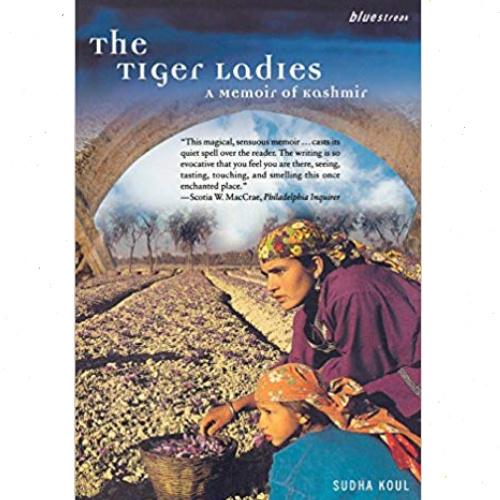
Sudha Koul’s The Tiger Ladies, an elegiac memoir of growing up in Kashmir, describes how Kashmiri Pandit weddings involved fathers giving their daughters solid gold ear ornaments called dejahor, so long that they hung “all the way down to their nipples”. Appalled at her as-yet-unpierced upper earlobes, Koul’s grandmother (Dhanna) hopes she might yet restore her modern grandchild to the way of tradition by explaining the socio-economic purpose of jewellery: “When women needed money, or when their daughters got married, they would cut off one dejahor, sell it, and make two of the other one. The size was the same, but it was hollow inside and no one would know that they had troubles.”

The Tiger Ladies by Sudha Koul

Dhanna’s ear ornaments remained solid till the end; it was her husband's Lahore University gold medal that was melted down to make ornaments for their daughters (“The fact that he stood first was enough—they knew it and everyone else knew it”). But few marriages are as well-adjusted, few households as equitable. And where there is familial strife, jewellery is frequently at its centre. Late 19th to mid-20th century Bengali literature is filled with women (especially widowed old aunts) guarding their jewellery from rapacious relatives: from Leela Majumdar’s children’s classic Padi Pishir Barmi Baksho (Aunt Padi’s Burmese Box, also a 1972 film by Arundhati Devi) to Shirshendu Mukhopadhyay’s Goynar Baksho (made into a 2013 film by Aparna Sen). 

Hearts Made of Stone
The woman obsessed with protecting her jewels appeared in a much darker register in Rabindranath Tagore’s 1898 story Manihara, translated as The Lost Jewels. The horrific vision that ends Tagore’s tale—and Satyajit Ray’s film version, since it forms part of Ray’s 1961 triptych Teen Kanya—is the wife as a ghostly skeleton, whose “bones glistened with gold and diamond ornaments”. 
The female ghost who preys on unsuspecting men is an old folktale trope from Kashmir to Japan. But Tagore is no simplistic misogynist. The narrator of Tagore’s tale pours scorn on Phani Bhushan for belonging to a “new race of men”, so without “a trace of masculine barbarity” that he “was quite incapable of saying bluntly to his wife, “Dear, I’m in need of money, bring out your jewels.” But he has also told us how things came to this pass: because the misguided Phani Bhushan demanded nothing from Mani Malika—he only gave, and “imagined that by giving, he would receive”. “The wife had no particular fault, yet the husband was not happy. And so he went on pouring diamond and pearl jewellery into the cavity of her heart, thereby filling her iron safe but leaving her heart as empty as ever.”
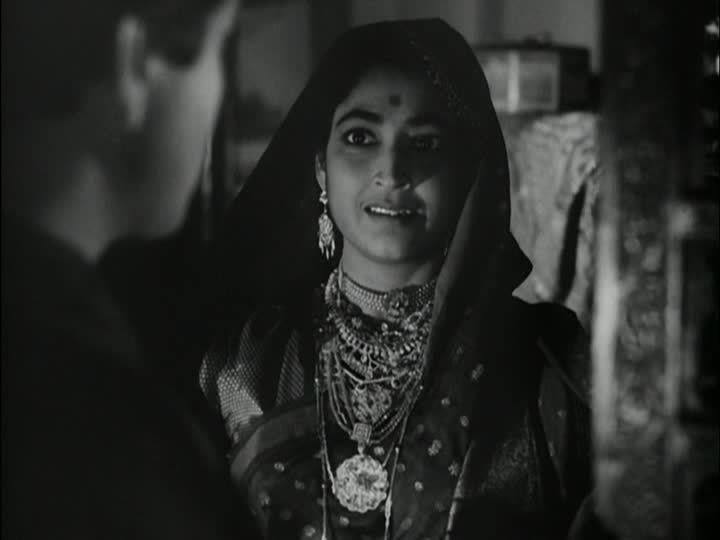
A still from the film adaptation of Tagore's story Manihara, which is part of Satyajit Ray’s 1961 triptych Teen Kanya


Not Quite a Girl’s Best Friend

In two famous European stories, jewels are used to pillory women's desires for other lives, other loves. If The Earrings of Madame De is about its married heroine's fickleness, Guy de Maupassant’s famous 1884 story, The Necklace is a brutal tale of comeuppance for a pretty woman who wallows in self-pity because she has “no dresses, no jewels, nothing; and these were the only things she loved.” The necklace she borrows for one grand party becomes a lifelong noose around her neck—and her loving husband's.  
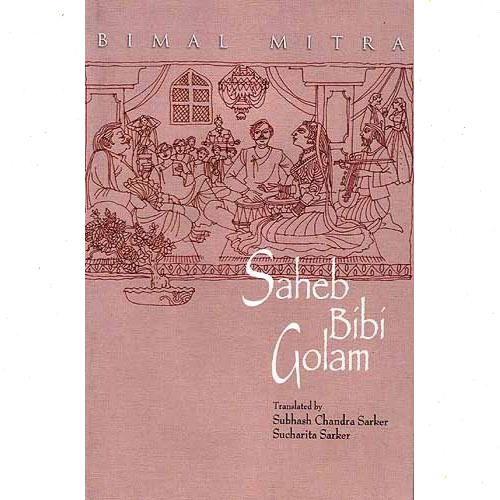
Indian fiction seems to have been more forgiving of the unhappy wife, perhaps because it contains few loving husbands. To end on a classic example, think of the tragically neglected Choto Ma of Bimal Mitra’s Saheb Bibi Golam, who became Meena Kumari’s Chhoti Bahu in Guru Dutt’s classic 1962 film. Half-mad with loneliness, she accosts her dissolute zamindar husband, asking what she should do while he is entertained by his tawaif mistress. His response cruelly suggests the dispensability of both her jewels and her feelings. “Gehne banwao, gehne tudwao,” he sneers. “Get jewellery melted, get new jewellery made.” 
An English translation of Bimal Mitra's Bangla classic, Saheb Bibi Golam
Perhaps, in the end, that is what makes jewellery such a powerful fictional symbol. It stands in for money, and somehow that means people keep trying to make it stand in for love.

Published in The Voice of Fashion,  6 Aug 2019.

30 January 2019

Obituary: Krishna Sobti 1925-2019

My obituary of a great Indian and a great writer, who was also warm, forthright -- and crucially, great fun. 

A DELIBERATE OUTLIER


Like the tragically rising caste of Indians educated almost entirely in English, the only Hindi writers I had read until 15 odd years ago were those prescribed in my school textbooks. Krishna Sobti was not one of them. Then, in 2005, I stumbled upon her Dil-o-Danish in the cold basement of a Columbia University library, and for the next 48 hours, exam semester notwithstanding, I couldn't tear myself away from Sobti's brilliant 1920s imagining of the city I called home.

Among the most delicious of Delhi novels, the saga of Kutumb, Kripanarayan and Mehek Bano is a universally recognisable love triangle embedded in a very particular Indian social context: the Kayastha patriarch, his lawfully wedded wife (perfectly named, 'kutumb' means family), and his beloved Muslim mistress, with whom, too, he has two children. Sobti captured the fraught but irrevocable tie of the marital, but also the deep-seated romantic attachment of the extra-marital. And she did all this while paying effortless tribute to the everyday cultural life of Delhi, from the making of new quilts at the onset of winter to the poems recited by children at weddings.

In the years since then, I read many more of Sobti's books, slowly realising that part of what made her oeuvre so remarkable was her mastery of language. In novel after novel, she worked to create a different milieu, each brought to fruition by her unerring ear for the multifarious spoken tongues that huddle together under the umbrella rubric of Hindi. The rhythms of rustic Punjabi (Mitro Marjani, Zindaginama) were as much under her control as the urbane Urdu-inflected language of Old Delhi's elite (Dil-o-Danish), or then again the mixture of English and Hindustani in a 1970s government office (Yaaron ke Yaar).

Her outspoken women characters, too, made her unique among Indian writers -- and unlikely to be prescribed in school textbooks. Whether it was the rough-tongued desirousness of Mitro in Mitro Marjani, or the difficult memories and sad-eyed yearning of Ratti in Surajmukhi Andhere Ke, or the many close mother-daughter pairs across her books, from Daar se Bicchudi to Ai Ladki, Sobti's very different women were unafraid yet never invulnerable. Perhaps a little like herself.

Her death yesterday, less than a month short of her 94th birthday, is likely to generate tributes to the grande dame of Hindi literature, but Sobti spent much of her career as a deliberate outlier. A Punjabi who chose to write in Hindi, she was too outspoken for the hidebound Hindi literary establishment. Her novel Zindaginama will live on among the most astonishing novelistic depictions we have of life in Punjab, but Sobti remained an outsider to the Punjabi scene -- especially after she filed a case of copyright infringement against the Punjabi literary doyenne Amrita Pritam for naming a book Hardutt ka Zindaginama. She was among the rare Hindi writers who wrote attentively, frankly and sharply about her peers, producing a series of magisterial sketches under the androgynous pen name Hashmat. Most of all, she was that rare Indian woman of her generation who carved out a life on her own terms: not succumbing to marital domesticity for most of her life, and only marrying the Dogri writer and translator Shivanath when she was 70.

When I first met her in 2009, Sobti was 84, and told me with all the clarity of experience: “Household chores sap women’s energies. If the family becomes the limit of your world, then you cannot think big.” It is a thought I often return to, and a dilemma that many women grapple with. Krishna ji resolved hers a certain way, but she knew that wasn't a possibility open to most women, especially in India.

By the time I met her again, for a long-form Caravan profile in 2016, she was 91, and practically as housebound as the mother in her Ai Ladki had been. Shivanath ji had passed away some years before, and she was back to living alone, with her trusted housekeeper-cum-assistant Vimlesh. But she rarely lacked for company: whenever she was well enough to see people, there were always writers, journalists or editors lining up to see her. And she loved to play the host, pressing Darjeeling tea and biscuits and namkeen upon guests in her small Mayur Vihar flat. Once I had spent the whole day listening to delightful tales of her Lahore or Shimla girlhood, or her frank, gleefully giggly accounts of scandalising the Hindiwallas, she might urge me to join her in a glass of rum-paani.

Yet there was something undeniably solitary about Krishna Sobti. When she retired to her desk, the world was always with her. But she always knew it had to be held at bay, in order for her to be free to do what she had been born to do: to write.