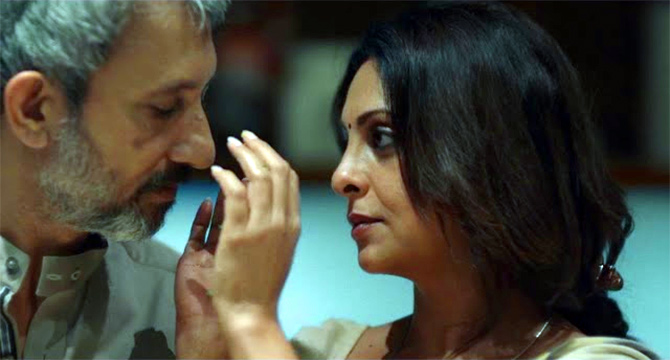
Almost unconsciously, Delhi Crime puts its finger on the disconnect between the police and the public. (The second of a two-part column)
Hindi: chhoti haziri, vulg. hazri, 'little breakfast'; refreshment taken in the early morning, before or after the morning exercise. (Hobson-Jobson: A Glossary of Colloquial Anglo-Indian Words and Phrases, 1994 [1886])
15 April 2019
In the name of a cause
Almost unconsciously, Delhi Crime puts its finger on the disconnect between the police and the public. (The second of a two-part column)
A blinkered vision
For me, the most revealing moment in Delhi Crime arrived a day or so
into the Netflix series’ recreation of how the Delhi Police apprehended the six
men later charged in the December 16, 2012 rape case. In director Richie
Mehta’s screen version, a man called Banke Lal arrives at the Vasant Vihar
police station to tell the cops that at about 8.30 pm on December 16, a little
before the rape took place, he had boarded a similar white bus from Munirka Bus
Stand, been attacked and robbed of his phone and wallet by the six men on
board, and thrown out of the bus near the IIT overpass.
“Had I landed on my head, I’d be dead,” says Banke Lal.
“Why didn’t you report it that night?” asks Vartika Chaturvedi, the
senior cop in charge of the case, played by Shefali Shah.
“Who would I have complained to? I was asking everyone for help, no one
listened,” Banke Lal replies. “I managed to borrow a phone from a passing auto
driver and called my brother, who told me to come home. I figured, what would
the cops do? It was only when I saw the news that I realised that this had to
be the same gang.”
The sequence ends with Chaturvedi thanking Banke Lal for coming to them
and asking for another case to be filed against the same suspects. She then
goes out of the room, leans against a wall as her right-hand man Bhupender
(Rajesh Tailang) wonders if there might be other victims to be found.
“If he had made a complaint that same night, maybe we could have
prevented this,” responds Chaturvedi.
“We don't know that,” says Bhupender. “Ismein hamari kya galti hai?”
“Try saying that to Deepika,” says Chaturvedi, half swallowing her
words.
As I watched the sequence, I couldn’t stop thinking about the fact that
we live in a country in which a citizen who has just been robbed, beaten up and
thrown off a bus can respond to his predicament with “What could the police
have done in this?” It seemed to me to offer an involuntary glimpse of
something the show appears to take entirely for granted: that we as a citizenry
have so little faith in our police force that we don’t go to them for help,
even when we’re victims of an act of targeted violence and robbery, bang in the
middle of the country’s capital.
Then, as I sat down to write this column, reliving my own memories of
December 2012, as all Indian women who watch it will do, I remembered that
there had indeed been such an incident. A man had been robbed on the night of
the gang rape, by the very same men, aboard the very same bus.
It didn't take much looking up online to find reports. What I found in
them was distressing. The Times of India reported on December 23, 2012, that
three constables from the Hauz Khas police station had been suspended for their
failure of duty when approached on December 16 by one Ramadhar Singh, who had
been picked up “from RK Puram Sector 4 by the six gang rape accused, and robbed
and dumped near IIT”.
The report continued: “The three cops were on patrol duty around 8.15pm
when they were approached by Ramadhar. He had told them that he was robbed and
that he had lost his mobile and, hence, cannot call 100. The cops, however,
told them they were from the Hauz Khas police station and he needs to go to
Vasant Vihar to register a case. They neither sent out a wireless message to
track the bus nor had they informed Vasant Vihar cops about the incident,” said
a source.”
I describe this incident in such detail not to make the point that the
heinous gangrape that would end up making Delhi the notorious site of frenzied
international attention was preventable. That may be true, or it may not. The
“what if” that it becomes on the show is easily voiced — and almost as easily
dismissed. Richie Mehta’s version is so insistent on showing Delhi Police in
good light that he simply erases the inconvenient truth that the victim of the
robbery did in fact try to report it and was turned away by cops. It then
absolves the police of even the glimmer of responsibility by making his female
cop protagonist have a moment of guilt, that can, however, be painted as
emotional, even irrational — since in Mehta’s version the onus is on the
citizen who didn’t come to the police earlier.
In many ways, this is transparently the position the show takes: it
makes the police the put-upon heroes, under-appreciated figures whose valiant
efforts to fight crime while being enormously understaffed and under-budgeted
are not appreciated by a thankless citizenry. All we ever see are good cops
being treated badly. The DCP who hasn’t gone home for three nights is taunted
by a judge as being someone who spends her time at parties and has probably
never been to a crime scene. Children in a posh South Delhi school regurgitate
their parents’ assumptions about the cops being corrupt. In a less monied
class, too, Bhupender tells Vartika that he hides his job from any prospective
in-laws he’s meeting because “no one wants either a dosti or dushmani with the
police”.
Vartika chastises Bhupender for not seeing that a family that doesn’t
respect his job will not “protect his daughter”. But the larger issue, the fact
of why a city of 20 million people has a relationship with its police force
that is one of “Best if we never have to deal with them” rather than “They will
help us get justice”, is never really discussed. When we get unwitting glimpses
of the reasons why — such as when some constables on duty taunt and torture the
not-yet-convicted suspected rapists, driving three of them to attempt suicide —
it is not treated as an abuse of power, but simply as something strategically
unfortunate that happens.
But surely if the police in Delhi and in the rest of India are assumed
by the man on the street — and even more so, by the woman on the street — to be
not just professionally incompetent, but a power-seeking, corrupt and
potentially malign class of people that is best avoided, there must be some
reason why. Surely the answer cannot be the one Mehta provides by
ventriloquising the ex-police commissioner Neeraj Kumar, who is a consultant on
Delhi Crime: that it’s every other constituency who’s wrong — the politicians,
the media, the judiciary, ordinary people, students — and the police who are
right.
17 September 2018
Film review: Once Again
My review of Kanwal Sethi's film Once Again, now streaming on Netflix:
Creating characters who share your sensibility is the oldest trick in the fiction writer's book, and writer-director Sethi unapologetically takes this route, making both Tara and Amar agents of the film's unhurried tactility. It makes perfect sense that Tara's cooking, all slow marination and hand-ground masala, should appeal to Amar, the sort of man whose first gift to her is a fragrant, creamy- white gajra.
9 September 2018
Backing and advancing
Has the mature woman with a marriage in her past finally become a legitimate recipient of romance in Hindi cinema?
![]() |
| Irrfan Khan and Parvathy in a still from Qarib Qarib Singlle (2017) |
The idea that their desires are illegitimate is buried so deep inside most Indian women’s heads that even to acknowledge them can feel like taboo. To want companionship, romance, intimacy — and yes, sex — is perfectly natural, but still fraught with the possibility of social censure, especially for a woman past a certain age. So Kanwal Sethi’s atmospheric film
And yet how little it takes to propel her back into guilt. Caught on camera by a paparazzi photographer while out walking with Amar, Tara finds herself to be the target of childish anger from her adult son as well as humiliating barbs from his prospective mother-in-law. Once Again eschews melodrama for piercing looks and pregnant pauses, but Tara’s samdhan manages to get in her critically frosty line: “In our family, we place our children’s desires far ahead of our own.”
Watching even the self-possessed Tara crumble under the pressure, I thought of another recent film in which a woman finds it hard to tell a judgemental world that she’s dating again. Released in 2017, Tanuja Chandra’s romantic comedy Qarib Qarib Singlle starred the well-known Malayali actress Parvathy as Jaya Shashidharan, a 35-year-old woman who’s been alone for so long that she’s forgotten she has the right to move on.
Unlike Tara and Amar in Once Again, whose relationship is conducted through lovely old-school means such as as landline conversations, handwritten notes and home-made meals, Jaya meets her suitor Yogi (
Despite many dissimilarities between the two films, it struck me that both the female protagonists are widows, not divorcees. And the films imply —sometimes humorously, sometimes with pain — that neither woman has been in any sort of intimate relationship since their husbands died. These social double standards are acknowledged by the way the characters are written, too: Irrfan has no compunctions chattering on about his exes to Jaya, from the sweet, quasi-familial terrace romance of his childhood to the sultrier adult one (with Neha Dhupia) — but he is rendered speechless when Jaya digs up an adolescent boyfriend of her own.
The figure of the still-youthful, attractive widow has a history in Hindi cinema — though much less of a history than proportionate reality would demand. Off the top of my head, I can think of Nutan as the translucently lovely widow Mahjubi in the 1973 Saudagar, whom a duplicitous
A much more radical portrayal of a widow who has desires was, of course, last year’s Lipstick Under My Burkha. Ratna Pathak Shah brought both comic flair and a tragic edge to the 55-year-old Usha Parmar, whom the world knows only as the stentorian Buaji, but who yearns to be recognised as someone altogether more tender. Usha’s secret life involves not just reading steamy Hindi romance novels and learning to swim, but also falling for her buff and youthful swimming instructor. Her secret phone conversations with him, unlike those between Shefali Shah and Neeraj Kabi, are unabashedly sexual. And yet when the veneer of anonymity is shattered and Usha suffers public humiliation, it is hard not to think of all those dozens of Hindi films we grew up on, in which the illusions of romance cultivated by the spinsterish figure of Lalita Pawar would turn out to be nothing but illusions.
It will be a while yet before Buaji swims free.
Published in Mumbai Mirror, 9 Sep 2018.
7 June 2015
The Heart of the Matter
![]() |
| Through the looking glass: Anil Kapoor and Shefali Shah in a scene from Zoya Akhtar's Dil Dhadakne Do (2015) |
and-pepper-haired Kamal (Anil Kapoor) and trying-to-lose-weight Neelam (Shefali Shah), both rather fine -- are celebrating thirty years of marriage by inviting close friends and family on an all-expenses-paid luxury cruise. The fact that it's a marriage both parties have pretty much checked out of doesn't seem to matter much to anyone, least of all the gossipy ladies who seem to hang out with Neelam only so they can make catty remarks behind her back. Even the Mehra progeny -- Ranveer Singh and Priyanka Chopra, both effective in their respective roles as hangdog and tightly-coiled siblings -- seem not to particularly care that the anniversary is just an excuse for their parents to conduct a lavish display of wealth.
There's nothing wrong with the premise. In fact, Akhtar makes things interesting by telling us that Kamal Mehra's plastic-container-manufacturing firm is making losses. It makes the expensiveness of the cruise a kind of Jalsaghar-style last dance, before the Mehras are forced to publicly acknowledge impending bankruptcy. It also increases the level of fakeness with which we're now dealing. Plus I enjoyed the idea that someone who thinks nothing of inviting three dozen people on a two-week-cruise can simultaneously keep zealous tabs on how much champagne is being drunk.
One of the unexpected things about DDD as a rich-people film is that the rich people in it aren't oblivious to questions of money. Kamal Mehra's self-made businessman (nouveau riche if you're being snooty) is full of resentment at the people living off the wealth he thinks has been produced by his talent and hard work, and the scenes in which this comes to the surface -- with his wife and son respectively -- are some of the film's most brutally honest. I wasn't quite as convinced by the idea of Ayesha's being self-made because she sold her jewellery to start a business: there's a bizarre obliviousness here about khandaani capital as what helps create capitalists.
But the film's take on these business families is so ridiculously monochromatic that one has the sneaking suspicion that this is the Bombay person's unreconstructed view of the Delhi rich.Whereas in both of Akhtar's previous films, one felt she wasn't harsh enough with her characters, here it seems that she doesn't like them at all. The men's golf-playing camaraderie involves snarkily pulling each other down on business deals, while the lunching wives do the same on personal matters. Ranveer and Priyanka's likeable characters are saddled with familial expectations whose unreasonable burdens Akhtar is clearly sympathetic to, being the inheritor of a weighty family legacy herself. But Akhtar's account of the Delhi elite stops at the lowest level of caricature: uncles who mispronounce English words, and aunties who have nothing better to do than matchmake their daughters, or those of others. And oh God, is it possible that a business scion distressed about selling his private plane would have a mother trying to comfort him with a Nirula's Hot Chocolate Fudge? The whole of the parental generation is shown as so dull, manipulative and narrow-minded that it's not at all clear how their children are managing not to be like them.
These are the distant, controlling rich parents we've met in many a Hindi film (think of Shenaz Treasurywala's parents in Delhi Belly, or Imran Khan's in Ek Main Aur Ekk Tu), and I applaud Akhtar's desire to scale up them into full-fledged characters. Anil Kapoor is brilliant in comic mode - wait for the moment when he hides behind a tree, or the smug grin with which he sits up from a hospital bed. The tragically under-used Shefali Shah is better in the bitter moments, but even she has some exceptional scenes of black humour: "Acting kyon kar rahe ho?" she says to her suddenly romantic husband, deadpan. "Koi nahi dekh raha."
Such constant transitions from humour to high drama are not easy, and the actors do a fine job, even if the film doesn't always pull it off as a whole. Even Rahul Bose, cruelly miscast as Ayesha's preachy illiberal bore of a husband, manages some decent physical comedy on the tennis court. It's clear that Akhtar is aiming for something that sits between our love of melodrama and a sharply funny undercutting of it. The signature scene that exemplifies this is probably the one where a character threatens to cut her wrist -- with a butter knife. The deliberately dramatised climax, too, is of this ilk.
But when you've spent a whole film showing people as hypocritical control-freaks who're only concerned with what 'society' thinks of them, it's hard to believe in their last-minute changes of heart. No matter what the film's most ridiculous device -- the family dog Pluto, pontificating on human foibles in the voice of Aamir Khan -- tells us, it's hard to believe these unpleasant people have a dil that dhadkos after all. We can but try.
Published in Mumbai Mirror, 8 June 2015.