Showing posts with label Bangalore. Show all posts

26 July 2020

The Reel Life of MS Sathyu - II

My Mirror column (a sequel to last week's piece):

In honour of his 90th birthday earlier this month, a look back at MS Sathyu's under-watched 1994 film Galige, currently streaming online.

At the very start of Garm Hava, Balraj Sahni's Salim Mirza waves goodbye to a train at the station and sits himself down in a horse-drawn cart. The Agra of the 1940s is small enough for the tangawalla to be acquainted with each customer. Who have you dropped off this time, he asks. “My elder sister,” says Mirza, adding a gloomy metaphorical remark about how thriving trees are getting cut down in this wind. Yes, agrees the tangawalla, those who refuse to uproot themselves will dry up. Then he adds a Hafeez Jalandhari couplet, rendered in its most charming street avatar: “Wafaaon ke badle jafa kar riya hai/ Main kya kar riya hun, tu kya kar riya hai?” (I'd translate that as “You torment me in exchange for my loyalty/What am I doing, and what are you doing?”)

What's remarkable is the spectrum of moods that the sequence encompasses. There is the sombre farewell, the meditative remark, the deep sense of living through a eventful time -- and yet all of it is leavened by the comfortable chatter of the everyday, by casual acquaintances who make up one's sense of home, and an ear for humour in the minor key that keeps one from dipping into the doldrums. Galige, which Sathyu directed in 1994, attempts to create the same kind of energy.

The film has two narrative threads, both with immense potential for melodrama -- but Sathyu staves off all maudlinness. Currently playing in the Indian section of an international film streaming platform, Galige centres around a young Bangalorean woman named Nithya. She lives alone in a rented house and has a job in the HMT factory, riding a two-wheeler to work each day. One day, the orphanage where she was raised calls her. An old couple has arrived from a North Karnataka village to claim her as their long-lost granddaughter.

Now this is a theme that doesn't just animate popular cinema in India, it forms the matrix for it: the family separated by a calamity and reunited at the end, the pauper who is really a prince, the enemies who are really biological brothers. Whether as the basis of a comedy of errors (think of every single double role film you know), or the underlying theme of the family melodrama from Waqt to Trishul, or even when ostensibly subjected to questioning by the plot -- as in Awara's nature vs. nurture debate, or Yash Chopra's unsuccessful but fascinating Dharamputra, in which a Muslim orphan grows up to be a Hindu fundamentalist, blood ties are assumed to be the ties that bind.

But unlike the hundreds of film orphans we have all grown up on, Nithya does not hanker for a family. She is guarded, unsure if she wants to be co-opted into an identity she has thus far escaped. The orphanage manager's reminder that she was brought in by a fakir, on the other hand, makes the wannabe grandmother baulk: what if she's actually a Muslim? They part company – but on her way back home, Nithya feels bad for the stranded old couple and decides to invite them to stay with her for a while.

A still from Galige (1994)

What Sathyu does is quietly subversive at many levels. By making the young female character financially independent, and the old couple needier than her, he shows how easily existing power equations of age and gender can be reversed. The 'family' becomes something chosen, contingent on mutual desire and supportiveness, rather than a unquestionable given. Within this new space of equivalence, the young woman makes her own decisions, refusing to kowtow to either neighbourly gossip or 'grandparental' interference. She looks out for the old people, and enjoys their companionship, but feels no obligation to live by their rules. The old couple, for their part, learn that their opinions are simply that – their opinions.

Galige's other subplot is even more surprising – the Khalistan movement, and the fate of a reformed terrorist. Girl does meet boy, even in an MS Sathyu film, and Nithya meets hers in a thoroughly charming Antakshari scene on a train. As a girl without a family, she is perfectly comfortable with a boy without a past. And by bringing a Punjabi boy into a relationship with a local girl, of course, Sathyu plays on Bangalore's insider-outsider tensions. In the film, though, the locals' suspicions turn out to have some basis in fact – not all unknown pasts are equally benign.

There are many other moments when the film touches on the question of identity – Nithya's Japanese boss at the HMT factory, the Sikh dhaba owner or the play within the film where Ekalavya's birth becomes the cause of his tragic fate, while Guru Dronacharya shifts all blame onto him: “How can you hold me responsible for your low birth?” In an early aside, the film's resident commentator, one Narhari, asks the rhetorical question: “Do we lack temples, mosques, churches, gurdwara here? Must slap Urban Ceiling on gods – only so many temples per god.” Nithya herself speaks often of not needing to have a religion, of being free to believe in people.

All the threads of Galige don't necessarily come together. The music can feel tacked-on, as can some of the attempts at comedy, and the Punjab segment has the rushed quality of nightmare. The film's uneven tapestry benefits from being woven of low-intensity conversations, like the Bangalore in which it unfolds. In one lovely odd little moment, a drunken Narhari sings a Kannada song by the poet Rajaratnam to a companion in a prison cell: “If you wish to live, escape from this world. Create your own, forget this one.” Words to live by, now more than ever.

Published in Mumbai Mirror, 19 Jul 2020

8 September 2019

Abhishek Majumdar: Theatre Interview

A two-part interview with the multi-talented Abhishek Majumdar, published on Firstpost in August:

At 38, Abhishek Majumdar is one of India's most exciting playwright-directors. An alumnus of the London International School of Performing Arts (LISPA), Majumdar grew up in a Bengali family in Delhi. For the last decade he has been based out of Bengaluru. The Indian Ensemble, which he co-founded in 2009 and ran until 2018 with his friend and colleague Sandeep Shikhar, has produced some of the most interesting Indian plays of recent years: the Kashmir trilogy of Rizwan, Djinns of Eidgah and Gasha, the 10th century philosophical-political drama Muktidham, and the Allahabad-set Kaumudi, which is both a tribute to Mohan Rakesh and a complex engagement with the epic heroes Ekalavya and Abhimanyu.

His plays have been published by Oberon Press, UK, and translated into multiple languages from Marathi to Czech. His play Djinns of Eidgah was staged by Jaipur's Jawahar Kala Kendra this January and at Mumbai's Prithvi Theatre earlier in August. Another production of Djinns by the Bread Theatre and Film Company of Cambridge is currently being staged at the Edinburgh Fringe until 18 August.

In this interview, he speaks about theatrical form and content, the politics of language in India, and his many interests beyond the stage.

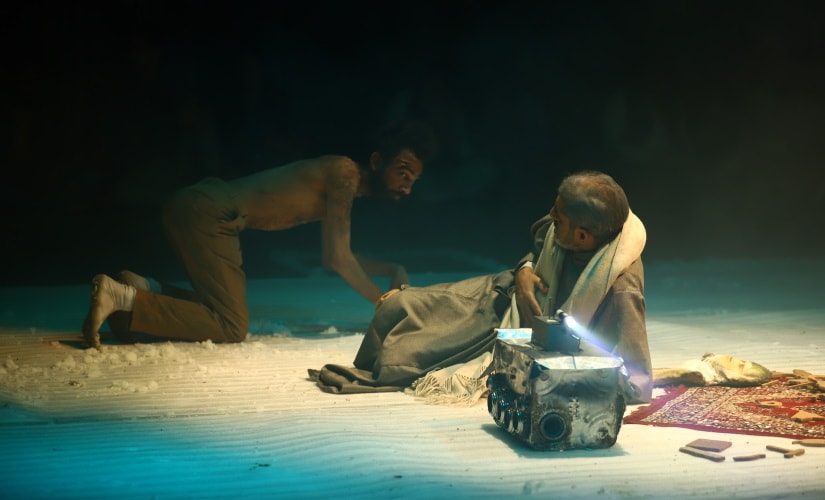
Muktidham, written and directed by Majumdar
The first time I heard of your work wasn't a play; it was at Lekhana, in Bengaluru in 2013/14, where you read a Hindi short story. Do you still write short stories, or things other than plays?
I do, but I don't share them with the world. They're not necessarily about personal subjects, but the act of writing a short story is for me very personal. I like to keep it for my friends and family. I have consciously never published my stories. I compose music sometimes, for other people, for other plays, sometimes for professional musicians. I also paint a little bit. That helps me in scenography, but mainly I paint for myself.
Coming back to the short stories, there is a series called Lakdi ke Makaan, which I have been working on, about women who live in the villages of Shimla (my aunt lives in Shimla). Someday it might become a monologue by an actor. But right now only about 10 people in this world know that I write stories.

Your short stories are in Hindi, but would it be true to say that you wrote plays in English earlier, and now write plays in Hindi?
I write in three languages: Bangla, Hindi and English. My first play, an adaptation of Sunil Gangopadhyay's novel Pratidwandi, was in Bangla. Later I wrote Dweepa in Bangla, but it has only been performed in Kannada.

I'm currently writing an adaptation of Shakuntalam, that's in Hindi. I recently wrote a satire about Communist history, which hasn't been produced as yet, called Dialectical Materialism Aur Anya Vilupt Jaanwar. That's in Hindi, although it starts in Calcutta at the time of collapse of the Berlin Wall, and then goes back to Karl Marx and Adam Smith at the Garden of Eden. I'm still working on that play, but strangely it's been translated into Czech and won an award in Prague. [laughs]

Translations of my plays are happening/have happened into Gujarati, Kannada, Marathi, French. Rizvan got translated from Urdu to Bangla, because there is a show in Bangladesh.

All my work internationally is in English. I write those plays in English whose natural language would not be Hindi or Bangla. So for example, Pah-la, which was staged at the Royal Court Theatre in London last year, is set in Tibet; that I wrote in English. I have another recent play, Batin, set in Medina on the two nights between the Prophet's death and his burial. It's about what happens when the word of God is not understood by everyone in the same way. The natural language of Batin would be Arabic. So that's in English. An early play of mine, Harlesden High Street, was in English. But now I don't produce any work in India in English.

So there has been a move towards Hindi?
Directorially, yes. Five years ago our company did make work in English. I consciously stopped. For two reasons. One, English is the only language in India where knowing the language is enough. In any other language, you also have to know how to act. Frankly, I find far fewer options for actors in English than in Hindi or Bangla or Kannada.
Secondly, an Indian audience watches Hindi or Bangla theatre differently than English. Their bodies change. Because theatre is fundamentally a community thing, you watch it with people. And when you get the third layer of the language — the language that you may have not gone to school in, but the language in which you make fun of people — that is the right language for that stage.
For example, if you read [Girish] Karnad in Hindi, that works much better than reading it in English (though some of the English translations are fantastic).
In India, my rehearsal room is also much more alive when I'm rehearsing in an Indian language. I am directing a play in New York in English, but there my actors' natural language is English. The contract of language is three-way: between the maker, the actor who is performing and the audience. [The play] has to be in the most suitable language for all three, not just for one.

Have you directed a play in a language you don't understand?
Yes, Kannada, which I follow, but don't speak. And I've done a play in London 10 years ago, which was seven vignettes: one in Hebrew, one in Cantonese, one in Arabic...

And that wasn't a problem?
No. Direction-wise, then it was less of a problem. Perhaps now it would be more of a problem. I was a drama school student then, more interested in form. Now I've gotten more interested in meaning.

Tell me more about your interest in form.
Essentially, a play is composing form over time. It's a bit like the work of an architect. One is always thinking about structure. And I've been an avid mathematics student, interested in pattern, shape, geometry, topography. Every play is a problem with multiple solutions.


Give me an example?
I'll give you two examples. For Muktidham, the problem was how do you write a play which from inside is European, but from outside is in the Indian epic format. Structurally, it's not a Greek play with three acts and five plot points; it is cyclical, there is a sense of elaboration. But the scene-work inside the play is not in the epic format: nothing is sung, for instance.

What is very Kathakali about it is that from the interval to the next scene, there is a big jump. We believe that time lapse for two reasons. One, because we believe there is a wall — the wall behind which the Buddhist king is standing. We never see it, but we believe it, and so we assume a certain urgency to everything else. Which is a very Kathakali thing to do. You know — “Duryodhana is coming”, but the scene only has Draupadi and the brothers. The other thing is that although you move forward in time, but the eclipse is stuck. It's nothing, really, it's one profab light on a disc! But it allows us, I think, to continuously imagine suffocation.
In Kaumudi, the challenge I set myself was linguistic: to write a play which used both the language of Aashaadh Ka Ek Din and Adhe Adhure [two classic Mohan Rakesh plays, one set in the time of Kalidasa, one in the 20th century]. So there is the play, and there is the play within the play. And there's a third language the characters use when they are playful, which is similar to Pandavani.

So each of your plays is a research project. Literary, anthropological, historical.
Yes. But art is about memory. It's about how you remember your research. That's the difference between researching and writing a paper, and researching and writing a play. A play has to go through oneself.  It can't be just your thesis — it's got to be your observation of life, your sense of taste, your politics, what you want to say.
But for me, if something doesn't have a hard problem to solve, it doesn't interest me. I can watch plays which are not very complex, I can watch anything live. But to work on an idea for two years of my life, it has to be intellectually complex.
PART II 

Is there one idea that each play starts with?
The theatre is all about confluence. For an idea to become a play, seemingly different things must stick together. Like in Kaumudi, you have a father and son, who mirror Ekalavya and Abhimanyu. The father is going blind, and there is a theatre inside a theatre. These could be four different plays. But I am fond of density, that's my thing. Though that is also one of the criticisms of my plays.

 Playwright-director Abhishek Majumdar on theatre as confluence, its future in India, and directing a film
Abhishek Majumdar

Density leads us nicely to my next question. You work in Hindi, in a moment when there's increasing criticism of the elitism of English. But you also work in theatre. Do you ever think about reaching out to larger audiences?
I have a lot of confidence in the theatre. If a play is worth anything, it will outlive at least one generation. And over time, plays have large audiences with a much deeper level of engagement. So I think the idea of audience is a more complex matrix than just the number of people right now — it's also about density, how many, where. 
The paradox of our time is that in this political moment, you want to make work because it feels urgent. Which is of course necessary, in the face of what is going on. But at the same time there are so many philosophical problems in the humanities and sciences which are completely worth looking at. Is an entire generation of artists only going to look at Hindutva? Maybe it has to, but we also need deviations.
Having said that, I make theatre because I like every dimension of it. I love the craft of it, the art of it, the coming together of people to do it it, the teams that we build, having that audience live, reaching out, going to small towns, going to big cities. While closing Muktidham, we had a moment where Sandeep Shikhar's daughter Sanchi, who I have seen being being born, was sharing a room with Ram Kissar, who does our make-up, who has worked with BV Karanth since he was 20. This is possible in the theatre, because of the nature of its form. It's not like everybody has to be trained in one dance form. It is rough, rugged, it is mixed, it reflects the streets of your town. The street has an old man and a young woman, so the green room must have that. And that is for me the reaching out of the theatre.

But are you often accosted by the question of whether you want to direct a film? Or turn your plays into films?
Suman Mukhopadhay, I call him Lal Da, has won a major award to make a film out of Djinns of Eidgah. I am not a big fan of cinema, though I will direct a film at some point. What I am interested in is directing concerts. I grew up travelling a lot with Indian Ocean, and that gave me the idea that there is a dramaturgy to concerts. A couple of bands have asked me. Susmit [Sen] also asked, but I've looked up to him for so many years, I can't direct him! He will have no problem, but I will have a problem. But now I'm thinking of a concert of sound designers, as opposed to musicians.
Djinns of Eidgah, by Abhishek Majumdar
A still from Majumdar's Djinns of Eidgah

Would you write the music for such a concert yourself?
Some of it. Right now I compose mostly for plays. I took music for granted, because I grew up with Hindustani music classes in my house, and my mother playing the piano every evening and singing Rabindrasangeet. I can use Bengali notation, Swaralipi, which is often used on the piano.

How do you see the state of theatre in India? Are there exciting things happening?
I think art and science need a lot more government support. These things are important for human beings to exist, and they can't be market driven. This emphasis on the commercial, treating ticket sales as the parameter of existence, as if without it you're not speaking to the people: that's a cop-out for not thinking deeply about what the human race needs.
Individually a lot of exciting stuff is happening, from solo performances to technological things. What in Europe is called 'site-specific theatre' has been happening in India in Prahallada Naatak for a thousand years. Going to the proscenium is a new thing for us. But now, the urban Indian is coming back from the West with the idea that only what's being made there is work.
As a person who teaches in a university, I straddle some of these worlds. For the last five years, I teach playwriting at the NYU campus in Abu Dhabi for a semester every year. I have never had two students in the same class from the same country.

How many students in a class?
Eight to eleven, from India, but also Jordan, Palestine, Latin America, the African countries. And the challenge is that they all need to find specific solutions to their postcolonial situations. We are much closer in the arts and sciences to Bangladesh or Algeria than to New York or London. But we have started thinking of the world as a ladder. That's not helpful at all. Yes, there are great things to learn from a cultural exchange of that sort. But just as the first world person is always operating out of a particular context, it is also important for us to operate out of our context.
I was telling a student the other day that if you want to know where you are making art, you have to ask yourself two questions. One, if about 10 to 12 percent of a country's GDP is spent on arts, then public support for the arts in say, Germany, is about 300 percent that of India. Second, you need to be conscious of historical imperative. It is lowest on Broadway, in New York, which is farthest from colonisation. You can make anything, it basically has to sell tickets. And it is highest in the Gaza strip, because right now, as you're making that play, you are colonised.
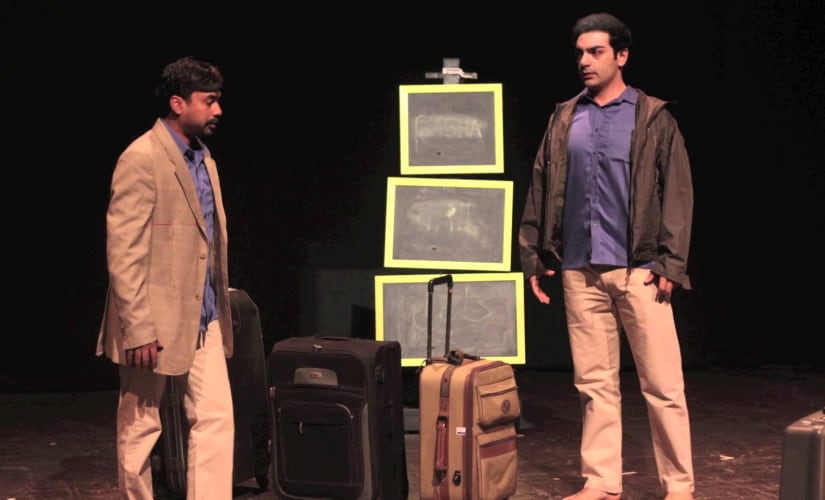
Gasha1 825
A still from Gasha, written by Irawati Karnik and directed by Abhishek Majumdar

Why is your idea of historical imperative limited to the experience of colonisation?
Yes, I'm being simplistic, in order to find an axis that works globally. There are other axes not directly related to colonisation. Within India, how many plays do we see with lower caste women as characters? Nothing, compared to the many with upper caste men.

You mentioned that developing a Dalit dramaturgy is one of the things you're excited about.
Yes. After we moved on from Indian Ensemble, Sandeep Shikhar and I started a new theatre company along with  Vivek Madan. It's called the Bhasha Centre, and our main focus are at the moment is to work with Dalit texts and Dalit writers, from Daya Pawar and Limhale on Dalit aesthetics to published Dalit autobiographies and the work of lok shahirs. It might not be a literature that already exists. We're collaborating on a version of Kisaan that will open at Prithvi Theatre in March 2020. Iravati Karnik is writing it, drawing on Prithiviraj Kapoor's original play Kisaan together with Daya Pawar's Baluta.

Any other ongoing projects you'd like to flag?
There's Tathagat, a street play we did in collaboration with Jan Natya Manch, which played in Mumbai from 9 to 14 August. There's a version of Eidgah ke Jinnat with Jawahar Kala Kendra, Jaipur, with many Rajasthani actors. Djinns of Eidgah is also being staged at the Edinburgh Fringe Festival this month, by Ananya Mishra and the Bread Theatre Company, formed by a lot of non-white Cambridge University students.

As someone who works in London and New York as well as in Bengaluru and Bangladesh, it is important to me to know how much time I work where. I am not making work in England in order to give up my work in India; that's not going to happen. But last year we were touring in Uttar Pradesh and sleeping in trains, and just after that I spent a month in New York. And that is absolutely fine in the theatre. But as time gets limited, it becomes important to choose, to measure.
I like that we have come back to the mathematics. Thank you, Abhishek.

Published in Firstpost in two parts, 19 and 20 August 2019.

17 July 2019

First as tragedy, then as farce

A very short profile of the playwright-director Abhishek Majumdar, for India Today magazine.

THEY TAKE AS THEIR THEMES OUR MOST DIVISIVE ISSUES, BUT ABHISHEK MAJUMDAR’S PLAYS CAN STILL MAKE YOU LAUGH


"Oonchi jaat ka rajnitik sammelan hai. Log bhadakne ke liye hi aaye hain (It’s an upper caste political meeting. People have come only to take offense),” says one of a trio of actors playing Nats, traditional street performers who make up the ostensibly “comic relief” track of Muktidham. It is a packed closing night for Abhishek Majumdar’s brilliant 2017 play, and Bengaluru’s Ranga Shankara Theatre breaks into laughter. The next evening, during a show of Kaumudi, another Hindi play written and directed by Majumdar, the crowd laughs even more uproariously. Yet those who follow Majumdar’s work are unlikely to call it funny. Working in English, Hindi, Bengali and sometimes Kannada, the 38-year-old playwright-director has subjected some of the most divisive issues of our time—immigration, Hindutva, caste, Kashmir, Tibet—to rigorous research and intense ethical questioning.

Harlesden High Street (2010) dealt with working class Pakistanis in London. Muktidham, set in a fictional 8th century temple town, uses the historical tussle between rising Buddhism and a threatened Brahminical Hinduism to interrogate the narratives of both religions, especially the present-day Hindu right’s claims to non-violence and castelessness. Kaumudi, set in early 20th century Allahabad theatre, wrestles with epic figures like Abhimanyu and Eklavya in the context of a conflicted father-son relationship. Three of his plays are set in Kashmir. Rizwan, based on Agha Shahid Ali’s poems and Eidgah ke Jinnat, about state and non-state actors caught in the cycle of violence, are both written by him; while Gasha, in which a Kashmiri Pandit man returns to the state years after leaving it as a child, is by Irawati Karnik. Violence and non-violence are also central to his most recent production, Pah-La, whose depiction of the Chinese use of force on Tibetans caused London’s Royal Court Theatre to delay it for over six months.

Actors Ipshita Chakraborty Singh and Sandeep Shikhar
in a scene from Majumdar's play 
Muktidham 
Seated in the green room with a tumbler of Ranga Shankara’s strong Rs 20 coffee, a deadpan Majumdar demonstrates he can treat humour as seriously as he does other things (or is it the other way around?). “I’m often asked ‘Is this play a tragedy or a comedy?’ I say, when you think about your life, is it funny or is it sad? It simply isn’t one way or the other. Also, tragedy and comedy are western categories. What is the Mahabharata, or Betaal Pachisi, or the Arabian Nights?” That said, he is excited about advancing his grasp of humour, starting with Dialectical Materialism Aur Anya Vilupt Jaanwar, a new play about Communist history by him.

“I’ve written comedy into plays that aren’t of a comic form, but this is my first satire. I’m older and maybe tragedy is a form for the young,” says Majumdar, who did a Masters at the London International School of Performing Arts and, since 2013, spends a semester a year teaching playwriting and philosophy at the New York University’s Abu Dhabi campus. In India, most of Majumdar’s plays have been staged by the Bengaluru’s Indian Ensemble, founded by him in 2009 with actor-playwright Sandeep Shikhar. In 2018, in an attempt at de-personalised institution-building, they handed it over to Chanakya Vyas as artistic director. “Everyone who wants to run a theatre company shouldn’t have to start it,” he says.

Majumdar has since started a new one. The Bhasha Centre for the Performing Arts, started with Shikhar and actor Vivek Madan in 2018, focuses on South Asian languages, particularly Dalit dramaturgy. “We maintain many principles from Indian Ensemble: all members paid equally; free tickets for those who can’t afford them,” says Majumdar, who believes theatre deserves more government support. “The Ramayana, which people are now fighting over, wasn’t created as a market-driven exercise. Neither was Bhasa or Kalidasa. They are important for humans to exist and they can’t be market-driven... On that Friday, a play may not have the largest audience, but if you ask in about 80 years, it might.”

Published in India Today, 5 July 2019.

20 November 2018

Streets full of dreams

My Mirror column:

Two recent city films, one from Delhi, the other Bangalore, make us think about the role fantasy plays in the lives of the poor.


The memorably named Ghode Ko Jalebi Khilane Le Jaa Riya Hoon (I’m Taking the Horse to Feed It Jalebis) is a welter of visions. “This film is culled from interviews and dreams of pickpockets, street vendors, small-scale factory workers, daily wage labourers, domestic workers, loaders, rickshaw pullers and many others labouring in the city of Shahjanabad, Old Delhi,” reads the opening text of Anamika Haksar’s debut film. A long-time theatre person and activist, Haksar has said in interviews that the film germinated in her mind soon after her marriage, when she first began to spend time in Old Delhi and had a window looking out on a roof where three men slept every night.

Watching Ghode at the Dharamshala Film Festival earlier this month, it was clear to me that Haksar had spent many years with that memory, trying to turn that real window into a metaphorical one.

Ghode retains her originary three men on a roof, giving them professions and roots — the pickpocket (Ravindra Sahu) and the sweet seller (a tragically under-used Raghubir Yadav) are from UP, while the loader (K Gopalan) is Malayali. But she surrounds them with a cast of 400 non-actors from Purani Dilli. An unorthodox mix of animation, fiction and documentary, Haksar’s film has a clear political aim: expanding an uncritical, vaguely nostalgic gaze (afforded by her upper-middle-class Kashmiri family’s Old Delhi connections) into a perspective simultaneously sharper and more broad-based.

A crucial conduit in that politics of representation is the portly figure of Akash Jain, a well-off resident who serves as guide to Old Delhi, and as faux-sutradhar to the film. Played by real-life theatre person Lokesh Jain (who with his partner Chhavi did the interviews on which the script is based), “Awaragard Akash” sings the city’s praises in highfaluting clichés as familiar as they are fake. To watch him shepherd clueless visitors through this overburdened, garbage-filled, drug-addled place of poverty and backbreaking work, while declaring it “Tehzeeb ki jannat (A heaven of civilization)” is to both laugh and cry at the ironies we live with.

Less successful is the film’s shunning of a linear narrative and near-total jettisoning of psychological realism. Ghode’s multitude of dream visions can be surreal and cheeky — levitating corpses bandaged in white; a calendar-style Lakshmi contending with a lehrata hua Communist flag, or my favourite: a labourer’s fantasy of his exploitative boss turning into a lizard. But there’s also a hyperreal mode that tries too obviously to grab our attention: for instance, that same labourer’s muscles shown pulsing exaggeratedly, at excruciating length.

Dreams animating the dreary lives of the poor are also the subject of Indu Krishnan’s 78-minute documentary, Good Guy, Bad Guy, which was screened at the Urban Lens Festival in Delhi yesterday. Like the 59-year-old Haksar, Krishnan spent over five years with a much younger working-class man who is her central character. She first meets Zakhir in Cubbon Park, that island of quiet in the raucous tide engulfing Bangalore. He is feeding the monkeys — not by strewing food on the ground, but feeding each individually.

Krishnan finds this unusual and decides to get to know him. A runaway who left home many years ago, Zakhir works as a ragpicker in Bangalore’s scrap-sorting area, Jolly Mohalla. By day, he trawls the city’s streets for reusable trash. By night, his primary concern is to find a safe place to sleep. The animals he befriends — monkeys in Cubbon Park, street dogs, even pigeons that roost above a house where he sleeps — are a refuge in a hostile city, and Zakhir imagines their lives as implicitly better than his own. “No one bothers these creatures,” he tells Krishnan. “They can do what they want. If they show up at Cubbon Park, they’ll get fed, too.”

That imagined life is quite different, however, from that of a caged animal. In one of the film’s oddly moving juxtapositions, when Zakhir ends up in jail in a murder case, the filmmaker manages to track him down and asks him if he might want to work in a zoo upon release since he likes animals so much. Zakhir’s response is characteristically gentle but immediate: “It is a sin to keep animals captive.”

Later in the film, he ends up working for a piggery. But with Krishnan’s help, he also embarks on an attempt to fulfil what he tells her is his real dream: directing a feature film. In contrast to Ghode’s biting sarcasm and rambling excess, Good Guy is a gentler, simpler film, a bit like Zakhir. Like Haksar, Krishnan remains a privileged outsider, never really exposing herself. Still, despite some unnecessary drama and bad background music, her honesty about her own position vis-à-vis Zakhir — bailing him out or connecting him with a Kannada filmmaker because “without that there would be no film” — disarmed me.

Watching the near-illiterate Zakhir create a script and songs for his film, with at least one featuring himself as a sort of anti-hero, it was hard to know how I felt about his dream life. The question is similar to the one implicitly raised in Haksar’s film: do dreams keep people from being crushed by hopeless conditions? Or are they a perpetual escape from reality?

18 April 2018

Book Review: Anjum Hasan's A Day in the Life

A Question of Belonging
Hamish Hamilton, 2018. 256 pages. 

Anjum Hasan's writing has never lacked craft or perspective. The 14 stories in A Day in the Life, Hasan's sixth book, surpass her own exacting standards.


The tenor might be meditative, but the prose is light-footed, spry, often droll, sometimes downright wicked. In 'Sisters', a woman shrunk by sickness starts to see the healthy as ogres: "They are huge, they dominate the skyline, they eat up the bandwidth". Sometimes a character swings between optimism and despair, grand resistance and quiet accommodation. "There were no new ideas to be found in the city so I retired last year to this small town," begins the narrator of 'The Stranger', before letting an air of meta-resignation take over: "A whole population's worth of people with reduced hopes, happy to cut their coats according to their own cloths."


Whether the protagonists feel at home or (more often) out of place, the places themselves are evoked with detail and tenderness. In 'The Legend of Lutfan Mian', we savour a two-day walk to Banaras in a 19th century Indian landscape about to reframed by trains and the telegraph. Shillong, the town of Hasan's childhood and setting of her first novel Lunatic in My Head, features here in the nostalgic but acute 'A Question of Style', while Delhi --  Okhla Gaon -- makes a surprise appearance in the melancholy but arresting 'Little Granny's Song'.


At their heart, Hasan's tales are investigations of the question of belonging. Her characters might inhabit a dense web of locality, like the protagonists of 'Nur' who must map the don Mushtaq Bhai's house in relation to the Arabic College, or the Islami Nikah Centre as being "where Salim's sister's wedding was fixed", but from which someone can be suddenly airlifted into an imagined Dubai. Or they might live in an impervious middle-class bubble, like Jaan in 'Sisters', or Gulfam in 'Yellow Rose', who wants to be an android in a post-apocalyptic society but is stuck with Bangalore, and sometimes forced to go to "Bengaluru".


Hasan understands this upper middle class person with a tenuous grip on the world. Gulfam arranges her life so that "week by week, she saw a little less of the outdoor world of heat and dust that did not respond to a click or a swipe". 
The retired Mr Murthy in 'I Am Very Angry' is unable to "wholeheartedly like his fellow in the old way anymore".

But Hasan's understanding is not indulgence. We are all implicated. "Each of us, the guiltily innocent, has his own means of getting away from the news," begins 'Elite'. The headlines press in -- urgent, destructive -- and often it needs nature to offer a reprieve.

5 January 2017

Men on the Ropes

My Mirror column

Dangal grapples with wrestling’s tradition of masculinity — and Indianness.


On the simplest level, the tale told in Dangal is an inspiring, heartfelt one — of women entering an arena traditionally reserved for men and not just surviving but making a mark. The two young women whose journey the film tracks — Gita Phogat and Babita Kumari — are a beacon not just of bodily discipline, but of the struggle against mindsets. Their lives are a window through which we catch a glimpse of a possible new world: the world as it might look if girls in North India were treated the same as boys.

At another level, though, Nitesh Tiwari’s film (not unlike Ali Abbas Zafar’s Salman-Khan-starrer Sultan earlier this year) is a carefully calibrated engagement with masculinity, femininity and nationalism (not necessarily in that order). And it is no coincidence, it seems to me, that the chosen site of that engagement is wrestling.

With links to royal patronage and feudal elite sponsorship, writes the anthropologist Joseph S. Alter in his study of wrestling culture in North India, wrestling has a long history in this part of the world. And although wrestlers earn prize money at the regional, state and national levels, it is not the professional sporting academies but the informal local akharas — public institutions often run on gifts, neighbourhood chanda collection and charitable donations — that feed the widespread popular interest in wrestling.

Both the wrestling films I am speaking of have taken on board the sport’s in-between, possibly ambivalent status —as something local and deep-rooted and organically Indian, but also tragically undervalued by the very national custodians of sport who should be propping it up. In both the fictional (Sultan) and non-fictional (Dangal) narrative, of course, the assumption is that this indigenous sporting tradition will finally acquire value by being showcased on the world stage.

Onwards to masculinity. “Wrestling in India (pahalwani) is a sport engaged in exclusively by men who are extremely concerned with the nature of their masculinity,” writes Alter. Any woman who has ever tried to enter an akhara (a gymnasium in which pahalwans practice) knows that it is well-nigh impossible to be allowed in, even just to watch. Just last July, at a small but reputed akhara in Shivajinagar in Bangalore, I was curtly told to stand outside, while my male companion — as much of an outsider there as I was — traipsed happily in. (Dangal’s titling images of real-life young wrestlers — large, serious-faced boys in langots — are thus a rare equal-opportunity sight.)

The point, however, is that keeping women out of the akhara is not just a regular form of gender injustice; it is entwined with traditional beliefs that have shaped wrestling in the subcontinent. This is a culture of masculine excess, simultaneously bombastic and threatened, driven by an obsession with celibacy, disciplined self-control and the retention of semen — all only achievable by steering clear of the poisonous temptations represented by women. As one old pahalwan says to Aamir Khan’s Mahavir Singh Phogat when he seeks training at the akhara for his daughters, “Is umar mein paap karvaayega ke?” 
The ideological links with certain traditions of Hindu asceticism should be clear. 

Less obvious — but more fascinating — is how wrestling is seen by its practitioners as a form of self-perfection in the service of the nation, and the way that self-construction might connect to Gandhi’s pushing of the celibacy ideal as part of nation-building.

So it should not surprise us that in what is arguably the most bombastically hypernationalist year independent India has yet seen, the Hindi film industry has given us not one but two films about wrestling. What’s interesting is that both Sultan and Dangal chose to engage with the figure of the female wrestler, rather a rare species in real life. In both, the women bear the burden of their father’s ambitions — and they come out shining, so long as they keep their sexuality at bay.

In Sultan, the educated daughter (Anushka Sharma) returns to the village to represent her father’s akhara and increase its status; she does very well in her appointed task, until love, marriage, and an ill-timed pregnancy comes in the way of her winning a world title. In Dangal’s retelling of the Phogat sisters’ lives, it is their ex-wrestler father Mahavir who makes the decision for them. Among the most emotive scenes in the film’s first half is the way the girls are coaxed and coached out of girly-ness. In what feels like a radical role reversal for a man who is otherwise a standard-issue rural Haryanvi father with traditional expectations for women, Mahavir practically forces his daughters to wear shirts and shorts, wakes them up at five every morning for a gruelling fitness routine, and in a gutwrenching scene, has the barber chop off their hair.

The plot of Dangal’s second half, in fact, turns on Gita’s becoming distracted from her appointed purpose in the world — wrestling — by relaxing into the ordinary femininity that was wrested from her as a child. Growing her hair, watching romantic Bollywood films, and generally acquiring a consciousness of herself as a woman is apparently enough to make her lose her edge as a wrestler.

Perhaps it would be incorrect to call Dangal a defense of celibacy, but certainly its deep suspicion of femininity owes something to wrestling’s particular history of (un)sexuality.


Published in Mumbai Mirror, 25 Dec 2016.

10 July 2016

Trivial Pursuit

My Mirror column on Brahman Naman:

A smartalecky new film about quizzers in '80s Bangalore treats its casteist, sexist and terribly horny teen protagonists with oddly unalloyed affection.


Brahman Naman, which released worldwide on Netflix last Friday, is being sold as a sex comedy, and I suppose it is one. But it's more accurately described as a film about being a smartalecky teenaged boy in 1980s Bangalore — in particular, being a quizzer. 


Sharply written by Naman Ramachandran and imbued with plenty of shock value by director Q (as Qaushiq Mukherjee, the director of such films as Gandu and Love in India, prefers to be called), the film is spot-on in its delineation of the Indian quizzing scene as a nerdy male subculture, sexist and sex-starved in equal measure. 


Ramachandran, who was an avid quizzer before he left Bangalore for the UK and started writing about films for Sight and Sound and Variety, clearly knows this world inside-out. The fetishisation of obscure trivia, the obsessiveness about minor things like where to sit, the cultic adoration of particular quizzers as '----' God, the offering of a position on the quiz team as a sort of entry into heaven, the sneering at girls when not leering at them — these are all recognizable to me from having been on the fringes of the Delhi quiz circuit in the 1990s. As is the particular brand of cynical coolth that could be established within Nerdistan — by drinking a lot, selling off prize-winning book coupons rather than allowing oneself to be excited about them, and then using the money to drink some more. 

Brahman Naman's protagonists Naman (Shashank Tiwari), Ajay (Tanmay Dhanania) and Ramu (Chaitanya Varad) do all of these things. They also smoke incessantly, vomit occasionally and jerk off often — and this being a film by Q, they do these in full view of an often strangely tilted camera. The darker, more elliptical Gandu had much more graphic sex, but Brahman Naman scores with innovative masturbatory scenes that are so crazy that they must be true — think fridges, fans and aquariums. 

A lot of this film is funny, if you're willing and able to laugh at the insides of horny boys' minds. Many Indian viewers will grimace in recognition of the nonstop terrible puns, long enshrined as a high form of wit in our 'good colleges'. But it's one thing to make jokes with similarly English-speaking friends about "cervix with a smile", or get up and bump seats so you get to say "Chairs!" before drinking. It's quite another to address the waiter at a cheap Bangalore bar as 'garcon', or order a drink in the same place by calling for "a beaker full of the warm South for the lad here". 

As an attempt at a linguistically accurate portrait of young English-speaking Indians in pre-liberalisation times, this film has a sole predecessor, Pradip Krishen's In Which Annie Gives it Those Ones, made in the late 80s and set in a Delhi architecture college in the mid-70s. 

But unlike Annie, where the English spoken by screenwriter Arundhati Roy's characters was embedded in a convincing matrix of Hindi and occasional Punjabi, Naman contains barely a word of any local language. What we get instead is locality by pronunciation. 

Let me explain. Brahman Naman seems conscious of the deep disconnect that its protagonists have with the world in which they live: their references are entirely Western, swinging between canonical English poems and contemporary American music. 

Apart from the hilarious adoption of Keats' "the warm South" by someone sitting in India (who's calling for beer or Old Monk and not wine anyway), we have Naman greeting the sight of his crush Rita with an impromptu rendition of Robert Burns' poem 'My love is like a red, red rose'. The boys affect a passion for Trichinopoly cigars because they were "smoked by Sherlock Holmes", not because they come from a town rather closer to Bangalore than London. 


Meanwhile, The Doors' 1966 version of Alabama Song, 'O show me the way to the next whiskey bar,' is practically the film's theme song. (And it isn't just the boys, either. Paddy alias Padma, member of the all-female Madras quiz team that floors our Bangalore boys on a train ride to Calcutta, comments on Naman's tongue-tied-ness with a sarcastic "I've seen Trappist monks speak more than your team captain". Which is all very educated, but it doesn't seem likely she'd have seen any Trappist monks growing up in Madras.) Even in a village on the Orissa-Bengal border, the boys can summon up only English. 

And yet, in one of the film's most dramatic moments - the final round of the Calcutta Superstars Quiz — all the Angreziyat that they've jhaaroed for so long comes to naught, merely because they cannot transcend the Indian pronunciation of a piece of American slang they have correctly guessed at. Their answer is deemed wrong, and they lose the quiz. 

The question of humour gets more complicated when it comes to the casteism and the sexism. Making the protagonists Brahmin supremacists could have been interesting, but Ramachandran's script stretches it too long and too thin, especially with Naman's constant commentary on "the servant classes" and hangdog rejection of what he thinks is a bottle of rum tainted by a non-Brahmin's mouth. 

There's something about the film's caricaturing of casteism that makes it seem like a distant joke, rather than the everyday reality it is. As for the boys' failed attempts to get the girls, their supposed comeuppance doesn't seem to change them at all. Naman, at least, ends the film as casteist and sexist as ever. It's hard to laugh at that, except bitterly.

Published in Mumbai Mirror.