Showing posts with label Dum Laga Ke Haisha. Show all posts

8 September 2019

The Spirit of Technologies Past

My Mirror column:

As we hurtle ever faster into a digitised present, some recent films cast an affectionate glance back at the technologies that made us who we are.


Right at the beginning of the recently released 
Shantilal O Projapoti Rohoshyo, director Pratim D Gupta tells us that his film is about a time “when porn was watched on DVD, news was read in print… and films were made for theatres”. Right from its charming children’s detective story title (the Bangla translates as ‘Shantilal and the Butterfly Mystery’), the film lives and breathes a certain gentle nostalgia. But its special focus is an era that existed until quite recently in India, a time that feels like it’s being elbowed out at top speed by technological transformation. What’s interesting is that the nostalgia is itself framed around an earlier era of technology: the newspaper, the cinema, the photograph.
The film’s deadbeat weather reporter protagonist, Shantilal, with his unquenched desire for a “front page story”; the neighbour who hounds him for a free spot in the matrimonial pages of The Sentinel; the DVD shop guy who urges Bertolucci, Bergman and Buñuel upon a customer who’s waiting for his supply of quality Malaysian erotica – all of these look back fondly to a time before the digital conquest of our lives. But the pirated DVD may be the one to focus on: a signifier of an in-between time. Not before computers, but before news stories began to be broken on Twitter timelines, before Shaadi.com, and before the endless glut of internet porn. It is an era that is not in fact that distant – which is perhaps why it feels so surreal that it is already gone.

Shantilal 
brings to the fore a theme that has, in fact, underlain many Indian films in the past five or six years: our memories of an analogue era. Ritesh Batra’s 2013 critical and commercial success, The Lunchbox, used a dabbawala mix-up to deliver a tribute to a fast-disappearing world – the Hindi music cassettes Deshpande Aunty still listens to, the Orient fan around which Deshpande Uncle’s stagnant life revolves, the Yeh Jo Hai Zindagi episodes recorded from Doordarshan that Saajan Fernandes watches endlessly in memory of his wife. (Using the voice of Bharati Achrekar as the never-seen Mrs Deshpande was, of course, the perfect meta-textual reference to Doordarshan, on which she was once such a profoundly familiar face.)


If
 The Lunchbox took a rather melancholy view, Sharat Kataria’s Dum Laga Ke Haisha (2015) was a more enthusiastic, even raunchy tribute to the 1990s, featuring Ayushmann Khurrana as the small-town owner of a cassette shop. Some of the most endearing moments of the film’s post-marital romance between Khurrana and Bhumi Pednekar involved the VCR as a therapeutic sexual aid and the playing of songs as messages on a cassette player.

The audio cassette with songs personally picked out and recorded was, of course, the ultimate 1990s romantic gesture. That was the matrix of a more recent 1990s-set romance, the Yash Raj production
 Meri Pyaari Bindu (2017), also starring Khurrana. In that film, Khurrana plays a Bengali middle class hero (complete with a daaknaam – Bubla), whose largely unrequited love for his neighbour Bindu is tied up with the technology of their adolescence: Ambassador cars, STD-ISD booths, a nascent virtual universe embodied in email addresses such as muqaddarkasikandar1977@hotmail.com.


Video cassettes were crucial to both Nitin Kakkar’s
 Filmistaan and Vishal Bhardwaj’s Haider. Both released in 2014: one set in Pakistan, the other in Kashmir, and both had political messages. Although tonally miles apart, the two films are united by their references to the early Salman Khan films Maine Pyar Kiya and Hum Aapke Hain Koun. Kakkar presents those films, as he does all Hindi cinema, as the great unifier of countries and people divided by Partition. Haider, written by the journalist and author Basharat Peer, adapts Shakespeare’s Hamlet to 1990s Kashmir: a dark and violent place, as searingly sarcastic as it is driven to desperation. In this world, the two Salmans – the original play’s Rosencrantz and Guildenstern turned brilliantly into Bhai fans and lookalikes who run a videocassette shop – initially seem like comic relief. But as the film builds to its necessarily tragic climax, it becomes clear that no amount of grainy re-watching of MPK songs can keep Haider (Shahid Kapoor) from seeing the reality of the Salmans – or keep Kashmir from seeing the reality of India.

To return to Shantilal o Projapoti Rohoshyo: it isn’t just a simple tribute to a past era. The protagonists of Pratim Gupta’s not-quite-mystery live on the cusp of the present, and often display an active reluctance to cross over. Shantilal himself doesn’t have Whatsapp, though he does have a mobile phone. The film star in her prime (Paoli Dam, very effective as Nandita) expresses a nostalgia for autograph seekers in an era of selfies, and keeps a corner of her bedroom as a photographic shrine to her past. But she finds her future threatened by a photograph from that past. Old technologies can inspire nostalgia, but our attachment to them may tell us less about those forms than about ourselves.

Published in Mumbai Mirror, 1 Sep 2019.

30 October 2018

Celebrating Acceptance

My Mirror column:

The awkward event of a mature couple having a baby ends up offering an optimistic view of the Indian family in Badhaai Ho.


Since his debut in Vicky Donor (2012), Ayushmann Khurrana has emerged as the Hindi film industry’s go-to actor for good-humoured family films about matters sexual. If Vicky Donor addressed anxieties around infertility and ‘naturalness’, Dum Laga ke Haisha (2015) and Shubh Mangal Saavdhan (2017) took on marital sex life complications: pre-judgement about female attractiveness in one instance, the man’s erectile dysfunction in the other. Badhaai Ho, too, belongs to this growing genre: taking the dark, shameful things we were only ever supposed to sob about solitarily and making us giggle about them collectively.

Director Amit Ravindernath Sharma, whose 2015 feature
 Tevar didn’t get credit for its attempt at creating a masculine small-town hero who respects women, creates another rather optimistic protagonist here. Khurrana plays Nakul Kaushik, the twenty-something son of fifty-something parents who finds himself profoundly embarrassed when his mother gets unexpectedly pregnant. “Tu hi bata yaar, yeh bhi koi mummy-papa ke karne ki cheez hai kya?” he demands frustratedly of his girlfriend Renee, mid-intimacy. The mental vision of his parents getting it on is enough to ensure that Nakul and his girlfriend don’t.

Nakul’s initial response is exactly what one might expect in a middle class Indian universe, where sex isn’t meant to exist except when given public ritual sanction by marriage, where it’s intended for the socially approved goal of procreation. Then, of course, the ‘success’ of a suhaag raat becomes the business of the whole family and community: think of both
 Dum Laga and Shubh Mangal. 

But 
Badhaai Ho shows us how quickly even that socially legitimised conjugal bed can turn into something transgressive. A baby bump makes visible the existence of a sex life where we’d rather not imagine it: in our parents’ beds.

Badhaai Ho
sets out to be winsome, and part of that winsomeness lies in the particular parents it presents us with. Jeetender Kaushik (the marvellous Gajraj Rao) is a Northern Railways ticket collector who’s miserly with his money and his mangoes, but remains warmly attached to his spouse Priyamvada (Neena Gupta).

Priyamvada, for her part, supplements her domestic responsibilities with being the admiring audience for her husband’s amateur Hindi poetry written under the quasi-comic penname ‘Vyaakul’ (it is reading aloud his latest published poem that brings on a moment of passion). (Another recent portrayal of a middle-class couple, Love Per Square Foot on Netflix, had Supriya Pathak play an admiring wife to her railway announcer husband Raghuvir Yadav’s secret musical ambitions.)


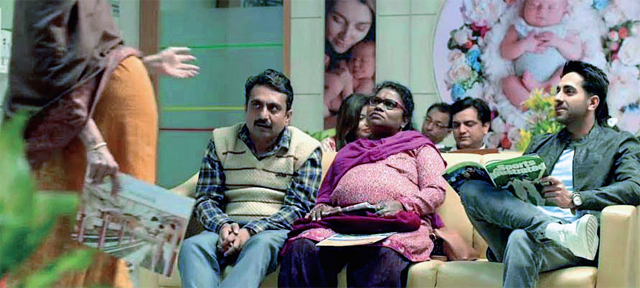
Ayushmann Khurana in a still from Badhaai Ho

The believable affection between the two is used to charming comic effect through the film — during the shadi song sequence ‘Sajan Bade Senti’, for instance, when Jeetender tries to get closer to Priyamvada within the space of a big family photo. Later, when he compliments her, she seems secretly pleased but tells him off because it’s his “saying this sort of thing that has put us in this mess”.


More interestingly, though, the film takes a very warm view of the joint family, where privacy and politeness might be missing, but bonds are strong enough to create acceptance, even in the face of declared social norms. It is clear where Sharma wants to go when he pits the Kaushiks’ cramped Lodhi Colony life against the cavernous bungalow inhabited by Renee’s single mother. There's a neat reversal of assumptions about social class and liberal openness: Sheeba Chaddha as Renee’s mother emerges as more judgemental —and less likeable — than Priyamvada.


From the fading mehendi to the sindoor in her broadened hair parting, Gupta makes Priyamvada layered and utterly real. Priyamvada is not a character one would call feisty, but there is a clear line between what she takes as her duties — e.g. listening to her mother-in-law (Surekha Sikri) — and what she takes as her due, e.g. the right not to have an abortion. There is also a way in which the film extends her maternal role from the familiar mode of asking after physical well-being (“Khana khaya tune?”) to inquiring, gently but firmly, after her children’s emotional health. The mother who can teach her son when to apologise in a relationship is a truly significant mentor in a world where so many men seem to grow up ill-equipped for emotional labour.

Badhaai Ho appears on our screens in a time when the opposition to court-approved entry of women into the Sabarimala Temple has brought women’s menstruating bodies onto our front pages. Given that powerful women like Smriti Irani still see fit to body-shame their own gender for a perfectly natural biological function, Neena Gupta’s smiling, quiet defence of her character’s ageing, but still sexual, pregnant body seems particularly valuable.

The family,
Badhaai Ho implies, can be a space of socialising for young men, a place to learn what female experience is like, through empathy with sisters and mothers and grandmothers, through simple things like learning that periods happen, or how to hold a baby. Its vision of joint family may be rose-tinted, but in these divided times it is a pleasure to watch proximity create acceptance, not its opposite.

Published in Mumbai Mirror, 30 Oct 2018.


17 January 2016

Bringing out the Bubbly - I

My Mumbai Mirror column on Jan 11, 2016:

2015 was a pretty good year for Indian cinema. Our columnist tots up some of the films that made it so.

Having taken a break for the last week of last year and the first week of this one, I thought I might escape the list-making frenzy that usually grips columnists like me around this time. But even on holiday, I had so many people asking me for recommendations— friends, relatives, even strangers who'd just learnt what I do — that I have succumbed.

So, without further ado, here's the first of my two-part column on my top picks of 2015's film releases. In no particular order:


Dum Laga Ke Haisha -- Sharat Kataria's second feature (after 10 ML Love, his frothy adaptation of A Midsummer Night's Dream to a bustling shaadi ka ghar) is a small-town family drama of the sort that's on its way to becoming a new Bollywood cliche. But Dum Laga Ke Haisha departs from previous such films in two remarkable ways: one, it's set in 1995, and two, the heroine is a fat girl. 

The first is done superbly: Kataria's surefooted grasp of his milieu is strengthened by Meenal Agarwal's wonderful production design and Anu Malik's nostalgia-inducing music, leading us by the hand into this remembered world of shopkeepers, shakhas and cassette players. The second aspect ends up being less satisfying: debutant Bhumi Pednekar impresses as the cheerful, unselfconscious Sandhya, but the film, like Ayushmann Khurana's Prem Prakash, seems unable to see beyond her size.

Also, Kataria is a little too influenced by mentor Rajat Kapur's marvellous Aankhon Dekhi, often channelling the public bickering and tearful squabbles of that film, and even re-casting prime players like Seema Pahwa and Sanjay Mishra. Despite these issues, though, Dum Laga Ke Haisha remains among the year's most charming films.

Titli -- Kataria also helped debut director Kanu Behl write this rather more alternative family drama. Set in the depressingly anonymous galis of a not quite up-and-coming Delhi ("past the Mother Dairy, behind the nala", says Titli, when asked where he lives), Behl's film is a searing indictment of our familial pieties. As I wrote when the film released in October, "This is the great Indian family turned inside out, revealing not just the ugly seams but the stuffing."

Titli turns violence into something banal - but also unmasks the banality of lower middle class life as its own kind of violence. Behl draws astounding performances from his actors: Shashank Arora as the eponymous Titli, Shivani Raghuvanshi as his reluctant but defiant bride Neelu, Kanu's own father Lalit Behl as Titli's father, and most chilling of all, Ranvir Shorey as Titli's elder brother, a man caught in a web of brutality and despair. A tautly edited portrait of class and criminality, Titli captures the claustrophobia of a society in which dreams seem attainable only for the very few. Behl is a director to watch out for.


Tanu Weds Manu Returns -- Director Anand L. Rai made a lot of people very happy with his return to the repartee-filled world of the Kanpur mohalla, in which the infamous Tanuja Trivedi (Kangana Ranut) had once caused such a stir by choosing the America-returned sweet but boring doctor (Madhavan) over her dashing beau Raja Awasthi (Jimmy Sheirgill). But what really made TWMR sparkle was Rai's decision to inject into this milieu that old Hindi movie staple: a double role. Ranaut topped her own return as the attractive but irresponsible Tanu with a newly minted persona as Datto, a heartmeltingly youthful Haryanvi hockey player who plays no games in real life.

TWMR had many other highlights —fhe return of Deepak Dobriyal, possibly the funniest actor now working in Hindi cinema, as Manu's ridiculous friend Pappi; Mohammad Zeeshan Ayyub as the shaatir Rampuria tenant easily reeled in by Tanu's charms; and of course, Sheirgill as the updated Awasthi, having gained a moochh and lost some of his fire, but still able to make his loutish UP man exterior speak of inner depths with the flash of an eye. But the real hero of the film is Himanshu Sharma's script, marrying old-school Hindi movie tropes to a sharply contemporary wit, creating a film that will likely be watched many times over by its fans.

Masaan -- Neeraj Ghaywan's film announces another of the debut filmmakers who made 2015 such a special year for Indian cinema. Set in present-day Banaras, Varun Grover's script weaves together the lives of several people dealing with distressing circumstances into a moving melange. A young woman eager to embark on her sexual adulthood is dealt a nasty blow by a venal hypocritical system; an old man finds himself preying on a child's talents to salvage his own situation; a young man finds unlikely happiness only to have it snatched from him. Most people who watched Masaan found themselves swept up, and moved by its very real struggles. But there have been those who have taken issue with its many coincidences. To me, it seems that the reason Masaan works so well is that it melds a closely observed realist eye with the sort of emotionally satisfying arc that has long given Hindi films their special flavour.

Note: This list is heavily tilted towards cinema in Hindi, with only a couple of exceptions. 

[The rest of my Best of 2015 list appears in the next post]