Showing posts with label gossip. Show all posts

26 February 2018

Book Review: Rahi Masoom Raza's Scene 75

Behind the Scene

My review of the remarkable 1978 Hindi novel, Scene 75, recently out in Poonam Saxena's English translation:


SCENE 75 by Rahi Masoom Raza 
Tr. by Poonam Saxena 
HARPER PERENNIAL Rs 399; Pages 224

Sometime in the 1960s, acclaimed Hindi author Rahi Masoom Raza migrated from Ghazipur to Bombay to become a dialogue writer for films. In this slim, memorable novel, Raza combines his two identities, casting an acute eye on the 1970s film industry.

At one level,
Scene 75 might be read as a fictional equivalent of Manto's Stars From Another Sky: From lesbian affairs to a domestic help servicing both mother and daughter, there's undeniably titillation here. And yet, Raza isn't quite a predecessor to Madhur Bhandarkar's preachy filmic unmaskings. Scene 75's tone is deadpan: "[E]veryone in the film world is a writer except for the writer himself. Never mind if they can't even speak proper Hindi, they are all writers. From Dilip Kumar to Raaj Kumar, everyone loves to write." Or: "The film got made but was never released because it didn't have a rape scene, it didn't have a fight between Shetty and the hero... there wasn't even a Padma Khanna cabaret number." But Raza's focus isn't filmdom as much as a cut-throat milieu that impels people to invent fake selves.

Bholanath Chopra earns Rs 192 as salary but inflates the figure to 1,092. His wife Rama frequents expensive sari shops, feigning the loss of a wallet at the final moment. Others have new selves thrust upon them: to work for Phandaji, "who was very secular but didn't eat anything that had been touched by a Muslim", the primary protagonist Ali Amjad becomes Gaurishankar Lal 'Krantikari'.


In Poonam Saxena's translation, Raza's prose retains the quicksilver quality of the raconteur, with backstories looping into each other. So Bholanath's quarrel with Rama sets us off on how the Chopras acquired their flat, which leads to Rama's admirer Sarla Midha and how she went from "simple, innocent Sarla" to a wife who "liked other men's wives".


Such juicy digressions, however, do not blunt Raza's sharpness, especially on the topic of communal feeling. "The [Chopras] were an educated family, and educated people know how to hide their bigotry," he writes, before explaining why Rama Chopra, 12-and-a-half when her family was forced to flee Pakistan in 1947, "believed she had every right to hate Muslims." The self-reinforcing fact of ghettoisation was "why no one told Rama that Muslims in India had been killed, just like Hindus in Pakistan." The clarity is even more devastating 40 years later.

9 February 2018

The fictions of filmdom

My Mirror column:

Rahi Masoom Raza's biting 1977 novel Scene 75 is a brutally frank and funny account of the Bombay film industry -- and of our need to tell stories.


“Ali Amjad was saying that they should take Rajendra Kumar. Harish was saying that Rajendra Kumar was a fool. He didn't know how to act... Slowly their voices grew louder. Harish Rai was the director. Ali Amjad the writer... VD said, 'There's a new boy. Rajesh Khanna. You'll get him cheap...”


Four decades after it was first published, Rahi Masoom Raza's marvellous novel Scene 75 – just out in Poonam Saxena's pacy new English translation – can still plunge us headlong into the hectic, gossipy universe of Bombay filmdom. Raza's prose has the infectious quality of the born raconteur, somehow managing to combine circuitous, detailed backstories with new characters introduced -- and parted from -- at breakneck speed.

But unlike say, Ismat Chughtai's Ajeeb Aadmi -- a rather thinly disguised version of the unhappy Guru Dutt-Geeta Dutt-Waheeda Rehman triangle -- Raza does not place us at what we might think of the centre of the action. Yes, big names are dropped with elan, but it is not their lives that Scene 75 wants us to enter.

Real-life stars, producers, character actors, from Asha Parekh and Sanjeev Kumar to David and Manmohan Krishna, only provide the matrix of instant credibility for Raza's fictional protagonists, who are people on the fringes of the industry: aspiring screenwriters, starlets on the make, housewives desperate to wrangle film premiere invitations.

This is the seamy underbelly of Bollywood, fed on crumbs dropped by the rich and famous. Sometimes these crumbs are literal, like the supposedly jinxed royal bed from the set of a film called Adle-Jahangir that becomes the centrepiece of the flat shared by the book's four struggling friends -- or the transparent nightie deemed too small for Hema Malini that makes its way to Radhika, wife of the failing screenwriter Phandaji, and practically changes her life.

More often, though, they are tidbits of information that offer access to the filmi duniya. Scene 75 derives much of its juiciness from the interactions between various classes of hangers-on, who have different degrees of this access, and most of whom are pretending to have more than they actually do. So, for instance, we have the grave, revolutionary VD acquiring new skills of deception when it comes to showing a young Anglo-Indian woman called Rosy dreams of a future as heroine: 'Today BR Chopra made a pukka commitment to give you a break in his next film. And Nasir Husain said, “Bring her over right now, I want to sign her for my next film.” But he makes such escapist films. I won't let you work there...' VD's friends – particularly the book's central protagonist Ali Amjad, who seems partly modelled on Raza himself -- are upset with his bald-faced lies. 'Why are you showing the poor thing these false dreams?' Ali Amjad demands to know. VD's answer is a counterquestion that really has no answer: 'But why does she see them?' 


Why does she, indeed? Scene 75, especially as it moves towards its tragic denouement, emerges as a book full of cynical truths, truths which it would be unfair to describe as takedowns because they don't seem to contain malice (even when, as with the book's many lesbian characters, they bear the burden of prejudice).

But even as Raza's humour transitions from dark to pitch black, and his heroes mock themselves for their loss of idealism, I had the impression that Raza could not entirely condemn his fantasising characters. Because he understood their need for fiction.


That need for fiction appears over and over again in the book – whether in Bholanath Khatak's desire to make his wife Rama dress like Waheeda, or in journalist Pancharan Mishra turning of the cook-turned-screenwriter Ramnath into Ramanathan, complete with a detailed life-story.

“Because of his father's sudden death, Ramanathan had been unable to take his MA exam. The memory of his university days still filled Ramanathan with sadness. The glory of those tennis lawns, the revelries of the drama club...” “Everyone knew it was lies,” writes Raza. “But everyone had had similar things written about them, so no one bothered to check the truth.”

Earlier in the book, we encounter the wonderful Mai's Adda, where everyone from Sahir Ludhianvi to Raj Kapoor had drunk alcohol and eaten fried fish on credit. Fiction here runs like a rich vein through fact; if you cut off the supply of make-believe, it might kill us.

“Whenever one of her debtors became famous, Mai would hang his photograph in her adda and talk about him as if he were her own son...” When D'Souza buys up Mai's Adda, he lets Mai masquerade as if she is still the actual owner. Then when the real Mai dies, people can't quite adjust to life without a Mai -- so they begin to call Mrs. D'Souza 'Mai'. That desperate desire to keep up appearances is also at the crux of Ali Amjad's titular Scene 75, in which a character called Abulkhair's mother is dictating a letter to a munshi at a streetcorner. “Everyone is unwell. Why are you making me say that everything is all right?” says the munshi.

This then, might be the truth at the heart of Scene 75, and perhaps Raza's comment on our cinematic fantasies: When is a lie not simply a lie? When it's what we need to believe to live.


Published in Mumbai Mirror, 4 Feb 2018.

21 June 2015

Stars, scandals and fandom

Today's Mirror column:

Reading in English about Hindi movies: a very brief history of the Indian film magazine as we know it.


Writing about films is one thing; writing about film stars is quite another. There are those who do both with aplomb. But in India, most long-running film magazines have been much more interested in the lives of film celebrities than the content of films.

The first Indian magazine completely devoted to cinema coverage was the Gujarati Mauj Majah, first published in 1924. Among English magazines, Baburao Patel's well-regarded monthly FilmIndia, published from 1935 to 1961, was one of the first. (The legendary and indefatigable Patel, who produced the entire content of the magazine himself – later aided and finally replaced by his wife Sushila – is the subject of a new book called The Patels of FilmIndia, which I'm looking forward to reading).

This was followed by the first trade publications, like KayTee Reports and Tradeguide, concerned not with stars but with predicting the commercial success or failure of particular films. In 1951 came Screen, launched by the Indian Express group in a colour broadsheet format. Screen, because it was concerned both with recent events in the industry and with films under production, could “be situated somewhere between the trade and the fan magazines”, writes film scholar Rachel Dwyer.

Close on Screen's heels came Filmfare, launched by the Times of India group in 1952. Filmfarewas glossy and upmarket, but it intended to be a family magazine and a sophisticated one. The first issue contained a manifesto that stated, “This magazine represents the first serious effort in film journalism in India. It is a movie magazine – with a difference. The difference lies in our realisation that the film as a composite art medium calls for serious study and constructive criticism and appreciation from the industry as also from the public.” This noble intention was cemented by the institution of the Filmfare Awards in 1953. Filmfare remained biweekly until 1988, when financial troubles forced it to become a monthly, which it has been since.

But the big moment of change in English-language film journalism in India was the 1970s, when a clutch of new magazines changed both the way we related to the stars and the language in which we were meant to do it. Jerry Pinto summed up the 70s magazine scene in his superb bitchy-funny Introduction to The Greatest Show on Earth, a spectacular anthology of writing on Hindi cinema that he edited in 2011. “Filmfare was the grand old lady, still published in an improbable size that meant you couldn't open it fully in a crowded bus or train. Stardust was the snazzy newcomer with a hint of middle-class contempt for the arrivistes and outsiders that made up the film industry. Cine Blitz came later and launched itself on the unsuspecting public with Protima Bedi – a Bollywood citizen through her open marriage with Kabir Bedi – running nude on a city beach. In between, for a brief while, there was Super, which had an almost indecipherable column, written as a letter, by Bubbles. Since Bubbles assumed we all knew the stars' nicknames, I often read it wondering at what was really happening and who was doing what to whom. When one did know (Daboo was Randhir Kapoor and Kaka was Rajesh Khanna) one felt validated in one's knowledge.”

Stardust, writes Dwyer, was founded in 1971 by Nari Hira of the Magna Publications group “as a marketing opportunity for his advertising business”. It was meant to be something along the lines of the American celebrity gossip mag Photoplay, more salacious than the then-staid Filmfare. Dwyer's 2001 essay contains the following wonderful account: “Twenty-three year old Shobha Rajadhyaksha (later De), who had been working for Hira for eighteen months as a trainee copywriter, was hired as the first editor. She had no interest in the movie world and had never worked as a journalist, but was hired on the strength of an imaginary interview with Shashi Kapoor, whom she had never met.” The imaginary interview was clearly a thing, combining an opportunity for writerly showing-off with a jokey fantasy that indulged the star's fans. Jerry Pinto cites one ridiculously risqué one with Bindu, from the now-defunct Film Mirror, which ends with the “reporter” waking from a dream. But more of that in another column.

To return to Shobhaa De, she apparently produced the first Stardust issue alone (with one paste-up man). She was later joined by a production staff of three and a team of freelance reporters who “collected stories which she wrote up”: a one-woman show not far from Baburao Patel. But De seems to have stayed put in her office, somewhat unusual for a young journalist. In her memoir Selective Memory: Stories from My Life, De's version of it is: “My eyes and ears were so attuned to reportage that I preferred my colleagues' version of their meetings with the stars to personal encounters.” Dwyer puts it somewhat differently. “De stubbornly refused to move in the film world, only meeting the stars if they came into the office,” she writes, making one envisage a scenario that seems nearly unimaginable today, when a respected and senior film journalist told me that even he finds it difficult to get interview appointments with current stars. Most stars, he added, seem in such a huge rush to finish the interview that it can barely become a conversation.
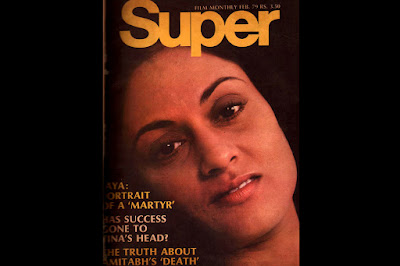
Super, too, was founded by an exceptionally young team that included Bhavana Somaya and Namita Gokhale. Gokhale, then 20, encountered Dev Anand some four decades later at the Jaipur Literature Festival, and was amazed to have him recall the last time they had met. “It was in 1981, I think,” he mused. “You were with your editor Rauf Ahmed – what was the magazine called...?” Whether it was the fact that these young people were just exceptionally memorable, or that stars in those days met less journalists, I don't know.