Showing posts with label Buddhism. Show all posts

28 May 2021

A child's view of the world through a train ride

This is the sixth column in my ongoing series on trains in Indian cinema. (Periodic reminder for new readers of this blog: I write a weekly column on cinema which appears in TOI Plus, as well as in Bangalore Mirror, Pune Mirror & Mumbai Mirror.)

-- In Gulzar's Kitaab, the railways are a route and a rite of passage for a child trying to find his place in the universe --

There are probably few films in any language that have been titled 'book'. But lest you think a film called Kitaab might be bookish (which in the eyes of many movie-viewers translates to boring), Gulzar's 1977 screen adaptation of Samaresh Basu's story begins in breathless motion. Gusts of black smoke rise into the sky, a train whistles, and the familiar “chooka-chook” of the moving carriage takes over, interspersed with a child's voice. He is making up a chant to match the train's rhythmic sound: Kidhar ja, kidhar ja, kidhar ja? Bhaag chala, bhaag chala, bhaag chala [Where d'you go, where d'you go, where d'you go? Running away, running away, running away].


It is only after this that we see him: Master Raju, ubiquitous and irreplaceable child star of 1970s Hindi cinema, squatting on the train's floor, in the space between two lower berths. Above him, in the upper berths, two children pass a notebook to each other, conducting a silent game of knots and crosses. Even before we know anything of what the film is about, Gulzar has communicated how marvellous train journeys could feel for the middle-class child -- the adults asleep below, while you looked down from the deliciously unsupervised space of the upper berth, the holidays stretching ahead of you. The train journey was a time out of time.

As it turns out, Gulzar is only pointing to that sense of sweet interregnum, secured at both ends by middle-class cushioning, as a contrast. What makes Kitaab memorable is the real-life adventure on which it launches its boy hero – but here, too, the railways are crucial. Bored with school and misunderstood at home, Babla runs away from the city home he shares with his didi (Vidya Sinha) and brother-in-law (in an odd bit of casting, Uttam Kumar!). He gets on the train to go back to his mother in the village. But when shoved out for being ticketless, the 12-year-old suddenly finds himself in the real world he's been so impatient to enter.

In flashback, we see Babla and his best friend Pappu bunking school to wander the city, entranced as much by the street magician as by the halwai making jalebis. Again and again, they try to apprentice themselves to these men, who greet their enthusiasm with mostly indulgent disbelief. On the surface, these scenes evoke laughter: The boys, it seems, will do anything to get out of having to go to school. But the camera's attention to the men's practiced movements and the boys' rapt gazes tell a different story: These artisans are indeed masters of their craft. The children, watching them, grasp that fact instinctively – and any craft so consummately carried out seems worth learning. If classroom education has failed to engage these young minds, Kitaab suggests, it has also not yet infected them with the casteist, classist belief that manual work, no matter how skilled, is unworthy of admiration.

It is people like these that adopt the runaway boy -- the railway engine driver and his assistant, the station's resident midget, and Shreeram Lagoo playing a blind singer of the sort that could once be met on every train in India. Asking very few questions, they simply add him into their lives. The middle class passengers ignore the unclaimed child in their midst, but the engine driver gives him the last of his tiffin, the blind beggar buys him tea and food. The instinctive humanity with which they share what little they have is moving – yet Gulzar doesn't let things turn maudlin. We smile at little things and big ones: The little boy and the dwarf literally sizing each other up; the hackneyed phrases people use for emotions. When someone says “Bechara anaath hai [He's a poor orphan]”, Babla adopts the phrase, trotting it out for a quick dose of sympathy, often to hilarious effect. “Bechara anaath hoon [I'm a poor orphan],” he tells one ticket checker -- just before saying he's headed to meet his mother.
 

Much of the bittersweet pleasure of Kitaab comes from watching the child watch the world go by – and learning from it as he does. And although Babla was curious, observant and sensitive at school and at home, it is the train that offers him a sense of what the world is really like. The network of trains and railway stations is like a pathway through the world, and a microcosm of it. As Babla negotiates his way through this network, he encounters old age and disease, blindness and deformity -- and death. Like a latter-day Siddhartha, the protected middle class boy is confronted with the sight of suffering, and is shaken by it.

Unlike Siddhartha, though, the experience doesn't lead him to renounce the world – but to return to it richer. One could read Kitaab as a cop-out: Issuing a challenge to middle class pieties and normative barriers, but turning back before risk turns to danger. But one can also see it as an expansion of the child's universe, an initiation into life that acknowledges the inevitability of sorrow -- while not undermining the value of the safety net. As the blind train singer puts it, “Gaadi chhutne ka gham mat kariyo, baalak. Station na chhutne paaye [Don't mourn the missed train, child. Just don't let the station get away from you.]”

Published in TOI Plus, and three editions of Mirror -- Pune, Bangalore and Mumbai.

15 October 2019

The Silk Route Between the Covers

My 'Shelf Life' column for October:

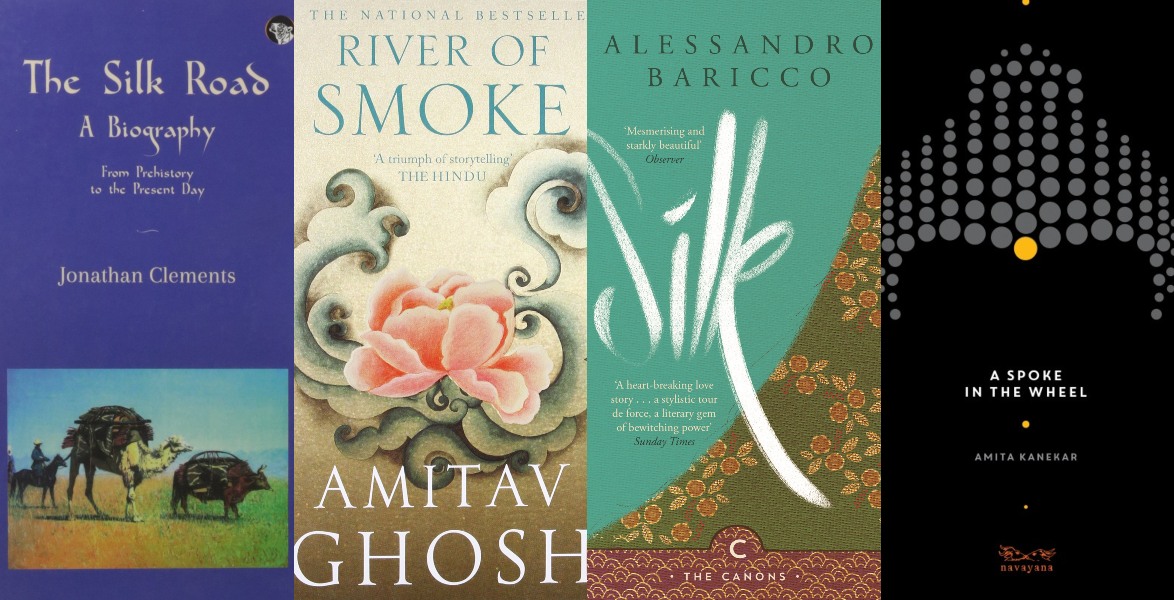
The unreal lustre of silk has long been the stuff of fantasy, in life and in fiction, from Alessandro Baricco’s Silk to Amitav Ghosh's River of Smoke


Cloth has been among the most ubiquitous items of exchange in the history of human civilisation—but silk is the only cloth to have had a trade route named for it. The legendary Silk Road was, of course, neither singular nor physical. It was more a name for a network, a direction in which goods travelled between China and the Mediterranean, with Xi’an and Samarkand as nodes. Jonathan Clements, in his book The Silk Road: A Biography (2016), points out that all manner of objects—gemstones, glass, tulips, spices, slaves—were traded on the route, but the commodity most likely to travel the entire length from East to West, was silk. The reason was its value in the West, but also its portability and durability. 

The moth called Bombyx mori was first cultivated in China, where the first evidence of silk goes as far back as 3000 BC. During the Han dynasty, silk became a form of currency in China. Arriving in the Central Asian steppes and deserts as bribes, gifts, soldiers’ salaries or just in lieu of cash, bolts of silk often carried on westwards, with tribesmen using them as payment for livestock or luxuries. Soon silk began to appear in the ancient Graeco-Roman world (332 BC -395 AD). But it was not common, and the fabric’s marvellous quality of light and shade, of movement, could alarm those who saw it for the first time. As late as 53 BC, Roman soldiers were so unnerved by the sight of the shimmering silken banners carried by the Parthian troops at the Battle of Carrhae that they took to their heels. 

By the 3rd century AD, it had become the cloth of kings. The Roman Emperor Heliogabalus, who reigned 218-222, reportedly wore nothing but silk. In Amita Kanekar’s superb fictional reimagining of the time of Ashoka, A Spoke in the Wheel (2015), all bhikkhus (monk) wear brown robes, as ordained by the Buddha. But those worn by the Thera of the Sanchi Stupa, made from “this amazing cloth from the lands of Chin”, mark him out as the first among equals. 

The Thera’s robes, like the Parthian banners, “looked alive”: “the same saffron-brown colour shimmered in the lamplight, making dark gold and orange pools that continuously changed shape and direction”. By the early centuries AD, Korea, Japan and India had also begun to practise sericulture. Silk appears twice more in Kanekar’s novel, both times more local. Once “pieces of stiff, shiny material” are hidden in a monk’s mattress, inscribed with a message in the Kharosthi script from Taxila. Another time, a conquered people forced to shift south from eastern India sport lengths of rough-textured golden mugga, “woven long ago on home-made bamboo looms and reserved for special occasions – for wild silkworms with their shining cocoons were not to be found in the Vindhyas, Bhima insisted.”

But even as silk earned the favour of the rich and powerful, it scandalised others. The Roman writer Seneca was appalled by the “glass togas” on sale: “I see silken clothes, if one can call them clothes at all, that in no degree afford protection either to the body or to the modesty of the wearer, and clad in which, no woman could honestly swear she is not naked.” 

Centuries later, when the Europeans had started to produce it, the sheen, softness and smooth drape of Eastern silk still retained an erotic charge. In Alessandro Baricco’s novel Silk (1996), translated from the Italian by Ann Goldstein, a 32-year-old French merchant travels to Japan to acquire silkworm eggs that have been spared from the damaging effects of a Pébrine epidemic. It is 1861, and it takes him three months. “How is the end of the world?” asks his associate Baldabiou. “Invisible,” responds Hervé Joncour. 

For his wife Hélène, Joncour brings back a silk tunic that she, “out of modesty, never wore”: “If you held it between your fingers, it was like grasping nothing.” Published in 1997, silk in Baricco’s novel is very much part of an erotic European fantasy of the East—but self-consciously so. In the house of Hara Kei, the Japanese lord who privately agrees to sell him the eggs, he is bathed daily by three old women whose hands are “gnarled, but very tight”, who dry him off with “warm silk cloths”. On his last day there, they are replaced by “the lightness of a silk veil” and unseen hands that caress his skin, “not the old hand of an old woman”. Joncour spends his life in the grip of those hands—never realizing the flesh-and-blood Hélène's rôle in stoking that fantasy.

In Amitav Ghosh's River of Smoke (2011), another mid-19th century merchant travels halfway across the world and brings back silk for his wife. Shireenbai does wear the pale brocaded China silk as a sari, and even the scarlet Jinliang slippers. Like the unhappy Hélène, though, Shireen knows that her opium-trading Parsi husband's heart lies in the East, even when he is in Bombay. 

But unlike Joncour's Japanese memory, the woman Bahram Modi becomes attached to in Canton is the opposite of ethereal. Chi-mei is warm, domestic, comfortable, she wears cotton not silk. She, not Shireen, bears him a son. And even in Bahram’s last pipe-dream, her fingers on his chest are rough and callused—as if to say that this Canton life has always been his real one. 

Silk’s very luxuriousness makes it a permanent figment of the imagination. Reality, it seems, feels rougher.

Published in The Voice of Fashion, 9 Oct 2019.