Showing posts with label freedom. Show all posts

20 February 2021

Book Review: Archaeology and the Public Purpose

A special book about a special man. My review for Scroll.

This study of archaeologist MN Deshpande’s work highlights the integrity and zeal of a true scholar
Archaeology and the Public Purpose: Writings on and by MN Deshpande
by Nayanjot Lahiri. Oxford University Press, 2020.


Before anything else, a personal disclaimer, or rather, a claim: I briefly had the pleasure of knowing MN Deshpande. I met him not in the capacity of archaeologist and scholar, but as my school friend Mita’s grandfather, calling him Azoba as she did.

As Class XI students at Delhi’s Sardar Patel Vidyalaya, Mita and I often came back from school together to the Deshpande home. I was already interested in history, and although Madhusudan Narhar Deshpande was not the sort of grandfather to lecture teenagers floating around the house, I remember wonderful occasional conversations with him about ancient India. 

After one such chat, Azoba lent me his copy of Heinrich Zimmer’s Myths and Symbols in Indian Art and Civilization. A classic of Indology, it was the perfect book to give an aesthetically and literarily-inclined history student at Delhi University, which I was to become soon after. I did not become a historian, but the book has remained in my bookshelf, its front page stamped with “MN Deshpande, Retired Director General of Archaeology”.

Heinrich Zimmer had held the Chair in Indian Philology at the University of Heidelberg in Germany from 1924 to 1938, but was forced to leave because of his criticism of Hitler. He moved first to Oxford and then to the USA. Soon after his arrival in New York, though, Zimmer died suddenly of pneumonia. Myths and Symbols is a collection of the lectures Zimmer delivered to his Columbia University students in the winter of 1941, posthumously compiled and published by Joseph Campbell in 1946 – the year the young Madhusudan became an Assistant Superintendent in the Archaeological Survey of India (ASI), where he would serve his entire career, eventually retiring as Director General in 1978.

Deshpande was born exactly a century ago, in 1920, and historian Nayanjot Lahiri’s six essays in Archaeology and the Public Purpose do a stellar job of placing his career in context.

Since the early 2000s, historians have begun to engage with the history of Indian archaeology. Upinder Singh’s fine 2004 volume The Discovery of Ancient India, for instance, traces the establishment of the ASI as well as the individual contributions of archaeologists like Alexander Cunningham, JDM Beglar and James Burgess. 

Tapati Guha Thakurta’s Monuments, Objects, Histories: Institutions of Art in Colonial and Postcolonial India, also published in 2004, moves expertly between the colonial and postcolonial periods, and between institutional and individual histories. There are portraits of early Indian archaeological scholars like Rajendralal Mitra and Rakhaldas Banerjee, while other chapters explore moments when ancient Indian art and archaeology have emerged as crucial basis of flashpoints in our contemporary cultural politics: MF Husain’s depictions of Hindu goddesses, for instance, or the Babri Masjid-Ram Janmabhoomi dispute, which hinged on archaeology.

But little has been written about Indian archaeology after independence. Recent Indian history is often a tricky project for historians, partly because sources are often scattered and hard to pin down. So it is fitting that Lahiri’s work on Deshpande emerges, at least partially, from her discovery of an archive.

Early career

The scholar-archaeologist’s family had preserved his personal papers, including personal diaries, notebooks, files, photographs (many of them not in the ASI archives) and professional writing (much of it previously unpublished). Lahiri adds her own research, archival and secondary, including things gleaned from her exchanges with family members, to paint a portrait of Deshpande as a member of a generation that came of age with Indian independence – personally as well as professionally.

The sole exception in a family of Maharashtrian doctors, he was raised by a father who had given up his government job in response to a call from Lokamanya Tilak. Having become a staunch Congressman, Deshpande’s father attended the 1936 Congress session at Faizpur, taking the sixteen-year-old Madhusudan along, though it was some 500 km from their home town Rahimatpur. It was on the same trip that father and son made an excursus to see the famous Ajanta caves – on which Deshpande would come to be an expert.

The search for academic excellence led young Madhusudan to Pune for the later years of schooling, and then to Fergusson College, renowned for language studies. But having started out as a traditional language-based scholar, specifically a Jainologist specialising in an ancient Prakrit language called Ardhamagadhi, how did Deshpande enter the relatively lesser-known field of archaeology?

Again, Lahiri’s answer to that question traverses the academic, institutional and social history of an era: the setting up of Deccan College as part of Pune’s educational renaissance; HD Sankalia’s rise to being the head of its archaeology department; Deshpande’s move to Deccan College coinciding with a two-month field training school in Taxila in 1944, devised by newly appointed ASI chief Mortimer Wheeler to address India’s scarcity of archaeological staff; Sankalia responding to Wheeler’s call by sending his best students to Taxila. Deshpande went too, becoming part of what was to become the defining cohort of post-independence South Asian archaeology.

He did return to Deccan College, but only to find that a Phd had been submitted on a topic very similar to his own, the scholar having remained under the radar because he was in jail (one assumes, though Lahiri doesn’t go into it, that this was one of many promising young Indians imprisoned during the Quit India agitation of 1942 – my mother’s father BM Singhi topped Banaras Hindu University’s Hindi MA exams from jail). Deshpande’s academic ambitions in Jain studies thus dampened, he took Sankalia’s advice and accepted one of the new ASI scholarships offered by Wheeler.

Multifaceted work

Lahiri’s biographical history of Deshpande and his cohort is full of details that offer unexpected pathways into the present. She reproduces, for instance, Wheeler’s Note to the Standing Committee on Education, in which he argues brilliantly and vociferously for an improvement in research on Indian heritage, rather than a “faint and usually sentimental consciousness that this great inheritance exists”.

Advertisement

“[W]ithout a high standard of research at the back of it all, even the most general education will fall short of its goal,” predicts Wheeler. He adds a great metaphor that new India’s research-scorning new technocratic elite might benefit from hearing: a country’s ability to conduct high quality research, he writes, is like its ability to produce a Rolls Royce: it helps maintain “the standard of the less intricate piece of machinery with which most of us have to be content.”

Deshpande himself did not become a university-based teacher-researcher, but his academic interests – in the caves of the Western Deccan, in Prakrit inscriptions, and in the relationship between archaeology, ethnography and history – remained. But this volume’s rarity lies in capturing the enormously multi-faceted work of the practicing public archaeologist in the second half of the 20th century: someone who “conserved monuments, undertook fieldwork, managed museums, dealt with infractions of laws relating to antiquities and protected sites, spearheaded new legislation as also replied to the stream of questions relating to archaeology raised in every parliament session”.

Deshpande’s career ranged from excavations at remote field sites – he writes of working with his mentor Sankalia on “the banks of the Sabarmati in Gujarat and in the river valleys of the Malaprabha and Ghatprabha in Karnataka” – to supervising the conservation of protected monuments, a task that involves a great deal of science, from structural engineering to acoustics to chemistry.

Highlights from Deshpande’s career include executing a conservation plan for the famed Gol Gumbad in Bijapur; following up on Sheikh Abdullah’s personal interest to bring Srinagar’s Hari Parbat fort under ASI protection; working with Indira Gandhi’s government to help pass the watershed Antiquities and Art Treasures Act in 1976 to help prevent smuggling – and arguing against the same government when it proposed a polluting oil refinery at Mathura, only 40 km from the Taj Mahal, and a “beautifying” weir on the Yamuna that would affect the Taj’s foundations.

Much before Indira, Deshpande had encountered her father – when Nehru visited the Ajanta Caves in 1958 and Deshpande, then superintendent of the South-Western circle, took him and Edwina Mountbatten around the caves as “the highest ranking archaeologist of the ASI based in Aurangabad”. Lahiri’s delighted, delightful account – aided by ASI file notings on special toilet cleaning and candid photos from Deshpande’s albums – shows us a man who never missed a chance to visit historic ruins even as a supremely busy Prime Minister, wandering about Mandu for his free day after a Congress meeting in Indore, making and executing a second Ajanta visit to experience the enchantment of the paintings again – and to show them to Edwina.

At the heart of the book is a very different sort of instance of the archaeologist at work. Deshpande’s “jugalbandi” with the famed Chipko activist Chandi Prasad Bhatt is a little-known event that changed the fate of a well-known shrine. The story of how the historic Badrinath Temple was saved from being turned into just another Birla Mandir is a remarkable one.

The temple’s amalgamation of structures, built from the 11th century through to the early 20th, was in the process of being replaced with an all-new structure by the Jayshree Trust, named for the daughter of Basant Kumar Birla. A massive new concrete wall had been built and red sandstone had arrived from Agra, which would have led to a new temple in an architectural style far from local pahari traditions, and an altogether different modern scale.

Chandi Prasad Bhatt’s interventions – reaching out to Deshpande as the ASI chief in Delhi, appealing to the Chief Minister of Uttar Pradesh, HN Bahuguna, and organising a public demonstration against the renovation – set in motion a train of events that eventually helped save the old structure. So different was Indian democracy in 1974 that we had politicians in power actually responding to agitating locals rather than being automatically on the side of the industrial magnates. 

More remarkably, when viewed from the flattened kneejerk responses of our present, public culture in that India did not equate service to history with being against tradition. A figure like MN Deshpande was emblematic of that India.

Own writings

The book is both on and by Deshpande, with more than half the volume devoted to an edited selection of Deshpande’s own writings (many translated from Marathi). These writings range widely across region, subject and style. Never verbose, Deshpande combines the archaeologist’s fine-toothed comb with an eye for what might interest the present-day layperson.

In a piece on the Maharashtrian site of Bahal, for instance, where he conducted fieldwork in 1952-3, Deshpande suggests that it may have lain on “the ancient route joining Bhrigukachha (Broach), the Barygaza of Ptolemy and Periplus, with Paithan (Pratishthan)”, been part of the kingdom of the Yadava kings of Devgiri in medieval times, and retained some degree of importance till Maratha times. He then explains why the place lost its importance: it did not lie on the railway route and became subservient to Chalisgaon, which is a junction on the Central Railways.

A scholar who limited himself to ancient times may not have ended the piece the way Deshpande does – his approach helps bring the ancient world alive, while also making a point about how the historical significance of a place depends on the vagaries of technocratic modernity.

Like his guru Sankalia, Deshpande wrote often in his native tongue, Marathi, to help communicate the archaeological worldview to laypeople. As a language scholar turned archaeologist, he was as comfortable with etymological theorising about the origin of the name Ajanta based on Pali proper names and local pronunciations as he was describing the specific architectural features of the chaityas at the site. In later life, Deshpande further developed his interest in local worship of various deities in the region, carrying out a fascinating archaeological anthropology that links the present with the past.

Despite his humanism and interest in communicating beyond scholarly circles, MN Deshpande was a true archaeologist: someone whose respect for the past was supreme. And unlike the bombast and lip-service that increasingly passes for “respect for the past” in India, this respect was measurable in the material details.

In a wonderful interview reproduced at the end of the volume, Deshpande explains how in conservation archaeology – the repair and maintenance of old structures and artwork – “structural stability is of prime importance, closely followed by aesthetic considerations.” He continues, “Some might argue that aesthetics is subjective but they would be wrong. An ancient monument signifies the achievements of a particular age and thus bears an indelible imprint...the solution of the problem of conservation of a monument lies in the complete understanding of the monument itself, that is why it cannot be left to civil engineers and practising architects.”

Spending time in Deshpande’s company helps us learn how to learn from the past. It is a lesson Indians sorely need.

Published in Scroll, 7 Feb 2021.

24 November 2020

Shelf Life: Out of Vaidehi's Closet

My Shelf Life column for October 2020:

The link between clothes, sexual attractiveness and power is incestuous and can be unnerving. Kannada writer Vaidehi’s stories literally disrobe it.


Vaidehi's stories shocked me when I first read them. I don't mean in the manner that the 1945-born writer has apparently “sometimes shocked Kannada intellectuals”, by publicly declaring such things as 'The kitchen is my guru, that's where I have learnt many lessons'. The incongruity there, as a critic cited by editor-translator Tejaswini Niranjana in her introduction to Vaidehi's Gulabi Talkies and Other Stories (2006) points out, lay in one of modern Kannada's most successful writers speaking like a 'full-time grihini or housewife'. And yet, what Vaidehi was doing by adopting such a public stance was precisely why her fiction jumped out at me: she was forcing the (male-dominated, genteel, largely upper caste) world of Kannada letters to engage with the world of women as she knew it. She refused to be co-opted into literariness as they knew it. 

Since the late 19th century, women have been writing fiction about women's lives, not just in Kannada, but in Bengali, Marathi, Tamil, Urdu, Hindi and more. So Vaidehi, also Janaki Srinavasa Murthy, born 1945, married to KL Srinivasa Murthy at 23, and mother of two daughters, wasn't the first. But her words lift the ceaseless labour of women's lives out of the domestic space and onto the page with a ringing clarity. Somehow, the closer she sticks to the materiality of these circumscribed, cyclical lives – food and rituals, weddings and babies, illness and mortality – the more starkly we see their political, even philosophical ramifications. As she puts it: “What is important to us [women] is not whether the world is truth or lie. But work, work and more work.”

A still from the film Gulabi Talkies (2008), adapted from Vaidehi's short story by the director Girish Kasaravalli.

Among the material objects that recur in Vaidehi's stories are clothes. At one end of the spectrum is what is ritually and socially prescribed for women: the red saris encumbent on shaven-headed Brahmin widows; the gold jewels to measure a bride’s status. At the other are clothes as markers of individuality, the body as a canvas on which fashion can paint new identities.

But what was fashion in this India of sleepy villages and one-street towns, where the age-old injunctions of caste and age and community controlled so much of what people wore? In the title story Gulabi Talkies the opening of a local cinema triggers new dreams: “Day by day the bangle shop began to stock various kinds of face powder and other cosmetics...the seamstress struggled to tune her skills to the new fashions and her creations were passed off as fashionable, causing a commotion in the world of clothing which crossed over into the speech and gait of women...”.

The fashions of Vaidehi's tales may seem basic to us – but oh, how women wanted them. And how willing they were to suffer the consequences, because fashion felt like freedom. In ‘Remembering Ammachi’, for instance, the child narrator helps the grown-up Ammachi pleat her sari pallu “so that both its borders could be seen”. They set out for a neighbour's puja, but are barred by Venkappaya, who has arrogated to himself a status somewhere between adoptive brother and future husband. “How coquettishly you're going to town,” he rages. “That pallu has been pleated in such a way as to show both the breasts.”

Kannada writer Janaki Srinavasa Murthy, also known as Vaidehi. (Photo: Wikimedia Commons)


The poorer the women are, the more meagre their aspirations – and the more excruciating their non-fulfilment. In Tale of a Theft, the hungry Bachchamma thinks of the prohibitive price of glass bangles while sitting next to women covered in gold. In Vanimai, the titular central character is a woman with mottled, flat feet whose “biggest dream was to own a pair of slippers”. This is nothing short of radical in a milieu where a man called Narasimha can tell Vanimai’s elders never to buy her slippers, declaring with perfect assurance: “Those who use footwear are either the prostitutes of Bombay or the mistresses of the town. Not decent people...” 

The spectre of the whore, in fact, is ever-present in these tales. Whether it's Narasimha taunting Vanimai or Venkapayya deliberately ruining Ammachi's secretly-tailored back-button sari blouse, being fashionable makes women attractive – too attractive. 

The late Nirad C. Chaudhuri, one of our most politically incorrect writers, once speculated that Indian women have historically had so little free contact with men that they dress only to compete with each other, that is they are acquisitive and overdressed. “It follows from this tradition,” wrote Chaudhuri in 1976, that “a woman in “very smart or piquant dress”... “must be fair prey”. To prove his point he recounted two anecdotes, in both of which “lower-class” men associate being well-dressed with sluttiness. 

But of course it isn't only poorer men, or even only men, who tar women for wearing certain clothes. In Vaidehi's Chandale, watching Beena “climbing up the compound in her short skirt” makes the older Rami “want to scream”. In a stunning image, the nervous housewife suddenly imagines the carefree teenager “winking at [her son Satisha] in the style of a Mumbai prostitute”. So obvious is the link between clothes and sexual attractiveness, and between sexual attractiveness and power, that it is all we can do to suppress it in those we believe don’t deserve power. Mostly, that’s other people. Sometimes, it includes ourselves.

Banner: A book cover of Gulabi Talkies and Other Stories (2006)' a still from the film Gulabi Talkies. (2008)

Published in The Voice of Fashion, 23 Oct 2020.

6 October 2020

The medical missionary

My Mirror column, the first in a series on films about doctors:

V Shantaram’s 1946 film about the legendary Dr Dwarkanath Kotnis sheds an odd light on the contemporary India-China moment and our pandemic year

2020 has been a year of medical heroism. It might be a good time to remember a heroic doctor from a very different period in the history of India and the world: Dr Dwarkanath Kotnis, whose valiant medical service in Communist China from 1938 to 1942 is still enshrined in that country's public memory. On August 28, even as Chinese and Indian soldiers faced off in a border conflict that remains far from being resolved, it was reported that a statue of Dr Kotnis was to be unveiled outside a medical school in North China named after him: the Shijiazhuang Ke Dihua Medical Science Secondary Specialised School. (‘Ke Dihua’ is Kotnis’s Chinese name.)

Kotnis is not often remembered in contemporary India, but barely four years after his death, his life and work were made the subject of a film by the great Indian director V Shantaram. Free on YouTube as well as available to stream on one subscription-based platform for world cinema, Dr Kotnis Ki Amar Kahani makes for interesting viewing for many reasons.

Released in 1946, a year before independence, Shantaram’s film commemorates Kotnis's as the ideal nationalist life: a life led – and lost – in the service of the nation. As one of the rousing patriotic songs from the film’s rather wonderful lilting soundtrack put it: “Jaan dene ka hi naam hai zindagi (Giving up your life is what living is really about)”. A film called The Immortal Tale of Dr Kotnis was clearly not shying away from either myth-making or propaganda.

What is fascinating to me, though, is that Kotnis’s nationalism is presented as what leads the youthful doctor to another country, where he helped their war effort. Heeding a Congress leader’s call for Indians to come to China’s aid during the Second Sino-Japanese War (Mao Zedong had apparently made such a request of Jawaharlal Nehru), the young graduate from Mumbai’s Seth GS Medical College decided to join a five-member medical mission to China in 1938. Watching Shantaram’s film in 2020, it is impossible not to be struck by the way Indian nationalism in the 1940s could be so naturally folded into an internationalist milieu of cooperation between what were then two poor Asian countries in a still-colonised world. (Some villains do exist: fittingly for a post-Second World War Indian film, it’s the Japanese, who are called ‘shaitan’ but shown as buffoons, in the almost classic tradition of the war movie.)

Scripted by the great KA Abbas, Dr Kotnis opens with the handsome young doctor (played by Shantaram himself) returning from Mumbai to announce to his shocked parents that he has just pledged to serve in China. His ageing father, caught off-guard while proudly displaying the clinic he’d had made for young Dwarka in their hometown of Solapur, has a teary turnaround. It’s a remarkable propagandist scene, where Shantaram and Abbas take the figure of the obedient son and finesse the resonant Indian idea of filial duty into duty to the motherland. The sacrifice is dual, because Dwarka’s father too must give up his ‘budhaape ki laathi’. The Hindi phrase about children as the support of one’s old age is propped up by an actual laathi that Dwarka presents to his father – which falls symbolically from the old man’s hand as his son boards the ship to China. The dramatic foreboding has a reason: the father will die without seeing his son again, and Dwarka will never return.

Shantaram cast himself as Kotnis, and the actress Jayashree – who had become his second wife in 1941 – as Kotnis’s assistant Qing Lan (pronounced Ching Lan), whom he married and had a son with. The relationship between them is tenderly depicted, though it doffs its hat quite obviously to both nationalist propaganda and Hindi film romance. For instance, Qing Lan first meets the good doctor disguised as a boy, and there must be some singing and dancing before love can be declared. But it is striking for a mainstream Indian film in the 1940s to have a foreign, Chinese, heroine, who wears trousers and a shirt all through (except a sweetly comic interlude when she attempts to wear a sari during their wedding) and is as deeply devoted to her work as her husband is to his. It helps that Vasant Desai’s lively, memorable soundtrack is so superbly integrated into the narrative: I loved Jayashree’s ‘Main hoon nanhi nayi dulhan’, though it is clearly not a traditional song sung by Chinese brides, and one of the film’s enduring images for me is the sight of the good doctor watching lovingly as his pregnant Chinese wife sings a rousing song to lead the Red Army to its next destination: “Ghulam nahi tu, josh mein aa / Yeh desh hai tere, hosh mein aa”.

The Chinese-Indian relationship and the internationalist iteration of patriotism apart, the film is remarkable for the way that the medical profession is celebrated. Dr Kotnis’s heroism is no less integral to the national war effort than the Red Army general whose camp he joins – he is captured by the Japanese, endangers his own life to create a vaccine for a plague that breaks out among the Chinese population, and succumbs to epilepsy, but after having saved the general from certain death of his bullet wounds. An internationalist nationalism that talks about saving lives, rather than merely laying down one’s own or killing one's enemies: that's propaganda almost worth having.

Published in Mumbai Mirror, 20 Sep 2020

28 April 2020

The Rules of the Game

My Mirror column:
 
A neighbourhood chess tournament provides both setting and metaphor in the Ektara Collective’s sharp and delightful indie Turup (Checkmate), currently free to stream online. 


“Unless, like Thelma and Louise, you plunge off the side of a canyon, there is no escaping the everyday,” wrote Geoff Dyer in his marvellously idiosyncratic sort-of biography of DH Lawrence, Out of Sheer Rage (1997). “To be free is not the result of a moment’s decisive action but a project to be constantly renewed,” he added. “There are intervals of repose but there will never come a moment of definitive rest where you can give up because you have turned freedom into a permanent condition. Freedom is always precarious.”

Dyer’s riffs on freedom and the everyday came back to me this week as I watched, for the second time, a lovely film called Turup (Checkmate), made in 2017 by an unusual group of filmmakers who call themselves the Ektara Collective. Turup is currently free to stream online in the ‘Viewing Room’ set up by the organisers of the Dharamshala International Film Festival and addresses both the precariousness of our freedoms and the mundane, unglamorous, repetitive settings in which we must fight for them.

Set in the Bhopal neighbourhood of Chakki Chauraha, the film uses a public neighbourhood chess-board as narrative and metaphorical anchor for its fine-grained take on a set of interlocked lives. It is very much a feature film, with a script, characters, and often sharp turns of dialogue –but it has a documentary-style sensitivity to its chosen milieu, attending carefully to the faces, spaces and sounds that bring it to life.

Some of Turup’s attention to the everyday is about catching playful moments of enjoyment. A man pauses to watch a woman he likes tying up her hair. A child hides some ber where an old man can find them. One young man cajoles another into betting on a chess game he’s not even party to. More often, though, what the film places under its observational microscope are aspects of Indian daily life that too often go unnoticed.  An upper caste man tells a little girl to move away from her spot at a public chessboard with a wordless gesture of caste distancing, adding that she should take “her pieces” with her. An upper middle class woman fails to recognise the sweeper who cleans the street outside her house. A husband thinks nothing of conducting large financial transactions from a marital ‘joint’ account without consulting his wife. A younger brother invites a potential groom’s family home to ‘see’ his elder sister because he disapproves of her choice of romantic partner.

That quasi-anthropological gaze, defamiliarising the familiar, forcing us to look at the inequities to which we usually turn a blind eye, is one part of what makes the film powerfully political. The other thing I think Turup gets right is how the local, the personal and the everyday are inextricably wound up with wider social, public and historical currents flowing through the country and shaping our times. Like a well-executed piece of ethnography, the film’s focus is small – one urban neighbourhood – but its socio-political canvas is large. It also manages to gesture to the ways in which our ‘local’ reality is now in constant conversation with mass media (Though I am less optimistic than Turup’s makers about the relative reach and effect of newspaper journalism and bigotry-filled WhatsApp forwards).

Made three years ago, the film is attuned to the rising tide of rightwing Hindu majoritarianism that now threatens to drown out all other political voices. At several points in the film, we see the mobilising of men – especially those who are unemployed, poor or in whatever way insecure — around the totem of the endangered cow mother, and the endangered Hindu daughter. The bogey of ‘love jihad’ is the apposite bedrock of Turup’s plot, revealing gender as the fault line along which fictional ‘us’ and ‘them’ narratives can most easily be spun. “Apni ladkiyon ko kaaboo mein nahi rakh paye toh izzat gawaayenge,” says one man. “Nahi maan rahi hai? Arrey toh manwaao,” says another, talking of a girl who is resisting a forced arranged marriage in favour of studying further and eventually marrying the man of her choice. A young Dalit man is shown as susceptible to such gendered messaging, especially when religion is thrown into the mix – but the film also reveals how caste is often the limit of Hindutva’s imagined solidarities. The same young man, who thinks he’s being enjoined to be part of a movement for dharam raksha, finds himself being urged to sacrifice a morning’s work to ‘help out’ with a blocked septic tank.

Turup offers no large victories. What it holds out are small incremental achievements in what the Italian political philosopher Antonio Gramsci would have called a War of Position, a process in which cultural activities and social interactions are the locales in which people can begin to imagine new ways of being. The young Dalit man refuses the work for which his caste is seen to make him automatically ‘qualified’. A woman starts to claw back some power in her marriage by re-establishing some professional self-worth. An upper caste local bigwig finds himself losing a final to the young ‘outsider’.

The wresting of freedom, as Dyer suggested, is part of the daily grind. But it is also a game in a continuing tournament.

Published in Mumbai Mirror, 26 Apr 2020.

Home viewing in times of quarantine

My Mirror column:

Everything I watch these days seems to be speaking to the current moment. One theme that jumps out at me, film upon film, is our relationship to the idea of home


It’s the third week of lockdown in India, and quarantine is having an odd effect on my film viewing. I don't know if it’s me, or the universe conspiring in some strange serendipity, but almost everything I watch these days seems to be speaking to the current moment. One theme that jumps out at me, film upon film, is our relationship to the idea of home. Home is a place where you feel safe – until you don’t. The other day, on a popular streaming platform, I stumbled upon Darren Aronofsky’s much-discussed (and frequently dissed) Mother! (stylised as mother!), a film I had missed when it came out in 2017. In the talky aftermath of the film’s release, Aronofsky went to some lengths to ‘explain’ his spooky, eventually grisly film as a Biblical allegory for the rape and torment of ‘Mother Earth’ by ‘God’, while other characters stand in for Adam, Eve, Cain and Abel.

I have to confess that the Judaeo-Christian analyses baffled me, because I found Mother! entirely intelligible (all right, not entirely!) as a film about domesticity and its dangers. Javier Bardem and Jennifer Lawrence play a couple living in a large and glorious old house. He spends all his time as writers often do, failing to write, while she cooks and cleans and continues the laborious process of restoring the unfinished house. Lawrence is an unbelievable combination of picture-perfect and extremely hands-on: her flowing hair piled into an artfully messy bun as she mixes new shades of wall paint, or conjures up meals that her husband pronounces “perfect” while making polite noises about how she didn’t have to make so many things. The dynamic between them is strained; her obsession with a private paradise is clearly not sparking his creativity. The more she tries to create the perfect space in which the two of them can live happily ever after, the more avidly he tries to invite the outside world in.

The first to arrive is a man who claims to be a great fan of the man’s previous book. Then his wife, his squabbling sons, and then more and more strangers arrive, until the house is overrun. As the ‘guests’ go from admiring and raucous to irresponsible and downright dangerous, the film walks a brilliant tightrope between possible ways in which we might see this. Is the woman overly anxious, closed off and selfish and the man generous, open, free-flowing? Or is he the selfish one, and she the victim? A pandemic that has us all panicking at the idea of strangers in our homes seemed to me to throw Mother! into a whole new light.


Then the night before last, on another streaming platform, I watched a Japanese film called Domains, directed by Natsuka Kusano. The 2019 film is a marvellous formal experiment that likely isn’t for everyone. A mild-mannered policeman reads out the confession of a woman called Aki who has drowned her old friend’s little daughter. From there, we move on to a series of scenes in which three actors – playing the woman, her friend and her friend’s husband – repeatedly rehearse the lines for what might be the film. Except, of course, this is the film.

For some two and a half hours, we almost never leave the bare room in which the actors sit. When we do, what we see is a near-empty city: roads almost free of traffic, a strangely quiet metro.

A more uncanny resonance with our time comes from the characters’ preoccupation with creating a space in which they feel safe. “Nodoka seemed stifled to maintain the comfort of the house. Naoto, on the other hand, treasured his home so much that he seemed to be keeping everyone out except his family,” remembers Aki. The ‘domain' created by the couple and their daughter is, for Aki, a rival to the one she shared with Nodoka in childhood, a magical “kingdom of chairs and sheets” that only the two of them could enter.

The husband, Naoto, on the other hand, feels visibly threatened by Aki’s being so at home with his wife. When he tells Aki to stop coming over because his daughter has caught a fever in her excitement, Aki responds angrily: “So you think I'm some kind of virus, don’t you?”

Naoto regulates everything, from his wife’s smoking to the humidity and temperature of the house. “I do want to feel safe. I need to protect my family,” he says peevishly. And yet, safe is exactly what they are not in the end. Control can backfire, just as much as openness.

Published in Mumbai Mirror, 12 Apr 2020

Status of women, women of status

My Mirror column: 

Thappad's single slap shakes the foundations of one marriage, but exposes the imbalances upon which most Indian families are built

Pavail Gulati and Taapsee Pannu play husband and wife in Anubhav Sinha’s thought-provoking film Thappad

Described in a sentence, the premise of Thappad seems rather all or nothing: a man slaps his wife once, and she decides to leave him. “Will a slap decide whether a couple can stay together or not?” was the response from the director of Baaghi 3. The actions of Thappad's heroine Amrita (Taapsee Pannu) look particularly outré in a country where domestic violence is not. Our last National Family Health Survey (2015-16) indicates that 31 per cent of India’s married women experience physical, sexual or emotional violence by their spouses - and 52 per cent women think it’s all right for a man to hit his wife.

Anubhav Sinha is that rare Indian filmmaker who’s gone from crafting money-spinners to slapping audiences in the face with ugly reflections of ourselves. His recent subjects of choice are all ones that New India would rather keep ‘in the family’ – i.e. things we don't like to talk about until people actually die, and even then the problem isn't us. In Mulk, it was the nationally normalised injustice of treating the Muslim community as guilty until proven innocent. In Article 15, it was the unconscionable continuance of caste hierarchies. In Thappad, Sinha targets the misuse of power often found closest home: gender. The aimed-for confrontation with the self here takes place within a two-person context: a marriage. But Sinha and his co-writer Mrunmayee Lagoo display a keen awareness that in this country even more than others, heterosexual domestic partnerships are part of an intricate web of familial, social and professional relationships. And that web is suspended in a matrix that’s invariably patriarchal.

With that in mind, let me re-describe the premise of Thappad. Confronted with a professional crisis while hosting a private party at his home, Vikram (Pavail Gulati) loses his temper at his wife Amrita and slaps her, in front of the assembled guests: his bosses as well as the couple’s family, friends and neighbours. Amrita, an educated upper middle class woman who has chosen not to pursue a career in favour of being a devoted wife to Vikram, finds herself unable to forget, forgive, ‘move on’. It doesn’t help that Vikram is entirely unable to see Amrita’s shock and humiliation – and unable to comprehend what he does see. It definitely doesn’t help that he assumes his wife’s forgiveness, even as he explains instead of apologising. “Saara gussa tum hi pe nikal gaya [All the anger tumbled out onto you],” is all he can manage before turning the marital conversation back to his only real preoccupation: himself.

The film is largely well cast and acted, with adeptly-written scenes that prevent characters from seeming like ideological messengers, even when delivering that usually bludgeoning thing: a climactic monologue. There are clever little touches, like Vikram complaining unendingly about feeling hard done by at work - “Vahan rehna hi nahi jahan value nahi hai [Who wants to stay on where you have no value?]” - while remaining tone-deaf to Amrita’s silences. What emerges, with empathy and without drama, is the patriarchal context that normalises the ‘working’ husband’s dependence on the ‘non-working’ wife - while invisibilising her labour, both physical and emotional. The wife is a full-time companion, hostess and cheerleader; manager of their upper middle class household, primary caregiver to him and his ageing mother and any potential children. But her husband doesn’t notice when her foot is hurt – so of course he doesn’t notice when her heart is.

Demanding empathy, support and sacrifice from their female partners while giving none back is simply the norm for men, and women have previously had no choice but to live with it. “Thoda bardaasht karna seekhna chahiye auraton ko,” says Amrita’s mother-in-law, not unkindly. “Aap khush hain bardaasht kar ke?” is Amrita’s counter-question. “Mere bachche khush hain,” the older woman replies.

Subjugating personal desires to the ‘larger’ cause of “family” is something women learn subliminally, becoming agents of our own submission. It is this acceptance that Thappad pushes back against: the notion that women should be content to derive satisfaction from satisfying others, not set out to find their own. “We know how to keep our families together,” says Vikram. “Hamare yahan ladkiyan chhoti chhoti baaton pe nahi jaati ghar chhod ke.” The totemic power of “ghar” is also the binding agent in the film's other relationships. Amrita's father (a superb Kumud Mishra) seems the gentle, supportive dad every girl needs, and a considerate husband. But the film makes him – and therefore us – come to see that his wife never had the freedom he did. She may not have been barred from pursuing her musical talents, as Amrita isn’t from dancing, but the household always took precedence over self-development. In other marriages, coupledom takes precedence over self-respect.

Divorce remains stigmatised in India (think Mohan Bhagwat), and so Amrita’s unshakeable resolve, however quiet, has raised hackles. As the film lets one of its own characters point out, if all women who’ve been slapped once by their husbands started leaving their marriages, the majority of Indian families would not be ‘together’. But like a before-her-time Preity Zinta insisting on being able to respect her man in Kya Kehna, Amrita isn’t most women. And Thappad is powerful because it isn’t programmatic. It doesn’t lay down the law about what you as a woman should do. It only lays out the possibilities for what you could.

Published in Mumbai Mirror, 29 Mar 2020.

22 March 2020

Unsuitable arrangements

My Mirror column:

Shubh Mangal Zyada Saavdhan mainstreams same-sex love and battles the insistence on marriage with wit and warmth.


Hailing an auto rickshaw the other day, I found myself thrust into an ongoing conversation. “He has no problems,” said the 50-something driver, waving goodbye to another autowallah. "His children are married. I have to make plans.” Did his son and daughter want to get married yet, I asked, and might they have partners in mind? The driver was surprised, then miffed: “If they decide, we’ll have nothing further to do with them. And if the marriage runs into problems, it’ll be their lookout!”

Arranging the marriages of their progeny, whether male or female, is the great universal burden of the South Asian parent. Romantic love is something we only celebrate in song and cinema; marriage is meant to ensure social and individual reproduction, and it is non-negotiable. “Shaadi toh karni hi hogi,” as the auto driver said, peering curiously into the mirror at me, “aur samaaj ke andar ho toh behtar.”

It is into this universe that a film like Shubh Mangal Zyaada Savdhan drops like a little grenade, exploding the smooth heteronormative shell of arranged marriage.

Many Hindi film heroes have refused particular girls, but Aman Tripathi (Jitendra Kumar) wants a boy. The boy is, by his very gender, unsuitable. And as unsuitable boys do in Hindi films from DDLJ onwards, Kartik (Ayushmann Khurrana) must win the family over.

The plot is slender: Aman goes home for a family wedding, taking Kartik along as a friend – but after his relationship with Kartik becomes known, finds himself being forced into marriage instead. The subplots also involve arranged marriages people desperately pushing for them, people trying to dodge them, people realising they aren’t happy in them. In almost the very first scene, the boys help one young woman (Bhumi Pednekar) elope. Meanwhile, Aman’s cousin Goggle is desperate to be married, even though the marriage market places her at the very bottom of the ladder, giving her ‘options’ that make her feel terrible about herself. Then there’s the hilarious (but perfectly believable) Kusum, Aman’s suitable bride, who turns out to have some unsuitable marital desires of her own. And finally there’s Aman’s parents’ marriage, with Shankar (Gajraj Rao) and Sunaina’s (Neena Gupta) accusations ending in the rare admission that it hasn’t been all that great.

All of this may seem like serious stuff, but Hitesh Kewalya (who adapted the 2013 erectile dysfunction comedy Kalyana Samayal Saadham from Tamil into the 2017 Hindi hit Shubh Mangal Savdhan) writes and directs SMZS with an in-your-face honesty and a zany energy that makes it hard to be bored.

Last year, Shelly Chopra Dhar and writer Ghazal Dhaliwal did something similar for lesbian love, putting a timorous Sonam Kapur to the test of resisting an arranged marriage. But Ek Ladki Ko Dekha Toh Aisa Laga had only half the madness of SMZS – and double the tears.

Kewalya’s film doesn’t shy away from things; it externalises them into a deadpan excess. “First floor ki ladkiyan sabse pehle patti hain, saare Dilli ke ladke jaante hain,” goes one great line. “Kangan aur beta ek hain (These bangles are my son),” says Sunaina, handing Kusum (Pankhuri Awasthy) the traditional gold bangles that promise a girl entry into North Indian family heaven. And while its dialogues perfectly capture the escalating madness of the Indian joint family quarrel, some of the film’s best moments come when it chooses actions over words.

So when Professor Shankar Tripathi (Gajraj Rao) stumbles onto the facts of his son’s sexuality, he responds by actually throwing up. He doesn’t make a long speech about gay sex grossing him out: he simply pukes. There’s something about this as a cinematic device that both allows us to see how starkly he experiences this – and also lets us laugh at him. Rao’s bodily responses make for some more hysterically funny sequences: the hosepipe scene, for instance, or his dancing face-off with Kartik. Another character with a hilarious bodily tic is Kusum, whose performance as the blushing bride involves a fake tinkling laugh on cue.

SMZS is unabashed about its case for the freedom of sexuality, and it uses anything at hand to prop up its argument – new rights in Indian law, humanity, common sense, filmi melodrama, and in one very entertaining thread, science. After the hypothalamus and oxytocin have been pressed into argument, the kaali gobhis (black cauliflowers) that form a crazy projectile backdrop to the film become a metaphor for the foolhardiness of trying to interfere with nature. The social arrangements Indians insist on making for their children, Kewalya seems to say, are unnatural too.

Published in Mumbai Mirror, 1 Mar 2020.

16 February 2020

Life after death

My Mirror column:

A range of recent narratives, including the quietly brilliant 2019 film Aise Hee (Just Like That), offer a perspective on the unexpectedly liberating possibilities of widowhood.


During a recent stint in a hospital room, I put on the television at low volume, hoping to distract the slowly recuperating 70+ patient. I searched fruitlessly for the things I knew he might enjoy – first for live cricket, then the news in English, old Hollywood films, or perhaps a soothing nature channel. But none of these seemed to be part of the already prohibitive ‘package’. A hospital staff member walked in and said, as if solving a non-existent problem: “Uncle ke liye? Arre bahut saare dhaarmik channel hain.”

How breezily we decide what the old ought to like. I was reminded immediately of the astute, delightful 2019 film Aise Hee, in which an old lady’s desire for the simplest of things – a stroll by the riverside, an ice cream, or just interesting company – raise eyebrows and then hackles across not just her family but the neighbourhood and then the city. Written and directed by debutant , the film received a Special Mention at Busan Film Festival and the Film Critics Guild award at MAMI, while Mohini Sharma won MAMI’s Special Jury Mention for Best Actor (Female) for her wonderful performance as an Allahabad-based woman who rediscovers a taste for life after her husband of 52 years suddenly dies.

For all our post-liberalisation embrace of consumerism, for the vast majority of Indians choice remains an illusion. The lives of old people, in particular, are regulated by a rack of rigid social expectations that offer very little room for individual expression. Of course, it's worse if you’re a woman. And if you’re a widow, your last link to life’s everyday pleasures is deemed to have automatically snapped when your husband dies – even in 21st century India. Some of this is simply an unthinking re-inscribing of deprivations ritually visited upon caste Hindu widows for centuries – in a brutal early scene in Aise Hee, a posse of younger female relatives matter-of-factly divide up Mrs Sharma’s wardrobe of saris without even asking her. It is simply assumed that she must exchange her suhaagan colours for vidhwa whites, or at least dull greys and beiges.

The widespread assumption is that as a widow, she will continue the socially approved life she lived with her husband – going for paatth, religious recitation, and attending the yoga circle in the neighbourhood park. But she is simultaneously expected to curtail her existence, literally reduce the space she takes up in the world. Her son, who lives on the ground floor of the family house with his wife and children, takes it for granted that unlike his father, his mother can be squeezed into one of the downstairs rooms while the upper floor is rented out for some extra income. When his mother resists, gently but firmly, in the direction of a quiet financial independence, even dealing with bank passbooks herself, there is shock. When she actually buys an air-conditioner for her own bedroom, there is outrage.

What makes Aise Hee a joy to watch, though, are Mrs Sharma’s new friendships – with an old neighbourhood tailor whom she persuades to teach her embroidery, and later with a 20-something single woman she meets on the ghat. And what Kislay’s subtle telling makes unmistakeably apparent is the extent to which contemporary Indian society frowns on such one-on-one connections: cutting across religion, gender and class in one instance (the tailor is Muslim), and across age and class in the other (Sugandhi works in a beauty parlour and isn’t a ‘respectable’ companion for an elderly widow).

Aise Hee
 reminded me of a short story called Compassionate Grounds by Tanuj Solanki, part of his collection Diwali in Muzaffarnagar, in which an ageing housewife whose husband has died worriedly contemplates the possibility of taking up a compensatory job in his government office. “I’ve only read Grihshobha and Kadambini after my BA. Not even the newspapers. The last time I dealt seriously with books was when I could still help with you with homework,” she tells her 26-year-old daughter. The documentary About Love, which I wrote about last week in another context, also featured a woman bemusedly describing how living with a dominant husband seems to have stunted her brain. When I’m with him, says the filmmaker’s fifty-something mother, I just do what he says.


Another powerful recent portrait of a spirited old woman suffering the stultifying effects of marriage – and the unexpected liberation afforded by widowhood – is Heena D’Souza’s short film Adi Sonal, which was the best part of last year’s anthology film Shuruaat Ka Twist. Neena Gupta is simply marvellous as a traditional, ritual-bound Sindhi housewife who understands marriage as being about serving her husband – and clearly expects her daughters-in-law to do the same. Until she doesn’t.

In an odd coincidence, in both Adi Sonal and Aise Hee, there is a younger woman played by the same actor, the wonderful Trimala Adhikari. In fact in all these narratives, we see the lives of the old partly through the eyes of the young, which is perhaps a good way for young audiences to empathise with the protagonists. But what we also see are the lives of the young through the eyes of the old. And in those older eyes, there is bafflement, curiosity, and sometimes envy.

Published in Mumbai Mirror, 26 Jan 2020.

8 September 2019

No connection home

(This was my Mirror column on 11 August 2019, six days after the Indian government announced the abrogation of Article 370, stripped Jammu and Kashmir of statehood, and bifurcated the region into two Union Territories -- while simultaneously plunging it into a total communications shutdown that continues indefinitely.)


The innocent Kashmiri child saved from a vengeful, violent future may still work for a Hindi film audience. But is it a delusional hope?

In Aijaaz Khan's Hamid, a CRPF soldier finds himself in an ongoing conversation with a little Kashmiri boy. One day, Hamid calls from outside when Abhay is on his way to disperse an ongoing protest. “I hope you're not with the stone-pelters! Go home!” Abhay yells into the phone. “I don't throw stones,” says Hamid. “Abbu used to say, you throw stones, they will shoot. And stones can't compete with bullets.” “Your Abbu made perfect sense,” the soldier agrees approvingly. “And Abbu also said, only Allah has the right to take away life, no one else,” the child patters on. “Tell me, have you ever taken a life?” The soldier's pleased expression crumbles.

Hamid, which won the National Award for Best Urdu Film last week (and can be streamed online), is built on a one-line premise: when the seven-year-old Hamid connects to Abhay, he thinks he's on the phone with Allah. Why does Hamid so badly want to speak to Allah? To urge him to send back his father, who disappeared a year ago -- and who he has been told is now with Allah.

The film uses the cuteness of its child protagonist in manipulative ways, draws out its one-line premise to excess, and often feels stilted in its performances. But in scenes like the one I described above, it opens up the possibility of conversation. The innocence of the child asking the question forces the adult to take a moment to confront his guilt – instead of responding, as Abhay does the rest of the time, with a torrent of thoughtless anger. In a time when all questions asked by Kashmiris seem only to elicit taunting counter-questions, when both grief and grievance is sought to be angrily bulldozed into compliance, such a cinematic moment is of great value.

The child protagonist is not a new device through which to view a conflict zone, and the effects do not need to be childish or cloying. Think of the marvellous clear-eyedness of Andrei Tarkovsky 1962 classic Ivan's Childhood, of Ziad Doueiri's atmospheric debut West Beirut (1999), Kurdish director Bahman Ghobadi's moving Turtles Can Fly (2004) or Yosef Baraki's underwatched Kabul-set film Mina Walking (2015). But Indian cinema hasn't really got there yet, certainly not with regard to Kashmir.

The best we seem to manage is the child poised on the precipice of losing his innocence – which in the case of Kashmir, seems to invariably involve losing him to a violent movement for Azadi. In 2008, Santhosh Sivan directed a film called Tahaan, also named for its child protagonist, and when I went back to watch it this week (it is also available online), I was amazed by how much it shared with Hamid. Sivan's film, like Khan's, centres on a young boy with a missing father, and a grieving mother who hasn't yet given up, but whose finances and hopes are fast dwindling. Unlike in Hamid, the object of Tahaan's cinematic quest isn't directly his father, the 8-year-old spends the film trying to get back his donkey from a merchant (played, interestingly, by Anupam Kher). But like HamidTahaan contains scenes in which the protagonist's mother makes a harrowing journey to identify what might be her husband's corpse, and later, joins a silent assembly of the Association of Parents of Disappeared Persons (the APDP is a real UN-backed human rights organisation founded by Praveena Ahangar).


Sivan's English title for Tahaan was The Child With a Grenade, and his child actor spends a lot of the film being roped into transporting -- and almost throwing -- a bomb. There was a deep disingenuousness to that film, especially the way it staves off the threat of violence to produce an immediate, miraculous justice. Tahaan's delusional ending made it a political travesty in the name of a fable.

Ten years later, Hamid and his mother have given up hope of his father's return. But the film's depiction of their calm acceptance of this terrible injustice may be another sort of delusion.

Talha Arshad Reshi, who plays Hamid, has won the National Award for Best Child Artiste (along with three others). But the total communication shutdown since Monday's announcement of revocation of Article 370 and bifurcation of J&K has meant that Aijaz Khan has been unable to share the news of the awards with Reshi.

In July 2016, during one of the worst shutdowns (after Burhan Wani's death), a ScoopWhoop reporter asked six children in Kashmir what they thought of when they thought of India. 

“India is police who beats boys. I hate India,” said one. “India is a cunning country. They oppress us. If it would have been our own country they wouldn’t have killed so many people. We don’t like to be with India,” said another. “India is tyrant. India kills people and disappears them. I want free Kashmir. I don’t want to be with India or with Pakistan. I am afraid to go out. Policemen can do anything to me. I can’t trust them. They can kill me. I rarely study. And I can’t play outside. Who should I play with? The Indian army men on the street?” said a third.

No Hamid is likely to talk to Abhay. Even if his phone connects again.

9 August 2019

Redeeming Men

My Mirror column:

The Malayalam film Kumbalangi Nights, now streaming on Amazon Prime, casts a warmly human look at 
not-so-eligible men -- while undercutting the ones we usually lionise.


Soubin Shahir, Shane Nigam and Sreenath Bhasi as brothers in Kumbalangi Nights
There's a scene midway through Kumbalangi Nights when an abashed son-in-law apologizes if he's put his mother-in-law to too much trouble by mentioning that he hasn't eaten pooris for a while. Then, still smiling under his perfectly trimmed moustache, Shammy pulls the protesting old lady to sit down in the chair next to him, calling out to his wife to serve her mother a poori. In a few minutes, the three women of the family are sitting down with him at the dining table. “In future, we should all eat together like this,” declares Shammy expansively.

In almost any other Indian film, such a scene would be a picture of domestic bliss. An educated, modern Indian family man, fondly requesting a treat from his new mother-in-law, and making sure that he eats his dinner not before but alongside the “three hapless women” he has taken charge of by marriage. But in Madhu C. Narayanan's directorial debut, we see the layers that would ordinarily be covered over. When Shammy – played masterfully by popular Malayalam star Fahadh Faasil – calls out for the poori, the film cuts to his wife and sister-in-law in the kitchen, making us note who is actually doing the cooking. We see the two women turn to each other, as they do often in the film, their eye movements and gestures an often silent commentary on the tension that actually animates life with Shammy.

Syam Pushkaran's script offers clues to Shammy's dangerousness right from the time we are introduced to him. He is the new occupant who has the neighbourhood children afraid of playing football near his house; the new husband who makes his wife nervous; the young man whose response to an older man's cooking for him is to mock him for time spent in the kitchen. Pushkaran's dialogue is brilliantly subtle, every unpleasant remark delivered with a smile, twisting the knife even he seems to be passing the butter. And so perfect is Faasil's delivery of it that it seems utterly believable when the film's simpler, more transparent characters take his statements at face value. In one superb scene, Bobby and his brother Saji come to Shammy's barber shop to ask for his sister-in-law Baby's hand in marriage. Shammy mocks the proposal with such finesse that Saji can't even see what's hit him. But we do.

“Cheta, this Ramayana was written by a forest-dweller, right?” says Shammy, which Saji takes as suggesting that anyone is capable of anything: his unemployed brother Bobby may yet get a job that makes him husband-material. But in fact it is proof only of Shammy's disdain. And that disdain extends beyond the poor Christian family of fishermen that thinks it is his equal; it extends to the law that allows women the freedom to decide their own fates: “Mr. Saji, you know, a girl can marry any scoundrel she wants. Unfortunately that's the law of the land.”

When the film begins, we see Bobby and Saji through the disappointed eyes of their youngest brother Franky, who has returned from school just in time for their father's death anniversary. But even as the schoolboy cooks a fish curry and waits for their fourth brother, Bony, to get home and eat together, Bobby and Saji have begun their usual brawl. It is a household of men – unkempt, unemployed and entirely unmotivated to any activities beyond drinking and fighting.

But by pitting Shammy's outward respectability, his perfect clean-cut exterior, against the dishevelled, largely unemployed bunch of layabouts that make up this family, Kumbalangi Nights achieves something quite remarkable. It shows us that men can redeem themselves, even those who seem beyond that hope. Sometimes the agents of that redemption are women, the promise of love and family, the softening -- if also demanding -- influence of children. But sometimes – as the remarkable arc with Saji and the therapist suggests -- the agent of redemption can be grief itself. Sometimes women refuse to be mothers, and men learn take care of each other.

16 October 2018

The Chairman and the Mahatma

Walter Bosshard’s photographs of Gandhi and Mao at the Kiran Nadar Museum of Art offer a provocative contrast between the leaders of different mass movements
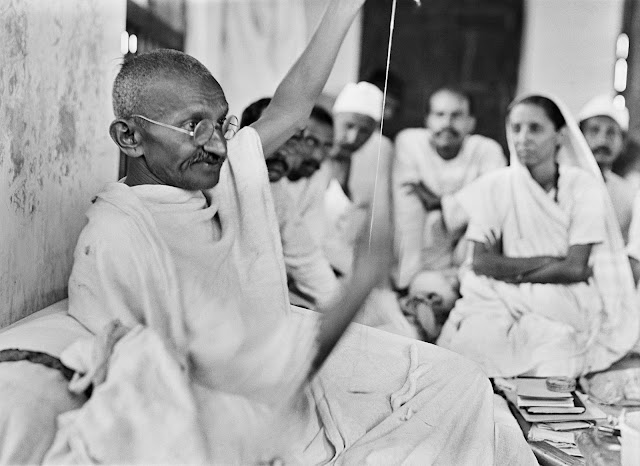
 Gandhi spinning at Dandi, April 2018. (Photo Courtesy: Fotostiftung Schweiz/Archiv fu.r Zeitgeschichte and Kiran Nadar Museum of Art)

Gandhi and Mao are not names often spoken together. So dissimilar do these giants of Asia seem, as men and leaders, that even thinking of them as contemporaries demands an imaginative leap. Luckily, Walter Bosshard met them both, and his pictures live to tell the tale.

Peter Pfrunder, co-curator of 'Envisioning Asia', the first-ever Indian showing of Bosshard's photojournalism, cheekily suggests in his brochure essay that "Bosshard himself could be seen as the link between Gandhi and Mao". Certainly, the 51 photographs and one silent film on show at Delhi's Kiran Nadar Museum of Art (KNMA) make clear that both men "welcomed this foreign photojournalist with open arms", at shaping moments of their careers. Bosshard met Gandhi in 1930 at Dandi, after the Salt March. In a piece of historical serendipity, he also met Mao after a march: in 1938, when he journeyed six days from the provisional capital of Hankou to Yan'an, the closely-guarded 'Red Capital' where Mao had withdrawn after the Long March.
Yan'an City Gate, entrance to China's Red Capital, 1938. (Photo Courtesy: Fotostiftung Schweiz/Archiv fu.r Zeitgeschichte and Kiran Nadar Museum of Art)

Unlike his legendary subjects, Bosshard never marched the length and breadth of a country to mobilise his people. But if we set aside for a moment his position as a white man in an imperialist world, Bosshard's own travels are quite impressive. A Swiss primary school teacher from 1908 to 1912, he studied art history in Zurich and Florence and did military service in Italy during World War I. Bosshard's life after 1919 would be the envy of any experience-hunting millennial: he worked on a plantation in Sumatra, as a gem dealer in East Asia, and as a merchant in India and Thailand. In 1927-28, he was a photographer on a German expedition to Central Asia. By 1930, he had so established himself that the Munich Illustrated Press sent him to India on a 'study trip'. Between February and October, Bosshard travelled over 20,000 km, gathering enough material for his 1931 book, Indien Kampft! (India Fights!).
Preparation at Congress Headquarters for 'Boycott Week', Mumbai 1930 (Photo Courtesy: Fotostiftung Schweiz/Archiv fu.r Zeitgeschichte & KiranNadar Museum of Art

The highlight of Bosshard's India trip, though, was reaching Dandi in time to shoot the coming of Gandhi. With 78 volunteers, Gandhi had walked for 24 days along the coast, crowds joining him to protest the British monopoly on salt. The power of these pictures is still undeniable: hundreds wading into the water to pick up salt; a child walking jauntily off with a cloth bundle of dripping, salty mud. The presence of women is striking. In one great image, Bosshard captures rural women marchers mid-stride, one end of their white saris wound over their heads, the other end hoisted up to reveal their calves. Here is the female Indian form cast for once as a labouring body in political action, unselfconscious and thus, unfetishisable. There are also women leaders: a stoic Mithuben Petit at an anti-alcohol protest in Navsari; Sarojini Naidu, the poet and Congress leader, who had urged Bosshard to visit Gandhi at Dandi, saying "he will have time".

It appears Gandhi did. In Bosshard's images, the 60-year-old fighting the world's most powerful empire appears utterly relaxed: grinning at a satirical The Times of India editorial, spinning, eating onion soup, cackling with uninhibited laughter, shaving. "At this stage of his career in 1930, he is the only world leader who treated the camera like a confidant of his inner circle, to be trusted, silently," co-curator Sinha said in an email interview. "There is a heartwarming naturalness and spontaneity in these pictures. By the time Margaret Bourke-White or Kanu Gandhi were to shoot Gandhi at the charkha or in public meetings, he was much older, much more studied before the camera." In the KNMA brochure essay, Sinha argues that these images also highlight Gandhi's "most pronounced areas of reflection and engagement": his astute grasp of the media, his obsession with diet and the body, spinning the khadi as integral to his idea of swarajya (self-rule). Whether it was the photographer or the Mahatma who determined its elements, Bosshard's pictures established a Gandhi iconography that still holds sway.


1938: Mao in front of the Red Academy (Photo Courtesy: Fotostiftung Schweiz/Archiv fu.r Zeitgeschichte and Kiran Nadar Museum of Art)
The Yan'an images are a stark contrast to the Indian ones. Whether it's a young, serious Mao Zedong standing scrupulously straight before the camera, the cold mountainous expanses through which the Eighth Route Army marches, or simply the short hair, trousers and jackets both men and women wear, Bosshard's 1938 visuals reveal how China and India's paths diverged. "China broke from an older civilisation in a way India did not," says Shilpa Sharma, a PhD scholar in Delhi University's department of Chinese Studies. "Also, Gandhi was responding to a bureaucratic state, where there was law and order. China's many bloody wars meant ahimsa (non-violence) could not have emerged there. Mao standing strong physically in pictures was part of a show of strength needed to win," she adds.
Despite differences, "these were mass leaders who led their illiterate, poor societies out of feudal and colonial oppression," says Hemant Adlakha, who teaches Chinese Studies at the Jawaharlal Nehru University. "There is comparable poverty, a shared idealism, the instruction of followers," says Sinha. "[Both had] a vision for change for their countries."


Nearly 90 years later, both India and China have diverged greatly from these men's visions.

'Envisioning Asia: Gandhi and Mao in the photographs of Walter Bosshard' runs at the Kiran Nadar Museum of Art from 1 to 30 Oct 2018.

8 September 2018

A sympathetic spirit

My Mirror column:

Do the men haunted by a female ghost learn any lessons in Amar Kaushik’s affable small-town comedy?


One, don’t leave the house alone, especially after dark. Two, if you absolutely must go somewhere, find a group to go with: there might be some safety in numbers. Three, if you encounter an attractive personage of the opposite sex, assume the worst. The more charm the person displays, the more dulcet the tones in which they approach you, the more determined you must be to avoid their advances. Grit your teeth and keep walking — for if you so much as turn around and look at them, your very life is on the line.

These instructions, given to young men in the fictionalised town of Chanderi in the new horror comedy Stree, will seem powerfully familiar to young women in real towns across India. Only here, it is men who must lock themselves into their houses, bidding their wives goodbye as they leave for the sandhya aarti at the temple ghat with a plaintive, “Come back home early, I feel scared.” Director Amar Kaushik and scriptwriters Raj Nidimoru and Krishna DK seem to thoroughly enjoy the role reversal. And so, I’ll wager, will most women — even though these instructions are only applicable for four days in the year, during the annual puja, when the town is said to be visited by a female spirit who preys exclusively on men.


The female ghost (or she-demon) who lures men in with her seductive charm only to reveal her true horrific form later, is a ubiquitous figure in sex-segregated societies that are also profoundly patriarchal. The cupboard of Indian folk belief is crammed unsurprisingly full of monstrous female creatures with highly specific attributes: the chudail, the rakshasi, the petni, the shakhchunni, the pishachini, the yakshi, to name just a few. At least some of the sharpness of Stree is that it takes this premise, so familiar to us as to be completely unremarkable, and turns it — partially — on its head.

The film is based on a clever but simple idea, and its viewing pleasures are simple, too. The first of them is that the particular ghost of Amar Kaushik’s film bears the generic name ‘Stree’: The Woman. This stroke of genius enables some of the best lines in the film, because all references to the scary lady in question can also be heard as statements about women in general. So that Pankaj Tripathi — in top form as Rudra Bhaiya, the town’s bookish authority on all things — has plenty of occasion to advise his quaking townsmen on “Asli stree se bachne ke asal upaay (Real ways to escape the real woman)”. No man, Rudra Bhaiya tells our ‘unspoilt’ bachelor heroes in one hilarious scene, can resist the voice of The Woman — by which he also implies any woman — calling out his name more than twice in a row, in a “swapnasundari” sort of voice. “‘Lag ja gale ki phir yeh haseen raat ho na ho’ waala bhaav aayega,” he warns them, in a nice little in-joke about the 1967 ghostly mystery film Woh Kaun Thi in which that song is sung.


But while never denying this world’s predictable gendered norms (“Suhaag raat ke baad hi fight shuru hoti hai”), Stree tries to stretch its audience in directions empathetic to women. One of these involves the ghost’s reasons for ghosting: she was a tawaif robbed of her one chance at love, on her suhaag raat.


There is something quite charming about the fact that the film’s hero Vicky (played with his usual flair by the brilliant Rajkummar Rao) is a tailor. He may believe that he hasn’t been put on earth to loosen blouses and shorten petticoats, but he has magic in his hands — his father, watching him at the sewing machine, sees in him nothing less than the perfection of Shiv Bhagwan. But it is significant, too, that Vicky is a ladies’ tailor — and a self-proclaimed ‘modern’ one. In the one scene in which we see Vicky interact with an older woman customer, he encourages her, with just the right touch of flirtatious appreciation, to get a slightly deeper neck for her sari blouse. (We have had another tailor-as-sensitive-hero for the modern Indian woman in the recent Hindi film past: Irffan Khan’s character in the Delhi-set Hindi Medium, who managed to marry ‘up’ into the somewhat English-speaking classes by virtue of his open-mindedness about women’s clothes — and thus, bodies and minds.)


Unlike its ghostly star attraction, however, this is not a film interested in floating several inches above the ground —it wants to remain rooted in its milieu. It is keen to suggest that the vrats and pujas on one hand, and all manner of black magic on the other, can happily co-exist in the same world with ‘azaad’ women — and azaad views about women. They may still be suspicious of the girls that rupture their bromances, and puzzle over whether “friendship” is code for sex — but in Amar Kaushik’s affectionately hopeful vision, the boys of Chanderi are on their way to a brave new world — and not just by means of the Ludo apps on their mobile phones.