Showing posts with label film magazines. Show all posts

19 December 2018

Page-turner from the past

My Mirror column:

Thinking about Dilip Kumar, who turned 96 last week, as I leaf through a book of Urdu film memoirs now translated into English
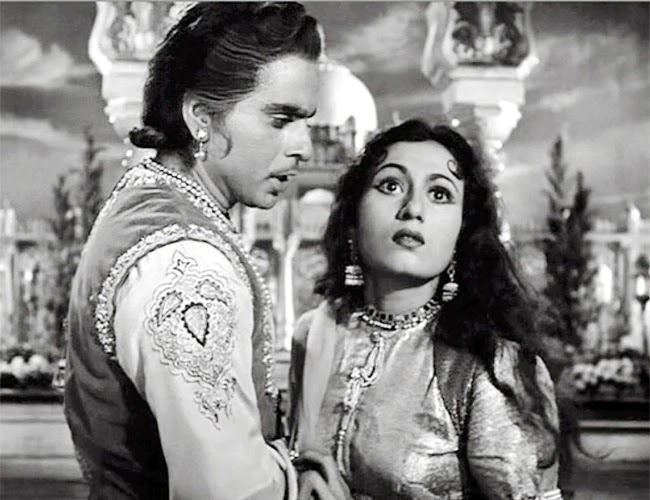
Dilip Kumar and Madhubala, who played Salim and Anarkali in Mughal-e-Azam


Last week, I started to read a new book called Yeh Un Dinon Ki Baat Hai: Urdu Memoirs of Cinema Legends, a collection of pieces from Urdu film magazines that have been selected and translated into English by Yasir Abbasi. Also last week, on December 11, actor Dilip Kumar turned 96. 

Dilip Kumar, born Yusuf Khan in Peshawar in 1922, has long been known as an Urdu aficionado, so I was hopeful that he might feature in the book. I was thrilled to find that there was actually a piece by him. Published in the Delhi-based Shama, it was a thoughtful reflection on his ‘King of Tragedy’ image. “I was declared a ‘tragedian’ at a time when I was still in the process of refining my skills,” he writes.

For Abbasi, a cinematographer and “lifelong film buff”, the book is clearly a labour of love, combining a nostalgic appreciation of Bombay filmdom with a desire to archive a lost world of Urdu journalism. By following each translation with a sample paragraph from the original essay, transcribed in Roman, the book offers a delightful little bonus to many readers like myself, who cannot read the Urdu script but are perfectly capable of understanding the words. 

But this also means opening up the translation to rather wider scrutiny than usual. To return to the Dilip Kumar reminiscence, for instance, it slips up in that single sample paragraph. “I believe real tragedy leads to a kind of sadness that permeates a person’s soul, making the individual stand out in a crowd,” reads Abbasi’s translation. But here is Dilip Kumar’s original Urdu: “Ya’ani andarooni wajood mein kucch aisi udaasiyan taari hon ki aadmi bharay mele mein bhi akela nazar aaye.” I’d say that “bharay mele mein bhi akela nazar aaye” here was meant to suggest that the tragic individual would have a profound air of solitude: he would appear alone even in a crowd.

Despite this, I was glad to read Dilip Kumar’s brief account, which revealed a man able to step away and scrutinise himself, both as an actor and a human being, in a way that would be rare in any era. He begins by pulling up those who equate tragedy with sentimentality. Tragedy, he says, goes beyond “superficial catastrophe” (though again, this is not how I’d render his “satahi qism ke haadsaat ki bharmaar”). His list of emotional markers is fascinating, because it maps a whole social -- and cinematic -- universe: “parting with the beloved, going bankrupt, betrayal of friends, or being disowned by the family”. (Again, the original ends with “makaan-jaaydaad se waalid ka be-dakhal kar dena”, which I’d have translated as “being disinherited from family property by a father”).

I was also struck by the remarkable honesty with which he spoke of his depressive tendencies — we must remember that he was writing for a mass Indian readership in 1973. He says he consulted psychologists in England, who suggested he take a break from melancholic roles. Taking on SMS Naidu’s comedy Azaad (a remake of the director's 1954 Tamil film Malaikkallan, starring MGRupon his return to India, he says, was a professional decision made for psychological reasons.

But while Dilip Kumar straddled Hindi cinema like a colossus (others in the book make many references to his aura, his linguistic skills and professionalism), what Yeh Un Dinon Ki Baat Hai makes clear is that his personal life also remained grist for the gossip mill. It comes up in all kinds of ways: as sly rumour, as tragedy, as professional hazard. An amusing instance of this is Dharmendra in Shama in 1977, where he cites Dilip Kumar’s affairs with co-stars as part of his aspirations: “Before I stepped into the world of films, I had heard a lot about the Raj Kapoor-Nargis and Dilip Kumar-Kamini Kaushal pairings. I too would fancy forming a similar duo with someone.”

His affair with Madhubala had a more tragic aftertaste because they separated on an acrimonious note (her father was, according to Dilip Kumar’s 2014 autobiography, not opposed to the wedding as much as keen to add Kumar to his money-making assets) — and because Madhubala died young. Madhubala seems to have other admirers: Nadira’s account here informs us that Premnath’s only true love was Madhubala, and the character-actor and later villain Ajit describes her after she dropped out of Naya Daur as “the wilted Anarkali who had been abandoned by Salim”. But other actresses could remain unsympathetic: the actress Veena’s version has Madhubala telling her during Chalti Ka Naam Gaadi that Dilip Kumar was her husband, and later, that she only married Kishore Kumar “[t]o annoy Dilip Kumar”. 

Among the last references to the thespian in the book is about how Ruby magazine went after the story of Dilip Kumar’s second marriage in 1982, when his vehement denials turned out to be false. But while it did not shy away from salacious or critical commentary, the Urdu magazine seems to also have offered a space for film folk to present themselves in their own words. Dilip Kumar's gift for words, of course, gave him an advantage here. Even in that tiny piece, he managed to suggest his perfectionism: “A misra [line of a poem] by Firaq saheb sums it up aptly for me: Akseer ban chala hoon, ki aanch ki kasar hai [I’d turn into an elixir, if only I could simmer a little more]." He may well have fulfilled that hope.

Published in Mumbai Mirror, 16 Dec 2018.

18 March 2018

The world according to women

My Mirror column, the week of Women's Day:

It’s always a good time to celebrate women who make films, but Frances McDormand, Aruna Vasudev and the Asian Women’s Film Festival make this week especially appropriate.

Film scholar & curator Aruna Vasudev (centre) being felicitated at the IAWRT festival. Delhi, 2018

Even if you’re not one of those people who wake up early in India for the live Oscar telecast from Los Angeles, there’s one acceptance speech this year that’s worth looking up: Frances McDormand, receiving the Academy Award for Best Actress for her performance in the blackly funny thriller Three Billboards Outside Ebbing, Missouri. The brilliant McDormand, whose first Oscar win was for Fargo in 1997, over two decades ago, has also been nominated thrice for her performance in a supporting role: for Mississippi Burning (1988), Almost Famous (2001) and North Country (2006). But that’s not why you should watch her acceptance speech.


You should watch it because McDormand did something remarkable with her two minutes on stage – like the consummate performer she is, she turned speech to action. “I’m hyperventilating a little bit so if I fall over pick me up ’cause I’ve got some things to say,” she began, placing a hand on her stomach as if to steady herself. She then thanked her director Martin McDonagh, the film’s team and what she called her “clan” (McDormand has been married since 1984 to Joel Coen, one half of the Coen brothers filmmaking team). “And now I want to get some perspective,” she said, putting her statuette down on the ground. “If I may be so honoured as to have all the female nominees in every category stand with me in this room tonight. The actors (Meryl, if you do it everybody else will, come on), the filmmakers, the producers, the directors, the writers, the cinematographers, the songwriters, the designers, the composers...”.


It was a sight to behold as women stood up across the length and breadth of the Dolby Theatre, to McDormand’s delighted laughter. “Look around, ladies and gentlemen, because we all have stories to tell and projects we want financed,” she said, exhorting Hollywood’s biggies to seek out these women to discuss their ideas for films.

Closer home, in a much smaller auditorium in Delhi, another vibrant celebration of women in film also took place last week. The 14th Asian Women’s Film Festival organised by the India chapter of IAWRT (the International Association of Women in Radio and Television) began by felicitating Aruna Vasudev, the pioneering writer, magazine editor and festival curator who first got Indian film enthusiasts thinking about Asian cinema.

The 1936-born Vasudev’s first claim to fame was launching Cinemaya, a quarterly journal about Asian cinema, in 1988. As a film-obsessed young person who came of age in the Delhi of the 90s, I remember Cinemaya fondly. It was a rare sort of publication then, and would be if it were around now. It was remarkable to be awakened to the fact that Taiwan and Hong Kong and Japan and China had film industries, and to discover through them a host of cinemas potentially closer to ours than the American, British or European work we’d hitherto thought of as world cinema.

Cinemaya was also rare simply because it was a carefully edited Indian film magazine that was actually about films. We’re so thrilled about being the world’s largest film-producing nation, but where is the sharp, informed conversation about the films we make? Much Indian film journalism remains driven either by industry gossip or box office figures. Those have a place. But we need much more writing and discussion of Indian films that is excited yet knowledgeable about the specificities of each film industry, from its fan clubs to lyric writing to cross-language adaptations. Isn’t it a pity that as of 2018, to my knowledge, we don’t have a single publication that does for the multilingual world of Indian cinema even what Cinemaya did for Asian films: to publish thoughtful reviews, each by a critic conversant with that film’s language, and that cinematic tradition?

Vasudev’s second achievement came in 1990, when UNESCO offered Cinemaya the funds for a conference on Asian cinema. Vasudev managed to use the five-day gathering in Delhi to form NETPAC (Network for the Promotion of Asian Cinema), which is still going strong 28 years later. Under Vasudev, NETPAC was responsible, in 1999, for launching Cinefan, the Delhi-based festival of Asian cinema that later became Osian’s-Cinefan, growing in size and popularity as Asian cinema became a global buzzword.

Sadly, Osian’s-Cinefan was last held in 2012. The IAWRT festival, held on a much smaller scale, is currently the only Indian festival focused on our connections with Asia. But what makes IAWRT doubly unique is the fact that all the films – documentaries, animation, shorts or fiction features – are directed or co-directed by women.

This year’s highlights for me included Gali, Shabani Hassanwalia and Samreen Farooqui’s spirited documentary on the subculture of hiphop in Delhi’s poorer neighbourhoods; Turup (Checkmate), remarkable both for its thought-provoking fictional take on a Bhopal mohalla and for the workings of the Ektara Collective that made it; Clair Obscur, Yesim Ustaoglu’s often harrowing fictional exploration of the domestic/sexual lives of two Turkish women, one a rural teenager and the other her psychiatrist; and the stunningly evocative Up, Down and Sideways, which transports you to the musical world of community farming in Phek, Nagaland.

As should be apparent even from this minuscule list, women making films does not necessarily mean films about women. It just seems that when it’s women producing and directing and filming, the world looks a little bit different from the way we’ve been shown it by the so-called mainstream. Just as ‘women’s issues’ are things that matter to half the world – and therefore should concern the other half, too.


Published in Mumbai Mirror, 11 Mar 2018.

20 October 2015

Book Review: A legendary ‘character’ from Hindi cinema’s early days

A book review, published in the Sunday Guardian:

Sidharth Bhatia’s book on Filmindia magazine and its founder Baburao Patel reminds us of a colourful man who embodied many of the conflicts of his time.

Baburao Patel with his wife and editorial assistant, Sushila Rani Patel. 
Over the period 1948-54, sitting in Lahore, Saadat Hasan Manto produced a series of sparkling pen-portraits of people he knew well in the Bombay film world of the 1940s. Some of those featured in Stars from Another Sky (1998) are still famous in our time, names like Ashok Kumar or Nargis, while present-day movie buffs might be hard-pressed to recognise others: comedian V.H. Desai, “Too Hot to Handle” Kuldip Kaur, or “Pari Chehra” Naseem, who was also Saira Banu’s mother. But they were all actors — except one: Baburao Patel.

That Manto chose to include him speaks of Patel’s importance to early Bombay moviedom, and his reputation as a “character”. Sidharth Bhatia’s new book re-certifies his legendary status. His Filmindia, founded in 1935, quickly became the most influential magazine on Hindi cinema, characterised by its editor’s brash opinions, rough-and-ready humour and appetite for industry gossip. It held on to that position for nearly two decades, before dissolving — like Baburao himself — into a strange brew of right-wing Hindu politics and crude sexual frisson.


Baburao’s journalistic career began with the trilingual (Urdu, Hindi, English) Cinema Samachar, and Manto himself mentions two other publications he started during the Filmindia years: Prabhat “which would publicise, but in an original way” the films produced by Prabhat Film Company, and an Urdu weekly called Karwan, which Baburao started to help a friend called Abid Gulrez, and then revived for Manto.

Baburao was also the rare film critic to have been a director first — rather than the other way round, as seems to be the norm. Of his six films, four were made before he launched Filmindia — Sati Mahananda (1933), Maharani (1934), Bala Joban (1934) and Pardesi Saiyan (1935). In the 1940s, he returned to direction to make Draupadi (1944) and Gwalan (1946), both vehicles for the acting and singing talents of his third wife, Sushila Rani.

Despite his towering presence, little of note seems to have been published about him in English beyond the occasional mention. Film histories of the time make mention of Patel’s scathing pen, the power his reviews wielded, and his tumultous association with everyone from Dilip Kumar to K.A. Abbas. Meanwhile, the Tamil writer Ashokamitran has reminisced about how his work at Gemini Studios’ publicity department in the 1950s included summarising Patel’s ramblings: “If Baburao Patel had only known how I rewrote the majority of his editorials...”

Sidharth Bhatia’s The Patels of Filmindia is, therefore, extremely welcome. And by weaving the book around Patel’s long-time partnership with Rani, it offers a useful counterpoint to Manto. Manto casts Rani as one of many women in Patel’s life: attractive but insubstantial. (Sample sentence: “Did he think politics was a Rita, a Sushila or a Padma whom he could put on top of a maypole and have it perform tricks according to his instructions?”) In contrast, Bhatia presents Patel through Rani’s eyes — as an impressive man with an indomitable will, but also impossibly demanding, inconsiderate and not as transparent in his personal life as in his public persona: during their courtship, for instance, he got rid of a rival suitor by writing him a letter on Rani’s behalf.


Bhatia’s book is the result of his meetings with the late Rani, and his admiration for her is apparent. We hear about her feistiness, her earning a law degree in her sixties, her impeccable classical training, her 2002 Sangeet Natak Akademi Award and her consistency at riyaaz even in old age. Rani, on her part, seems to have taken the book as an opportunity to speak frankly about Patel, and the eventful life she led with him: from being deputed to teach English to the youthful Madhubala, to campaigning in Raipur in 1971 against the combined might of Congressmen S.C. and V.C. Shukla.

The book paints a revealing portrait of an Indian marriage of a certain era, in which the wife, despite being no pushover, struggles for control over her life, while the husband can’t decide between promoting her talent and throttling it. “Baburao got me teachers but when it came to concerts, he put his foot down. It used to leave me in tears,” Rani told Bhatia. After marrying Rani, he tried to make things up to his earlier wife Shireen by bringing her to live with them in Girnar bungalow in Bandra. He even “started publishing articles on cookery, including a food column, “A La Girnar” in the magazine under her name”. Both women were thus trapped in an unpleasant situation not of their making, while Patel carried on “writing books, thundering in his columns and unsurprisingly, chasing women.”


Patel’s “thundering” shifted in focus over time. From bad films, he graduated to ranting against what he saw as bad policies. By 1957, he was raging against a Censor Board directive against films that “glorify or sanctify social usages, customary practices or other actions which according to modern standards of social behaviour in India are considered sinful or criminal”. He saw this, like much else, as deliberately anti-Hindu action on the part of the Congress. In a 1957 sentence that speaks of his ideological turn, Patel wrote: “Congressmen have come to realise that orthodox and traditional Hinduism is the only force that challenges the secular supremacy of Congress rule in India.”

In 1960, he re-jigged the magazine as a general publication, calling it Mother India. He was not the man to toe a party line, but his views had become largely pro-Hindutva: he even hired as a columnist P.N. Oak, author of various Hindu conspiracy theories, such as the one about the Taj Mahal actually being a Shiv temple called Tejo Mahalaya.

Patel became an MP in 1967. He remained active as editor until the Emergency, when he was thrown into Arthur Road Jail, apparently for some question about Sanjay Gandhi which he had answered with his usual sharp tongue. Although Rani’s letter to Indira Gandhi got him out soon, she told Bhatia that a broken Patel left the magazine to her after that.

Bhatia provides a readable, informative account of a colourful man. The volume is also meant as a sort of archive. This works exceptionally well with images: every alternate page is a glossy reproduction of one of Filmindia’s memorable hand-painted covers, which doubled up as film publicity. It doesn’t work so well with the Filmindia reviews, articles and Q&As which take up the volume’s second half. For one, Patel was no stylist, as is apparent from such headlines as “Purab Aur Pacchim (sic): A Howling Nonsense” and “Zid Gives Incurable Headache: A Picture Rotten All-Round”. His replies to readers’ queries can be glibly funny: “Gandhism these days is a prayer for the poor and profits for the rich”, but are often deeply sexist: “Q: Who can be the best companion for travelling purposes? A: A young woman who eats less, sleeps less and talks less.” Even if we grant that there is value to reproducing this material, it seems a pity that the pieces are not dated, annotated, or illuminated by any critical analysis. Still, Bhatia’s labour of love will certainly revive interest in a long-forgotten maverick whose life and work deserve closer critical study.

Published in the Sunday Guardian, 17 Oct, 2015.

6 September 2015

Painting the Stars

Today's Mirror column:

FilmIndia's memorable covers reveal the intertwined history of advertising and journalism, art and cinema.


Among the page-turning pleasures of Sidharth Bhatia's luxuriously-produced new volume, 
The Patels of FilmIndia, are the pictures. The Patels in question are editor Baburao Patel and his much younger wife Sushila Rani, who together ran FilmIndia, the country's most popular film magazine for much of the first half of the 20th century. At its best, the magazine seems to have been an irrepressible mix of witty one-liners, scathing reviews, bizarre rants -- and of course, industry gossip. But it could never have achieved its popularity were it not for the remarkable images - often in full colour - that appeared in its pages. 

The founding of the magazine in 1935 was the result of a collaboration between Baburao - who had worked as a film journalist for something called Cinema Samachar, and also made five films in the period 1929-1935 -- and a man called DN Parkar, who owned a printing press called New Jack. An offshoot of Prabhat Studios, New Jack had become a lucrative business based on Parkar's monopoly on printing anything the Pune-based film production house brought out: posters, handbills, books. "He knew Baburao and they decided to launch a film magazine; their rationale was that since they had a press, and paper was easily and cheaply available, venturing into publishing made sense," writes Bhatia. "BB Samant and Company, another child born out of Prabhat, had the rights to the publicity of the film company and could be relied upon to give ads." 

From the start, it was clear that production values were going to be high. The launch issue, dated April 1935, was priced at 4 annas. Printed on high quality art paper, it had a rather spectacular hand-painted cover image with a woman's face in a rectangular frame, and the rest of the space devoted to a painted backdrop showing a kind of grand Indian crowd scene: bullocks, camels, turbaned men with spears, caparisoned elephants and a palm tree. The woman was Nalini Tarkhud, the heroine of V. Shantaram's film Chandrasena - which was advertised on the inside pages. 

Soon, FilmIndia's beautifully hand-painted covers began to themselves double up as advertisements for particular films - sometimes much before they arrived in theatres. In one fascinating instance, the January 1946 cover announced Mughal-e-Azam with a rather lovely painting of Prince Saleem picking roses in a garden. May 1946 and July 1946, too, were devoted to illustrations of K. Asif's Mughal-e-Azam. Yes, you read that right - 1946! It seems that Asif first planned to make the film in that year, with an actor called Chandramohan and the then-upcoming Nargis. Except Chandramohan died before shooting could begin, and the film was finally completed (with its now-legendary cast of Dilip Kumar, Madhubala and Prithiviraj Kapoor) only fourteen years later, in 1960. Those FilmIndia covers from 1946 are probably among the last surviving reminders of the film that might have been. 

In October 1944, the FilmIndia cover was a eye-ball-grabbing colour illustration of a giant hand, reaching out to disrobe a distressed young woman in a golden crown and the gleaming bratop that would later become the staple costume of mythological Hindu females in Amar Chitra Katha. The image was publicity for the film Draupadi, produced by New Huns Pictures (Huns as in swan, not Attila) as a launch vehicle for Sushila Rani, whom the already-married Baburao had assiduously wooed and finally married. 

Sometimes the cover could even be given over to an actual product. The February 1946 issue, with a properly 'Oriental' couple (seated next to a brass surahi of wine and a rather incongruously modern Western-style loaf of sandwich bread) announced Panama Cigarettes as that which "Would have completed Omar Khayyam's Paradise". But although the magazine was unabashed about the tie-up between film publicity, product advertising and film journalism, Baburao was publicly adamant from the start that his reviews of films would never be coloured or prejudiced by advertisers. Writes Bhatia: "Advertisers who did not like this policy were welcome to take their ads elsewhere, he declared." 


The other noteworthy thing about these covers, of course, was that they were painted. Sabina Gadihoke, among others, has pointed out that the artists often took photographs as their reference points to produce realistic likenesses of the stars. But the standards of printing at the time did not allow for photographs to come out well enough. Gadihoke quotes Alyque Padamsee, who joined the advertising agency Lintas in the 1950s, as saying that copywriters had to be careful not to put lines like '"This is what Lux does for my complexion," says Mala Sinha', "because poor Mala's face would look like a poached egg." Often photographs had to be enhanced - dull studio backdrops enlivened, cheeks made rosier, lips reddened - for the requisite glamour to appear in printed colour. 

The artists credited most often on FilmIndia covers are DD Neroy and SM Pandit. The talented Sambanand Monappa Pandit (b. 1915) was among a new generation of artists who had graduated from the JJ School of Art in Bombay, and was much sought after. Like many of his ilk, SM Pandit simultaneously produced film-related work, product advertising and calendar art. Pandit's work is a stellar example of the cross-fertilization of style between Bombay cinema and the popular print representation of characters from Hindu mythology: the stars became more like gods, and the gods became more romantic, more sexualised. But that is another story.


Published in Mumbai Mirror, 6th Sep 2015.

8 July 2015

Speaking English, Doing Desi

Last Sunday's Mumbai Mirror column:

'Convent' English, Hinglish and the non-filmi journalist: the last in a three-part series on the Indian film magazine.


Devyani Chaubal, columnist for Star'n'Style magazine
There was something strange about Indian film journalism, at least as it was conducted by English language journos writing about Hindi cinema. For the last two weeks, as I've written about how this world came into being, I've been trying to put my finger on what that was. Now I think I have it: the more magazines became about film stars, the less their writers needed to know about the films. In fact, the snob value that the Indian elite of the time attached to not watching Hindi films became the cachet of the English-language film journalist.

Film journalists who wanted to be taken seriously had long maintained a social distance from the film world. Last week, while writing on the venerable BK Karanjia who edited Filmfare for 18 years and Screen for ten without attending filmi parties, I stumbled upon Karanjia's own charmingly matter-of-fact explanation. Talking about the big bash Dev Anand threw when BKK became Filmfare editor, he recalled: "There was too much drinking going on, dinner was served at 4.00 a.m. and I had to attend office five hours later. That put an end to my partying."

But Filmfare was "the stuffy dowager", "a widowed aunt", as Shobhaa De's 1997 memoir put it. In the '70s, its place at the top was threatened by a host of upstart mags, staffed almost entirely by twenty-somethings. These included Stardust (launched in October 1971 with De as editor), Cine Blitz (started in Dec 1974 by Russi Karanjia's Blitz group, with BKK's niece Rita Mehta as editor) and Super (ran 1976 to 1982). Just before them came Star'n'Style (1965), and later Movie (1982) and Showtime(1984).

All these new magazines lived off filmland gossip -- and not the coy variety of it in which heroines "confessed" to sleeping with their teddy bears. The uncrowned queen of gossip columnists was Devyani Chaubal of Star'n'Style, known as Devi, and a bit of a publicity magnet herself. When she was famously assaulted by a sloshed Dharmendra for having written various things about his sexual appetite, Khushwant Singh, who enjoyed her "bitchy pieces", felt quite free to write a bitchy piece on Chaubal herself. "I wrote in my column that had I been in his shoes, I would have done exactly what Dharmendra had done to her," Singh wrote in his 2002 autobiography. Even when she was issued sexual threats by the drunken sons of an actor whose histrionic talent she had scorned, Singh's interpretation of Devi's teary retelling was bizarre: "I was not sure if she was really upset with the threats... or... looked forward to their being fulfilled". (All this despite - or perhaps because? - Singh had "the feeling that we were meant for each other"!)

Shobhaa De had her own mixed feelings. "With her paan-stained mouth, fair skin, curly strands of hair and voluptuous figure, Devi was irresistible to some men," De wrote in 1997. "It was her practice to hold court at parties, often sabotaging the host's efforts by staging a parallel soiree of her own in one corner of the lawn or bungalow... she was a high-profile star in her own right, unlike our schoolgirlish reporters speaking 'convent' English to all the 'Punjab da putters' who couldn't tell a compliment from a slur."

De's recognition of her staffers' "convent" English didn't reduce her disdain for Chaubal's own. Describing how Stardust's hit column "Neeta's Natter" was first written by a freelancer called Mohan Bawa, she writes: "Short, thickset and very camp... Bawa was also the only film journalist who wrote decent copy in grammatical English - entire sentences with punctuation marks. This was more than anybody could say about... Devi's 'Frankly Speaking'... written in catchy but clumsy Marathi-English."

The last comment is particularly fascinating, because Khushwant Singh liked Chaubal's columns for her "brand of Hindustani English (Hinglish)", and because De's own much-feted contribution to the new film journalism was also Hinglish. Namita Gokhale, who published Super, described Shobhaa (then Kilachand, nee Rajadhyaksha) in her marvellous 2011 essay "Super Days" as having "unleashed a whole new dhakar street vocabulary via Neeta's Natter". 


Namita Gokhale in the Super days.
Clearly there was a discernible difference - linguistic, but also social - between someone like Chaubal, who was, for instance, notoriously besotted with Rajesh Khanna, and these "convent girls" for whom Hindi filmdom held a horrifying fascination at best, and no interest at worst. De writes proudly that she watched only four or five Hindi films a year. Bhavana Somaya's parents, who disapproved of her working for a film mag (Super), were lied to whenever she had to cover a film party. Gokhale was fresh from literature at Delhi's Jesus and Mary College, and went back to books, but at least the stars had some frisson for her. De (like BKK, but more grandly) declares that barring two film parties, she "did not step into a film studio, attend a muhurat, visit a star home, or party with the film crowd", while editing Stardust


De is right that this "enforced distance" helped create a "credible level of objectivity". But there was more to it, as is made apparent by De's take on stars who "dared to show up at the Cat House" as "setting themselves up for further ridicule in... the magazine". De's description of "Shatrughan Sinha, with his broad Bihari accent and crude manner", or the drunken Sanjeev Kumar's crassness as that "of a grain-seller... a shop-keeper... a frustrated labourer" reveals how new English-language journalists often experienced their difference from the Hindi film world in class terms. And they felt no need to hide it. In fact, they wore their fluent English and "well-spoken" backgrounds like armour against the industry's perceived boorishness. Vinod Mehta once told me that his "England-returned" accent helped impress filmwalas for his Meena Kumari book.

It needed liberalisation to turn "Bollywood" into something Anglophone Indians could find cool. That transformation has coincided with the rise of the fully English-speaking star -- and perhaps, the disappearance of the snooty film journalist?

29 June 2015

CineVoice of the Nation

My Mirror column:

Continuing my short history of the Indian film magazine in
 English: editor Burjor K Karanjia and his many publications.


In last week's column ("Stars, Scandals and Fandom", Jun 21, 2015), I began a short history of the English-language Hindi film magazine. Starting in the 1930s, I brought the story down to the 1970s, when a series of new magazines altered the tone and texture of Indian film journalism in English.

But in 1970, the highest-circulating English magazine about Hindi cinema was Filmfare. It was edited by the late Burjor K Karanjia, whose politeness, erudition and general gentlemanliness were legendary. Karanjia was an unlikely film journalist: a Parsi from Quetta, Karanjia qualified for the much-prized Indian Civil Service in 1943, but got quickly bored and decided to abandon a potential bureaucratic career to explore other options. 

In his memoir, Counting My Blessings (Penguin, 2005), he describes how his fascination with cinema, first kindled in his Wilson College years by a chance witnessing of Franz Osten directing the lovely Devika Rani on the sets of his film Always Tell Your Wife, grew into a serious interest in film journalism. Being from a moneyed family, the 27-year-old Burjor decided to enter the field by launching a magazine. (Burjor's brother Russi Karanjia had already founded the investigative news tabloid Blitz, to which Anurag Kashyap's Bombay Velvet recently paid fictional homage.) 

Cinevoice, launched on June 7, 1947 at the Taj Mahal Hotel, in a glittering ceremony attended by many film grandees, was meant to "represent the industry's point of view" and fight its battles, while also being, in Karanjia's own words, "a journal that was clean, that was constructive and that had a conscience". Among the 'battles' waged in the pages of Cinevoice was a campaign "to plead for social recognition of the film community". It may seem difficult to imagine in our Bollywood-besotted era, but in those days, writes Karanjia, "film stars found it difficult to secure flats in decent localities in the city. No club, moreover, would admit film stars as members." Motilal, and later David Abraham, were the first actors to be admitted to the Cricket Club of India. Cinevoice also tried to gain film folk respectability by marshalling them into national political participation. He credits his colleague Ram Aurangabadkar with the idea of getting three contemporary actresses -- Nargis, Snehprabha Pradhan and Veera -- to attend the first All India Congress Committee (AICC) session held after Independence, and report on it for Cinevoice. 

Karanjia is also credited with instituting a system of film awards as early as 1949 - the Cinevoice Indian Motion Picture Awards (CIMPA) - and for programming a live charity show to raise money for "Kashmir Relief and Troop Comforts", called "A Nite with the Stars." Neither of these ventures quite took off independently, but both live shows with the stars, and film awards (which Karanjia managed to run with greater success as Filmfare editor), have proliferated to such a degree that our cinematic culture is unimaginable without either. Cinevoice did not last long, and neither did Karanjia's other self-funded journalistic venture, Movie Times.

But with the editorship of Filmfare came a certain stability. The magazine was a commercial publication that gladly put Hema Malini or Rajesh Khanna or a bikini-clad Sharmila Tagore on the cover, but also allowed Karanjia the space to do what he had set out to in Cinevoice: represent the voice of the film industry.

In the February 13, 1970 issue, while applauding the liberal attitude taken towards film censorship by the Khosla Committee Report, Karanjia's editorial called it out for equating commercial considerations with dishonesty, and wrote that the charge "betrays an ignorance of the many complex factors that have made film-making in India an adventure and a gamble, and that have attracted to it the wrong type of finance and the wrong type of filmmaker." 

Karanjia also combined in his person roles that today might seem impossibly divergent: he edited Filmfare for 18 years (and Screen for ten), while being Chairman of the Film Finance Corporation (FFC, later to become NFDC). The same February 13, 1970 issue of Filmfare, for instance, reported a press conference at which film director Basu Chatterjee discussed the film he had just finished shooting, with a loan from the FFC: Sara Akash. Chatterjee, the report noted, was a well-known Blitz cartoonist who had adapted Rajendra Yadav's Hindi novel into a film with an all-new cast and "a determination to steer away from songs, dances and other cliches of the Hindi cinema". 

The magazine quoted its own editor as having stated at the press conference that "Audiences, I think, are ready... The question no longer should be where these films will be screened, but what sort of films should now be made." The report went on: "The Corporation, he revealed, has already sent a proposal to the government for securing a network of theatres based not on opulence, but utility." 

As editor, he was credited with almost doubling Filmfare's circulation, and making a genuine effort to return the Filmfare Awards to their early prestige. He went on to write even sharper editorials for Screen.

Karanjia resigned from his position as FFC Chairman during VC Shukla's unsavoury reign as Minister for Information and Broadcasting during the Emergency, in January 1976 (though he did later become NFDC Chairman). But what distinguished BKK was a rare combination of traits: an enthusiasm for helping finance a new kind of cinema, but never being disdainful of commerce.

Published in Mumbai Mirror, 29 Jun 2015.

21 June 2015

Stars, scandals and fandom

Today's Mirror column:

Reading in English about Hindi movies: a very brief history of the Indian film magazine as we know it.


Writing about films is one thing; writing about film stars is quite another. There are those who do both with aplomb. But in India, most long-running film magazines have been much more interested in the lives of film celebrities than the content of films.

The first Indian magazine completely devoted to cinema coverage was the Gujarati Mauj Majah, first published in 1924. Among English magazines, Baburao Patel's well-regarded monthly FilmIndia, published from 1935 to 1961, was one of the first. (The legendary and indefatigable Patel, who produced the entire content of the magazine himself – later aided and finally replaced by his wife Sushila – is the subject of a new book called The Patels of FilmIndia, which I'm looking forward to reading).

This was followed by the first trade publications, like KayTee Reports and Tradeguide, concerned not with stars but with predicting the commercial success or failure of particular films. In 1951 came Screen, launched by the Indian Express group in a colour broadsheet format. Screen, because it was concerned both with recent events in the industry and with films under production, could “be situated somewhere between the trade and the fan magazines”, writes film scholar Rachel Dwyer.

Close on Screen's heels came Filmfare, launched by the Times of India group in 1952. Filmfarewas glossy and upmarket, but it intended to be a family magazine and a sophisticated one. The first issue contained a manifesto that stated, “This magazine represents the first serious effort in film journalism in India. It is a movie magazine – with a difference. The difference lies in our realisation that the film as a composite art medium calls for serious study and constructive criticism and appreciation from the industry as also from the public.” This noble intention was cemented by the institution of the Filmfare Awards in 1953. Filmfare remained biweekly until 1988, when financial troubles forced it to become a monthly, which it has been since.

But the big moment of change in English-language film journalism in India was the 1970s, when a clutch of new magazines changed both the way we related to the stars and the language in which we were meant to do it. Jerry Pinto summed up the 70s magazine scene in his superb bitchy-funny Introduction to The Greatest Show on Earth, a spectacular anthology of writing on Hindi cinema that he edited in 2011. “Filmfare was the grand old lady, still published in an improbable size that meant you couldn't open it fully in a crowded bus or train. Stardust was the snazzy newcomer with a hint of middle-class contempt for the arrivistes and outsiders that made up the film industry. Cine Blitz came later and launched itself on the unsuspecting public with Protima Bedi – a Bollywood citizen through her open marriage with Kabir Bedi – running nude on a city beach. In between, for a brief while, there was Super, which had an almost indecipherable column, written as a letter, by Bubbles. Since Bubbles assumed we all knew the stars' nicknames, I often read it wondering at what was really happening and who was doing what to whom. When one did know (Daboo was Randhir Kapoor and Kaka was Rajesh Khanna) one felt validated in one's knowledge.”

Stardust, writes Dwyer, was founded in 1971 by Nari Hira of the Magna Publications group “as a marketing opportunity for his advertising business”. It was meant to be something along the lines of the American celebrity gossip mag Photoplay, more salacious than the then-staid Filmfare. Dwyer's 2001 essay contains the following wonderful account: “Twenty-three year old Shobha Rajadhyaksha (later De), who had been working for Hira for eighteen months as a trainee copywriter, was hired as the first editor. She had no interest in the movie world and had never worked as a journalist, but was hired on the strength of an imaginary interview with Shashi Kapoor, whom she had never met.” The imaginary interview was clearly a thing, combining an opportunity for writerly showing-off with a jokey fantasy that indulged the star's fans. Jerry Pinto cites one ridiculously risqué one with Bindu, from the now-defunct Film Mirror, which ends with the “reporter” waking from a dream. But more of that in another column.

To return to Shobhaa De, she apparently produced the first Stardust issue alone (with one paste-up man). She was later joined by a production staff of three and a team of freelance reporters who “collected stories which she wrote up”: a one-woman show not far from Baburao Patel. But De seems to have stayed put in her office, somewhat unusual for a young journalist. In her memoir Selective Memory: Stories from My Life, De's version of it is: “My eyes and ears were so attuned to reportage that I preferred my colleagues' version of their meetings with the stars to personal encounters.” Dwyer puts it somewhat differently. “De stubbornly refused to move in the film world, only meeting the stars if they came into the office,” she writes, making one envisage a scenario that seems nearly unimaginable today, when a respected and senior film journalist told me that even he finds it difficult to get interview appointments with current stars. Most stars, he added, seem in such a huge rush to finish the interview that it can barely become a conversation.

Super, too, was founded by an exceptionally young team that included Bhavana Somaya and Namita Gokhale. Gokhale, then 20, encountered Dev Anand some four decades later at the Jaipur Literature Festival, and was amazed to have him recall the last time they had met. “It was in 1981, I think,” he mused. “You were with your editor Rauf Ahmed – what was the magazine called...?” Whether it was the fact that these young people were just exceptionally memorable, or that stars in those days met less journalists, I don't know.

29 March 2015

Shashi Kapoor, the perfect partner

My Mirror column today: 

Whether paired with Amitabh Bachchan, Shabana Azmi or his wife Jennifer onscreen, the understandably secure Shashi Kapoor always made for a compelling foil in the movies.


I think he's completely deserving of it, but Shashi Kapoor might seem an unusual choice for the Dadasaheb Phalke award. Unlike his larger-than-life father, Prithviraj, whose grand passion for theatre and cinema started the Kapoor clan off on their path to show business, and unlike his two elder brothers Raj and Shammi, both of whom - though not comparable - carved out distinct, individual niches for themselves in an unforgiving film industry, Shashi has always been the perfect foil. Never an actor who sought to have the spotlight turned solely on him, he has always been someone who gave himself wholly and freely in partnerships. And rarely, in the world as in cinema, is that quality given the applause it deserves. 

One of his earliest romantic pairings, with the lovely late actress Nanda, lasted through the whole decade of the 60s, with seven films, starting with Char Diwari (1961) and ending with Rootha Na Karo (1970). The most successful of these, of course, was Jab Jab Phool Khilein (1965), in which he went from being a carefree Kashmiri boatman singing 'Pardesiyon se na ankhiyan milana' to being the wealthy Nanda's uncomfortably suited-booted husband, singing 'Yahan main ajnabi hoon' at the sort of piano-centred party that Hindi cinema so often used to depict the terrible un-Indian debaucheries of the rich. In an interview in the 90s, Shashi said Nanda was his favourite heroine. Nanda, who was by far the bigger star when they started acting together, returned the compliment. The figure of the ghuta-hua poorer man to the little rich girl of 60s cinema was one Shashi repeated the following year, in Waqt, where he played Sharmila Tagore's educated-but-poor lover who must work as a driver to support his mother. 

A very different sort of partnership, with Amitabh Bachchan is, of course, legendary. The two did so many films together that Jaya Bhaduri once apparently referred to Shashi as her "soutan", because he spent more time with her husband than she did. The Amitabh-Shashi on-screen relationship ran the gamut, from estranged brothers (most famously in the 1975 classic Deewar, but also in other films like 1979's Suhaag), to servant and master (Namak Halal, 1982), blue collar worker and white collar boss (Kala Patthar, 1979), sometimes even sort-of-rivals for the love of a woman (Kabhie Kabhie). Much as I loved watching Shashi's sunny, ethical engineer play off the brooding Amitabh in the fictionalised prevention of a real-life mining tragedy that was Kala Patthar, my favourite of their performances together is probably the ridiculously enjoyable Do Aur Do Paanch, in which they play rival thugs who've taken jobs at a school, pretending to be music teacher and sports teacher respectively, in order to kidnap a little boy. 

Amitabh being the spotlight-grabber that he is, it took a persona as secure as Shashi's to remain completely unthreatened. Which he did, despite the conspiracy theories floated in film magazines of the time, about Shashi's role having been cut down to size in Deewaar. In a short but rather remarkable 1975 interview to Bikram Vohra in Filmfare, Shashi categorically refused to add any fuel to that fire: "[I]t's ridiculous to say that Amitabh's role [in Deewaar] was engineered to show me up. After all, before I took the role I knew I was playing the second lead. So the idea of a conspiracy against Shashi Kapoor is Bullsh*t. And in any case why do we have this hang-up in our country? About always coming out as heroes. In the West great names like Olivier, Burton, Harrison frequently played second roles. There's nothing demeaning about that." 

Another of Shashi's most interesting - if somewhat unlikely - romantic pairings was with Shabana Azmi. The films they did together that remain embedded in my mind are both literary adaptations. They played husband and wife in the memorable Junoon (1978), Shyam Benegal's adaptation of Ruskin Bond's A Flight of Pigeons, and many years later, in the 1993 In Custody (Muhafiz), the Merchant-Ivory adaptation of Anita Desai's novel by the same name. Shabana plays the neglected, petulant wife in both films, but Shashi's roles could not be more stunningly different: a fiery young 1857 mutineer called Javed, and an aged, overweight poet whose world is crumbling. As an aside: it's funny to think of the fact of these actors as people who've known each other for ever - that same Bikram Vohra interview from 1975 has Shashi tossing off a remark about how he told Shabana that she's a great actress but not very goodlooking (as opposed to Parveen Babi, to whom he apparently said the opposite). 

But perhaps Shashi's oddest and most interesting film pairings were with his wife Jennifer Kendall. The first one I recall is also in Junoon, where as the troubled Javed, Shashi becomes obsessed with the teenaged Ruth (an exquisitely young Nafisa Ali) and his potentially dangerous attentions are only kept at bay by Jennifer, playing Ruth's mother Miriam. The second is in the 1970 Merchant Ivory production Bombay Talkie, where he played a Bombay film star who has an affair with the visiting American novelist Lucia Lane (Jennifer). These were not performances that let on that the two actors were, in fact, husband and wife. 

I don't know very much about their real-life relationship, but the same 1975 interview paints a picture of the Jennifer-Shashi household as one where Shashi was forced to eat organic breakfasts at 7.30 am, and occasionally, at least, have vegetarian stints. This seemed unbelievable to the Filmfare journalist in 1975. But it fits perfectly with Sanjana Kapoor's memory of growing up in a house where three things were banned: aerated cold drinks, comics and film magazines. Clearly, Shashi's lifelong ability to keep the Hindi film world he was born into at a safe, sane, distance owed something to Jennifer. But that would need another column.

5 January 2015

Book Review: Museum of Cinema

A review of the biggest book I've ever read. In the year-end issue of the book review journal Biblio:


Project Cinema City
Edited by Madhusree Dutta, Kaushik Bhaumik and Rohan Shivkumar
Foreword by Arjun Appadurai
Design by Sherna Dastur
Tulika Books, New Delhi, in association with Majlis and Goethe Institute, 2013, Rs. 3500 (HB)

If you can imagine a book that combines the experience of an art exhibition, an archive, a seminar and a guided city walk -- all going on at the same time – then you've pretty much imagined Project Cinema City. This book, which won the Printed Book of the Year award at the first edition of the Publishing Next Industry Awards (September 2014), seems to want to redefine what a book might be. It is huge, a massive hardback potha that runs into more than 550 pages, and heavy – larger and heavier than any coffee table book I've seen, and with a hundred times more reading material, too. It is capacious, filled with many kinds of voices. It might be useful to think of them as multiple guides on that walk through the city of cinema: some have gone far ahead of you, and are describing the view from up there; some are telling long and complicated stories (which are fun in parts, but sometimes all you want to do is sit down); some are recording and taking pictures so you can later 'remember' what really happened, and some, inevitably, are talking above your head.

A less bulky (but no less stimulating) volume has previously come out of the Cinema City project and goes by the stylish no-caps name of dates.sites. I reviewed that, too, in these pages (Biblio, Nov-Dec, 2012). But while that was more a compendium of fascinating information that one felt no obligation to read at a stretch from cover to cover, this book is guilt-inducing from the word go. The Contents pages inform us that the book is divided into three sections, all with titles made up of terrifyingly vague buzzwords: 1. 'Mapping Imaginations: Terrains, Locations', 2. 'Performing Labour: Bodies, Networks', and 3. 'Viewing Limits: Narratives, Technologies'. As with most buzzwords that seem to settle and fatten on the meaty intersection of academia and art, there's nothing particularly wrong with each word on its own. But put them all together like this, and most people – I'd venture, even many potential enthusiastic readers of this book – will be longing to sit down.

Also, with apologies to the editors, who presumably thought long and hard about the categories and where each contribution fits, I confess I do not see why Meena Menon's piece on mill workers goes into 'Terrains, Locations' rather than 'Performing Labour', or why Paromita Vohra's piece is in “Performing Labour' rather than 'Terrains, Locations', or why one of the most enjoyable (and readable) things in the book – interviews with women film spectators who live in Bombay-- is divided into three sections. There are also some pieces in here that are not about Bombay, or not about its cinema, and (even if they're fabulous pieces of work) I don't quite see why they're here. I must also mention that after I said I would review this book, I realised that it includes the work of at least three people I'm on friendly terms with. This is the trouble with multi-contributor books. In any case, instead of puzzling over these matters any more, I'm just going to use the space I have here to discuss a few of the pieces I found interesting.

Avijit Mukul Kishore's 'Notes on Technology: At the Time of Going to Press' is a lovely, detailed account of shooting a documentary called Kumar Talkies (dir. Pankaj Rishi Kumar) in the year 1997, which was “a major cusp in the history of film technologies”, with 16mm on its way out and digital video (DV) the new chosen medium. Kishore and Kumar set out to make a film that would marry both forms, and also had some old 8mm home movies they wanted to include. The piece describes the unbelievably complicated journey that followed with more warmth and clarity (and yes, inevitably, some nostalgia) than I've ever read anyone writing about technology with.

'Manufacturing Cinema: Control, Dispute, Workers' Rights', by Shikha Pandey provides a rare longue durée view of the film industry with reference to an aspect of it that we usually hear very little about: unions and the regulation of workers' rights. Pandey's piece is packed with fascinating nuggets about the industry's organisational history, and how the state's policy on popular cinema shaped the industry, creating artificial booms and busts and shaping labour supply in ways that we don't often think about. If you've ever been curious about the number of Bengalis who made their way to Bombay to work in Hindi cinema, for example, you might be interested in the ban on Indian films in East Pakistan in 1962, which led to a decline in Bengali cinema across the border in West Bengal, which in turn was part of the reason for an increased migration of talent from Calcutta to Bombay. For those who've followed the recent attempts by Bollywood screenwriters to organise fr better terms, it might be of interest that the Film Writers Association, formed in 1954 by Qamar Jalalabadi, Ramanand Sagar and Sahir Ludhianvi, was the first film workers' collective to be registered under the Trade Union Act, with a majority of its initial members affiliated to “the communist-led All India Progressive Writers' Association (PWA) and Indian People's Theatre Association (IPTA)”.

There are remarkable insights into how cinematic output is influenced by material conditions. Pandey tells us about the government's freeze on building new cinema theatres through the 1960s, and how the ban-induced scarcity of exhibition infrastructure made film producers dependent on exhibitors' whims for bookings. Exhibitors began to demand 'saleable' plots, making demands for particular stars. Payments to stars rose, growing to anywhere between 31% and 50% of the total production budget. When the ban on new theatres was revoked in 1969, Pandey points out, film production exploded: 199 films released in 1970, as compared to 89 in 1969.

Pandey's research into industry organisational practice is revealing. In the 1980s, the apex body for cine workers, the Federation for Western Indian Cine Employees (FWICE), formed in 1958, joined with the apex producers' body to form a Joint Dispute Settlement Committee (JDSC), to solve disputes in the film industry “internally”. Pandey demonstrates how the JDSC defends and maintains the industry's feudal basis, using the discourse of “outsiders” versus “film fraternity” to prevent cine workers from going to court. She also points out how in the 2000s, the secular, non-party affiliated FWICE has been challenged by the rise of a parallel cine workers union, affiliated to the militant right-wing Maharashtra Navanirman Sena. But the scenario is changing with the entry of corporate finance, international studios, and more foreign workers. Having broached this subject, though, the piece leaves us hanging: one wishes there was a more concerted effort to describe the kinds of conflicts that are currently ongoing.

A very different perspective on workers' organisations is provided by Meena Menon's lucidly written, semi-autobiographical account of the mills of Bombay. Menon is persuasive when she argues that much of the feted “spirit” of Bombay -- a hard-working place where public transport ran till late, large numbers of women went to work, and were safe on the streets and trains -- came out of the working class culture at the city's core. Migrant workers, mostly Marathi, built themselves a home in the city through organised networks of community – the gaokari mandals, the bhajan mandals, the khanawals, and of course, the labour unions. Menon's account is important for its succinct synthesising of the city's transformation, from the perspective of what was once an influential leftist working class: one which sees itself as having lost “one generation to the mafia, and the next one to the Shiv Sena.” The Bombay mafia and later, the political class that emerged partly out of it, have of course found representation in mainstream Hindi cinema. So has the police, and its strong connections with both. But an interesting thing that emerges from Menon's piece is the absence of mill workers from the city's cinema – or any depiction of the deep-seated class and familial links between mill workers and mafia members, between mill workers and police.

There is a richness that the intelligent, honest personal memoir is able to achieve, especially with regard to portraying a neighbourhood: a layering in lived time that the research paper, however impeccable, almost never manages. Paromita Vohra's memoir of becoming “permanently temporary” in Andheri East displays her usual flair for puncturing the platitudes that tend to gather around forms of life and community in this country. She manages to wield a sharp scalpel that spares neither the 'safe' middle-class family life, nor visions of the alternative non-bourgeois one. Vohra has a talent for turning anecdotes into symbolic bookends, and she does this very effectively with the Aarey milk booths and subway tunnels of Andheri. Seemingly random stories of encounters she's had over the course of two decades are carefully structured to produce a narrative about what the two Andheris mean in terms of the film world.

There are many, many images in the book: some leaping out at you, some skulking behind the door until you decide to notice them. It is absolutely impossible to do any justice to them here, but I particularly like Sameer Tawde's Slum Cinema photographs and Kalpit Ashar and Mamta Murthy's map-plus-photograph meditation on cine bazaars in Mumbai. There is also a plethora of images from The Calendar Project, under which 33 artists produced 56 date-calendars of different years in the twentieth century, mostly using found images and print from the public culture of that moment in the past.

Perhaps what is eventually most valuable about the book is the way that different parts of it are invisibly, chaotically in conversation with each other. To cite just one example: Bishakha's Datta's astute, thought-provoking essay 'F**kland Road' speaks to Ashar and Murthy's visuals, as well as to the Parsi lady who grew up on Foras Road, and tells a tale of a drunken man outside Silver Talkies who thought she was a sex worker – and so “pinched her chest”.

So long as you don't try to read this book from cover to cover, it's a wonderful mad museum of cinema. A single orderly visit will never be enough.

Published in Biblio.