Showing posts with label Post Facto. Show all posts

6 September 2015

Post Facto: The Brave New World of Brooklyn

Today's Post Facto column is about a book I recently fell in love with.

There are books you can read all the way through without knowing what you think of them—like some people. There are books that annoy you from the word go—also like some people. And there are the rare ones that reach out and touch you, surprising you with the warmth you feel towards them though you've just met. I knew Brooklyn was one of these by page 40.

I'd only heard of Colm Tóibín, I'm ashamed to admit, when he was nominated for the Booker Prize for The Testament of Mary in 2012, and even then I did not follow up on my curiosity. But on a recent visit to a bookshop, Brooklyn leapt out at me. Bookshops, one is sadly in danger of forgetting, can be magical places. Suddenly, instead of shadow beings to be conjured into being with the guilt-ridden clicking of my mouse, real creatures beckoned from the shelves, each displaying its particular attractions: lightness or heft, honest blues or mysterious purples.

I cannot say whether it was the faceless girl on the cover who intrigued me, with her summer dress stopped from billowing by objects on either side, or whether the lovely diner-style type in which it said 'Brooklyn' in gold letters triggered in me a subconscious nostalgia for a New York five decades before I lived there. All I know is that I put away my biases – 'a book about the Irish in the 50s must be a tragic tale of poverty and I don't feel like one of those', or 'oh, an older man writing a book that seems almost entirely about a young woman character, how good could that be?' -- and bought it. 
And a novel hasn't felt so right to me in ages. You feel like you know Eilis and everyone in Wexford—and by extension, what it felt like to live in an Irish small town in the 1950s. Tóibín has a way of making his characters come alive through the words they speak, and without the use of anything so trite as adjectives. One of the first people you meet in the book is Miss Kelly, who runs a grocery shop where Eilis works part-time. Here's a sample of Miss Kelly's dialogue, as she initiates Eilis into the job: “Now there are people who come in here on a Sunday, if you don't mind, looking for things they should get during the week. What can you do?”

But Wexford is only one of the novel's locales. The other, of course, is Brooklyn. It is a fairly standard story – the family needs money, and there's no proper job for Eilis in Ireland. So her mother and sister arrange to send her to America via the good
offices of an Irish priest who assures them that it's safe. “Parts of Brooklyn,” Father Flood replied, “are just like Ireland. They're full of Irish.”

And so they are. Before long, Eilis is ensconced in a Brooklyn lodging house run by the Wexford-born Mrs. Kehoe, where her co-boarders are Irish or Irish-American, and her social life is dominated by the Friday dances at Father Flood's parish hall.

And yet this is a brave new world, where things are certainly more mixed up than back home in Ireland. At Bartocci's, the department store where Eilis works as salesgirl, a new brand of stockings in Sepia and Coffee shades is a deliberate invitation to the hitherto-invisibilised clientele of “coloured women”. Eilis' night classes include a Professor Rosenblum, who makes “jokes about being Jewish”. And after she meets Tony, her experience opens up to what is clearly the other big community of Brooklyn immigrants: the Italians. One of my favourite scenes in the book is the first time Eilis is invited to dinner at Tony's, where among the first things his little brother does is to declare that “We don't like Irish people”. As you might expect of Italians, the fact that a family of six is packed into two rooms does not preclude the serving of a magnificent meal. To read Tóibín's description of Eilis puzzling over the bitterness of the coffee, and trying to eat her spaghetti “using only a fork, as they did” is to recognize the surmounting of cultural barriers I hadn't thought of.

The delineation of Eilis's coming of age, both her growing confidence and her fears, is wonderfully fine-grained. There is an enormous sense of quiet in this book, and yet we feel each moment of Eilis's anxiety. 

Massive changes are taking place in her life, and yet we see her searching for events she can put into the letters she writes home. There is too much she cannot tell. Most obviously, about Tony. Then she goes back to Ireland, and now she cannot tell Tony...

Tóibín is a writer of great emotional intelligence, laying out in deceptively unruffled manner a young woman's gradual recognition that the shape of the man she marries is the shape of her future. The choice between two suitors and the lives they represent is of course at least as old as Austen. But this made me think of Rajnigandha, Basu Chatterjee's 1974 film. Rajnigandha moves between Delhi and Bombay, while the story it was based on, Mannu Bhandari's 'Yahi Sach Hai', located itself in Calcutta and Delhi. Eilis's dilemma is made even deeper by the near-unbridgeable gulf between continents.
Eilis's combination of determination and naivete held my interest completely. She isn't perfect, but Tóibín's delineation of her imperfections is done with such tenderness as to draw you even closer to her. I can hardly wait to read Nora Webster.

Published in the Sunday Guardian, 6th Sep, 2015.

10 August 2015

Post Facto - Take me to the water: An equal opportunity case for a casual swim

This month's Sunday Guardian column:


One of my most thrilling childhood memories is of jumping into a village pond in a place called Gadiara. We lived in Calcutta then, and although the city brims with ponds and tanks and lakes, I had never so much as dangled my feet in any of them. Because who would let a girl go swimming in such a public place? Or perhaps it was upper middle class sanction: I never saw anyone but boys swimming in Poddopukur or Dhakuria Lake, but they were probably poor. In any case, Gadiara, though only a few hours' drive, seemed aeons away from Calcutta. The government rest house sat sleepily at the junction of the Hooghly and the Rupnarayan, and there was nothing to do except wait for sunset. Some enthusiasts, like my father, went shopping for fresh prawns for lunch, while another of the adults, an "uncle" I didn't know well, initiated this marvellous dive for the kids. Oddly enough, I don't remember anyone swimming in the river. I suppose the pond was shallower and safer: Diving Uncle created much excitement by digging out two live molluscs from the squelchy pond bed.
I was eight then. I've never swum in a river or pond since, though I have enviously watched from the sidelines as mixed groups of children splashed about, in the rushing Bringhi at Daksum, Kashmir, in the clear-as-glass waters of the Periyar at Kodanad, Kerala, and in the boulder-strewn Betwa at Orchha, MP. I have also gazed incredulously at a photograph from a 1954 guide to Kashmir, in which a mixed party of tourists in swimsuits dive into the Dal from a houseboat called Honolulu.
All this came back to me when I read a piece from the Guardian archive, about British women gaining the right to swim in natural water bodies in the UK. "Few realise the hard work that their mothers and grandmothers have had to get the taboo removed from fresh-water swimming for women," wrote Margaret Nevinson on 24 July, 1930.
It may seem, at first glance, a very frivolous thing to fight for. "The right to swim" doesn't quite have the sonorous ring of "the right to vote", or "the right to work". But like we've finally begun to understand that loitering is essential to an equal right to the street, it seems to me that the freedom to swim where we like is part of our right to the universe.
"I remember how bitter it was in our childhood to be told," Nevinson wrote, "when we saw our brothers going joyously out to swim in any river or pond handy: 'Little ladies may only bathe in the sea; God made the canals and rivers for boys. You are very rude girls to want to go.'" In one egregious case from the summer of 1881, "a poor woman of Coal Court, Drury Lane, was seen bathing in the lake, arrested at once by a scandalised policeman, and dragged before a magistrate, while 200 male persons were left happily swimming." As late as 1929, a woman was fined for swimming in the Serpentine.
One reason freshwater swimming was an all-boys' thing seems to have been the assumption that women in bathing suits would cause a "public sensation": the "public", of course, being imagined as entirely male. Thus, efforts to get some Heath ponds in North London opened for women were met with mockery from the men on the committee: "The crowds would be so great on the banks that people would be crushed to death, and the tramways and North London Railway would run special excursions to see such a sight." It is a spectacular irony that in January 2015, British newspapers reported that half a million women – more than three times as many women as men -- stopped swimming between 2005 and 2014, and research suggested that body image issues were responsible. The world for women really has come full circle.
Interestingly, a dip in the sea wasn't off-limits for British women, even in the 19th century. In India, village women regularly bathe and wash in ponds and streams. But barring Goa and perhaps a few other secluded beaches, women still don't swim in the ocean. How many times have I walked the length of a beach, watching bare-bodied men and boys in the water while the women and girls sit on the sand in torturous self-denial, or paddle fully-clothed. Even if some gather the courage to dive in, there are other problems. On beaches in Kerala and Maharashtra, I have managed to arrive wearing swimwear under my regular clothes and sneak a swim before any men notice -- only to then find there's nowhere to change out of my dripping things.
So on a recent trip to Tel Aviv, I was thrilled to find free showerheads on practically every city beach. And the best part? These hand-cranked showers are right on the sand, with just a cement platform to stand on. No doors, no walls, no floors to keep clean – and no prying eyes to keep away. Since everyone's fully visible as they shower, no one takes too long, no one carries soap and shampoo and such paraphernalia, and no one tries to ogle – you could stare right back if they did. Admittedly you can't strip at these open showers, but you can get the sea water out of your hair (and the caking salt off your arms) before drying off in a deckchair and then putting on your clothes.
Of course, the very idea that you can hang about on the beach in your swimsuit assumes the absence of oglers. But surely if we started a movement – if all the women on every Indian beach decided to take to the water, there'd be too many of us to ogle? And let's build some open showers and paid toilets while we're at it. Female public, any takers?

15 June 2015

Post Facto: Wake up and smell the fish: perfume and plebeian stinks

My Sunday Guardian column this month:


"When he regained consciousness, the first thing that hit Ali was the smell of fish. Rich, pungent and briny — with a hint of decay. This was not the mild, innocent fish that was tandooried every evening by his neighbourhood kebab vendor. This was formidable fish, fish that boldly declared its presence, fish that, once consumed, would stamp itself on you at the cellular level and define your character in strange, unpredictable ways. This was fish whose odour could transform, cleanse and purify you."

That’s a passage from Shovon Chowdhury’s superbly funny 2013 novel, The Competent AuthorityDescribing a smell is a great way to transport the reader. It’s even better when you have a time-travelling protagonist just coming to, in a place he doesn’t recognise. We’re forced to think on our feet, like Ali. We inhale the very air he’s breathing, until the smell reveals where we are. Of course, it’s Calcutta.

Smell really is about time-travel. Most people will have had the uncanny experience of entering a place for the first time and having their nostrils assailed by a deep, distinctive sense of familiarity. A trace of some remembered scent is often all that’s needed to throw one into another space, another time. The whiff of mothballs in a long-closed cupboard, the steamy smell of starched clothes being ironed, the damp Cuticura scent of a swimming pool changing-room — these are smells that can propel me with unstoppable force into my own Calcutta childhood.

Eventually, though, those are mild smells. Let us return to fish, which is the very definition of odorousness — to many people, not in a good way. The very expression “smelling fishy” suggests dubiousness, odd though it is that the phrase comes to us from an island whose biggest culinary export to the world is fish and chips. But then fish-eating doesn’t necessarily acclimatise people to the smell of fish. In his 1950s travelogue Aakhiri Chattan Tak, recently translated as To the Farthest Rock, the Hindi writer Mohan Rakesh returns to Mumbai after a mere two-year gap, and is confused by “the overpowering smell of fish”. As Vir Sanghvi recently wrote in an accusatory column, North Indians seem to want to eat fish without the taste and smell of it.

Some of this aversion to strong smells is directly proportional to the degree of our post-liberalisation poshness. Even in Mumbai, where Sanghvi would agree with Rakesh that “the smell of fish was never very far away” some decades back, fish-buying has now become a “plastic-wrapped affair”. And when Sanghvi applauds the Bengali man for treating fish-buying as a sacred ritual, one can only wonder how long this proud act of baajaar will hold out against gentrification’s olfactory dictates.

I was surprised that Sanghvi didn’t mention the Malayalis, the other grand fish-eating, fish-inhaling community in the country. I sometimes think of Malayalis and Bengalis as engaged in a silent fish-eating contest, one which occasionally breaks out into fervent arguments about sea fish versus river fish. Then comes the invariable question of frying fish before putting it in a curry, and both sides decide there’s no point talking. Cue return to the silent contest. (In case you’re wondering, other fish-eaters — Maharashtra, Kashmir, Assam, and so on — are barred from competing.)

Anyway. I recently watched a Malayalam play called Matthi, where the sharp smell of fish was key to innovative stagecraft. The LTG Auditorium in Delhi was redolent of sardines when we took our seats. “Yes, the name of this small, cheap and popular fish is Matthi. A poor fish. Not to chide you, but some things have to be said to make people understand,” said the supertitles. As in Seema Pahwa’s wonderful one-woman show Saag Meat, the eponymous item was cooked on stage, and offered to the audience afterwards. Although wrecked by an inchoate politics that bundled a maudlin working class nostalgia with anti-outsider prejudice, the play managed to make the tang of matthi a stand-in for the life of the poor. “Don’t wash off the smell using soap,” one character urged the other. “Some smells remain even after us,” said another man.

Some smells certainly do. The writer Mrinal Pande has often spoken of how the lack of ventilation in the old-style Pahari houses of her childhood gave rise to a specialised vocabulary of smell. There was a word for the stench of burnt cloth, a word for the lingering odour of urine, and so on.

But if some smells are hard to get rid of, we have also spent millennia producing substances that can transform how we smell. In Delhi this January, the historian Emma Flatt spoke on the multifarious perfume palette of the medieval Deccan. According to the Itr-I-Nauras-Shahi, a remarkable treatise on perfumery written for legendary Bijapur sultan Ibrahim Adil Shah, it was “incumbent that all created beings, particularly the followers of the Prophet, use perfumes and share them with one another.” Deccani poetry suggests that floral smells, like rose and jasmine, were prized, as were animal compounds like musk and amber. Paan was highly approved: bad breath didn’t just indicate lack of etiquette, but of social status. Of course, as Flatt pointed out, perfumes and unguents were—and are—a luxury. But if poorer people smell stronger, it’s not because they can’t afford perfumes. It’s because work means sweat, and they don’t have the luxury of spending their summers in fragrant khus-cooled (or air-dried) chambers. And so, to the many privileges of the rich, is added that of smelling better than the poor. And coining phrases like “the great unwashed”.

21 April 2015

Post Facto: Bharatanatyam, ‘sleeveless’ and a threatened museum

My Sunday Guardian column this month:
Last month, the Dr Bhau Daji Lad Mumbai City Museum had to abandon its plans to host the grand finale of the Lakme Fashion Week, after alleged threats from a Maharashtra Navanirman Sena (MNS) leader. The tie-up with a fashion event was part of managing trustee and honorary museum director Tasneem Zakaria Mehta›s attempts to raise money (a fee of Rs. 2 lakh was to be paid for the use of the venue), while giving the museum›s visibility a fillip. Whether one thinks that the idea of a museum being given over to a fashion show for an evening is an exciting innovation or a bizarre mismatch, it is clear that those who actively opposed the event did not see it in the Mumbai Mirror's neutral terms — as "an alternative public space being used for an international event."
A museum trustee told the Mirror that the event had to be shifted elsewhere at the last minute because Byculla corporator Samita Naik's husband, Sanjay Naik (also an MNS leader) went to the museum premises and threatened to take another 300 people there to protest against the show. The fashion show episode is only the most recent in the battles between the BMC and Mehta, who have earlier crossed swords over ambitious plans for the museum›s expansion. Last week, things came to head when the BMC (Brihanmumbai Municipal Corporation, which partially funds the museum) unanimously passed a proposal to revoke the agreement between the BMC, Jamnalal Bajaj Foundation and Indian National Trust for Art and Cultural Heritage (INTACH). The current management, which is responsible for creating one of India›s very few exciting museum spaces, was meant to last another five years. It has now been put on six months' notice.
Reports quoted Sandeep Deshpande, an MNS group leader who presented the proposal to oust Mehta, as saying: "What culture does she intend to show? Our culture is Bharatanatyam, Kuchipudi, Lavni and Kathak; this is what we should be showing to the foreigners, not the culture that these people talk about."
When I posted that quote on Twitter, one response I got was "our culture is Bharatanatyam? Who›d have thunk the Hindu right would admit to sexual slavery as its culture." The tweet was referring, snarkily, to the fact that Bharatanatyam as a dance form emerged out of the centuries-old devadasi system, in which young girls were married off to a deity or a temple, effectively becoming bound to provide sexual services for upper-caste men in the community.
Snark aside, the ironies of Deshpande's remark are inescapable — and several. First, Bharatanatyam's origin really is tied to what can honestly be described as a Hindu way of life — just not in a way the Hindu right would like to admit. Second, what's on display here from the MNS and its ilk is an incredible historical amnesia, an erasure of the decades of struggle that went into reclaiming Bharatanatyam and sanitising it into an art form that girls "from good families" could practice. Third, that sanitising was a deeply controversial thing, with voices like that of Balasaraswati publicly criticising the way the dance form was stripped of its erotic gestures. And finally, while Bharatanatyam as practiced in the wake of Rukmini Devi Arundale and Kala Kshetra might be de-eroticised, lavani certainly is not. The erotic charge of lavani is integral, both in its lyrics and its dance steps.
At one level, I'm glad that the MNS wants to claim these dance forms, or any dance forms, as part of "our culture". But given that this "support" is so uninformed by history, and so kneejerk and hypocritical in its sense of morality, it seems possible that the tables could turn at any moment. Lavani and tamasha were once beyond the pale of Brahminical culture; now they have been appropriated as Maharashtrian culture, so much so that they were made exempt from the ban on bar dancing. Right now, the world of fashion is tagged as Western and upper class, thus immoral. Tomorrow, "our culture" could co-opt it, and label something else immoral.
Meanwhile, when pushed to the wall by the moral police, we can end up defending things in their terms. "Anamika's collection was celebrating Indian garments and was not immoral," Mehta was quoted as saying — if it had been Western wear, would it have been less morally upright?
Chaitanya Tamhane's unmissable debut feature, Court, trains its steady gaze upon a Mumbai courtroom in which similar culture wars are being played out just below the surface. The charge is one of abetment to suicide, but what is really on trial is a man's refusal to toe the hegemonic cultural line. If a man claims to be a folk singer, a lok shahir, then it is terribly suspicious that he should be a member of any social and political organisations — and oh, downright fraud that he should voice political or economic dissent "in the guise of cultural workshops".
Culture here is what a majority endorses — it seems almost its job to mock the minority, whether that be a Catholic lady publicly punished for wearing a "sleeveless" top, or the North Indian migrant who is a figure of fun because he dares propose marriage to a Marathi girl. Culture, in this view, is only culture if it challenges nothing. It must laugh foolishly at its master's jokes, and roll over and die when told to. It must bark at outsiders, but it must never bite its own.
Published in the Sunday Guardian.

23 March 2015

Post Facto: Flipping the script for Urdu?

This month's Post Facto column, for the Sunday Guardian
Last weekend, Jashn-e-Rekhta, a "celebration of Urdu", unfolded at the India International Centre (IIC) in Delhi. The two days of festivities — and it really did feel festive — included at least two plays, a mushaira, qawwali, ghazals, dastangoi, recitation, and a host of lively discussions about Urdu's past and present, from detective fiction to the internet.
Now Delhi is blessed with an abundance of cultural activity, of which qawwalis and ghazals often form a part — privately-funded events like Muzaffar Ali's Jahan-e-Khusrau, dedicated to "sufi music", or the Agha Khan Foundation's Jashn-e-Khusrau, actually dedicated to Amir Khusrau. The Delhi government also pays official homage to Urdu: the Urdu Academy's drama festival at Shri Ram Centre, the annual Republic Day mushaira at the Red Fort (meant to evoke the memory of Bahadur Shah Zafar's Lal Qila mushairas) and the qawwali at Jahaz Mahal in Mehrauli that brings the state-sponsored part of Phoolwalon ki Sair to a close. So what made Jashn-e-Rekhta special?
Organised by entrepreneur Sanjiv Saraf, the man behind Rekhta.org, the festival was as different from sarkari Urdu events as the stylish, effortlessly trilingual poetry website is from the Urdu Academy's. The Rekhta team produced a tapestry of remarkably high quality, with no whiff of patronage being dispensed. There were no technical glitches or interminable chief guest speeches. And by locating itself in the IIC, genteel silver-haired cultural heart of New Delhi, the organisers announced their affinity to a Nehruvian ethos as invested in secular modernity as traditional roots.
And yet, as the few people I did know kept saying to each other in delighted surprise, it wasn't an audience of "IIC regulars". Of course, it was a middle/ upper middle class audience (unlike the wider demographic Phoolwalon ki Sair attracts), but it included young and old, grungy and normcore and exquisitely turned out. That mix, and the general excited hulchul, lent a magnificent vibrancy to the proceedings. The buzz only grew when Mahmood Farooqi began to intersperse his and Darain Shahidi's brilliant dastangoi performance with non-diegetic jokes, taking arch cognisance of Manish Sisodia, Delhi's current Deputy CM, who had queued up for his first dastan.
As for the programming, while hats were doffed to some expected icons (a musical tribute to Begum Akhtar, a dramatic one to Manto and a conversational one to Krishan Chander), the audience seemed as large and as rapt for SR Faruqi's delightfully meandering chat about the ghazal as for Nandita Das and Irshad Kamil disagreeing on the quality of today's film lyrics. The huge presence of Pakistanis -- writers, poets, critics, translators, performers -- was remarkable. More remarkably, I didn't hear anyone introduced as Pakistani, or even addressed in that sugary DD anchor sort of way as "our guests from across the border". If you knew who Intizar Hussain was, you already knew he migrated to Pakistan in 1947. With less famous people — Ali Akbar Natiq, whose Urdu short stories have just been translated into English, or Ali Madeeh Hashmi, who's done the translation, or the writer and critic Asif Farrukhi, or several of the poets at the mushaira — one had no idea that they were "guests from across the border", until a reference to Karachi or Dawn clicked into place.
The language, it was clear, really does bind us. And whether it was Intizar Hussain speaking of how he came to write jataka tales, or Mahmood Farooqui's rendition of Vijay Dan Detha's Rajasthani folktale "Chouboli" as the evening's dastan, there is no doubt that this language is as deeply and widely subcontinental as anything we have.
But while there was plenty to celebrate, let's not be coy about facts. One: like most Urdu events I've seen, the stage was dominated by men, mostly men above a certain age. The (all-male) mushaira placed this upfront: the oldest poet was 88, the youngest 65. Only eight women appeared over two days: two as musicians, and two others in connection with literary great men — Baran Farooqi was in conversation with her father SR Faruqi; Salma Siddiqui appeared as "the wife of the legendary Urdu fiction writer Krishan Chander". I was just feeling somewhat gratified that at least the most active question-askers were women, when from the impressively poetry-literate men behind me rose the loud murmur: "Uff, phir wahi feminism".
An Urdu literary festival also makes visible the undeniable tragedy of Urdu in India, that those who speak the language well enough to take the stage are almost invariably Muslims. As for reading and writing it, well, there are no Krishen Chanders left.
The identification of Urdu with Muslims is a self-fulfilling prophesy. But surely it must mean something that there is still a Delhi audience excited enough by Urdu to make the IIC burst at the seams, for two days? Perhaps Urdu remains a constituency coveted by both community and capital. I recently read a fun piece by Aneela Zeb Babar (who is, among other things, a Pakistani living in Delhi), mocking the attempted takeover of Urdu by the Modi sarkar and Tata Sky alike, via Salim Khan (who inaugurated Modi's Urdu website last May), and Javed Akhtar (who is now "Active" on Sky).
There is already one irate blogpost complaining that Jashn-e-Rekhta's signage and scheduling were in Roman. I get it. But when my free booklet of shers turned out to be in Urdu script, I considered leaving it behind. No script should be left behind. But with Urdu, we risk throwing out the baby with the bathwater. (And perhaps here Urdu shares a quandary with Hindi: the Roman script has made swift inroads, aided by an army called Microsoft.)
If, on one hand, the Urdu script is taught only in madarsas, on the other hand, we see the massive popularity of Zee's Zindagi channel, launched in India last summer with a bouquet of Pakistani TV serials. No literature festival, however seductive, can escape (or answer) the nagging question of "fast food" oral consumption versus the actual labour of reading. But for people like me, who cannot read Urdu, but follow enough of a dastan performance to remain enthralled (as Danish Hussain quipped, "Is there anyone here who claims to understand 100% of every Hollywood film they see?"), the spoken word may offer a path back to a language we must not leave behind.

22 February 2015

Post Facto -- Mufflers, jhadoos, onions and metros: symbolic politics in our time

My Sunday Guardian column this month:


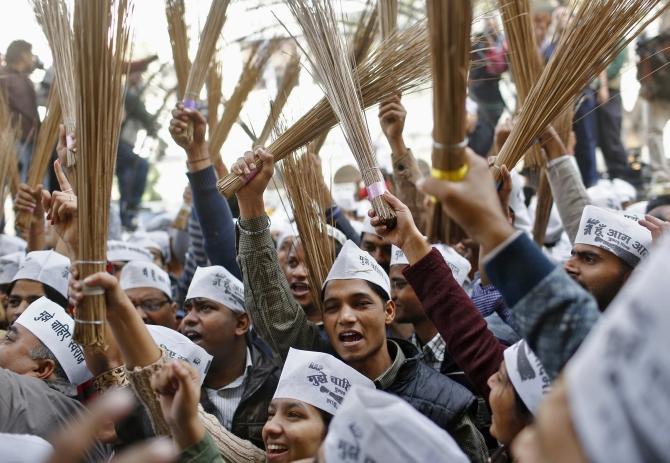
On 10th February 2015, as news began to come in of the AAP win in Delhi, Facebook, Twitter and WhatsApp were flooded with jokes. The best of these one-liners drew on symbols: the ordinary muffler weighing heavy on the bespoke pinstripe suit, or the jhadoo's clean sweep: "Modi wants a Swachh Bharat. AAP has the broom".


Of course, politics everywhere throws up symbols. But the Delhi elections turned bitter symbolic battles into smart, vibrant politics. The muffler made him seem like a chowkidar, went the sharply classist refrain in 2013. But the more Kejriwal-mockers made fun of his ever-present muffler, the more he clung to it. And eventually some clever young things in AAP turned the name "Mufflerman" into a kind of indigenous Dilli superhero — complete with T-shirts. As for the jhadoo, rarely has there been an Indian election in which the allotted symbol of a political party has assumed such far-reaching metaphorical meaning. The AAP jhadoo is now so profoundly linked to the party's "clean up the system" discourse that the anti-corruption message seems inextricable from the visual cue for cleaning up.
And yet the thing about images is that they can signify different things to different people, and mean many things at the same time. Days before the election, I happened to hear one of the city's cultural czarinas talking about how the visual matters in every field. Her example, but naturally, came from her driver, who had apparently said that Arvind Kejriwal and his message resonated with him to a great extent, but he could not bring himself to vote for AAP because its symbol – the broom – seemed to him to represent everything he had managed to leave behind. The visual association, in other words, was powerful enough to negate the effect of an otherwise convincing verbal campaign.
I don't know anything about the driver's background, but it seems unlikely that he was responding to the broom's valence as an instrument for cleaning. He was identifying it with those who usually wield it – not as a political weapon, but as a necessary act of earning their livelihood. Such are the powerful ways in which caste lives on in this country. Jhadoo dena remains an indelible Indian shorthand for manual labour in general, and polluting labour in particular. Those who followed the anti-reservation campaigns of a few years ago would remember students in front of AIIMS, would-be doctors who would eventually have to render service to human bodies in advanced stages of decay, protesting against the terrible fate that threatened them by sweeping the streets with brooms. And on 10th February this year, there was a WhatsApp joke doing the rounds: "Zadu wala becomes CM. Chay wala becomes PM. We Graduate, Engineers & MBA thinking of how to catch train at 8.37 AM & PM".

The Delhi election has been a turning point in many ways, but the real cleansing of our minds will need something more than empty Swachch Bharat slogans.
What is clear, though, is in a country so sharply fractured by class, symbols can go either way. While being a chaiwala's son definitely helped Modi win the votes of the poor in May 2014, it is not that aspect of him that appeals to "Graduate, Engineers and MBA" – though it seems that a ten lakh rupee suit might have swung too far in the opposite direction. And if the jhadoo's power is its everydayness, its familiarity, its emblematic connection with the poorest, then it also stands to be rejected for those very reasons — by that steadily increasing section of the population that aspires to something less every day, less basic, less poor.
Two other anecdotes might make the point better. The first is from a heritage walk I went on the day after the election. It was a young, upper middle class crowd, but for once, politics was on everyone's mind. The AAP enthusiasts may have been slightly more vocal, but I managed to overhear two twenty-somethings confirm their hopes of a BJP win. "The other night I saw a whole TV programme about the price of onions," sniggered the young man. "Imagine what will happen if AAP wins!" The price of onions, while it thankfully still has enough weight to swing the electoral taraazu, is something these young people think of as ridiculous.
The second anecdote is from the last day of campaigning. I was taking the metro from RK Ashram Marg towards Connaught Place when I saw a burly forty-ish Sikh man loudly accosting a group of AAP volunteers with caps. Apparently he'd seen one of them hawk and spit on the platform. I couldn't tell who the chastised volunteer was, but a whole host of his colleagues were apologising profusely: "He didn't know the rules, he's from outside, in fact he's from Andhra. But of course he shouldn't have done it. Humne samjha diya hai..." Sardarji, however, was not to be placated so easily. "You people want to run Delhi!" he raged. "But this is the respect you show to the metro. How will you ever make it a world class city!"
Whether it's onions or the metro, no symbol can ever represent any reality fully. But some symbols aren't interested in reality. What they want to do is to present an image whose grandeur people might aspire to — like a naam-wala suit, or a shiny new metro. The power of such symbols lies precisely in their distance from the real. In the politics of symbols, then, we must choose whether we want to be represented by our aspirations or our realities. Might our leaps not be more successful if we start with the ground beneath our feet?

First published in the Sunday Guardian.

8 December 2014

Post Facto -- Unforeseen effects: Why I love film festivals

My Sunday Guardian column (written after IFFI 2014):
Queuers, conferrers and posers: Outside the INOX complex, at the 2014 IFFI in Goa.
It's hard to describe the lure of a film festival to people who've never done one. And yes, it is something you do. Like a drug. I'd never quite thought about it before I started to write this column, but clearly my subconscious has known all along — I often call myself a film festival junkie.

A film festival isn't somewhere you show up for an evening because you're bored, or something to which you make an obligatory social visit, politely applauding the efforts of the organisers. No, you plan for it in advance, having taken leave from work and from all social responsibility. Sure, you meet people, but the bright light of day soon begins to feel like something to scurry away from. It's in the velvety darkness, as the screen flickers to life, that you do, too. And as you go from one darkened theatre to another, cinema seeps into your veins.

In close to two decades of film-festivalling, I've often been asked how I can possibly absorb five films a day, or even four. Don't they start to bleed into each other? Don't I zone out by the third film, or fall asleep in the fourth? Doesn't every [worthwhile] film I watch make me want to pause for the day and analyse it, instead of rushing to grab a quick lunch and hurtling into the next film? In short, these people want to know, isn't the film festival the very antithesis of the ideal film-watching experience?

The answer to most of these questions is yes, of course, sometimes. Sometimes I zone out, sometimes I decide a particular film is the one to take a nap in, sometimes all I remember from a hectic festival day is a single climactic scene. But the films you remember are ones that have managed to stand out in a sea of images. And anyway, does the leisurely, sit-down, one-film-at-a-time mode really give a film its due? Of course films need free time — but doesn't the multiplex visit, with its absurdly powerful popcorn-and-soda ritual, muffle every film we watch with the unvoiced expectation of sameness? The film festival might seem frenzied, but it rescues film from the domesticated tedium of packaged leisure — by turning it into something a little like work.

And by juxtaposing all kinds of narratives, from all kinds of places, it reinstates some of the unruliness and unpredictability of cinema. Where else but at an international film festival could I go from watching a Russian postman on his rounds of a sleepy lake-edge settlement (
The Postman's White Nights), to experiencing the joys and sorrows of a group of sightless Chinese masseurs (Blind Massage), and then on to Iran in the 1990s, waiting endlessly with a mother whose son never came back from the Iran-Iraq War (Track 143)?

Of course, I understand that there is such a thing as a festival film. Capitalism being the sophisticated thing it is, it has built the so-called "niche" into the market. If you've ever looked up films on the internet to decide what you're watching at a festival, you've read those 
Variety and Hollywood Reporter reviews with their pithy summing up of the film's chances. Here's one such evaluation of a Greek film I fell in love with at this year's IFFI: "It should appeal to festivals and distributors with a mainstream or more female-oriented sensibility as well as broadcasters of classy European fare." 

This film, called
 Mikra Anglia (Little England), is an atmospheric period piece set in (and shot on) the craggy island of Andros. The plot centres on two sisters who fall in love — unwittingly — with the same man. But this is no generic love triangle: after a point, we barely see the man. And then he dies (somewhere off-screen), and it is his death that tears the sisters' lives asunder. If this is a women's picture, it is so in the most gloriously literal way: Andros in the 1930s and '40s is almost entirely female, because most men are sailors, out at sea, sometimes at war, while the women hold the fort at home — often for most of their lives.


A festival can paint a portrait of a country you've never been to. The other Greek film I saw this year, for instance, would seem to have nothing at all in common with 
Mikra Anglia. Set in present-day Athens, Xenia is about two brothers who dream of winning a national musical talent search. The film uses their marginal status — poor, orphaned, half-Albanian, one of them queer — to highlight the fascist, racist intolerance of contemporary Greece: in one early scene, we hear street thugs harassing some unseen people with the line: "This is not your Bollywood".

But placing 
Xenia next to Mikra Angliaone sees a country that remains recognizable in many ways — a place where family still counts for a great deal, where high drama is normal. Watching random films back-to-back can make you see patterns — a Chinese murder mystery and a Turkish romantic thriller emerge as unlikely partners in neo-noir; you begin to notice how often filmmakers in cold countries use snow and ice to create a sense of emotional desolation.

In a world of torrents downloadable at will, the film festival is no longer about enabling access. Choices, in fact, are limited by the programming. But what you end up watching at a festival can create unintended, powerful effects. It's as close as one can get to fate.
Published in the Sunday Guardian, 7th Dec 2014.

9 November 2014

Post Facto - Chandigarh Diary: notes from the fringes of a litfest


The Rock Garden in Chandigarh
My Sunday Guardian column today: 
I have just returned from my second visit to Chandigarh. The Chandigarh Literature Festival (CLF), organised by the Adab Foundation, has a unique format which places critics — and books — ahead of authors' and publishers' pitches. Each critic is invited to nominate, in advance, a book they think should be more widely read. At the fest, she or he introduces the book and conducts a conversation about it with the author. As a critic, it's a real pleasure to choose a book I think is worth discussing, rather than having to be part of a "panel" of someone else's design. If you want to spend a relaxed weekend hearing books being discussed, without any queues, I recommend a trip to Chandigarh this time next year.
Last year, I was too caught up with the festival to see anything of the city, except to note that it was cleaner and greener — and emptier — than any Indian urban space I've seen. This year, my hotel was further out: a rather lonely bit of Panchkula opulence, ringed by fields and the dusty outcrop of the Morni Hills. (A taxi driver told one co-delegate that it was owned by the outgoing CM, though I have no evidence for whether this is true.)
I'm quite unused to spending all my time in a new place holed up in some building. And hanging out only with other non-locals always seems a bit of a cop-out. So I was thrilled that on the last day, the festival organisers offered us a spot of sightseeing. Escorted by three schoolteachers — among the CLF's shiny, happy volunteers — we went first to Sukhna Lake. It was a Sunday morning, and families were out in full strength. As were the geese. A whole gaggle of geese waddled up the ghat-like steps, honking loudly, and surrounded a father and son offering bits of roti. As soon as we climbed back up to the promenade, I saw a sign: "Do not feed migratory birds." I don't know if the geese were migratory or local, but I did see some brown-headed ducks keeping a dignified distance from the handouts.
The obligatory visit to the Rock Garden followed. We lined up behind a huge crowd of visitors: two school groups, plus a set of tourists from Maharashtra in royal blue caps. Expecting a vast expanse of parkland, I was surprised by the tightly-wound paths, often with high walls on either side. The average walker can squeeze through the narrow entrances if she stops and stoops — but only just. The crowd made it hard to get a sense of the space. But it revealed its contours in other ways: the ebb and flow of people forming little eddies and occasional blockages. As each passage opened out into a courtyard, pavilions, bridges, flowing water and, slowly, vast armies of figures began to appear — human, animal, bird.
The garden has an incredible history. In the early 1950s, a Roads Inspector for the Public Works Division started gathering debris from the villages that were being demolished to create Le Corbusier's planned city. Working alone, he transported these materials — cement, sand, iron slag and other waste, like broken crockery, ceramic tiles, and glass bangles — to a gorge within what was then a forest buffer zone, and began creating his strange secret wonderland. It took 18 years for Nek Chand's illegal creation to come to the notice of the city authorities. Officials considered demolishing the complex, but the garden soon gathered popular support and was opened to the public in 1976. The bureaucratic establishment even named Nek Chand "Sub-divisional Engineer, Rock Garden", giving him a team of 50 labourers to help finish the garden.
In a city that is the poster-child of high modernist planning, Nek Chand’s vision feels like a necessary corrective. A maze-like space in a city of straight lines, it is a marvellously surreal response to the symmetry imposed upon the city by Le Corbusier. 
It didn't last. In 1990, a plan to bulldoze a VIP road through the garden was thwarted only by public demonstrations. Funding began to dry up, and in 1996, when Nek Chand was away on a tour of the U.S., the city withdrew its staff, resulting in acts of vandalism. Since then, the garden has been run by the Nek Chand Foundation, receiving some 5,000 visitors a day.
In a city that is the poster-child of high modernist planning, Nek Chand's vision feels like a necessary corrective. A maze-like space in a city of straight lines, it is a marvellously surreal response to the symmetry imposed upon the city by Le Corbusier. And the sculptures made from construction waste offer an eloquent comment on the process of creation — how the new demands the destruction of the old, and yet how the old can find unexpected new form.
The litfest had opened with a discussion of "30 years of Operation Blue Star", the only session filled with non-literary speakers: editors, journalists and bureaucrats. Several retired local bureaucrats grabbed the mike, angrily providing alternative versions of events. I was glad the litfest hadn't shied away from an important political commemoration, but it did seem clear that that the conversation had barely begun.
On my last day, I met a respected Chandigarh historian who said he had considered attending the festival, but hadn't for two reasons. One, he felt, it ought to be in the university or the museum, not in the Chandigarh Club, "where people only go to drink and play cards". And two, why was a litfest discussing Operation Blue Star? Clearly the new must try harder to work with the old. The city needs to channel the spirit of Nek Chand.
Published in the Sunday Guardian.

14 July 2014

Post Facto: Too graphic for grown-ups? Thoughts on pictures in books

A spread from the book 'Hope is a Girl Selling Fruit' by Amrita Das. Tara Books, 2013.
ave you ever thought about what it means that we think picture books are for children? Clearly, it's not that we think pictures are for children: visual art in other forms, whether paintings or movies, is seen as perfectly grown-up. But somehow, when pictures enter a book, they become, in the eyes of most people who consider themselves "real" readers, a form of dumbing-down.
One reason for this sort of thinking is obvious. If books are meant to be about text, then anything that detracts from the serious business of words is an illegitimate interloper, that›s managed to sneak in without the permission of the Book Guards.
As the kid who never quite got why anyone should want to read comics when they could read real  books, I get that thought. And certainly, I agree that we respond differently to narrative when the only pictures we have access to are the ones in our heads. Images might hook you faster, but they also change the rhythm of your reading. Some people might only look at the pictures. Some look at the pictures first, and then go back to read the text. Some — like me — might race through the text (and wonder at there being less of it) before realising that sometimes, pictures demand a slowing-down — quite different from the swept-up feeling that can characterise a good story.
But if placing images alongside changes our experience of text, why is that necessarily a bad thing? Who decided that books have to be about text, anyway? And that art must only hang on a wall?
I started thinking these thoughts because of three stunning publications that came out recently from Tara Books, the Chennai-based independent publisher. All three are drawn by Indian folk artists, all women. In Drawing from the City, the Ahmedabad-based Teju Behan tells, in beautiful black and white pen-drawings, the tale of how she and her late husband Ganesh Bhai Jogi went from the village to the city, and how they became artists. In Hope is a Girl Selling Fruit (2013), the Mithila-style folk painter Amrita Das draws — and draws us into — meditations on her life, the life of a girl she sees on a train, the lives of women in India. The third book is Sultana's Dream, Rokheya Sakhawat Hussain's famous 1905-fable about a world where peace-loving women rule over men, is illustrated by the Gond artist Durga Bai. The text in these books is spare and simple, but it talks about serious things. The images, though, are what one lingers over. Like the albums in which the Mughal aristocracy housed their miniature paintings, this is art between the covers.
{
And certainly, I agree that we respond differently to narrative when the only pictures we have access to are the ones in our heads. Images might hook you faster, but they also change the rhythm of your reading.
started to think about these things again on a recent trip to Germany, where six Indian editors and I had been sent to meet German publishers of graphic novels, young adult and children's books. Some entered these genres for somewhat instrumental reasons. Carl Hanser Verlag — publishers of Sophie's World — said their children's list first emerged because they wanted to stop their authors from taking their manuscripts for kids to other publishers. Similarly, the venerable Suhrkamp, known for publishing theory and literary heavyweights, started its graphic novel list partly as a way of keeping all versions of their great books. So they started with celebrated Austrian artist Mahler doing a graphic version of Thomas Bernhardt's novel Alte Meister (Great Masters), and a graphic interpretation of Robert Musil's mid-century novel The Man Without Qualities. But last year, they stopped playing safe like that: they brought out the graphic autobiography of Volker Reiche, veteran of the German comics scene. Also, publishing Mahler's Musil was a radical thing to do — turning Musil's dense, thousand-page classic into a fairly slender set of pages, with barely six sentences to a page, could easily be seen as sacrilege.
And really, one part of me agrees vociferously: how can reading Mahler be the same as reading Musil?
Other German publishers we met come from the opposite side. They have not, shall we say, had to readjust their reading glasses to see the pictures. Some of these are, like Mosaik, comic publishers first and foremost, their adventurous Abrafaxe threesome dating back to the East German 1950s. Others, like Reprodukt, are part of the coming of age of the German graphic novel. Their recent Kinderland, about a seventh grader before the Berlin Wall fell, has won awards and critical acclaim from the "serious" quarters of the press.
But it was at our last meeting, with the Frankfurt publishers Edition Buchergilde, that I saw the most imaginative responses to the text/image debate. Buchergilde has long published illustrated titles for adults, and they're unafraid to tap into our most childlike forms of wonder: I saw a truly remarkable edition of Patricia Highsmith's dark thriller, The Talented Mr. Ripley, with 3-D illustrations that need accompanying 3-D glasses. More recently, Buchergilde published Arthur Schnitzler's classic  Traumnovelle (Dream Novel, the origin of the film Eyes Wide Shut)in a graphic version. What's great is that Jakob Hinrichs' graphic version is an adaptation, and says so — but Buchergilde pleases everyone — and both aspects of everyone — by publishing the full original text as an appendix to the graphic novel.
If the Tara books I spoke of appeal to the thoughtful side of children, Buchergilde appeals to the playful desires of adults. And yet you could reverse that assumption about pictures just as easily: Hinrich's images can be pretty disturbing. Anyway, don't we all need both?
Published in the Sunday Guardian.

18 May 2014

Post Facto: Ode to the Gourd, and Other Forms of Vegetable Love


Earlier this summer, the European Union banned the import of certain Indian fruits and vegetables. The Indian media reported the event with alacrity, but our sense of national humiliation was reserved entirely for one of the five banned items: the alphonso mango. I quite understand: regional battles may rage over alphonso versus langda or himsagar versus rataul, but the mango's unofficial king-of-fruit status reveals a national consensus much broader than that around Modi. What's more, it is officially our national fruit. (And why not, predictable candidate as it is for naturally obvious gloriousness, alongside the also eminently suitable national tree — banyan — and national flower — lotus.)
But let me come swiftly to my point. (a) There is a national fruit, flower and tree, but no national vegetable. (b) The four other items banned by the EU were all vegetables, and poor, unsung summer vegetables at that: eggplant, taro plant (colocasia), bitter gourd and snake gourd. Since no one in the country's media — unsurprisingly — has come forward to defend their honour, I have decided the task is mine. Having spent my childhood being the strange little girl who wouldn't eat aloo but loved all sabzi, perhaps vegetable love has been calling me a long time. To adapt Marvell less than marvelously to my purposes, it has grown "vaster than empires, and more slow".
I spent eight years of my childhood in Calcutta, and it was not until my teens that I registered the caste system that holds sway over vegetables in Delhi. The Punjabi palate — or to be fair, the depressingly generic version of it that has colonised North Indian eat-out culture — has perfected "vegetarian" without vegetables. There's the ubiquitous kaali dal, rajma (kidney beans) and chholey (chickpeas), and when in doubt, there's always paneer. If you absolutely demand vegetables, the neighbourhood dhaba-on-call is a 100% likely to nudge you in the direction of "MixVeg" (I am convinced this is also because it comes straight out of a frozen Safal packet). If truly pressed, they might give you Aloo Gobhi.
In Kolkata, where there is scarcely a winter, it makes some sense that cauliflower, peas, beans and carrots should be granted higher status. But it is Delhi that behaves as if the garmi ki sabzis are untouchable. Something of an exception is made for bhindi (brats agree to eat it occasionally, and I hear that even more avid vegetable-rejecters, across the border in Karachi, have a chic restaurant named Okra) and eggplant (though only as baingan ka bharta).
But the summer's bounty of gourds — the small striped parval, the graceful, long, curvaceous lauki, the light green spheres of tinda, the ridged torai, the knobbly-skinned karela — is treated like a pack of poor relations, allowed to sit at the table but not permitted to speak. The same goes for arbi — colocasia — like the gourds, I've never yet seen it invited to a city restaurant, a wedding, or even a party.
I find this appalling, and tragic. Because I was lucky enough to grow up with a zillion ways in which to cook and eat these vegetables. From my Nana's side came thin but fiery Marwari gravies, often pairing a soft gourd like torai or tinda with besan, mangori or papad — the devisings of a desert where fresh veggies had to go a long way. The classic UP-style sookhi sabzis that came via my nani's family include two favourites I now produce as staples: a simple but always superb aloo-parval with zeera, haldi and mirch, and an arbi ki sabzi with nearly-crisp edges, its ajwain and amchoor dancing on the tongue. Being of that terribly deprived world population called 'O-Baangaali', my mother did not, unlike Jhumpa Lahiri's Mrs. Sen, sit on the ground with a boti "curved like the prow of a Viking ship" to chop her eggplants "small as sugar cubes". But while soon becoming adept at catering to my Bengali father's preferences, she constantly learnt from eating — and cooking — with friends, friends' parents and domestic help. I grew up with an undying love of jhinge posto (ridged gourd cooked with a paste of poppy seeds) and lau chhechki (the lightest of lauki, with only kalonji and green chillies for company, unless you add shrimp and turn it into a lau chingri). These, among many other things, I have learnt to cook, and each time I turn out one of these vegetables to a level that nearly approximates my mother's, I feel more close to being grown-up than at any other time.
One gourd can still push me back into childhood, though — the karela, which I do not yet cook and still scarcely eat. Popular in my nani's home as bharwan (stuffed with masala and secured with string) and at my parents' place either as shallow-fried bhaja, or as part of that "combination of subtle half-tones" that is shukto. Chitrita Banerjee's Life and Food in Bengal says Bengali housewives followed Ayurvedic practitioners in serving karela as a cure for biliousness. Clearly I have little faith: I appreciate a good shukto, but karela by itself still seems to me more cause of biliousness than cure.
But the last word on the karela must be Kipling's. Mowgli's Song Against People holds out the fantastic prospect of the gourd's revenge, more final even than Carl Sandburg's grass:
"I have untied against you the club-footed vines —
I have sent in the Jungle to swamp out your lines!
The trees — the trees are on you!
The house-beams shall fall;
And the Karela, the bitter Karela,
Shall cover you all!