Showing posts with label Chashme Buddoor. Show all posts

10 July 2017

Bombay Confidential


In a murder mystery set in the film industry 40 years ago, the crime writer HRF Keating tapped into our preoccupation with tinsel town.


Fiction writers are strange creatures. The British crime writer HRF Keating famously did not visit India until he had written nine books featuring the Maharashtrian policeman Ganesh Ghote. Keating didn’t originally intend to stay with Ghote longer than a a couple of books. His first Ghote mystery, The Perfect Murder (1964), won him a gold dagger for fiction from the Crime Writers' Association and commercial success (especially in America). In response to readers’ demands, he obliged, writing nine Ghote novels by 1974, becoming anointed India expert of sorts. 

In 1976, with his tenth book featuring the Bombay-based detective, Keating finally took the plunge into what might be the city's most obvious real-life locale for intrigue – the film industry. Forty years down, Filmi, Filmi, Inspector Ghote's take on Bombay's commercial cinema in the 1970s is perhaps more interesting for Indian readers than it was then. Especially if we treat it not as some sort of documentary evidence of what the industry was like, but of what about this world -- and our relationship with it – seems to have struck a Western outsider.

Keating won points from me with his very first paragraph: “The Deputy Commissioner was reading a filmi magazine. There was no mistaking it. Inspector Ghote had come hurrying into his big airy office in response to a crisp summons on the intercom and he had caught him in the act.”


The scene is set consummately, establishing Ghote's position in the Crime Branch bureaucracy – as well as Hindi cinema's position in the Indian cultural universe. I gesture to the crucial fact that Hindi cinema was, for the ’70s Indian elite, still very much a guilty pleasure — a low-brow taste that many partook of, but that anyone in any position of seriousness preferred not to be seen indulging in publicly. (For years, even filmmakers working on the edges of commercial Hindi cinema made such tongue-in-cheek references to its popularity – Hrishikesh Mukherjee's Guddi, which cast Jaya Bhaduri as a teenager besotted with the iconic Dharmendra (playing himself), was a dissection of the Indian public's besottedness with popular cinema. A film like Sai Paranjpye's Chashme Buddoor parodied Hindi movie romance both in letter and spirit. Guddi, if I remember right, also actually begins by gently mocking a figure of authority – a school teacher – for being immersed in a film magazine.)


The book's plot has Ghote called in to investigate the mysterious death of an ace actor during the shooting of a Hindi film adaptation of Macbeth (something that took another thirty years to happen in reality: Vishal Bhardwaj's Maqbool). Ghote's character may be a bit off sociologically, but in his disavowal of any knowledge of Hindi cinema and his simultaneous desire to claim familiarity with Macbeth, I think Keating cottons onto something about the split cultural self of the Indian elite. Popular Bombay cinema in the '70s – and its most famous denizens – had a great deal of money and influence and a hold on millions of people, but our Anglophone elite only thirty years after independence was reluctant to grant it any cultural capital.


The book is also interesting as a portrait of a pre-liberalisation economy, in which of course the film world is a shaping influence and participant. We hear of the parallel black money economy in which everyone receives shadow payments, we hear familiar terms like Dearness Allowance and Vigilance and we also hear of how the secret desires of a pre-liberalisation elite are catered to — the importing of cosmetics, “foreign television sets and watches with digital face”, the making of blue films on the sly in Bombay, the smuggling out of the films and the smuggling in of the girls in them.


Keating gets many details right – some extras are described as Ghati women, there is a “tall Pathan chowkidar”. Still he falters often when it comes to words and names. The murdered actor is called Dhartiraj, a rendition of Prithviraj that feels terribly unidiomatic; the Macbeth film, in a rather obvious inspiration from
Akira Kurosawa's Throne of Blood, is titled ‘Khoon ka Gaddi’ when it should grammatically be ‘Khoon ki Gaddi’; his use of phrases like “Choop chaap” and “Ek dum” can seem colonial and bizarrely dated. But Keating is clearly interested in linguistic specificity – from the very first paragraph he refers often and without annotation to the “filmi duniya”; he revels in using Indian words like raddiwallah and crorepati; he devotes a section to explaining “chumchas”. And all through, he renders dialogue in an excessive but heartfelt Indian English: “Wining and dining, booted and suited,” “Madam, if you are wanting to see me, I am altogether at your...”, or “But, excuse me, to make a film in bits and pieces only, is that truly possible?”


But to return, in conclusion, to Ghote: whether he is meeting Seth Chagan Lal, the beady-eyed moneybags with threats as cold as his cash, the swaggering Ravi Kumar or the almond-eyed screen goddess Nilima, Ghote finds himself unable to behave authoritatively. It is as if, in his unbidden transformation from stern law enforcer to obliging supplicant, he embodies our relationship to the filmi duniya. However much we might scorn the silver screen, it taps into some part of us that's secretly helpless.


27 November 2015

The Karma Chameleon: Saeed Jaffrey

My Mumbai Mirror column last week:

Saeed Jaffrey was that rare actor who could fit in seemingly anywhere -- and yet carved out a very specific niche for himself.


There are few actors in the annals of cinema who have straddled such different worlds as Saeed Jaffrey -- American theatre, British sitcoms, Indian art cinema and the commercial Bombay potboiler. Crucial to Jaffrey's chameleon-like ability to switch between these industries was his ability to sound both authentically British and authentically Indian. Language was key. 

A young Jaffrey was initiated simultaneously into acting and British-accented English at boarding schools in Mussoorie in the 1940s. He credited his refined Urdu to his time at Aligarh Muslim University, where he earned a BA and MA in history. In 1951, Jaffrey began his actual acting career by founding a theatre repertory company called Unity Theatre in Delhi.

The first production, a Jean Cocteau play, had Saeed in the lead opposite a young actress called Madhur Bahadur, with whom he promptly fell "madly in love". Madhur (later to become famous as an Indian cookery expert) left to study at the Royal Academy of Dramatic Arts, and Saeed followed. His first stint abroad was in the US, where he studied Speech and Drama at the Catholic University. Madhur married Saeed, and the couple spent the late 1950s between Washington DC and New York doing plays, working with Lee Strasberg's Acting Studio, while surviving off public relations and radio jobs, with everything from the New York Times' radio channel and the Government of India's Tourist Office. 

It was only in the mid-60s, after his marriage ended, that Jaffrey moved to London. There he remained for the rest of his life, moving gradually from theatre into cinema. Being a brown man in a largely white acting scene, it made complete (if depressing) sense that many of Jaffrey's early roles in English films had him playing servant, or at least second fiddle to the film's protagonists. Meanwhile, in Hindi cinema, his combination of mellifluous Urdu and BBC English lent itself to aristocratic -- or at least upper class -- characters. 

So, for instance, one of Jaffrey's first big international roles was in John Huston's adaptation of Kipling's colonial fantasy, The Man Who Would Be King, where he starred (alongside such grandees as Michael Caine and Sean Connery) as Gurkha soldier Billy Fish, who becomes the primary interpreter between the British soldiers and the Afghan villagers with his ungrammatical pidgin English. 

His start in the Indian film industry could not have been more different. In Satyajit Ray's Shatranj ke Khiladi (1978), Jaffrey played a leisure-loving noblemen of the Awadh court. The film is set in the period of Nawab Wajid Ali Shah, when the Lucknow court was seen as the acme of culture, and Jaffrey's mellifluous Urdu was integral to his deliciously circumspect turn as Mir Raushan Ali: a man happy to turn a blind eye to his wife's amorous adventures, matters of state, and even matters of death, so long as he is free to carry on what has become to him the real business of life —the eating of paan, and the playing of chess. 

Jaffrey's networks were wide by now, and he earned the rewards. Getting to know Richard Attenborough, who played General Outram in Shatranj Ke Khiladi, landed him a role as Sardar Patel in the Oscar-winning Gandhi. His friendship with Ismail Merchant and James Ivory, who in fact met through the Jaffreys in New York, led to several roles in their films. 

Indian audiences began to recognise him after blockbusters like Raj Kapoor's last film Ram Teri Ganga Maili (1985), where he played Rajiv Kapoor's Kunj Mausa with an entertaining touch of camp. But my most enduring memory of Jaffrey in a commercial Hindi film is his performance as the khaandaani raees industrialist Mehra in Indra Kumar's 1990 hit Dil. The film's romantic track between Aamir Khan and Madhuri Dixit plays alongside a comic-dramatic track between their fathers played by Anupam Kher and Saeed Jaffrey. 

Kher is a small-time trader in recycled goods called Hazariprasad, who cons the super-rich Mehra (Jaffrey) into having his daughter marry Hazariprasad's son. Mehra's chief characteristic is immeasurable wealth, and so Jaffrey's 'entry' has him emerge from a chauffeur-driven car, surrounded by a posse of suits he is waving aside. "Pachaas lakh? Pachaas lakh is nothing... ", switching to English to achieve the desired dismissive effect: "It's peanuts. Do you know peanuts?" "Yes, sir, moongphali... " comes the baffled reply. There is something brilliantly believable about Jaffrey's presentation of self as both cultured old wealth and snazzily up-to-date. The pipe-smoking goes hand-in-hand with lavish temple donations and the morning run on the beach, with his executives panting alongside. 

While he may seem carelessly collegial over a shared bottle of whiskey at the club, Mehra is nothing if not conscious of status. The discovery that his prospective samdhi is a 'mere' kabaadiya is met by a brutal public put-down that almost turns him into the villain. This is followed by a Jaffrey not many had seen until then: a crazed patriarch with bloodshot eyes and a loaded gun. 

But the collegial air was one that Jaffrey drew on often. One of the best-known of these performances was as Delhi businessman Suri in Shekhar Kapur's first film Masoom (1980). As Naseeruddin Shah's close friend, Suri is emotionally unhelpful but warmly garrulous, most memorable for breaking into 'Huzoor Is Kadar Toh Na Itraa Ke Chaliye' at a Delhi house party. I've never seen anyone do a drunken-ghazal-duet better. 

His other classic 'Delhi' performance, of course, was Sai Paranjpye's Chashme Buddoor (1981), in which he played the friendly neighbourhood paanwaala to a trio of aspiring young Romeos, doling out cigarettes and romantic encouragement with equal joie de vivre. Jaffrey brought to Lallan Miyan his trademark linguistic brio, managing to be both lungi-clad and urbane at the same time.

As in all of Jaffrey's performances, he brought a puckish, comic touch to his more melancholy roles (think of Shatranj Ke Khiladi) and a raffishness to his comedy. But urbanity was perhaps Jaffrey's strongest suit, and he could achieve it in each milieu you set him in.
Published in Mumbai Mirror.

15 December 2014

Bitten by the film bug

My Mumbai Mirror column:

The funny, warm indie Sulemani Keeda shows us a world of Bollywood aspirants, but it isn't so much a film about that world as a voice from within it.

Last month, Bollywood gave us Happy Ending, a self-proclaimed takedown of rom-coms in general and happy endings in particular. In it, Saif Ali Khan's bestselling writer hero — assailed by the worrying thought that he might have actually fallen in love —was urged out of the house by his imaginary alter-ego, in pursuit of the departing girl. The film's 'airport scene' (as the film's makers labelled the cliche they were making fun of) was allowed to end in the girl leaving—but only to create room for the real, apparently inescapable, happy ending: the boy flying to India to convince the girl. It was a glib, unconvincing claim that they'd avoided the cliche. 

Last week, in Amit Masurkar's Sulemani Keeda, I watched as the protagonist Dulal, having confessed he's in love with a girl he met three days ago, was urged by his friend, housemate and screenwriting partner Mainak to go to her house and stop her leaving for America. "Bahut ho gaya ye chori chori pyar. Daaku ban, daaku!" exhorts Mainak, and even though we, the audience, know better than Dulal that Mainak is far from being sincere, we can't but egg the boy on, towards the distant possibility of a happy ending. But equally, it's impossible not to be charmed by what follows: let in by a surprised Ruma, the lovestruck Dulal first begs her not to go. Then, before she can say anything in response, her parents emerge from the other room to see who this boy is, and Dulal falls to his knees, declaring his love for their daughter. 

This is the scene as it ought to have been played; a moment that captures both the intensity of feeling that Dulal has built up in all sincerity, and the insane filminess of it—reflected in Ruma's parents' quiet bemusement (casting Uday Chandra as her father is a stroke of genius), and in Ruma's own gentle but firm refusal to change her carefully laid-out plans for a boy she thinks is sweet, but whom she barely knows. 

The funny thing is that Sulemani Keeda doesn't set out to rewrite 'romedy'. In fact when the Ruma angle begins to take over, Masurkar manages to sneak in a funny line about how she was supposed be the side track, not the main track. 

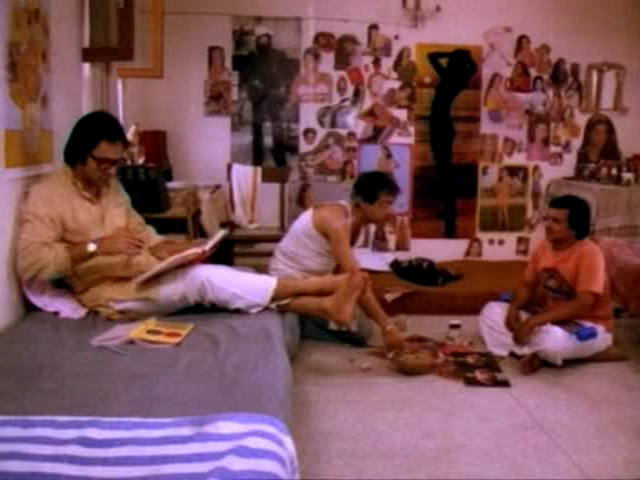
The film has been described in the media as a "bromance", and its opening moments—the two young men asleep in their unkempt apartment, and the camera moving from the magazines upturned on their stomachs to the posters on the wall and the books in their bookcases, until a girlfriend calls and wakes one of them up—reminded me of Delhi Belly. Plenty of films have used this young-men-living-scruffily-together setting since: I can think of Pyaar ka Punchnama and Go Goa Gone. But the film to which Sulemani Keeda seems to truly doff its hat is the original bachelor comedy, Sai Paranjpe's Chashme Buddoor. Mainak is the Rakesh Bedi-cum-Ravi Basvani to Dulal's sincere Farooque Shaikh, providing comic relief, trying to woo the ladies a little too obviously, and throwing in some amusing untruths along the way. There's even a scene where Mainak drives 'Oona from Poona' home in a hopeful horny haze, and we see him ascend her staircase, doing the ridiculous almost-jig that Baswani made unforgettable. And his quick-footed retreat at the sight of her muscley boyfriend immediately brings Deepti Naval's threateningly large brother to mind. 

The film is self-aware without being smart-alecky and warm without being mushy. It experiments with form in zany animated sequences and slow-mo black and white interludes, yet is consistently well-observed, whether in the male-female dynamics of its chilled-out house party or the hilarious interactions with Pokhriyal, the landlord's poet-aspirant son. Perhaps this is because of how close its director and actors are to the world they're recreating here. Masurkar, whose 30-lakh-rupee directorial debut this is, has spoken in interviews of how he came to write a film about two screenwriting hopefuls doing the rounds of Bollywood's important people in the hope of a break. "Generally what happens when you're writing is that you write with a director in mind. This was something I wrote with people in mind," Masurkar said. Many of these people are real: famous people like Mahesh Bhatt and Anil 'Gadar' Sharma (though their cameos as themselves I thought were the film's most amateurish sections), as well as Dulal and Mainak, played by Masurkar's friends Mayank Tiwari and Naveen Kasturia, both working their way through Bollywood in real life. Himself a film and television writer who moved to Versova in 2009, Masurkar's film is an unvarnished, wry, but not quite bitter look at the world of culture industry aspirants he inhabits. 

These young men have come to Bombay (in this case from Delhi) to become 'writers', and they appear torn between an aspirational literate milieu of bookshops and open mics, and a Bollywood world that will seemingly only reward them for not pushing the envelope. There's also an all-too-real moment where the aspiring young filmwalas come to blows with TV-walas they're in the process of insulting for having sold out. The film doesn't make a big hoo-ha about it, but the tug of war between making it and being true to yourself is definitely its "main track". One hopes all its protagonists can stay on it. That really would be a happy ending.

14 April 2013

Mocking 'filmi-ness': more on Chashme Buddoor

A guest column I did for Business Standard:

A still from Sai Paranjpye's Chashme Buddoor (1981)
Sai Paranjpye's Chashme Buddoor, a light-hearted and mild-mannered comedy which also gave us an unforgettably sweet romance between a bespectacled, padhaaku Farooq Shaikh and Deepti Naval as the irresistible but real girl next door, was recently restored and re-released in theatres alongside a new David Dhawan remake. A distressed Paranjpye has charged Dhawan with having killed her delicately funny film by injecting it with double entendres, bawdy jokes and a general crassness so antithetical to the sensibility of the original that to call the new Chashme Baddoor a remake was a travesty.

I watched both films last week, and I have to confess that while the old one has lost none of its delicate charm, the new one is a rambunctious and rather enjoyable ride. The new film, like the old one, centres on a trio of young men (inaugurating a whole Hindi film tradition of male friendship movies since). One is the sincere student who reads Economics textbooks for pleasure, while the other two spend their time gadding about the empty leafy avenues of 1980s Delhi in search of girls. Or to adopt the celebratory whoop with which they greet every sighting of young female flesh - "shikaar!". The reference to prey may sound shocking, but there's something about Omi and Jomo's unthreatening comicness that makes it not just alright but hilarious. And yet the indiscriminateness of their attentions is enough to indicate the unabashedly joyful sexual basis of their interest. Paranjpye's world may have been innocent, but it was not coy.

That frank vision of youthful (male) hormones is a clue to what made Chashme Buddoor such a remarkable film: its absolute outsiderness to the conventions of the Hindi movie - and even more, the quirky, tongue-in-cheek way in which it chooses to play with those conventions.

In 1981 - the year in which Chashme Buddoor released - the top 10 grossers at the Hindi box office included four Amitabh Bachchan starrers (Yaarana, Kaalia, Naseeb and Lawaaris) replete with dramatic father-son battles and villainous villains on whom revenge had to be wreaked. Other films in the top 10 were a colonial fable involving revolutionary Indian pirates and evil Britishers (Kranti), a reincarnation-revenge-romance (Kudrat), and two stories of star-crossed young lovers (Ek Duuje Ke Liye and Love Story). This was the cinematic universe that Chashme Buddoor emerged into - a universe whose high drama and heroic stunts it both distinguished itself from, and gently but thoroughly mocked. From the first scene, in which the Mehdi Hassan classic of the scorched heart Yeh dhuan sa kahan se uthta hai plays as accompaniment to our heroes' silent communion over a shared cigarette, to having them imagine their romantic conquests as a medley of old Hindi film songs, Chashme Buddoor never stops making fun of our filmi-ness.

Sai Paranjpye was not unique in this sort of mockery. The urban "middle class cinema", represented among others by Hrishikesh Mukherjee and Gulzar, enjoyed poking fun at the more unreal aspects of Hindi films. One of their favourite things to mock was the ubiquitous double role. Gulzar pushed it to its limits (and returned it to source) with Angoor (1982), his superb adaptation of The Comedy of Errors, giving us not one but two pairs of twins. And Mukherjee's Gol Maal (1979) used the idea of fake identical twins as the masterful basis of its comic plot. (Rohit Shetty's reworking, Bol Bachchan, 2012, was grotesque, among other things, because it created a "real" humshakal for Asin - seemingly unaware that Gol Maal's humour was based on mocking the proliferation of twins.)

But Chashme Buddoor went further than those. There's the marvellous scene in which Amitabh and Rekha appear to demonstrate a Hindi movie-style wooing - and how "the technique" falls flat in real life. Earlier, Jomo (the late Ravi Baswani) pretends to be a Bombay producer "talent-scouting" in Delhi, and, in his imagination, Deepti Naval giggles delightedly to hear that "there's a bit of a vacuum in the industry after Jaya ji" that she can fill. In the scene as it actually unfolds, Jomo is crisply rebuffed: she never watches Hindi movies.

Yet, when Naval and Shaikh fall in love and find themselves in a flower-filled Delhi park, they cannot but burst into song. "How do those people in the movies think up rhyming words and tunes on the spot?" muses Neha to Siddharth, before seguing neatly into a half-jokey rhyming song, holding a large flower up like a microphone. And while the climax sets out to stage a kidnapping so that the hero can rescue the heroine filmi-style, Paranjpye decides to play with our now-established expectations by turning the fake kidnapping into a real one. We may laugh at Hindi movies, she seems to say, but we also inhabit them.

David Dhawan, self-declared acolyte of Manmohan Desai - a specialist in mistaken identities and long-lost reunitings if ever there was one - has made a much louder, filmi-er, lowbrow film than the original. But it is also a cheery, self-conscious send-up of the raucous comedies for which he became famous in the 1990s. And in that combination of self-consciousness and inhabiting lies his tribute to Chashme Buddoor.

7 April 2013

Film review: David Dhawan's Chashme Baddoor


"Full disclosure: I have always been a Chashme Buddoor fan – the delicately romantic, hilariously funny 1981 film starring Farooque Shaikh, Deepti Naval, Rakesh Bedi and Ravi Baswani is one of my favourite Hindi films ever. And I have never been a David Dhawan fan. I spent the 90s avoiding the raucous comedies that Dhawan produced in quick succession, most successfully with Govinda – Aankhen, Raja Babu, Banarasi Babu, Saajan Chale Sasural, Bade Miyan Chhote Miyan. The only David Dhawan film I can remember laughing rather than cringing at is Hero No. 1, where Dhawan remade another classic of our quietly funny ‘middle class cinema’- Bawarchi. And Dhawan’s 2011 release, Rascals, starring Ajay Devgn, Sanjay Dutt and the unfortunate Kangana Ranaut’s cleavage, was among the most distressingly sexist, grotesquely tasteless films of the year.

So I went into David Dhawan’s remake of Sai Paranjpye’s classic expecting to abhor it. Imagine my surprise that I did not, and then my shock when I found that I was thoroughly enjoying myself."

Read the whole piece HERE.