Showing posts with label Hindi literature. Show all posts

7 January 2021

Book Review: Desire and Despoliation

A book review for Firstpost:

A recent English translation brings Shivani's 1978 novel 'Bhairavi' to new readers

Bhairavi: The Runaway begins in medias res, with the protagonist slowly coming back to consciousness in a room she does not recognise, surrounded by strangers whose presence terrifies her. An “old hag” with a man's dhoti wrapped around “her enormous stomach” and her bare breasts are “covered in blood-red sandalwood paste”; a younger woman with a face “as black as that of an African”; an ash-smeared naked sadhu with bloodshot eyes and half-grey, half golden dreadlocks — these are characters that might throw anyone off. Certainly our heroine Chandan, a conventionally pretty, fair young woman whom we are to understand is 'from a good family', is scared as well as repelled.

Chandan's experience has the sensory overload of a nightmare: the semi-nakedness of those around her, the stale smell of chewing tobacco on the sanyasin's breath, the cave-like room filled with smoke, and occupied by rudraksha beads, marijuana chillums, a skull or two, and a live pet snake. And yet, what begins as a petrifying glimpse of otherness soon starts to feel arresting, even beautiful. Maya Didi has a sagging but once voluptuous body and a radiant face that “must have ensnared many men in its youth”; the “black girl” Charan has a laugh that “lit up her whole face”'; the guru's “divine face” is “like a light tearing into a room”. This ability to stay with what was initially frightening, to allow one's gaze to be transformed — perhaps this was the gift Shivani's writing gave her readers.

Shivani was the pen name under which the writer Gaura Pant wrote from the 1960s to the 1990s, her fiction often first appearing in serialised form in Hindi magazines. Bhairavi was her fourth novel, published in instalments in Saptahik Hindustan and then as a book in 1978. Shivani was hugely popular, but as far as I am aware, only some of her short stories have hitherto been translated into English: Trust and other stories (Calcutta, Writers Workshop, 1985); Krishnakali and other stories (Trans. by Masooma Ali, Rupa & Co., 1995) and Apradhini: Women Without Men (Trans. by Ira Pande, HarperCollins, 2011). (Ira Pande is Shivani's daughter, who has also written a deeply personal biography of her mother called Diddi, 2005). Priyanka Sarkar, Bhairavi's English translator, suggests in her introduction that the reason Shivani wasn't as feted as her contemporaries because “she was seen as a writer of 'love stories' and not a chronicler of society”. Other than Bhairavi, I have only ever read Apradhini, but based on what I know about the Indian, specifically Hindi, literary universe, I'd extend Sarkar's point even further. Shivani was probably not feted by the Hindi establishment precisely because she was popular, particularly popular with women — and not with literary-minded ones.

Reading Bhairavi: The Runaway revealed the possible reasons for that vast popularity. First, the story is fast-paced. Second, the central characters are all women. Men, whether fathers, husbands, lovers or sons, are often absent, and when they do appear, they're fairly one-dimensional figures whose sole purpose seems to be to drive the plot forward. Third, there's a racy, almost overripe quality to the narrative — a sort of Indian Gothic that combines two of this country's abiding concerns: mothers worrying about their daughters, and a deep-rooted fascination with ascetics.

What brings these two disparate threads together? A preoccupation with sex and sexuality — all the more powerful for being almost unspoken.

So on the one hand, we are told the backstory of Chandan, which is linked to the further backstory of her mother Rajrajeshwari — both revolving around the need to keep young women's sexuality in check, lest they lose their prized virginity and become unmarriageable. On the other hand we are plunged into the world of the Aghori ascetic, seeing through Chandan's eyes this storied space of Shiv-bhakt sadhus whose austerities, like those of other sects with an affinity to Tantrism, involve rituals that would be considered shocking by most ordinary Hindus. The 'ideal' Aghori embraces what others consider taboo — living off the cremation ground, drinking not only liquor but urine, consuming not just flesh but human corpses, and having intercourse with a female partner who is preferably infertile — the withholding of semen and the non-reproductiveness of the act being crucial. As the anthropologist Jonathan Parry argues in his classic study Death in Banaras, the Aghori route to siddhi (supernatural powers) not just allows meat-eating and intoxicants and sex, but makes them the very stuff of their sadhana (ritual practice).“For the tantrics, that which binds you — desire — is also what will set you free,” writes Madhavi Menon in her delightful book Infinite Variety: A History of Desire in India.

Bhairavi offers the fascinated lay reader a glimpse of this tabooed universe, but Shivani was no anthropologist, and her Aghoris don't stick to the rules. Yes, the guru and his prime disciple Maya Didi do wander the cremation ground in search of enlightenment, seeking to attain mastery over life by surrounding themselves with death. But Shivani's narrative cannot go the whole hog. She makes their relationship non-sexual — or rather, unconsummated: Charan describes seeing them once at the cremation ground, “sitting across each other like a snake couple”, with Maya saying to the guru: “You are my only Shiva, Guru, and I am your Shiva Shakti”. Somehow, by keeping any actual sex out of it, Shivani manages to turn the relationship into something filled with sexual-romantic energy, even danger: a classic double bind that would be recognisable to all her readers.

Meanwhile, in the ordinary world, marriage continues to rule the roost, offering the only legitimate space for sexuality — if you're very lucky, some happiness is a possibility. But even marriage cannot protect women from the constant fear of sexual despoliation: Bhairavi has not one but two moments when (the fear of) rape becomes the motor of the plot. A woman can go from the grihasth (domestic) universe to the world of supposed renunciates, Shivani suggests implicitly, but she won't ever be free of this fear — if not on her own behalf, then on behalf of younger women. That's a bleak thought: one can only hope it's a little less true in 2020 than it was in 1978.

Bhairavi: The Runaway | By Shivani | Translated by Priyanka Sarkar

Simon and Schuster/Yoda Press, 2020 | 139 pages

This review was published in Firstpost, 27 Nov 2020.


21 May 2020

Shelf Life: The Hand-Me-Downs

My Shelf Life column for May 2020.

Other people’s clothes can be prickly things, fulfilling neither the wearer’s desire nor the giver’s expectation of gratitude.

In Vinod Kumar Shukla's magnificent 1979 novel Naukar ki Kameez, a low-level desk employee in a government office is forced to do duty at the big boss's home. In his spare, masterful style, Shukla condenses his narrator's class-ridden predicament into a single object: a shirt. The sahib's first servant, we are told, wore ill-fitting clothes, obviously belonging to someone larger than him. So a thick white shirt was stitched for him. But the servant didn't last. His replacement, too, was fired soon. The shirt, like the position, now lies empty, awaiting someone who can fit into it. “Naukar ki kameez ek saancha tha, jisse adarsh naukaron ki pehchaan hoti,” writes Shukla: 'The servant's shirt was a mould, which would help identify the ideal servant'.

In an unsettling episode, Shukla's naive young narrator Santu is tricked into visiting the big boss's home, and physically held down until his own “bush-shirt” has been exchanged for the servant's waiting white kameez. Forced to wear it home, Santu returns the next day in his own clothes. When made to take his boss's wife shopping or conduct other semi-domestic duties, he goes along reluctantly. He doesn't see how else to keep his job. His resistance condenses into not wearing the servant's shirt.

The attempt to preserve one's self while being compelled to wear someone else's clothes is also the theme of the Hyderabadi writer Wajida Tabassum's famous story 'Utran' ('Cast-Offs'), translated by Sayeeda S. Hameed and Sughra Mehdi for Parwaaz, a now-classic volume of Urdu short stories by women. 'Utran' features a servant, too – but Chamki is the epitome of insubordination from the very first scene in which we meet her, as a seven-year-old who wants to exchange dupattas with her much richer playmate and 'become sisters'.
Her mother Anna Bi is wet-nurse to an aristocratic family, and so Chamki receives all of Shahzadi Pasha's innumerable cast-offs. But where Shahzadi's hand-me-downs leave Anna Bi thrilled and grateful, the one-way traffic only makes Chamki angrier: “Ammini! I am prettier than Bi Pasha. Then why doesn't she wear my cast-offs?”

 It is no surprise that the single saffron-coloured outfit that the mistress has tailored for Chamki, though it is of cheaper material than Shahzadi would ever wear, becomes the girl's favourite. Those clothes “elevate her to the heavens”, giving her a heady confidence that leads to the story's denouement.

And yet, there can also be confidence in wearing someone's old clothes. Upendranath Ashk's 1961 Hindi story 'The Ambassador' demonstrates this perfectly. It begins with a man arriving at the narrator's well-appointed bungalow in “a dirty shirt with no buttons, a loose coat full of holes, baggy trousers patched and torn, and boots that seemed worn down by centuries of use.” The houseboy is chasing the stranger away when he stretches out his hand, says “Hello, Bakshi” and advises the narrator, in perfect English, to fire his impolite servant.

By the end of Ashk's tale, the narrator's old roommate – for that is who he is – has eaten a sumptuous meal, wiped his dirty hands on his tattered clothes and demanded a set of clean old ones. As he walks away with them thrown casually over his arm, the narrator is struck that he hasn't even said 'thank you'.

Is this what makes old clothes so fraught? Those who receive them might use them, they might even be glad to have them. But the giver's demand for gratitude, wanting to be thanked for a 'gift' that the receiver knows to be mere surplus: that can cause heartburn.

And yet, clothes are often so powerfully desired that someone else's clothes can also become fetishised, objects of illicit passion. In Saadat Hasan Manto's story 'Kali Shalwar', a prostitute down on her luck tells her new lover that she really wants a new black shalwar for Muharram. When he actually brings her one, Sultana is very happy. It is just like the satin one her friend Anwari recently got made. Then she realises it is the same one.

Published in 1942 in the Lahore-based journal Adab-i-Latif, its frank portrayal of the margins of polite society got it banned for obscenity. But in fact the story displays Manto's characteristic combination of deceptively casual plotting and rare emotional subtlety.

If coveting a black shalwar brings Sultana quiet sorrow, coveting a dead sister's wedding trousseau brings grand gothic tragedy in Henry James' 1868 story 'The Romance of Certain Old Clothes'. Two New England sisters find themselves, as the daughters of 19th century gentry apparently often did, vying for the same man. One marries him, but dies soon after giving birth. The second, Rosalind, promptly inveigles herself into the widower's life, becoming the new Mrs. Lloyd. It is interesting that James seems to judge her less for wanting her dead sister's husband than for desiring her locked-away wardrobe. Of course, like a good gothic tale, when Rosalind opens the forbidden trunk, her sister's spirit finds a way to punish her. 

Aspiring for more can seem ungrateful. The sahib of Shukla's novel knew what he was doing: scotching desire. “I would never give my own shirt to the servant,” he tells his head clerk. “The tastes we know, they should never know. If they do, they will be ungrateful.”

Seen through the eyes of those who rule, even old clothes can disrupt status quo.

Published in The Voice of Fashion, 21 May 2020.

8 September 2019

Abhishek Majumdar: Theatre Interview

A two-part interview with the multi-talented Abhishek Majumdar, published on Firstpost in August:

At 38, Abhishek Majumdar is one of India's most exciting playwright-directors. An alumnus of the London International School of Performing Arts (LISPA), Majumdar grew up in a Bengali family in Delhi. For the last decade he has been based out of Bengaluru. The Indian Ensemble, which he co-founded in 2009 and ran until 2018 with his friend and colleague Sandeep Shikhar, has produced some of the most interesting Indian plays of recent years: the Kashmir trilogy of Rizwan, Djinns of Eidgah and Gasha, the 10th century philosophical-political drama Muktidham, and the Allahabad-set Kaumudi, which is both a tribute to Mohan Rakesh and a complex engagement with the epic heroes Ekalavya and Abhimanyu.

His plays have been published by Oberon Press, UK, and translated into multiple languages from Marathi to Czech. His play Djinns of Eidgah was staged by Jaipur's Jawahar Kala Kendra this January and at Mumbai's Prithvi Theatre earlier in August. Another production of Djinns by the Bread Theatre and Film Company of Cambridge is currently being staged at the Edinburgh Fringe until 18 August.

In this interview, he speaks about theatrical form and content, the politics of language in India, and his many interests beyond the stage.

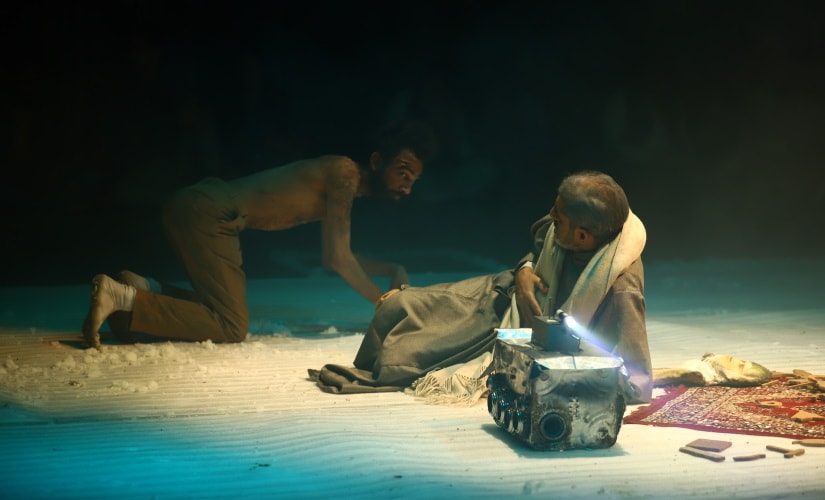
Muktidham, written and directed by Majumdar
The first time I heard of your work wasn't a play; it was at Lekhana, in Bengaluru in 2013/14, where you read a Hindi short story. Do you still write short stories, or things other than plays?
I do, but I don't share them with the world. They're not necessarily about personal subjects, but the act of writing a short story is for me very personal. I like to keep it for my friends and family. I have consciously never published my stories. I compose music sometimes, for other people, for other plays, sometimes for professional musicians. I also paint a little bit. That helps me in scenography, but mainly I paint for myself.
Coming back to the short stories, there is a series called Lakdi ke Makaan, which I have been working on, about women who live in the villages of Shimla (my aunt lives in Shimla). Someday it might become a monologue by an actor. But right now only about 10 people in this world know that I write stories.

Your short stories are in Hindi, but would it be true to say that you wrote plays in English earlier, and now write plays in Hindi?
I write in three languages: Bangla, Hindi and English. My first play, an adaptation of Sunil Gangopadhyay's novel Pratidwandi, was in Bangla. Later I wrote Dweepa in Bangla, but it has only been performed in Kannada.

I'm currently writing an adaptation of Shakuntalam, that's in Hindi. I recently wrote a satire about Communist history, which hasn't been produced as yet, called Dialectical Materialism Aur Anya Vilupt Jaanwar. That's in Hindi, although it starts in Calcutta at the time of collapse of the Berlin Wall, and then goes back to Karl Marx and Adam Smith at the Garden of Eden. I'm still working on that play, but strangely it's been translated into Czech and won an award in Prague. [laughs]

Translations of my plays are happening/have happened into Gujarati, Kannada, Marathi, French. Rizvan got translated from Urdu to Bangla, because there is a show in Bangladesh.

All my work internationally is in English. I write those plays in English whose natural language would not be Hindi or Bangla. So for example, Pah-la, which was staged at the Royal Court Theatre in London last year, is set in Tibet; that I wrote in English. I have another recent play, Batin, set in Medina on the two nights between the Prophet's death and his burial. It's about what happens when the word of God is not understood by everyone in the same way. The natural language of Batin would be Arabic. So that's in English. An early play of mine, Harlesden High Street, was in English. But now I don't produce any work in India in English.

So there has been a move towards Hindi?
Directorially, yes. Five years ago our company did make work in English. I consciously stopped. For two reasons. One, English is the only language in India where knowing the language is enough. In any other language, you also have to know how to act. Frankly, I find far fewer options for actors in English than in Hindi or Bangla or Kannada.
Secondly, an Indian audience watches Hindi or Bangla theatre differently than English. Their bodies change. Because theatre is fundamentally a community thing, you watch it with people. And when you get the third layer of the language — the language that you may have not gone to school in, but the language in which you make fun of people — that is the right language for that stage.
For example, if you read [Girish] Karnad in Hindi, that works much better than reading it in English (though some of the English translations are fantastic).
In India, my rehearsal room is also much more alive when I'm rehearsing in an Indian language. I am directing a play in New York in English, but there my actors' natural language is English. The contract of language is three-way: between the maker, the actor who is performing and the audience. [The play] has to be in the most suitable language for all three, not just for one.

Have you directed a play in a language you don't understand?
Yes, Kannada, which I follow, but don't speak. And I've done a play in London 10 years ago, which was seven vignettes: one in Hebrew, one in Cantonese, one in Arabic...

And that wasn't a problem?
No. Direction-wise, then it was less of a problem. Perhaps now it would be more of a problem. I was a drama school student then, more interested in form. Now I've gotten more interested in meaning.

Tell me more about your interest in form.
Essentially, a play is composing form over time. It's a bit like the work of an architect. One is always thinking about structure. And I've been an avid mathematics student, interested in pattern, shape, geometry, topography. Every play is a problem with multiple solutions.


Give me an example?
I'll give you two examples. For Muktidham, the problem was how do you write a play which from inside is European, but from outside is in the Indian epic format. Structurally, it's not a Greek play with three acts and five plot points; it is cyclical, there is a sense of elaboration. But the scene-work inside the play is not in the epic format: nothing is sung, for instance.

What is very Kathakali about it is that from the interval to the next scene, there is a big jump. We believe that time lapse for two reasons. One, because we believe there is a wall — the wall behind which the Buddhist king is standing. We never see it, but we believe it, and so we assume a certain urgency to everything else. Which is a very Kathakali thing to do. You know — “Duryodhana is coming”, but the scene only has Draupadi and the brothers. The other thing is that although you move forward in time, but the eclipse is stuck. It's nothing, really, it's one profab light on a disc! But it allows us, I think, to continuously imagine suffocation.
In Kaumudi, the challenge I set myself was linguistic: to write a play which used both the language of Aashaadh Ka Ek Din and Adhe Adhure [two classic Mohan Rakesh plays, one set in the time of Kalidasa, one in the 20th century]. So there is the play, and there is the play within the play. And there's a third language the characters use when they are playful, which is similar to Pandavani.

So each of your plays is a research project. Literary, anthropological, historical.
Yes. But art is about memory. It's about how you remember your research. That's the difference between researching and writing a paper, and researching and writing a play. A play has to go through oneself.  It can't be just your thesis — it's got to be your observation of life, your sense of taste, your politics, what you want to say.
But for me, if something doesn't have a hard problem to solve, it doesn't interest me. I can watch plays which are not very complex, I can watch anything live. But to work on an idea for two years of my life, it has to be intellectually complex.
PART II 

Is there one idea that each play starts with?
The theatre is all about confluence. For an idea to become a play, seemingly different things must stick together. Like in Kaumudi, you have a father and son, who mirror Ekalavya and Abhimanyu. The father is going blind, and there is a theatre inside a theatre. These could be four different plays. But I am fond of density, that's my thing. Though that is also one of the criticisms of my plays.

 Playwright-director Abhishek Majumdar on theatre as confluence, its future in India, and directing a film
Abhishek Majumdar

Density leads us nicely to my next question. You work in Hindi, in a moment when there's increasing criticism of the elitism of English. But you also work in theatre. Do you ever think about reaching out to larger audiences?
I have a lot of confidence in the theatre. If a play is worth anything, it will outlive at least one generation. And over time, plays have large audiences with a much deeper level of engagement. So I think the idea of audience is a more complex matrix than just the number of people right now — it's also about density, how many, where. 
The paradox of our time is that in this political moment, you want to make work because it feels urgent. Which is of course necessary, in the face of what is going on. But at the same time there are so many philosophical problems in the humanities and sciences which are completely worth looking at. Is an entire generation of artists only going to look at Hindutva? Maybe it has to, but we also need deviations.
Having said that, I make theatre because I like every dimension of it. I love the craft of it, the art of it, the coming together of people to do it it, the teams that we build, having that audience live, reaching out, going to small towns, going to big cities. While closing Muktidham, we had a moment where Sandeep Shikhar's daughter Sanchi, who I have seen being being born, was sharing a room with Ram Kissar, who does our make-up, who has worked with BV Karanth since he was 20. This is possible in the theatre, because of the nature of its form. It's not like everybody has to be trained in one dance form. It is rough, rugged, it is mixed, it reflects the streets of your town. The street has an old man and a young woman, so the green room must have that. And that is for me the reaching out of the theatre.

But are you often accosted by the question of whether you want to direct a film? Or turn your plays into films?
Suman Mukhopadhay, I call him Lal Da, has won a major award to make a film out of Djinns of Eidgah. I am not a big fan of cinema, though I will direct a film at some point. What I am interested in is directing concerts. I grew up travelling a lot with Indian Ocean, and that gave me the idea that there is a dramaturgy to concerts. A couple of bands have asked me. Susmit [Sen] also asked, but I've looked up to him for so many years, I can't direct him! He will have no problem, but I will have a problem. But now I'm thinking of a concert of sound designers, as opposed to musicians.
Djinns of Eidgah, by Abhishek Majumdar
A still from Majumdar's Djinns of Eidgah

Would you write the music for such a concert yourself?
Some of it. Right now I compose mostly for plays. I took music for granted, because I grew up with Hindustani music classes in my house, and my mother playing the piano every evening and singing Rabindrasangeet. I can use Bengali notation, Swaralipi, which is often used on the piano.

How do you see the state of theatre in India? Are there exciting things happening?
I think art and science need a lot more government support. These things are important for human beings to exist, and they can't be market driven. This emphasis on the commercial, treating ticket sales as the parameter of existence, as if without it you're not speaking to the people: that's a cop-out for not thinking deeply about what the human race needs.
Individually a lot of exciting stuff is happening, from solo performances to technological things. What in Europe is called 'site-specific theatre' has been happening in India in Prahallada Naatak for a thousand years. Going to the proscenium is a new thing for us. But now, the urban Indian is coming back from the West with the idea that only what's being made there is work.
As a person who teaches in a university, I straddle some of these worlds. For the last five years, I teach playwriting at the NYU campus in Abu Dhabi for a semester every year. I have never had two students in the same class from the same country.

How many students in a class?
Eight to eleven, from India, but also Jordan, Palestine, Latin America, the African countries. And the challenge is that they all need to find specific solutions to their postcolonial situations. We are much closer in the arts and sciences to Bangladesh or Algeria than to New York or London. But we have started thinking of the world as a ladder. That's not helpful at all. Yes, there are great things to learn from a cultural exchange of that sort. But just as the first world person is always operating out of a particular context, it is also important for us to operate out of our context.
I was telling a student the other day that if you want to know where you are making art, you have to ask yourself two questions. One, if about 10 to 12 percent of a country's GDP is spent on arts, then public support for the arts in say, Germany, is about 300 percent that of India. Second, you need to be conscious of historical imperative. It is lowest on Broadway, in New York, which is farthest from colonisation. You can make anything, it basically has to sell tickets. And it is highest in the Gaza strip, because right now, as you're making that play, you are colonised.
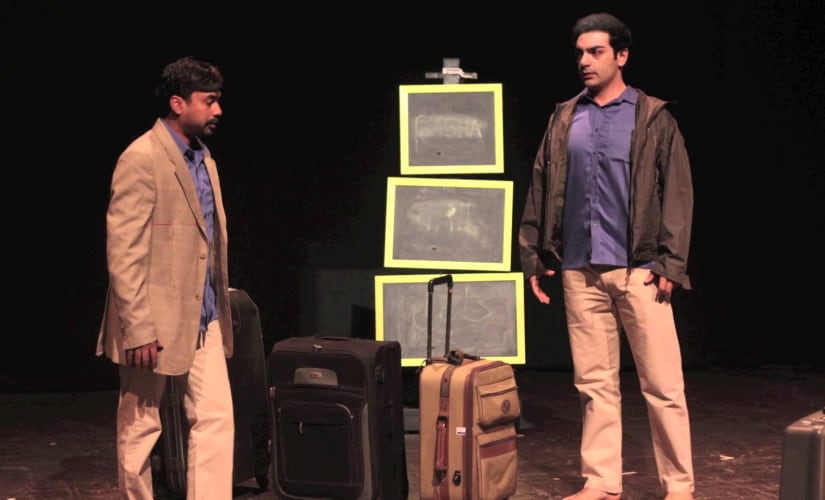
Gasha1 825
A still from Gasha, written by Irawati Karnik and directed by Abhishek Majumdar

Why is your idea of historical imperative limited to the experience of colonisation?
Yes, I'm being simplistic, in order to find an axis that works globally. There are other axes not directly related to colonisation. Within India, how many plays do we see with lower caste women as characters? Nothing, compared to the many with upper caste men.

You mentioned that developing a Dalit dramaturgy is one of the things you're excited about.
Yes. After we moved on from Indian Ensemble, Sandeep Shikhar and I started a new theatre company along with  Vivek Madan. It's called the Bhasha Centre, and our main focus are at the moment is to work with Dalit texts and Dalit writers, from Daya Pawar and Limhale on Dalit aesthetics to published Dalit autobiographies and the work of lok shahirs. It might not be a literature that already exists. We're collaborating on a version of Kisaan that will open at Prithvi Theatre in March 2020. Iravati Karnik is writing it, drawing on Prithiviraj Kapoor's original play Kisaan together with Daya Pawar's Baluta.

Any other ongoing projects you'd like to flag?
There's Tathagat, a street play we did in collaboration with Jan Natya Manch, which played in Mumbai from 9 to 14 August. There's a version of Eidgah ke Jinnat with Jawahar Kala Kendra, Jaipur, with many Rajasthani actors. Djinns of Eidgah is also being staged at the Edinburgh Fringe Festival this month, by Ananya Mishra and the Bread Theatre Company, formed by a lot of non-white Cambridge University students.

As someone who works in London and New York as well as in Bengaluru and Bangladesh, it is important to me to know how much time I work where. I am not making work in England in order to give up my work in India; that's not going to happen. But last year we were touring in Uttar Pradesh and sleeping in trains, and just after that I spent a month in New York. And that is absolutely fine in the theatre. But as time gets limited, it becomes important to choose, to measure.
I like that we have come back to the mathematics. Thank you, Abhishek.

Published in Firstpost in two parts, 19 and 20 August 2019.

17 July 2019

First as tragedy, then as farce

A very short profile of the playwright-director Abhishek Majumdar, for India Today magazine.

THEY TAKE AS THEIR THEMES OUR MOST DIVISIVE ISSUES, BUT ABHISHEK MAJUMDAR’S PLAYS CAN STILL MAKE YOU LAUGH


"Oonchi jaat ka rajnitik sammelan hai. Log bhadakne ke liye hi aaye hain (It’s an upper caste political meeting. People have come only to take offense),” says one of a trio of actors playing Nats, traditional street performers who make up the ostensibly “comic relief” track of Muktidham. It is a packed closing night for Abhishek Majumdar’s brilliant 2017 play, and Bengaluru’s Ranga Shankara Theatre breaks into laughter. The next evening, during a show of Kaumudi, another Hindi play written and directed by Majumdar, the crowd laughs even more uproariously. Yet those who follow Majumdar’s work are unlikely to call it funny. Working in English, Hindi, Bengali and sometimes Kannada, the 38-year-old playwright-director has subjected some of the most divisive issues of our time—immigration, Hindutva, caste, Kashmir, Tibet—to rigorous research and intense ethical questioning.

Harlesden High Street (2010) dealt with working class Pakistanis in London. Muktidham, set in a fictional 8th century temple town, uses the historical tussle between rising Buddhism and a threatened Brahminical Hinduism to interrogate the narratives of both religions, especially the present-day Hindu right’s claims to non-violence and castelessness. Kaumudi, set in early 20th century Allahabad theatre, wrestles with epic figures like Abhimanyu and Eklavya in the context of a conflicted father-son relationship. Three of his plays are set in Kashmir. Rizwan, based on Agha Shahid Ali’s poems and Eidgah ke Jinnat, about state and non-state actors caught in the cycle of violence, are both written by him; while Gasha, in which a Kashmiri Pandit man returns to the state years after leaving it as a child, is by Irawati Karnik. Violence and non-violence are also central to his most recent production, Pah-La, whose depiction of the Chinese use of force on Tibetans caused London’s Royal Court Theatre to delay it for over six months.

Actors Ipshita Chakraborty Singh and Sandeep Shikhar
in a scene from Majumdar's play 
Muktidham 
Seated in the green room with a tumbler of Ranga Shankara’s strong Rs 20 coffee, a deadpan Majumdar demonstrates he can treat humour as seriously as he does other things (or is it the other way around?). “I’m often asked ‘Is this play a tragedy or a comedy?’ I say, when you think about your life, is it funny or is it sad? It simply isn’t one way or the other. Also, tragedy and comedy are western categories. What is the Mahabharata, or Betaal Pachisi, or the Arabian Nights?” That said, he is excited about advancing his grasp of humour, starting with Dialectical Materialism Aur Anya Vilupt Jaanwar, a new play about Communist history by him.

“I’ve written comedy into plays that aren’t of a comic form, but this is my first satire. I’m older and maybe tragedy is a form for the young,” says Majumdar, who did a Masters at the London International School of Performing Arts and, since 2013, spends a semester a year teaching playwriting and philosophy at the New York University’s Abu Dhabi campus. In India, most of Majumdar’s plays have been staged by the Bengaluru’s Indian Ensemble, founded by him in 2009 with actor-playwright Sandeep Shikhar. In 2018, in an attempt at de-personalised institution-building, they handed it over to Chanakya Vyas as artistic director. “Everyone who wants to run a theatre company shouldn’t have to start it,” he says.

Majumdar has since started a new one. The Bhasha Centre for the Performing Arts, started with Shikhar and actor Vivek Madan in 2018, focuses on South Asian languages, particularly Dalit dramaturgy. “We maintain many principles from Indian Ensemble: all members paid equally; free tickets for those who can’t afford them,” says Majumdar, who believes theatre deserves more government support. “The Ramayana, which people are now fighting over, wasn’t created as a market-driven exercise. Neither was Bhasa or Kalidasa. They are important for humans to exist and they can’t be market-driven... On that Friday, a play may not have the largest audience, but if you ask in about 80 years, it might.”

Published in India Today, 5 July 2019.

15 July 2019

The White Noise of an Urdu Poet

Very happy to report that I started a new column called Shelf Life, down at TVOF. A monthly look at literature through the prism of clothing. Here's the first piece!

In fiction and film, Urdu poets find their distance from the mundane through pristine white, mostly a kurta pyjama. Time perhaps to dye them differently? 


In Anita Desai's magisterial 1984 novel In Custody, which was adapted into a Merchant Ivory film in 1993, a small town college lecturer sets out to interview a great poet. The lecturer, Deven Sharma, teaches Hindi for a living, but dreams his literary dreams in Urdu—and Nur Shahjehanbadi is his idol.
Almost from the beginning, Desai uses clothes to mark the gulf between the two, to show us who they are and sometimes who they are trying to be, but failing. 

When Deven first knocks timorously at his door, Nur is lying there, “like a great bolster laid on a flat low wooden divan”. But even without words, in semi-darkness, the poet exudes a certain charisma, a grand visibility that has something to do with being dressed entirely in white, his “white beard splayed across his chest and his long white fingers clasped across it.” To Deven's awestruck eyes, his size and immobility suggest a marble statue, “large and heavy not on account of obesity or weight, but on account of age and experience."
Nur's all-white kurta-pyjama emerges as a signifier of his distance from the mundane, his separateness from the crowd. When Deven begins to doubt his gaze, Nur reappears “freshly bathed and looking truly poet-like in fresh, starched white muslin clothes, loose and flowing and free...”. He is a vision of purity, but purity in danger of being soiled by the lowly chaos around it. That metaphorical image is one Desai draws out fascinatingly, given that this is a Muslim man being described by a Hindu one: “It was clear to Deven that these louts, these lafangas of the bazaar world—shopkeepers, clerks, bookies and unemployed parasites lived out the fantasy of being poets, artists and bohemians here on Nur’s terrace, in Nur’s company... what was astonishing was that the great poet Nur should be in the centre of it, like a serene white tika on the forehead of a madman.”


It is Deven's hero-worshipping gaze that keeps Nur “poet-like”, even after he soils his clothes. So it should be no surprise that the gaze Deven turns upon his own clothes is one of self-loathing, a tragic combination of economic deprivation and aesthetic despair. His Urdu department colleague Siddiqui Sahib has both the money and the taste for “a fine muslin shirt” to wear to college, Deven's only new shirt is a pale green nylon one from his in-laws. When his wife brought it, “he had tossed it on to the floor in an obligatory fit of temper--the meek are not always mild—saying the colour was one he detested, that the buttons did not match, that the size was too large—how could they have chosen such a cheap garment for their son-in-law?” Now, setting out on what feels like the most important assignment of his life, he feels he has no better option—though Sarla smirks when he asks her for it. 
Om Puri, the superb Deven of the film, gets a better deal. We see him in a Nehru jacket over a khadi kurta-pyjama, and once even a dark sherwani. Ismail Merchant seems to have decided that no Indian literary man—even a mere lecturer with a penchant for Urdu poetry, who keeps announcing self-deprecatingly that he is “only a teacher”—can be clad in the cheap bush-shirts and trousers that Anita Desai wrote.
But how do we understand Merchant's decision? Is there a self-Orientalising gaze here? Of course, the Urdu poets of the late Mughal court wore even finer clothes: Shamsur Rehman Faruqi's The Mirror of Beauty spends pages describing Zauq's mashru tunic and wide pyjamas, or Dagh's five-pointed black cap. But does associating present-day Urdu poets with the imagined uniform of a long-gone Muslim nobility celebrate that historical culture, or is it a form of othering we could really do without now? 
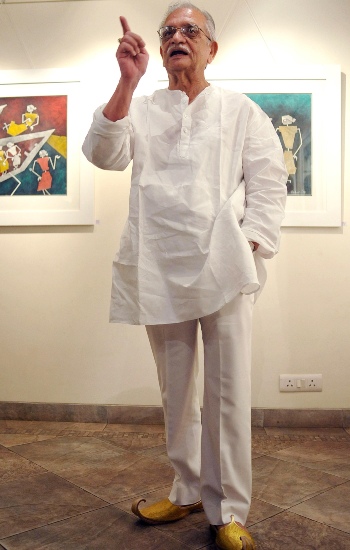
The great film lyricist Gulzar said in a 2017 interview that he has worn white since his college days, and it would “feel false” to wear colour now. But when asked if he feels most himself in a kurta-pyjama, he said he has never worn a pyjama! He wears a Punjabi-Pathani shalwaar on Sundays, of the sort worn in his home-town of Dina in Pakistan, and earlier often wore a dhoti. But what he wears almost all the time is “a regular pair of trousers, with the front crease and everything...” said Gulzar. “It’s just because I’m an Urdu poet that people assume I’m wearing a pyjama with my kurta.”
Photo: AFP PHOTO/STR STRDEL/ AFP

Poet and lyricist Gulzar at an exhibition in Mumbai.
Who is this fictional Urdu poet, who must wear only white, or even only kurta-pyjama? The image may have been truer when In Custody was written, but even the 84-year-old Gulzar has spent a lifetime playing tennis, wearing shorts. The young Urdu poets you might meet at a mushaira in Delhi, at Jashn-e-Rekhta or one of the city's many literary festivals, might be software engineers or tourist guides, TV journalists or government school teachers. They may be “of the bazaar world”, but are no lafangas. And you cannot identify them by their clothes.
Published in The Voice of Fashion, 2 July 2019.

22 April 2019

Prisons of the Mind


At 25, Ismail Merchant's In Custody (Muhafiz) remains a striking vision of poetry amidst pettiness, as well as a memorable tale about Urdu and Hindi.  


In 1984, Anita Desai was nominated for the Booker Prize for a novel called In Custody. It was a marvellous book about a shaggy old poet called Nur, whose last days we observe through the eyes of a college lecturer called Deven. Desai wrote her story in crystalline English, but the world she captured was that of the death throes of Urdu – as witnessed by a teacher of Hindi.

A decade later, the novel was made into a film by Ismail Merchant, starring Om Puri as the nervous, embattled Deven, and Shashi Kapoor – who had been a Merchant Ivory favourite from The Householder (1963) through ShakespearewallahBombay Talkie and Heat and Dust (1983) – as the teetering but still somehow charismatic Nur.


Interestingly, Desai agreed to adapt her book for the screen, collaborating with Shahrukh Husain, to whom we owe the fluid Urdu/Hindustani/Hindi in which Desai's imagined universe is translated back to life. Desai, the daughter of a German mother and a Bengali father who had been to school and college in Delhi, had set her novel between the hubbub of Old Delhi and the dusty provincialism of the fictional Mirpore, a trading town not far from Delhi. The film kept the poet's locational moniker “Nur Shahjehanabadi”, but transposed him (and the hole-in-the-wall magazine office run by Deven's friend Murad, which is angling for an interview with him) from the gullies of Shahjahanbad to Bhopal.


It was probably a practical decision, and certainly a more visually pleasing one. The circuitous route to Nur's house no longer went past “the reeking heart of the bazaar”, “evil-smelling shops” or the “lane lined with nothing but gutters”, but into a picturesque part of Bhopal. And the cinematic version of the haveli has a certain charm, despite the dysfunctional lives lived in it. The downstairs is presided over by the poet’s first wife, the perfect Sushma Seth, who spends her days supervising the fine chopping of onions and the utaaroing of nazar, while the upstairs is the preserve of the younger second wife, the complex, high-strung aspiring poetess Imtiaz Begum (Shabana Azmi).


Deven arrives with a very different vision of the life poetic than the one he finds being led by Nur. The film distils Desai's sharp-edged observations into something quite brilliant. An admirer of Nur's verse, Deven initially sees the great poet as trapped: when he seeks to escape the petty domestic squabbles of his household, his escape is limited to a circle of lowbrow sycophants. The delicacy of Nur's poetic imagination, it seems to Deven, cannot be nurtured by the coarseness that surrounds him. There is clearly an echo of recognition here – Deven, too, has aspirations to poetry, which he still writes – in Urdu. He feels defeated by having been tied to the mundane: the teaching job – in Hindi – that pays his bills but forces him to suffer the sly, mocking glances of students for whom romance tends more to dark glasses and motorbikes than literature; the harried, put-upon wife who does not understand poetry or the desire for it; the little son whose abilities seem too ordinary and unliterary to attract Deven's attention.


But Desai is not so one-sided as to allow even her favoured protagonists to get away with such easy self-delusion. The film incorporates these layers beautifully into the performances. We watch Deven's petulant, unnecessarily bossy behaviour with his wife Sarla (a superb Neena Gupta, who responds with the perfect balance between silent reproach and jaded complaints). We observe Nur’s own flaws: his indiscipline, his indulgence of the senses, his addiction to the excesses of alcohol and rich Mughlai cooking and late hours kept in the company of flatterers whose crude verse is so obviously no match for the quality of his. If coarseness there is, it is as much of Nur's making. And if the women are insecure, jealous, petty even when they have some ambition, In Custody is astute enough to show us that they cannot really be blamed: the limits of their imaginations are the limits of what their civilisation has allowed them.


The book went into much greater detail about the politics of Hindi and Urdu, with the poet often mocking Deven's employment in a Hindi department: “Forgotten your Urdu? Forgotten my verse? Perhaps it is better if you go back to your college and teach your students the stories of Prem Chand, the poems of Pant and Nirala. Safe, simple Hindi language, safe comfortable ideas of cow worship and caste and the romance of Krishna,” he derides Deven, in a line that seems bizarrely blind now. There are complaints about the Congress having placed Hindi and the Hindiwallahs atop the literary establishment, while Urdu is imprisoned in “those cemeteries they call universities”. Thirty-five, even 25 years ago, the fictional Nur and his bazaar hangers-on – largely Muslim, young, unsophisticated of taste and insecure of income – could still mock a Hindu lecturer of Hindi who had come to pay his respects to Urdu. If Nur stood for the decrepitude and self-delusion of Urdu, Hindi was represented by the innocuous wannabe poet Deven. That equation has changed, perhaps forever.

30 January 2019

Obituary: Krishna Sobti 1925-2019

My obituary of a great Indian and a great writer, who was also warm, forthright -- and crucially, great fun. 

A DELIBERATE OUTLIER


Like the tragically rising caste of Indians educated almost entirely in English, the only Hindi writers I had read until 15 odd years ago were those prescribed in my school textbooks. Krishna Sobti was not one of them. Then, in 2005, I stumbled upon her Dil-o-Danish in the cold basement of a Columbia University library, and for the next 48 hours, exam semester notwithstanding, I couldn't tear myself away from Sobti's brilliant 1920s imagining of the city I called home.

Among the most delicious of Delhi novels, the saga of Kutumb, Kripanarayan and Mehek Bano is a universally recognisable love triangle embedded in a very particular Indian social context: the Kayastha patriarch, his lawfully wedded wife (perfectly named, 'kutumb' means family), and his beloved Muslim mistress, with whom, too, he has two children. Sobti captured the fraught but irrevocable tie of the marital, but also the deep-seated romantic attachment of the extra-marital. And she did all this while paying effortless tribute to the everyday cultural life of Delhi, from the making of new quilts at the onset of winter to the poems recited by children at weddings.

In the years since then, I read many more of Sobti's books, slowly realising that part of what made her oeuvre so remarkable was her mastery of language. In novel after novel, she worked to create a different milieu, each brought to fruition by her unerring ear for the multifarious spoken tongues that huddle together under the umbrella rubric of Hindi. The rhythms of rustic Punjabi (Mitro Marjani, Zindaginama) were as much under her control as the urbane Urdu-inflected language of Old Delhi's elite (Dil-o-Danish), or then again the mixture of English and Hindustani in a 1970s government office (Yaaron ke Yaar).

Her outspoken women characters, too, made her unique among Indian writers -- and unlikely to be prescribed in school textbooks. Whether it was the rough-tongued desirousness of Mitro in Mitro Marjani, or the difficult memories and sad-eyed yearning of Ratti in Surajmukhi Andhere Ke, or the many close mother-daughter pairs across her books, from Daar se Bicchudi to Ai Ladki, Sobti's very different women were unafraid yet never invulnerable. Perhaps a little like herself.

Her death yesterday, less than a month short of her 94th birthday, is likely to generate tributes to the grande dame of Hindi literature, but Sobti spent much of her career as a deliberate outlier. A Punjabi who chose to write in Hindi, she was too outspoken for the hidebound Hindi literary establishment. Her novel Zindaginama will live on among the most astonishing novelistic depictions we have of life in Punjab, but Sobti remained an outsider to the Punjabi scene -- especially after she filed a case of copyright infringement against the Punjabi literary doyenne Amrita Pritam for naming a book Hardutt ka Zindaginama. She was among the rare Hindi writers who wrote attentively, frankly and sharply about her peers, producing a series of magisterial sketches under the androgynous pen name Hashmat. Most of all, she was that rare Indian woman of her generation who carved out a life on her own terms: not succumbing to marital domesticity for most of her life, and only marrying the Dogri writer and translator Shivanath when she was 70.

When I first met her in 2009, Sobti was 84, and told me with all the clarity of experience: “Household chores sap women’s energies. If the family becomes the limit of your world, then you cannot think big.” It is a thought I often return to, and a dilemma that many women grapple with. Krishna ji resolved hers a certain way, but she knew that wasn't a possibility open to most women, especially in India.

By the time I met her again, for a long-form Caravan profile in 2016, she was 91, and practically as housebound as the mother in her Ai Ladki had been. Shivanath ji had passed away some years before, and she was back to living alone, with her trusted housekeeper-cum-assistant Vimlesh. But she rarely lacked for company: whenever she was well enough to see people, there were always writers, journalists or editors lining up to see her. And she loved to play the host, pressing Darjeeling tea and biscuits and namkeen upon guests in her small Mayur Vihar flat. Once I had spent the whole day listening to delightful tales of her Lahore or Shimla girlhood, or her frank, gleefully giggly accounts of scandalising the Hindiwallas, she might urge me to join her in a glass of rum-paani.

Yet there was something undeniably solitary about Krishna Sobti. When she retired to her desk, the world was always with her. But she always knew it had to be held at bay, in order for her to be free to do what she had been born to do: to write. 

13 January 2019

Blue-sky filmmaking

My Mirror column:

The late Mrinal Sen’s career took off with a 1959 film, Neel Akasher Neechey, a rare portrait of a Chinese protagonist in Indian cinema.


Mrinal Sen’s directorial career started with a hiccup. Raat Bhore, starring Uttam Kumar and Sabitri Chatterjee as the lead pair, was released the same year as Sen’s contemporary Satyajit Ray released Pather Panchali (1955). But while Pather Panchali made Ray the immediate toast of the town (and the world), Raat Bhore sank at the box office and was panned by the critics.

In 1959, however, Mrinal Sen made a second film,
Neel Akasher Neechey, and this one gained him both popular approval and acclaim from high places. Even here, though, Sen was not the first choice as director. The singer-composer Hemanta Mukherjee (known to Hindi film-viewers as Hemant Kumar) was starting his own film production house and initially approached Sen only to write the script. It was only later, when he had disagreements with the director he had chosen, that Hemanta decided to offer the job to Sen.

Based on a piece called ‘Cheeni Feriwalla’ from the famous Hindi writer Mahadevi Varma’s book Smriti ki Rekhayein (Lines of Memory), the film traces the unexpected connection that develops between an itinerant Chinese peddler and a Bengali housewife who is an active participant in Gandhi's Civil Disobedience Movement. The treatment of the central relationship tugs unabashedly at heart-strings – Mrinal Sen later looked back at it as embarrassingly sentimental. But the thematic content is interesting even today.

Neel Akasher Neechey
 opens in the Kolkata of 1930, and in bringing that historical-political context to life with shots of newspaper headlines, nationalist speeches, and street-corner protests, Sen shows glimpses of the full-frontal political filmmaking that he would later be identified with. The first time we see our protagonist, Kali Banerjee as Wang Lu, he is but a blip on a screen dominated by a horde of schoolboys chanting, “The policeman’s stick, we don't fear it!” The city is in the grip of nationalist fervour, and the Chinese street seller is caught unawares. But the policeman who grabs him also lets him go almost immediately, recognising an outsider even as they both speak in Hindustani – as Calcuttans used to call the hybrid Hindi of the city’s streets, a lingua franca likely shaped by the Bengali speaker’s inability to handle the high genderedness of Khari Boli Hindi, and spoken by the polyglot city of Biharis and Anglo-Indians and Armenians and yes, the Chinese.

Among the first interactions the film shows between Wang and the locals is another troupe of children following him in the streets, yelling, “Here comes the Chinaman, he’ll take you away!” The scene offers up the first of the urban myths that seem to follow the foreigner in India. One little girl tries to stop the other kids, but even her childish sweetness is based on the belief that if you call a Chinaman a Chinaman, you’ll turn into one yourself, conjuring up what is to her clearly a horrifying vision (“Chinaman ke Chinaman bolle, shobai Chinaman hoye jabe”). Another weird Chinaman myth is provided by a household help called Haran, who claims they save their ill-gotten gains as gold teeth.

The exchange between Wang and the little girl evokes another important film of the period, Kabuliwala, which was made in Bengali in 1957 and in Hindi in 1961. Based on Tagore’s 1892 short story, it was also centred on a man from a distant country who walks the streets of Calcutta selling things. And sure enough, this is borne out by what happens next. Where the Afghan Kabuliwala saw his far-away daughter in the figure of little Mini, Sen’s lonely Chinese-silk-seller begins to see his long-lost sister in Basanti, the Bengali bhadramahila whose colloquial use of “bhai” Wang hears literally.

The sister-brother theme is, of course, one that has particular resonance in Bengali cinema, from Pather Panchali’s Durga and Apu to Ritwik Ghatak's Subarnarekha and Meghe Dhaka Tara. But here Sen uses it to a broader effect, suggesting a bond of kinship across class and language and country. He even brings in the rakhi-tying that was adopted by Bengal’s Swadeshi movement to produce a ritual bond between communities.

Calcutta’s Chinatown appeared in several big Hindi films of the period, notably Howrah Bridge (1958) and Chinatown (1962), both made by Shakti Samanta. But it served primarily as a setting for illegalities, with the depiction of the Chinese community stopping at Helen singing ‘Mera Naam Chin Chin Chu’ and Madan Puri as a Chinese villain named John Chang. In Neel Akasher Neechey, that depiction feels more substantial: the Tiretta Bazar ghetto where Wang lives, the Chinese temple where he once prays, the dhaba where a mix of locals and Chinese men eat, the latter eating their rice with chopsticks from a bowl. Together with a running stereotype of all Chinamen being involved in the opium trade, Sen creates a vivid picture of life in Calcutta as a Chinese alien.

And yet, in what might be the film’s most wonderful exchange, when the Swadeshi khadi-wearing woman tries to tell the Chinese man she doesn’t wear foreign stuff, he insists he is not a foreigner: “Eyes not blue, not foreigner, Chinaman!” Released in the era of Panchsheel, the film’s unspoken message of Indians and Chinese as being on the same side of a colonial divide was much appreciated by Nehru, who told Sen: “You have done a great service to the nation.”

It is a sad comment on how little faith our state has in our people that declining Sino-Indian relations after 1962 led the same film to be banned, albeit briefly.

Published in Mumbai Mirror, 13 Jan 2018.

20 May 2018

Meet the American who translates some of India’s finest Hindi writers into English: Daisy Rockwell

An interview I did for Scroll:

‘I was tired of translating detailed descriptions of male desire and women’s breasts.’


Daisy Rockwell is the translator of Hats and Doctors, a collection of short stories by the Hindi writer Upendranath Ashk, as well as of Ashk’s famous novel, Girti Diwarein, titled Falling Walls in English. Her 2004 book, Upendranath Ashk: A Critical Biography, is an exemplary work of literary biography, locating Ashk and his writing within the history of Hindi language and literature. An American, Rockwell is also an artist ­– her grandfather was the legendary painter (and author and illustrator) Norman Rockwell – and has written a novel titled Taste. She spoke to me about how she got into Hindi and translation, why Hindi literature might be more difficult to translate than Urdu, and where translations stand in the larger scheme of publishing. Excerpts from the interview, as published in Scroll.in:


You’re one of Hindi literature’s most devoted, thorough translators into English. How did you happen to set out on this path?


That’s very kind of you to say. I started off being interested in translation in graduate school, when I began my doctorate in South Asian studies. Before studying Hindi, I had studied Latin for many years, as well as French, and some German and ancient Greek. Classical languages really teach you to break down language into microscopic bits, and that is how I first started translating, although not with the purpose of publication.

My advisor in graduate school at the University of Chicago encouraged me, and I also had the great good fortune to take a translation seminar with AK Ramanujan, perhaps the best known and most talented translator from South Asian languages. My subsequent experiences in academia discouraged me from pursuing translation, as it is not currently considered an academically rigorous form of scholarship, at least not in the US. It was not until I turned my back on academia altogether that I returned to translation.

Many of us in India, growing up in a multilingual society, take it for granted that we move constantly between languages. For most bilingual or trilingual Indians, their relationship to different languages may not be something they actively consider very often. Do you think your relationship to Hindi is qualitatively different from that of a native speaker because you acquired the language as an adult? And does your (perhaps) more self-conscious relationship with Hindi aid your life as a translator, or make it harder?


My relationship to Hindi is absolutely different from that of a native speaker. I am an apt language learner, but I did not start learning Hindi until I was 19. By then, as studies have shown, your brain is less capable of soaking in new languages. It took me a long time to be able to read or speak Hindi with any fluency, and even now I make ridiculous mistakes and find some idiomatic phrases and words impenetrable.

There is a fluidity to the South Asian language-scape that is wholly lacking in the United States, which is, despite the diverse population, ferociously monolingual. Code-switching, the practice of sliding effortlessly from one language to the next, or mixed idioms, like Hinglish, are practically non-existent in the US, outside of immigrant communities. I find it very hard to switch back and forth mid-stream between Hindi and English.

I do think all of this difficulty makes me extremely attentive to linguistic details and nuances. Hindi and English do not flow into each other in my mind, the way they might for a bilingual person, and when I am translating from Hindi into English, I’m carrying every word and phrase to a completely different territory.

Like many well-known translators – William Weaver with Umberto Eco or Italo Calvino, or Constance Garnett with Fyodor Dostoevsky or Anton Chekhov – you have built up an association with the work of a particular writer. Why were you drawn to Upendranath Ashk?


I started reading Ashk in graduate school and I was drawn to his attention to detail and his focus on literary production. His work is full of poetry and quotations, and is a great meditation on what it means to be a creative person.

But I actually have five book translations in the translation/publication pipeline right now, and only one is by Ashk, the second of his 
Falling Walls (Girti Divarein) series. That volume, In the City, a Mirror Wandering (Shahar Mein Ghoomta Aina), was due out from Penguin RandomHouse last summer, but is held up over a copyright problem. Then I have two novels by the Urdu author Khadija Mastur coming out from PRH: The Women’s Courtyard (Aangan) will be published in September of this year, and Zameen, which I am working on right now, will come out next year. Both of these are Partition-related novels. I’ve also just finished Krishna Sobti’s latest novel, Gujarat, Pakistan se Gujarat, Hindustan, and that will be published early next year. Last, but not least, I have just agreed to translate Geetanjali Shree’s new novel, Ret Samadhi. Publisher, TBA.

Although I consider Ashk my first love, I am on a bit of a hiatus from him at the moment for a variety of reasons, one of which is that I decided two years ago that I wanted to focus on translating women authors. I realised suddenly that I’d only been translating men (Ashk, Bhisham Sahni, and Shrilal Shukla), and I felt fed up with the male gaze. It’s a bit of a Twitter truism to say this, but there are many interesting stories being told by women, and I was tired of translating detailed descriptions of male desire and women’s breasts. All of my most recent translations, therefore, are of works by women, and the stories really are much more diverse.

Tim Parks once wrote: “The translator should do his job and then disappear. The great, charismatic, creative writer wants to be all over the globe. And the last thing he wants to accept is that the majority of his readers are not really reading him. His readers feel the same. They want intimate contact with true greatness.” Do you think the role of translator requires this invisibility?


It is ironic that Tim Parks wrote that since, although he is a translator, he refuses to disappear, and is always popping up with unnecessarily nasty critiques of other translators, particularly women who are getting more attention than him, such as Ann Goldstein (Elena Ferrante’s translator), and Deborah Smith (the Man Booker award-winning translator of the Korean novel 
The Vegetarian).

Of course translators must disappear. Despite the very strenuous and granular work required in translation, in the end, the translator’s work generally billows like a diaphanous curtain across the work, and the reader doesn’t notice the translation at all, unless he or she is a translator too, in which case he or she notices all the details, both good and bad.

I think the nicest analogy I have seen is a comparison with classical music. A translator is like a musician, and the original author is the composer. There are an infinite number of ways to play Vivaldi on the violin, or Bhairav raga on the sitar. There are also a lot of ways to mess them both up horrendously so that the audience members clap their hands over their ears and run out of the room. When we say a translation is unsuccessful, it is because the translator has not been able to perform the underlying text in the target language in a felicitous manner so that it could be enjoyed by the new readers as much as it was in the original.

And yet, given the unequal power differential between English and other languages, certainly any Indian language, being translated into English is such a writer’s only route to world fame: eg, the recent case of 
Ghachar Ghochar, which has put Vivek Shanbhag on the global literary map. You’ve not only been Ashk’s translator but his biographer: your book on him is a stellar literary biography of a modern Indian writer, it really deserves a new edition! But even setting aside the biography, do you see yourself as Ashk’s representative in the English-speaking world? Does that feel onerous?

I don’t see it as onerous, I see it as a stroke of luck. Every time I get permission to translate something, and believe me, that is not as easy as it sounds, I feel tremendously grateful that I have been allowed to render that work into English. English is the power language and the link language, so much so that readers and publishers often show little interest in works translated from other languages. In fact, I have never published a book-length translation in the United States because there is simply no interest. Perhaps 
Ghachar Ghochar will change that, but it’s a heavy lift for one small book.

Thus, I feel that translation from non-European languages into English is a way to challenge that hegemony and remind English readers that there are other ways of expressing and thinking in the world. As far as fame and glory for the original author goes, Hindi publishing, for one, probably is much more lucrative than English publishing in India, at least in terms of raw book sales. A Hindi writer can expect a much larger reading public than many an Indian English writer, unless they make it into the global publishing market. So I don’t think Hindi authors are really feeling under-appreciated or read in that sense. Maybe they are not being invited to fancy lit fests, but fancy lit fests are really quite a hollow marker of fame compared to a robust and enthusiastic readership.

Are you more invested in the degree to which your translation is faithful to the original text, or in the degree of ease with which readers in English will be able to enter it? 


I wouldn’t commit to one or the other. My translations go through phases: each book will go through a minimum of five drafts before it hits the editor’s desk. The first draft focuses on accuracy; the fifth draft focuses on English readability. The ones in between are on a continuum between these two. My copy editors will tell you that I continue to aggressively revise the text all the way until it departs for the printer.

What do you do about dialect, or idiomatic phrases? Do you try to produce an equivalent in English? This can be a difficult thing to do... I remember in 
Falling Walls, you have Chetan calling his Bhai Sahib, Ramanand, the Old Codger. The nickname is remarked upon at some length, but we do not learn the original term in Hindi.

Some aspects of dialect and idiom just cannot be translated, and if they were kept in the original language in the translation, it would not be a translation anymore. There is a school of translation in India which feels that smoothing these elements out is doing violence to the original text and that translating it into English at all is doing violence really, because of the hegemony discussed above. However, if one has committed to rendering a text in English, one must bite the bullet and figure out how to get it done. If a nickname or something is particularly hilarious, I might keep it in Hindi. It’s really a case-by-case basis for me. In the case you are talking about, the nickname was 
baṛhaū, which is a) not that funny by contemporary Hindi standards, and b) difficult and unattractive to render in the Roman script, thus I chose to come up with something a bit old fashioned in English.

Now the big problem for a translator from Hindi and Urdu into English is that one is bound to have many readers who not only know at least a passing amount of said languages, but may actually be fully fluent in them, and literate too. Why are they reading the English? Often it’s just their habit to read in English, but they are also the most critical readers of translations, and complain of translators “over-translating”, having a preference for being able to “feel the Hindi” through the English. I have seen many reviewers say such things about translations from Hindi and Urdu (not of my books, but of others), and I must say, if they are so eager to “feel the Hindi”, they really ought to take the trouble to purchase the Hindi original, since they don’t need an English translation.

As someone who is also a writer of fiction, how would you describe the difference between the work of writing and that of translation? Does translating ever create a temptation to rewrite?

Translation is a form of creative writing, it’s just creative writing within very strict parameters. Robert Frost once said that “writing 
free verse is like playing tennis with the net down.” Non-translation writing for me is like tennis with the net down as well. You can do anything, but do you want to?

Are there books you’ve read, especially before you became a translator, that you never considered as works in translation? Do you see them differently now?


I’ve always been very conscious of language and started studying Latin when I was eleven or twelve, so I can’t remember a time that I wasn’t conscious of the way translated language stretches English into new and interesting shapes.

Conversely, are there books you’ve read that you think would be untranslatable? Kazuo Ishiguro once castigated his fellow English writers for making their prose too difficult to translate. Does this idea of developing a style for its translatability – leanness, simplicity – make any sense to you?


Translatability I think is really the fluke of the individual writer’s style. I know that Murakami works closely with his translators and often prefers the English editions of his books to be the authoritative ones. Hindi writers are generally speaking all about regional specificity and inhabiting their linguistic sphere fully. Hindi literature was mostly born and developed as a nationalist impulse, somewhat like modern Hebrew, and I think that Hindi authors still feel that they are forging a new idiom and a new literature. This makes Hindi extremely difficult to translate at times. Certainly way more difficult than Urdu prose, which does not have the same “newness” chip on its shoulder. Hindi writing is still in a state of efflorescence and contestation. Krishna Sobti, for example, is extremely difficult to translate – she almost has her own idiolect – and I have just started to work on Geetanjali Shree, who is also very challenging.

Do you think there needs to be a different kind of translation for readers who are familiar with the cultural context of a work – Indians reading in English – than there is for foreign readers who have never encountered a basti or a chulha or a hakim? Are Indian publishers becoming more comfortable with and cognisant of this need?


I would say yes, and covered some of this above, as in the case of the readers who actually know Hindi but do not read in it. However, since publishers outside of India do not currently have any interest in South Asian literature in translation, I feel that we translators must attempt to create texts that can be all things to all people. I do keep many Indian words in the text, but I also tend to give a cursory gloss for terms that a non-Indian reader wouldn’t get. I don’t like having glossaries, and I do think in a long book, readers can learn certain terms from context. The trick is not to overdo it so that the non-Indian readers get overwhelmed and put the book down.

Similarly, one should not under-do it because then the Indian readers will get annoyed. One rule of thumb I use is I ask myself: “Is this word used very often in Indian English?” “Did this word make it into Hobson Jobson?” If the answer is yes, I will keep it. I might also put in a word to give the reader a hint, like “crunchy chiuda”, but never naan bread or chai tea.

Kinship terms are hands down the most difficult aspect of translation into English from South Asian languages in my opinion. Women’s writing contains way more of these terms than men’s writing, simply because there is more action inside the house than outside, generally. With these I try my best to come up with English equivalents, but also include some original terms so I won’t be accused of over-translation. The problem with the kinship terms of course, is not only are they very elaborate, but they are all context-centric, so one person’s 
devar is another person’s bhai sahib, is another’s chacha ji, etc. In Falling Walls, I called Chetan’s elder brother Bhai Sahib and used as I would a name, because I simply couldn’t imagine him without that title, and he was an important character. I called the mother Ma because this is perfectly understandable in English, but I didn’t call Bhai Sahib’s wife Bhabhi, because he also gives her real name, and it would get confusing with all the bhabhis in the house.

This interview continues. To read the whole thing, please go to it on the Scroll site, 13 May 2018.