Showing posts with label film festivals. Show all posts

10 March 2025

"Hindi filmmakers should go back to the drawing board": Interview with Manoj Bajpayee

A wide-ranging interview with the celebrated Hindi film and OTT actor Manoj Bajpayee, published in Frontline in May 2024.

The team of The Fable was jumping up and down—for joy and for Instagram—in the mid century modernist foyer of Berlin’s Akademie der Künste (Academy of Arts) building. Manoj Bajpayee, 54, stood graciously for the first few photographs, and then sat down a little to the left of where his 34-year-old director Raam Reddy and team continued their youthful photo shoot. Even at rest, Bajpayee exuded a kind of coiled nervous energy—quiet, unfailingly polite, but also watchful.  

Meeting the Mumbai-based actor in Berlin, on the fringes of the Berlin Film Festival where his film The Fable was premiering, felt unusual and yet oddly fitting. Born in 1969 to a farming family in rural Champaran, Bajpayee’s journey to becoming Hindi cinema’s best known ‘alternative hero’ has been nothing if not unusual. Rejected more than once by the National School of Drama, Bajpayee conquered his disappointment by finding work with Delhi’s theatre stalwarts like Barry John and N.K. Sharma, with whom he founded the Act One troupe in 1990. The route to cinema was not easy either. Bajpayee’s first film was Shekhar Kapur’s Bandit Queen (1994), which premiered at Cannes and was India’s entry to the Oscars that year. But his minor role as the dacoit Man Singh did not get him any new work. What it did, though, was lodge his performance in the mind of Ram Gopal Verma, who when he met Bajpayee two years later, promised him a role in his next film, a gangster drama set in Mumbai. This, of course, was the era-defining Satya (1998), with Bajpayee’s Bhikhu Mhatre at its incandescent core. 

Fine turns in films like Shool, Kaun, Zubeidaa, Aks, and Pinjar followed. While it has not always been a smooth ride, Bajpayee has successfully stayed the course. In 2024, he is really everywhere, appearing in OTT offerings, in theatres and in film festivals. Bajpayee’s recent roles have run the gamut in terms of power and social position: a middle class lawyer in Sirf Ek Banda Kaafi Hai, a troubled business scion in Gulmohar, a semi-feudal plantation owner in The Fable, a dispossessed adivasi in Joram, and to top it off, a double role as both abusive, womanising husband and clingy, put-upon lover in Killer Soup. Clearly, this is an actor at the peak of his prowess.

Excerpts from an interview:

You were an Amitabh Bachchan fan but began your career in parallel cinema—Bandit Queen, Drohkaal—and were part of creating a more realistic mainstream cinema, Satya onwards. How would you evaluate the state of Hindi cinema today, especially given OTT platforms and the pandemic? 

I think Hindi cinema had reached a good place—experimenting, entertaining but also not compromising on art. So many films—Oye Lucky! Lucky Oye!, Gangs of Wasseypur, Special 26 and many others achieved this mix. Then Covid came and people got out of the habit of going to the theatre. They aren’t completely back yet. During the pandemic, audiences got a chance to explore the new medium [OTT] that had come into their households. Now that option of watching on your phone is always there. Post pandemic, the Hindi mainstream is confused. I see a desperate attempt to entertain that was not there before. Earlier, creators came from a place of conviction. Now they don’t know what will convince the audience to come out of their homes and spend the kind of money needed.

Thus the tilt towards spectacle? 

That is the Marvel effect! It was there before too, but it is much more now. Producers seem to feel that people need an extravaganza to come to the theatre. 

Is that true? 

I don’t think so. The success of Kantara, or a small film like 12th Fail, or the huge critical acclaim for a film like Joram… give me hope. Hindi filmmakers should go back to the drawing board. Before COVID-19, we were doing everything right: women-led films were doing well, films were engaging as well as entertaining… But now the fear of failing is such that there is a push towards extravaganzas. I think we just need to look at Amitabh Bachchan’s films. Larger than life characters, yes, often rags to riches plots, the triumph of good over evil. But the hero was a coolie, or an orphan, or a police inspector who was non-corrupt, or an unwanted child who becomes a multi-millionaire. People related and clapped for him. Replace Marvel-style films with this; you’d save a lot of money on VFX. 

But Hindi cinema no longer tells stories about poor people, they are not the paying audience… 

But the same audience is watching a Telugu film where the protagonist is from a poor background. They are watching Kantara in the non-Kannada circuit and making it successful. Kantara’s story is like a lok katha, with a hero from a village. If we take the lead from there, I think we will find clarity. 

By “from there” what do you mean? 

South India. I do not mean imitate them, but take a cue from them. Heroes should look like us, talk about the problems that the common man is facing. Very few Indians actually make it to the civil services, but when you make something like 12th Fail, the level of identification is huge. The Marvel model might make money once or twice, but that is not a long-lasting solution. I have no problem with larger-than-life films. But stories should be rooted in our society. Because people want hope, and you can’t give them hope by showing life on Mars. 

Has OTT helped or hindered? 

OTT has opened up possibilities for storytelling. You can make things with good intentions and find an audience. Take Sirf Ek Bandaa Kaafi Hai. A regular lawyer fighting for a minor, fearful that someone might come out of any gali and kill him. It became a streaming phenomenon overnight. So audiences are looking for relatable characters, stories that offer excitement—and hope. 

Sirf Ek Bandaa... is based on a real-life sexual assault case against Asaram Bapu. But are things getting more difficult, the stories that can be told?

The censor situation was as brutal 20 years ago. But filmmakers are intelligent people. You can’t sit down and say you can’t make a film. You are a creative person, right? Then you will find a way. Among just my films, think of Sirf Ek Bandaa… or Gulmohar—that “family film” speaks of so many things so cleverly. Or Joram, about a tribal man who is displaced… and Joram has a U/A certificate. 

Could these be exceptions? 
One can be an exception, not five. I think cinema and theatre has gone through changes and challenges in any decade, and always come out on top. 

Theatre was where you began as an actor. Do you miss it? 

I miss it. So much that I tried going back to it. But theatre does not give you crutches—no takes, editing, background music, or sound. What you see with your naked eyes is the truth. It is an actor’s medium, but the actor has to be completely prepared. I was not. I would have to completely stop working in cinema for a time, to work on myself and be ready for theatre. 

Is that something you might do? 

Yes, I might. 

What is it you miss about theatre? The audience? 

The audience used to be a blur. It was as if nothing else existed. The stage was my safest space in the world. That is what I miss. 

Is the film set not like that?

The film set, you can’t really own it. There are too many factors that own it. 

Do you still watch theatre? 

Yes, I do. Whenever I am free and there is a play by friends—Makarand Deshpande or Danish Husain, so many people—I go to Prithvi Theatre. 

Do you prepare for a role by seeking out real people who resemble your character? 

I have met lakhs of people, thousands of them very closely, from all strata of society. From a village to a Paharganj basti to a Vasant Vihar palace, life has taken me everywhere. Everything is stored in the hard drive of my brain. So no.

I may not have grown up as a rich businessman’s son, but playing Arun Batra in Gulmohar or playing Dev in The Fable was not hard. These people are all around me, I know how they think. What was hard was Zubeidaa. To play a prince is a whole different mindset. I still remember [Shyam] Benegal telling me, “You don’t know anything about poverty. You are raja and they are praja. And you are not an exploiter. Don’t complicate matters too much. From the moment you open your eyes, you have only known this.” 

Do filmmakers write roles for you now?

When you’re dealing with Raam Reddy or Devashish Makhija or Kanu Behl, these are very creatively committed people. They do not write roles for anybody. But if those roles suit me, they do give me scripts to read. There I can compliment myself, I have never led a closed life—and I think they also feel that if Manoj Bajpayee comes on board, he doesn’t go away easily.

Are there roles you want to play? Any historical figures, maybe? 

Oh no, I don’t want to do biopics. See, you need an Attenborough to make a Gandhi. And then Attenborough needs to give Ben Kingsley the time to prepare. We do not give our biopics that commitment of time, money, and energy. Also some shades of grey are needed, which Indian biopics don’t offer. The only biopic I have done is Aligarh. I based the character of Dr Siras on a one-minute interview clip with Barkha Dutt. It was almost nothing to go by. But people who knew Siras told me, “He was just like how you showed him.” 

Does acting ever seem scary to you, its power?

I think acting affects people, though only up to a point. Dev’s journey in The Fable makes people realise the void they unknowingly carry. Siras’ plight in Aligarh affects people because it is hard to see a person trapped in his own house. We relate to it, because we are all the time invaded. 

Have you had that Dilip Kumar experience, of being too close to the character? 

It happened with Shool. But I was very young then. I did not know how to switch off and switch on. But even now, am I ever totally off? How many bruises I carry, I will only know at the end of my life. Until then I am enjoying myself! Maybe my moodiness is also the effect of playing all these characters so deeply. But I love acting. If I love the perks, I have to love the bruises. 

Has acting ever felt strange to you, the combination of intensely feeling something internally but having to perform it externally?

Acting is like stripping yourself in front of everyone. If you are ready for that, then come into this business. But yes, it’s amazing there are many actors like me—people who prefer to be quiet, very shy in many ways—who suddenly feel completely comfortable when the camera is on. It excites me, what art can do to an artist. 

Do you feel like each role teaches you something new? 

Yes. Each role’s humanity affects me. Also, don’t forget that the script is written material. You are finding new meaning as you go through every line, repeatedly.

Are you a reader? 

I am a reader, but not a voracious one. Because I do not have time. I read my scripts on flights. 

Have scripts become more professional? 

They have. When I entered the industry, there was only narration. People looked at me strangely if I asked for a script. Then people started giving me a page. Then ten pages. Now you see professional bound scripts. I ask for them in Devanagari, I am from Hindi medium. To read Hindi in Roman is impossible for me. 

You would be an exception, since most Hindi film scripts are originally written in English, and most actors and even directors are increasingly only English-speaking. Does this disconnect not link to the lack of rooted stories? 

Definitely. Look at all the filmmakers who’ve made an impact, from Vishal Bhardwaj to Rakeysh Mehra to Hansal Mehta to Anurag Kashyap to Devashish Makhija: all of them write in Hindi, though they studied in English-medium. I’m glad you asked me this. If you’re from north India, and coming into this industry, Hindi should be something you practice. Sure, we need English, absolutely, it’s empowering. But the lack of Hindi is a handicap. I sometimes see on a talk show, people making fun of a [Hindi] word that some actor has used. I think, how can you do that? You are making fun of yourselves. And I tell my 13-year-old daughter, sit with me, work on your Hindi, you’ll be at a huge advantage. She gets irritated, but it will have an impact. Especially since she is very active in theatre in school, and she wants to act. We are heading towards a situation in this industry where knowing Hindi will be the exception.

20 October 2024

PS Vinothraj: Filmmaker Profile

PS Vinothraj, whose last film Pebbles was selected as the Indian entry for the 94th Oscars, premiered The Adamant Girl at the Berlin Film Festival 2024. Like Pebbles, it makes astonishing use of Tamil Nadu’s unique light, sounds, landscape and even animals.

PS Vinothraj burst onto the indie cinema scene when his directorial debut Koozhangal (Pebbles) won the Tiger award, the top prize at the International Film Festival of Rotterdam in 2021. Late that year, it was India' entry to the Academy Awards. In February 2024, his second feature Kottukkaali (The Adamant Girl) premiered at the Berlin International Film Festival, and all five screenings across the city were sold out. 

When I meet Vinothraj in person, he is all smiles after a wonderfully engaged post-screening discussion with the audience at Arsenal, one of Berlin’s many thriving arthouse cinemas. At his hotel in Mitte two days later, with his co-producer Kalai Arasu as our interpreter, it becomes clear that the smiles are part of his persona.

Vinothraj wears his experience lightly, but the 35-year-old’s journey into filmmaking has taken unimaginable grit and clarity. Compelled to drop out of school in Class IV, he worked as a child labourer in a Madurai flower market and a Tiruppur singlet factory before landing a job at a Chennai DVD shop, where he started watching three world cinema DVDs a day. The aesthetic of Vinothraj’s films—long takes, minimal background music, no songs, zero melodrama—may have been shaped by this immersion.

He beams when I mention the late Greek director Theo Angelopoulos, whose 1998 Palm D’or winner Eternity and a Day he has called his favourite film. His favourite filmmaker, he says, is Tony Gatlif, French director of many films on the Roma community. A picture of Gatlif, a 70-something man with grey hair and a warm smile, is Vinothraj’s phone wallpaper. Gatlif’s films and Eternity and a Day are “travelling films”, which Vinothraj says “will always be my inspiration”. But while admiring these European masters, his cinematic material is drawn from his immediate surroundings, both physical and socio-political. Formally, too, he makes astonishing use of Tamil Nadu’s unique light, sounds, landscape and even animals: a stray puppy, a sacrificial rooster, a mute but recalcitrant bull.

Pebbles
 featured an angry alcoholic called Ganapathy (stunningly played by Karuththadaiyan) who drags his son Velu (Chellapandi) out of school, so that they can go fetch his wife from her natal village 13 km away. Vinothraj mapped their journey, much of it on foot, onto a barren landscape of searing white heat that echoed Ganapathy’s relentless rage. Nothing really ‘happens’ during the 75-minute film (too short for an interval, which prevented a theatrical release in Tamil Nadu); it is about the mundaneness of this violence. But you cannot but be gripped by the father-son dynamic, with the child’s reaction to his father swinging between fear and subversion, and often settling for a watchful silence.

Silence is also the only weapon left to Meena in The Adamant Girl—if one can call it a weapon. Malayalam actor Anna Ben brings to the titular character a sense of mental fatigue combined with the last dregs of physical resistance. Meena is often in frame, in a moving vehicle. But she stays unmoving, even in her expression—except in one shot where she walks free, in her mind’s eye. And she speaks only one sentence in 100 minutes. We learn early in the film that she is ‘promised’ in marriage to Pandi (played with scarily believable aggression by popular Tamil actor Soori) but is in love with a boy she met in college.

Having failed to talk her out of it, both families decide to take Meena to a shrine where the ghost of her lover will be exorcised out of her. Her silence, Vinothraj told me, is because “the film starts after she has tried everything else”; one imagines the arguing and yelling and weeping that went before. Thinking about it later, I wonder if having a mostly silent protagonist also aids in Vinothraj’s quest, as he put it to me, to make films “that keep you visually engaged, that keep your attention despite whatever language barrier may exist.”
In other words, pure cinema.

Kottukkaali
 certainly is. It begins with a woman bathing, fully-clothed, at a public tap. Before seeing her face, we have felt her tears. Walking back home in the pre-dawn light, she passes by a covered bike and a buffalo, both somehow evoking the must-always-be-clothed bodies of women. Vinothraj takes us quietly by the hand into this cloaked world of women’s sadness, from Meena’s crying mother to Meena, whose tears have run dry. Parallel to it, often its cause, is the world of men’s anger, represented here by Pandi, his throat coated with a white lime paste because he is so hoarse from shouting.

Many have read the film as feminist, and it is. But Vinothraj’s clarity about everything that’s wrong with this universe does not preclude a profound understanding of everyone in it. “The film is about the internal war between Pandi and Meena. Neither of them is bad,” he told me, going on to explain how even minor characters fit into his cinematic vision. “The small boy in the rickshaw is like Pandi in childhood, a good boy. The little girl who drags the bull away is how Meena would have been in her childhood. Meenakshi was the ancient queen of Madurai. Pandi, Pandian, is also a historical king. So in my backstory, right from childhood, they’ve been ‘the king’ and ‘the queen’. Pandi would have felt responsible for Meena.”

Fictional backstories aside, his scripts often draw on things that have happened to people he knows. For Kottukkaali, his sisters contributed a lot of what became the women’s dialogue. “Everyone is very supportive (of my process). In fact, they joke: ‘Don’t get into any other trouble, or he’ll make another film!’”

His films, too, show a close-knit community where people look out for each other. But they also reveal a deeply patriarchal society: its rituals, its alcoholism, the lack of freedom for women, verbal and physical violence by men. Does he ever worry about the critical gaze he turns on a society he knows so intimately, exposing it to an international audience? “There are positive things in each culture, but also a few (negative) things that need to be addressed. As a responsible artist, it is my job to send a message across, so that these things will stop,” says Vinothraj. “There are no heroes and villains, only the social situation that is creating the conflict.”

First published in Moneycontrol, 10 Mar 2024. 

13 March 2024

On the Indian documentary Nocturnes, shot in Arunachal Pradesh, which won an award at Sundance Film Festival 2024

My review of Anirban Datta and Anupama Srinivasan's documentary Nocturnes. 

Nocturnes won the World Cinema Documentary Special Jury Award for Craft at the Sundance Film Festival a few hours after my piece was published on Moneycontrol.com, on 27 January 2024.


A still from the Sundance-award-winning Indian documentary Nocturnes.


We hear them before we see them -- a faint but persistent rustling in the darkness, which turns out to be the fluttering of a million little wings. And when we first see the moths, they seem tiny, insignificant. Why, we wonder, would two human beings spend so much time and effort on them? A few moments later, though, we see the two researchers again. This time, walking along a forest path, dwarfed almost entirely by the dark green tree canopy that takes up most of the frame, it is humans who seem insignificant, just a speck on the surface of the earth. 

Of such glorious visual revelations is Nocturnes made. Directed by long-time Delhi-based non-fiction filmmakers Anirban Dutta and Anupama Srinivasan, the 2024 documentary which premiered at the Sundance Film Festival in Utah, USA earlier this week was shot on location in the misty mountainous forests of Arunachal Pradesh. This is not Datta and Srinivasan’s first work in the Northeast: their previous collaboration, Flickering Lights, which won the top prize for cinematography at the International Documentary Film Festival Amsterdam (IDFA) in 2023, was about electrification -- or the lack of it -- in a village in Manipur. 


Anirban Datta, one of Nocturnes'
two directors
 Nocturnes, unlike FL, approaches science not   through pragmatics or politics but as a source of   wonder. We follow Mansi Mungee, an Indian   entomologist in her 30s, as she traverses the   forests of the Eastern Himalayas in search of the   hawk moth. She is accompanied by Gendan   “Bicki” Marphew, a young man from the local   Bugun community who works part-time as her   photographer-assistant. Sometimes other   collaborators appear, too, but the point of view   remains very much Mansi’s. As she and Bicki scout out locations, we learn about the practicalities she must keep in mind: the specific elevation or height above sea level; the presence of old-growth trees; the existence of a forest clearing to enable light from the moth screen to travel some distance -- but also some natural limits to that clearing, so that the moths that show up can be assumed to have come from a single elevation. 

Anupama Srinivasan, one of Nocturnes
two directors
Sukanta Majumdar’s impeccable location sound brings the forest to life, overlaid by Nainita Desai’s almost eerie musical compositions complementing our sense of visual discovery. But the work of science is not glamorous, and Yael Bitton’s editing stays close to the precision and slowness and often repetitive labour of the process: recording, measuring, comparing, evaluating. We get a real sense of the long hours spent waiting, with little control over the outcome of their labours. Night upon night, the researcher and her assistant are awake into the wee hours, their headlamps and hoods abuzz with winged visitors -- hoping that their little island of light will attract at least some of the specific creatures that they are here to study. But there are no guarantees of anything, and in these moments, scientific work begins to echo the practice of faith. 

At one point, when Mansi sketches out the route along which she intends to map the population of hawk moths, and explains to her assistants that they need to take two hundred photographs at each point on it, one of them stops her. “How long will this take?” he asks. Mansi’s reply is immediate: “However long. Four months, five months, two years -- whatever it takes, we’ll do it.” That commitment to a timeline without end feels like deep romance, especially in a world that thinks it needs everything faster and wants nothing forever. 

Several recent Indian documentaries have gained worldwide attention by training their lenses on the subcontinent’s infinitely various natural world and the relationships we have with some particular aspect of it. Kartiki Gonsalves’ The Elephant Whisperers (2022) won an Academy Award for its portrait of the man-animal bond through one couple and an elephant in Mudumalai, Rahul Jain’s Invisible Demons (2022) mapped the apocalyptic state of Delhi’s polluted air, while Shaunak Sen’s All That Breathes (2022) achieved a brilliant mix of the poetic and political with its mordant portrait of two Delhi-based brothers who run a hospital for injured kites. 

Nocturnes is a quieter, smaller film than both the latter, the filmmakers having chosen a milieu with less scope for ecological handwringing or socio-political critique. But neither does it resort to crowd-pleasing appeals of the orphaned baby elephant variety. It just nudges us to slow down and look -- at gossamer spider webs trembling in the weak morning light, a caterpillar looping itself along the strength of a slender branch, the mist unfurling over a dark forested valley, and most often, at its mysterious world of whirring creatures that sometimes live only a few days, but whose ancestors have been on the planet since before the dinosaurs. Like its researcher protagonist, it hides a deep existential investment in its subject under an implacable workaday front. 

The film’s least successful moments, for me, are those when its almost meditative focus on time and labour and the eternal ‘show’ of nature is punctured by overt moments of ‘tell’: Mansi verbalising her enchantment with the species she studies, or asking existential questions to which science may not have any answers: “Why are moths so variegated in colour and pattern? Why do they thrive in these remote forests?” It would also have been interesting to see a little more of the indigenous Bugun and Shertukpen communities, who are thanked in the credits as “the guardians of this forest”. But that would have been a different film, and for now, this one is quite enough.

First published in Moneycontrol on 27 Jan, 2024.

3 October 2022

Making Waves at MoMA

A short essay I wrote for India Today on a festival of contemporary Indian cinema at New York's Museum of Modern Art (MoMA) in 2022. 


'Making Waves: A New Generation of Indian Independent Filmmakers' is the largest Indian festival at MoMA since 2009, and is intended to showcase small-budget but artistically ambitious and accomplished films 


(CLICK THE IMAGE TO ENLARGE) 

Published in India Today, 19 Sep 2022.

14 June 2021

Why you can't watch these films while cooking

My Mumbai Mirror/TOI Plus column:

A bouquet of independent films at the 2021 New York Indian Film Festival doesn't leave us smelling of roses, but takes a wry, gentle and honest look at our lives today

A still from Arun Karthick's wake-up call of a film, Nasir (2020).

What do you want to see on your screen? What you watch on your television screen, your computer screen or your phone screen is inextricably connected to what you're willing to play on the most important screen of all – the mind's eye.

Since the Covid-19 pandemic struck India last year, those who can work from home and still earn a living have been the lucky ones. But we have been robbed of what was once our daily life. As our live interactions with the outside world recede into the distance, those who have access to a screen of any sort spend more and more time on it. And yet, simultaneously, the degree of attention people give to what's on the screen in front of them, seems to decrease every day – and I don't just mean their long-distance girlfriends.

We all know people who watch only foreign TV shows, or only old movies, or only comedy these days, because the Indian here and now seems too grim to engage with. That desire to screen out the darker parts of Indian reality extends from the middle class consumer to media producers: I was recently told that international funders are very keen on fresh documentary content from India, but it needs to be light and preferably humorous. I speak anecdotally here, but I know more and more people who keep a film or a web series running on a phone or tablet screen beside them, while they proceed with the work of the day – sometimes on another screen. I suppose it's no different from keeping the television on for company, as people of an older generation have done for years. But it means that the 'content' you're watching shouldn't need your full attention. And what does that mean for how you engage with the world?

The films playing as part of the New York Indian Film Festival 2021, however, demand your full attention – and they're worth it. The festival is being held virtually for the second year running, and this year a substantial chunk of the programming is available to view in India. Online tickets to the NYIFF films are available to purchase on the Movie Saints platform till June 13, and streaming until June 20, along with specially-curated interviews and discussions with many of the filmmakers, actors and producers.

The festival line-up includes some of the best films I've seen to come out of India in the last year or so. Several of these are short films - a category tragically under-represented online, with almost no opportunities for a sustainable, commercial-release format, despite the massive jump in OTT viewership in India. 

Pratik Thakare's superb short film Salana Jalsa (Annual Day) is subtle yet completely absorbing.

There is, for instance, Pratik Thakare's debut short Salana Jalsa, made as his dissertation project at the Satyajit Ray Film and Television Institute, which is a stunning exploration of young people straining towards art – and towards their true selves. Set during an Annual Day function at a Marathi-speaking school in suburban Maharashtra, Salana Jalsa moves fluidly and beautifully among its three primary characters, each of them trying to make themselves heard or seen or just treated a little bit better -- in a world where they're expected to merely tick a box, and no one appears to notice if they don't quite fit in it. I could say that it’s about an aspiring poet, a girl who wants to do Western dance rather than Indian, and a boy who is bullied because he's fat. But Thakare's characters have unexpected arcs, and his atmospheric framing and soundscape make the school experience come alive.

Another of the superb shorts is the Bengali film Tasher Ghawr. Director Sudipto Roy, screenwriter Sahana Dutta and actor Swastika Mukherjee together create a portrait of the quirky housewife next door that you're unlikely to forget. Cleverly staged as a conversational monologue with the viewer, the film is about a woman stuck at home during lockdown. It is chatty and quirky and funny – until it isn't. She complains, as so many middle class housewives do, about her husband being home every day now – and we smile at first. But then we see him, the faceless man sprawled on a sofa, yelling for his breakfast, storming out of the house because of a stray seed in his apple juice, or whispering on the phone to his secret girlfriend. And then we start to see her, the dreamy-eyed kooky lady who talks to the mice – and we begin to see what makes the crazy ladies around us crazy.

Among the features, I was charmed by the Telugu film Mail, about the computer's arrival in an Indian village in 2006. “You can write a letter to anybody in the world,” the dubious cyber guru announces to his first wide-eyed shishya. Of course, in the absence of any further teaching, the student's Gmail inbox remains empty, while the teacher receives a daily quarter of alcohol in return for fifteen minutes with the sacred machine. Uday Gurrala's film has an affectionate eye for the absurd, making us laugh at our responses to new technology, while capturing the visual joys of the Telangana rural landscape.

The most unmissable film in the festival, though, is the Tamil feature Nasir. Arun Karthick's film about a sari shop salesman, which won the NETPAC award at Rotterdam last year, is a warm, gentle telling of our current political predicament. If it doesn't change you, then nothing will.

For that to happen, though, you'll have to pay attention.

Published in TOI Plus/Mumbai Mirror, 12 June 2021.

30 November 2020

Freeing Films

My Mirror column:

A delightful new online film festival to mark South Asian Women's Day defines feminism as “a politics based on principles of equity, equality, justice and peace”

A still from If You Dare Desire (2017), directed by Debalina.

Anantha Ramanan's short film Ticket Please (Sri Lanka, 2018) begins with an older woman preparing a younger man, who might be her son, on how to get to a particular part of town. “The bus conductor speaks Sinhala only,” she says, speaking from the kitchen where she is washing something at the sink. “Give ten rupees exactly. It's very difficult to get the balance from him... If the conductor asks you again whether you have paid, say “Dhunna”. Dhunna means “I have given”.” Before he leaves the house, she instructs him to carry a newspaper in English, saying it will help. I felt a mild sense of irritation. Wasn't the older lady overdoing the multiple instructions, I wondered? And why force the young fellow to pretend to be something he's not? But from the second the young man got to the bus stop, I started to realise that she had been right. Sometimes when you don't fit in, it just makes it easier to pretend that you do.

The young man in Ticket Please is marked by his inability to understand Sinhala; his being a Tamil speaker is cause for irritation. And yet the strapping young bus conductor, so impatient with him for not knowing Sinhala, is only indulgent and excited when an Indian passenger gets on – speaking bad Hindi, gushing about Salman Khan and singing 'Tujhe dekha toh yeh jaana sanam'.

Linguistic politics in Sri Lanka may not seem, on the surface, to have much to do with feminism. But what is feminism really about? Ticket Please seemed to me to make the point quietly but clearly -- it isn't our differences from each other that are the problem, it's whether we've been brought up to regard that difference as either threatening or inferior.

Organised by well-known documentarian Reena Mohan, Aanchal Kapur of the Kriti Film Club and Sangat (a network begun by veteran feminist Kamla Bhasin in 1998), the exciting new South Asian Feminist Film Festival expands the meaning of feminism to make us think about difference and equality in a variety of South Asian contexts. Among the host of wonderful films and panel discussions at the festival (streaming free on http://www.doculive.in/ until 30 November) are Prateek Vats' brilliant debut feature Eeb Allay Ooo!, Vaishali Sinha's Ask the Sexpert (2017), Saba Dewan's Sita's Family (2002), the Ektara Collective's Chanda ke Joote (2011) and Nirmal Chander's Dreaming Taj Mahal (2010).

A good film festival always lets you connect the dots in expected and unexpected ways. From linguistic differences made visible on a busride, I moved to gender difference made visible on a metro ride in Please Mind the Gap (2018), a wonderful short film directed by Mitali Trivedi and Gagandeep Singh. An affectionate documentary portrait of transman Anshuman Chauhan as he negotiates the Delhi Metro, Please Mind the Gap never rubs in its metaphors. Anshuman is an effortlessly engaging subject, though, bringing his wry, laughter-filled gaze to bear upon everything he speaks of. In one early conversation, for instance, he maps his personal sense of space onto the world of public transport with a marvellous lightness. “I instinctually create a gap and maintain it,” he tells the filmmakers, going on to describe how he keeps a distance from everyone, men and women, choosing for himself the space between metro compartments, where the wall has his back, as it were. “Kisi se touch nahi hoge”.

But no matter how much he may want not to be touched, or even just to pass unseen, it isn't always easy. Men who have mistaken him for a man jump up apologetically when they see his face and think they have accidentally touched a woman. Security queues, public toilets, the metro's own Ladies compartment -- every space seems insistent on compartmentalising by gender.

In If You Dare Desire (2017), Debalina's fictional telling of the lives of real-life couple Swapna and Sucheta, their difference is less visible on their bodies -- but that doesn't make it easier. Swapna and Sucheta committed suicide by consuming pesticide together in Nandigram, West Bengal, in 2011, with Swapna leaving behind a six-page suicide note. As the film puts it, “Only this much is fact in the film. The rest, fiction.” The poetic urban interlude Debalina creates for the two young women is no idyll, but it allows us to see how it might have been for them if they had escaped to the city, how it probably is for the many South Asian women whose love seems invisible to the heterosexual worlds they inhabit. Until it becomes visible, is instantly interpreted as difference, and that difference as grave and present danger.

But sometimes when you don't fit in, you can no longer pretend that you do. 

Published in Mumbai Mirror, 29 Nov 2020

20 November 2020

Short of nothing

My Mirror column for Sun 8 Nov:

Among the hundred-odd films screening till tonight in the online edition of the Dharamshala International Film Festival are a variety of accomplished shorts – Indian, foreign, fiction, documentary, animation.

Aditi Bhande's devastating Ghaziabad-set short film Did You Do It? traces one building's waste as it leaches into the surroundings

There are many exceptional films in this year's Dharamshala International Film Festival, but this column focuses on the shorts: films under 30 minutes. Some of the ones I really liked include:

1) Sudhamayee -- Megha Acharya's observational film is composed of family vignettes that may seem artless, but speak volumes. The film starts with a woman describing how she ended up becoming the primary caregiver for her father: her brother declared he was “scared of hospitals” and couldn't “bear to see those things.” “As if, we like seeing those tubes. We don't,” he voice trails off. There is a momentary lull in the conversation, as though the two women are absorbing these facts of life: the ugliness and pain of hospitals, but also the easily declared inability of so many men to perform the labour that surrounds illness and death. Or any domestic labour at all. As if on cue, a man emerges from the bedroom, retreating when he sees the women. The women, in turn, immediately rise with their plates - the man's entry is a sign that time for real conversation is over, and everyday labour must resume now. Again, later, when the couple discuss the woman's promotion sending her elsewhere, she knows she cannot. The man remains, as always, oblivious.

Sudarshan Suresh's brilliant 17-minute fiction is a chilling comment on who loses and who gains from the spectre of "love jihad"
 
2) Mizaru -- A young couple in a Mumbai park become a target for a group of unemployed men, but no-one comes to their aid. It is the sort of incident that is stiflingly familiar to any young person who has ever conducted a romance in India. By zoning in on it in film, Mizaru makes us question what we apparently don't in life: what have the couple done to deserve this treatment? Ah, they have displayed physical affection for each other. And since anything sexual in India is automatically shameful, they can be publicly humiliated by a bunch of louts. As self-appointed guardians of Hindu morality, the men feel entitled to bully them in every possible way. We live in a country in which the villains are confident that their actions will find support from society (the members of a laughter club in the park) and the state (the cops who show up and seem quite happy to have been delivered up some easy victims). Shot in one remarkable fluid take, Sudarshan Suresh's 17 min fiction is a searing indictment of everything that is wrong with India.

3) Did You Do It? -- This disturbing, largely dialogue-less film manages to be somehow programmatic and a mood piece. It begins with a characteristically North Indian dust-storm. The strange menacing half-light, the distant flocks of birds, the persistent slapping sound of the rain may have no diegetic purpose, but the aandhi is dark, slow and harrowing, just like the journey the film sets out to trace: a single day's worth of garbage emerging from an apartment complex in Ghaziabad and leaching inexorably back into our water, earth, air.

Aditi Bhande's Did You Do It? forces us to look at the processes we Indians so expertly turn away from in reality: the unsegregated dumping of garbage, the rising mountains of plastic, the barefoot young workers who do the irreplaceable work of clearing our surroundings, the stinking lorries, the overflowing landfills, and the ridiculous vision of middle class citizens in denial, marching against the municipality. Winner of the Best Editing award for Student Documentary at the Dadasaheb Phalke Film Festival 2020, Bhande is remarkably adept at delivering the facts as a quiet punch to the gut. “The water here has high levels of iron, nitrate, fluoride and aluminium,” reads a subtitle, going on to enumerate the diseases caused by such minerals in water, the depleting ground water levels, the pumping of semi-treated water back into the Hindon river. On screen, water continues to flow down the drain.

Vividly shot, with superb sound, the film constantly unravels our increasingly delusional expectations from nature and the natural. The deceptively attractive rushing sound of water takes us not a river but to the swirling pool of the sewage plant; the green piles of bhindi look poisonously greener in the unearthly tubelit glow of the street market. This film made me restart my lapsed composting bin. It might be the wake-up call you need, too.

Other shorts at DIFF that deserve more than a mention: Stray Dogs Come Out at Night, in which we meet a Pakistani sex worker; Irani Bag, a clever 8-minute essay on the purpose women's bags serve in post-revolutionary Iranian cinema; Anonymous, which movingly maps the stark realities of the Indian construction site; and the stunningly animated dystopia of Wade, in which a group of human scavengers navigate a flooded future Kolkata.

If you think an immersive film necessarily means an hour and half of plotted drama, try these out.

Published in Mumbai Mirror, 8 Nov 2020.

10 November 2020

Dharamshala International Film Festival 2020: From Pearl of the Desert to Yalda, five must-watch picks

Late to put this piece I wrote for Firstpost up on the blog, this year's online edition of DIFF is over. But these five films are totally worth looking out for.

Dharamshala International Film Festival 2020: From Pearl of the Desert to Yalda, five must-watch picks
Still from Pushpendra Singh's wonderful film Pearl of the Desert, 2019, about a Manganiar boy musician called Moti

The Dharamshala International Film Festival went online this year, making its thoughtfully curated mix of features, documentaries and short films available to anyone in India with a screen and an internet connection, offering both season tickets and a daily Binge pass. Sunday, 8 November, is the last day of this year's festival. I've picked out five unusual films worth the price of admission:

Pearl of the Desert, 2019

Documentary | Rajasthani | 1 hour 22 mins

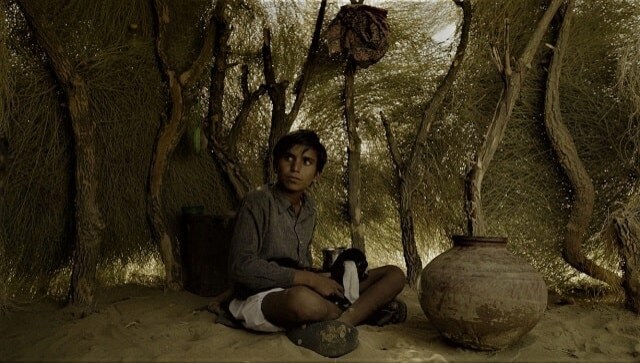
A boy is walking home with a group of other boys, all wearing that familiar dull blue shirt that is the uniform of countless government schools across India. Suddenly he falls behind, telling the rest to go ahead. “You do this every day!” complains another boy in the group. But they carry on, and the boy settles himself on a crooked tree trunk and begins to sing. As the rich, rugged notes emerge from his throat, the desert seems to spring to life. In case the sound doesn't thrill you, the filmmaker catches a black buck leaping up at the sound of Moti's voice. Then another. Animals seem to respond to the beauty of Moti's music, evoking mythical depictions of cattle gathering to listen to the flute-playing Krishna.

It is the sort of coded, powerfully cinematic image that makes Pushpendra Singh's hybrid documentary on the Manganiars such a layered, resonant piece of filmmaking. Time and again the film reminds us, without a word, that we live in a country of remarkable admixture: a country in which Muslim musicians have for centuries been the appointed bards to the upper caste Hindus of the Thar Desert.

It is something to listen to these men singing the praises of their Hindu patrons: enumerating the heroic exploits of their ancestors, laying out their genealogies, mourning the departure of their daughters — all in words profoundly redolent of the desert. If one song describes the carriage of the camel, another pays tribute to the dusky beauty of the lover in the courtyard, while one particularly stunning verse asks the stubborn lover to come back home, saying, “I have written you a carnival, at least now return”.

Whether the occasion is a birth or a marriage or any other celebration, the Manganiars are always called upon. They sing songs to the goddesses their patrons worship, and they also sing songs to the pirs of the Thar desert. The film closes with a group of Manganiar men harvesting cluster beans, singing in joyful unison a song that invokes Allah. In one of the film's reenacted scenes, Moti's grandfather is asked to relate the community's history — he connects them with Parashuram, with stories about asking for necklaces (maangan, haar), and their name to the Sanskrit word “mangal”, meaning auspicious.

Whenever the increasingly misguided votaries of Hinduism insist that their vengeful politics of purity is the only defense of Indian tradition, it is worthwhile bringing up the Manganiars — for this, too, is our tradition. One we must now fight to keep alive.

Dharamshala International Film Festival 2020 From Pearl of the Desert to Yalda five mustwatch picks
Still from the delightful Gaza Mon Amour, 2020

Gaza Mon Amour, 2020

Fiction Feature | Arabic | 1 hour 27 mins

Set in the small, densely populated Palestinian territory of Gaza, this film about an ageing fisherman who decides he has had enough of singledom is a quiet delight just for the stellar performances by Salim Daw as the externally crotchety but secretly romantic Issa and Hiam Abbas as the serious-faced widowed seamstress whom Issa finally gathers the courage to court after a naked ancient statue lands in his fishing net — that feels like a sign. Atmospherics are provided by the rundown location, where checkpoints, power cuts and bombings are the norm — as is the fact that many of the younger people want to escape to Europe even via the dangerous illegal route. Directed by Tarzan Nasser and Arab Nasser, this gently comic romance comes to DIFF after a premiere at this year's Venice Film Festival and the NETPAC award for best Asian film at Toronto.

Dharamshala International Film Festival 2020 From Pearl of the Desert to Yalda five mustwatch picks
Still from the documentary Influence, 2020, a film about the dangerous directions in which advertising and PR have taken us

Influence, 2020

Documentary | English | 1 hour 45 mins

Tim Bell was a British advertising man who went from being part of the founding team of Saatchi & Saatchi to Margaret Thatcher's campaign manager, his “Labour's Not Working” hoardings held responsible, among other things, for the decimation of the British Labour Party in that election. Diana Neille and Richard Polak's ambitious documentary portrait of Bell unpacks the rise and fall of a morally dubious man who created and ran the world's most influential political consultancy for decades. Bell Pottinger's clients ranged from the Chilean dictator Pinochet to South African Presidents FW De Klerk and Jacob Zuma. He was hired by the Pentagon to create a flood of propaganda videos in post-Saddam Iraq and by the Gupta Brothers to stir up racial violence in South Africa using hired bots to tweet and post on #whitemonopolycapital.

The film's watchability is aided by its incorporation of an interview with an aged Bell, who died in the summer of 2019 — perhaps precisely because Bell gives away so little, even as he has supposedly decided to tell his story. But its true impact lies in using Bell's life to trace the transformation that characterises our era perhaps more than any other: the dangerous transformation of advertising and marketing from an “art form into a science — and in many respects, into a workable weapon”. Those words belong to Nigel Oakes, an ex-Saatchi & Saatchi man now infamous as the founder of the SCL group, the parent company for Cambridge Analytica. The untrammelled rise of “strategic communication”, alongside social media, is the story of our times, altering political outcomes across the globe for several decades, and now scarily part of our present in India. In Oakes' words, what was once “just democracy” is now a “controlled democracy, maybe available to the highest bidder.”

Dharamshala International Film Festival 2020 From Pearl of the Desert to Yalda five mustwatch picks
Still from the gripping Yalda, 2019: Iranian realities filtered through the drama of a reality TV show

Yalda, 2019

Fiction Feature | Farsi | 1 hour 39 mins

Winner of the World Cinema Grand Jury Prize (Dramatic) at the Sundance Film Festival this February, Massoud Bakhshi's film Yalda, A Night for Forgiveness is a gripping drama that manages to reveal a great deal about the contradictions and hypocrisies of present-day Iran. The film unfolds on the set of a TV show called 'Joy of Forgiveness', during which a woman convicted for killing her husband might receive a pardon from her husband's daughter — and thus be saved from the death penalty.

Bakhshi based his fictitious show on a real show called Mah-e-Asal that aired daily on Iranian television during the month of Ramadan from 2007 to 2018, and does wonders by alternating between the scripted reality we see on TV and the real drama taking place off-camera. The story of why the 20-something Maryam Komijani married her late father's 65-year-old employer and became pregnant with his child brings into view not how skewed Iranian law is against women — the permissibility of 'temporary marriage', the greater claims of sons over family property — but also the deep fault lines of class in Iranian society. Dominant social morality and the law may see Maryam a certain way, but it is hard to look away from the alternative picture the film shows us.

Ghar Ka Pata, 2020

Documentary | Hindi, Kashmiri, English | 1 hour 7 mins

The filmmaker's search for the home she left at six is the basis of a personal essay about a very political place. Madhulika Jalali's family home was a traditional house in the neighbourhood of Rainawari in Srinagar, among the areas in the city that was home to the Kashmiri Pandit community. Like thousands of other Pandit families, Jalali's Hindu parents found themselves forced to leave the valley by the events of the early 1990s, when militancy in Kashmir took a dangerously communal turn. Like the others, they were never to return. The film makes this tragic political-communal context visible through a very personal keyhole. As if to compensate for her own lack of memory, Jalali tries to find an image of the house she can't see in her mind. When her own family albums are exhausted, the search leads her to cousins and relatives — and eventually to Srinagar.

Dharamshala International Film Festival 2020 From Pearl of the Desert to Yalda five mustwatch picks
Poster for Madhulika Jalali's moving personal documentary Ghar Ka Pata, 2020

The film splices these journeys with Jalali's two elder sisters reminiscing, about the house but also about the traumatic nights leading up to their departure, when proclamations of violence made from the neighbourhood mosques made their father dig out his hunting rifle — but eventually take his close Muslim friend's advice to leave.

Her parents, like most adults Jalali speaks to, remain reticent. But those who were younger then, seem happy to speak. Jalai's sisters talk about how happy and peaceful their childhoods had been in the Srinagar of the1980s: the fruit trees in their garden, the snow they used to try to make into ice cream, the neighbourhood shop from which they bought dahi, the walking route they'd try to take home to get their hands on any festive meetha chaawal being distributed. But even within this gently nostalgic past, one can see the inevitable seeds of the future. In one remarkable anecdote, one of the sisters recalls how in those months that Doordarshan telecast Ramanand Sagar's version of the Ramayana, Hindu and Muslim children alike used to come out onto the streets of their neighbourhood with homemade bows and arrows, taking aim with a "Jai Shree Ram".

Jalali doesn't dwell on it, or on anything really. Her film has a lightness that sometimes feels surprising. Is sorrow filtered through time and distance and forgetting still sorrow? Perhaps the answer is, sometimes.

Published on Firstpost, 8 Nov 2020.

25 October 2020

Taking the festivities online

With the pandemic raging on, film festival organisers are making the most of the digital space.


Gaza Mon Amour, above, is part of the line-up for DIFF 2020. Passes to this year's online film festival: www.online.diff.co.in

Among the many communities barred from assembling by the coronavirus is that of devout Indian film buffs. Movie theatres have been shut for eight months, and even the very occasional new film ‘dropping’ on an OTT platform makes for sad, solitary viewing. Theatres cautiously reopened on October 15, but it might be a while before audiences, and thus filmmakers, risk a Friday release in the cinema. Even worse is the fate of that critical mass of film buffs who eagerly await the annual Indian film festival season, held from October to January, with big and small festivals taking place across the country. Given the new social distancing and hygiene norms, organisers have had to grapple with whether to go digital, cancel, or postpone and hope for the pandemic to reduce in intensity. The bigger festivals, which attract larger crowds and members of an international film fraternity, have almost all chosen the latter two options.

The Jio MAMI Mumbai Film Festival was the first to cancel its 2020 edition, rescheduling to October 2021. Two other highly-awaited festivals, the International Film Festival of India (IFFI) and the International Film Festival of Kerala (IFFK), have postponed. IFFI, organised by the Directorate of Film Festivals and the Entertainment Society of Goa, has been pushed from November to January 16-24, 2021, and IFFK from December to February 12-19, 2021.

The start of the lockdown saw an explosion of energy online with many film archives and commercial sites making selected films free to stream, like Criterion expressing its support for the Black Lives Matter movement by removing its paywall on classic black cinema. In June, when 21 festivals including Berlin, Locarno and Cannes, collaborated on We Are One, a free 10-day digital festival, MAMI contributed three films. Festivals like KASHISH, the Mumbai International Queer Festival and the International Documentary and Short Film Festival of Kerala held successful online editions. The Dharamshala International Film Festival (DIFF) ran an online Viewing Room for months, screening critically-acclaimed Indian and world cinema previously shown at DIFF.

“At that time, many said [the virtual] was the new normal. Online screenings got huge audiences as people were starved,” says Bina Paul, artistic director, IFFK. “But we are busier now, and the distractions are many. It is harder to take time out for an online festival.” There are also piracy concerns, especially for new films, since India has a particularly well-developed network of hackers. “Most crucially, people are realising that films are only part of the festival experience,” adds Paul. “That sense of community is not there online. For filmmakers, the feeling of the film finding its audience cannot come from a scattered, anonymous viewership.” Subasri Krishnan, curator of the Urban Lens festival (Delhi and Bengaluru) for the Indian Institute of Human Settlements (IIHS), agrees that a festival is a space of validation for independent and documentary filmmakers, and 100 people gathering in a dark room is integral to that. But IIHS is moving Urban Lens 2020 online, to be held over six days in December. “One cannot substitute for the other,” says Krishnan, but adds, “Real spaces can sometimes be exclusionary; an online festival may find new audiences. Also, geography becomes irrelevant.”

For DIFF co-founders Ritu Sarin and Tenzing Sonam, too, the prospect of attracting new viewers across South Asia makes their upcoming digital version exciting. “We love the warmth of the physical festival, but we realised that both for indie filmmakers ready with new films this year, and for viewers, there aren’t many options,” says Sarin. DIFF 2020, which will run online from October 29 to November 4 at Online.diff.co.in, is larger than the previous eight editions, with over 100 films screening over a week. Acclaimed international films include Babyteeth (2019), Air Conditioner (2020) and the Wuhan-set documentary 76 Days (2020). There’s an exciting new section of Indian documentaries and an extended programme of shorts, including Ashmita Guha Neogi’s CatDog, the only Indian film selected for Cannes this year. “Without the logistical constraints of time or venue size, we could accommodate more films. And we’re starting an Audience Award for Best First Film, which seems easier to achieve online,” says Sarin. “Next year’s festival may well be a hybrid of online and off.”

For smaller independent or crowd-funded film festivals, going digital can open up exciting possibilities, says Nitya Vasudevan, co-organiser of the Bangalore Queer Film Festival (BQFF). “There’s the prospect of inviting international filmmakers that we would find impossible non-virtually, while freeing up time and money spent on venue hire, brochures and tech. But as a queer festival, the roles it plays are many,” says Vasudevan of BQFF. But she may speak for all film festival regulars when she says, “People look forward to attending because it’s a space of intimacy: you can dress a certain way, have certain conversations you can’t have outside.”In true community spirit, BQFF is currently contemplating an audience poll of the festival’s regulars to decide on whether the festival should be held online in February-March, or wait until it can be held safely offline. Of course, the poll itself would be online.

Published in India Today magazine, 23 Oct 2020.

18 December 2019

Countries of the Mind

Solitary young immigrant men traverse Parisian streets in Na

Read more at:
https://mumbaimirror.indiatimes.com/opinion/columnists/trisha-gupta/countries-of-the-mind/articleshowprint/72623618.cms?prtpage=1?utm_source=contentofinterest&utm_medium=text&utm_campaign=cppst
My Mirror column:

Solitary young immigrant men traverse Parisian streets in Nadav Lapid's Synonyms and Jérémy Clapin's I Lost My Body, two of 2019's most befuddling, memorable films. 

A still from Synonyms (2019)

The opening sequence of Nadav Lapid's Synonyms bursts with a strange, irrepressible energy. A 20-something man charges through Paris, the camera capturing his long-legged strides and his thumping footsteps. He arrives in a grand old building, finds a key hidden under a corner of carpet, and enters a vast, rather beautiful apartment -- with not a scrap of furniture. Seemingly unsurprised, he is in the bathtub when he hears a sound. He runs out, nude and slippery, onto the polished wooden floors, to discover that his possessions – clothes, sleeping bag, money – have disappeared. He races downstairs looking for the thief, banging on the doors of other apartments. No one answers. He comes back to the apartment, still without his clothes, and settles back into the bathtub, seemingly prepared to freeze to death. The next thing he knows, he is waking up in a large clean bed, having been adopted by the young bourgeois couple downstairs. His rescuers Emile and Caroline – children of rich industrialists who have pretensions to the arts – feed him and clothe him, giving him money and a phone and a particularly memorable mustard yellow coat in return for the pleasure of his amusing, sometimes outlandish company. Stripped quite literally of his past, Yoav – for that is the name of Lapid's Israeli protagonist – resurrected in a new identity.


Synonyms, which won the Golden Bear at the 2019 Berlin Film Festival and was screened in India at both MAMI and IFFI, is a film about a man who wishes to shed his old skin, an Israeli man insistent that he will not speak Hebrew, who walks the streets of his new city with a Larousse dictionary under his arm, reciting synonyms from the language he thinks will grant him entry into a new nation.


Lapid's film, apparently at least partly autobiographical, is filled with anger against in-your-face Israeli militaristic nationalism. But as Yoav gradually realises that France isn't quite the haven of liberty, equality and fraternity that he has imagined, it also indicts nationalism of the French variety – with its insistence on linguistic blending in, its closet anti-Semitism, its citizenship classes that involve learning the words of La Marseillaise: “Let us march! Let us march! So that impure blood irrigates our fields!”.


Still from the award-winning animated film I Lost My Body (2019)

I found myself thinking about Synonyms as I watched another 2019 film about a young immigrant wandering the streets of Paris, this time a Moroccan pizza delivery boy called Naoufel. Jérémy Clapin's stunningly crafted I Lost My Body – the first animated feature film to receive the top prize at the Critics' Week section at Cannes, and now available to stream online -- has even grander ambitions than Lapid's film. It opens with a severed hand coming to life and making its way out of a medical laboratory. Surely this must be horror, you think – and I Lost My Body does have its tense, borderline macabre moments: a body-less hand suddenly wringing a pigeon's neck, or clicking an abandoned cigarette lighter into flame in self-defense against a pack of subway rats. But even as we watch the hand creeping and crawling and dancing its way across rooftops and drains, over pianos and under trains, it takes on a personality of its own. We begin to identify with its search – for its missing body, for itself. We do not tremble when the hand approaches a gurgling baby, placing a fallen pacifier back in the baby's mouth, and then laying itself down to be held in the baby's sleepy grip.


Perhaps our comfort has something to do with what we see in the film's parallel narrative, about the film's human protagonist, Naoufel. Bespectacled, shy and slight of build, Naoufel sometimes seems like the opposite of Yoav in Synonyms. And yet they share many things: an irredeemable homelessness, an emptiness that seems to express itself in a need to attach themselves to something or someone, and a painful preoccupation with the past, with a country of memory. Their responses to trauma are quite different. Yoav is constantly vocalising, telling outrageous stories about his past in Israel, once even presenting them to his writerly friend Emile in an extravagant gesture of generosity. Naoufel is painfully quiet, seeming to relive certain moments of his childhood over and over. If Yoav recites new words from a dictionary, Naoufel listens to old tape recordings of his parents. And the hand – the hand remembers trying to catch a fly.


A hand separated from its owner, a tongue separated from its language – these are strange but powerful metaphors for alienation. We might want desperately to leave our pasts behind, but the body remembers.