Showing posts with label folktales. Show all posts

13 November 2019

From Tejimola to Cinderella

My 'Shelf Life' column for November:

Clothes that fit and people that don't: reading Aruni Kashyap’s retelling of a classic Assamese folktale


In Aruni Kashyap's story 'Skylark Girl', part of his recently published collection His Father's Disease, a young Assamese man is invited to an international conference at a Delhi-based university. There are other writers there from the Northeast, but Sanjib gets the feeling that they already know their way around—they know each other's names, the editor of the journal, how to negotiate the Mexican items at the conference lunch.

Kashyap weaves Sanjib's experience in and out of the story he has submitted to the conference: a retelling of the Assamese folktale 'Tejimola'. There is no obvious overlap between Tejimola and Sanjib. Her tragedy is of a different order from his discomfort at the conference. And yet, if you read carefully, clothing is crucial to both narratives: clothing as identity. So Sanjib notes how the young men on campus turn up in shorts and the women wear their cotton saris “as if they were in bed till a moment ago”. They are the epitome of ease, while he feels “like that classmate who came to school with long nails and smelly clothes and got bullied”. Sanjib's sense of impostor syndrome is reiterated in a scene from his past that he has turned into a visual metaphor: his only visit to a well-off girlfriend's house, where his tattered chappals seemed to “permanently taint” the gleaming marble floor.

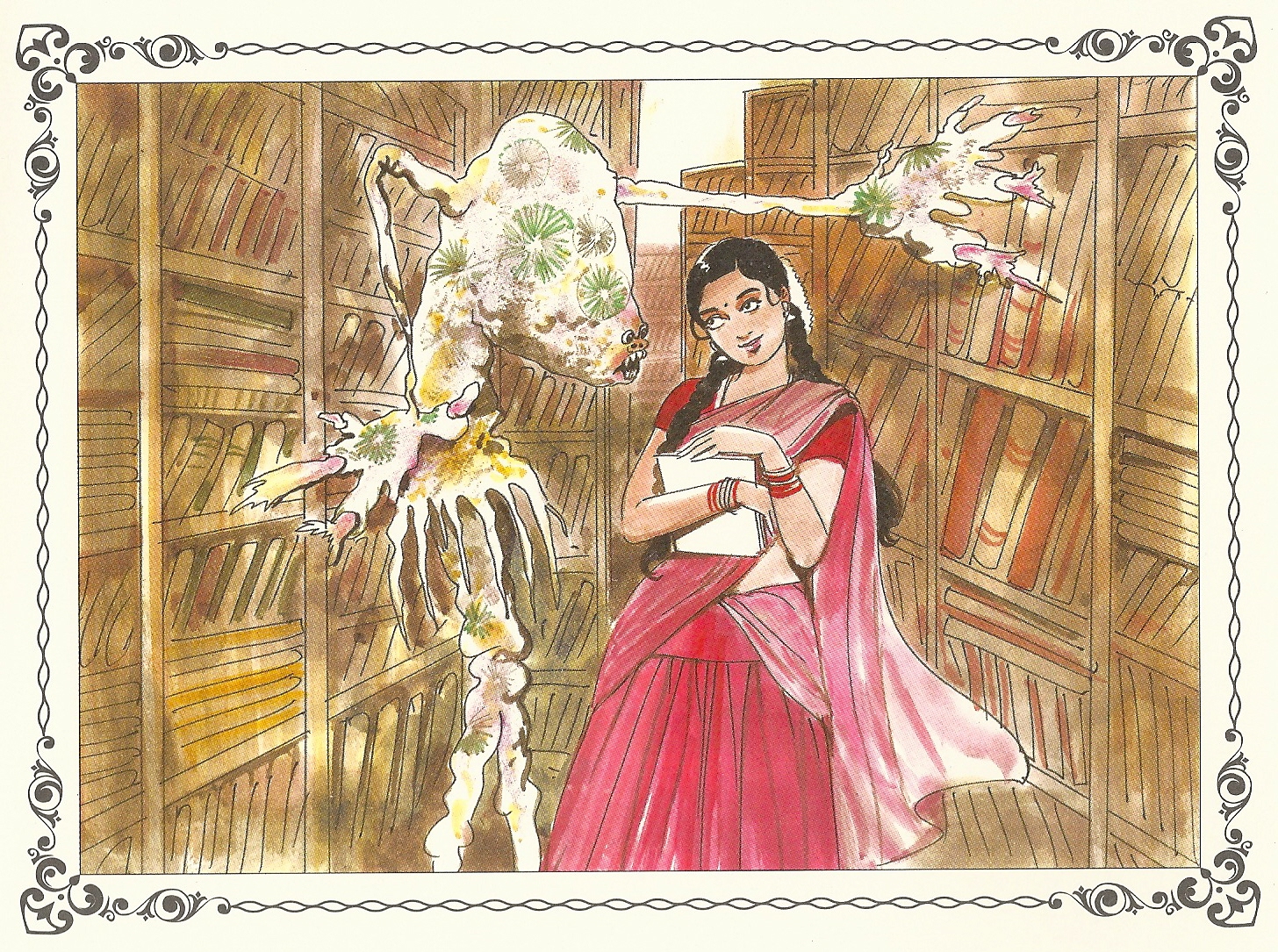
Meanwhile, Tejimola's mother dies in childbirth, and the baby girl is saved and raised by the midwife Aghuni. But then one day Aghuni dies. Soon after, Tejimola's father—a silk merchant called Dhaniram Saud—sets off on a long journey, leaving her at the mercy of her stepmother Romola. Romola has waited a long time for this moment. When Tejimola wants to attend her friend Sokhi's wedding, her stepmother takes out a particularly fine mekhela-sador, “an expensive golden muga-silk dress from Sualkuchi”.

Tejimola is very surprised, because she hasn't known her stepmother to be so generous—especially when she has only asked for“good cotton”. But she accepts, doesn't think too much about it, and sets off with the clothes in a jute satchel. Unbeknownst to her, though, the stepmother has slipped in a piece of burning charcoal and a little rat. By the time the girl reaches her destination, the clothes are half-burnt and rat-eaten. Sure enough, upon her return home, the stepmother uses the ruined mekhela-sador as an excuse to put her to work grinding rice. And then, in one of those scenes of horrific graphic violence that punctuate folktales, she crushes the trusting Tejimola to death with the rice grinder, one limb at a time. 

Buried in the backyard of her own home, the young girl's body sprouts into a gourd-bearing creeper. When a beggar woman tries to pick a gourd, the plant sings out in Tejimola's voice. The stepmother chops it down in fury, but its remains grow into a plum tree—in Kashyap's version, an elephant lime plant. Uprooted and thrown in the river, Tejimola's next incarnation is as a water lily. When her returning father encounters the lily's lament, he coaxes her: “If you are my Tejimola, be a mynah and eat the betel from my hand.”

In Kashyap's telling, the mynah is a skylark and the coaxing is an order. When he returns home, the father takes “a long piece of red-bordered sador”, walks up to the skylark's cage and says, “My daughter, now I command you to take your real form and wear this.”

There is a core idea Kashyap seems to be juggling, of clothes being a good fit—and consequently perhaps clothes as the means that reveal when things are not a good fit. When Sanjib tells his posh girlfriend that his school uniform khaki trousers were the only ones he had before moving to Guwahati, she says “it sounded like a fable”. And in Sanjib's retelling of the classic folktale, the stepmother's too-fine mekhela-sador is a trick, one which Tejimola should have recognised as being too good to be true. She doesn't. She suffers. And she returns to human form by wearing the clothes brought for her by her father.

To fit the clothes you wear is to know who you are. The motif is not uncommon to the folktale. The French Cinderella is identified by her foot fitting the glass slipper. In his pioneering anthology Folktales From India (1991), the legendary scholar-translator AK Ramanujan points out that tales of the Cinderella cycle are told from China to South America, with a central female character being found and lost and found again.

In another Assamese folktale, that of Teja and Teji, the evil stepmother turns Teji into a mynah, dresses her own daughter in Teji's clothes and sends her to the king instead of his wife. “When the stepsister sat at the loom and made a show of weaving, the mynah cried: Whose cloth is it? Who weaves it? She breaks the threads and leaves them knotted.” The king finally notices—a little late, like most men. Like Tejimola's father, he enables the mynah to return to human form, and all is happy again. The story is steeped so deep in the fabric of Assam that the heroine is identified not by the clothes she wears, but the cloth she weaves.

11 June 2017

The Poet-Scholar: A.K. Ramanujan


A conversation about the legendary late poet, translator and scholar AK Ramanujan, occasioned by a fine new book by Prof. Guillermo Rodriguez: When Mirrors are Windows: A View of A.K. Ramanujan's Poetics (Oxford University Press, 2016).

An excerpt from this interview was published in the Jan-Mar issue of the wonderful Indian Quarterly.


A.K. Ramanujan, location unknown (1983). Copyright: The Estate of A.K. Ramanujan
1. How did you first encounter the work of A.K. Ramanujan?

In the summer of 1993, after an overland trip from Spain to India, I was living on a houseboat in Benares and among the first books I picked up at a bookshop were A.K. Ramanujan’s volume of translations of medieval Kannada mystical poems, titled Speaking of Siva, and R. Parthasarathy’s anthology Ten Twentieth-Century Indian Poets, which included several poems by Ramanujan. 

I was immediately struck by the unusual imagery and magical power of suggestion of his poems, as well as by the mysterious quality of the translations which contained ancient wisdom in a surprisingly provocative fresh language and almost riddle-like form. So it was the poetry – original and translated verse –which drew me first to his multi-disciplinary genius. I wanted to know more about their hidden meanings, layers and tricks. It was only gradually that I learnt about Ramanujan's other facets as a folklorist, essay writer, scholar and mentor.

In an odd coincidence, the same summer I learnt of him, he passed away unexpectedly in a Chicago hospital (on 13th July 1993). His collection Folktales from India was published the same year, but The Collected Essays, edited by Vinay Dharwadker, came out much later in 1999, when I had already started my doctoral research on Ramanujan's poetry in English.

2. What made you decide to work on him for a PhD, and what is it about him that sustained your interest for so many years?

I made up my mind to undertake serious research on contemporary Indian poetry in English in the mid-1990s, when I was living in Chennai. I first enrolled in an M.A. course at Loyola College and completed my master's dissertation there in 1997, which was a stylistic and symbolic study of a single poem by AKR titled “Snakes” from his first poetry book The Striders (1966). I was fascinated by the way the “meaning” of the poem comes to the reader in its design, in the particular way the poet-narrator renders the “experience” through the linguistic structure, while the symbolism of the snake allows for interpretations from the psychological (Jungian), philosophical and mythological (Hindu) perspective. That was Ramanujan's trademark style. His multi-layered art and poetics came from his being exposed to, and having absorbed in his poetry, multiple traditions and disciplines, living in India during his first thirty years and then in America.

My discovery of AKR’s other talents as an influential scholar and essay writer, besides his work as a translator of classical and medieval South Indian poetry, folklorist and bilingual poet (English and Kannada), further challenged my view of his poetry in English. This prompted me to focus on his aesthetics and poetics as the topic of my Ph.D. research under the University of Kerala and the University of Valladolid, Spain. As I travelled all over India for my research, at a crucial moment I met Girish Karnad, who had been Ramanujan's friend since the 1950s.

Girish encouraged me to travel to Chicago to research the A.K. Ramanujan Papers that had been deposited at the University of Chicago in 1994. These had never been described before in any publication, and contained a treasure trove of data and unpublished notebooks, diaries, journals and letters which enriched my understanding of AKR as a poet-scholar and spurred my intellectual curiosity. The Papers are indeed a repository of the contribution to the fields of linguistics, anthropology and Indian folklore, culture and literature by one of India's most versatile and seminal intellectuals and poets.

3. Your book is titled When Mirrors Are Windows, which I believe is also the name of an essay by AKR. Why did you choose this phrase as the title?

AKR’s essay, published in 1989, is in fact titled “Where Mirrors Are Windows: An Anthology of Reflections on Indian Literatures.” In this imaginative paper he gives some examples of how the concentric concepts of akam (love poems, domestic) and puram (war poems, public) operate in classical Tamil Sangam literature (first century BC to third century AD), and also points to different types of co-relations (“responsive,” “reflective” and “self-reflexive”) between and within structures and systems in Indian languages and literatures. I changed this phrase slightly and chose “When Mirrors Are Windows” for the title of my book, borrowing it as a fitting metaphor and critical tool to assess AKR’s own (private and scholarly) writings and their intertextuality.

In another sense of the phrase, it was only now that readers could get a glimpse of his unpublished diaries and other private writings. So by exposing them in my book, these diaries, originally meant for no one else but himself (self-reflexive “mirrors”), had become “windows” -- opening up new vistas into AKR`s intimate world and creative process.

Moreover, AKR was quite obsessed with the metaphors of glass and mirror. They appear throughout his poetic oeuvre, such as in the famous “Self-Portrait” poem which I reproduce in manuscript form in the opening of my book. Ultimately, the mirror/window-glass metaphor stands for the self and for poetry, for as AKR observed: “Poetry contains, transforms, and returns our reality to us, and us to reality, in oblique ways.”

4. Your book contains a quote from Ramanujan that runs: “I write in two traditions and I belong to at least three.” He seems to bring together the Indian classical, the regional and the Western traditions in a way that might be unique. Could you say a little about these different influences on him, and how they emerged in his work?

As a Tamil Brahmin who grew up in Mysore, AKR was surrounded by four languages (Kannada, English, Tamil, Sanskrit) and received a trilingual formal education (Kannada, English, and to a less extent Tamil). He did not learn Sanskrit formally, but absorbed it as a religious language from his father. He wrote poetry in two languages -- English and Kannada -- and translated mainly from Kannada and Tamil into English. His father was a mathematician and was also steeped in Indian philosophy. Kannada was AKR's first literary language and he wrote plays in Kannada in his early college days in the 1940s, before becoming part of the navya (new) modernist poetry scene in Kannada in the 1950s. He was also deeply influenced by the oral literatures and the medieval Virasaiva Kannada bhakti poetry which appealed to his rebellious nature in his youth. By the time he was 30 he had become somewhat tired of being a professor of English in Indian provincial towns, and in 1959 he went to the US as a Fulbright scholar to pursue his studies in linguistics. It was there that he studied Tamil formally and learned to translate the Tamil classics.

As I state in the book, many Indian writers of the twentieth century had been brought up in a similar milieu of multiple layers (regional, pan-Indian, English). What is unique about AKR is how he made use of these traditions in a profoundly rich, yet apparently simple, natural way; how he creatively absorbed and displayed these layers in his English-language poetry; and the success with which he translated between these languages (of different cultures and literary periods). More so, he relentlessly encouraged others to do the same, at a time when no one paid attention to some of the lesser-known Indian regional and oral traditions.

5. How do we think about his Brahminical upbringing – including his fathers Sanskrit training – with what he himself chose to study as a scholar: Dravidian linguistics and folklore? Was it an oppositional stance?

AKR renounced his Brahmin-ness as a teenager in 1946, throwing away his sacred thread. As a young student he evinced an innate urge to compare and contrast divergent points of view and he never embraced any particular dogma. As U.R. Ananthamurthy once told me, Ramanujan was “a man of ideas, not of ideology... he liked to play with opposite ideas.”

From his formative years, he was drawn to what he called the 'mother-tongue’ traditions, including folk wisdom, women's tales and diverse oral literatures. And he was fascinated by the anti-establishment of the Kannada poets of the medieval Virasaiva bhakti tradition.

But I would not define this as an oppositional stance. Throughout his life and career, AKR strove to come to terms with his (father's) Brahminical heritage and explored the complex issues of identity as an Indian living in a modern western world. In fact his entire scholarly work aims to project a model for Indian literature that is not based on opposition but on dialogue (which includes quarrels, of course), permeable membranes and intertextuality in a cross-fertilising network of traditions. And I think these issues are still very relevant today in Indian literary and cultural studies.

6. How did his multilinguality – or what he calls his multiple monolinguality -- affect his worldview and his work? How did he fit languages to genres he wrote in, or vice versa? What we might be in danger of losing as a younger generation of poets and scholars in India seems to be becoming increasingly monolingual?

In the interviews and notes AKR explains how each of his several languages “specialised” in a particular “area of experience” and simultaneously engaged the other in a continuous dialogue. The practice of reading and writing in Kannada and English in such dissimilar cultural contexts as India and the US implied a degree of code-switching and exchange in his writing (structural, stylistic, thematic) that is yet to be addressed by critics of his work in English and Kannada. Though AKR felt like an “alternating monolingual” in each of the languages he wrote in, it was not his aim to separate them: “All my writing, of course, is concerned with the three languages I have… they are constantly interacting,” he said. And it was more of a cultural, rather than purely linguistic, interface between the three languages he worked in. It was both an unconscious and conscious process.

As a poet, for instance, he believed that the use of one language or another was determined by a complex combination of personal, cultural and contextual factors. Writing a poem in a particular language was not a question of choice or control, as poems could not be willed into one language or another. They were originally triggered by a particular situation, an incident, a real experience. And then, once the poem was nurtured, groomed and polished, it had a delightful mosaic-like quality, wrapped up in a deceptively simple, conversational style. It is this richness of cultural reverberations in his verse that present-day Indian writers who may not be exposed to more than one language, or one culture, are in the danger of losing.

7. You've studied both Ramanujan's poetry in English and his English translations of the Sangam poets and the poetry of Nammalvar (from Tamil) and the medieval mystic Virasaiva poets (from Kannada). How did his poetics inform his translations – and vice versa?

There are multiple techniques, images, motifs, styles and themes that AKR absorbed into his English-language poetry which derive from the Indian poetic traditions he translated. To name just a few, he imitated conventions from Tamil classical literature such as the Sangam poetics (metonymic “inner landscapes,” understatement, poetic economy, dramatic scenes, poetry cycles etc.), the Tamil prayer forms (in mock prayer-poems such as “Prayer to Lord Murugan”), and the fourth century Tamil Kural (in the couplets used in poetic sequences in his collection Second Sight). He also emulated the meta-poetic play with words as “body,” poetry as possession, and the changing “flow” of forms and metaphorical “immersion” of the Tamil Alvar saints. And much of his poetry was preoccupied with the concept of “grace” and anubhāva (mystical experience) found in the medieval Kannada Virasaiva poets, and the paradoxical notion of poetic inspiration as an “ordinary mystery”.

On the other hand, his double vocation as a poet and linguist was decisive in his translation work. Though he believed that “only poems can translate a poems”, his training in linguistics was fundamental to “transpose” the original faithfully into a new “poetic body” making use of syntactic devices, modulation, but also structural and visual design, texture, and images.

Some have charged AKR with infusing his translations, especially the early 1970s renderings of the Virasaiva vachanas (sayings) with a modernist, ironic style which distorts the original voices. These critics say he could not free himself from his Western modernist attitude a la Carlos Williams, Wallace Stevens and Ezra Pound. But we should not forget that he was living in Chicago and translating into the idiom of the American reader of the 1970s. His translations, widely admired as marvels of exquisite craftsmanship, were said to communicate the spirit of the original as only true poetry can. They made these unknown South Indian poetic traditions come alive in a contemporary language. Even the British poet Ted Hughes was profoundly influenced by them. And his translational technique had an enormous impact on a whole generation of translators.

8. Would you explain the Akam-Puram divide, and how and why you find it useful in analysing Ramanujan's body of work?

Akam and puram traditionally denote two poetic genres in Tamil Sangam poetry, poems of love and poems of war, but the terms also stand for the private and public spheres in life, that is, for the world of the self and that of others, and for the codes of conduct and expression appropriate to one or the other.

I adopt these concentric concepts as two converging approaches to analyse AKR. He was a scholar and a poet, and his writings contain personal matters (private diaries, journals etc.) and academic material (published essays, linguistics etc.).The akam-puram paradigm is therefore not a divide, but a conceptual model that provides two different entry points into the same world of mirror reflections and textual interplay in AKR`s work. One can look at AKR`s aesthetics and poetics through his “inner” forms (life experience, his first thirty years in India, family, etc) or through the “outer” forms (linguistics, anthropology and other scholarly disciplines). Yet, as he himself observed, “they are continuous with each other” -- and more often than not, he could not “tell what comes from where”.

9. A related binary that Ramanujan occupied both sides of was the scholarly and the creative. You suggest that there were several instances in his lectures and scholarly texts where “biographical and domestic elements enter the public sphere”. Did the academic self ever percolate into his poetry?

Indeed in his classroom presentations and public lectures it was quite typical of AKR to disclose personal details and autobiographical stories to place himself as the specimen, the object within the scholarly exposition. He used this method also in some of the published papers where he discloses incidents about himself and his multilingual upbringing, his childhood, the family house, mother or father, to illustrate an idea. In the inverse direction, AKR occasionally muses over academic issues and scientific questions in his private journals and diaries.

But the “academic self” enters his poetry only in as far as the act of writing is a natural extension of a person's entire learning: “A poem comes out of everything one learns, not just a little part of you,” was AKR's conviction. As a linguist he was of course very much aware of the language structure and texture, and it shows in his clinically polished verse. But according to him, there cannot be anything like “academic” poetry; it would not be poetry. Most of the poetic process was not a self-conscious act, though “the conscious and unconscious elements are very hard to de-segregate.” This unrelenting openness to miscellaneous areas of knowledge (academic and scientific matters, life experiences, stories, even television) kept his scholarly mind as well as his poetic creativity in constant motion.

10. Did moving to the US shaped Ramanujan's writing, or his sense of self?

It was linguistics that took AKR to America in 1959. He became Professor of Dravidian Studies at the University of Chicago in the early 1960s. His was a self-chosen exile, and he took it as a mediating role between Indian and American scholarship and as a dialogue in himself. Being suspended between two worlds was both a double resource and a source of tension for him. Despite inevitable disconnections from his native culture, family relations, etc, he believed that no part of the self could be isolated from the other. And this notion permeates his creative writing, where the different components of his cultural knowledge (America, English literature and diverse Indian traditions) interacted in a creative give-and-take. He even called himself half-seriously “the hyphen in Indo-American Studies” to illustrate the “splits and connections” that nurtured his existence as a poet and scholar equally at home in America and India.

In fact, the experience of being between worlds added another skill to his “miscellaneous criss-crossing:” he became an expert in the art of translating little-known ancient texts into a contemporary English idiom, or rather, a specialist in 'transposing' his readers – and himself -- into other cultures, voices and literary traditions. At the University of Chicago his two-fold academic and poetic vocation was able to thrive in a natural extension of the early environments of his past. And ironically, it was in the US that AKR discovered Tamil classical poetry when, in 1962, he chanced upon an anthology of Sangam poets in the basement of University of Chicago Library. That’s his story of creative twists and turns, just like a good folktale, or poem…

11. And finally, which of his writings would you recommend as a starting point -- for someone who has never read any Ramanujan?

Among the essays, I would start by recommending “Where Mirrors Are Windows: An Anthology of Reflections on Indian Literatures” (1989) and “Is There an Indian Way of Thinking. An Informal Essay” (1989). These are two of his most influential essays and the opening pieces in his Collected Essays (OUP, 1999). Lovers of folklore and popular wisdom should not miss his marvellous collection Folktales from India: A Selection of Oral Tales from twenty- two Languages, first brought out by Penguin in 1991. Of his books of translation Speaking of Siva (first published in 1973 by Penguin) quickly became a backpacker's favourite -- and has by now turned into a classic. One should not fail to read the introduction to this anthology, for its insights into bhakti poetry as well as his own poetic preoccupations.

The Collected Poems of A.K. Ramanujan (OUP 1995) covers all of the poems published during his lifetime and some of the posthumous compositions. The poems do not need to be read chronologically, but it is interesting to observe how his early poems (for instance “Self-Portrait”, The Striders”, “Snakes”, “Anxiety” or “Small-Scale Reflections on a Great House”) share a common “language within a language” with the later poems, such as “Chicago Zen”, “The Black Hen” and “Children, Dreams, Theorems.” We find AKR in a continuous dialogue of selves, always quarrelling with the work of art, with memory/images, and with his multiple 'reflections'.

An excerpt from this conversation was published in the Indian Quarterly, Jan-March 2017 issue.

24 October 2016

Ram, Lokhon, Sinta. And Sabin.

My Mumbai Mirror column:

Altaf Mazid’s film on the Karbi version of the epic underlines why we need all our many Ramayanas.


It’s not yet Diwali, and the Ramayana season this year already feels more disturbing than festive. First, the Shiv Sena successfully prevented actor Nawazuddin Siddiqui from acting in the annual Ramlila in his hometown Budhana (which is in Uttar Pradesh’s Muzaffarnagar, a district that was torn apart by Hindu-Muslim riots in 2013). So what if Siddiqui is the town’s most famous export by far and actually wants to return to fulfil a childhood dream? No Muslim had ever acted in the Budhana Ramlila, said the Shiv Sainiks, and there was no way they’d let one start now.

Then, timing it carefully to coincide with Dussehra, the Modi government announced a Ramayana museum with a Rs.151 crore budget. Part of a projected Ramayana tourism circuit, the museum - to be built in Ayodhya – clearly targets the BJP’s Hindutva voters in UP: building a Ram Mandir at the site where the Sangh Parivar demolished the Babri Masjid in 1992 has been part of the BJP’s manifesto for years. While a Ramayana Museum is a wonderful idea in itself, the present project — to be carried out in UP’s most politically sensitive town, in an election year, by a pernicious and culturally insecure government — does not inspire confidence as being anything but a sop to Ram temple enthusiasts.

The Ramayana museum I’d love would be one that lets us marvel at how communities across our vast and varied subcontinent have made the epic their own. Such a museum is unlikely to get built in the near future — but it would have benefited greatly from the knowledge and enthusiasms of Altaf Mazid, the Assamese filmmaker, critic and restorer who died in April this year.

I say this because I recently watched Mazid’s striking 50-minute film Sabin Alun (titled ‘The Broken Song’ in English), about how the Ramayana story is told and lived by the Karbis, an ethnic group in the hill areas of Assam. Although screened as ‘documentary’ (at the 2016 Mumbai International Film Festival and at Delhi’s Open Frame festival organised by the Public Service Broadcasting Trust which also funded the film), Sabin Alun refuses to fit into a pre-established genre. It rolls around playfully between ethnography and storytelling; between serious-minded, unadorned documentation of the epic and a tongue-in-cheek contemporary staging (in which the geeky Ram keeps adjusting his spectacles while the dark-suited Rabon drives Sinta off in a big black car).

Mazid’s film assumes — correctly — that we know the epic inside out. He does not so much describe the Karbi version as draw us into it, demonstrating with quiet beauty and unspoken ease how a story can be entirely retold while still remaining recognizable as the same story. The extent of reimagining is apparent from the very name — of the Karbi story as well as the film. Sabin Alun means ‘Song of Sabin’, and Sabin is what the Karbis call Surpanakha, Ravan’s sister.

It seems both marvellous and fitting that Surpanakha, as Sabin, comes to occupy centre space in the Karbi narrative — rather than being stuck on the periphery as the snub-nosed, dark-skinned villainess so horribly rebuffed by Lakshman that the episode is what triggers Ravan’s revenge, the abduction of Sita. Marvellous, because to those of us raised on upper-caste Hindu tellings of the Ramayana, there is still a shock when we’re made to see the tale from the other side, to perceive our fair-skinned heroes as the arrogant, marauding, misogynist outsiders they are in Sabin’s forest home. Fitting, because as a Karbi woman explains, “Sabin has her nose chopped off, and there is no mention of Sabin. So it is ‘Song of Sabin’.”

Even more than Sabin, it is Sinta
 — the Karbi Sita — who demands our attention. Of course, there are many other Sitas stronger than the prettily useless version thrust upon us by Tulsidas and Ramanand Sagar — in the Oriya 15th century Vilanka Ramayana, based on the older Adbhuta Ramayana, Sita is the one who finally kills Ravana, having assumed the form of Kali, but lets the world believe that Rama did the deed.

But Sabin Alun gives us a truly earthy Sita (though ironically Sinta is not found in a furrow, but in an egg). In the song sung in the film, we hear Sinta ask her mother for a knife. “And holding it in her hands... Sinta while on a tour... Felled trees big and small... So mighty was she.” Mazid maps these words onto a staging: a modern-day Karbi woman riding angrily off on a tractor. Later, he reiterates the epic’s agricultural basis among the Karbis, by asking an interviewee why Ram, Lokhon and Sinta had to go into the forest. She responds without a moment’s thought: they had to take up farming, and there were no fields like there are now. “So they went to clear the forest... and then they stayed to supervise the farming.”

Perhaps the finest moment of revelation for me, though, was the quietest: an old lady sings of how Lokhon refused to leave Sita when she bade him go to Ram’s rescue. “I am not going, my brother is not dying,” proclaims Lokhon. But Sita is not one to give up so easily. “Oh Lokhon, if you do not go,” she says, “You want to marry me. And this is what you have in your mind.”

The line is delivered in the same drone-like monotone as everything before and after it, and one can only wonder why it is such a shock. It is, after all, a perfectly imaginable dynamic to emerge between a woman and her attractive (temporarily single) brother-in-law. Or perhaps it is too imaginable? There is probably a reason why a man’s relationship with his saali (wife’s younger sister) and a woman’s with her devar (husband’s younger brother) are categorised as ‘joking relationships’ across North India. It takes the matter-of-fact frankness of the Karbi telling to let us see this aspect of the Sita-Lakshman relationship that we have suppressed for years.


Published in Mumbai Mirror, 23rd Oct 2016.

24 October 2015

Picture This: Dark waters


Bhaskar Hazarika’s striking directorial debut, Kothanodi, turns the magic realism of the Assamese folk tale into something ominous


A man buries newborn babies in a dark forest. A woman gives birth to a vegetable, and is driven out of her village. A young girl called Tejimola is tortured by her evil stepmother. A captured python is welcomed as a bridegroom for a young woman.
Bhaskar Hazarika’s debut feature Kothanodi (River of Stories), just back from Busan and London for its Indian premiere at Mumbai’s Jio MAMI festival, weaves elements of four Assamese folk tales into a weird, unsettling tapestry. In its matter-of-fact melding of the supernatural with the everyday, Hazarika’s film follows in the footsteps of previous attempts to translate folktales to the Indian screen. Satyajit Ray’s Goopy Gyne Bagha Byne (1969), though not itself a folktale, was based on a folk-style story about a pair of tone-deaf musicians, by Ray’s grandfather Upendrakishore Raychaudhury, who was famed for his retellings of Bangla folk tales. Ray’s adaptation struck a cheerfully irreverent note, giving his ghosts a caste system, and making the Bhooter Raja, the King of Ghosts, speak in Ray’s own voice, with a layer of metallic vibration akin to the sound of a fast-forwarded audio cassette.

The late Vijaydan Detha’s retellings of Rajasthani folktales have been the other big source of folktale adaptations in Indian cinema. The least watched of these are Shyam Benegal’s Charandas Chor (1975) — in which Smita Patil made her debut — and Prakash Jha’s terrifying moral fable, Parinati (The Inevitable, 1989). Another of Dan Detha’s tales forms the basis of two films that couldn’t be more different from each other. Mani Kaul’s Duvidha (1973) is a classic of the Indian New Wave, where the dazzling white light of the Rajasthani sun alternates with dark shadows and quivering silences. Amol Palekar’s Paheli, which took on the same story in 2005, is a rather too-well-appointed mainstream drama, but Rani Mukerji and Shah Rukh Khan managed to imbue the relationship between young bride and shapeshifting ghost with affecting chemistry (despite the distractions of too much Tanishq jewellery). A ghost was also crucial to Anup Singh’s beautifully crafted Qissa (2015), whose disturbing plot about a girl raised as a boy by her stubborn father shares much with another Dan Detha tale, 'Dohri Zindagi' (A Double Life).
But where all of these films deal with the supernatural either bouncily or in a haunting, melancholy register, Hazarika’s chosen rasa is bhayaanaka. Shot in the Assamese island of Majuli, Kothanodi immerses us in a watery world of bamboo forest and river, its brilliant greens set off by the scarlet of women’s sindoor-filled partings and paan-stained mouths. The sunlit lushness of this world does not, however, preclude the possibility of dark things lurking beneath the surface. In one long early sequence, as a solitary woman makes her way across the verdant Assamese landscape, crossing field and water and forest, a vegetable rolls along behind her. It is an ou tenga, an elephant-apple, a staple of Assamese cuisine. What could be more innocuous than a vegetable? And yet, as the ou tenga manages to find its way across marsh and river, even persistently rolling up the bamboo stilts of the Mishing-style house in which the woman lives, it fills us with a sense of foreboding. On the soundscape, too, the chirping of birds is overlaid by jeering children; lapping water by the threatening creak of bamboo.
Unlike in the Western horror film trope of something external disturbing the placidity of a rural idyll, here the sources of danger are concealed within the everyday. In the true magic realist tradition of the folk tale, anyone and everything might be magic. Vegetables might contain spirits, a snake might be a god — and conversely, children might be devils, or women witches. Sometimes the protagonists misidentify one for the other. Sometimes the film plays on our fearfulness: our inability to tell whether something is simply what it seems to be, or a magical creature yet to reveal its true form. Sometimes this feeling is twisted into another sort of chilling statement, such as when a mother tells her daughter, “Can one be scared of one’s own husband?”
Hazarika adapted the stories from Laxminath Bezbaroa’s Buri ai’r Xadhu (Grandmother’s Tales); shortening some, altering others and emphasising their macabre qualities. Some tales work better than others. Perhaps the least effective is the one about the buried babies, partly because its climactic sequences suddenly expose the film’s low budget. The tale of the python’s wedding was for me the most powerful, aided by a bone-chilling performance from the ever-stellar Seema Biswas. The other well-known actor in the film is Adil Hussain (English Vinglish, Life of Pi, Umrika) who bridges two tales — he is both the father of the tortured Tejimola, and the curious merchant who becomes interested in the mysterious ou tenga.
I found it striking that Kothanodi’s makers went out of their way to produce what they conceive of as a timeless Assamese landscape. Populated by beautiful wooden almirahs, carved canoes and hand-drawn grindstones, this pre-technological idyll seems clearly datable to the 19th century. There are no telephones, no cars, no buses, or even bicycles. The greatest treasures are gold jewellery and woven textile, for which women are ready to die — and to kill. This is a seemingly pristine world, unspoilt by modernity — and yet not untainted by evil.
Published in the Hindu Business Line, 24th Oct 2015.

4 August 2013

Talking Pictures: a report on graphic storytelling

As graphic storytelling gains momentum in the world of Indian English literature, a slew of indie publishers become the champions of a new visual culture.

First published in Elle India, July 2013.


A page from Blaft's Times New Roman and Countrymen
The Obliterary Journal is a compendium of comics, typography and all sorts of visual pleasures, brought out by Blaft in 2012. It opens with a graphic foreword in which a bunch of symbols declare a war on text. “Obliterate literature!” says one angry pictogram. “Down with novels! Long live comics with publications of remarkable variety. And picture books and graffiti and wacky art!” “Alphabets are stupid!” pronounces another annoyed glyph. “Unless you handpaint them with a lot of style...” 

There couldn’t be a better illustration of the exciting new climate for visual storytelling in Indian English publishing than this mock-serious manifesto. Of course, even such a whimsical call-to-arms recognises that books with “lengthy passages of unadorned text” aren’t going away anytime soon. But more and more publishers are beginning to see that there are other ways to tell stories than just through text. There is a realisation that the visual book can often do things that the purely verbal might find difficult. They can bridge the imagined gulf between children and grown-ups, serious and non-serious, and subvert the common perception of the picture book as necessarily lightweight. Conversely, they can leaven even the most serious subjects with a joie de vivre that can only come from images.


Mainstream publishers like Penguin and Harpercollins have used this medium to bring physicality and dynamism to subjects as varied as 
our gated cities, the Mahabharata and the emergency through writer-illustrators like Sarnath Banerjee, Amruta Patil and Vishwajyoti Ghosh. But it is the smaller, independent publishing houses that are really altering the Indian literary landscape. And they are the ones pushing the image to centrestage with publications of remarkable variety. 


Manta Ray (MaRa)


The publishing collective’s self-proclaimed goal is to move away from escapist fantasy and superheroes to tell real stories about young people in India – their target readership. Their first book Hush (2010) told a tale of child sexual abuse in beautifully hand-drawn black-and- white sketched panels. Stark as its subject was, Hush was also striking for sticking absolutely to the suggestion of its title: it used no words. “I didn’t think I had the right to express what the girl is going through. I didn’t want to put words in her mouth,” says Prateek Thomas, one of MaRa’s founders, who wrote the detailed script on which the book is based. “Also, as a writer, I avoid declamation, exposition. I try to keep brevity. I like the art to do the talking.” Their more recent publications – an anthology of four stories called Mixtape and Twelve, a series of 12 character-driven narratives united only by the theme of choice – don’t steer as completely clear of words. But what they do share is Hush’s distinctive quality of not spelling out everything. That puzzle-like effect is deliberate, says Thomas: “not to make it hard on the reader, but to make you pick the book up again... to see things you didn’t see the first time.”

Blaft

A page from Blaft's Kumari Loves a Monster

For this publisher, the visual is often an end in itself. From tear-out ‘postcard books’ that reproduce Hindi pulp fiction covers (Heroes, Goondas, Vamps and Good Girls [2009]) or juxtapose contemporary newspaper classifieds with retro images from Hindi cinema and Raja Ravi Varma (Times New Roman and Countrymen [2009]), to the tongue-in- cheek, hard-to-explain subversive madness of Kumari Loves a Monster (2010), Blaft revels in the goofy, kitschy, off-the-wall worlds of Indian art. As Blaft founder Rakesh Khanna says, this is art that cannot be packaged either as “tourist coffee-table book [or in] a white cube gallery with wine and cheese”. Their devotion to typography and pulp cover art can sometimes junk narrative preoccupations in favour of a celebratory visual anthropology. 

Tara Books

The cover of I Saw a Peacock with a Fiery Tail
A love of Indian visual traditions is also enshrined in the work of Tara Books, whose originary question when they started out in 1998 was, “Can different visual cultures survive in a rapidly homogenising world?” Since then, they have blazed a trail, working with indigenous artists from Madhya Pradesh, Gujarat and Bengal. They adapt artisanal traditions of bookmaking – handmade paper manufacturers, silkscreen printers and hand binders – to produce handmade books on an astounding scale. Tara’s innovative design practice has created playful, stunning books. 

Whether it’s turning the vertical Patua scroll into a horizontal accordion book (The Enduring Ark [2013]), adapting Patua imagery into a Western-style panelled graphic narrative (Samhita Arni and Moyna Chitrakar’s Sita’s Ramayana [2011]), or even matching up the marvellous micros and macros of Gond artist Ram Singh Urveti’s imagination with a 17th- century English trick poem (I Saw a Peacock with a Fiery Tail [2012]) – Tara Books fuse the contemporary with the traditional. Their books travel to the US, the UK, Brazil and Mexico via handmade book collectives and children’s book publishers, reversing the usual flow of visual communication from west to east. “What we take from our immediate visual context, it goes all over the world,” says V Geetha, editorial director at Tara.

Navayana

A page from Bhimayana
Also working with traditional Indian artists is Navayana. Its hard-hitting work on caste and marginalisation includes two visual books – A Gardener in the Wasteland (2011)a cheeky, unstintingly graphic interpretation of Jotiba Phule’s Gulamgiri, and Bhimayana (2011), in which Gond artists Durgabai and Subhash Vyam recreated experiences of untouchability from Bhimrao Ambedkar’s life. The ecology of Gond art is filtered through the individual readings of the Vyams and their textual collaborators, Srividya Natarajan and Navayana founder, S Anand, to create a work that is unique and often profound. Traditional digna floor patterns are used as page dividers instead of panels, the thirsty young Bhim is imagined as a fish, and when Ambedkar finds himself homeless and takes shelter in a park, he becomes the park.

Did you believe that reading takes time, and pictures can be looked at in a jiffy? But images can be more multifarious than text, unfurling new meanings with each reading. “You can spend two minutes with each panel in Bhimayana, or two hours. Or two days,” says Anand.


While one finger constantly hovers on the page down button, these are books that can make us hit pause. The picture speaks, and we cannot help but listen.

14 August 2008

Is IT a bird? Witchcraft and the Computer Course

An essay I wrote in January 2002, some months after finishing a Social Anthropology degree at Cambridge, and in the immediate wake of a visit to Ganesh Devy's then-nascent Tejgarh Tribal Academy in Gujarat. 

The Azande of Sudan, immortalised by EE Evans-Pritchard in that wonderfully unselfconscious, "The-Tagawawa-are-my-best-friends" way that anthropologists still had in 1937, lived in a world in which witchcraft was all pervasive. Witches could be men or women, and had the hereditarily-acquired power to do harm to a person or his family, psychically. Those who suffered misfortune could try and find out who was responsible by consulting one of several oracles. The most common oracle was a chicken, who was fed a reasonable quantity of poison called benge and given the name of a possible witch. The truth or falsehood of the accusation was then established by whether the fowl lived or died.

The tribal world, if at all such a gross generalization is possible, is populated with a host of spirits and forces that are capable of having a powerful influence upon human beings. Some are usually associated with seriously deleterious effects on mind and body, while others might be rather more beneficial in their impact. In no way do I mean to suggest that only tribal people believe in ghosts and spirits, but it so happens that I recently spent a few days discussing these things with some adivasi students in Gujarat, and time and again in those conversations I found myself making, with a passion that I never realised I could invoke in the service of modern science, a case for rationality, (as opposed to belief in the ojha's powers or jhaadh-phoonk techniques).

I had gone to explore the possibilities of working with a Baroda-based organisation that has set up a first-of-its-kind Diploma in Tribal Studies. It's a two-year course, with a theoretical and a practical side to it. The idea is for adivasi students to be trained in development survey work in villages and introduced to some development jargon - so that the classroom is the constant site of discussions in which terms like Needs-Based Approach, BPL Families (Below Poverty Line families), Microcredit Mandli and so on, are bounced back and forth with as much faith and vigour as in any self-respecting TISS project report. The other parallel motivation is to provide exposure to viewpoints and theoretical perspectives that the students may not have had a chance to engage with before.

Already, at the academy, ideas for the preservation of traditional Rathwa medicine jostle with government schemes which rest upon doling out large quantities of additional vitamins and minerals in tablet form each month. There is a tradition of Pithora wall painting in the region, which the Artists' Cooperative is trying to preserve. The three-day ritual performance which culminates in the creation of Baba Pithoro might, they have realised, be a difficult thing to market. So they sell large expanses of cellophane-protected muslin, stretched taut on wooden frames. Caught behind the cellophane, whole forests teem with life. Peacocks and mynahs and raucous green parrots fly above the horses of Indralok, scarlet and green, their hooves kicking up the dust. To me, though, they seem constrained. In a way that they didn't on their mud wall in Malaaja village. But these seem like unsolvable dilemmas, and I decide to leave them alone for the moment.

Then the next day, fifteen young men -- graduates in Gujarati and sociology and economics, who have lessons in basic linguistics and computers, and have set up committees to deal with sickle-cell anaemia patients -- started talking to me about bhoots and prets who carry off children and daayans who bewitch families. One speaks of the ojha who cured him of an undiagnosed "weakness", another of a local Rathwa tribal ritual specialist, the badhwo - in the same breath as the 'modern' medical system: injections, haemoglobin counts, hospitalisation. And suddenly, I find myself shifting -- slowly, but surely, from the supposedly value-neutral anthropological position -- to that of the scientific, anti-superstition rationalist. The process alarms me slightly.

So when I come home, I find myself turning the pages of notes I wrote as part of a long-ago course on the anthropology of knowledge. Anthropology, right from its early Fraserian avatar, has been interested in what it saw as 'irrational' beliefs and practices: the world of gods and demons, magic and witchcraft.

{Often, the domain that the anthropologist describes as magic or witchcraft does not exist as a category in the minds of those who practice them. Evans-Pritchard makes clear, for example, that Zande magic, though it may be systematic, is not theorised or systematised by the Azande themselves. If the category is of the anthropologist's making, then there must be anthropological criteria that make certain practices or beliefs magical. Behaviour which seems not to be effective in the realisation of its apparent goal, or a belief in powers or beings whose existence is not substantial, can be classified as magical. Already, we have stepped beyond mere observation of behaviour into defining what its goals might or might not be.}

Three kinds of explanations have tended to emerge for such beliefs and practices. There have been those who categorise magic as ineffectual behaviour, based on mistaken or illogical belief systems: the so-called intellectualists (Fraser, Tylor, etc). The problem with a strong form of this position is that those who practice witchcraft also perform tasks that involve fairly complex abstract reasoning: the same 'primitive' who believes in voodoo also builds real houses, using techniques that are fairly complicated.

Then there are the symbolists - who provide an 'expressive' explanation of magical practices. As Peter Winch argued with regard to the Azande, the oracular revelation is not a matter of intellectual interest, but a tool which is used to decide how to act. Therefore, the question of refutation or confirmation does not arise. Winch's question is: does someone who presses the notion of witchcraft to its logical conclusion (and finds inconsistencies) necessarily act more rationally than the Azande (who do not)?

He argues that something can only appear 'rational' or 'irrational' to someone in terms of his understanding of what is and is not rational. Winch, in effect, suggests that Zande magical rites and practices express an attitude to human life, and a recognition that life is subject to contingencies, rather than an attempt to control these. This position has been taken also by others who draw a contrast between scientific explanation and magical analogy: the former can be judged true or false, the latter only legitimate or 'felicitous' - or not.

But does a strong form of relativism, a la Winch, tell us anything about rationality? If magic is an expressive ritual -- like kicking a chair when one is angry -- then belief, at least in the propositional sense needing rational approval, is not germane to the explanation of ritual/magic action. Yet, rationality is measured with respect to beliefs, coherence, consistency of thought and so on. Magic may have expressive and performative elements, but if it has any claims to an impact in the material world, then can it be considered a different type of thought from say, science?

Critics of the strong relativist position, like Robin Horton, point out that such an assumption of 'difference' would prevent anthropologists from making a studied culture intelligible to their own at all. Horton argues that western anthropologists, afraid to be seen as 'inegalitarian' or racist, have insisted therefore that much of what seems like theoretical thought in non-western cultures is actually thought of quite a different genre, with goals quite different from those of explanation, prediction and control.

Horton's argument is that science and magic are not so far apart. The opposition between them is not that between common sense and mystical thought. In fact, both explain the world in terms of underlying uniform laws. Both are forms of theory used to explain what common sense cannot: action at a distance. Magic is not used as a substitute for a theory of natural causation, but works as an explanation for particularity -- 'why did my son fall ill? In Evans-Pritchard's terms, beliefs about witchcraft and magic form a closed system - 'a web of belief' which insulates those who lived in it from anomaly. Thus, apparent falsifications - a mistaken prediction or an ineffective cure -- can be explained by bad materials, fraudulent practitioners, broken taboos or occult interference. Such 'secondary elaborations' help to preserve the truth of magic.

Horton argues that scientists, too, practice secondary elaboration in their explanations, citing bad apparatus or otherwise imperfect conditions as reasons for anomalies, or tagging caveats onto their theories to make them fit the evidence better.

Horton's conclusion: that it is wrong to think of magical thought as anything less than scientific. What is not scientific, or strictly rational, in magical thought is the fear of abandoning theory - the'closed predicament' in Popperian terms. Whereas magical thought and practice is hedged round with taboo, and believers react with fear when it is questioned, Horton argues that scientific thought is constantly actively challenged: a continuous critical monitoring of theory takes place.

But I do not know if 'science', when it appears as a solar lantern in an adivasi village in Gujarat, or even in the computer centre in Tejgarh Tribal Academy, is indicative of, or subjected to, a greater degree of critical questioning, than say, the spirits of the badhwo's dream-world or the bhagat priest's cure for jaundice. There is really not much difference in the faith that the badhwo asks the adivasi to place in his ritual incantations, and the faith we would rather he places in say, the power of two yellow tablets a day to keep him from fainting in the fields at noon.

Regardless of the particular effects of each, the point I am trying to make is this: seen from the point of view of the woman in Malaaja village, the workings of both processes -- traditional medicine and modern science - are equally hidden from view. And offered to her in quite the same way, from above, to be accepted unquestioningly.

All over India, and all over the world, perhaps, there is this sudden great desire to learn computers. In these days of IT, the computer course, from Bareilly to Belgaum, has come to represent a hotline to information that is knowledge that is power -- and of course, money. 'Computer course' : most potent symbol of the modern age, of science, of technological advancement - the word is almost magic.

There will be computers, too, in Malaaja. But having access to the tools of modern science does not change how people think. The astronomer who believes in Vishnu's creation of the world, the state trading associations which perform yagnas to ensure that stock prices will rise, all of us who read the Sunday newspaper horoscopes and feel that slight sense of apprehension -- or happy anticipation -- perhaps none of us subscribe to a single, coherent belief system. People often have views that are inconsistent with other views that they themselves hold -- and they may argue for different views at different times.

What then makes my belief in Bejan Daruwalla's predictions for heartbreak this week, or whatever, different from Veereshbhai's belief in the ghost who is the cause of his household's misfortune? Is it just that I have more choices, greater access to a greater variety of preventions and cures? Perhaps what is crucial is that we do not merely dole out the bounties of science, but attempt to spread that elusive thing -- its spirit. The spirit of critical enquiry, to which both the badhwo and the sarkari dawakhana must be subjected, so that one is not merely substituted by the other.

Published on the website 'digitaltalkies.com', January-February 2002.