Showing posts with label English Vinglish. Show all posts

17 September 2018

Film review: Once Again


Old School Romance

My review of Kanwal Sethi's film Once Again, now streaming on Netflix:
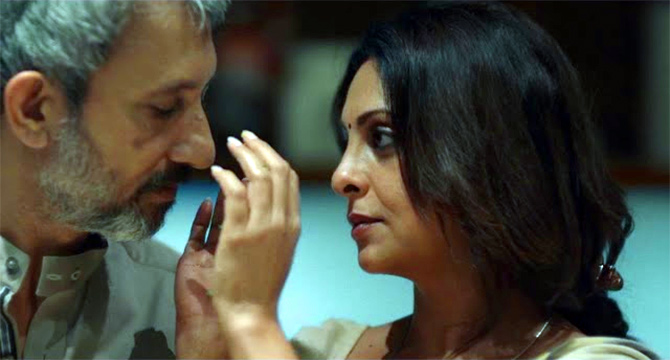

A few minutes into Once Again, we see the middle-aged female protagonist Tara Shetty (Shefali Shah) patting her face carefully with her hands. The deliberateness of her gestures suggest a nightly ritual: she seems to be putting something on, perhaps an invisible layer of cream? Almost immediately after, there is a mirroring, when we see the film's middle-aged male protagonist in the midst of his own cleansing ritual. But Amar Kumar (Neeraj Kabi) is a famous film star called Amar Kumar, and his smoky black eye make-up is being gently dabbed away by someone else. The addition of an invisible layer versus the removal of a visible one; the woman's actions hoping to stave off the inevitability of age, while the man has just shot for an erotic dance sequence with a bevy of much younger women: of such contrasting details is Kanwal Sethi's film made.

Creating characters who share your sensibility is the oldest trick in the fiction writer's book, and writer-director Sethi unapologetically takes this route, making both Tara and Amar agents of the film's unhurried tactility. It makes perfect sense that Tara's cooking, all slow marination and hand-ground masala, should appeal to Amar, the sort of man whose first gift to her is a fragrant, creamy- white gajra.

The premise -- of a connection fostered through the daily delivery of a freshly-cooked meal -- is bound to invite comparisons with The Lunchbox (2013). Stylistically, too, both films are redolent with old-school romance: the anonymous pleasures of Mumbai's streets, and nostalgia for handwritten notes and landline appointments. Unlike the plotted safety of Ritesh Batra's film though, Tara and Amar do meet, and meet several times, letting the charmed flame of their phone banter flicker into unscripted disappointment. “What are you thinking?” Amar asks Tara after one tense moment. “Just that it's all so easy on the phone,” says Tara.

Women have long cooked to express love. The film recognizes both the intimacy of the act, and the unequal gendered labour of it. Tara's response when Amar introduces her as someone who cooks for him is not that different from Sridevi in English Vinglish when her husband declares “My wife, she was born to make laddoos”. But Sethi's glancing, atmospheric style doesn't delve too deep, sometimes leaving us with more suggestion than substance. 

The protagonists' relationships with their respective grown-up children – Rasika Dugal, Bidita Bag and Priyanshu Painyuli – never feel fully fleshed out, coming off like distractions from our main focus. This is particularly so because Shah and Kabi are both fine actors, and Shah's trademark intensity makes her chemistry with Kabi a live, smouldering thing. We could really do with more of her.

An edited version of this review was published in India Today magazine, 15 Sep 2018.

26 July 2017

Revenge, Served Cold


Sridevi's return to the screen as an avenging mother offers us a chance to think about the female vigilante film in Hindi cinema.


The 1970s in Hollywood inaugurated the era of the female vigilante film, in which the rape-revenge narrative was the most powerfully recurring one. Films like Abel Ferrara's Ms 45 (1981), the Sondra Lock-Clint Eastwood film Sudden Impact (1983), the Farrah Fawcett starrer Extremities (1986), among many others, were about a woman protagonist avenging a sexual crime whose perpetrators both society and the law had failed to punish.
A particular subset of this genre centres on an older woman who steps in to mete out vigilante justice on behalf of a younger or defenceless victim. An early Hollywood film in this genre, involving an elder sister and a teenaged younger sister -- Lipstick (1976) -- inspired BR Chopra's Insaaf ka Taraazu (1980), which cast Zeenat Aman and a childlike Padmini Kolhapure as a pair of stereotypically 'modern' sisters who find the world ranged against them -- and on the side of Raj Babbar's skin-crawlingly creepy admirer-rapist. Ravi Udyawar's Mom is the latest film in this sub-genre.

The last few years have seen Bollywood return to the avenging woman protagonist. In the wake of the widespread protests after the rape and murder of Jyoti Singh in December 2012, mainstream film producers seem to have finally decided this was a theme whose resonance they could monetise. Industry writers also clearly find the female vigilante slot useful, especially when tossing up comeback vehicles for heroines whose formidable acting chops aren't enough to keep them in male-dominated Bollywood.

So in August 2014, we got Pradip Sarkar's Mardaani, marking the return of Rani Mukherjee as a cop named Shivani Shivaji Roy who is provoked to violence by the abduction of an orphaned girl she has semi-adopted. In April 2017, we got Ashtar Syed's Maatr, with Raveena Tandon turning bloodthirsty avenger after her daughter is sexually assaulted and dies. And now, in July, we have Mom, in which Sridevi returns to the Hindi screen for the first time since English Vinglish (2012), again with a plot driven by an ungrateful daughter.


In a non-coincidence of the Bollywood kind, Sridevi's Devaki Sabarwal is an ethical schoolteacher pitted against Delhi's 'Pata hai mera baap kaun hai' louts - just like Raveena's Vidya in Maatr. Given the ubiquitousness of sexual violence in India across class, caste and region, it is remarkable how limited the Hindi film imagination of it is (barring notable exceptions like the superb Anaarkali of Aarah, or the more uneven Parched). One fixed node in that imagination is the youthful upper middle class victim; another is Delhi. Within Delhi, too, there are two points upon which Bollywood scriptwriters seem to converge: the farmhouse and the car.


The first imagined location for male predators in Mom is a farmhouse, as it was in Maatr and in another recent film about sexual assault in Delhi: Shoojit Sarkar's Pink (2016). But it is the car with windows rolled up, circling the streets of the capital, that offers a bone-chilling depiction of how sexual violence takes place, in plain sight. In Pink, as well as in Nicholas Kharkongor's Delhi-set drama Mantra (2016), we are allowed into the car; in Mom, we are kept terrifyingly out. Of course the car is not just a site of violence but also a mode of escape and an instrument of revenge: think of Navdeep Singh's NH10, in which the car amplifies Anushka Sharma's sense of siege - but can also conquer it.


Mom
ticks off a host of other predictable Delhi types: men with no redeeming qualities like the spoilt schoolboy rapist, his drug-taking playboy cousin, a security guard who's a Bihari or Eastern UP migrant (the talented Pitobash Tripath, wasted here). Sridevi's husband Anand (Adnan Siddiqui) and daughter Arya (a Kareena Kapoor-lookalike called Sajal Ali) are pretty but merely decorative. The only pleasurable character is a Daryaganj detective, and this is because Nawazuddin Siddiqui sinks his teeth into a slim role to prove he can still surprise us with unheroicness. Udyawar tries with his locations, filming on the Delhi Metro, in a Mehrauli stepwell and a suitably upscale art gallery, but the Sabarwals' home has an unlived servantless poshness that simply doesn't cut it, especially for a family in which the woman works and is a hands-on mother of two.


Motherhood is the film's titular theme. As with Maatr and Mardaani (and Drishyam, in which Tabu is the cop-mother engineering violence), it is maternal protective instinct that is churned into cold-blooded revenge. Here all the strict biology teacher wants is to have her brattish stepdaughter call her 'Mom' rather than Ma'am. Of course we know of Sridevi's personal status as real-life stepmother to Boney Kapoor's children. And Udyawar doesn't spare the mythic references: naming her Devaki after Krishna's loving mother, or citing Draupadi as the original Indian avenger.


Mom does offer glimpses of fun on the femininity front: a criminal who makes her own poison from something ostensibly healthful; men obsessing over other men while a woman drives off under their noses. But the film is weighed down by a trite, obvious sense of righteousness.


Vigilante politics aside, it left me longing for a little of the legendary Sridevi lightness.


Published in Mumbai Mirror, 16 July 2017.

13 December 2016

Food for Thought


My Mirror column:


Gauri Shinde’s Dear Zindagi reminded me of the role of food in her English- Vinglish.


I didn't go into Dear Zindagi expecting to find connections with English-Vinglish. But the more I saw of Alia Bhatt's Kaira, the more I began to feel that Gauri Shinde had channelled one of the primary concerns of her 2012 debut into her 2016 film as well — our relationships with our mothers. In English-Vinglish, Shinde kept the focus on the mother – Sridevi as the shy, smiling housewife Shashi, whose endless supply of delicious food provides both real sustenance and metaphorical weight to the thankless business of keeping the family together. 

The 2012 film was interested in Shashi's fears and insecurities, but most of these came to us filtered through her relationship with her tween daughter. So when the self-centred little girl cringed with embarrassment at her mother's inability to converse with her classmate's obliviously English-speaking mother or went into a long sulk merely because Shashi had enthusiastically conducted a conversation in Hindi with her Malayali Christian teacher, we found ourselves reluctantly identifying with her – only to later feel joyfully empowered when the film finally allowed us to cheer Shashi on, instead of just being her unseeing, drag-her-down detractors.

In Dear Zindagi, the perspective is reversed. It is the daughter – Alia Bhatt's Kaira alias Koko – through whose eyes we are meant to view the world, and although Kaira is a lovely twenty-something rather than a plump tween, her attitude to her mother does indeed seem quite similar to the one we saw in English-Vinglish. Four times out of five, when her middle-aged mother calls her, Kaira can't be bothered to take the call. When she does take it, she is almost always bored or annoyed, and sometimes downright rude.

And food, again, is key to this fraught mother-daughter relationship. “Always khana, khana, kya pakana hai... what do you like to eat? Either woh meri asli ma nahi hai, ya apni yaaddasht kho chuki hai! [It's always food, food, what should I cook, what do you like... either she isn't my real mother, or she's lost her memory],” Kaira cribs loudly to her gang of friends.

There is a definite resonance between the taken-for-granted-ness of Shashi in English-Vinglish and that of Kaira's mother here. But since it is Kaira that Shinde wishes us to feel for, the script goes on to more than justify her irritation with her mother. It turns out that being asked what she would like to eat irritates Kaira not so much because she doesn't have preferences but because she does – but she expects her mother to know them.

Food gets several more references in Shinde's script. When we meet Kaira, she has a stable, sweet, loving boyfriend whom the more exciting Kunal Kapoor mocks (with only barely suppressed jealousy) as “the bawarchi”. It turns out that the man in question (Angad Bedi) is a restauranteur – a metaphor for something real and sustaining and solid? And though the film doesn't stress this, the one time we see him, he has laid out what appears to be a grand meal of several courses for his beloved. Kaira, however, only really drinks a bit of the fancy wine before making an awkward confession that ends up in her having to leave both the man and the meal midway.

Almost immediately after, we see her wolfing down a plate of streetside chow mein from a cart that announces itself as Taj Chinese. Bhatt is very effective here, conveying a sense of being not hungry so much as desperate, as if the food is meant to fill some internal vacuum. The wholesome and proper meal has also been replaced by something unhealthy, attractive precisely for its unwholesomeness, echoing her character's almost-deliberate jilting of the 'marriage material' guy for an impulsive dalliance with a much less predictable commodity.

But even as one thinks that thought, a little beggar boy has appeared on the scene, and the half-eaten plate of greasy noodles has been passed on to him.

Food is not the only consumable that plays a role in Shinde's script. A rather in-your-face product placement for eBay is incorporated into the graph of Alia's character – even as she distances herself from emotional investment, we see her purchasing complicated items of clothing with a click on her phone that combines distractedness with a strange and absolute focus.

In a moment meant to invoke laughter, she responds to her friend Jackie's recognising the jacket she's wearing as being something she had in school by saying with savage irony: “I can also have a long-term relationship!”

Still later, we listen as Shah Rukh Khan – perfectly cast as a charming and unconventional therapist with an air of infectious amusement – conjures up the most marvellous metaphor for trying out relationships in order to decide which person is right for you: choosing a chair. “I have a new kursi,” announces Kaira a couple of sessions later. “Comfortable?” asks SRK.

It is a powerful metaphor, one that successfully rids romantic/sexual relationships of the moral baggage that most young women find themselves lugging around. But I am left with the niggling feeling that comparing people to objects cannot quite be the innocuous thing that Shinde's advertising-shaped brain wishes us to see it as. Maybe that ought to be the subject of Mr Khan's next therapy session.

19 January 2015

Picture This: Poster Girl

My BLink column this month:

Whether they’re swiped or free or paid for, there’s something about film posters that I’ve always loved... they capture something essential about the film, in a medium so different.


Recently, a friend asked me if I had ever stolen books. It was a casual question, but clearly also a challenge, a gauntlet thrown down to test just how low I lay in the good girl stakes. Well, I had to confess I’ve never stolen a book. Then, searching for a chink in the boring middle-class moral carapace that clearly covers me, I came up with the only things I’ve ever stolen: food from a college pantry — and film posters.
Regardless of whether they’re swiped or free or paid for, there’s something about film posters that I’ve always loved. Maybe it’s the way in which they capture something essential about a film, in a medium so different from it. No matter how much one might love a film, it unfolds in time, and at its own pace. Imagine running a film nonstop in your living room as the background to your life! But the poster which picks out one moment from a film, arresting that flow of time that defines the medium — that can stay on my wall forever, and each time I look at it, it is possible to have it evoke the series of moments of which it is a part. So many of my favourite posters are often based on a single film still.
For years I had, above my bed, a poster of Matir Moina (The Clay Bird), the late Tareque Masud’s lyrical portrait of a childhood unravelling in the build-up to the Bangladesh War of Liberation. Two young boys in a classroom in skullcaps. One of them is Anu, the film’s protagonist, sent away to a madrasa by his increasingly inflexible, increasingly orthodox father. The other is the sole friend he makes there, the jeered-at ‘mad boy’, Rokon. In the image on the poster, Anu has his mouth open, as if to speak, while Rokon watches him, as if waiting for the tentativeness to dissipate. I haven’t seen the film since 2002, but the image has kept alive in my mind the nervous hesitation of Anu’s first few days at the madrasa — the melancholy, the cramped sleeping spaces, the strict teachers, the mocking classmates.
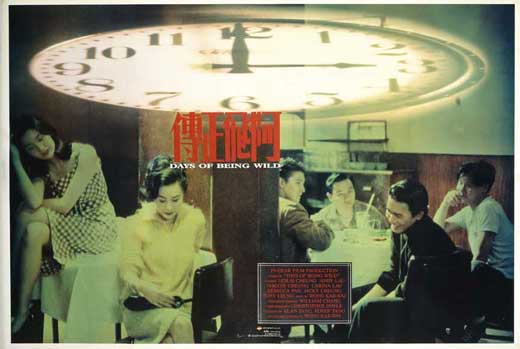
Another poster on my wall, whisked away from outside some film festival, is a lovely one of Wong Kar Wai’s Days of Being Wild. I used to be a fan, and could probably still summon something of my old enthusiasm for Chungking Express, Fallen Angels and Happy Together — despite the unmitigated disaster that was My Blueberry Nights. But I’ve never watched Days of Being Wild. It’s as if the poster has sated my curiosity. The bluish-green tint to it, juxtaposed sharply with the bright red Chinese characters bunched together in the centre; the strangely flattened clock that seems to suggest that time (for being wild?) is running out — the whole thing has a stylised melancholy so typical of Wong Kar Wai’s aesthetic in the ’90s, that it makes me feel like I’ve watched the film.
The mainstream Hindi film poster, no longer painted, has little to separate it from the mainstream Hollywood poster: they share the generic, claustrophobic effect produced when all the ‘designer’ is doing is fitting in the film’s big faces. There are, of course, occasional posters which do more with photographs, if they use them at all. I remember admiring the ones for Dev D, which used a psychedelic palette of bottle green, dark pink and blood red, and tweaked images of the actors into mind-altering forms. There was Mahie Gill reproduced several times to create a butterfly; Abhay Deol’s face morphed out of recognition, with aviators and giant lips; a green Deol viewed through a pink vodka bottle. There was another (my favourite) where Gill and Deol’s profiles were superimposed so that they seemed to share a single eye. It sounds monstrous, but in fact it succeeded in conjuring up a strange sense of stillness, of the merging of souls.
Dibakar Banerjee’s Love Sex Aur Dhokha was another film with strongly conceptual posters. They used the acronym LSD strategically, also producing psychedelic images, each with a scarlet heart placed at the centre. In one, the ‘heart’ was made up of two pairs of entwined feet, suggesting sex. In another, it was a pincushion, suggesting pain. (Caused by the dhokha, naturally.)
But what I think makes for the most marvellous posters, really, is text used either alone, or in conjunction with images. Dev D’s posters incorporated some phrases from the film’s songs: ‘Emotional Atyachar’ appeared bookended by the bandwallas who played it, ‘Ek Hulchul’ emerged in a spiral of smoke from Chanda’s (Kalki Koechlin’s) smouldering cigarette. But very little use is made of typography even in these designs. The only recent example of a recent poster with attention to type that I can remember offhand is English Vinglish, which did the obvious well, by placing a Devanagari ‘ga’ and ‘sha’ in place of ‘g’ and ‘sh’, effectively highlighting both the Indianness of the title and the film’s linguistic theme.
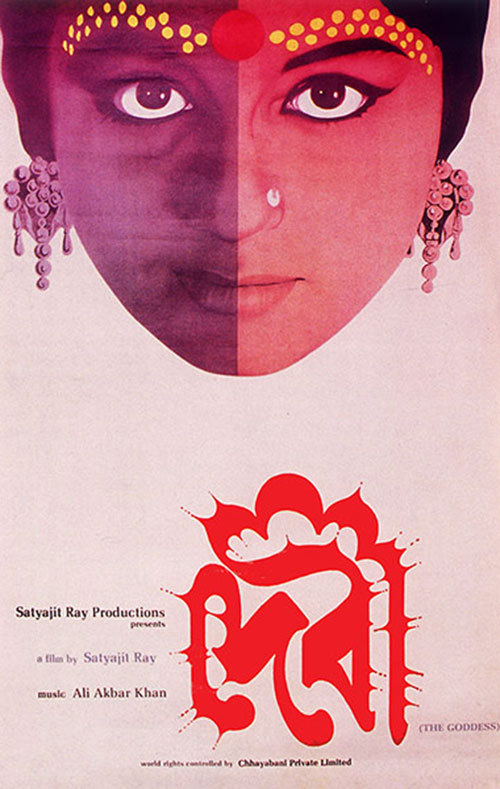
The master of the typographic poster was, of course, Satyajit Ray. Each was more striking than the last. The all-black Joi Baba Felunath poster had no images at all; just the film’s title in plump geometric white, the Bangla letter ‘la’ holding a pistol, from which a shower of sparks emerges to create the only triangle of colour on the page. Shatranj ke Khiladi, using English, created a typeface whose heavy, leaden bottoms evoked the form of the chess piece. The most unforgettable is probably Ray’s poster for Devi (The Goddess), where the eerie energy of Sharmila Tagore’s face, half in shadow and half in blazing light, is echoed by a typescript that seems aflame. The word ‘devi’, in Bangla, forms the crimson outline of a temple. Someday soon, perhaps, I’ll see a new poster as good as that in a cinema — something really worth stealing.

1 January 2015

2014: The Year of Sheroes

My Mumbai Mirror column, 28 Dec 2014. 

Hindi cinema this year gave its female actors a chance to spread out. Some punched, while others pulled no punches. What matters is that as the audience, we agreed to clap for both.


Madhuri Dixit in Dedh Ishqiya (2014)
The Hindi film industry has been hero-dominated for so many decades now that it's hard to believe that its earliest decades were all about the heroines: Sulochana, Fearless Nadia, Devika Rani. But 2014 might go down in history as the year that Bombay cinema came back round to the idea that there could be hits without heroes. 

This was made possible, in some measure, by the return of Hindi cinema's last generation of big-ticket heroines. It's fabulous that at least some of these utterly deserving divas are landing age-appropriate roles in films designed to showcase their particular charms. 2012 already saw Sridevi bring a lump to every throat in the room as the guileless housewife on a journey of self-discovery in English Vinglish. 2014 marked the glorious comeback of Madhuri Dixit, who played the poetically-minded Begum Para with the perfect air of seductive mystery in January's Dedh Ishqiya, and later in the year, played off her once arch-competitor Juhi Chawla (with Chawla playing against type) in the somewhat anti-climactic Gulab Gang.  


This year also saw a more recent returnee - Rani Mukherjee came back from a longish sabbatical with the immensely watchable, cheer-eliciting Mardaani. Priyanka Chopra had her own no-heroes movie: Mary Kom. The two films couldn't be more dissimilar in theme - a punchy cop drama set in Mumbai and Delhi, and a biopic of the stocky Manipuri woman who is India's most famous boxer - but in very different ways, these were films in which female audiences derived much pleasure from watching the woman on screen emerge victorious from physical battles. Mary Kom's initial attraction to boxing is linked to beating up badly behaved boys; Shivani Roy loves shocking male rowdies with some rowdyisms of her own, and plays gleefully to the gallery as she does so. 

Rani Mukherjee in Mardaani, 2014.
Interestingly, though, both films felt the need to play up their protagonists' nurturing side - a part-explanatory, part-compensatory move to balance out all that unfeminine punching we see them do. Mukherjee's character in Mardaani, a no-bullshit female cop with the ringing name of Shivani Shivaji Roy, is given no children of her own. But she and her doctor husband play adoptive parents to a young niece, and she is moved to eradicate a ring of child traffickers because they've abducted an orphaned girl with whom she has a quasi-maternal relationship. 

Motherhood was also played up in the movie version of MC Mary Kom's life, with Mary shown risking her coach's disfavour when she decides to get married and then have children, all at the peak of her hard-won boxing career. Produced by Sanjay Leela Bhansali, Omung Kumar's film devotes an inordinate amount of screen-time to showing Mary being a hands-on mom: singing her twins to sleep, nursing them to health, and so on - one can't avoid the sneaking feeling that it's all in aid of preventing audiences judging her when she does decide to return to her career, while the kids still very young. (It was lovely, though, to see a man on the Hindi film screen play a hands-on dad as competently and believably as Darshan Kumar did as Onler Kom.) 

The parade of rough-talking women continued with Kangana Ranaut's strange and over-the-top outing in and as Revolver Rani (RR). A Tarantino-inspired take on a female Chambal dacoit some two decades after Phoolan Devi and Bandit Queen, RR could have been great but was tragically uneven in tone. Later in the year, we got Richa Chadda in the depressingly awful Tamanchey: another trigger-happy female gangster, like Ranaut in RR, ready to junk it all for marriage and motherhood. 

But Ranaut's film of the year -- and everyone's favourite 'woman-centric' movie -- was Queen. Vikas Bahl's surprise hit had Ranaut deliver a terrific stream-of-consciousness performance as sheltered Delhi girl Rani who, jilted at the mandap, makes the wonderful transition from panic-stricken to determined to carefree. 


Kangana Ranaut (right) in Queen, 2014

The foreign trip as transformatory ritual isn't new (think Zindagi Na Milegi Dobara), and Rani is perhaps a younger version of Sridevi in English Vinglish—but the film wins points for a host of other things, from giggly female friendship to joyful drunken spree to first exploratory kiss with a stranger, and most importantly, Rani's non-vengeful but firm rejection of her baffled groom. Queen opened up the universe a little more. 

Two other films delivered freedom to their female protagonists in surprising guises: Alia Bhatt as the poor little rich girl who finds liberation via abduction in Highway, and Parineeti Chopra as the oddball science geek who runs away from home -- to China! -- in the under-appreciated and charming Hasee Toh Phasee


Vidya Balan in Bobby Jasoos, 2014
My pick for independent woman character of the year, though, is probably Vidya Balan's Hyderabadi detective in the comic mystery caper Bobby Jasoos. Perhaps because there's nothing grand or heroic about her loose-plait-and-dupatta persona. She loves her family, but will risk their ire to fulfill her dream of her own detective agency. Since she's not in the realm of myth, she neither beats up any men nor has to prove her femininity. But when personable young men open car doors for her, they encounter a brisk dismissal: "Mereko aata hai gaadi ka darwaza kholna." For me, that's more than enough.

30 March 2014

Picture This: Living life Queen-size

My BLink column from yesterday:

I can’t quite pinpoint when Queen won me over. Was it the superb dadi, whose enthusiasm for her granddaughter’s wedding is focused on rehearsing her own dance steps? Was it the flashback when Vijay woos Rani, literally encircling her on his bike, overwhelming her with balloons and winsome PJs: “Manchow, Man jao?” Or was it when the now-jilted Rani, having courageously gone on her ‘honeymoon’ by herself, accosts the impossibly long-legged Lisa Haydon with that memorable expression I’ve never heard in a film before: “Aapka bachcha hai? Phir toh bahut hi figure maintain kiya hai aapne!
But almost everything else about Queen feels like something you’ve seen before. So what’s the big deal?
Sure, Vikas Bahl’s foreign vacation is thankfully not the tourist brochure of Zindagi Na Milegi Dobara, and we’ve finally moved away from the all-boys-trip narrative inaugurated by Dil Chahta Hai. But the Indian woman transformed by going abroad is not new: she appeared in English Vinglish (2012). In fact, Kangana Ranaut’s sheltered Rani often feels like a younger version of Sridevi’s unworldly Shashi: the halting English, the under-confidence that comes from never having done anything alone, the lack of exposure that makes everything in the Western city a potential culture shock, and yet the innate warmth that enables both women to make friends with a motley international crew.
We’ve also seen another outwardly demure young woman travel halfway across the world with a tiny bhagwan ki murti like Rani does: Diana Penty in Cocktail. And even the friendship that develops between Ranaut and Lisa Haydon’s Vijaylakshmi has much in common with the one between Penty’s Meera and Deepika Padukone’s Veronica. In Queen too, the ‘good girl’ and the ‘wild child’ forge an unlikely connection, though here the equation is tilted much more towards the liberation of Rani. Unlike Veronica, the part-Indian Vijaylakshmi expresses no desire for stability or roots. The difference has received applause from expected quarters. But if it’s Rani who seems the one transformed, it’s because this film is her journey. She’s the one to try new things: drinking, dancing, but also finding her way around a new city — and in one memorable scene, kissing a man she will probably never see again.
The drunken woman in Hindi cinema up until the ’70s had to be the vamp, like Bindu in the brilliant disco-lights original of Queen’s now iconic remix. ‘Maine hothon se lagaayi toh... hungama ho gaya,’ complains Bindu before she’s dragged off by Sanjeev Kumar. Ranaut doesn’t inaugurate the era of the tipsy heroine by any means — Deepika Padukone first caught my eye by being believably drunk in Love Aaj Kal and later, Cocktail, and Mallika Sherawat’s drunken sprees in Pyaar Ke Side Effects and Ugly Aur Pagli are legend. But Queen goes further. The “yaar” who gets our girl drunk, helping her up on the bar counter with an affectionate push on the behind, is now the female friend. And where the original lyrics had one hichki causing a hungama, Queen runs with that thought and turns it into a magnificent tribute to indelicacy as a gendered form of freedom. As Rani’s drunken truth goes: “In India, girls aren’t allowed to burp. Girls aren’t allowed to do anything.”
Even more importantly, Rani’s opening up to the universe involves not just herself, but other people. Unlike the boys of DCH or ZNMD, for whom travel seems merely a way to bond with old friends, the girls — Rani, like Shashi in English Vinglish — actually make new ones. Director Vikas Bahl deals a gently ironic hand here: Rani’s fiance Vijay (the stellar Rajkummar Rao, channelling his Love Sex aur Dhokha avatar) calls off the shaadi saying he’s changed and she hasn’t. It turns out, for all his having lived in London and ‘seen the world’, it’s Vijay who clings to fixed notions of what ‘foreigners’ are like — while Rani, with what starts as naiveté but turns into conviction, suspends judgement enough to forge connections.
The other overly familiar aspect of Queen is its Dilli punjabiyat. It’s now an industry conceit that everyone knows Lajpat Nagar, Karol Bagh or Rajouri Garden, just as we ‘knew’ Bandra or Virar. The cinematic journey from Oye Lucky Lucky Oye (2008) to Band Baaja Baaraat (2010) to Queen might even trace a shift in self-depiction — from wanting to erase one’s West Delhi roots to claiming Rajouri as home even in a foreign country. But is Bollywood just milking Dilli punjabiyat for laughs? If Vicky Donor (2012) and Do Dooni Chaar (2010) displayed some insider affection for Lajpat Nagar, Cocktail’s deprecatory references to “wohi Lajpat Nagar mentality” were code for what Boman Irani’s London-dweller ought to have left behind, Rani’s misidentification of sex toys for fashion accessories — “Yeh toh hamare Lajpat Nagar mein mil jayega (We can get this in our Lajpat Nagar)” — is code opaque to her bemused firang companions, but an inside joke for Indian viewers. It’s a wink-wink moment at the expense of the middle-class Punjabi, who is urban but not quite urbane. But Ranaut’s brilliant portrayal of good-natured humour turns the scene from superior and knowing into something goofy and laugh-at-oneself.
Perhaps that, eventually, is the secret of the film’s appeal: like its protagonist, it’s neither sharp nor perfectly sorted, but it’s not pretending to be either. Rani does whatever she does, not with the thin-lipped determination that she must, but with a bumbling enjoyment in the discovery that she can. What makes Queen endearing is precisely this lightness, this refusal to underline. When she returns from her solo ‘honeymoon’, Rani is still unselfconsciously carrying a backpack marked ‘Vijay’. But the weight of it has rolled unceremoniously off her back — leaving in its wake a young woman’s first, quiet victory.
x

6 October 2012

Film Review: English Vinglish

My review of English-Vinglish:


My wife, she was born to make laddoos!” says the grinning husband to the white boy who’s being inducted into the family. The white boy, whose name is Kevin, has just taken his first-ever bite of a moist, delicious little globe of motichur goodness produced by the aforementioned wife, Shashi, and he looks suitably overwhelmed with delight. Then the camera moves across to Shashi, and that single fluid moment, as we watch her face silently transform from happy to tremulous to brave, encapsulates everything that the film wants to show us.

What Gauri Shinde’s debut film insists on showing us is so deliberately unspectacular, so quiet and dull and taken-for-granted, that when we see it in real life (and we see it all the time), we merely avert our eyes. It is the predicament of the person whose personhood is summarily dismissed by a refusal to value the work they do—casually, perhaps without malice—but resulting in no less cruelty than if it were intentional.

Because English-Vinglish, despite its name, is not just about English. English here is a placeholder. Being fluent in English, in the sadly skewed universe of contemporary India, automatically codes you as modern, fashionable, worthy of respect. Not being fluent in it relegates you to the back room: a second-class citizen unworthy of display.

Dibakar Banerjee’s films – Oye Lucky most of all, but also Pitobash Tripathy’s character in Shanghai­ ­– have given us what are perhaps Hindi cinema’s most nuanced commentaries on English as a marker of social class. What Shinde does in English-Vinglish is very different, not just because her style involves broader strokes and a happier, more feel-good mood— but because the domain she chooses to set her film in is the family.

Shashi is, first and foremost, a wife and mother, and Shinde’s masterstroke is to create a character whose fears and conflicts and insecurities are almost never a consequence of direct assaults made by the wider social world. Her experience of the world comes to her filtered through her husband and children.

So it is Shashi’s own daughter who is embarrassed and angry at Shashi’s inability to understand her classmate’s English-speaking mother—the classmate’s mother seems, at worst, oblivious. It is the same daughter who sulks for hours because Shashi speaks to her teacher in Hindi while the Malayali Christian teacher himself seems quite charmed by this woman who unselfconsciously talks to him about banana chips and wants to know if her daughter is not just a good student but also a popular one. The loyal clients she’s built up for her high-quality home-made laddoos are glad to have a friendly chat when she makes her delivery rounds in person. It is her husband’s lackadaisical dismissal of her excitement about the day’s sales that silences her.

So it makes complete sense when Shashi, at the film’s end, describes her view of family as a little world within the wider world, a space in which you ought to be held safe from the judgements and cruelties of the wider world. It is as close to a statement of worldview as a Hindi film heroine has ever been allowed to come, and whether you think of it as beautifully hopeful, or sadly, simplistically delusional, it is unlikely that you will come away unmoved.

Because in the deliberate simplicity of its canvas—and its protagonist—lies the strength of Gauri Shinde’s film. By refusing to situate the vexed question of English in a larger socio-political context, by focusing its attention on the home, it does simplify the issue—but it also holds up a mirror to what must be the most mundane, most neglected aspects of our social lives: how we treat our mothers.

And yet, the reason why English-Vinglish is so successful is because it is careful not to underline its chosen subject too heavily. Shashi is not above the occasional well-aimed barb—“Oh, main bhool gayi, important baatein toh sirf English mein hi hoti hain na?”—but her deepest wounds are ones she hugs tightly to herself. Our sense of Shashi’s intense privacy, her shyness, helps the film steer clear of melodrama, and lends itself rather beautifully to the few moments when she does open up. It seems entirely fitting that she speaks her heart out only to a man who does not understand her words.

That besotted Frenchman (Mehdi Nebbou) is one of the people in Shashi’s English class, a cheerfully updated version of Mind Your Language that provides the film with most of its lighter moments, via a slightly caricatured but affectionately drawn collection of immigrants—a Pakistani cab driver, a Tamilian techie, a Spanish-speaking nanny, a young Chinese girl, a largely silent African man—all struggling to improve their English.

The New York segment is necessarily shot with the eyes of the dazzled outsider—all skyscrapers and downtown views— but Shinde also manages to fill it with nicely-observed moments that anyone who has ever negotiated the terrifying newness of any (Western) city will immediately identify with: the minor but life-altering trials—and triumphs—of making Metrocards work, finding your way to an interview, placing an order in a café without holding up the queue.

But eventually, it is Sridevi, with her trademark winsome girlishness of old now beautifully balanced by a new quiet dignity, who makes us experience each of these triumphs as her own. Go, cheer her on.

Published in Firstpost, here.