Showing posts with label Hinglish. Show all posts

12 June 2015

Book Review: The Long Voyage of the Ibis

My (long) review of Amitav Ghosh's Flood of Fire. Published in the Wire.

A recent article in Slate on the surprising survival of “the very long novel” suggested that it works as counterprogramming. In these times of avowed attention deficit, reading a VLN feels ever more like resistance. The novels that make up Amitav Ghosh’s Ibis Trilogy, at 550-600 pages each, don’t quite qualify as VLNs. But a trilogy goes one further, by returning us to the committed seriality that was once de rigueur for literary consumption.
At the Delhi launch of Flood of Fire, one gentleman in the audience managed to ask the question on many people’s minds. “If I want to read this book, do I have to first buy and read the other two books?” Ghosh smiled and assured him that he didn’t. I wasn’t quite convinced: as one of those devoted Ghosh readers who read Sea of Poppies with great excitement and River of Smoke with a patience born of waiting, I’m not the ideal candidate to test this claim. But having now read Flood of Fire, I think it actually does manage to be a stand-alone narrative. This is a remarkable feat, given that it is also within these 600-odd pages that all surviving loose threads from the previous two books must be tied up.
Several characters from the previous books reappear, many having transformed themselves, chameleon-like, as they travel through time and space. Neel, an English-educated Bengali who was once the Raja of Raskhali, is now a translator in Canton; the Bengali-speaking French orphan Puggly has emerged fully formed as the botanical collector Paulette; the ‘half-caste’ son of a Parsi seth and a Chinese woman has gone from being the convict Ah Fatt to the rather less threatening Freddy Lee. Among those who undergo truly radical change in this book are Mrs. Burnham, who acquires both a past and an interiority one might never have suspected, and Seth Bahram Modi’s wife, who emerges from a sequestered, literally purdahed existence at the top of the Bombay mansion she was born in, to take her place in a new world. (Ghosh helps her along, slyly dropping the “Shirinbai” of the previous books for the more contemporary “Shirin”.)
There are new characters, too, none more important than Kesri Singh, the elder brother of Deeti,  who was the centre of the first book, and whose invisible presence continues to haunt the third. I will refrain from naming the other new characters, but what is remarkable to me is the degree to which Ghosh is invested, in this book, in chance reunions. The coincidental coming together of long-lost characters–lovers, siblings, parents, children–after a long and complex plot involving their separation, is very much among this book’s narrative pleasures, both Shakespearian and filmi.
A petarrah of words
One of the other pleasures of the Ibis Trilogy has been the joyful proliferation of multiple Englishes, allowing the hybrid speech of a polyglot colonial world to roll off our tongues. Sea of Poppies made enjoyable use of this, having characters switch from one sort of language to another—I think particularly of ship’s mate Zachary, moving from the slangy American “What the hell you pesticatin me for at this time o’night?” to the sahebi civility of “If I may be so bold”. River of Smoke contained not just negotiations, but even flirtation and lovemaking in the pidgin-English of Canton’s boat-people. Flood of Fire is no different. Some characters make do with a couple of signature interjections, like the young banjee-boy Dicky’s use of “ya” and “bugger”, and Freddy Lee’s “lah” and “ne”. But the book bubbles over with the vocabulary of the Raj, in which English met Hindustani to create a unique lingo used not just between English masters and native servants, but between white colonialists themselves: the Burnhams, thus, are looking for a mystery (mistri) for the purpose of bunnowing (banaoing) their boat, and are willing to offer a good tuncaw (tankhwah).
Certain aspects of Raj life threw up a greater number of hybrid words, such as the British Indian army, whose workings form the most engaging chunk of Flood of Fire. Within the first two pages of the book, we’ve already seen the tamasha of a paltan going by, with ox-drawn bylees and a host of army camp-followers: dandiawallas, syces, berry-wallahs, bhisties, naach-girls, mess-consummers (a combination of the English ‘mess’ and the Hindustani ‘khansaama’) and bangy-burdars (“men who are each obliged to carry forty pound weight, in small wooden or tin boxes, called petarrahs,” says my Hobson-Jobson). On page 5, we encounter ‘badmashes’, ‘coolie’ and ‘subedar’ as part of a (fictitious) report in the Calcutta Gazette. By page 22, Ghosh brings this linguistic hybridity explicitly into his narrative, when Neel is asked for help by an Englishman in Canton who is puzzling over the many Indian words in an article on opium production in the Chinese Repository: maund, tola, seer, chittack (all weights and measures), arkati (a kind of agent), ryot (raiyat, peasant) and carcanna (karkhana, meaning workshop or factory).
In Ghosh’s compelling vision, words emerge as aides to love—and to war. We giggle at Mrs. Burnham’s Hindustani-inflected sexual banter, describing her lover’s “bahawder sepoy” as “a lathee always ready to be lagaoed” and informing him that “In India, chartering is what you do with… your jib”. We also wonder at how conflict can result from deliberate misconstruals, even at the level of states: as when Compton accuses inaccurate translators of “twisting the Chinese language in order to make trouble” with the British. Still, when Neel writes of being “besotted with words”, one imagines Ghosh’s own voice, reaching out to readers who might share that particular intoxication.
Not quite a peace pipe
Although the trilogy is named for the Ibis, the schooner on which its disparate cast of characters first come together, the ship plays less of a role in the second and third books. What in fact does unite the books is opium. Opening in the poppy fields of Ghazipur, by the Ganga, the first book offered an arresting account of opium production: how the sap from ripe poppy bulbs was harvested to be made into opium in the East India Company’s factory. The second book described its transportation, and how large a role opium played in financing British rule in India. In Flood of Fire, more layers emerge: we observe an opium auction in Calcutta, discover a trade in opium futures, and learn that Indian sepoys often took a form of opium known as maajun to calm their nerves before battle.
Opium is the intricate web that links these characters: Deeti and Kesri belong to a district where most fields have been opium-growing since they were children; there is Deeti’s addicted first husband, and her discovery of how the opium she harvests for a living can be put to more surreptitious uses. There are Bahram Mody and Benjamin Burnham, whose trade is built on opium exports to China, and Ah Fatt, who smokes it. Opium, finally, is the link that brings Britain, India and China together—or drives them apart—in the First Opium War.
That war forms the climax of Flood of Fire, and much of the book’s second half is taken up with the slow-burn build-up, as merchants, soldiers and ordinary folk prepare themselves for upheaval. One of the reasons why River of Smoke didn’t entirely work was that it felt like a middle, and often a slow, meandering one. Also, despite its vivid descriptions of Fanqui-town and its strange rules (no foreign women, for instance, were allowed in), or the flowering plants that went from Canton to the West, the primary characters – Paulette and her botanist mentor, Bahram and the Co-Hong merchants, and the overly chatty Robin Chinnery – just weren’t that interesting. Or they needed a grander Grand Finale.
Flood of Fire moves much more purposefully. As I said, it is full of uncanny reunions, and the outbreak of war provides a crescendo of sorts (although Ghosh is not the writer to pretend that everything happened in one fell swoop; he plays the war out, with at least some of the tortuous waiting that it actually involves). But the new characters, too, take you along with them. The strongest of these is Kesri Singh, through whose eyes Ghosh offers a fine-grained sense of the life of an East India Company sepoy.
Castes of mind
I cannot begin to describe here the book’s impeccable research (as a snarky friend once said, Amitav Ghosh writes novels for graduate students). But unlike in The Hungry Tide, or River of Smoke, the historical detail never weighs this book down. Let me offer one example: that of caste in the army.
In a superb monologue early on, an army recruiter explains to Kesri’s father that the English, contrary to his anxieties, care “more about the dharma of caste than any of our nawabs and rajas ever did”. Earlier armies, he points out, were routes for caste mobility, but the Angrez are very clear about hiring only Brahmins and Rajputs. “Under the sahib’s guidance every caste will once again become an iron cage,” the recruiter says, and one can only applaud how Ghosh distils years of academic scholarship by the likes of Bernard Cohn into the fictive brilliance of this passage. Later,  a group of Ghazipur-born sepoys decide to act as a caste-panchayat, which is also an informal court martial. And caste is the unspoken reason for sepoys balking at carrying loads.
Why is this important? To anyone who reads the Trilogy—or in fact anyone who’s read In An Antique Land, or The Shadow Lines—it will be clear that for Ghosh, the draw of historical fiction is to create a version of the past in which old shackles are broken, and unexpected connections made. This can lead him to underplay or ignore the ways in which his characters might realistically have behaved with each other. One feels this less in Flood of Fire. Here, when a memsahib recognizes a sepoy, or a Rajput lets an untouchable feed him when sick, the characters are strong enough to make us believe in the uniqueness of their actions. Perhaps because we have seen how stratified their world is, we strive – with Ghosh – for them to forge another.

13 October 2014

Guns, Roses and Gangsters Gone Wrong

Tamanchey, like Revolver Rani from earlier this year, makes a half-baked attempt at an atypical gangster heroine. But in both, the desi dominatrix on overdrive exposes the limits of male fantasy.

Richa Chadda in Tamanchey, 2014.


Kangana Ranaut in Revolver Rani, 2014.

Tamanchey, one of several smallish films that released at the box office this week, features Richa Chaddha and Nikhil Dwivedi as two hoods who meet while on the run from the cops and end up getting involved. In one of the interviews before the film's release, the film's makers insisted that the film should not be seen as another Bunty Aur Babli, because these two aren't cons - they're criminals. 

They certainly are. Chadda's character, who goes by the slightly masculine name of Babu, is the girlfriend and associate of a lethal Jat known as Rana Tau. They run a 'business' of supplying drugs across the NCR. Dwivedi's character, Munna Mishra, works as a professional deliverer of threats for a big man, until he inveigles his way into Tau's gang and moves with alacrity into drug dealing and bank robbery. 

Tamanchey tries hard to bring us atypical protagonists -- a foul-mouthed heroine with plenty of experience, in every sense of the term, and a Bihari hero who shunts sulkily between his miffed male pride and his unwilling status as sexual ingenue who can't help but admire this "parkati". There's an attempt at giving the characters nuance based on their language -- Munna's exaggerated Purabiya lilt and Babu's largely superfluous use of English words to impress the (non-English-speaking) Munna - but that's as deep as Navneet Behal's characterising skills go. For the rest, it seems, surface outfitting will have to do. So Munna gets loud printed shirts and red trousers to announce his poor boy flashiness, while Babu gets various cleavage and thigh-revealing outfits to tell us how brazen she is. But their insane inappropriateness in a villain's den where everyone else is most soberly clad helps catapult the film into gangster's moll territory of a previous Hindi movie era. (That era is also evoked by the RD Burman song from Mahaan, 'Pyar mein dil pe maar le goli', which has been revived in a Bappi Lahiri version as the title song, and perhaps unwittingly -- by the cops who arrive at the very end of the nth bank robbery and proceed to be out-shot and outwitted by our anti-heroic couple). Though one can very dimly glimpse where they wanted to go with the deliberate 'crude cool', the direction is too erratic to get this film even a quarter of the way there. On one hand, it is far from the superbly realized comic caper of Bunty Aur Babli, on another, it fails to get within spitting distance of the Tarantinoesque. 


What it did remind me of is Revolver Rani. Directed by Sai Kabir and produced by Kabir's guru Tigmanshu Dhulia, that film's USP was another foul-mouthed, violent, gun-toting young woman. "I love phasion, phun, aur gun", she announces in what is supposed to be Bhind-Morena's special brand of Hinglish. Kangana Ranaut's portrayal of a new-age dacoit-cum-politician might be imagined as being a tongue-in-cheek updating of the one real-life female dacoit-cum-politican we've had from the Chambal badlands: the ill-fated Phoolan Devi. If only it weren't so absolutely clear that the gun-slinging Alka Singh of the insatiable sexual appetite and spiky bustiers -- just like Richa Chadda's trigger-happy and libidinous Babu -- is pure male fantasy. 

Both Revolver Rani and Tamanchey have half-baked plots and badly written scripts, dispensing with characters' backgrounds in two-minute sob-stories while trying to distract us with dialogue-baazi. Both lay claim to a sense of place, but are too inept to do anything but flag their failures. Ranaut and Chadda, both having proved their considerable talent in other films, fail miserably to keep these rudderless ships afloat. 


All they're riding on is the 'innovation' of man-eating heroines who pick men as objects of lust, not love. Alka Singh, in one of the film's more successful scenes, picks Vir Das as winner of an underwear modelling contest. In the tradition of big men through the ages, she then gives him the privilege of sleeping with her and then pretty much keeps him captive as toy boy, making grand plans to make a movie "for him" while occasionally feeding him weird local delicacies that will keep him virile enough to service her. Babu in Tamanchey isn't quite as demanding, but she is certainly the only one allowed to make the moves. She slaps Munna when he tries his luck, though later thaws enough to succumb to a roll in the hay (er, in the tomatoes) before abandoning her sleeping conquest to return to her gang. The girl, true to this tough-as-nails characterisation, is initially completely unaffected by their drunken sexcapade; it is the boy who does the post-coital coyness of "Hum tumse I love you karte hain" and follows her all the way to gangland. 

But the gender role reversals that are meant to power both films fizzle out astoundingly fast. Alka becomes obsessed with raising a baby, and Babu, too, reveals that her thick gangster skin hides a girl who's been dying to play housewife. Clearly, that's where even the most libidinous Indian male fantasy ends.


A version of this was published as my Mumbai Mirror column last Sunday.

28 July 2011

Triumph of Hinglish: How shuddh Hindi lost its groove

The second part of an essay published on Firstpost.

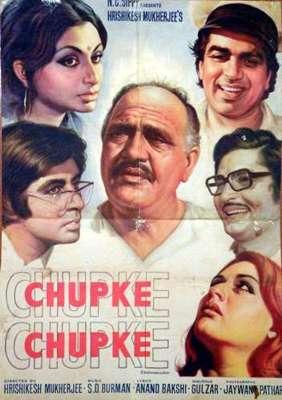
In Hrishikesh Mukherjee’s comedy classic Chupke Chupke (1975) language purist Raghavendra Sharma (Om Prakash) is given a taste of his own medicine in the form of deliberately abstruse shuddh Hindi thrown at him by his Hindi-premi Ilahabadi chauffeur Pyare Mohan (Dharmendra). Of course, in reality, no Hindi speaker ever talks of travelling by lauhpathgamini agnirath (the fiery chariot that travels on an iron path), smoking a dhoomra-shalaaka (smoke-emitting stick), or wearing a kanth-langot (neck-loincloth).

These super-Sanskritic words — said to have been coined by Hindi’s guardians to combat the onslaught of English words like ‘train’, ‘cigarette’ and ‘tie’ — have long been mocked in popular culture. As the late comedian Johnny Walker once famously said of Doordarshan, “They should not announce ‘Ab Hindi mein samachar suniye‘ (Now listen to the news in Hindi); they should say, ‘Ab samachar mein Hindi suniye‘ (Now listen to Hindi in the news)”

Yet in 1975, when the film’s dialogue writer (the wonderful Gulzar) made fun of shuddh Hindi for its distance from the speech of the common man, it was (like Dharmendra’s treatment of his jijaji) a gentle, almost affectionate form of trip-taking. For in the world of Chupke Chupke – the educated North Indian middle class world – speaking shuddh Hindi still had a certain cachet: a sense of national-cultural authority backed by Doordarshan, All India radio and school textbooks.

But by 2011, in the world of Bheja Fry 2, speaking Hindi without interruption marks Bharat Bhushan not as erudite or well-educated, but merely as ridiculous.

How has this come about?


Tyranny of the Hindi purists

It is clear that in post-globalisation India, English is an essential component of upward mobility. It is the only linguistic status-marker that counts. In this deeply screwed-up world, the adoption of English words into spoken Hindi is thus an indisputable way to display status – to establish yourself as not being a Hindi-medium-type.

But Hindi, too, has done its bit to aid the rise of Hinglish.

One of the crucial problems faced by India immediately after Independence was of creating a common language of communication and official discourse. If there was to be a national language, it could not be English, which was perceived as colonial and elitist.

In the shadow of Partition, the Hindiwallas in the Constituent Assembly managed to press their claim for the first official language of the Union to be Hindi, written exclusively in the Devnagari script (rejecting the original recommendation of “Hindustani written… either in Devnagari or the Persian script”). This Hindi was characterised by a Sanskritic uniformity that deliberately rejected the hybridity of the people’s vernacular.

“Pure Sanskrit words are used in the same form everywhere. Therefore only that language can be acceptable all over India which is rich in pure Sanskrit words,” declared the President of the Hindi Sahitya Sammelan, KC Chattopadhyaya, in 1949.

As Alok Rai decribes it, the years “between the unconsummated triumph of 1950 and the anticipated climax of 1960, when the enforced cohabitation with English… would come to an end” were spent by Hindiwallas like Dr. Raghuvira in grooming Hindi for its exalted “national” role. In 1960, the Commission for Scientific and Technical Terminology was set up, to provide an expanded lexicon that would match that of English.

While the non-Hindi regions’ staunch opposition to Hindi’s hegemonic claims meant that English could not possibly be dropped (it was retained post-1965 as “associate additional official language”), a lot of this new Hindi lexicon gained acceptability via the school system, bureaucratic use and state television: for example, words like ‘prayojak’ for ‘sponsor’.

But this strategy left stranded the poor who did not have a school education and whose spoken language never encompassed the high Sanskritic Hindi of the state. And it had no hope of gaining traction with the educated middle class in the rest of the country, who gained access and familiarity to Hindi mainly through the movies. On the other hand, there was the metropolitan elite – and increasingly, a wider middle class – who had easier access to that other status marker: English.

Official Hindi’s insistence on purity – a positive suppression of the Hindustani word in favour of the Sanskritic equivalent (I remember a succession of school Hindi teachers in ’80s Calcutta and ’90s Delhi insisting on samay instead of waqt, kathin instead of mushkil, deergh instead of lamba, with no explanation) – left the Hindi-speaking public two choices: they could either learn the Sanskritic words, or adopt words from English.

But as Rupert Snell has argued, the more Hindiwallahs coined ever-more-difficult words in higher registers, disdaining Hindustani, the more effectively they drove the Hindi-speaking public towards pre-existing English words, and therefore towards Hinglish.

And it is a vicious cycle: the more the literary custodians of Hindi retreat into an ever-more-shuddh Sanskritic bastion, the more the language of popular culture appears to them too informal, too uncouth.


The age of Delhi Belly

So Hindi today is a beleaguered bastion. The democratisation of the Hindi cultural sphere has been greeted by its upper-caste, upper-class custodians with deep ambivalence.

Is the audience for the mostly-English version supposed to be more comfortable with colourful language – more English abuses, but ironically also more Hindi swearwords – because they’re imagined as the younger and hipper ‘new India’?

On the one hand, they have to acknowledge that the spread and increasing visibility of Hindi owes much to the mass media. As lyricist Prasoon Joshi put it at the Jaipur Literature Festival 2011, “Film aur vigyapan ki duniya ne Hindi ko nayi izzat bakshi” (The world of film and advertising has given Hindi a new respect). Another speaker on the JLF panel ‘Aisi Hindi Kaisi Hindi’ said, “If the language is now on the tongues of those who have never before pronounced a Hindi word, then something very powerful is happening.”

On the other hand, however, there is the recurring lament that this filmi and media Hindi has a severely depleted vocabulary and no longer accords importance either to the literary, or to what Javed Akhtar calls “the softer emotions”. “Tameez kam ho gayi hai, dignity has become outdated,” said Akhtar, talking of the changing Hindi film lyric.

Most Hindi sessions at JLF seemed disproportionately concerned with whether the Hindi of hit songs, films and popular blogs had, in the name of “janta ki bhasha”, opened the floodgates to crudity and vulgarity. “Nowadays it is being said that saala is not even a swearword,” said one speaker sarcastically, referring to Sudhir Mishra’s response to the Censor Board’s objections to naming his film Yeh Saali Zindagi.

The discussion of badtameezi has recently come to a head in the heated debates around the language of the film Delhi Belly. While some are celebrating the film’s unexpurgated dialogues, complete with swearwords, many are either appalled at the Censor Board, or dismiss the film’s colourful language as a juvenile shortcut to cheap laughs.

What’s fascinating, though, is that the original dialogue of the film – described by its producers as 70 percent English, 30 percent Hindi – has been deliberately “toned down” in the “all-Hindi” version. “This was a conscious decision taken to make the Hindi version more acceptable to a wider adult audience,” said Aamir Khan’s spokesperson.

What conclusion can one draw from the producers’ decision? Is the audience for the mostly-English version supposed to be more comfortable with colourful language – more English abuses, but ironically also more Hindi swearwords – because they’re imagined as the younger and hipper ‘new India’? Or are they assumed to be more evolved simply because they’re English-speaking?

Hindi blogger Mihir Pandya has pointed to a crucial moment at which the English dialogue veers from its Hindi version. The original dialogue in the build-up to the ‘Ja Churail’ fantasy song is: “Yeh shadi nahi ho sakti, because this girl has given me a blow job – and being a 21st century man, I have also given her oral pleasure.” The dialogue in the ‘100 percent Hindi’ version is “Yeh shadi nahi ho sakti, kyonki is ladki ne mera choosa hai – aur badle mein maine iski li hai.” So in Hindi, oral sex can be spoken of when performed by a woman, but when a man returns the favour, it is erased to say “I took her”?

In a panel on Imperial English at JLF, writer Mrinal Pande spoke of how Hindi had never given her the freedom to speak of sex that English had. If the gatekeepers of Hindi – even in the world of popular cinema – are able to keep at bay what might be truly radical to shield Hindi’s denizens from the very possibility of transformation, then is it any wonder that they should turn to English?

The first part of this essay is here.

1 July 2011

Does ‘Hinglish’ democratise English, or bastardise Hindi?


The first of a two-part essay on Hinglish, published on www.firstpost.com
June 29, 2011

In a scene in Rang de Basanti (2006), a young man in contemporary Delhi, faced with a letter which says, “Maine azaadi se shaadi kar li hai”, can only respond in bafflement: “Who talks like this now?”

“People in non-metropolitan centres in India do, but they are not the ones projected as templates for modernity,” responds academic Rita Kothari in an essay published in the anthology Chutnefying English: The Phenomenon of Hinglish. Not only are people who “talk like this” perceived as ‘not modern’, to the young urban metropolitan upper middle class, they are practically invisible.

As a young woman who writes screenplays and dialogue for Bollywood recently informed me, people “in real life” no longer say things like “Kya waqt hua hai?” or “Tum yahan kaise?”. The idea of speaking full sentences in Hindi is now so anachronistic as to be automatically funny.

The recent popular film Bheja Fry 2 (its title itself a stellar example of Hinglish) derives much of its humour from the fact that Bharat Bhushan, tax inspector and old Hindi film song enthusiast, speaks almost entirely in Hindi. This is apparently hilarious, not just within the upper middle class world of Bheja Fry 2 – a TV crew, corporate bigwigs, passengers on a luxury cruise – but also in the world of the audience watching the movie. As one reviewer remarked by way of explanation, “Bharat Bhushan is the sort of person who refers to the island as taapu.”

But taapu is, in fact, the most everyday word for island in Hindi/Urdu. The only others I can think of offhand are the more Sanskritic ‘dweep’ or the Arabic-origin ‘jazeera’. What the reviewer – and the filmmakers – assume is that most Bheja Fry 2 viewers – even if they are ostensibly speaking in Hindi – would use the English word ‘island’.

This, then, is the power of Hinglish.

English loanwords into Hindi no longer supplement an existing Hindi vocabulary – they replace existing terms and words. For large numbers of speakers, Hindi words for relationship terms, colours, left/right directions, parts of a house, garments, time and a vast number of items have been “all but displaced by their English equivalents,” argues Hindi professor Rupert Snell in another essay included the book. For example: “Daddy ki blue shirt bathroom ki table par padi hai,” or “Maine apni sister ko eighteenth birthday par dress present kari”.

The oddest English words to have become ubiquitous among Hindi speakers are “life” – and even more so – “death”: the latter a single uninflected usage that has displaced an entire range of possibilities – mrityu, maut, dehaant, nidhan, swarg sidhaarna. “An unfortunate side effect of this process is that the Hindi words themselves begin to sound quaint and exotic,” says Snell.

Think of taapu again, and you realize Snell is absolutely right. The lingua franca of contemporary Indian popular culture, and — in a mutually reinforcing loop — the language actually spoken by the consumers of that culture, is Hinglish. Whether it is a phrase like “Lock kiya jaaye” from Kaun Banega Crorepati, advertising slogans like “Hungry kya?” or “Life bane jingalala”, or the title of every second Bollywood film (just this month’s releases include Luv Ka The End, Always Kabhi Kabhi, Bhindi Bazaar Inc., Kuchh Luv Jaisa and Double Dhamaal), Hinglish is now accepted currency in the media.

But what is Hinglish?

The mixture of Hindi and English is not new. Prof. Harish Trivedi, who teaches English at Delhi University, cites a ghazal written in 1887 by Ayodhya Prasad Khatri:

“Rent Law ka gham karen ya Bill of Income Tax ka?
Kya karen apna nahiin hai sense right nowadays.
… Darkness chhaaya hua hai Hind men chaaro taraf Naam ki bhi hai nahiin baaqi na light nowadays.”

While it sounds startlingly contemporary, Khatri’s ghazal is not the same as, say, the lyrics of a song from Always Kabhi Kabhi:

Thoda sa complicated hai yeh love ka art,
Undi the condi of my heart;
Kehte hai ki pyar mein, Feelings ko feel karo;
Main toh kehta hun bas, Fun mein deal karo [Oh yeah]”

The difference is that Khatri’s lyrics are meant as parody, while the 21st century ‘Undi the Condi” is written entirely in earnest.

Both Harish Trivedi and writer Namita Gokhale have independently traced the first non-parodic use of Hinglish to ‘Neeta’s Natter’, Shobha De’s famous Stardust column of the 1970s. Trivedi takes a swipe at “natty Nita [who] felt obliged to go slumming in the language of the masses” because “only Hindi words could convey the real zing and sting” of industry gossip. Gokhale, on the other hand, celebrates De as the heroine who “unleashed a whole new dhakar street vocabulary”, “absolutely nanga-karoed things”.

In the end it comes down to which end one looks at Hinglish from. Does Hinglish democratise English, or bastardise Hindi? Is Hindi’s absorption of English words proof that it wins hands down “in the battle for hybridity”? Or is the onslaught of English beginning to make Hindi’s “innate lexicon… appear esoteric… even within its own geographic territory”?

Is Hinglish “the language of fun on Indian terms”, the marker of a world in which Rupert Murdoch could only succeed in capturing a mass Indian audience by ‘chutnefying’ his English programming? Or is it the self-congratulatory voice of a minuscule elite that is successfully selling a top-down vision of coolth to Indian youth? Is Hinglish really a socially unifying force in a deeply stratified society, reducing the gap between a once hoity-toity English-speaking elite and the “vernacs”, or will it remain forever marked by who uses it, and how?

Whichever way one looks at it, it is hard to escape the conclusion that Hinglish is our inevitable fate. And that Hindi has brought Hinglish upon itself.

In Part II: Why Hindi is losing the battle against Hinglish