Showing posts with label Neeraj Kabi. Show all posts

17 September 2018

Interview: Neeraj Kabi

Actor Neeraj Kabi came into the limelight with Ship of Theseus (2013). His work has since been appreciated in content as different as Hichki and Sacred Games. He spoke with me about the stage, films and streaming TV.

For film audiences, you burst onto the scene as the ailing Jain monk in Ship of Theseus (2013). Tell us something about your life before that.

I'm from Jamshedpur. My father is Oriya, my mother Parsi. I finished college from Pune and came to Bombay in 1991. I did all kinds of work for survival. In 1997, I did an Oriya feature film called The Last Vision, by AK Bir. It won a National Award. But nothing happened till 2010. I did form my own theatre group. Veenapani Chawla's Brihannala lit a spark in me. I directed plays; I did a Hamlet which drew on Yakshagana and Dhrupad. But I don't like to discuss that 'struggle' period much. What I went through is my strength.

Do you see film and stage as different kinds of acting?

In theatre, you're there from start to finish; you understand context, subtext. In films, you might shoot Scene 56 today and Scene 1 tomorrow. Actors who've never done theatre can end up with a mishmash. My training in theatre helps me stay centred, to produce continuity of character in a film. You have to be larger than life to be on stage. In films, you can get by without. Everything I did as a theatre actor was defined by physicality. It was stylised. I was not in the realist zone. I played Hamlet in Rosencrantz and Guildenstern Are Dead, where I was on stilts. Another time I did a Moliere play, all jumps and somersaults, landing on the knees. When I came into films, it became all about realism, getting deeper into the psyche of the character.

What inspires you as an actor?
I have this madness of falling into character when I'm outside, in public. Say, if I'm limping right now because I've hurt my leg, can I add a limp to one of my current characters? Maybe a character has a psychological limp: can I can translate that into something physical? The set or the stage, that's my office. But I'm living as an actor all the time. Like you have a way of the warrior, you have a way of the actor. If you do this, nothing in your life is a waste. You don't crib about it. You use it. Life and acting cannot be separated. You can't perform by reading books on acting!

Any books ever seemed useful?
[Shakes his head dismissively]

Do you miss the physicality of the stage?
I do.

Is a different kind of performance needed in an independent film like Ship of Theseus versus a Hichki or a Byomkesh Bakshy?

Thankfully, not yet. Maybe because the directors have been people like Meghna [Gulzar] or Dibakar [Banerjee]? And our audiences are not so insensitive that they only understand flamboyant acting. Both coexist: entertainment films and parallel films. I am a fan of all the Khans. For my entertainment, as Neeraj, I love it! And Imtiaz Ali, Zoya Akhtar, Aditya Chopra, Abhishek Chaubey make great entertainment films, which I'd love to be in as well. But for an industry to make only entertainment films is to numb an audience. It misrepresents Indian cinema to the world. Asked about actors, we name entertainers. With all due respect, they're not actors: they are stars. If you seem the same on screen as in real life, you haven't used the craft of acting at all.

Any trends in the Hindi film industry that look exciting to you?
One, audiences are transforming. It's slow, but they're starting to accept everything. There's no formula any more that guarantees a hit. Two, entertainment content is becoming slightly better. Films like Raazi, or Vishal Bhardwaj's work, these are somewhere in between, written to appeal to a larger audience.

Is streaming allowing for different kinds of content – aesthetically, socially, politically?
Absolutely. One, the format of cinema is two hours: you can't say everything. The web series format allows more space and freedom. Also, there is no censorship, so people are trying every damn thing they can do over here. It's like a new school has opened, where there's no principal. It'll settle down soon. But yes, right now that fire is there.

You've done many grey roles. Did playing the romantic lead exercise different muscles?
I was very excited. I'm a diehard romantic, I'll be that until I'm 90. But I came into the industry in my 40s, and the love stories are written for 25-30 year olds.

Unless you're Shah Rukh Khan.
All the Khans, even the Kumars have an audience that's seen them at 25. They can do this till they're 70. People will still accept them. But I'm doing this mature love story; I wanted to look good! Ship of Theseus, I was a monk in a dhoti; Byomkesh I had a massive beard; Talvar, I had a paunch; twice I've played Gandhi with head shaved: I thought a change would be nice. I'd like the audience to love me, even fall in love with me.

Do awards matter to you?
When you're acting, no. Critics and awards are the cherry on the top, after it's done. I used to get excited about award nominations. Now I don't care as much. I'm more keen on getting my audiences in place. I plan to create a theatre residency soon. I want to direct my own kind of films. I don't want to feed the audience what they say they want. I want to give them what I think they deserve.  

A shorter version of this interview was published in India Today, 15 Sep 2018.

Film review: Once Again


Old School Romance

My review of Kanwal Sethi's film Once Again, now streaming on Netflix:


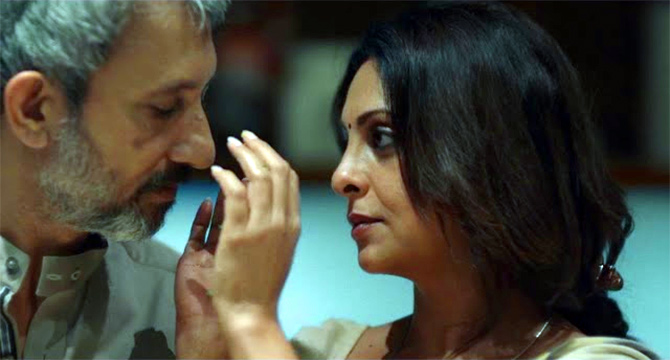
A few minutes into Once Again, we see the middle-aged female protagonist Tara Shetty (Shefali Shah) patting her face carefully with her hands. The deliberateness of her gestures suggest a nightly ritual: she seems to be putting something on, perhaps an invisible layer of cream? Almost immediately after, there is a mirroring, when we see the film's middle-aged male protagonist in the midst of his own cleansing ritual. But Amar Kumar (Neeraj Kabi) is a famous film star called Amar Kumar, and his smoky black eye make-up is being gently dabbed away by someone else. The addition of an invisible layer versus the removal of a visible one; the woman's actions hoping to stave off the inevitability of age, while the man has just shot for an erotic dance sequence with a bevy of much younger women: of such contrasting details is Kanwal Sethi's film made.

Creating characters who share your sensibility is the oldest trick in the fiction writer's book, and writer-director Sethi unapologetically takes this route, making both Tara and Amar agents of the film's unhurried tactility. It makes perfect sense that Tara's cooking, all slow marination and hand-ground masala, should appeal to Amar, the sort of man whose first gift to her is a fragrant, creamy- white gajra.

The premise -- of a connection fostered through the daily delivery of a freshly-cooked meal -- is bound to invite comparisons with The Lunchbox (2013). Stylistically, too, both films are redolent with old-school romance: the anonymous pleasures of Mumbai's streets, and nostalgia for handwritten notes and landline appointments. Unlike the plotted safety of Ritesh Batra's film though, Tara and Amar do meet, and meet several times, letting the charmed flame of their phone banter flicker into unscripted disappointment. “What are you thinking?” Amar asks Tara after one tense moment. “Just that it's all so easy on the phone,” says Tara.

Women have long cooked to express love. The film recognizes both the intimacy of the act, and the unequal gendered labour of it. Tara's response when Amar introduces her as someone who cooks for him is not that different from Sridevi in English Vinglish when her husband declares “My wife, she was born to make laddoos”. But Sethi's glancing, atmospheric style doesn't delve too deep, sometimes leaving us with more suggestion than substance. 

The protagonists' relationships with their respective grown-up children – Rasika Dugal, Bidita Bag and Priyanshu Painyuli – never feel fully fleshed out, coming off like distractions from our main focus. This is particularly so because Shah and Kabi are both fine actors, and Shah's trademark intensity makes her chemistry with Kabi a live, smouldering thing. We could really do with more of her.

An edited version of this review was published in India Today magazine, 15 Sep 2018.

9 September 2018

Backing and advancing

My Mirror column:

Has the mature woman with a marriage in her past finally become a legitimate recipient of romance in Hindi cinema?


Irrfan Khan and Parvathy in a still from Qarib Qarib Singlle (2017)
Tara (Shefali Shah) runs her own small Mangalorean restaurant, drives herself around Mumbai, and has been a single mother to her two children since her husband’s death twenty years ago. But when this highly capable, independent woman gets home at the end of the day and her grown-up daughter asks her if the restaurant landline is working, Tara feigns ignorance, brushing the question off quickly. The phone relationship she has struck up with the almost-divorced actor Amar (Neeraj Kabi) is, for some reason, a guilty secret.


The idea that their desires are illegitimate is buried so deep inside most Indian women’s heads that even to acknowledge them can feel like taboo. To want companionship, romance, intimacy — and yes, sex — is perfectly natural, but still fraught with the possibility of social censure, especially for a woman past a certain age. So Kanwal Sethi’s atmospheric film 
Once Again, released last week on Netflix, gives us in Tara a rare Indian heroine: a woman who has walked the slow path towards recognising her needs.


And yet how little it takes to propel her back into guilt. Caught on camera by a paparazzi photographer while out walking with Amar, Tara finds herself to be the target of childish anger from her adult son as well as humiliating barbs from his prospective mother-in-law.
Once Again eschews melodrama for piercing looks and pregnant pauses, but Tara’s samdhan manages to get in her critically frosty line: “In our family, we place our children’s desires far ahead of our own.”


Watching even the self-possessed Tara crumble under the pressure, I thought of another recent film in which a woman finds it hard to tell a judgemental world that she’s dating again. Released in 2017, Tanuja Chandra’s romantic comedy
Qarib Qarib Singlle starred the well-known Malayali actress Parvathy as Jaya Shashidharan, a 35-year-old woman who’s been alone for so long that she’s forgotten she has the right to move on.


Unlike Tara and Amar in
Once Again, whose relationship is conducted through lovely old-school means such as as landline conversations, handwritten notes and home-made meals, Jaya meets her suitor Yogi (Irrfan Khan) via a dating website. As a match for the tastefully turned out, punctual Jaya, Yogi seems an eccentric and unlikely choice at first: a self-published shayar with a fondness for mangoes, banter and running — invariably running late. But Chandra’s idea of romance is all about entertaining unlikely possibilities: before we know it, Jaya has joined Yogi on a tripartite journey to visit his three ex-girlfriends, and romance is afoot.


Despite many dissimilarities between the two films, it struck me that both the female protagonists are widows, not divorcees. And the films imply —sometimes humorously, sometimes with pain — that neither woman has been in any sort of intimate relationship since their husbands died. These social double standards are acknowledged by the way the characters are written, too: Irrfan has no compunctions chattering on about his exes to Jaya, from the sweet, quasi-familial terrace romance of his childhood to the sultrier adult one (with Neha Dhupia) — but he is rendered speechless when Jaya digs up an adolescent boyfriend of her own.


The figure of the still-youthful, attractive widow has a history in Hindi cinema — though much less of a history than proportionate reality would demand. Off the top of my head, I can think of Nutan as the translucently lovely widow Mahjubi in the 1973
Saudagar, whom a duplicitous Amitabh Bachchan marries for her talent in making the best palm gur, and Padmini Kolhapure as the exploited young creature whom Rishi Kapoor takes it upon himself to save in Raj Kapoor’s 1982 social melodrama Prem Rog (interestingly, Kamna Chandra — who is Tanuja Chandra’s mother — has partial writing credits for both Prem Rog and Qarib Qarib Singlle).


A much more radical portrayal of a widow who has desires was, of course, last year’s
Lipstick Under My Burkha. Ratna Pathak Shah brought both comic flair and a tragic edge to the 55-year-old Usha Parmar, whom the world knows only as the stentorian Buaji, but who yearns to be recognised as someone altogether more tender. Usha’s secret life involves not just reading steamy Hindi romance novels and learning to swim, but also falling for her buff and youthful swimming instructor. Her secret phone conversations with him, unlike those between Shefali Shah and Neeraj Kabi, are unabashedly sexual. And yet when the veneer of anonymity is shattered and Usha suffers public humiliation, it is hard not to think of all those dozens of Hindi films we grew up on, in which the illusions of romance cultivated by the spinsterish figure of Lalita Pawar would turn out to be nothing but illusions.


It will be a while yet before Buaji swims free.


Published in Mumbai Mirror, 9 Sep 2018.