Showing posts with label ageing. Show all posts

23 November 2020

In vino veritas – I

My Mirror column:

Jayaprakash Radhakrishnan’s deceptively simple film The Mosquito Philosophy (2019) leaves you asking, who really are the suckers?

A drinking session becomes a place for revelations in The Mosquito Philosophy (2019).

About ten minutes into Jayaprakash Radhakrishnan's sort-of-mumblecore Tamil film The Mosquito Philosophy (2019), a man complains to his friend that the liquor shop overcharged him, but no-one in the crowd supported his case against the cheating shopkeeper. “Do they have no self-respect or guts?” Suresh mutters. “Well, it is to gain self-respect and guts that we drink!” laughs his friend JP (played by Radhakrishnan himself). “Don't expect anything from the men in a liquor shop until they're high!”

It feels like a throwaway line, just a bit of humour. But as we get deeper into the nightlong drinking session that is the film's chosen milieu, we are made to realise that alcohol does serve that purpose, among others. In fact, The Mosquito Philosophy feels almost inspired by that old Latin proverb, In vino veritas - In wine, there is truth. As an English poet called Abraham Fraunce put it as far back in 1592: “Wine moderately taken maketh men joyfull; he is also naked; for, in vino veritas: drunkards tell all, and sometimes more then all.”

The four men have met because Suresh has some news that deserves a celebration. The only single one in their group, he’s finally decided to get married. But he is just a little cagey about telling his friends, and it soon becomes clear why: he has sworn for years that he would only have a love marriage. Now, at forty, he has made a decision to accept an arranged marriage prospect. It's all to make his mother happy, he insists – and then it turns out that the girl chosen by his mother is fifteen years his junior.

What makes the film successful is its quality of creeping up on you, rather than bombarding you with the things it wants you to think about. The predictable wife jokes at the start ease the viewer gently into a familiar middle class Indian milieu dominated by them. “Oh don't worry, no wife thinks her husband's friends can ever be a good influence,” says JP, and over the course of the film, each man in turn gets mocked for being afraid of his spouse. “Suresh, that's life after marriage,” the friends say to the soon-to-be-married man when one of them rushes back home to eat because his wife hasn't given him permission to be out for dinner.

JP seems the best adjusted of the men with respect to his wife – she is in and out of the room while his friends drink, and even joins in the conversation occasionally. But he has also asked his friends over for a drinking session without first checking with her - if he asks her first, he chuckles to Suresh, she is likely to refuse. Again, it's a throwaway moment – but it finds a larger echo when we hear over the course of the evening that JP followed his wife around for nine months before she agreed to marry him. What he describes as a college romance, a drunken Suresh now points out, could well be understood as stalking – JP simple didn't take no for an answer.

Is there is something worrying about a world in which husbands must ask their wives' "permission" to go have a drink or hang out with their friends? Yes, but there is also something worrying about a world in which a twenty-four-year old woman finds herself in the position of accepting an arranged marriage with a not-particularly-attractive man over fifteen years her senior. There is something particularly sad about the fact that a man who isn't even married already feels put upon, not excited, when his fiance calls him to make weekend plans. 

"Truth is like fire, it glows and burns," Suresh quotes the artist Gustav Klimt as having once said. The scalding truth of this society is that men and women continue to look at each other as separate species, each brought up to perceive the other as a creature that needs to be tricked into captivity -- not lived with in mutually defined freedom. It is no coincidence that even the alcoholic haze that lets home truths be spoken is closed off to one gender. 

(The first part of a two-part column. The second part is here.)

Published in Mumbai Mirror, 15 Nov 2020.

26 July 2020

The Reel Life of MS Sathyu - II

My Mirror column (a sequel to last week's piece):

In honour of his 90th birthday earlier this month, a look back at MS Sathyu's under-watched 1994 film Galige, currently streaming online.

At the very start of Garm Hava, Balraj Sahni's Salim Mirza waves goodbye to a train at the station and sits himself down in a horse-drawn cart. The Agra of the 1940s is small enough for the tangawalla to be acquainted with each customer. Who have you dropped off this time, he asks. “My elder sister,” says Mirza, adding a gloomy metaphorical remark about how thriving trees are getting cut down in this wind. Yes, agrees the tangawalla, those who refuse to uproot themselves will dry up. Then he adds a Hafeez Jalandhari couplet, rendered in its most charming street avatar: “Wafaaon ke badle jafa kar riya hai/ Main kya kar riya hun, tu kya kar riya hai?” (I'd translate that as “You torment me in exchange for my loyalty/What am I doing, and what are you doing?”)

What's remarkable is the spectrum of moods that the sequence encompasses. There is the sombre farewell, the meditative remark, the deep sense of living through a eventful time -- and yet all of it is leavened by the comfortable chatter of the everyday, by casual acquaintances who make up one's sense of home, and an ear for humour in the minor key that keeps one from dipping into the doldrums. Galige, which Sathyu directed in 1994, attempts to create the same kind of energy.

The film has two narrative threads, both with immense potential for melodrama -- but Sathyu staves off all maudlinness. Currently playing in the Indian section of an international film streaming platform, Galige centres around a young Bangalorean woman named Nithya. She lives alone in a rented house and has a job in the HMT factory, riding a two-wheeler to work each day. One day, the orphanage where she was raised calls her. An old couple has arrived from a North Karnataka village to claim her as their long-lost granddaughter.

Now this is a theme that doesn't just animate popular cinema in India, it forms the matrix for it: the family separated by a calamity and reunited at the end, the pauper who is really a prince, the enemies who are really biological brothers. Whether as the basis of a comedy of errors (think of every single double role film you know), or the underlying theme of the family melodrama from Waqt to Trishul, or even when ostensibly subjected to questioning by the plot -- as in Awara's nature vs. nurture debate, or Yash Chopra's unsuccessful but fascinating Dharamputra, in which a Muslim orphan grows up to be a Hindu fundamentalist, blood ties are assumed to be the ties that bind.

But unlike the hundreds of film orphans we have all grown up on, Nithya does not hanker for a family. She is guarded, unsure if she wants to be co-opted into an identity she has thus far escaped. The orphanage manager's reminder that she was brought in by a fakir, on the other hand, makes the wannabe grandmother baulk: what if she's actually a Muslim? They part company – but on her way back home, Nithya feels bad for the stranded old couple and decides to invite them to stay with her for a while.

A still from Galige (1994)

What Sathyu does is quietly subversive at many levels. By making the young female character financially independent, and the old couple needier than her, he shows how easily existing power equations of age and gender can be reversed. The 'family' becomes something chosen, contingent on mutual desire and supportiveness, rather than a unquestionable given. Within this new space of equivalence, the young woman makes her own decisions, refusing to kowtow to either neighbourly gossip or 'grandparental' interference. She looks out for the old people, and enjoys their companionship, but feels no obligation to live by their rules. The old couple, for their part, learn that their opinions are simply that – their opinions.

Galige's other subplot is even more surprising – the Khalistan movement, and the fate of a reformed terrorist. Girl does meet boy, even in an MS Sathyu film, and Nithya meets hers in a thoroughly charming Antakshari scene on a train. As a girl without a family, she is perfectly comfortable with a boy without a past. And by bringing a Punjabi boy into a relationship with a local girl, of course, Sathyu plays on Bangalore's insider-outsider tensions. In the film, though, the locals' suspicions turn out to have some basis in fact – not all unknown pasts are equally benign.

There are many other moments when the film touches on the question of identity – Nithya's Japanese boss at the HMT factory, the Sikh dhaba owner or the play within the film where Ekalavya's birth becomes the cause of his tragic fate, while Guru Dronacharya shifts all blame onto him: “How can you hold me responsible for your low birth?” In an early aside, the film's resident commentator, one Narhari, asks the rhetorical question: “Do we lack temples, mosques, churches, gurdwara here? Must slap Urban Ceiling on gods – only so many temples per god.” Nithya herself speaks often of not needing to have a religion, of being free to believe in people.

All the threads of Galige don't necessarily come together. The music can feel tacked-on, as can some of the attempts at comedy, and the Punjab segment has the rushed quality of nightmare. The film's uneven tapestry benefits from being woven of low-intensity conversations, like the Bangalore in which it unfolds. In one lovely odd little moment, a drunken Narhari sings a Kannada song by the poet Rajaratnam to a companion in a prison cell: “If you wish to live, escape from this world. Create your own, forget this one.” Words to live by, now more than ever.

Published in Mumbai Mirror, 19 Jul 2020

9 June 2020

Art stops at nothing

A short feature for India Today magazine.

Displaying work created during the lockdown, a virtual initiative proves the pandemic won’t stymie art.


As the weeks of India’s coronavirus lockdown dragged into months, many of those privileged enough to isolate started to chafe at the bit. But not artists. Almost all those involved in Art Alive Gallery’s #ArtForHope initiative confess that their working lives are less disrupted than most people’s. Virus or no virus, visual artists are so used to days spent in splendid isolation that they exhibit few signs of cabin fever.

Many of the senior names, Krishen Khanna (b. 1925), Maite Delteil (b. 1933), Sakti Burman (b. 1935), Gopi Gajwani (b. 1938) and Jogen Chowdhury (b.1939), had already retreated from the hubbub of gallery openings and art fairs. They are devoting themselves to work with enviable focus and often childlike enthusiasm. Gajwani, for instance, has been drawing after many years, describing these solitary times with impish humour. In one of his drawings, a man at his window ignores a curious crow and an expectant dog. In another, a man has tied himself into a knot: a large ball of thread that rolls on even as he tries to unravel it. In a third, a painter baulks at the sight of his own easel, like it is a mirror.

Others, too, speak of the lockdown as a time of greater reflection. “As artists, we like our solitude,” painter Jayasri Burman says on the phone. “Yes, first I was confused, I was crying. What is this coronavirus? What will happen? Artistically, I responded as I had during the tsunami and 9/11. I started making abstract drawings. They’re like my private diary. I might show that work some day, but not now.” Burman, who draws on the Indian epics and myths for her jewel-like canvases filled with dreamy women, says she settled down when the Navaratras began. “I painted Durga, who is important to me. Then I came back to my Dharitri, the universe,” she says. Like her goddesses who often shelter other creatures even as they are themselves sheltered, by the multi-headed Shesh Nag, trees filled with birds, or cornucopias of lotuses, her current work is a world map on a sea of blue, protected by mandala-like rings of ducks and fish. “Nature is now protesting. And she decides how she will clean up,” Burman says. “All we can do is maintain harmony and try to improve. Humans need to learn that you cannot take any panga with nature.”

Several artists have responded to the unseeable threat by envisioning the virus. Kolkata-based Chandra Bhattacharya, who speaks of a constant “uneasy feeling” during these months, offers up the image of a man emerging from a tunnel, a flaming blue torch in his hand, the virus blooming, or being conquered?

Debasish Mukherjee’s series of inky blobs with ragged edges seem to suggest the virus is embodied in other human beings: now faceless, now utterly real.

Jogen Chowdhury extends his distinctive visual vocabulary of men and beasts to create drawings in which the human figure cowers in the face of a demonic presence that is all claws and tongues.

But in ‘Corona Vs Man-Man Vs Corona I’, the creature who holds up the virus for examination has turned into a beast himself, ridges running down his back.

US-based Tara Sabharwal, who is recovering from (untested) pneumonia, has been doing ink drawings of “menacingly beautiful cellular creatures in armour, with jelly-like frightened interiors”.

“The way to keep hope alive is to actually feel this moment... It is so heavy, it gets one down. But to run away from it would be to not be able to go to the next step,” says Sabharwal.

SIDEBAR: "THIS IS NOT A WAR"
 

Krishen Khanna is 95 and still paints daily. “It’s like a demon inside me that wants it,” he says on the phone. “I have been through more than one migration, seen how people are forced to live in new situations. And this is not new, pushing people around: think Tughlaq. But this is probably the worst.”

Born in Faisalabad in what is now Pakistani Punjab, Khanna was a schoolboy in England during World War II and his vivid memories of war and Partition offer sobering comparison and perspective.

“The people in charge are still talking of winning the “battle” against coronavirus. As if it is a war. But it is not. This is our overreach. We are the sole generators of this. There is a need for re-examination of the human spirit.”

Published in India Today magazine, 6 June 2020.

The Krishen Khanna sidebar appeared in the same spread, in print. 


16 February 2020

Life after death

My Mirror column:

A range of recent narratives, including the quietly brilliant 2019 film Aise Hee (Just Like That), offer a perspective on the unexpectedly liberating possibilities of widowhood.


During a recent stint in a hospital room, I put on the television at low volume, hoping to distract the slowly recuperating 70+ patient. I searched fruitlessly for the things I knew he might enjoy – first for live cricket, then the news in English, old Hollywood films, or perhaps a soothing nature channel. But none of these seemed to be part of the already prohibitive ‘package’. A hospital staff member walked in and said, as if solving a non-existent problem: “Uncle ke liye? Arre bahut saare dhaarmik channel hain.”

How breezily we decide what the old ought to like. I was reminded immediately of the astute, delightful 2019 film Aise Hee, in which an old lady’s desire for the simplest of things – a stroll by the riverside, an ice cream, or just interesting company – raise eyebrows and then hackles across not just her family but the neighbourhood and then the city. Written and directed by debutant , the film received a Special Mention at Busan Film Festival and the Film Critics Guild award at MAMI, while Mohini Sharma won MAMI’s Special Jury Mention for Best Actor (Female) for her wonderful performance as an Allahabad-based woman who rediscovers a taste for life after her husband of 52 years suddenly dies.

For all our post-liberalisation embrace of consumerism, for the vast majority of Indians choice remains an illusion. The lives of old people, in particular, are regulated by a rack of rigid social expectations that offer very little room for individual expression. Of course, it's worse if you’re a woman. And if you’re a widow, your last link to life’s everyday pleasures is deemed to have automatically snapped when your husband dies – even in 21st century India. Some of this is simply an unthinking re-inscribing of deprivations ritually visited upon caste Hindu widows for centuries – in a brutal early scene in Aise Hee, a posse of younger female relatives matter-of-factly divide up Mrs Sharma’s wardrobe of saris without even asking her. It is simply assumed that she must exchange her suhaagan colours for vidhwa whites, or at least dull greys and beiges.

The widespread assumption is that as a widow, she will continue the socially approved life she lived with her husband – going for paatth, religious recitation, and attending the yoga circle in the neighbourhood park. But she is simultaneously expected to curtail her existence, literally reduce the space she takes up in the world. Her son, who lives on the ground floor of the family house with his wife and children, takes it for granted that unlike his father, his mother can be squeezed into one of the downstairs rooms while the upper floor is rented out for some extra income. When his mother resists, gently but firmly, in the direction of a quiet financial independence, even dealing with bank passbooks herself, there is shock. When she actually buys an air-conditioner for her own bedroom, there is outrage.

What makes Aise Hee a joy to watch, though, are Mrs Sharma’s new friendships – with an old neighbourhood tailor whom she persuades to teach her embroidery, and later with a 20-something single woman she meets on the ghat. And what Kislay’s subtle telling makes unmistakeably apparent is the extent to which contemporary Indian society frowns on such one-on-one connections: cutting across religion, gender and class in one instance (the tailor is Muslim), and across age and class in the other (Sugandhi works in a beauty parlour and isn’t a ‘respectable’ companion for an elderly widow).

Aise Hee
 reminded me of a short story called Compassionate Grounds by Tanuj Solanki, part of his collection Diwali in Muzaffarnagar, in which an ageing housewife whose husband has died worriedly contemplates the possibility of taking up a compensatory job in his government office. “I’ve only read Grihshobha and Kadambini after my BA. Not even the newspapers. The last time I dealt seriously with books was when I could still help with you with homework,” she tells her 26-year-old daughter. The documentary About Love, which I wrote about last week in another context, also featured a woman bemusedly describing how living with a dominant husband seems to have stunted her brain. When I’m with him, says the filmmaker’s fifty-something mother, I just do what he says.


Another powerful recent portrait of a spirited old woman suffering the stultifying effects of marriage – and the unexpected liberation afforded by widowhood – is Heena D’Souza’s short film Adi Sonal, which was the best part of last year’s anthology film Shuruaat Ka Twist. Neena Gupta is simply marvellous as a traditional, ritual-bound Sindhi housewife who understands marriage as being about serving her husband – and clearly expects her daughters-in-law to do the same. Until she doesn’t.

In an odd coincidence, in both Adi Sonal and Aise Hee, there is a younger woman played by the same actor, the wonderful Trimala Adhikari. In fact in all these narratives, we see the lives of the old partly through the eyes of the young, which is perhaps a good way for young audiences to empathise with the protagonists. But what we also see are the lives of the young through the eyes of the old. And in those older eyes, there is bafflement, curiosity, and sometimes envy.

Published in Mumbai Mirror, 26 Jan 2020.

19 November 2019

Dispatch from Dharamshala – 2

My Mumbai Mirror column:

Films about animals at this year's edition of the Dharamshala International Film Festival had powerful things to say about the state of our humanity
 

The monkey as metaphor: a still from Prateek Vats's film Eeb Allay Ooo

You can never watch all the films at a film festival. What you can do is to make your choices, whether based on frontbencher commitment (read high-intensity googling of film titles) or a more backbencher attitude (what the lady in the loo queue seems excited about) and hope that the darkness of the auditorium will end up illuminating something you haven't quite seen before.
 
One of the things this year's DIFF threw into focus for me was age and ageing. There's no single model of the good life, but observing old people throws up possibilities to aspire to – or guard against. Archana Phadke's stunning documentary portrait of her grandparents and her parents, About Love, is as brutal as it is affectionate, letting us see these long-term relationships as the simultaneous safety nets and shackles they are. The bent, ancient fisherman of Kazuhiro Soda's Inland Sea smiles wryly about how the years can sneak up on you: “I thought I was still 50 or 60, turned out I had turned 90.” 

The other theme that seemed to me to emerge serendipitously from DIFF 2019 was animals. Zooming in on the non-human seemed, in film after film, to be a way of 
opening up the human condition. Sometimes the association felt subtle, like the gleaming night hauls of fish in Inland Sea that the old man disentangles from his net and tosses into the boat's watery hold, so they might live a little longer. The persistent slippery toughness of their bodies, leaping for life even at death's door, struck me as akin to their captor. 

Elsewhere, the weight of the beastly allegory seemed too much for the narrative to bear. The acclaimed Malayali director Lijo Jose Pelissery was at DIFF with his latest, Jallikattu, in which a buffalo due for slaughter runs amok, destroying plantations and shops in its wake. As the village men set off in pursuit, armed with nothing but ropes and their egos, it becomes clear that the film is only ostensibly about the buffalo.  

Pelissery's last two films, Angamaly Diaries and Ee Ma Yau,  demonstrated a talent for richly orchestrated set pieces, but Jallikattu feels more like a runaway display of that ability than a controlled experiment. For most of the film's running time, we watch men with flaming torches tramp through acres of hilly woodland and splash through streams, yelling, leaping, tearing at each other, with increasingly less rational cause. The buffalo seems almost forgotten as long-held internecine rivalries bubble up. The energy of the crowd is both majoritarian and masculine – “We will take it! There are more of us!” The thrill of the hunt, the performative frenzy of competition, the adrenaline and the testosterone – these, Jallikattu drills into us, are what drive humanity at its basest. And somehow, humanity at its most primitive is signified by animality. 

“Even now, with us here, this place belongs to animals,” says a goggle-eyed old man in Jallikattu. The sentiment is echoed at one point in Prateek Vats's stellar feature debut, Eeb Allay Ooo!, when Mahinder the monkey repeller of seven generations declares to the befuddled new recruit Anjani (Shardul Bhardwaj) that he has been asked to help train: “This is the neighbourhood of Raisina, traditionally ruled by monkeys.”  

But neither Pellisery nor Vats seem actually interested in our relationship with the animal world. What Vats's film does brilliantly is to use the monkey as metaphor, creating a multifarious web of associations that traverse the distance between animal and god – but elude the human. The bonnet macaque monkeys of Lutyens' Delhi, as elsewhere in India, have exploded as a population partly because they are worshipped and fed as a form of Hanuman – and as a bit of video footage in the films repeats, “The gods become pests.” 

Combining real locations and non-actors with a sharp script and a core of trained actors, Eeb Allay Ooo! follows the travails of a Bihari migrant who is hired to shoo away monkeys from the national capital's most grandly symbolic architectural corridor. There are several interwoven strands that combine to make this such a scathing indictment of the state of the nation: the humour of a young man's masculinity seemingly pitted against monkeys, the deeply unfair conditions of contractual labour, the absurdity of bureaucratic rules that defeat all of Anjani's innovations on the job. Meanwhile, the performative masculinity of the state at both the lowest level: Anjani's security guard brother-in-law being forced to wield a rifle that he can barely carry – and the highest: the Republic Day parade – emerge as equally farcical. 

It is only when the man pretends to be an animal – in a man-sized monkey costume, in blackface imitation of the lion-tailed macaques of Karnataka's R-Day tableau – that he manages to scatter the monkeys. We watch him wander through the streets, a modern-day Hanuman in his own sad Ramleela

His success is because the monkeys cannot tell the difference between a real langur and a fake one. Mahinder's real death at a mob's hands goes unmourned. Meanwhile, towards the film's end, the real rifle ends up in a costume tailor's shop, its value as limited to the performative as the fake costume. When, in the last scene, the jobless Anjani joins the parade of Hanuman impersonators, we know acche din has made monkeys of us all.

Published in Mumbai Mirror, 17 Nov 2019

13 November 2019

Dispatch from Dharamshala – 1

My Mirror column:

The Dharamshala International Film Festival, now in its eighth year, is still the most intimate, charming setting in which to encounter films and filmmakers in India


I arrived early at DIFF this year, walking up the 20 minutes from McLeod Ganj’s main chowk and making it into the campus of the Tibetan Institute for the Performing Arts (TIPA) just before the first sharp shower of the day. In the main auditorium, Tenzing Sonam and Ritu Sarin, wonderful filmmakers and creators of this extraordinarily delightful film festival in the mountains, were supervising the last-minute arrangements to make sure the eighth edition of the Dharamshala International Film Festival (DIFF) began without a hitch.

The opening ceremony was two hours away, and DIFF’s truly international team of youthful organisers – “Tibetan, French, Punjabi, Bengali, Telugu, Ladakhi, Italian and Malayali!” said Sarin in a Facebook post – were hard at work. At DIFF, details are everything. Two people were pasting black chart paper to reduce reflection from the auditorium balcony, while others made sure the two DIFF banners on either side of the screen were at the same height. The festival trailer and the opening film were test-run, the projection evaluated for sound and stretch and quality of image. Only when all had been approved did Sarin and Sonam make a dash for it, hoping to get a bite to eat (they had missed lunch), change and return to the venue in the 40 minutes left.

It’s my fourth consecutive year at DIFF, and as always, I am warmed not just by the carefully handpicked mix of independent films – shorts and features, documentary and fiction, Indian and international – but by the atmosphere of conversation and camaraderie in which they are screened. Like most film festivals, DIFF is a great place to talk cinema: you will encounter both gushing enthusiasm and agitated criticism over parathas and hot ginger lemon tea in the flag-bedecked courtyard. But there seems something self-selecting about DIFF audiences – the vibe is always more generous and open-ended than nerdy and competitive.

One of the first screenings is Agnes Varda’s last film, an autobiographical, self-evaluative work called Varda by Agnes, the very title evoking the playfulness and joie de vivre that marks much of Varda’s work as a director. Completed in early 2019, a few months before her death, Varda by Agnes allows us to spend two hours in the company of a charming, sensitive filmmaker who was never afraid to embrace her eccentricities. The film opens with Varda seated in a director’s chair, addressing an audience in the grand environs of an opera house. The opera-house-turned-movie-theatre intimidates her: the children of paradise might be up there, she says, laughing and simultaneously bringing in with that one sentence the ghosts of cinemas past – Carné’s delightful 1945 Les Enfant du Paradis, in which the courtesan Garance juggles various loves against the backdrop of the 1830s Paris theatre scene. Like Garance, Carné has an enviable lightness of touch, and so does Varda.

The film has her speak of her love of documentary, of her preferring to explore the nearby and familiar – the bakers and butchers of her Paris neighbourhood, or the murals of Los Angeles where she spent some time – than making “big documentary journeys”. She talks of her love of recycling, something at the heart of her marvellous film The Gleaners And I as well as various artistic projects showcased here, including an arched gate made with old film canisters. “I’ve learnt that recycling brings joy,” she says, because you can preserve things that might otherwise be lost. Then there is her abiding interest in the question of time – from immersion in the everyday art of the baker to the experience of time for her heroine Cleo (in the classic Cleo from 5 to 7) on the nerve-wracking day when she is awaiting the results of a medical test. About Cleo, she says she wanted to bring in both objective time – the universal, fixed clock time that we have no control over – and subjective time: how time actually feels to each of us, an experiential thing that changes all the time.

The passage of time is also integral to the film in a personal sense. Varda made it at the incredible age of 90, and yet age appears in it fleetingly, with that marvellous light touch. There is a moment with footage of her at a protest holding a sign that says “It hurts everywhere”. Varda comments, I could still hold up that sign, it’s still true. She does speak of the experience of turning 80 as paralysing, saying that it felt like a train that was going to crash straight into her. But ten years later, she seems to have made peace with her body.

The question of ageing – the many ways we might age if we set ourselves free to do so – is also at the centre of several other films at the festival this year. The documentary Golden Age, directed by Beat Oswald and Samuel Weniger, is set in an ostentatious retirement home called The Palace, where residents are invited to continue to party into eternity. Kazuhiro Soda’s lovely elegiac documentary Inland Sea takes us into the Japanese seaside village of Ushimado, presenting in a dream-like black and white the real and imagined lives of its many “late-stage elderlies”. RV Ramani’s documentary Oh That’s Bhanu maps the personal and performative life of the 90-something Bhanumathi Rao, once well-known as a dancer and theatre actor. Most radical of all is the superb Aise Hee, the first fiction feature from the writer-director Kislay, in which an old Allahabad housewife responds to the death of her husband by learning to live life anew — thereby rattling everyone around her.

To watch old people live — and to examine their lives — is somehow among the most wonderful things you can do as a young person. Doing so at a film festival is the next best thing to doing so in life.

(The second instalment of this column will appear next wee

Read more at:
https://mumbaimirror.indiatimes.com/opinion/columnists/trisha-gupta/dispatch-from-dharamshala1/articleshow/71988360.cms?utm_source=contentofinterest&utm_medium=text&utm_campaign=cppst
(The second instalment of this column will appear next week.)
(The second instalment of this column will appear next wee

Read more at:
https://mumbaimirror.indiatimes.com/opinion/columnists/trisha-gupta/dispatch-from-dharamshala1/articleshow/71988360.cms?utm_source=contentofinterest&utm_medium=text&utm_campaign=cppst

Published in Mumbai Mirror, 10 Nov 2019.

3 November 2019

The Pearly Gates

My Mirror column:

An octogenarian Uttarakhandi farmer offers up an unusual model of the good life in an inspiring new documentary called Moti Bagh.

 
“In two minds am I this year,
To till or keep fallow my soil?”

The old man's tinny voice wafts out over a visual of his feet, loose inside his dusty leather shoes. A mynah hops alongside, perhaps waiting for the insects that will be dislodged as two brown cows drag the wooden plough through the field that Vidyadutt Sharma is clearly not leaving fallow. 

“Almost seven times a day/ the monkeys my fields do visit,
And the wild boars—they at night are my visitors.
Crows, parrots and their kin my fruits enjoy,
While jackals and porcupines await their turn.”

Back under the wooden roof of his own balcony, Sharma, 83, ends his little self-composed ditty, his hands performing a little hopeless flourish to go with the words:
“These animals it is beyond me to understand --
Earlier 50-50 was the arrangement,
But this year a full share they want.”

Then the camera pans out into the valley, and a langur turns to look at us from a distant treetop, its fur brilliantly white against the hillside's verdant green. Between the song, the cows, the mynah and the langur, we instantly get a sense of a universe shared with other creatures, of what it might be like to live off the land in Pauri, a district in the hill state of Uttarakhand.

Nirmal Chander's 59.23 minute documentary Moti Bagh, in which this scene appears, has been described as being about the struggle of a farmer in a remote Indian village. That isn't untrue, but neither does it do justice to Moti Bagh, which is as gentle, quirky and determined as its octogenarian protagonist. Vidyadutt Sharma, who happens to be Chander's uncle, first began to farm the consolidated farm for which the film is named in 1966. He had had other jobs – as a survey expert in the Uttar Pradesh government (a position from which he resigned at age 28), and later as the manager of a government school in Mundeshwar, during which time he went on a hunger strike to pressure the government into keeping its word on granting it high school status (It is now an inter-college.)

Sharma's educational and professional background might be considered by most people to be at odds with his choice of vocation: farming. But in many ways, that is what Moti Bagh is about: one man's realization that getting a formal education need not automatically translate to an office job. For Sharma, nurturing the land is both philosophy and praxis. “Bade bade granth likhna bahut aasaan hai, lekin tamaatar ka daana uga ke dikhaye koi (It's easy to write big books, but let's see someone grow a tomato seed),” he says. Sharma's dry wit somehow cohabits perfectly with his deep sense of belief. “Physical work has a special importance,” he says later, while carrying a pitcher of water up to his house. “Even if you don't get tangible results from it at the end of the day, you're sure to get a deep sleep!”

Chander's film is an affectionate portrait of Sharma as well as a cinematic glimpse of the socio- economic context of Pauri which makes him such an outlier. That context is the large-scale migration out of Uttarakhand – especially of educated upper castes -- into urban areas in the plains, leaving thousands of villages empty and much fertile land uncultivated. “The new generation is afraid of physical labour. They want to live purely off intellectual labour,” says Sharma. And earlier, perspicaciously, “The producer has become a consumer. We shall suffer the consequences of that...”

Nepali migrants, like Ram Singh and his family who work on Sharma's land, have replaced local farmers as agricultural labour, and the film points to the resulting tensions: jealousy and discrimination from locals, and the instability of devoting their lives to a land that they might well be ejected from.

Moti Bagh won first prize for Best Long Documentary at the International Documentary and Short Film Festival of Kerala (shared with Pankaj Rishi Kumar's Janani's Juliet), and the filmmakers have been claiming that this counts as a "nomination to the Oscars". The film recently received media attention because the Uttarakhand Chief Minister mentioned this with pride -- which is interesting not just because it is untrue, but also because the film is, as much as anything, an indictment of political corruption and the lack of political will (on such matters as forest fires, government school closures and land consolidation, which Sharma argues would help farmers to cultivate more efficiently and to stave off animal depredations).

Watching Vidyadutt Sharma shooing monkeys away from his orchards, I was reminded of another old man in total synch with a difficult environment: the crabby old shepherd of the atmospheric fiction feature The Gold-Laden Sheep and the Sacred Mountain (2018). Moti Bagh also brings to mind another film funded by PSBT: Rintu Thomas and Sushmit Ghosh's deeply inspiring 2012 documentary Timbakt. Timbaktu is a farming collective in Anantapur, Andhra Pradesh, which has weaned a large area away from chemical pesticides and mono-cropping into sustainable, organic agriculture, thus also helping restore the surrounding forest. (Timbaktu is available on Youtube.)

At the end of the documentary, Chander asks Sharma a grave question: what will become of Moti Bagh once he is gone. “That's not for me to worry about!” says Sharma, starting to laugh delightedly. “Let others worry about that!” Unlike Timbaktu, Moti Bagh isn't a movement. But sometimes all it takes to start one is one man with an infectious grin – and a willingness to be the odd one out.  


29 January 2019

Heartless Days

My Mirror column: the 2nd in a series of tributes to Mrinal Sen

In Baishey Shravana (1960), the late Mrinal Sen created a film as much about callousness during a famine as about the cruelty of time itself.


Mrinal Sen was 20 when he witnessed the Great Famine of 1943, a manmade tragedy wreaking havoc in the streets of Calcutta. Seventeen years later, in 1960, he made a film about it. Unlike many of his later films, where the politics was upfront and the city centre stage, this film was set in a village, and the famine remained the backdrop for a very intimate story: that of one marital household.

In another somewhat odd decision (which caused him great trouble with the Censor board), Sen titled the film Baishey Shravana. Some context might be useful here: Since 1941, that date—the 22nd of the month of Shravana—had been observed as Rabindranath Tagore’s death anniversary, and a Bengali audience would have assumed they were in for a film about the legendary writer. But of course, Sen never did what was expected of him. In his film, it is the date on which the couple’s wedding takes place, but that fact barely registers. To anyone who watched Baishey Shravana, it would seem to have nothing to do with Tagore or his death.

The connection existed— but only in Sen’s mind. In 1941, at 18, he had been present at Nimtola Ghat when Tagore’s body was being laid to rest. In that crush of public mourning, he had witnessed a terrible scene—hundreds of ostensibly grief-stricken people stepping over a dead child’s body. Somehow, in Sen’s memory, the callousness of that crowd appears to have merged with the cruelty of the famine—with that sense of eroded humanity reconstituted in Baishey Shravana as the callousness of a husband to his wife.

Many years later, Sen spoke of the clichés he was hoping to avoid: “I made it a point that mine would never be a journalistic approach, that I would not count the number of people who starved and died, that I would not show vultures and jackals fighting over the carcasses.” That decision about what not to show perhaps led organically to what stayed in focus: “The camera remains indoors, picking on the cracks appearing in their relationship, and moves outside only once. A long shot of the starving villagers abandoning the village in search of food...”

But the film’s non-obvious, somewhat contrarian origins are only important if you’re interested in understanding the way Sen’s mind worked. It is perfectly possible to watch it without factoring them in. Baishey Shravana is a remarkable film for many reasons.

It is, first of all, a tender portrait of an arranged marriage, perceptive about how romance in these circumstances involves both newness and security: the quietly giddy realisation that you now belong to another person, and they to you. The relationship between Priyanath (Gyanesh Mukherjee) and his bride Malati (Madhabi Mukherjee) starts out with scope for awkwardness: he is much older, graver, slow to cotton on to her playful ways.

The film is also notable for being Madhabi’s second film appearance. The lovely mobility of the face that would illuminate later classics like Charulata and Mahanagar is already in place. But there is still something of the child about her here, as witnessed in the lovely scene where she runs and hides in response to hearing Priyanath’s bicycle bell approach. Malati’s initial youthfulness is also gestured to in her stealing mangoes off a neighbour’s trees with the other village girls: this seems to have been a popular Bangla trope about the childish freedom of girls before marriage, it appears both in Pather Panchali and in Samapti, a Tagore tale that is one of the three stories in Ray’s Teen Kanya.

Ageing, in fact, is one of Baishey’s grand themes: the inevitability of it, but also the tragedy. We see both of those in the way Priyanath’s widowed mother accepts the shift of power within the household from herself to her daughter-in-law. Her son now listens to everything his wife says, he bids her goodbye where once he had bid his mother. But embedded in that recognition is the sense that Malati’s time of deprivation will come: she should go to the fair now, while she still can, before the baton of responsibility passes from one generation to another

This turnover of generations is inevitable for men, too, but in the world of work. Priyanath, who sells women’s cosmetics on trains, finds himself at a loss to compete with younger men. Even as tragedy makes him less and less appealing, Priyanath never seems an unsympathetic character, only a weak one. And yet, as Sen so sharply perceives, the same man who yells about injustice at the ration shop can obliviously consume his wife’s share. Sen’s shot of Priyanath gobbling down rice, his cheeks puffed up, apparently caused outrage. 

As with much of Sen’s work, the brilliant sound design is integral to the film. In the very first scene, when we see Priyanath hawking his wares in a local train compartment, the loud rumbling of the train is overlaid with a child’s voice singing a song that goes, ‘Mon re krishi kaaj jaano na (Oh heart, you don’t know the work of cultivation)’. It is only when watching it a second time that I realised it was no coincidence in a film about a famine; a drying up of both food and affection.


30 October 2018

Celebrating Acceptance

My Mirror column:

The awkward event of a mature couple having a baby ends up offering an optimistic view of the Indian family in Badhaai Ho.


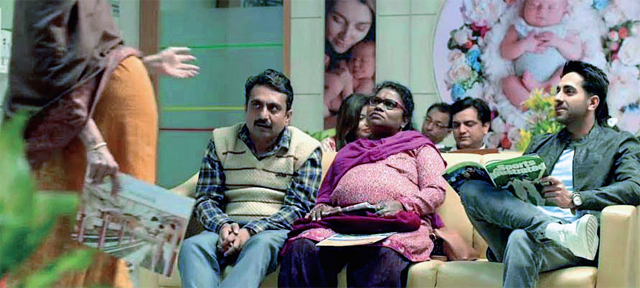
Since his debut in Vicky Donor (2012), Ayushmann Khurrana has emerged as the Hindi film industry’s go-to actor for good-humoured family films about matters sexual. If Vicky Donor addressed anxieties around infertility and ‘naturalness’, Dum Laga ke Haisha (2015) and Shubh Mangal Saavdhan (2017) took on marital sex life complications: pre-judgement about female attractiveness in one instance, the man’s erectile dysfunction in the other. Badhaai Ho, too, belongs to this growing genre: taking the dark, shameful things we were only ever supposed to sob about solitarily and making us giggle about them collectively.

Director Amit Ravindernath Sharma, whose 2015 feature
 Tevar didn’t get credit for its attempt at creating a masculine small-town hero who respects women, creates another rather optimistic protagonist here. Khurrana plays Nakul Kaushik, the twenty-something son of fifty-something parents who finds himself profoundly embarrassed when his mother gets unexpectedly pregnant. “Tu hi bata yaar, yeh bhi koi mummy-papa ke karne ki cheez hai kya?” he demands frustratedly of his girlfriend Renee, mid-intimacy. The mental vision of his parents getting it on is enough to ensure that Nakul and his girlfriend don’t.

Nakul’s initial response is exactly what one might expect in a middle class Indian universe, where sex isn’t meant to exist except when given public ritual sanction by marriage, where it’s intended for the socially approved goal of procreation. Then, of course, the ‘success’ of a suhaag raat becomes the business of the whole family and community: think of both
 Dum Laga and Shubh Mangal. 

But 
Badhaai Ho shows us how quickly even that socially legitimised conjugal bed can turn into something transgressive. A baby bump makes visible the existence of a sex life where we’d rather not imagine it: in our parents’ beds.

Badhaai Ho
sets out to be winsome, and part of that winsomeness lies in the particular parents it presents us with. Jeetender Kaushik (the marvellous Gajraj Rao) is a Northern Railways ticket collector who’s miserly with his money and his mangoes, but remains warmly attached to his spouse Priyamvada (Neena Gupta).

Priyamvada, for her part, supplements her domestic responsibilities with being the admiring audience for her husband’s amateur Hindi poetry written under the quasi-comic penname ‘Vyaakul’ (it is reading aloud his latest published poem that brings on a moment of passion). (Another recent portrayal of a middle-class couple, Love Per Square Foot on Netflix, had Supriya Pathak play an admiring wife to her railway announcer husband Raghuvir Yadav’s secret musical ambitions.)


Ayushmann Khurana in a still from Badhaai Ho

The believable affection between the two is used to charming comic effect through the film — during the shadi song sequence ‘Sajan Bade Senti’, for instance, when Jeetender tries to get closer to Priyamvada within the space of a big family photo. Later, when he compliments her, she seems secretly pleased but tells him off because it’s his “saying this sort of thing that has put us in this mess”.


More interestingly, though, the film takes a very warm view of the joint family, where privacy and politeness might be missing, but bonds are strong enough to create acceptance, even in the face of declared social norms. It is clear where Sharma wants to go when he pits the Kaushiks’ cramped Lodhi Colony life against the cavernous bungalow inhabited by Renee’s single mother. There's a neat reversal of assumptions about social class and liberal openness: Sheeba Chaddha as Renee’s mother emerges as more judgemental —and less likeable — than Priyamvada.


From the fading mehendi to the sindoor in her broadened hair parting, Gupta makes Priyamvada layered and utterly real. Priyamvada is not a character one would call feisty, but there is a clear line between what she takes as her duties — e.g. listening to her mother-in-law (Surekha Sikri) — and what she takes as her due, e.g. the right not to have an abortion. There is also a way in which the film extends her maternal role from the familiar mode of asking after physical well-being (“Khana khaya tune?”) to inquiring, gently but firmly, after her children’s emotional health. The mother who can teach her son when to apologise in a relationship is a truly significant mentor in a world where so many men seem to grow up ill-equipped for emotional labour.

Badhaai Ho appears on our screens in a time when the opposition to court-approved entry of women into the Sabarimala Temple has brought women’s menstruating bodies onto our front pages. Given that powerful women like Smriti Irani still see fit to body-shame their own gender for a perfectly natural biological function, Neena Gupta’s smiling, quiet defence of her character’s ageing, but still sexual, pregnant body seems particularly valuable.

The family,
Badhaai Ho implies, can be a space of socialising for young men, a place to learn what female experience is like, through empathy with sisters and mothers and grandmothers, through simple things like learning that periods happen, or how to hold a baby. Its vision of joint family may be rose-tinted, but in these divided times it is a pleasure to watch proximity create acceptance, not its opposite.

Published in Mumbai Mirror, 30 Oct 2018.