Showing posts with label food. Show all posts

10 November 2020

Art For the Binge-Watcher

A quick wrap of the current art scene for India Today magazine:

Virtual platforms are breaking the barriers of social distancing with new ways of exhibiting art

'The Half Of It', a painting from Nityan Unnikrishnan's upcoming solo show, It Is Getting Louder,
opening on Nov 13, 2020 at Chatterjee and Lal Gallery, Mumbai

You might think that visual artists have had it better than most during the Covid-propelled lockdown, and you would be right. Most artists work alone, and display only needs to shift from the clean white 3D cube of the art gallery to the 2D rectangle of the digital screen. So even as the lockdown left a series of shuttered shows in its wake, many galleries rose to the challenge. One exciting development has been In Touch, a digital platform created collaboratively by galleries across India (Artintouch.in/).


Edition 4 of In Touch, which runs till November 10, includes Rustom Siodia’s little-seen 1920s and ’30s watercolours on the Chatterjee and Lal site, Kanu Gandhi’s astonishingly intimate photographs of the Mahatma on PhotoInk, Dhruvi Acharya’s arresting pandemic-inspired work at Nature Morte, and Buddhadev Mukherjee’s marvellously humorous human figures, playful studies in scale, at Mirchandani + Steinruecke. Chemould Prescott Road is showing Lavanya Mani’s ‘Game of Chance’, mixing science with miracles and omens in a manner perfect for a pandemic year. In ‘Miraculous Sights 2’, a town floats into the sea aboard a ship, which itself hovers over the scaly back of a submarine creature. In the hypnotic ‘Portents’, a gigantic red flower opens a bleeding glass eye to a world buffeted by strange animal-headed comets.

In Touch’s on-screen display is effective: you can see a chosen artwork as it might look on a wall (with a virtual chair for scale) and zoom in. I wish, though, that more galleries had done what Gallery Espace has with Manjunath Kamath’s dream-like pastiches, to identify sections of each work for higher-resolution reproduction. It feels like a privilege to have his strange, vivid imagination enlargeable on one’s private screen: a pile of books in flames as an elephant grazes placidly in a field outside, a television splashing into a bathtub, an angel approaching a Mumbai taxi, or a giraffe a buffet.

Others, too, have made efforts online. The Kiran Nadar Museum of Art has a superb virtual tour. Kolkata’s CIMA has a new website. The uncertainty of recent months seems to have pushed the artistic process into the foreground. Mumbai’s Tarq Gallery is presenting Garima Gupta’s notes and sketches from the Southeast Asian wildlife trade, “unarchived fragments of a conflict that is pushing us into a war with the very world we inhabit”. Nature Morte offers up a downloadable colouring book by Acharya, while Kolkata’s Emami Gallery has devised a virtual flipbook. The flipbook is a great format both for Prasanta Sahu’s Suburban Shadows (see below) and Aroh, a group show that came out of Emami’s open call for lockdown work by young artists (I particularly liked Arindam Sinha’s ‘Marking’, Arpita Akhanda’s ‘Hung Up On the Past’ and Jahnavi Khemka’s ‘Lockdown 1’). Finally, the digital crossing of geographical limits allowed us to view, sitting in India, 35 sketches from the late great modernist Ram Kumar’s 1960s and ’70s notebooks on Art Basel’s Online Viewing Rooms.

But while the hushed silences and ‘no touching’ rules of the gallery may feel only a step away from the literal untouchability of a virtual display, an aura still clings to the work of art in the era of digital reproduction. Three of the five shows to look out for this month, at DAG and Art Heritage Galleries in Delhi, and at Chatterjee and Lal in Mumbai, are open for offline visitors.

From Prasanta Sahu's ongoing show 'Suburban Shadows', online on the website of Emami Art Gallery, Kolkata

ART RESTART: Five art events to keep an eye out for

Nityan Unnikrishnan’s solo show It is Getting Louder, showing at Mumbai’s Chatterjee and Lal gallery from November 13 to January 2, feels very much like India right now. The acrylic images on khadi spill over with people: reading, eating, dreaming, waiting. The other set of the images, graphite on muslin or bamboo fibre paper, are abstract, filled with black and white forms which could be anything: masts, mountains, plants, porcupines. All that unites them is their jaggedness.

Art Heritage Gallery, Delhi, together with Kolkata’s Seagull Foundation, is showing The Self Portrait, a show of early and rare woodblock prints, sketches and watercolours by the late K.G. Subramanyan, who died in 2016, aged 92. They aren’t all depictions of the artist: watch out for ‘Jangpura Women’ (1950), and many striking untitled linocuts and litho prints of seated women. Open by appointment till December 15.

DAG’s The World Will Go On, on view online since October 25, will be open to visitors at The Claridges, Delhi, between November 2 and 12. Highlights include a 1980 Raza, an M.F. Husain Hanuman, Nandalal Bose’s ‘Diwali’, and one of Krishen Khanna’s bandwalla images.

Prasanta Sahu’s Suburban Shadows, on the Emami Gallery website till November 30, visibilises the links between rural and urban through his studies of food and farming: a lettuce in a shopping cart, vegetables sprouting from human limbs, a bhindi as skeleton, shadows of the labouring body.

Five Million Incidents, a set of public art interventions funded by the Goethe Institute, has been reconceptualised in digital form. Visit Goethe.de/ins/in/en/ver.cfm to join the imaginary chatroom of Ranjana Dave’s Age Sex Location, add to Sultana Zana’s Fieldness, a collaborative digital archive of time spent in nature in the city, or log in to play Shraddha Borawake’s virtual game Chaat Meets... A New World Order on November 7.

 Published in India Today magazine, 8 Nov 2020. (Two separate links)

28 June 2020

The smells of others

My Mirror column:

Nicholas Kharkongor's Delhi-set dramedy Axone traces some of the fault lines that mark the urban Indian melting pot.


Growing up between cultures, I learnt long ago that smell was most people’s strongest, most intimate sense – and thus the one that lent itself most easily to kneejerk reactions, especially with relation to food. Members of my family’s staunchly vegetarian side, North Indian Jains of the not-even-egg variety, have sat me down as a child to tell me how difficult they found it to keep their own food down while having their nostrils assailed by the fried fish smells wafting down from a tenant’s house.

Nicholas Kharkongor’s film Axone, recently released on an online platform, is named for the strong-smelling fermented soya bean paste that forms a necessary ingredient in many traditional northeastern dishes. Often spelled akhuni, axone has a distinctive smell that you can’t ignore – which makes it a useful metaphorical marker of difference. And differences that cannot be ignored make for a strange but potent cocktail of attraction and repulsion.

That mixture of attraction and repulsion appears sharply in the film, in the alternately lascivious and judgemental gaze that Delhi folk turn upon the young northeasterners in their midst – being judged by the women for wearing ‘Western’ clothes and having boyfriends, while being the object of the men’s unsolicited attentions. But that attraction and repulsion also plays out, perhaps unintendedly, in Axone’s own cinematic form. The film plays out the food/smell motif against a tenant-landlord scenario in one of those urban villages in Delhi that thrum with the sounds of many languages, focusing on a group of friends from the Northeast who have to make an akhuni-flavoured pork curry for a last-minute wedding feast. That food-and-wedding narrative, though, feels like a mere sweetener, an attractive hook on which to hang a script full of bitter – abeit necessary – pills. Kharkongor's central concern is the racism, sexual predatoriness and aggression that migrants from the Northeast are forced to suffer in Delhi (and most other Indian cities). But what he does is to take that disturbing narrative and plonk it down in a Delhi-set middle class comedy that has become a Bollywood subgenre from Do Dooni Chaar and Vicky Donor to Queen to Badhaai Ho.

So alongside the central group of friends, we get a fairly detailed glimpse of the landlord's family: the hard-nosed landlady (Dolly Ahluwalia doing a version of her alcohol-swigging Punjabi grandmother from Vicky Donor), her layabout son-in-law (Vinay Pathak) and her overenthusiastic grandson, the curly-haired Shiv (Rohan Joshi). Shiv's multiple machinations and largely well-meaning mistakes form some of the film's warmer bits of comedy, but his father and grandmother's characters feel derivative and ungrounded. Still, there is something to be said for the fact that the homogenous lower-middle-class Punjabi milieu, a staple of so many previous Delhi films, has finally been extended to a whistle-stop tour of the very real admixture of so many Delhi neighbourhoods like Humayunpur, where locals rent out parts of their properties to people from across India and beyond.

Axone gently impresses upon us that everyone judges each other, using community and skin colour and language to make easy categorisations. If the Hindi-speaking landlords claim not to be able to tell northeastern faces apart, or remember their names, then the Nepali girl, too, can't get her head around her African neighbour's name – and the African neighbour, in turn, makes an assumption about her based on her looks. And the whole group of northeastern friends keep their distance from the landlord’s son, whose interest in them is very much a curious fascination with the coolness their clothes, their English-speaking-ness, their music represent for him.

Kharkongor’s real sympathies, though, lie with Chanbi, Upasana, Zorem and Bendang (played by Lin Laishram, Sayani Gupta, Tenzing Dalha and Lanuakum Ao), each of whom is dealing with their own troubles. Even here, however, his script constantly points out how their relationships with each other, and with themselves, are inflected by the politics of identity and belonging. These include some small observations that shape the plot – like the perceived difference between being Nepali and being northeastern, and other observations that don’t quite go the distance – like the fake American accent or the Bollywood lyrics that are needed to get by in a world in which those languages have bigger markets. But whether it be the northeastern man who feels emasculated by racist North Indian violence, or the northeastern woman exhausted by nonstop sexual slurs and harassment, Axone brings home the trauma and injustice of the migrant northeastern experience as perhaps no Hindi film has before.

Published in Mumbai Mirror, 21 Jun 2020.

10 August 2018

Book review: The Revenge of the Non-vegetarian

A book review for Scroll:
Upamanyu Chatterjee’s new novel is a minimalist study of revenge (and features Agastya Sen’s father). 

Speaking Tiger Books, June 2018. 128 pp, Rs. 350.

Upamanyu Chatterjee’s most recent book, 
The Revenge of the Non-vegetarian, is a sharp departure from his previous work – in the best ways. His earlier predilection for excess has been pared down into something almost unrecognisable: a tautly told tale which prizes control rather than the lack of restraint, its humour confident enough to be buried below the surface instead of being perpetually paraded for laughs. At the age of 59, exactly thirty years after the publication of his first (and best-known) novel, Chatterjee might finally have stopped needing to shock.

His debut, English, August (1988) was an India book that got off on the idea of not being one. Its bored, horny young IAS officer protagonist Agastya Sen, having been forced out of his tiny Westernised urban pond into the terrifyingly unfamiliar ocean that is the Rest Of India, responds with deliberate flippancy to everything the respectable middle class world would have him take seriously. Sample dialogue: “I’d much rather act in a porn film than be a bureaucrat. But I suppose one has to live”.

Inside Agastya’s brain, everything is either sexual or scatological. So his cook’s surprise at being asked to bring milk is “as though Agastya asked for his wife’s cunt”; when asked what his name means by the District Collector, he wants to say it is Sanskrit for “one who shits only one turd every morning”, and so on. Several of Chatterjee’s later books, like The Mammaries of the Welfare State (2000), and Weight Loss: A Comedy of Sexual and Spiritual Degradation (2006), continued to cultivate this quality of deliberate affront to decorum, and circle around the world of Indian bureaucracy.

The father of principles
With The Revenge of the Non-VegetarianChatterjee returns – again – to the figure of the city-bred Indian bureaucrat posted in a remote small town. Only this time, the protagonist is not Agastya Sen but his father Madhusudan Sen, ICS. The senior Mr Sen first appeared in English, August, writing serious advice-filled letters to his dissolute, incorrigibly cynical son. In Non-Vegetarian, we meet him at at an earlier stage of his life: he is the newly appointed Sub Divisional Magistrate of Batia, in the period just after independence.
He leads the recognisably dull life of the bureaucrat in a provincial posting, surrounded by punkhahs, peons and other eavesdropping functionaries. His daily stimulation, such as it is, consists of the walk back from the magistrate’s court to his Civil Lines bungalow, followed by a glass of Cutty Sark whiskey and a single Gold Flake cigarette. Unlike his future son, however, Madhusudan Sen is the opposite of dissolute, cynical, or confused.
Chatterjee’s crisp telling cannot be accused of something so florid as nostalgia – and yet there is a lingering sense here of a finer, uncorrupted past. At this previous point in the history of the nation-state, Chatterjee seems to suggest, the very same conditions that produced an Agastya could (and did) produce the principled pillar of bureaucracy, upright and correct.

The meating point

But Sen does have desires that he is unafraid to voice. Soon after his arrival in Batia, when he learns that his official residence on Temple Road is part of an unofficial no-meat zone because of its geographical proximity to the town’s resident vegetarian deity, he devises a complex arrangement to get himself a non-veg meal every evening.
If Madhusudan Sen is “both cautious and intelligent”, a highly educated man with a commitment to justice, a servant of the people, the other figure who occupies centre-stage in this 124-page novella might be seen as his social, intellectual and moral opposite. Sadly, Basant Kumar Bal, servant to the six-member Dalvi family, is not someone whose interiority we learn much about. At one point in the book, we are told that Bal “did not wonder what was going on in the world beyond [the walls], whether anyone remembered him. He was not that kind of human being.”
Chatterjee does allow Bal one monologue that might gain him our understanding, if not our empathy – and that understanding is routed through Madhusudan Sen’s. Fittingly, it is about the eating of meat. “They always ate well,” says Bal of his late employers. “They had non-vegetarian almost every day, saab, goat or chicken or fish or egg. They ate like rakshasas themselves and always left only two pieces of meat in the pot, one each for the sister-in-law and her daughter.”
The desire for meat is all the sahib has in common with the servant, the judge with the accused. It is a delicious premise, and one that Chatterjee manages to manoeuvre perfectly towards a wicked, satisfying conclusion. Like a well-made mutton curry, this is a book whose pleasures are dependent on the attention you give it. Don’t eat while you read.
To see this review as it was first published online: see Scroll, 4 Aug 2018.

7 August 2018

Home is where the hearth is

My Mirror column:

Carrying on from last week: how the chef film appeals to our corniest instincts, bringing fathers and sons together while serving up bite-sized doses of life philosophy.


The chef movie has emerged as a popular cinematic lens on family and fatherhood. Last week, while watching Jon Favreau’s 2014 film Chef alongside Raja Krishna Menon’s 2017 Hindi remake of it, I thought about the fact that while male chefs might have achieved near-acceptability in the West, in the Indian middle-class setting, there is still a great deal of resistance to men choosing to cook for a living.


Menon’s adaptation tries to take this fact on board, supplementing Favreau’s nuclear father-son equation with a third generational angle that’s much more fraught with social censure. Saif Ali Khan’s Roshan Kalra, we are told, became a chef entirely against his father’s wishes. Running away from his Old Delhi home at fifteen, he went first to Amritsar — where he scraped together a living as a boy-of-all-work in a local eatery — and then to the US, where he rose to become a well-known chef at an Indian restaurant.

Roshan’s attempt to reconnect with his son Ary (Svar Kamble) also becomes a way to rebuild his own relationship with his estranged Bauji. It isn’t a bad idea per se, and Indian theatre doyen Ram Gopal Bajaj is a fascinating choice of actor to play Roshan’s embittered, lonely father. But though Roshan is supposed to be introducing Ary to the chhole bhature he grew up on, he seems as much of a tourist in 
Chandni Chowk as his son — while Bajaj’s prickly isolation hits a much deeper, harsher note than the rest of the film.


No such tonal disjuncture afflicts the similar return-to-roots narrative of Anwar Rasheed’s Ustad Hotel. A popular Malayalam drama from 2012, the film starred Dulquer Salmaan as its hero Faizi. As with Roshan in Chef, Faizi’s choice of career is not what his father Abdul (Siddique) wants for him. Having paid for Faizi’s expensive Swiss education, Abdul is shocked to learn that his only son and heir has trained not in hotel management but as a chef. Humiliated and deprived by his father of the passport he needs to take up his foreign job as a chef, Faizi goes off to stay with his grandfather Karim (Thilakan) who runs a small but famed biryani joint in Calicut.

Ustad Hotel is wonderfully comfortable with its orthodox, often patriarchal Kerala Muslim setting, in which for instance, the birth of three daughters in the effort to produce a son incites wry laughter, not external condemnation. That comfort in its own skin extends into the film’s grasp of its social milieu, which ups the believability of the father-son battle. Rather than being a simple gendered rejection of cooking as a woman’s job, it turns out that Abdul’s angst comes from his own biography. Having grown up a cook’s son, he is now a self-made businessman. The perceived social stigma of his father’s profession is not yet a distant memory — and his son’s decision seems to mock his struggle.

And yet, becoming a chef in a fancy foreign restaurant has a certain cachet. But in all these films, from Favreau’s to Menon’s to Ustad Hotel, the lure of that position threatens to distance the protagonist not just from his roots but from the very purpose of cooking: giving people joy.

That tussle between the imaginary high-status job and the down-home eatery is also at the centre of another chef-centred film featuring a father and son conflict: David Kaplan’s 2010 indie drama Today’s Special. If Faizi in Ustad Hotel finds himself waging a war against a five-star hotel to keep his grandfather’s eatery from closing down, Samir in Today’s Special becomes unexpectedly attached to his father’s dowdy old Indian restaurant in Queens.

Today’s Special isn’t a great or even a good film. But despite a by-the-numbers romance and exaggerated gesture-laden performances from the supporting cast, it’s hard to resist the charm of food-as-philosophy. Corny as it is, this is what makes both Ustad Hotel and Today’s Special so watchable. The grandfather-grandson pair in Ustad Hotel find their match in Samir’s chance encounter with a flamboyant New York cabbie called Akbar. Akbar (Naseeruddin Shah thoroughly enjoying himself) converts the over-cautious Samir (Aasif Mandvi) to spontaneous cooking with the aid of lines like “A man who measures life never knows his own measure”. And again, in both these films, snobbery is decried and labour applauded as experience. If Samir finds himself making deliveries by bicycle, grandfather Karim turns young Faizi’s ‘book knowledge’ on its head, gently but firmly nudging him to work at every level of the business, from cleaning tables to carrying rice sacks.
It isn’t as if our heroes don’t resist. A tense Samir once snaps at Akbar, “I’m a chef. I don’t need to learn how to cook from a cab driver.” But he returns quickly, shamefaced, just like Faizi in the rice bag scene. In these times of prioritising poshness, these films are lovely lessons in dressing it down.

Published in Mumbai Mirror, 5 Aug 2018.

Feeding the soul


Food seems to bring out feelings. So perhaps it isn’t surprising that films about chefs are films about family and fatherhood. The first of a multi-part column.


Sometime in 2011, an award-winning Italian photographer called Alessio Mamo decided to travel through Uttar Pradesh and Madhya Pradesh, taking pictures for what he called The Hunger Project.
Last Sunday, when Mamo’s pictures showed up on the World Press Photo’s Instagram page, they were met with outrage. Here were real poor, underfed people, posing before tables laden with fake food. Mamo’s explanation — that he meant to make “western people think, in a provocative way, about the waste of food” — does not excuse his bizarre insensitivity. The attempt to shock by displaying malnourished Indian bodies has led to allegations of ‘poverty porn’. But the more widespread anger is triggered by the fakeness of the food. Making hungry people dream of lavish meals with no intention of actually satisfying that longing seems deliberately cruel.

Thinking about the controversy made me think about how deeply food is wound up with our emotions. Hunger is the purest physical sensation, but it is also the strongest metaphor for a sense of deprivation -- just as the act of feeding someone is often a stand-in for love and care. Almost all over the world, almost all of the time, it is women who do that cooking and feeding. Meals are the most crucial part of the invisible, unpaid labour that keeps the household going. But of course cooking can only get its moment in the sun once it is taken out of the domestic arena, and when men who wouldn’t lift a finger in their own kitchen are willing to lay claim to it as a terrain.

Worldwide, as well as in India, any celebrated chef is invariably a man. Yet a man’s association with cooking isn’t something we can take for granted. It remains something that demands thinking through, making a big deal about. Further, being associated with a traditionally ‘feminine’ activity seems to push restaurant kitchen culture in the direction of an overcompensatory machismo.

So it’s interesting to find that films about chefs are so often about finding a balance between what's often understood as masculine and feminine, between worldly ambition and the nurturing of family. Jon Favreau’s 2014 film Chef, for instance, centres around a well-known Los Angeles chef called Carl (played by Favreau himself), whose public meltdown in response to a nasty review goes viral on Twitter. Having lost his job, he ends up on an unanticipated trip to Miami with his ex-wife and ten-year-old son Percy — and finds himself starting anew by opening a food truck.

Many elements of the plot aren’t new: the road trip, the father-and-son bonding, a man trying to reinvent himself after a midlife crisis. But putting food and cooking at the centre of this cinematic journey allows Favreau to wax gently philosophical about what we really need to nourish our souls. The battle between Carl and his restaurant owner boss Riva (Dustin Hoffman) speaks of how catering to a known market can kill all creativity, making you feel distant even from a job you love in theory. The road trip is another classic trope in a world of deadening capitalist routine – moving into unfamiliar surroundings to re-familiarise yourself with your feelings.


It’s in rejigging the beat-up old truck, though, that the film really hits its stride. There is something here about actual physical labour, about father and son working side by side, that feels wonderfully real. What’s nice is that it isn’t just about being able to summon up strength — something that might be seen as the displayable test of masculinity. Here, instead, we have a forty-year-old man initiating his ten-year-old son into a thoughtful work ethic. Clearing out the old doesn’t always mean acquiring shiny new stuff, Carl suggests to Percy: it can often mean the slow and laborious process of saving what can still be used, and the drudgery of actually cleaning it. The unglamorous stuff needs to be done, even if it’s not what goes into the social media pictures.


Favreau’s film was officially remade last year in India by Raja Krishna Menon, starring 
Saif Ali Khan in Favreau’s role. Rather than the overweight Carl, who has a hilariously deadpan verbal contest with his father-in-law about who’s dropped more pounds recently, Saif’s Roshan Kalra is super-fit — but with anger issues, expressed in actually punching a customer in the US restaurant where he works. His return to India is spearheaded by losing his job as well as adesire to see his son Ary, who lives with Roshan’s estranged wife Radha in Kochi.


That seems believable. What doesn’t is the food truck — especially Menon’s attempt to relocate the father-son bonding over work into an Indian upper middle-class scenario. The ethic of dignity of labour is practically impossible to translate into a world in which all cooking and cleaning around a child like Ary is done by servants.


In Favreau’s film, the labour we see – even under Hollywood conditions and with the fetishising of such things as the chef’s knife – feels undoubtedly like work. In Menon’s film, neither father nor son can make us believe that it is anything but play.

(To be continued next week)

19 March 2018

Coffee Break: thoughts on Stuart Freedman's pictures of Indian Coffee Houses

The Palaces of Memory: Tales from the Indian Coffee House is Stuart Freedman's visual journey of urban India.


The Indian Coffee House, Kollam (now closed), 2013

When Stuart Freedman first arrived in Delhi in the mid-90s, it felt overwhelming. "I'd been to Pakistan, I'd been at the siege of Kabul, but India was something else," laughs the British photographer, now a veteran of many visits. "When I needed a break from the relentless push and pull of the city, I'd go to the Coffee House and be quiet. It was a refuge." But it wasn't till about 2010 that he picked up his camera inside one of them. Soon after, on assignments in Jaipur and Kolkata, he ended up photographing the Indian Coffee Houses there. "Then I knew it was a book," says Freedman, in Delhi for the Indian launch of his photo-exhibition and accompanying book, The Palaces of Memory: Tales from the Indian Coffee House (Tasveer/ Dauble, 2017).

If you grew up in urban India before liberalisation, the Coffee House, or at least the idea of it, is likely to have been part of your coming of age. Set up by the British government in the 1930s as a response to the Depression-era decline in coffee exports, the India(n) Coffee House chain did much more than create a local demand for the beverage. Its outposts across India became places where middle-class people met, to drink coffee, yes, but also to discuss politics and poetry and the day's gossip, to meet classmates after class or colleagues after work, or to conduct a romantic rendezvous in a place that offered anonymity but also safety. In short, to do all those things that not many places in the 20th century Indian city yet enabled, and to do so in a public place, inexpensively.

Yet, while the Coffee House experience captured something of modern western urbanity, it also represented India's unabashed, wholehearted claiming of it. Here, we produced our own version of modernity: where the coffee came in white ceramic cups (with saucers) but the kettles were aluminium; where you might cut up a mutton cutlet with a knife and fork but happily eat sambar-vada with your hands. Palaces of Memory does the much-needed job of making us look afresh at these remarkable places in our midst, their unpretentious formica tables and faded Gandhi-Nehru images offering a magical window into a vanished past. As the post-liberalisation city around it grows ever more brash and shiny, the more the Coffee House seems like a holdout: the last surviving outpost of what Amit Chaudhuri's 'Prologue' calls a "deliberately, almost jealously protected austerity".

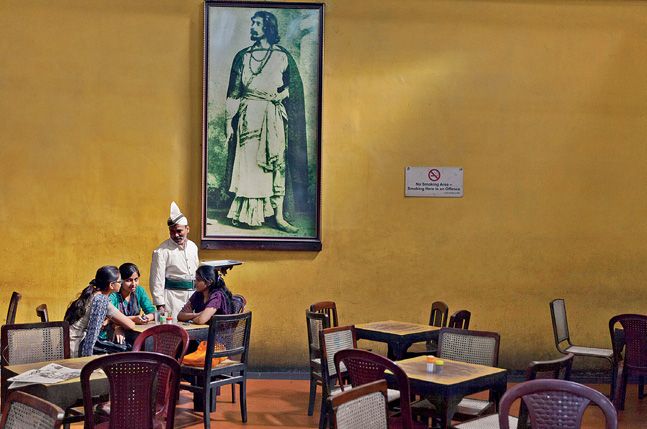
A waiter serves schoolgirls beneath a portrait of Rabindranath Tagore in the Indian Coffee House, Kolkata, 2013

Freedman's images do not shy away from this plainness, or signs of age: the peeling walls, the fraying pockets of uniforms, the blackened switchboards, table legs balanced in empty Amul cheese tins. But his gaze is affectionate, forgiving, even celebratory. Even a fly sitting in a bowl of sugar seems innocuous, yet another visitor to the Coffee House who hasn't been turned away. "I'm not romantic about India, the nonsense about elephants and maharajas. But there is a romance about what the Coffee Houses allow people to do. You can sit all afternoon with a cup of coffee and no one's going to tell you to leave," Freedman says. "I'm from Hackney, from a working class background. The Coffee House became this kind of translation device for me because I saw the same people there as in the cafes at home."

Of course, Coffee Houses are not all the same. "South Indian ones have much more substantial food," says Freedman. And one Coffee House might cater to different constituencies: retired old men, college students, middle-aged couples or a family on a ritual outing, young lovebirds. But what all these people are likely to have in common is that they are lower middle class.

Men sit and talk in the Indian Coffee House, Baba Kharak Singh Marg, New Delhi, 2010

Freedman is clearly drawn to places that democratise leisure. If England's greasy spoon cafes summon up an era of post-war rationing that he didn't quite witness, his book on another dying British institution, the Eel, Pie and Mash shop, "is really about [his] past" and "that section of London's working class that feels dislocated". He has also photographed the cafes of Cairo "as a way to examine the Egyptian revolution". Does he see Indian Coffee Houses as resisting the neoliberal economy? "Modern cities privatise space," Freedman agrees. "Places where people gather and are not monetised like Starbucks are places where people discuss. And discussion is dangerous to the state. Indira Gandhi knew this; she closed the Coffee House during Emergency, saying it was seditious."

Indian Coffee House, Chandigarh, India, 2013

What also makes the Indian Coffee Houses unique is that they are worker-run. In the 1950s, after the Coffee Board decided to privatise 43 outlets and fired many employees, the workers formed cooperative societies and persuaded the management to let them run the outlets.

Freedman's many superb portraits of waiters and kitchen staff are testament to the wonderful sense of ownership that pervades the Coffee Houses as a result. In one image in Palaces, a frail old man in a dhoti sits with his back to a man in collared shirt and trousers. As they raise their identical cups of coffee to their lips, one has the sense of a world in perfect balance, something sadly missing in the world outside.

28 June 2017

Cinema in the City

My Mirror column:

Watching films in the theatre used to be a sensory experience that extended beyond the screen, tied to rituals of urban life. Now the screen floats free, and so do we.


I made my acquaintance with Trivandrum’s single screen theatres during my first visit to the International Film Festival of Kerala (IFFK) in 2011. In Godard’s Own Country (2012), a longform Caravan essay on the IFFK and Kerala’s love of world cinema, I described some of them: “There is Ajanta, dense with the smell of rose petals, and with a pedestal fan that whirrs incessantly; Sreekumar, with a treacherous set of stairs in its balcony; the twinned Dhanya (big) and Remya (small); and Sree Padmanabha, for whom becoming an IFFK venue has been crucial in regaining the respectability it had lost as a softporn theatre in the ’90s. (Sree Padmanabha went all out in 2011, creating a two-minute laser display that played before each festival screening. The effort won it the ‘Best Theatre’ award.).”

I didn’t mention in the 2012 essay why I gravitated to Sree Padmanabha: in the dense warren of streets behind it was the finest, most well-priced Malayali lunch joint in the city, the inimitable Mubarak, serving up unlimited mounds of piping hot rice, veggies and moru curry — to which, with the merest incline of the head, one could add a steady chain of seafood accompaniments: perfectly crisp matthi, spicy squid fry, or the most delectable mussels. By not being held in a private enclosed space like INOX in Panjim, or a government-created auditorium complex like Siri Fort in Delhi, IFFK allowed visiting viewers, like myself, to explore the city through its cinemas, discovering not just their characterful architecture but also eateries near them, just by following my nose — and the crowd.

I also didn’t mention how I first learnt about Sree Padmanabha’s pornographic past. A few days after IFFK, chatting with my Kollam homestay host, I discovered he had actually worked as its manager for several years, helping end its seedy phase! His father’s connection with it was older — he had watched films there his entire childhood, and even now no expedition to Trivandrum was complete without a solo visit to Sree Padmanabha, including a snack and a soft drink.

I haven’t been back to Sree Padmanabha since 2013, but think of it fondly. So I was delighted, on opening Yesterday’s Films for Tomorrow, a newly released book by the late film archivist PK Nair, to discover its prehistory. “It was in the early 1940s, the height of the War period. I must have been hardly eight years old,” writes Nair. “The venue: a tent cinema in Trivandrum’s Putharikandam Maidan, almost the same location as the present Sree Padmanabha theatre. Nearly half the hall was filled with immaculate shining white sand, probably got from the local beach. This was the lowest priced seating, classified as ‘floor’. Just behind was the ‘bench’ class packed with wooden benches, and further behind was the highest class with folding wooden chairs.”

Nair’s nostalgia is jocular and precise, listing the “half-wall” against which floor-sitters vied to rest their backs, the “women's barricades” for “your wife and kids” (the assumed viewer and reader is a man, of course), and the “hawker boys” who roamed freely through the hall, “canvassing aggressively” to sell their beedis and cigarettes, soda or peanuts during the many short intervals (A single projector necessitated five or six breaks between reels).

Given his father’s certified disapproval of cinema (typical of that generation of educated nationalists), Nair took to sneaking out when the family was asleep, begging the doorman at Sree Padmanabha or Chitra to let him in to the last hour of the late night show. “[L]ater I would catch up with what I had missed at a matinee show on the weekend.” “Perhaps such lopsided viewings in repetition enabled me to look at films more objectively and sharpened my critical faculties even as a school kid,” he muses.

Nair’s spare reminiscences reminded me of a more extravagant account of childhood film viewing: the late theatre doyen Habib Tanvir on Raipur’s Big Top theatre. Tanvir, like Nair, watched many films for free; he and his friends would slash the tent with a razor blade and sneak into shows where half the audience’s enjoyment came from the vulgar, funny running commentary provided by the co-owner, Chunnilal: “Oye, what are you standing around for, motherfucker, the villain will kill your heroine. Bastard, make the horse go faster, faster, you idiot!”

Nair and Tanvir’s memoirs reveal how inexorably film-watching was once tied to places and people — the physical experience of the theatre, the particular doorman or commentator, the food you ate after. Now a film can play anytime we want it to, often opening up on a screen that we carry around with us. Watching a film this way no longer leads us into the city; just back into ourselves.


Published in Mumbai Mirror, 25 June 2017.

21 June 2017

Alone Together

My Mirror column:

Living in collectivities can not only produce new relationships, but also new forms of individuality, as two powerful European films reveal.


I write this column from a friend’s charming old wooden Himachali house: a huge open balcony to welcome the sun and tightly shuttered rooms to block out the cold. The house is only opened for the summer, when she retreats here from the heat and dust of Delhi, bringing a variety of people with her. This summer’s assemblage consists of the friend, her 15-month-old baby, her 50-something male friend (whom I met here), the baby’s 18-year-old maid, and me. There are also two friendly locals who come in to help with provisions, cleaning and additional babysitting. Barring occasional expeditions to the river or the village, the emotional and material life of the household revolves around the next meal, the cooking of which is subject to the all-important task of Feeding The Baby. It has been an interesting exercise in communal living.

Serendipitously, while I’ve been up here, two friends in Delhi have been calling with updates on their respective rental searches: where to live, is the question – and whom to live with? Most people share domestic space with others at some point in their lives. Middle class young people leaving family homes often move to organised communal quarters – school or college hostels, or shared university flats. Shared homes remain the norm in early careers, too, for financial reasons.

But if you’re single and can afford it, then living alone, it seems, is the unspoken top of the hierarchy. The older one gets, the more unusual it becomes to live with anyone who isn’t either family or a romantic partner. The socially normative heterosexual coupledom at the core of these living arrangements is so deeply embedded as to really only strike most of us in absentia.

It is true that once your personal rules are set, to live with others is to test the limits of your adaptability. Unlike youthful communal spaces, whose appeal often lies in the suspension of childhood’s rules (or in breaking institutional ones), shared domesticity in later life is likely be based on the establishment of new ones.

In Thomas Vinterberg’s The Commune (2016), an architecture professor called Erik Moller inherits a house he dismisses as too large for his family. “Living together is about seeing each other,” he says, telling a broker to sell it for a million. But his wife Anna and teenaged daughter Freja have other ideas. Anna loves Erik, but two decades in, she needs newness – and what better way to create it than by inviting new people into a new sort of domestic life? “You speak all the time, and it’s sweet when you do, but it’s as if I’ve heard it all before. I need to hear someone else speak, otherwise I’ll go mad,” she says to her befuddled husband, proposing that they turn the many-roomed mansion into a commune. Friends bring in other friends, and soon there is a collective, a united front interviewing potential applicants.

And so, without any rebuilding, a classically bourgeois European home becomes a space that challenges the norms of bourgeois family life. Decisions now are made not to preserve coupledom, but a more expansive domesticity. It is not that familial love ceases to exist, but rather that the commune allows difficult emotional burdens – like a child’s terminal disease – to be shared across more shoulders. Meanwhile new freedoms and new proximities mean that people fall into new relationships – and sometimes out of old ones. The self-important Erik, increasingly lonely as the commune fills Anna’s emotional needs, starts an affair with a student. Anna, shaken but deep in her own love affair with the commune, invites Erik’s lover into it, saying: “There should be room for you, too. That’s what it’s all about.”

I happened to watch The Commune within a day of watching Swiss-born director Hans Steinbichler’s 2016 German-language feature The Diary of Anne Frank, in which, too, an unlikely assortment of people find themselves holed up together – though in rather more involuntary circumstances. Steinbichler’s is the latest cinematic version of the famous diary, kept by the Jewish teenager during the Nazi-ruled wartime years that she and her family lived hidden above a workshop. Unlike the deliberate newness inaugurated in The Commune, the Franks’ communal life in the annex strives to recreate their home. It is a forced exile into which they take as many possible accoutrements of their bourgeois life, from clothes and dinner sets to books and the writing instruments that make possible Anne’s startlingly frank record of emerging selfhood.

These things – the thingness of these things – help sustain something of the illusion of normalcy, but life in the commune produces its own effects. There is something about the inauguration of a collective domestic arrangement with people you wouldn’t ordinarily expect to live with that pushes buttons and expands boundaries. We are far from the free-spirited world of Vinterberg’s childhood memories, but here, too, the new freedoms and new proximities conjure new relationships – and alter old ones.

The communal life certainly allows for more openness than the traditional family unit, and yet in its difference, it can feel closed off from the world. Both the teenaged Freja in The Commune and the teenaged Anne develop an enhanced sense of privacy, not just because they are exploring their sexuality, but because they are beginning to see themselves as separate from their parents. The breakdown of the old family unit perhaps also enables each of the girls to see her parents separately, as individuals. Embracing the collective, it turns out, can be strangely individuating.


Published in Mumbai Mirror, 18 June 2017.

14 November 2016

Bombay Continental

(A piece for Mumbai Mirror's 'Relative Value' section, as Gaylord Restaurant turns 60.)

It may be hard to digest for die-hard Bombaywallas, but the credit for what might be one of the city’s most iconic eateries goes to a Delhi-based family.


On November 16 this year, when Gaylord restaurant in Churchgate turns 60, Sunil Lamba and his sons, Dhruv and Divij, will have flown in from Delhi to play hosts at the birthday party. Gaylord is the sprightliest of sexagenarians: unafraid to flaunt its age, and yet wearing the years lightly.

Established in 1956 by the late Pishori Lal Lamba along with his friend and brother-in-law Iqbal Ghai, Gaylord was the second offering from the partnership that had already given India the Kwality brand. “My grandfather and his brother-in-law were living in a crowded dwelling with 20 people in Connaught Place. They had no background in food,” says Divij, “To make ends meet, they started a little outlet selling chips and eggs to people that came out of Regal Cinema (in Delhi).” From that single cornerstone of British working-class cuisine, the Ghai-Lambas (as they were known until they split in 1978) graduated to a more varied menu. The first Kwality Restaurant came up in the same spot as the shop, and was also where the duo first began selling ice-cream (often whole bricks of Cassatta and Tutti-Frutti) to Delhi’s population of American GIs: private soldiers in the US army stationed in Delhi during World War II, whose non-fighting duties afforded them both time and money for the pleasures of 1940s India.

The Gaylord brand was launched in Connaught Place in 1952, followed by Churchgate in 1956. It was pitched a notch higher than Kwality in style and expensiveness. “It was almost 5 to 6,000 square feet, it had that grandeur,” remembers Sunil. In both cities, it swiftly became the place to be seen for the sophisticated Indian diner, and it was only a short step to the creation of a Gaylord’s in London. The London branch served only the Indian menu, but its huge popular cachet — with visitors ranging from Peter Sellers to Ravi Shankar to George Harrison — soon produced an international Gaylord network, with outposts as far-flung as Trinidad and Kobe. “They didn't want us to invest money — which in those license raj days was impossible anyway. Just the name. And the recipes. And our chefs were sent,” says Sunil.

In Gaylord’s heyday, there weren’t many fine dining options. “So Gaylord was the gathering place for people in politics, business, arts and film, and for family events, the arranging of marriages, and so on. Also, it was a breakfast, lunch, teatime and dinner-time place, plus a nightclub — all bundled up in one,” says Divij, who handles the company’s Bread & More chain of bakeries.

“Nowadays, in the daytime, people probably don’t want to spend more than 300-400 rupees,” Sunil points out. “And there is also this idea of not eating rich food, especially in the day.” The Bake Shop, started about two decades ago, is the attraction for a younger crowd, but innovation in the direction of healthier, cafe-style dishes is essential, even with Gaylord’s loyal customers. “We go through our menu every year, remove nonsellers, and add on new innovative dishes,” says Dhruv, who handles Gaylord Mumbai in conjunction with its longtime Mumbai-based staff – CEO, AN Malhotra and General Manager, Noel D’Souza.

But Gaylord’s list of most popular dishes is still topped by the Butter Chicken (“North Indian food is less easily available in Mumbai than in Delhi; a lot of our Parsi customers come for that,” says Sunil). Continental classics like the Chicken Chasseur (chicken in a demi-glace sauce with mushrooms and green pepper, which happens to be Sunil’s staple order), the Pomfret Meuniere (a fillet of pomfret with lemon butter sauce, which is Divij’s favourite) and the Roast Lamb (serves with mint sauce and potatoes) also retain their loyal customers. Unlike many others of its ilk, Gaylord proudly retains its cream-based sauces (like the Chicken Cecilia), its baked cheese dishes (like the Lobster Thermidor, beloved of the legendary columnist Busybee) and the Chicken a la Kiev — whose delicious sinfulness has meant its unceremonious removal from more timid 21st century menus. Dhruv is currently excited about the 60 Year Nostalgia Menu, with popular favourites from the last six decades, including a Tawa Kheema Kaleji and a Banana Split that takes us right back to the GI era.

“We’re also launching a special 60 year label for Gaylord wine — a tie-up with Fratelli,” Dhruv says. “When the restaurant began in 1956, we didn’t serve liquor. It was only in the 70s that we could get alcohol licenses,” remembers Sunil, who returned from Cornell in 1974 and married his Bombaybred wife soon thereafter. “I didn't know this!” exclaims Divij, who trained as a sommelier alongside an early career in public policy. “Imagine all these people dancing to the Spanish band without alcohol. Conversing over coffee and patties! It’s amazing that an era like that existed.”

The cosmopolitan clientele to which Gaylord originally catered was an Indian elite that had come of age in a colonial moment, plus a generous sprinkling of foreigners who frequented what was then Bombay. “[Gaylord] was always this mix of Indian and Continental. Earlier there was also Chinese on the menu,” says Sunil, whose own youthful tastes ran to East Asian food (and who was later involved with the company’s Chopsticks brand). The restaurant’s Continental menu was meant to recreate colonial club food: in Divij’s words, “what the British would have had in gymkhanas all over India, stuff that reminded them of home, yet adapted to the local cuisine.”

Now, the company’s catering business (overseen by Dhruv) runs the kitchens of several old-style clubs: the Delhi Gymkhana, the Vasant Vihar Club and the naval officers’ clubs. The subcontinent has come full-circle.

Published in Mumbai Mirror, 13 Nov 2016.

15 June 2015

Post Facto: Wake up and smell the fish: perfume and plebeian stinks

My Sunday Guardian column this month:


"When he regained consciousness, the first thing that hit Ali was the smell of fish. Rich, pungent and briny — with a hint of decay. This was not the mild, innocent fish that was tandooried every evening by his neighbourhood kebab vendor. This was formidable fish, fish that boldly declared its presence, fish that, once consumed, would stamp itself on you at the cellular level and define your character in strange, unpredictable ways. This was fish whose odour could transform, cleanse and purify you."

That’s a passage from Shovon Chowdhury’s superbly funny 2013 novel, The Competent AuthorityDescribing a smell is a great way to transport the reader. It’s even better when you have a time-travelling protagonist just coming to, in a place he doesn’t recognise. We’re forced to think on our feet, like Ali. We inhale the very air he’s breathing, until the smell reveals where we are. Of course, it’s Calcutta.

Smell really is about time-travel. Most people will have had the uncanny experience of entering a place for the first time and having their nostrils assailed by a deep, distinctive sense of familiarity. A trace of some remembered scent is often all that’s needed to throw one into another space, another time. The whiff of mothballs in a long-closed cupboard, the steamy smell of starched clothes being ironed, the damp Cuticura scent of a swimming pool changing-room — these are smells that can propel me with unstoppable force into my own Calcutta childhood.

Eventually, though, those are mild smells. Let us return to fish, which is the very definition of odorousness — to many people, not in a good way. The very expression “smelling fishy” suggests dubiousness, odd though it is that the phrase comes to us from an island whose biggest culinary export to the world is fish and chips. But then fish-eating doesn’t necessarily acclimatise people to the smell of fish. In his 1950s travelogue Aakhiri Chattan Tak, recently translated as To the Farthest Rock, the Hindi writer Mohan Rakesh returns to Mumbai after a mere two-year gap, and is confused by “the overpowering smell of fish”. As Vir Sanghvi recently wrote in an accusatory column, North Indians seem to want to eat fish without the taste and smell of it.

Some of this aversion to strong smells is directly proportional to the degree of our post-liberalisation poshness. Even in Mumbai, where Sanghvi would agree with Rakesh that “the smell of fish was never very far away” some decades back, fish-buying has now become a “plastic-wrapped affair”. And when Sanghvi applauds the Bengali man for treating fish-buying as a sacred ritual, one can only wonder how long this proud act of baajaar will hold out against gentrification’s olfactory dictates.

I was surprised that Sanghvi didn’t mention the Malayalis, the other grand fish-eating, fish-inhaling community in the country. I sometimes think of Malayalis and Bengalis as engaged in a silent fish-eating contest, one which occasionally breaks out into fervent arguments about sea fish versus river fish. Then comes the invariable question of frying fish before putting it in a curry, and both sides decide there’s no point talking. Cue return to the silent contest. (In case you’re wondering, other fish-eaters — Maharashtra, Kashmir, Assam, and so on — are barred from competing.)

Anyway. I recently watched a Malayalam play called Matthi, where the sharp smell of fish was key to innovative stagecraft. The LTG Auditorium in Delhi was redolent of sardines when we took our seats. “Yes, the name of this small, cheap and popular fish is Matthi. A poor fish. Not to chide you, but some things have to be said to make people understand,” said the supertitles. As in Seema Pahwa’s wonderful one-woman show Saag Meat, the eponymous item was cooked on stage, and offered to the audience afterwards. Although wrecked by an inchoate politics that bundled a maudlin working class nostalgia with anti-outsider prejudice, the play managed to make the tang of matthi a stand-in for the life of the poor. “Don’t wash off the smell using soap,” one character urged the other. “Some smells remain even after us,” said another man.

Some smells certainly do. The writer Mrinal Pande has often spoken of how the lack of ventilation in the old-style Pahari houses of her childhood gave rise to a specialised vocabulary of smell. There was a word for the stench of burnt cloth, a word for the lingering odour of urine, and so on.

But if some smells are hard to get rid of, we have also spent millennia producing substances that can transform how we smell. In Delhi this January, the historian Emma Flatt spoke on the multifarious perfume palette of the medieval Deccan. According to the Itr-I-Nauras-Shahi, a remarkable treatise on perfumery written for legendary Bijapur sultan Ibrahim Adil Shah, it was “incumbent that all created beings, particularly the followers of the Prophet, use perfumes and share them with one another.” Deccani poetry suggests that floral smells, like rose and jasmine, were prized, as were animal compounds like musk and amber. Paan was highly approved: bad breath didn’t just indicate lack of etiquette, but of social status. Of course, as Flatt pointed out, perfumes and unguents were—and are—a luxury. But if poorer people smell stronger, it’s not because they can’t afford perfumes. It’s because work means sweat, and they don’t have the luxury of spending their summers in fragrant khus-cooled (or air-dried) chambers. And so, to the many privileges of the rich, is added that of smelling better than the poor. And coining phrases like “the great unwashed”.

1 September 2014

Morning Glory: Calicut's fuss-free breakfasts

Months after a breakfast-heavy Kerala trip, a brief recounting for Nat Geo Traveller magazine: 


Mutton stew and fiery fish curry are traditional accompaniments to appams. Photo: Simon Reddy/Alamy/Indiapicture
I was due to arrive in Calicut (Kozhikode) early in the morning, en route to Wayanad’s thickly forested hills. I had only a couple of hours to spare. Anticipating a rumbling tummy when I got off the train, I asked
 a friend to recommend a place
 for breakfast, something near 
the railway station that would
 be open at 6 a.m. “Not near the station,” he texted back, “inside it.”
That was my introduction 
to Hotel Salkara on platform number one—and to the seaside city with breakfasts as bracing as its ocean breezes. 
By 6.35 the next morning, 
my companion and I were ensconced at a Salkara corner table, our two small strolley bags standing flat against the wall 
so they wouldn’t get in the way 
of the waiters striding about at top speed. Salkara is run by the same people who own Paragon, an old Calicut institution known for its lush beef fry and Malabari biryani. Like its more famous sibling, Salkara’s decor is spotless, but functional, with rows of plastic chairs and tables on a gleaming tiled floor. This no-frills style, I soon discovered, was typical of Calicut’s eateries. The focus here is solely on the food. Within minutes of our arrival, we had steaming appams with two delicious accompaniments: a richly flavoured egg roast (hard-boiled eggs in a chunky onion-tomato gravy) and a subtle kadala curry, black Bengal gram cooked with onions, curry leaves, and shredded coconut. By 7 a.m., we were done—and only because we dawdled over our filter coffee.
Rice is the star of the Malayali breakfast menu. Photo: STA/Shutterstock

The humble grain (Rice) takes on numerous avatar, including appams, string hoppers, and puttu. Photo: AJP/Shutterstock

Three days later, after the quiet of Wayanad’s forests, we were back in buzzing Calicut. And I couldn’t wait to have breakfast. We made our way to Paragon, expecting crowds, even a queue. But the branch we visited on Kannur Road was pleasantly relaxed. At the table next to ours, a middle-aged man was tearing methodically into a gigantic dosa. We gave in to greed, ordering both a ghee roast dosa and a plate of appams with mutton stew. The dosa was great, but breakfast at paragon really is all about appams. Crisp and lacy around the edges and soft in the middle, they looked like bowls because of the deep tawa they’re cooked on. The fluffy centres sopped up the silky mutton stew perfectly. We left promising to return for Paragon’s legendary biryani and mango fish curry.
Next morning, we abandoned the hotel’s complimentary buffet for the next stop on our Calicut breakfast pilgrimage. Though I like stuffed parathas and kachori- samosa-jalebi as much as the next person, all the force of my half-North Indian blood can’t make me eat them at 8 a.m. Good half-Bengali though I am, I can’t eat rice in the morning either. But once rice has been magically transformed into dosa and idli, appam and puttu (rice flour steamed with grated coconut)
 by the infinite Malayali genius, it feels like the perfect thing to eat at breakfast.
Pillai Snacks, on the busy Kallai Road, seemed like the ideal stop en route to the Tali temple. It was a long, narrow space crammed with tables and customers on their way to work. We began with idlis and kutti dosas, fluffy mini uthappams that seemed to be on everyone’s plates. Then we ate our way through a massive, milky-white mound of upma on a green banana leaf, had a vada each with thick, spicy coconut chutney, and rounded off our meal with a plate of pazham puzhungiyathu, steamed Kerala bananas steamed to golden perfection and sweetened with sugar.
Somehow we managed the 15-minute walk to the temple, but it was hard to summon up energy for anything with that breakfast sitting in my stomach. So I settled down in a shady corner and watched sari-clad women lead little girls in pavadais (long skirts) around the Shiva shrine and the courtyard.
Calicut has many culinary icons, but there are also surprises around the corner. On our way back from the Kadalundi Bird Sanctuary, we stopped at a 
little bakery for flaky, spicy egg puffs and ice-cold milkshakes. There was a luscious avocado (butterfruit) smoothie, but the real winner was the Sharjah shake, made with milk straight from the freezer, blended with banana, coffee powder, sugar, and Horlicks. The sugar rush continued on the walk along S.M. Street, where several
 shops sell the dense, rich Calicut black halwa.
Work up an appetite for a big Kerala breakfast with a walk along Kozhikode beach. Photo: Luis Davilla/Dinodia

On our final morning in the city, we took a long stroll on the beach, working up a voracious appetite. We considered returning to Paragon, but decided to try Sagar Hotel, another local icon, instead. Thinking we should end the trip the way it had begun, we ordered appams with kadala curry. But then we looked at what everyone else was eating: pungent gravy the colour of red earth. Wasn’t 8 a.m. a bit early for fish curry?
Round off the meal with Kumbiappams, steamed dumplings made of rice flour, jaggery, and coconut. Photo: STA/Shutterstock

We got only one plate, and with it, a green gram curry and a plate of puttu. The gram was subtle and creamy without being heavy, but it was no match for the ayyakoora (kingfish) in a fiery-red curry redolent with the sourness of kudampuli (Malabar tamarind). If a breakfast like that doesn’t put a fire in your belly, nothing will. On my next trip to Calicut, I know where I’m starting.