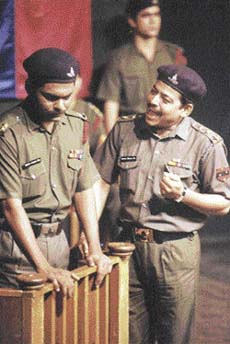
My review of Sunil Shanbag's marvellous play, published in the new Kolkata-based performing arts magazine, Avantika.
We’re used to thinking of music as an aid to theatre, something that underscores the mood of a dramatic performance, perhaps even alters it. But Sunil Shanbag’s new production uses theatrical performance as a route into the multiple worlds of Indian music. It is a reversal without precedent, at least in India. The result of an enormously productive artistic collaboration between Shanbag and musicians Shubha Mudgal and Anish Pradhan,
Stories in a Song makes for scintillating theatre. Shanbag has long been invested in the theatrical tradition of live music – in 2007 he staged a musical adaptation of Brecht’s
Threepenny Opera at the Prithvi Festival with 16 songs – but the idea of telling stories of music through theatre came from Mudgal, who also did the research and composed or selected the music together with Pradhan.
Stories in a Song is unusual because it is neither a single narrative, nor even a collection of interconnected vignettes. It plays out as a series of dramatised anecdotes, unconnected to each other, but for the fact that each brings to life a specific moment in what we might call the social history of music.
The first of these ‘moments’ is the least fleshed out. The women on stage chanting in Pali are meant to represent the Elder Nuns, the Theri, who gave their name to the
Therigatha, a collection of short poems recited by early members of the Buddhist Sangha around 600 BC. We are informed that the Therigatha is the earliest collection of women’s literature. But the performance doesn’t give us a sense of the content of the verses, apparently composed in the voices of women dealing with individual yet deeply universal experiences: the song of a mother whose child has died, the song of a prostitute who becomes a nun, or that of a wealthy woman who abandons her once-luxurious life.
From a musical experience bound up with faith, self-realization and withdrawal from the material world, we leap into the very worldly space of a kotha in early 20th century Banaras. Adapted from Amritlal Nagar’s story 'Yeh Kothewaliyan' by Aslam Pervez, this second segment of the play tells of an encounter between Gandhi and the tawaifs of Banaras. A famed courtesan’s musical performance is interrupted by social reformers who think of tawaifs and their music as morally reprehensible. She puts up a spirited fight, but the tawaif community is increasingly beleaguered by rising middle class morality. Until Mahatma Gandhi himself makes a public statement to the effect that no profession should be condemned if it is practiced honestly. The grateful tawaifs continue to sing, gladly adding patriotic songs to their repertoires.
The next episode is called ‘Chandni Begum’. Ashok Mishra’s adaptation draws on Qurratulain Haider’s Lucknow-set novel of the same name to bring to life a family of folk performers who are attempting to survive in a world without nawabi patronage. It’s a snapshot which somehow succeeds in not feeling hurried. It is also remarkable for the acuteness with which it juggles parallel emotional tracks. Our introduction to Mogrey Master, his wife Chandbeli Begum, their comedian son (“
mendhakon ki ladai ki asli awaaz nikaal kar dil jeet letein hai”) and daughter Bela “singer and poetess” may be outwardly comic, but the narrative is tinged with an urgent despair that manages to communicate itself perfectly despite our laughter: in Nishi Doshi’s poised performance, we see Bela’s use of her beauty as both crutch and object of barter, her quiet but rising desperation.
A woman is at the forefront of the next piece, too, but here the register is very different indeed. From the nuanced, literary evocativeness of Qurratulain Haider we jump into the broad folksy humour and energetic physicality of nautanki: an excerpt from
Bahadur Ladki (The Brave Girl), credited to the legendary nautanki performer Gulab Bai (b. 1926). The Great Gulab Theatrical Company, which she founded in 1955, still tours the Hindi heartland with its famous nautanki productions. Set in colonial India, this piece focuses on a courageous young village girl who stands up to a lecherous English officer. The heroine is brave and virtuous, the villain is ridiculously villainous. There is little space here for nuance – but the pleasure is in the feisty, joyful recreation of a largely rural theatrical form by a cast of metropolitan actors (especially the marvellous Ketaki Thatte) without a hint of condescension.
The theme of women making music is taken up again in the memorable ‘Hindustani Airs’. The cross-cultural encounter here is also profoundly colonial, but more recognizable for a contemporary audience. Written by Vikram Phukan, it presents a fictional meeting between a Lady Isabella Hardinge who wishes to collect and transcribe what she calls ‘Hindustani airs’, and sends for an accomplished
tawaif called Khanum Jaan to sing for her, so she might pick up the essence of the melodies – and put them down on paper. Piya Sukanya plays the memsahib as harmless but oblivious: to her gracious guest’s social and economic status (she wonders about her sleeping on the floor, while the
tawaif chuckles to herself, thinking of her luxurious quarters), to the spontaneous innovative interpretation of the melody by the singer that makes Indian music what it is, and most of all, to Khanum Jaan’s increasing sense that she is talking to a fool. But what is charming about the piece is that Phukan refuses to close on a negative note: even as the long-suffering Khanum (the charming Mansi Multani) winks and nudges the willing audience easily onto her side of things, a window is left open for us to see how the abyss of otherness might be bridged in a moment.
The next piece, ‘Whose Music Is It?’, also written by Phukan, tracks the journey of a song through different musical worlds in India: from the
guru-shishya parampara to the commercial studio, with the versatile Ketaki Thatte transforming effortlessly from ‘Bahadur Ladki’ to a hesitant classical music shishyaa. The piece is enjoyable enough, but stays at the level of caricature.
The glorious final segment, however, more than compensates. Drawing on Dr. Arjundas Kesri’s
Kajri Mirjapur Sarnaam, it recreates what’s called a
kajri dangal: a competition where the different
kajri akhadas, or schools of kajri singing, battle it out for top honours in kajri writing and singing. Here, as in ‘Bahadur Ladki’, Namit Das walks away with the applause. There it is his evil afsar singing nautanki lyrics Angrezi-style, here it is the reverse: his rendition of a
kajri in English.
In fact, Shanbag’s cast of actors is uniformly excellent. What is even more astounding is the passion and interpretive wit they bring to each of the musical renditions: from the bandish performed by the guru in ‘Whose Music’ to Pia Sukanya’s operatic aria in ‘Hindustani Airs’, each piece is performed in a superbly expressive way – ironically, a feat that most musicians may not be able to emulate.
The anecdote, as every
rasik knows, is the most popular way in which the knowledge of and love for Hindustani music is passed on. Sheila Dhar’s brilliant
Raga’n Josh: Stories from a Musical Life (2005) took a lot of the best stories she had told and retold over the years and immortalised them in prose: from Siddheshwari Bai’s impromptu rendition of the English ‘My love is a little bird’ in thumri style at the advent of the British Chief Commissioner to Bhimsen Joshi’s imagined performance of Malkaus at the Harballabh festival. The anecdotes brought to life by
Stories in a Song manage to achieve a similar richness and communicative power. May the shows never end.