Showing posts with label Sai Paranjpye. Show all posts

28 June 2021

Saving the tiger and wildlife will take more than a few Shernis

My TOI Plus column:

The man-animal conflict in India is a complex, burgeoning problem, and one that is left unaddressed both by our national forest policy and by our mainstream politics
 

https://images.hindustantimes.com/img/2021/06/17/550x309/vidya_balan_sherni_1623932168804_1623932179349.jpg
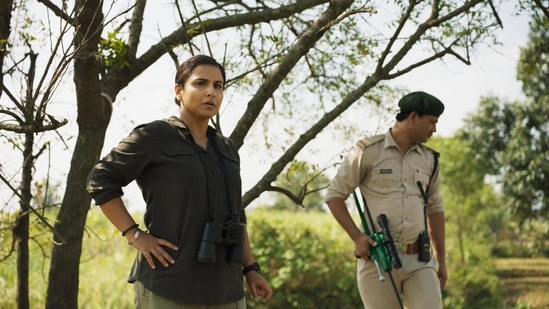
Vidya Balan plays an ethical Indian forest service officer in Sherni (2021)

Amit Masurkar's new film Sherni has some things in common with his award-winning 2017 film Newton -- the central Indian jungle setting, the town-bred government official working against the odds in an unfamiliar setting, and unlikely collaborations among people striving towards something larger than themselves. The plot in one sentence: When a tigress named T2 starts to attack villagers in the vicinity of a Protected Forest area, an idealistic new forest officer named Vidya Vincent (Vidya Balan) struggles to prevent more human deaths, while also keeping her thoughtless, corrupt bosses from letting a self-appointed hunting hero kill the tigress.

Where Newton tackled the state of Indian democracy with pitch-dark humour and a sometimes-manic edge, Sherni approaches the tragic impasse of environmental conservation with enthusiastic sincerity, tempered by something akin to haplessness.

Perhaps that is inevitable, given that the man-animal conflict in India is a complex, burgeoning problem, and one whose roots are left unaddressed both by our national forest policy and by our mainstream politics.

To try and summarise a complicated history: India spent the first 25 years after Independence wooing parties of tiger-hunting foreign tourists, getting them to pay for the privilege of what sahibs and maharajas had always done. A 1964 New York Times article reported 15 government-approved jungle camps (up from only three in 1954) that organised these expensive shikar holidays, complete with “clean, tasty Western-style food” and liquor. “It is estimated that 3,000 tigers roam the forests, and they are multiplying fast enough to support the present shooting rate of about 300 a year,” the NYT declared.

That proved catastrophically untrue, and in 1972, the government did an about-turn. According to a 2017 article by the Kumaon-based butterfly expert Peter Smetacek, a group of hunters and naturalists had petitioned for a three-year break from tiger hunting to let populations recover, but in response Indira Gandhi's government promulgated the Wildlife Protection Act, under which hunting of any species was banned permanently.

Smetacek, like some others, has questioned the wisdom of this wholesale outlawing of hunting. For one, it made it illegal for farmers to protect their hard-earned crops from incursions by wild boar, monkeys, porcupines, nilgai, bears or birds without permission from a forest officer, pitting locals against the animal world they had cohabited with, while leaving them at the mercy of a corrupt state.

Also, if hunting was strictly regulated instead of being banned, allowing permit-based hunting of animals whose populations were growing too large, we would actually have records of animal populations besides the tiger -- and in fact be able to track and respond better to their declining numbers. That suggestion, outlandish and violent as it may sound to those who of us brought up in a sanitised modernity alienated from the ways of the wild, may be just the starting point we need to rethink the simplistic, often counterproductive legal regimes that have failed in practice to protect our forests.

Few Indian films before Sherni have engaged with this difficult terrain. In Anay Tarnekar's brilliant 2016 short The Kill, a poor adivasi man's deep, reverential knowledge of the jungle and the tiger goes from being a useless, non-monetisable asset to the only thing he can sell – but at a terrible cost.

In 1994, Sai Paranjpye made the sweet, well-intentioned, Chipko-inspired feature Papeeha, where her daughter Winnie Paranjpye played an anthropologist representing the tribal perspective on living in and off and with the forest, cast alongside a forest officer hero (Milind Gunaji) and a series of corrupt forest officer villains who run clandestine logging businesses.

A year earlier, in 1993, Pradip Krishen had made a film called Electric Moon (scripted by his then-partner Arundhati Roy), which takes a more sideways, ironic look at the situation. The film's central protagonists are a family of fading Indian royals who run a wildlife resort catering to foreign tourists, selling tiger hunting as an Orientalist fantasy, while responding to the new Hindi-speaking forest officer (Naseeruddin Shah) with snobbish class outrage. The humour is spot-on, as is the context: many Indian princely families who had once pursued hunting, often in forests that were part of their own territories, did indeed make this transition to being conservationists. It was a mixed metamorphosis that allowed them to retain their privileged relationship to the wild -- sometimes speaking legitimately from a place of knowledge, and sometimes just bending the rules for themselves.

The other film Sherni made me think of is Bhuvan Shome, Mrinal Sen's 1969 New Wave classic. Sen's film isn't intended as a realist comment on anything, certainly not on Indian wildlife policy. Yet, at its centre, is a man on a hunting expedition, who ends up not killing a single duck – and handing over the single one he brings down to a young girl he has become fond of.

Utpal Dutt sets out to hunt birds in Mrinal Sen's New Wave classic, Bhuvan Shome (1969)

Further, Sen's marvellous lightness of touch achieves much more than what that narrative outline suggests. Utpal Dutt, acting the grand hunter with his sola topi and rifle, is actually a tragicomic figure. The anglicised Bengali bureaucrat out of his depth in the Gujarati rural desert landscape represents not just bureaucratic mechanisation and urban dessication, but also a State totally disconnected from ordinary people's lives.

The low-level chai-paani bribes that Bhuvan Shome so sternly polices, and Mrinal Sen treats with comic indulgence, are still not the primary enemy. Nor is the biggest enemy the still-surviving big game hunter, who is given a little too much play in Sherni, perhaps understandably because a film needs a villain.

The problem is that out-of-touch State. Under cover of 'development', that State now cuts secret deals to give away our rivers and mines and forests to big men. It postures as a protector, but its grand diktats only cut off the deep, pre-modern, symbiotic relationships on which our forests managed to thrive for generations -- leaving both people and nature vulnerable to the worst kind of short-sighted profit motive. We cannot conserve our wildlife – or any heritage, actually – if we continue to treat those who live beside it as errant, trespassing children, rather than as dignified, proud, well-paid stakeholders.

Humans and animals have lived together before. We could do so again. But the task needs both intellect and courage.

Published in TOI Plus, Sun 27 Jun, 2021

27 November 2015

The Karma Chameleon: Saeed Jaffrey

My Mumbai Mirror column last week:

Saeed Jaffrey was that rare actor who could fit in seemingly anywhere -- and yet carved out a very specific niche for himself.


There are few actors in the annals of cinema who have straddled such different worlds as Saeed Jaffrey -- American theatre, British sitcoms, Indian art cinema and the commercial Bombay potboiler. Crucial to Jaffrey's chameleon-like ability to switch between these industries was his ability to sound both authentically British and authentically Indian. Language was key. 

A young Jaffrey was initiated simultaneously into acting and British-accented English at boarding schools in Mussoorie in the 1940s. He credited his refined Urdu to his time at Aligarh Muslim University, where he earned a BA and MA in history. In 1951, Jaffrey began his actual acting career by founding a theatre repertory company called Unity Theatre in Delhi.

The first production, a Jean Cocteau play, had Saeed in the lead opposite a young actress called Madhur Bahadur, with whom he promptly fell "madly in love". Madhur (later to become famous as an Indian cookery expert) left to study at the Royal Academy of Dramatic Arts, and Saeed followed. His first stint abroad was in the US, where he studied Speech and Drama at the Catholic University. Madhur married Saeed, and the couple spent the late 1950s between Washington DC and New York doing plays, working with Lee Strasberg's Acting Studio, while surviving off public relations and radio jobs, with everything from the New York Times' radio channel and the Government of India's Tourist Office. 

It was only in the mid-60s, after his marriage ended, that Jaffrey moved to London. There he remained for the rest of his life, moving gradually from theatre into cinema. Being a brown man in a largely white acting scene, it made complete (if depressing) sense that many of Jaffrey's early roles in English films had him playing servant, or at least second fiddle to the film's protagonists. Meanwhile, in Hindi cinema, his combination of mellifluous Urdu and BBC English lent itself to aristocratic -- or at least upper class -- characters. 

So, for instance, one of Jaffrey's first big international roles was in John Huston's adaptation of Kipling's colonial fantasy, The Man Who Would Be King, where he starred (alongside such grandees as Michael Caine and Sean Connery) as Gurkha soldier Billy Fish, who becomes the primary interpreter between the British soldiers and the Afghan villagers with his ungrammatical pidgin English. 

His start in the Indian film industry could not have been more different. In Satyajit Ray's Shatranj ke Khiladi (1978), Jaffrey played a leisure-loving noblemen of the Awadh court. The film is set in the period of Nawab Wajid Ali Shah, when the Lucknow court was seen as the acme of culture, and Jaffrey's mellifluous Urdu was integral to his deliciously circumspect turn as Mir Raushan Ali: a man happy to turn a blind eye to his wife's amorous adventures, matters of state, and even matters of death, so long as he is free to carry on what has become to him the real business of life —the eating of paan, and the playing of chess. 

Jaffrey's networks were wide by now, and he earned the rewards. Getting to know Richard Attenborough, who played General Outram in Shatranj Ke Khiladi, landed him a role as Sardar Patel in the Oscar-winning Gandhi. His friendship with Ismail Merchant and James Ivory, who in fact met through the Jaffreys in New York, led to several roles in their films. 

Indian audiences began to recognise him after blockbusters like Raj Kapoor's last film Ram Teri Ganga Maili (1985), where he played Rajiv Kapoor's Kunj Mausa with an entertaining touch of camp. But my most enduring memory of Jaffrey in a commercial Hindi film is his performance as the khaandaani raees industrialist Mehra in Indra Kumar's 1990 hit Dil. The film's romantic track between Aamir Khan and Madhuri Dixit plays alongside a comic-dramatic track between their fathers played by Anupam Kher and Saeed Jaffrey. 

Kher is a small-time trader in recycled goods called Hazariprasad, who cons the super-rich Mehra (Jaffrey) into having his daughter marry Hazariprasad's son. Mehra's chief characteristic is immeasurable wealth, and so Jaffrey's 'entry' has him emerge from a chauffeur-driven car, surrounded by a posse of suits he is waving aside. "Pachaas lakh? Pachaas lakh is nothing... ", switching to English to achieve the desired dismissive effect: "It's peanuts. Do you know peanuts?" "Yes, sir, moongphali... " comes the baffled reply. There is something brilliantly believable about Jaffrey's presentation of self as both cultured old wealth and snazzily up-to-date. The pipe-smoking goes hand-in-hand with lavish temple donations and the morning run on the beach, with his executives panting alongside. 

While he may seem carelessly collegial over a shared bottle of whiskey at the club, Mehra is nothing if not conscious of status. The discovery that his prospective samdhi is a 'mere' kabaadiya is met by a brutal public put-down that almost turns him into the villain. This is followed by a Jaffrey not many had seen until then: a crazed patriarch with bloodshot eyes and a loaded gun. 

But the collegial air was one that Jaffrey drew on often. One of the best-known of these performances was as Delhi businessman Suri in Shekhar Kapur's first film Masoom (1980). As Naseeruddin Shah's close friend, Suri is emotionally unhelpful but warmly garrulous, most memorable for breaking into 'Huzoor Is Kadar Toh Na Itraa Ke Chaliye' at a Delhi house party. I've never seen anyone do a drunken-ghazal-duet better. 

His other classic 'Delhi' performance, of course, was Sai Paranjpye's Chashme Buddoor (1981), in which he played the friendly neighbourhood paanwaala to a trio of aspiring young Romeos, doling out cigarettes and romantic encouragement with equal joie de vivre. Jaffrey brought to Lallan Miyan his trademark linguistic brio, managing to be both lungi-clad and urbane at the same time.

As in all of Jaffrey's performances, he brought a puckish, comic touch to his more melancholy roles (think of Shatranj Ke Khiladi) and a raffishness to his comedy. But urbanity was perhaps Jaffrey's strongest suit, and he could achieve it in each milieu you set him in.
Published in Mumbai Mirror.

14 April 2013

Mocking 'filmi-ness': more on Chashme Buddoor

A guest column I did for Business Standard:

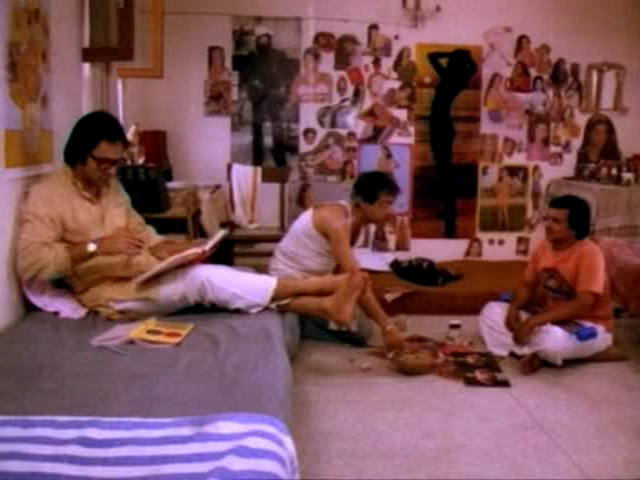
A still from Sai Paranjpye's Chashme Buddoor (1981)
Sai Paranjpye's Chashme Buddoor, a light-hearted and mild-mannered comedy which also gave us an unforgettably sweet romance between a bespectacled, padhaaku Farooq Shaikh and Deepti Naval as the irresistible but real girl next door, was recently restored and re-released in theatres alongside a new David Dhawan remake. A distressed Paranjpye has charged Dhawan with having killed her delicately funny film by injecting it with double entendres, bawdy jokes and a general crassness so antithetical to the sensibility of the original that to call the new Chashme Baddoor a remake was a travesty.

I watched both films last week, and I have to confess that while the old one has lost none of its delicate charm, the new one is a rambunctious and rather enjoyable ride. The new film, like the old one, centres on a trio of young men (inaugurating a whole Hindi film tradition of male friendship movies since). One is the sincere student who reads Economics textbooks for pleasure, while the other two spend their time gadding about the empty leafy avenues of 1980s Delhi in search of girls. Or to adopt the celebratory whoop with which they greet every sighting of young female flesh - "shikaar!". The reference to prey may sound shocking, but there's something about Omi and Jomo's unthreatening comicness that makes it not just alright but hilarious. And yet the indiscriminateness of their attentions is enough to indicate the unabashedly joyful sexual basis of their interest. Paranjpye's world may have been innocent, but it was not coy.

That frank vision of youthful (male) hormones is a clue to what made Chashme Buddoor such a remarkable film: its absolute outsiderness to the conventions of the Hindi movie - and even more, the quirky, tongue-in-cheek way in which it chooses to play with those conventions.

In 1981 - the year in which Chashme Buddoor released - the top 10 grossers at the Hindi box office included four Amitabh Bachchan starrers (Yaarana, Kaalia, Naseeb and Lawaaris) replete with dramatic father-son battles and villainous villains on whom revenge had to be wreaked. Other films in the top 10 were a colonial fable involving revolutionary Indian pirates and evil Britishers (Kranti), a reincarnation-revenge-romance (Kudrat), and two stories of star-crossed young lovers (Ek Duuje Ke Liye and Love Story). This was the cinematic universe that Chashme Buddoor emerged into - a universe whose high drama and heroic stunts it both distinguished itself from, and gently but thoroughly mocked. From the first scene, in which the Mehdi Hassan classic of the scorched heart Yeh dhuan sa kahan se uthta hai plays as accompaniment to our heroes' silent communion over a shared cigarette, to having them imagine their romantic conquests as a medley of old Hindi film songs, Chashme Buddoor never stops making fun of our filmi-ness.

Sai Paranjpye was not unique in this sort of mockery. The urban "middle class cinema", represented among others by Hrishikesh Mukherjee and Gulzar, enjoyed poking fun at the more unreal aspects of Hindi films. One of their favourite things to mock was the ubiquitous double role. Gulzar pushed it to its limits (and returned it to source) with Angoor (1982), his superb adaptation of The Comedy of Errors, giving us not one but two pairs of twins. And Mukherjee's Gol Maal (1979) used the idea of fake identical twins as the masterful basis of its comic plot. (Rohit Shetty's reworking, Bol Bachchan, 2012, was grotesque, among other things, because it created a "real" humshakal for Asin - seemingly unaware that Gol Maal's humour was based on mocking the proliferation of twins.)

But Chashme Buddoor went further than those. There's the marvellous scene in which Amitabh and Rekha appear to demonstrate a Hindi movie-style wooing - and how "the technique" falls flat in real life. Earlier, Jomo (the late Ravi Baswani) pretends to be a Bombay producer "talent-scouting" in Delhi, and, in his imagination, Deepti Naval giggles delightedly to hear that "there's a bit of a vacuum in the industry after Jaya ji" that she can fill. In the scene as it actually unfolds, Jomo is crisply rebuffed: she never watches Hindi movies.

Yet, when Naval and Shaikh fall in love and find themselves in a flower-filled Delhi park, they cannot but burst into song. "How do those people in the movies think up rhyming words and tunes on the spot?" muses Neha to Siddharth, before seguing neatly into a half-jokey rhyming song, holding a large flower up like a microphone. And while the climax sets out to stage a kidnapping so that the hero can rescue the heroine filmi-style, Paranjpye decides to play with our now-established expectations by turning the fake kidnapping into a real one. We may laugh at Hindi movies, she seems to say, but we also inhabit them.

David Dhawan, self-declared acolyte of Manmohan Desai - a specialist in mistaken identities and long-lost reunitings if ever there was one - has made a much louder, filmi-er, lowbrow film than the original. But it is also a cheery, self-conscious send-up of the raucous comedies for which he became famous in the 1990s. And in that combination of self-consciousness and inhabiting lies his tribute to Chashme Buddoor.

7 April 2013

Film review: David Dhawan's Chashme Baddoor


"Full disclosure: I have always been a Chashme Buddoor fan – the delicately romantic, hilariously funny 1981 film starring Farooque Shaikh, Deepti Naval, Rakesh Bedi and Ravi Baswani is one of my favourite Hindi films ever. And I have never been a David Dhawan fan. I spent the 90s avoiding the raucous comedies that Dhawan produced in quick succession, most successfully with Govinda – Aankhen, Raja Babu, Banarasi Babu, Saajan Chale Sasural, Bade Miyan Chhote Miyan. The only David Dhawan film I can remember laughing rather than cringing at is Hero No. 1, where Dhawan remade another classic of our quietly funny ‘middle class cinema’- Bawarchi. And Dhawan’s 2011 release, Rascals, starring Ajay Devgn, Sanjay Dutt and the unfortunate Kangana Ranaut’s cleavage, was among the most distressingly sexist, grotesquely tasteless films of the year.

So I went into David Dhawan’s remake of Sai Paranjpye’s classic expecting to abhor it. Imagine my surprise that I did not, and then my shock when I found that I was thoroughly enjoying myself."

Read the whole piece HERE.