Showing posts with label Shah Rukh Khan. Show all posts

12 July 2021

Dilip Kumar exemplified an idea of India we've lost

My Mirror/TOI Plus column dedicated to the actor Dilip Kumar, who passed on this week:

Born in Peshawar and brought to Bombay, he was the true child of a country that revelled in its linguistic and regional variety, rather than craving to homogenise it.

Like the country it claims to represent, the public culture of Bollywood has a tendency towards hagiography. We like to anoint heroes, inflating even their minor talents into grand achievements, and painting an unrealistically spotless picture of their greatness. Bhakti leaves no room for considered evaluation of a person’s strengths and flaws, or even for placing someone in the context of his time, looking at how he may have responded to his professional and historical milieu. It is as if we have never got our heads around the relationship between the individual and society: Either the individual’s achievements are credited entirely to his being from x community or y institution, or else he is pronounced sui generis in some unbelievable way.

The actorly legend of Dilip Kumar is no different. The stories of his dedication abound - of his being a ‘method actor’ before Marlon Brando, or learning to play the sitar in reality from Ustad Abdul Halim Jaffar Khan for the 1960 film Kohinoor, or refusing the role that eventually went to Omar Sharif in Lawrence of Arabia. Some of these narratives say less about Dilip Kumar than about the Indian desire to lay claim to an actor who was the equal, nay superior, of anyone Hollywood could throw at us.

That path of global comparison, though, feels to me like a red herring - not because Dilip Kumar was not a fine actor, but because the style he developed was so specifically Indian. He may have been understated, using a mixture of gently caustic dialogues and brooding silences and dropping his booming voice to a whisper in the throes of love or pain, but there was never any doubting the intense ebb and flow of emotion under that surface. Dilip Kumar was drama – just conducted with dignity.

Still, it is true that he was among the first Indian leading men to step away from our previously theatrical histrionics – and I mean theatrical here quite literally; the exaggerated gestures and loud oratory were characteristic of the spectacular Parsi Urdu theatre, from which early Bombay cinema emerged. Actors like Motilal and Ashok Kumar were his predecessors in this change. Ashok Kumar, in fact, was the first actor he met at Bombay Talkies, telling him to “just do what you would do in the situation if you were really in it” – and young Yousuf took the big star’s naturalistic instructions to heart.

Despite a rocky start with the lost 1944 film Jwar Bhata (in which the outspoken FilmIndia critic Baburao Patel called him “the new anaemic hero” whose “appearance on the screen creates both laughter and disappointment”), by 1947, Dilip Kumar had made the screen his own.   

But to me, what made Dilip Sahab a true legend (and he was always called Dilip Kumar Sahab, making the PM’s condolence tweet calling him “Dilip Kumar ji” sound strangely off) was not his acting, or even his perfectionist attention to detail, or even his undeniable mastery of both voice and language. Though that last quality was shaping, both of him and the film industry he strode like a colossus for decades. Born in Peshawar in 1922 and brought to Bombay as a toddler by his fruit-merchant father, Dilip Kumar was a true child of that polyglot city -- and of an India that revelled in its regional and linguistic variety rather than craving to homogenise it.

Other than his renowned flair for Urdu (he told a young Tom Alter that the secret of good acting was “sher-o-shairi”), he was fluent in Hindi/Hindustani, Pashto, Punjabi, Marathi, English, Bengali, Gujarati, Hindko, Persian and the Awadhi and Bhojpuri dialects. You can watch the words roll off his tongue in old YouTube interviews, or read the many remembrances in which he made people feel deeply at home by speaking, literally, in their language. For 10 years from 1960 on, a special train ran annually from Bombay to Poona on which people bought tickets for the sheer pleasure of travelling with Dilip Kumar – but it seemed he took enormous joy in it too, talking to people in Tamil, Telugu, Konkani and all of the languages mentioned above. 

Which brings me back to the qualities that really seem to define Dilip Kumar: His warmth and integrity and feeling for people, across the bounds of religion and background and age. You didn’t need to know him personally to be able to see the strength of his relationships. It is enough, for instance, to read Rishi Kapoor talk about his father Raj Kapoor’s lifelong camaraderie with “Yousuf Uncle” - extending from their shared Pashto-speaking childhood to the superb playing-off of their personas in the hit love triangle Andaaz (1949), through the many schemes they hatched to raise funds for national causes, all the way to Dilip Kumar addressing an unconscious Raj Kapoor in his hospital bed just before Kapoor passed away in 1988 – as filmi as it gets, and yet real and deeply felt.

It is enough, also, to watch Dilip Kumar reach out, mid-speech on stage and hold the hand of the much younger Shah Rukh Khan, turning what might have been just another filmi commemoration into something memorable and intergenerational and true. Or Dharmendra, visiting for his birthday a few years ago, clasping his hands with a fraternal love you could not stage – or cradling the late thespian’s head after his death, tweeting “Maalik mere pyaare bhai ko Jannat naseeb kare”.

Dilip Kumar came of an age in a film industry that was, as anthropologist William Mazzarella points out, then in a rare period of organic synch with the nation-state. If filmmakers between the ’30s and early ’60s seemed to voice the hope and popular enthusiasm of the new nation, the nation could also see itself in the cinema. In 1955, the chair of a Sangeet Natak Akademi seminar could welcome Prime Minister Nehru as “the Director of one of the greatest films in history – the film of New India’s destiny…”.

Dilip Kumar was a great admirer of Nehru, whom he called Panditji, like so many of his generation. In his memoir, he speaks fondly of Nehru singling him out on a rare visit to a film set, and in later years, giving his 1961 film Ganga Jumna a hearing against decisions by Nehru’s own information and broadcasting minister BV Keskar. Screenwriter Salim Khan, writing at the end of Dilip Sahab’s memoir, makes the fascinating argument that the legendary pauses in his dialogue delivery were modelled on Nehru’s Hindi speeches, where the pauses were because he was translating from English in his head.

In 1962, Nehru only had to say the word for Dilip Kumar to agree to campaign for the Congress Party, for the great VK Krishna Menon. Kumar later served for a year as Sheriff of Bombay and as a nominated INC member to the Rajya Sabha from Maharashtra from 2000 to 2006. This was also a man whom Pakistan had awarded the Nishan-e-Imtiaz, leading Shiv Sena leader Bal Thackeray to cast public aspersions on his nationalism. And yet Dilip Kumar’s book makes a point of mentioning not only his hurt, but also the Thackerays’ later invitations to him and his wife Saira Banu.

In his grace and his depth of feeling, for India and the cross-subcontinental culture he spoke for, Yousuf Khan had few equals. Dilip Kumar exemplified an era, and his life and character seem to sum up what was best about it. He could only have emerged in a time and a place where we believed in stitching things together – not tearing them apart. Long may his memory live.

Published in TOI Plus/Mumbai Mirror, 10 July 2021.

22 March 2020

Fear Eats the Soul

My Mirror column:

Kamal Haasan's Hey Ram, released twenty years ago this February, is a complex, unresolved film about India's unresolved inner life. 


A man returns to the Calcutta building in which his wife was raped and murdered in a riot. He stands in the street, looking up at their old balcony, and she appears there, beckoning him as she used to. When he climbs up the stairs, the new occupant mistakes the name he mentions for that of the person he is looking for. 

Mr. Nair: “All the tenants here are new. What's the name again?”
Saket Ram: “Saket Ram.”
Mr. Nair: “When did you see him last?”
Saket Ram: “Whom?”
Mr. Nair: “Saket Ram.”
Saket Ram: “A year ago, exactly.”
Mr. Nair: “A year ago there was a massacre. Many of the people in this building died. Maybe your friend also... Sorry.
Saket Ram: “It's alright.”
Mr. Nair: “What was your relationship to this Saket Ram?”
Saket Ram: “Like that of the body to the soul. We were very good friends.”

It is a moment typical of Hey Ram: the visuals dense with imagery, the dialogue packed with associations, a certain excess that seems ready to leap off the screen. Our Tamil protagonist's lovely Bengali first wife Aparna -- played by Rani Mukherjee, her character's name a nod to Sharmila Tagore as Apu's wife in Satyajit Ray's Apur Sansar, a cinematic emblem of perfect young marital domesticity and early death -- is dead. But she haunts her living husband, appearing everywhere – in the balcony of what was her own home, but also writhing in a pool of blood in his new wife's bathroom, or smiling in the faces of other women, or assuming the form of a goddess. Meanwhile, Saket Ram (Kamal Haasan, his character carrying the old poetic name for Ayodhya) lives through the trauma of Aparna's death, but in his acquiescence to Mr. Nair's words, we hear a tacit acknowledgement that perhaps he is not quite alive. Did Saket Ram's soul die with Aparna that Direct Action Day, leaving his body to wander the streets, available for possession by more devious spirits?

It seems no coincidence that Haasan's Saket Ram first encounters the film's other Ram in those very Calcutta streets, in a moment that has the two men literally mirroring each other, in name and in gesture. But Saket Ram is a man in trauma, speaking of surrendering to the police to confess about the Muslim men he has just killed, only one of them the actual rapist and murderer of his wife: he carries the stains, literally, on his white kurta. Shriram Abhyankar (Atul Kulkarni) is a RSS-influenced Hindu fundamentalist, who has covered over an old wound with a new skin of pure hatred. “There is no punishment for doing one's duty. If killing is a crime then so is war, isn't it?” asks Abhyankar. And when Ram protests that he is a mere civilian, Abhyankar counters smoothly: “This is civil war.”

And it is certainly no coincidence that the film's other reference to body and soul is when Abhyankar, finding himself paralysed waist downwards in a riding accident, tells Ram that he must now “be his body” and carry out their mission of assassinating Gandhi, whom Abhyankar and his ilk believe a traitor to the so-called Hindu cause, because of Gandhi's sustained support to the idea that the Muslims have as legitimate a claim to live in India as the majority community does.

Haasan's film is among the most detailed filmic depictions we have of the Hindutva mindset -- not just the admiration for Hitler and the distaste for Gandhi, but how that maps onto an eroticised masculinity in which violence and nationalism come together with a reworked Hindu renunciatory ideal. But there is great confusion in this mindset. In one of the film's most honest, most complicated scenes, Ram imbibes an opium drink given to him by Abhyankar, and it is in that opium-induced haze that he both finally feels the stirrings of sexual attraction to his new young wife Mythili, and agrees, in effect, to leave her side. When he makes love to her, he fantasises about a giant gun. To become a warrior for Hindutva, Ram must take a pledge to “renounce bondage and relationships”. We see him touch, in one seamless gesture, the picture of his unseen dead mother and the map of India, both of which he can only love as abstractions – and leave the house, abandoning for his grand masculine mission all the real, maternal figures he knows, including the newly-pregnant Mythili (Sita to match Ram).

In a directorial sleight-of-hand that makes fine use of both melodrama and coincidence, Haasan ensures that this would-be Godse suddenly finds himself being defended from suspicious Muslims somewhere near Jama Masjid by his trusted old Muslim friend Amjad (Shah Rukh Khan) – and then, in a matter of minutes, defending Amjad and all the other Muslims holed up in the nicely-named Azad Soda Factory.

There is a great deal more that can be said about Hey Ram, but let me end here on the note that Amjad does. In a dying declaration to the police trying to identify the armed Hindu assailant whose entry into the curfew-bound Jama Masjid area set off the bloodbath, Amjad is asked if he had ever seen Bhairav before. Bhairav is the name Ram had assumed on that excursion, and also the name of Lord Shiva's destructive form. “I have never seen that animal before,” says Amjad. “I only know Ram, my brother. He saved my life.”

3 May 2018

Educational Hiccups

My Mirror column:

Hichki talks of schools being places of learning not just for students, but for teachers and parents as well. This is a lesson we aren’t ready to accept in practice.


Schools are revealing places. They are institutionalised locales in which a modern-day society passes down the norms and values it wishes its younger generations to absorb. The task of socialising children into adulthood, which in smaller-scale pre-modern social units was carried out by the family and the community, is something that now takes place in the structured but often more anonymous setting of the school.

Some of this is at the formal, pedagogical level – through textbooks, syllabi, rules of eligibility for students and codes of conduct binding on both teachers and students. At the more informal level, the classroom is a social laboratory: a place in which the biases, hierarchies and faultlines that exist in the adult world outside can either be allowed to perpetuate themselves unhindered, or be called out for their divisiveness and illogicality.


The recent Hichki, starring Rani Mukherjee as a teacher who attempts to do the latter, is a somewhat unusual film for Bollywood. Popular Hindi cinema has traditionally dealt with social questions by telling a story about how they impinge on one particular individual, the heroine or hero, while Hichki, set in a fictitious 'posh' Mumbai school called St. Notker's, places a class full of teenagers centrestage, allowing a fine ensemble cast to get its space in the sun.

There have, of course, been precedents for this sort of narrative: as far back as the team of convicts in V Shantaram's Do Aankhen Barah Haath (1957) and as recent as the women's hockey team in Chak De India. Like Hichki, those films balance the screen-time afforded to the group with an equal focus on a guru-like protagonist who has made their progress a personal goal – Shantaram as the reform-oriented prison warden, or Shahrukh Khan as the national hockey coach. And the guru has problems of his own: if Chak De's Kabir Khan had an unjust corruption charge hanging over his head, Mukherjee's character Naina Mathur is an overqualified teacher who's been rejected by every school she's applied at because she has Tourette's Syndrome: an untreatable condition that results in her making involuntary disruptive sounds during many of her social interactions: sounds that most people find impossible to get beyond.

When Naina finally lands a job, it's because no-one else wants it. The Hindi-speaking working class teens she is brought in to instruct are not the usual St. Notker's kids. They are government school kids who've been admitted to the private elite school under legal duress when the government school was shut and its land turned into a playground for the St. Notker's (the metaphorical implications of this plotline are astounding). Described alternately as “bastiwale bachche” and “municipal garbage”, Hichki's “Class 9F” is a broadstrokes fictional stand-in for the real life underprivileged kids brought into elite schools across the country by the Right to Education Act of 2009, which ensures that a specific number of seats in government-aided private schools are left open for children from a lower income bracket.

The 'F for Failure' implication in the name 9F is a little sledgehammer, as is much of the film. But Hichki is a rare attempt in popular cinema to engage with a legislation that needs a great deal of political will to implement – but that might determine whether our best-equipped schools are going to be part of the social revolutions we need, or only zealously guard their privilege (like Neeraj Kabi does as the dedicated but classist teacher in Hichki).


If one way to think of mainstream Hindi cinema is as a barometer of the popular, then Hichki has an uncanny finger on the pulse of the nation: the film released on March 23, 2018, featuring a leaked exam paper as part of the climactic plot, and by end-March, a national scandal had erupted around the leaking of the CBSE's Class X Maths and Economics papers.


Finally, I have nothing against a script that wants to educate Indian audiences about a little-understood condition that probably afflicts a huge number of people. But it's worth pointing out that the equivalence the film suggests – between Naina's physical disability and the socio-economic disability that 9F students are battling – is one more example of the class-based spoonfeeding Bollywood now does so much of. I think here of two fine films that have dealt with class in the schoolroom – Stanley ka Dabba and Hindi Medium. Stanley is based on the subliminal premise that the sympathy of a middle-class, primarily English-speaking audience can only be gained by a child character who goes to a good convent and recites English poems: only then might we care if he turns out to be a child labourer. In Hindi Medium, we apparently need Irrfan Khan and his upper middle class family to playact at poverty as our route to Deepak Dobriyal's real travails and hopes for his child's education.


It appears then that for Indian multiplex audiences, even the poor child seeking an education becomes worth assisting only when some upper middle class person makes it a life goal.


7 January 2018

The Year of Sex - II

My Mirror column:

Hindi films in 2017 made more space for sex than ever before, but there’s still a self-fulfilling hierarchy to be overcome. (Second of a two-part column.)


2017, as I wrote last week, was a year in which sex got more screen space than ever before. Films like Lipstick Under My Burkha, Haraamkhor, Shubh Mangal Saavdhan, Tumhari Sulu, Anaarkali of Aarah and others gave us a whole host of characters, many female, for whom sex was a factor in their lives. Its role in these films was as varied as in real life.

But whether sex appeared as a painful yearning, a trigger for excitement, a source of anxiety or a comfortable anchor, after a near-century of watching butterflies alighting on flowers, it felt remarkable that it was allowed to appear at all. Having finally made its entry into an area reserved for romance, however, sex remains a second-class citizen. This hierarchy was expressed over and over in what the Hindi film industry put on our screens.


One way in which the hierarchy appeared was the traditional one — to pretend that romantic love has no sexual component. Tu Hai Mera Sunday, which I mentioned last week, did this in all the relationships it wanted us to root for. The test of love was doing things for the other person: Rashid’s connection with his neighbour (Rasika Dugal) involved watching out for her disabled children, Barun Sobti’s romancing of Sahana Goswami took the route of babysitting her ageing father, a third relationship blossomed over being on the same side in an office battle. All very heart-warming, but there was something incongruous about the way the film kept the erotic at bay — as if the appearance of sex would make these loves less true.

Another instance of this in 2018 was Bareilly ki Barfi. For all its sharply-observed portraits of masculinity, there was a deeply asexual quality to the film. Its old-fashioned romance, produced by the old-fashioned means of handwritten, hand-delivered letters, unfolded with zero erotic charge.

The hierarchy becomes clearer when you compare Bareilly’s chaste world of Mishras and Dubeys with another 2017 film set in the Uttar Pradesh small town: Babumoshai Bandookbaaz. If Bareilly’s Brahminical universe has not a smidgeon of sexiness, Kushan Nandy’s thriller (which also had a Dubey) seems wholly propelled by it. Right from the first scene where a man gets off on watching his wife receive a massage, to the heroine Bidita Bag’s ‘intro’ scene demanding that Babu (Nawazuddin Siddiqui) pay her double for the privilege of having checked her out as she repaired his sandal, all the way through to the lust-fuelled denouement, this is a film intent on delivering a sock in the jaw to old-school romance. It is of a piece with that ambition that Nandy makes ‘Kucch toh log kahenge’ the soundtrack to Nawaz taking a shit in the open, and has ‘Maine tere liye hi saat rang ke sapne chuney’ playing in a butcher’s shop. In Babumoshai’s world, love is fuelled by lust — but so is violence. And the lusty woman’s loyalty is always suspect.

The suspect-ness of sexual passion is clearly a powerful narrative in our heads, appearing even in what was the year’s most programmatic attempt to frame female desire as a legitimate thing. In Lipstick Under My Burkha, Aahana Kumra’s Leela broke from a long lineage of coyly resistant Hindi movie heroines when she showed up at her lover’s room proposing a bout of passionate make-up sex. But Lipstick also shows how easily all the power of that openness can be turned against her, as soon as the man decides to demean the woman’s desire by calling it ‘merely’ physical.

Even in a film with as risk-taking a heroine as Simran, the old separation between sex and love has not left us. Despite the non-judgemental calm with which Kangana Ranaut’s Praful deals with her friend’s and her own sexual escapades, the film’s only depiction of a loving, potentially-long term relationship for Praful is one in which there is only conversation, and the conversation isn’t even flirtatious. The having of sex, it seems, is now allowed, but it is a marker of non-seriousness. Of non-love.


So it should be no surprise at all that the year’s self-proclaimed big romantic release, Imtiaz Ali’s Jab Harry Met Sejal, turned on precisely this hierarchical division between lust and love. The film’s plot, such as it is, turns on a whirlwind journey through Europe, during which Shah Rukh Khan’s tour guide character Harry becomes unwillingly, unwittingly involved with his sort-of client, Anushka Sharma’s Gujarati heiress Sejal. Harry is the textbook hero of modern romantic fiction aimed at women: cocky on the outside, unhappy on the inside, the man for whom flirtation is a game in which he always wins, until he loses his heart — to you. But what’s relevant for our purposes here is that even when the man is a player — or perhaps especially when he is one — and the relationship hinges on a tantalising sexual chemistry more than anything else, sex must be removed from the equation, to prove it is love.

I’d be the last person to suggest that sex must be necessarily tied to love, or even to a relationship. Sometimes sex is about pure erotic thrill, and that can be a wonderful thing. But it is the converse that worries me. As long as Hindi cinema continues to insist that true love must be produced independent of sex, all lust will continue to remain suspect.


Published in Mumbai Mirror, 7 Jan 2018.

1 August 2016

Everything is Illuminated

This week's Mirror column:

Are there more stoners on the Hindi film screen? A short history of filmi drugs, from old-fashioned to uber-cool  

Nawazuddin Siddiqui's Faisal in GoW is one of Anurag Kashyap's many pot-smoking protagonists
Earlier this year, we had much brouhaha about showing drug use on screen, in the context of Abhishek Chaubey's Udta Punjab. Producer Anurag Kashyap came out swinging against the CBFC, and when Udta Punjab finally released (with just one cut), many people, including myself, noted that its tragic portrait of drug-addled youth and a corrupt state couldn't possibly be seen as encouraging drugs.

The week after Udta, Kashyap released another film, this one directed by himself. Raman Raghav 2.0 was publicised as a portrait of a serial killer. Which it is. But it is equally a portrait of a killer cop, played by Masaan actor Vicky Kaushal. And drugs are crucial to Raghav's character: driving his violence, while also providing a crutch that helps him live with its effects. The introductory nightclub sequence, cut to Varun Grover's marvelous lyrical wordplay about qatl-e-aam, has a psychedelic quality that could rival any of Udta's blazingly coked-up scenes. And unlike in Udta, these scenes in RR2.0 aren't swaddled in a thick layer of anti-drugs messaging. But no-one batted an eyelid.

Not that I wanted them to. Kaushal's coke-fuelled murderous cop can't possibly be perceived a dangerous role model. But there is no doubt that this is a different sort of character from the sort that Hindi movies used to allow in the drug-consuming department.

Through the '70s and '80s,
drugs were what the villain's evil empire was built on, along with illicit daru and adulterated dawai. An occasional hero might take on a drug cartel, sometimes for a personal reason: Charas (1976) had Dharmendra falling for Hema Malini's hapless drug mule; Janbaaz (1986) had Feroz Khan avenging the drugged death of his girlfriend (Sridevi); the sparky Jalwa (1987) had Naseeruddin Shah as a cop fighting brown sugar traffickers after his younger brother died injecting it.

Very few Hindi films had protagonists who used drugs. If they did, you knew they had to die for their sins: the
hippie Janice/Jasbir of Hare Rama Hare Krishna (1971), icon of cool though Zeenat Aman and 'Dum Maro Dum' made her, had to commit suicide for shame. That strand of moral comeuppance is still around: think of Madhur Bhandarkar's Fashion (2008), in which Kangana Ranaut's reigning supermodel Shonali loses her job and later her life to her addiction, although heroine Meghna (Priyanka Chopra) is allowed to reform herself. And as late as 2011, we had a film like Dum Maro Dum rejigging the old Hindi film villain, with Aditya Pancholi as the white-suited Lorsa Biscuita, whose benevolent industrialist is a front for secret druglord.
Abhay Deol in Kashyap's Dev D (2009) drowns his sorrows in drink and drugs
More recently, though, marijuana-smokers have begun to appear on the Hindi film screen. Anurag Kashyap might have heralded the change, with dopehead heroes as dissimilar as Abhay Deol's Dev D and Nawazuddin Siddiqui's Faisal (in Gangs of Wasseypur 2). He also possibly gave us Hindi cinema's first female smoker-up: Jesse Randhawa's sari-wearing college lecturer in Gulaal, who lights up while laughing about her “bahut buri aadat”.


The new comfort-level with stoners has opened up space for a film like Go Goa Gone, a silly but funny comedy in which a Goa rave produces an outbreak of zombies. Even in a film as harrowing as Udta, the relaxing effect of drugs is allowed a moment: a syringe planted in Diljit Dosanjh's neck brings down his guard enough to voice his feelings to Kareena Kapoor. But the good-drug vs bad-drug line remains zealously guarded. Kashyap himself seems to recognize more serious drug use as part of a dark, dystopic inner world: in his unreleased first film Paanch (2003), for instance, to which the teenage-gang-gone-wrong in Bejoy Nambiar's Shaitan (2011) paid homage. Even last week's shallow and annoying M Cream, which centres on four rich Delhi brats setting out for the hills in search of a legendary hash—and ostensibly finding themselves, crafts its single moment of drama around Imaad Shah's charsi hero Figaro preventing his silly friend Maggie from shooting up.

The idea of marijuana as harmless and happy-making is making its way into the cool new family film: Shandaar turns not eating meat on Tuesdays into an extended gag involving magic mushrooms, while Kapoor and Sons has a grandfather (Rishi Kapoor) sharing a joint with his warring grandsons.
Jesse Randhawa as Anuja in Gulaal (2009) may have been Hindi cinema's first female pot-smoker
But any conversation about drug consumption in Hindi films should really include the narcotic that Indian civilization has sanctioned since time immemorial: bhang. Unlike cannabis rolled into cigarettes, whose popularity comes via a firang route, bhang is made by grinding cannabis leaves into paste and eaten (see Shrilal Shukla's classic novel Raag Darbaari for a paean to the process). Sometimes mixed into sweets (or milky thandai on Holi), bhang is not just socially licensed but ritually encouraged. And while they may be new to dope-smoking, our films have always treated bhang as a gentle inducement to hilarity. think of Rajesh Khanna and Mumtaz singing Jai Jai Shiv Shankar as they careen down temple steps, or Amitabh Bachchan breaking into the rambunctious Khaike Paan Banaraswala in Don, or my all-time favourite: the bhang pakodas in Angoor which make Aruna Irani amorously giggly and Deven Verma imagine a toad to accompany his rendition of Preetam Aan Milo.


Unfortunately, barring 2012's charming Luv Shuv Tey Chicken Khurana (in which the family in question isn't exactly 'cool', but the script's use of cannabis undeniably is), bhang seems to have exited the Hindi film universe. Maybe the cool people think it's too old-fashoned. Around the 2011 release of Don 2, Shah Rukh Khan was asked if he enjoys bhang on Holi. “Apart from smoking,” said SRK, “aur koi buri aadat abhi tak nahi hai mujh mein.” As someone who is a fan of its entirely legal (and smokeless) joys, I must confess to being devastated. 


25 April 2016

Good Fans and Bad Fans

My Mirror column yesterday:

Watching Fan made me think about the lives of Indian film fans, both on and off the silver screen.


Narcissism is integral to stardom. But in Fan, Shah Rukh Khan has gone where no superstar has gone before: he has played, in the same film, two versions of himself. As Aryan Khanna, the superstar, he looks like his contemporary self (and the footage supposedly from Aryan's early years in the industry is Khan's own). As Gaurav Chandna, the fan, Khan presents a persona that echoes his own screen self from an earlier era, the crazed young stalker of Darr and Baazigar.


The figure of the film fan has appeared in Hindi cinema before, but in every previous instance I can think of, fandom has been a route to romantic fantasy. Hrishikesh Mukherjee's Guddi (1971) cast debutant actress Jaya Bhaduri (who had just graduated from the Film and Television Institute of India) as a schoolgirl besotted with Dharmendra. Bhaduri's Guddi is a charming mix of precocious and innocent - confident enough to use filmi acting as a way of tricking the adults around her, and yet so dumbstruck by Dharmendra's screen image as to decide that she will be a lifelong adoring Meera to his unseeing Krishna.


Mukherjee's tone is gently pedagogic about the psychological impact of films on society - there's the sly scene in the beginning where the teacher tells Guddi's class to produce a "paanch pannon ka lekh" on 'Janta ka swabhaav, us par cinema ka prabhaav' and then promptly opens her copy of a Hindi film magazine to read while they write it. Dharmendra plays himself, with his friend Gulzar's script enabling him to add to his public persona this additional layer of the socially concerned film star who goes out of his way to undo the impact of his reel life on his fans' real lives. Gulzar and Mukherjee want us to see Guddi's emergence from fandom as a painful but necessary coming of age.

Fandom is an infantile state of being in the 1999 release Mast, too - just not one from which escape is encouraged. Instead director Ram Gopal Varma creates an infantile star to match the infantile fan. The schoolboyish Kittu (Aftab Shivdasani) runs away to Bombay to meet his idol Mallika (Urmila Matondkar). When he discovers that the superstar is actually a sweet, sad orphan kept under lock and key by her evil mamaji, the scene is set for the ultimate fan fantasy - the fan rescues the star, and she recognises him for the wonderful creature he is, and they live happily ever after.


Rajat Kapur's 2003 Raghu Romeo also features a crazed fan 'rescuing' his heroine. But if Mast entered entirely into the fan's imagination, Kapur's film is a sharp and often hysterically funny takedown, presenting the fan as someone unable to differentiate image from reality. Vijay Raaz, playing the eponymous Raghu with a perfect hangdog expression, kidnaps an uppity television star (Maria Goretti) ostensibly to save her from a hitman. He keeps the actress in captivity for days, driving her up the wall by insisting on treating her as the pious housewife she plays in the daily soap he watches obsessively. Many things happen, but Kapur's resolution to Raghu's fixation with 'Neetaji' involves not just her clear romantic rejection of him, but also her screen death.


Fan
is different from these, because Gaurav's relationship with Aryan cannot be subsumed easily under the category of romantic love. He does not only love Aryan -- he wants to be him. Fan's premise is much closer to the real-life phenomenon of organised fandom in India, which is overwhelmingly made up of all-male fan associations focused on male stars. Many such fans model themselves on their heroes; those who manage 'duplicate' status can sometimes build a career out of performing the star's hit dances, just as Gaurav does in the film. It is a strange combination -- a mode of self-promotion that the fan presents as altruistic support of the star. (One such group of Salman Khan lookalikes in Nagpur featured in the insightful 2014 documentary Being Bhaijaan.)


Narcissism apart, Fan plays too much to its imagined audience of fans, with unending chases and fisticuffs between the two SRKs making the film drag. But its plot taps astutely into what the film scholar SV Srinivas, in his superb book about the Chiranjeevi phenomenon, has described as "conditional loyalty". "The fan is a loyal follower and devotee only if the star lives up to the expectations the fan has of him..." writes Srinivas. "This [sense of entitlement] results in a situation in which fans become the guardians of the star's image and resort to drastic actions in his name."


The irrationality of fans -- usually jobless young men -- is linked to potential criminality: black-marketing tickets, rioting or 'rowdyism'. Srinivas documents attempts by Telugu stars to school the fan into becoming "a responsible admirer committed to socially purposeful activities". It is this spectre of the criminalised fan that Fan summons up. It makes some token gestures towards suggesting the star's fallibility as a human being. But by presenting Gaurav as an infantile fan gone rogue, the film becomes another part of the pedagogic machinery by which SRK the star wants to 'reform' his fans.


Gaurav spends his whole life duplicating his hero, and when his hero finally talks to him at length, it is only to lecture him about living his own life. But Gaurav, it seems, can only step away from Aryan by dying. Is death the fan's one original act?


Published in Mumbai Mirror, 24 April 2016.

29 February 2016

Cover to Cover

A 'Perspectives' piece for The Caravan, about books in Hindi cinema. 


"People in Hindi movies don’t read many books. When you do see a character with a book, it’s often just another accessory: as meaningless as the brand of sunglasses they’re wearing, or the kind of sofa in their living room. Sometimes the book in a person’s hand seems incongruous—think of Nushrat Bharucha’s Chiku, the spoilt, screechy caricature of an upper-class young woman in Pyaar Ka Punchnama 2, holding a copy of Marjane Satrapi’s plucky graphic novel Persepolis. Sometimes, though, book-spotting can be more fun, when the choice of title is meant to function as shorthand for a character’s personality, or as a sideways comment on a situation.
In the 1965 hit Jab Jab Phool Khile, for instance, when we meet the protagonist Raja, a poor Kashmiri boatman played by Shashi Kapoor, he proudly displays a shelf of classics in his houseboat to a guest, Rita, played by Nanda: “Ismein Tagore hai, Shakispeer … aur Munshi Premchand hai. Bahut accha log hai ismein, memsaab!” But the memsahib merely rolls her eyes. A little later, we see Rita—her high-heeled feet on a divan and a string of pearls around her neck—absorbed in Vladimir Nabokov’s Lolita, a 1950s American novel about a man’s sexual obsession with a young girl. The besotted boatman, slate in hand, cajoles her into giving him Hindi lessons, and the two later begin an unlikely romance. But once you’ve seen that book in Rita’s hands, you know that this modern woman will soon find herself struggling to deal with this traditional Indian man.
A more recent instance of book-as-comment occurs in Imtiaz Ali’s Tamasha, when Tara (Deepika Padukone) picks up a half-read copy of Joseph Heller’s classic Catch-22 from the floor where Ved (Ranbir Kapoor) left it the previous night. Strangers in Corsica, they have embarked on a fling on conditions of impermanence and anonymity. Her quick, knowing smile on reading the book’s title suggests an internal dialogue, an unspoken note to herself on their predicament. She checks the flyleaf for a name. (If there had been one, their agreement would have fallen through—as would have half the film’s plot.) But all she finds is a stamp from Social, a fashionable “urban hangout” with branches in Delhi, Mumbai and Bengaluru. Years later, that remembered stamp becomes Tara’s clue to finding Ved.
It is a sign of the times that the book now functions merely as a form of product placement—and not for its publishers, but for a café and bar chain. But perhaps the real thing to note about the book in Tamasha is how little it matters. In a film that’s all about celebrating the power of stories, the printed word is barely a blip. It is the oral tradition of Urdu storytelling, dastangoi, as practised by Piyush Mishra’s character, that leaves an impact on our hero. And even that crabby old man tells his stories for money.
Books were not always so inconsequential in Hindi films..."
Read the whole essay on the Caravan site.

27 October 2014

Nothing happy, or good, about this year

This week's Mirror column:

Farah Khan's Happy New Year rides on her usual tweaking of Hindi film history, only with a dash of low level slapstick humour.


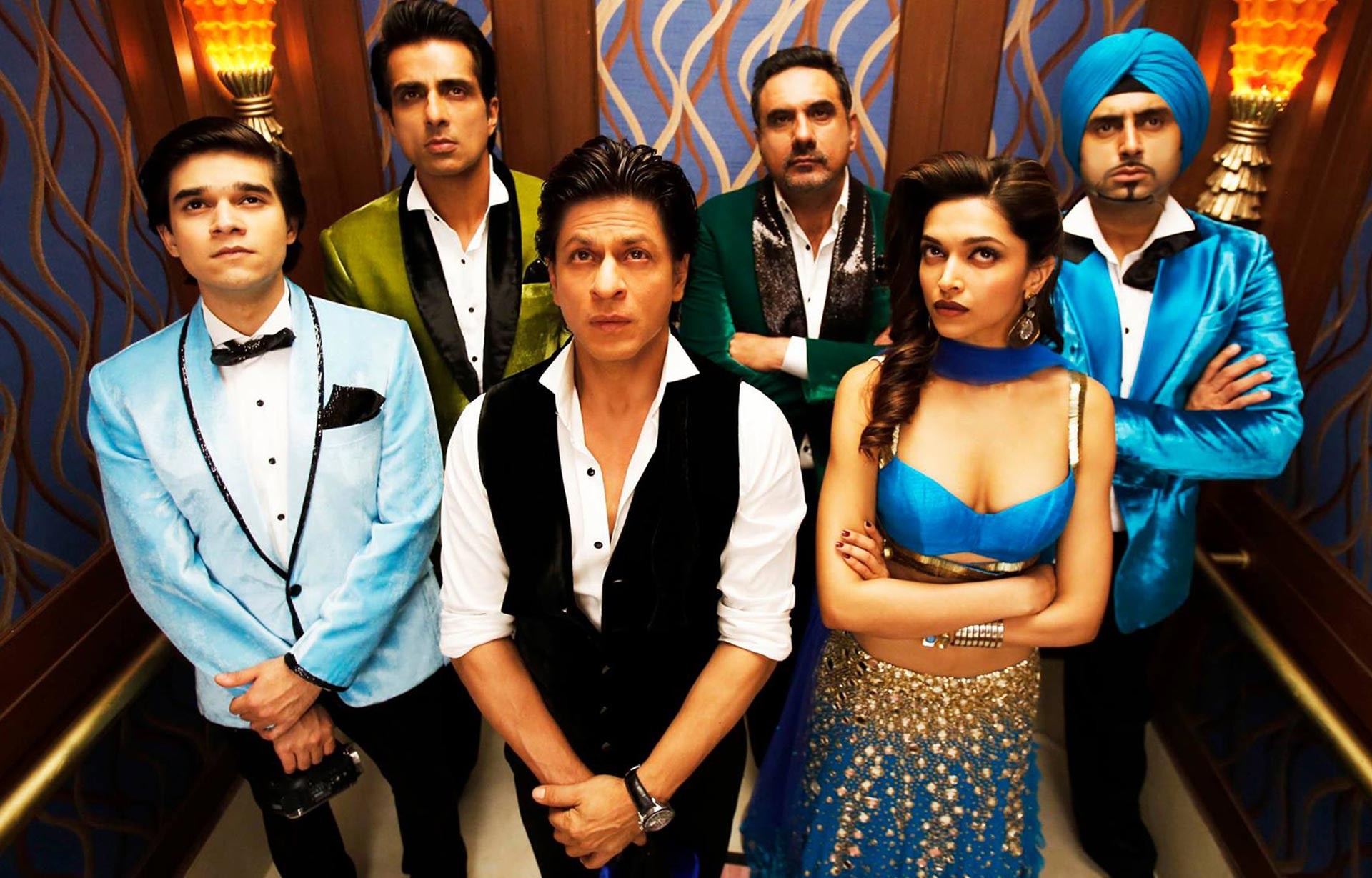
Coming from a director so obsessed with sculpted bodies, Farah Khan's Happy New Year is surprisingly flabby. It's ostensibly a heist film, where Charlie (Shah Rukh Khan) and his ragtag bunch -- a deaf ex-army bomber (Sonu Sood), an expert safecracker (Boman Irani), a youthful hacker (Vivaan Shah) and a ghati lookalike of the villain's suave son (Abhishek Bachchan) -- are out to rob expat millionaire Charan Grover (Jackie Shroff) of the world's most expensive diamonds. But, it turns out, all this is only to avenge the framing of Charlie's honest father -- and a perfectly fun heist gets padded out with enough weepy declarations to make a giant sponge. If these mile-long intros for each annoying character weren't enough to make you wring your hands (and feel like wringing their necks), the gang decides its best form of cover is to show up as competitors in a dance championship, and a bar dancer called Mohini (Deepika Padukone) is hired to turn this worse-than-Full-Monty group into a national team. 

The film reprises every trick in Farah Khan's book, some in double dose. So there's not one but two sets of abdominal muscles on gleaming display (Sonu Sood gives Shah Rukh competition). Abhishek Bachchan compensates for the absence of a six-pack by offering us two of himself for the price of one. (He's not bad at being funny, but it's a pity that Farah serves him up with a large dollop of gross-out-loud humour of the kind usually associated with Rohit Shetty and Sajid Khan (Farah's brother). And finally, of course, there's the director's well-known penchant for making every second scene play a double role -- as itself in the present, and as the ghost of some iconic Hindi movie moment in the past. So we have prize fighter SRK, asked why he tolerates being beaten up, answering, "Kaun kambakht bardaasht karne ke liye pitta hai." Our hero explodes when he hears "Tera baap chor thha" echoing in his head. Grover's firm is called Shalimar Securities, and RD Burman's 'Mera Pyar, Shalimar' soundtrack rings out every time bachelor Boman encounters the topsecret safe. Deepika's 'entry' is via an expectant crowd shouting 'Mohini, Mohini', catapulting us into memories of Tezaab (1988), where Madhuri Dixit played the hapless Mohini, forced to dance by her drunkard father to pay off his many debts. Later, Deepika's speech as a dance coach is a repeat of Shah Rukh's hockey coach act in Chak De India. The list goes on; Khan is clearly indefatigable when it comes to piling on the references. But one dearly wishes her Hindi movie homage amounted to more than a series of knowing winks. 

To be fair, there are a few other things going on the film, things that can't be explained as part of Hindi movie pastiche. First, this is a Shah Rukh Khan film in which SRK refuses to romance the girl - leaving the girl to romance him. (Leading to a running visual gag I most enjoyed - every time Mohini touches Charlie, sparks fly - literally. Flames leap up, shirts catch fire.) Second, though Sonu Sood tries to convince Mohini that Charlie's refusal to turn the charm tap on is because he doesn't know how to talk to women, it's clear that Charlie can't imagine Mohini as a love interest because he's such a smooth-talking English-vinglish type and she's just a sadakchhap bar dancer. 

As soon as Charlie (once Chandramohan Manohar Sharma, but now "naam bhi English") lets loose his stream of fluent English, the Marathispeaking Mohini arrives to luxuriate in it. Khan's use of English as what turns Mohini on is clearly drawn from another heist comedy, A Fish Called Wanda. But while Jamie Lee Curtis being seduced by the sound of Italian (and later Russian) played only on some stereotype about sexy European-ness, the non-English speaker being seduced by English is a devilishly fun take on cross-class desire in India. 

I was disturbed, however, by the film's continual dwelling on Mohini's work as a bar dancer making her a "cheap" "bazaaru aurat", with Charlie feeling no compunction either about making these judgements, or delivering completely unconvincing apologies to Mohini when she overhears him. Khan has no qualms about buying into the patriarchal mindset that creates and condemns the "chhamiya" -- nor any about co-opting this condemned cultural form into a saleable commodity called "Chhamiya style". 

Perhaps that's because anything goes in pursuit of a win, especially a win for India on international soil. HNY purports to be a film about winners and losers, but how is loser-ness defined? By the lack of money (for most of them), the lack of English (for Deepika), and in the case of our hacker boy, the lack of girls falling all over him. But at least they all had integrity. And who are our winners? A team which hacks, blackmails and essentially cheats its way into the dance championship finals, finally winning by emotional manipulation of the audience.

30 October 2011

Cinemascope: Harishchandrachi Factory; Ra.One

Manufacturing joy
HARISHCHANDRACHI FACTORY
Director: Paresh Mokashi
Starring: Nandu Madhav, Vibhawari Deshpande, Atharva Karve

***1/2

Dhundiraj Govind Phalke's life would be considered a remarkable one even if he was not credited with having made the first-ever Indian motion picture. The son of a Sanskrit pandit from Trimbakeshwar, Phalke was a young man with an unquenchable thirst for the new. At 15, he went to Bombay to study at the JJ School of Art. After several more years at Baroda's Kala Bhawan, he started a small photography studio in Godhra. Soon after this, he apprenticed himself to a German magician called Carl Hertz, who had been employed by the Lumiere Brothers. He then worked as a draftsman with the Archaeological Survey of India before entering the printing business: specialising in lithographs and oleographs, working for artist Raja Ravi Varma, even visiting Germany to learn more about the technology.

Sometime around now, Phalke watched his first moving picture, The Life of Christ. Struck by the possibility of making an Indian film where it would be Indian gods who flickered into life on screen, he sold his stake in the printing press and embarked on what was to be his most ambitious project yet. Harishchandrachi Factory focuses on this section of Phalke's life, showing us a man both eccentric and driven. Marathi theatre director Paresh Mokashi gives us a film whose finely-tuned sense of the tragicomic is reminiscent of Chaplin and Jacques Tati. Phalke is introduced in a black top hat doing magic tricks for delighted children, only to actually disappear when an angry debtor shows up. We laugh, but there's a sense that we could cry instead. We see a grieving wife and neighbours and prepare for the worst, but they're mourning a cupboard Phalke has sold off. Even his temporary blindness in 1912 is not off-limits for laughter: as Phalke lies there with eyes bandaged, someone says with mock gravity, "Your eyes will get cured – what shall we do about your mind?"

Mokashi extracts superb performances from his cast, especially Nandu Madhav as the irrepressible Phalke, Vibhavari Deshpande as his wife, and the child actors. The 'period feel' goes much beyond the slightly low-grade costumes and sets: one comes away thinking about modernity's transformation of everything, from technology to caste and the marital relationship.

(Harishchandrachi Factory is playing at PVR Director's Cut in New Delhi this week).

A bad Hollywood film
RA.ONE
Director: Anubhav Sinha
Starring: Shah Rukh Khan, Kareena Kapoor, Arjun Rampal

*

The best thing about Ra.One, depending on the different people I've asked, is a) the kid (Armaan Verma): though truthfully, it's not him but his large Beatle-ish mop of hair; b) the spectacle of Bombay's VT Station cracking up into magnificent ruin, with accompanying sound effects; or c) Kareena Kapoor as a crazed automaton under the control of the evil villain, driving a Bombay local train towards certain death for its passengers and herself. No-one – not even the kids at whom the film is ostensibly targeted – seems in the slightest bit arrested by the epic battle between Ra.One and G.One – between the forces of evil and good – that is supposed to be the crux of this film.

The plot, for what it's worth, centres on a geeky South Indian dad (played by Shah Rukh Khan as a caricature that's worse than even his Om Shanti Om act), who designs a video game with a supremely powerful villain because his son Prateek thinks villains are cooler than heroes. The video-game villain (Ra.One) plays his first game with Prateek (who, in his badness obsession, calls himself Lucifer), is irritated at having been almost beaten and comes out of the video game to kill Lucifer in real life. Poor nerdy dad and his nerdy Chinese colleague die quick and pointless deaths, while the irritating kid has barely shed a tear for the dad who was too uncool for him when he gets a much cooler substitute: the video-game hero, G.One.

Unfortunately, though, there can be no substitute for feeling. And in this film, we feel nothing at all. When Shah Rukh Khan dies, we're too busy wondering how he gets put in a coffin only to emerge as asthi in a pot. Emotions probably run higher in an actual video game.

Nor does the film imbue its virtual world with any depth. The final video game encounter is the most underwhelming I've seen, while the Ra.One–Raavan connection is utterly banal (how much more Rakeysh Mehra did with Raavan in the flawed but fascinating Aks). The closest connection this film has to Indian mythology is a children's birthday party overrun, for some inexplicable reason, by women in skimpy green outfits and gold jewellery who look straight out of Amar Chitra Katha.

Watch Ra.One if you don't mind sitting through a series of pointless cameos (a ridiculous Priyanka Chopra defending her modesty in a red dress, Sanjay Dutt just so we can hear the word Khalnayak, and Rajinikanth as Chitti the robot – to compensate for the horrific South Indian treatment earlier?) to watch a lot of things being blown to smithereens.

Published in the Sunday Guardian.