Showing posts with label thumri. Show all posts

14 February 2017

Heritage, after a fashion


Relative Value: The youngest of the Kotwara royalty weaves her way into the family business. 

(My first-ever 'fashion' story, and one that allowed me to meet a director whose work I have admired: Muzaffar Ali. Published in the Mumbai Mirror's 'Relative Value' slot last Sunday.)


The home shared by Muzaffar Ali, his wife Meera and their daughter Sama is very much a reflection of them. Kotwara Farm lies at the end of Rumi Lane, just off the Gurgaon-Faridabad Road, a graceful amalgam of the contemporary and traditional — much like the clothes that emerge from the Kotwara fashion label that Muzaffar and Meera created in 1990, with Sama joining in 2014. Their latest collection at the recently concluded Lakme Fashion Week (Aditi Rao Hydari walked for them) was well received by critics and fashionistas alike. The line was what some described as “Indian with modern touches”.

We meet the family in their plush but comfortable drawing room, off an arched courtyard that would be stately if it weren’t for a slender stone frog that rises, as if to welcome you, one leg raised off the ground. Muzaffar’s quirky artistic touch (paintbrushes embedded in glass doors, leftover tiles crafted into a striking floor) combines with a studied elegance — yet the farm is a relaxed domestic space, with space for a cow called Gomti and Rough Collies called Drogo and Sansa (Sama is a
Game of Thrones fan). The house was designed by Meera, who trained as an architect before she accepted a small role in a film Muzaffar was making — and ended up marrying him, six weeks after they met. Muzaffar, a painter, poet and acclaimed director of films such as Gaman, Umrao Jaan and Anjuman, had been married twice already: to art historian Geeti Sen, and then to CPM politician Subhashini Ali (director Shaad Ali, of Bunty Aur Babli and OK Jaanu fame, is their son.)

My parents had no formal training in fashion. But I guess destiny finds you,” says Sama. In 1989-90, dealing with the setback of an aborted film project in Kashmir (the unreleased 1989 Zooni), Muzaffar moved back to his ancestral home in Uttar Pradesh with Meera. Even as a filmmaker, Muzaffar had been fascinated by how clothes and textiles can constitute a milieu, whether it was the khaki he foisted upon Farooq Sheikh’s taxi driver in Gaman, or the attention he lavished on Rekha’s clothes in Umrao Jaan. “For me, soft furnishings were a tactile experience, a layer which preceded the making of any film. 
Costume was the outer expression of a character, a situation, a mood,” says Muzaffar.

That interest, honed by his work with American couturier Mary Mcfadden exploring Kashmiri craft traditions during Zooni, now combined with his desire to give something back to the place his ancestors had ruled for centuries. Meera and he decided to develop Kotwara as a centre for handicraft. Since 1990, they have been training local artisans under their Dwar pe Rozi (‘employment at your doorstep’) initiative. Producing jobs for people where they are, the foundation ties into Muzaffar’s early concern with the travails of migration (think Gaman), producing exceptionally skilled embroiderers who give Kotwara clothes their distinctive quality.

“A mechanisation process had set into zardozi and chikan after 1947: cheap patterns, cheap markets, saris with big-big bootas, being sold in Punjab and Delhi,” says Muzaffar. “When we started, in 1990, chikan was at its lowest ebb in workmanship and aesthetics,” Meera agrees. “It took us 7-8 years to improve the quality of work, and to bring the buyer back.” The Alis are in agreement that the contemporary rich need to be educated into being patrons who recognise quality and are willing to pay for it. “Historically, art has always bloomed under the patronage of rulers,” says Sama.


Meera points out that Kotwara has been a trendsetter with silhouettes and reviving South Asian fashions. “In 1990, we brought in angarakhas and peshwas, which people now call anarkalis. When people only wore churidars and salwars, we brought back the chauda pyjama, the wide loose pants which everyone now wears as palazzos. Culottes have come back to India, where it is now called the Pakistani pyjama. But it were the Awadh Nawabs who took the Mughal style of dressing to the highest level: the gharara, sharara, big farshi pyjamas,” she says. Kotwara ventured into zardozi with thread work, creating “evening wear that’s elegant but not blingy”. “How chikan and zardozi have come together through us is itself a new form: let’s call it Kotwara craft,” smiles Muzaffar. “When you’re working with artisans with a regional legacy, your innovations become organic.”


The Alis are justifiably confident of the quality of their work, and between their aristocratic past (Meera just published a coffee-table book called Dining with the Nawabs) and Muzaffar’s association with Bollywood, Kotwara lacks neither for glamour nor cultural capital. The UP Tourism Department is co-sponsoring Muzaffar’s current pet project — reviving Lucknawi thumri and kathak as part of his Wajid Ali Shah festival, whose fourth edition opens on 14 February in Lucknow.


But they seem concerned about not being cutthroat enough for the present. “I’m hoping that Sama can learn the business end of things, because we get taken for a ride very easily,” Meera smiles ruefully. “My mother didn’t want me to get into this. She said, ‘fashion is beautiful, everything around it is ugly’,” laughs Sama.

“I want to add my own touch to their brand. Right now my focus is making Kotwara more contemporary, [to cater to] the many independent young people with well-paying jobs, who can buy a 30,000 rupee item without asking mothers or mothers-in-law. Papa’s too nice. I’m very open. But being nice doesn’t mean being stepped over,” says Sama resolutely. Muzaffar is accepting of his daughter’s vision for their brand and changing times. “Today’s reality is very harsh,” he agrees. “But we agree on being exacting and being human.”


Published in Mumbai Mirror, 12 Feb 2017.

10 June 2012

Thumris lost and found deptt.: a search for the Gaya thumri


This is the first instalment of Post Facto: my new column for the Sunday Guardian.

At 7 o' clock, the conference room in the India International Centre basement was only half full. Any ditherers still deciding if they should stay were arrested by the arrival of a slender sari-clad lady with cropped silver hair, who announced (in impeccable IIC English strewn with equally impeccable Hindi) that Dr Kumud Jha Diwan, soon to begin her lecture-demonstration on 'The Earthy Thumris of Gaya — Revival of a Lost Tradition', was both a scholar-researcher and a thumri singer blessed with "a voice like Rasoolan Devi".

Diwan is a striking woman in her 40s. Dressed in a dark sari with just enough zari to be festive, her still-black hair left open but kept carefully off her face, she exuded a combination of managerial efficiency and enthusiastic determination (her manner fell into place nicely when she said she had a PhD in Business Studies). Bustling between the podium and the small low stage, she moved fluently between school-teacherly historical declamation and seductive ada-kari (ada is integral to the courtesanal art of thumri). She also constantly switched languages: English when standing, Hindi as soon as she sat cross-legged on the stage. The thumri lyrics, of course, were in Braj and other Poorabiya dialects.

The thumri, said Dr Diwan, reached its creative zenith in 19th Century Lucknow, in the court of Nawab Wajid Ali Shah, which sustained such thumri greats as Moizuddeen Khan, harmonium maestro Bhaiya Saheb Ganpat Rao (a Gwalior royal) and legendary kathak dancer Bindadeen Maharaj, of the renowned family of dancers from which Birju Maharaj descends. Apart from being a great patron of the arts, Wajid Ali Shah was himself a rather good poet, and – under the pen name Akhtarpiya — composed many thumris. (The most famous of these is probably Babul Mora Naihar Chooto Jaye, immortalised in filmic form by K.L. Saigal's superbly melancholy rendition of it in Street Singer (1938). The naihar of the song was both the departing bride's natal home, and Lucknow: the beloved home from which the British had exiled the Nawab.)

With the splintering of the Awadh court, its poets and musicians got scattered. For many, the obvious thing to do was to follow the Nawab to Metiabruz, a small township near Calcutta, on the banks of the river Hooghly, where a 'second Lucknow' was being created. With the coming of the railway network, said Diwan, the cities of Banaras and Gaya, both of which had many rich patrons of music, became stops for musicians on the way to Calcutta and back. "A golden triangle was established," Diwan said.

{
The pandas of Gaya, familial priests who facilitate pind daan ceremonies, made enormous fortunes. Their mansions became the sites of night-long musical baithaks

The Lucknow thumri, Diwan told the IIC's Music Appreciation audience, since it was created to accompany the vigorous rhythms of Kathak, tended to follow a fast taal cycle like Teentaal or Ektaal. Because the bol (lyrics) would often be split into syllables by the inherent rhythm of the taal, it became known as bol-baant ki thumri. The thumri of Banaras, made famous by courtesan-singers like Badi Moti Bai, Siddheshwari and Rasoolan, had a slower tempo. With its stylistic emphasis on which bol would be musically highlighted, it became known as the bol-banao thumri.

Having demonstrated both styles, Diwan turned her attention to the Gaya thumri, the subject of her Sangeet Natak Akademi research in 2008-9. Gaya is a centre of Hindu pilgrimage, where people come to give pind daan to their ancestors at the famed Vishnupad temple. The pandas of Gaya, familial priests who facilitate these ceremonies, made enormous fortunes. Their mansions became the sites of night-long musical baithaks. Diwan showed a black and white slide of one such soiree: it looked every bit the straitlaced, teetotalling affair she described. "It was a gathering for musicians," said Diwan, "You could sing the same phrase all night long if you wanted."

The Gaya ang thumri has an even slower tempo than Banaras, and is known as the thaah ki thumri (Thaah means stoppage). The Gaya thumris were sung by Diwan's co-performer, the marvellous Rajan Sijuar of the Gaya gharana. Gaya-based Sijuar was the quiet foil to Diwan's exuberance, smiling gently even when Diwan suddenly decided to turn him into Exhibit A in her narrative: "Those panda families have so much money you can't imagine... Rajan ji is from one of those families!"

She showed pictures of the major figures of Gaya thumri: the unfortunately named Dhela Bai (dhela means pebble) seated fashionably with one leg crossed over the other, the harmonium maestro Soni Maharaj, the legendary singer Ramuji Mishra. She played a rare tape of Ramuji Mishra singing, and bemoaned the shocking fact that Dhela Bai's descendants had destroyed all her recordings because they wished to erase all association with a tawaif ancestor. She raged against the Nagphopha family, who were refusing to give her access to the vast collection of recordings they had.

"The Gaya thumri is lost to us," Diwan said many times. "You people must listen to it, so that it can be preserved." Sijuar made no comment.

21 November 2009

Bring On The Dancing Girls

An essay published in Tehelka magazine in November 2009.

The figure of the tawaif continues to haunt popular culture, but what sent the real ones into obscurity?


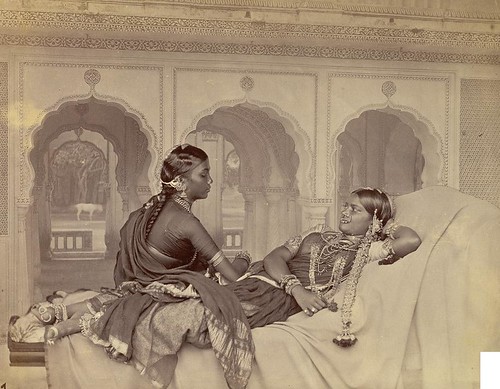
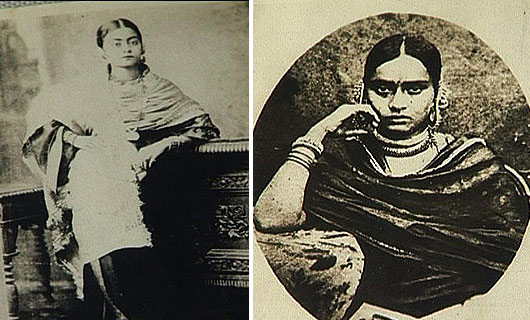
From Umrao Jaan to Pakeezah to Chandramukhi, the figure of the tawaif has been a figure of fascination in the popular South Asian imagination: the bejewelled, sensuous dancing girl with a golden voice – and almost always, a golden heart. To our Hindi-film-overloaded eyes, therefore, it may seem strange for an instant to look upon the black and white images of women who populate The Other Song, Saba Dewan’s film about tawaifs, looking out of the frame at us with a gravitas we do not expect.

But the gravitas is ephemeral. In one revealing moment, the camera pans an old album, with the moving finger on screen stopping at a pleasantly plump face. The grainy voice of an old sarangi player says, “Yeh Rasoolan Bai hain.” The filmmaker asks, “Kya yeh hamesha itne saade kapde pehentin thi? (Did she always wear such plain clothes?)” The reply is brusque and quietly ironic: “Mujra naach toh karna nahi tha. (Well, she wasn’t going to dance the mujra.)”

Rasoolan Bai gave up the mujra – the expressive, sometimes suggestive kathak-based dance that accompanied the tawaif ’s music – in 1948. At the same time that she moved out of her kotha and into a gali ka makaan in Banaras, the woman whose aching songs were perhaps India’s most famous renditions of the thumri stopped performing in her own city. The timing is remarkable. As India and Pakistan entered independent nationhood, the thumri was taken out of the kotha. A musical genre whose very form — intimate, expressive, always sung in a first-person female voice — had emerged from the courtesan’s salon, had, in order to survive in the bright light of modernity, to move into the concert hall, the radio station, the cinema. And in order to be heard in this new world, the tawaif herself had to become a ganewali or – in even more Sanskritised form – a gayika.

The most famous of such successful metamorphoses is that of Akhtari Bai Faizabadi into Begum Akhtar. The courtesan who had achieved fame in her teens became a respectably married lady, even giving up her singing career for years, “only to emerge into the public domain transformed into a national symbol iconic of the courtly musical culture which had shaped her,” writes scholar Regula Qureshi. But the nation exacted its toll. In order to be the voice of a new India, Akhtari Bai had to live a double life – her newfound respectable status was dependent on dissociating herself from every shred of her past, while the power she had over her audience, what independent scholar and historian Saleem Kidwai calls “chemistry”, derived in large measure from that very past.


Saba Dewan’s fascinating film, The Other Song, derives its name from a similar instance of doubling, of a repressed erotic self. Told by a respected Banarasi musician called Shivkumar Shastri that Rasoolan Bai had once recorded a different version of her famous Bhairavi thumri “Lagat karejwa mein chot (My heart is wounded)”, Dewan set out in search of the lesser-known variation. As she asks musician after musician (and later, tawaif after tawaif) if they’ve ever heard the version that goes, “Lagat jobanwa mein chot (My breasts are wounded)”, without success, we begin to see glimpses of a hidden world, a world whose frank sexuality and often joyful bawdiness were pushed deep below the surface, often by its own practitioners. Song after song turns out to have had its lyrics altered to suit ‘respectable’ tastes – from soibe (sleep) to jaibe (go), choli (blouse) to odhni (veil).

The tawaifs of North India (like South India’s devadasis) came from hereditary performing communities. According to historian Katherine Butler Brown, the term tawaif was first used to describe communities of female singers and dancers in Dargah Quli Khan’s Muraqqa’-i-Dehli (1739-41). But it was not until the early 19th century that it became a catch-all term. Even then, Brown argues, before 1857 there was always a distinction made “between elite tawaifs who were highly cultured, highly refined, models of etiquette and masters of performance genres, who might only have had a single sexual patron in their lifetime; and tawaifs who were less talented, less well trained, and thus more dependent on sex work”

BUT AFTER 1857, when British Crown Law came into effect throughout India, all tawaifs were criminalised alongside common prostitutes, with court judgements stating that singing and dancing were ‘vestigial’ activities while their real income came from prostitution. Meanwhile, the rising middle class, “influenced by Victorian values and empowered by colonial law, increasingly dismissed the tawaif as immoral and decadent, and began various moves to ‘rescue’ Hindustani music from them,” says Brown. The campaign for a national music — cleansed of its associations with tawaifs and Muslim musicians — aimed to make it appropriate for middle class women. In a stunning double move, the very processes that enabled ‘respectable’ women to come out of purdah worked to invisibilise the highly skilled, often highly educated, women who had been ‘in public’ all along: the tawaif.

With the decline of the feudal patronage that had sustained the kotha and its arts, many tawaifs explored other options. All India Radio (AIR) in its early days was almost entirely dependent on the ganewalis, as were recording companies: it was tawaifs like Gauhar Jan who were the first gramophone superstars. But in the early 2000s, a skilled singer like Saira Begum (one of the women from tawaif backgrounds that Dewan shot with) gets a recording slot at AIR in Banaras because of a zealous Italian pupil, only to be humiliated with a ‘musical theory’ examination she cannot possibly pass.

As the new guardians of music locked it up and shut the door, women from tawaif backgrounds entered first the theatre company, and later, the movies. “Cinema becomes a part of tawaif history, documenting tawaifi arts we’d never get to see – and also providing a way for the tawaif to reinvent herself,” says Kidwai. “And this reinvention was both on screen and off it. If Hema Malini in Sharafat wears plumes and a tiara to do a mujra, one can’t complain of inauthenticity: many real tawaifs like Siddheshwari learnt to sing in English – even if it was Twinkle Twinkle Little Star!” The tawaif’s remaking of self, as Kidwai points out, could take more radical forms: such as in the case of Nargis, whose mother Jaddan Bai prepared her for a cinematic career by teaching her everything except how to sing. The stardom of Nargis – the ganewali’s daughter divorced from the gana – demonstrated one route by which the tawaif could make it in the modern world. (It is tempting to conclude that this was the necessary obverse of the rise of the playback singer – the disembodied female voice who retained respectability by never being seen on screen.)

Cinema, though, isn’t an accessible career for most women. The two other films in Saba Dewan’s trilogy address more subterranean worlds of female performance. Delhi-Mumbai-Delhi (D-M-D) centres on Riya, who dances in a bar in Mumbai but is from Delhi, while Naach is about girls who dance to Bollywood numbers on massive, rickety stages in the town of Sonpur, between Muzaffarpur and Patna, during the annual cattle fair. For Dewan, the differences between these categories of women outweigh any similarities. Her D-M-D protagonist Riya, from an ordinary working class background, may have gained confidence and decision-making power within her family, but she remains wage labour. “The tawaif was much more her own mistress: the owner of the space, the person who paid the accompanists,” says Dewan.

Whether we like it or not, though, the tawaif remains the imagined reference point. “There is an attempt to recreate the mujra past, mediated via Hindi films,” acknowledges Dewan. “In Bombay bars, the girls wear so-called Indian costume – ghaghra choli, partly because it’s easier to get license for ‘Indian dance’, but also because it fits the audience’s appetite. The man there wants to imagine Rekha dancing for him, at least.” Even the filmic bar dancer draws on the pure tawaif of the 1970s Hindi movie: Tabu in Chandni Bar must remain chaste while working in a bar, just like Asha Parekh in the kotha of Main Tulsi Tere Aangan Ki.

But the relationship between bar dancers and tawaifs runs deeper. Ethnomusicologist Anna Morcom estimates that 80-90 percent of Mumbai bar dancers, “by informal accounts”, are hereditary professional performers from tribes like the Deredar, Nat, Bedia and Kanjar. They have also been the target of a moral campaign eerily similar to the Anti-Nautch campaigns of a century ago. In 2005, a ban on dancing in Mumbai bars made 75,000 such women redundant. It is still in force.

In early 20th century India, it was dance that seemed to lie at the root of moral opprobrium. The tawaif gave up the mujra to acquire respectability as a concert singer or actress. But in a newly-globalised India where ‘Bollywood dance’ is now a legitimitised ‘cool’ activity for the urban middle classes – think NRI/urban weddings, Shiamak Davar classes, TV shows like Boogie Woogie and Nach Baliye, feeding back into films like Dilli-6 or Rab Ne Bana Di Jodi – how does dance re-acquire its immoral connotations when performed by women in bars? That is a new double standard that will take longer to resolve.

From Tehelka Magazine, Vol 6, Issue 44, Dated November 07, 2009