Showing posts with label Kerala. Show all posts

23 November 2020

In Vino Veritas -- II

My Mirror column:

In Sanal Kumar Sasidharan's An Off-Day Game (2015), a drunken day unmasks a society intoxicated with its own sense of power.

Four men gather for a day of drinking in Sanal Kumar Sasidharan's harrowing An Off-Day Game (Ozhivudivasathe Kali, 2015).

Last week's column on The Mosquito Philosophy was about what truths might emerge when a group of men get together to drink. This week, too, my subject is a film about an all-male drinking session – An Off-Day Game (Ozhivudivasathe Kali) directed by Sanal Kumar Sasidharan. Sasidharan is best known outside Kerala for his internationally award-winning film Sexy Durga (2017); An Off-Day Game won him the 2015 Kerala State Film Award for Best Film and is currently streaming on two platforms.

and is currently streaming on two platforms.

Read more at:
https://mumbaimirror.indiatimes.com/opinion/columnists/trisha-gupta/in-vino-veritas-ii/articleshow/79345533.cms??utm_source=contentofinterest&utm_medium=text&utm_campaign=cppst

The film is adapted from Unni R's Malayalam short story 'Holiday Fun', available in J Devika's wonderful English translation as part of the collection One Hell of a Lover (Westland 2019). Barely nine pages long, Unni's tale begins with a reference to Boccaccio's 14th century Italian classic in which seven women and three men gather in a remote villa to escape the plague-stricken city of Florence - an interesting aside in a pandemic year. “They were like refugees from the plague in The Decameron,” writes Unni. “Only, they were escaping the monotony of work, the four of them... gathered in Room No 70 of Nandavanam Lodge, that Sunday, as usual, around a bottle of liquor.”

Unlike Unni, though, Sasidharan does not launch straight into the action. Instead, as he would do two years later in Sexy Durga, he begins his film with a semi-documentary prelude: footage from a real-life by-election in Kerala, where we see red Communist flags challenged by a rising wave of saffron BJP ones. We also see a Kathakali dance performance as part of the election campaign: this is a state where art and politics are allowed to cross-fertilise each other. It is from the assembled crowd at a rally that the camera first picks out two of our protagonists, following them as they join the other two at a little bend in a stream: a picturesque spot for daytime drinking. Another man driving by is tempted to join them, and a plan is made for another drunken assignation on Election Day.

The electoral backdrop serves Sasidharan well, allowing the film to fit in both India's official dry day rules, that bar the sale of liquor on polling days, and the simultaneously ubiquitous unofficial fact that liquor changes hands during almost all Indian elections: as a bribe, or more categorically in exchange for votes. It also works beautifully as a way of working up to the conversations between his characters – and to the 'game' of the film's title, in which four players pick chits labelled 'King', “Minister', 'Police' and 'Thief', and the one who's picked 'Police' must then guess who the 'Thief' is.

But plenty happens before the game unfolds. Unni's story has an early paragraph laying out the quality of the men's weekends in Nandavanam Lodge: “The usual criticism of the government, the rant about bedroom squabbles, the description of the body of the young girl one brushed against in the street or on the bus...”. Among Sasidharan's achievements is the way he takes this bare-bones description and gives it flesh, adding dialogue, characters and subplots that make his film into the terrific, terrifying slow-burn watch that it is. There is no woman actually present in Unni's scenario, for instance -- but Geetha in An Off-Day Game is crucial. Right from the moment that the men arrive at the lodge, she is the cynosure of all eyes, and not in a good way. She tries her hardest to just do her job: preparing a meal for her boss's visitors. But being the sole woman in a remote location with an increasingly drunken group of men, as we will see, isn't quite conducive to just doing one's job.

The relationship of each character to their 'job' is, at a deeper level altogether, the subject of Sasidharan's film. Much before the 'game' plots each man into a 'professional' role, the film has begun the perspicacious process of observing how even within a circle of friends, every man is supremely conscious of social status – his own and that of the others. “The kind of places this Brahmin fellow digs out,” says one man as they approach the lodge. “He always howls when he sees the jungle,” says another. What may have felt like gentle ribbing turns darker and darker as the film proceeds, especially as everyone presses first the woman and then Dasa into unwanted tasks. “You need me to pluck a jackfruit and now kill a rooster,” says Dasa.

As befitting a film set in Kerala, politics is the matrix of all things – the idea of democracy, for instance, is the context for a sharp argument about the man-woman relationship, and an anecdotal history of Emergency for a discussion of the 'duties' of citizens: “the cops did cops' job, the scavengers did scavengers' job, the army men did army jobs...”. Caste, or its modern-day version, serves an authoritarian society perfectly: no-one is meant to challenge their socially-ordained roles.

Some of Sasidharan's long scenes are pure genius, and the long takes and the stunning forest soundscape create an atmosphere of menace that is unerring in both its sense of beauty and danger.

The 'game' may feel a little contrived, but the conversational fluidity the film achieves is astounding. Under the influence of alcohol, everything is laid bare. In vino veritas.

This is the second part of a two-part column. The first part is here.

Published in Mumbai Mirror, 22 Nov 2020.


28 April 2020

Social maladies

My Mirror column:

Two films about contagious infections, in the starkly different milieus of the USA and Kerala, point to the cracks in which a virus can really make a home.

 
Films about pandemics have catapulted to unprecedented fame in the last two months, as people across the globe seek out fictional material that resonates in the age of Covid-19. Two of the better films available to stream online in India are Steven Soderbergh’s 2011 medical thriller Contagion, where a highly infectious fictional new virus makes its way from Hong Kong to the USA, and Aashiq Abu’s 2019 Malayalam film Virus, which depicts how the state of Kerala dealt with the outbreak of the Nipah virus in 2018.

In both films, one is constantly struck by the use of terms that most of us are only beginning to learn – “incubation period”, “treatment protocol”, “index patient”. Both films deal with zoonotic viruses that have entered the human body from animals, and the fear factor derives from the fact that the scientific situation we are dealing with is not just new, but unknown – and therefore extremely difficult to predict. In an early scene in Contagion, the scientist working on a vaccine seems to almost marvel at the novel virus. “It's still changing," she tells the head of the Centre for Disease Control, Dr Ellis Cheever. "It's figuring us out faster than we’re figuring it out.”

“It doesn’t have anything else to do,” says Dr Cheever, looking unimpressed.

It’s a droll little moment in a relentlessly grim film, but you barely register the comment as dry humour because you’re too busy registering it as fact. Contagion makes it very clear that human beings are on the back foot here. Unlike the virus, we have a great deal to do if we’re to protect the species from the deathly microscopic foe – and from ourselves.

For there are two seemingly contradictory facts about human beings that both Virus and Contagion make visible. First, that the virus piggybacks on the existence of community: the fact that human beings live with each other, and don't seem to know quite how to do without. Second, that human beings are quick to suspect each other, and the way the virus can really conquer is if our leaders choose to divide and rule.

Contagion opens with an off-screen cough that may or may not have had the same chilling effect in 2011 that it does now. In 2020, we are more than primed to watch the film’s opening sequence of people going about their closely proximate urban lives as a series of dangerous acts – pressing elevator buttons in public places, clutching the same steel pillar on the metro that a thousand other hands have clutched, sitting next to each other on planes, in stations, at bar counters, in hotel casinos. Kate Winslet, playing an Epidemic Intelligence Service Officer called Dr Mears, has the job of contact tracing – finding out who the first American casualty, Beth Emhoff (Gwyneth Paltrow), may have met and infected in the days before her death, and thus hoping to prevent the further spread of the virus.

Virus unfolds in a less transnational context, but contact tracing is very much at the centre of the narrative. A medical volunteer called Annu (Parvathy) conducts a painstaking investigation, following up with patients and their friends and family members to try and establish the links between seemingly unconnected cases. She is aided in her task by Kerala’s fairly well-organised administration – the fact that there are tickets given out at government hospital, for instance – and by increasingly ubiquitous technology – the presence of time-stamps on mobile phone photos, for instance. But what is really striking about the film’s depiction of the process is not just Parvathy’s sharp instincts, but her sensitivity.

In fact, sensitivity is what distinguishes the actions of almost all those who populate Aashiq Abu’s film: doctors and nurses most of all, but drivers and attendants, and because this is Kerala, even ministers and bureaucrats.

If Contagion maps all the ways in which an infectious disease can bring out our worst selves as a society – people profiteering off potential fake cures, panicked hoarding of goods that creates grocery store shortages, stampedes and food riots – Virus suggests that it is also possible to combat our fears. The mother of a young man who has died is surprised that Annu is willing to have tea in her house. The ration delivery for her place is now dropped off on the road, with the driver honking before leaving. When a crematorium is chosen for the last rites of Nipah patients, villagers in the vicinity block the road in fear. But a set of volunteers is found to conduct the rites elsewhere. In a revealing conversation, the district magistrate says that enforcing the cremation through the use of police force would have been the easiest thing to do – but the point is to try and do it without. Even the debate about whether it is unsafe to bury the bodies of virus-affected patients is conducted without rancour or religious fervour, and resolved with the scientifically approved solution of deep burial.

As an ill-prepared India waits for whatever is to come in the next few weeks and months, we have a socio-political climate that tragically encourages the well-off to turn away from the poor, while turning Muslims into scapegoats by testing the participants of one ill-advised religious gathering rather than all those that have taken place. Watching Virus makes it clear that we will sink or swim based on our ability to allay each others' fears and suspicions, not stoke them.

Published in Mumbai Mirror, 5 April 2020

30 December 2019

"Fiction should prophesy the future": Benyamin


With his new book [in English translation] hitting stores, Benyamin says novel-writing is now a purely political act.

(A short author profile of the Malayalam writer that I did for India Today.)


Benyamin—the Malayali writer Benny Daniel—did
not grow up a reader. Other than the Bible, which was read every night before supper in his orthodox Syrian Christian household, he had read no other books in his childhood. He began to read after moving to Bahrain in 1992. For the next seven years, he read voraciously, while working as a project coordinator at a construction site. Writing grew organically out of a readerly desire. “I wished to read about the situations I felt and saw around me. But I realised nobody was writing about it yet. So, I started,” he says in an email interview. 


His first short story appeared in the Gulf edition of Malayala Manorama in November 1999. There has been no looking back. Now the author of over 16 books in Malayalam, Benyamin remains prolific and hugely popular in Kerala, to which he returned in 2013. His Aadujeevitham ran into more than 100 editions, selling over a hundred thousand copies, and a Malayalam film version, starring Prithviraj, is planned for release by end-2020. The book
also did well in Joseph Koyipalli’s English translation as Goat Days (2012). Three other Benyamin novels have appeared in English translation: Yellow Lights of Death (2015), translated by Sajeev Kumarapuram; the JCB Prize winnerJasmine Days (2018) and, most recently, Al Arabian Novel Factory (2019), both translated by Shahnaz Habib. 


Together with its ‘twin novel’ Jasmine Days, Al Arabian offers a rare portrait of urban life in the Gulf through the eyes of diasporic South Asian characters. Jasmine Days was told in the winsome voice of a Pakistani radio jockey called Sameera, the narrative echoing the young woman’s move from sheltered ignorance to humanitarian and political awakening. Al Arabian uses an even more open-ended device; the narrator Pratap is a Toronto- based Malayali journalist hired by an “internationally acclaimed writer” to help research a novel about present-day life in West Asia.

Among the joys of these books are the conversations across social, religious and national lines: between Shias and Sunnis, Arabs and South Asians, Malayalis and Hindi/ Urdu speakers, Third World passport-holders and those with First World privileges. “When we are inside India, we see a Pakistani as an enemy. Bangladeshis and Nepalis see us as enemies. But in a third country, we realise we lead the same kind of life. We eat together, work together. It dilutes the fear among us,” Benyamin says. These real-world diasporic encounters are supplemented by virtual ones. “Cyberspace deletes the borders drawn by politics,” in Benyamin’s words. But in his fiction, Facebook, Orkut, Viber, WhatsApp and email also enable unlikely connections and reconnections, secret affairs and the creation and destruction of new identities. This is of a piece with Benyamin’s penchant for “demolishing the wall between real and fiction”. He often makes his narrator a writer, a figure who
listens to stories, or presents eyewitness accounts. In Yellow Lights, the writer is even called Benyamin.

Based on what is available in English, Benyamin comes across as deeply curious about the stories he hears. But these four books also reveal a keenness to place those personal stories in social and political context. And in this, he is fearless. Goat Days, in which a poor Malayali migrant is turned into captive labour in the Saudi Arabian desert, is banned in the UAE and Saudi Arabia. Characters in Jasmine Days and Al Arabian argue often about politics, challenging and being challenged by each other’s posi- tions on colonialism, oil-rich capitalism, dictatorship and religious conflict. “In the age of visual and social media, fiction-writing does not have entertainment value. It is a purely political activity,” Benyamin says. “It should shine a torch upon our dark areas. It should prophesy the future.”


Al Arabian Novel Factory takes that responsibility seriously. Pratap’s taxi ride from the airport into ‘The City’ transports him—and us—into the heart of a dictatorship. The man just ahead of Pratap is forced to get out of his car by a soldier demanding to see his phone. In an instant, he is on the ground, being thrashed with the soldier’s gun. His phone is smashed, and he is forced to sing the national anthem. A petrified Pratap awaits his turn. But it turns out the taxi driver was right: “This is a very safe city for tourists.”


Unlike Goat Days, Jasmine Days and Al Arabian Novel Factory feature mostly middle-class members of the South Asian diaspora: people who have built relatively prosperous lives in West Asia as nurses, doctors, restaurateurs, journalists or businessmen. And both books repeatedly show us these people being apathetic or worse, actively opposed to all local political resistance against the authoritarian regime. Silence is apparently a small price to pay for the privileges they enjoy. What doesn’t affect them directly, they turn a blind eye to. It is hard not to see that self-serving quality all around us in present-day India. Benyamin doesn’t mince words on the subject. “We have almost abandoned democracy and are rapidly moving to autocracy. In the name of strong leadership, a majority of Indians have become fans of fascism. But we really don’t know the rights we are going to lose in this dangerous game.”

Published in India Today, Dec 27, 2019. 

Note: You can read my review of Jasmine Days here.

10 August 2019

Acrobats of the Upper Canopy

Don’t be fooled by the name or the sharp canines, the endangered lion-tailed macaque
is a shy, fruit-eating primate that inhabits the upper canopy of the rainforests of the Western
Ghats.
Slug: Narr
Don’t be fooled by the name or the sharp canines, the endangered lion-tailed macaque
is a shy, fruit-eating primate that inhabits the upper canopy of the rainforests of the Western
Ghats.

Slug: Narr
Reporting and researching this piece was a joy, though it also made me tragically aware of how we're ruining the earth for other creatures. It's my first piece for the nature and environment website Roundglass Sustain (please click link for all the superb pictures). 

Don't be fooled by the name or the sharp canines, the endangered lion-tailed macaque is a shy, fruit-eating primate that inhabits the upper canopy of the rainforests of the Western Ghats.

It was April 2014, and I was in the Western Ghats to meet an endangered primate. We drove on, the way the man had pointed, our gazes fixed on the tangled canopy. There! A group of monkeys with black faces, black bodies, and light facial hair. But Erinjery chuckled. This wasn’t the monkey we wanted. The Nilgiri langur we’d met has glossy black fur and a striking mane, similar enough to be confused with the monkey we were looking for. But what distinguishes our chosen primate is its shorter, tufted tail.

Fewer than 4,000 lion-tailed macaques — locally known as simhavaala or singavaal kurangu, literally ‘lion-tailed monkey’ — exist in the wild. They are, Erinjery informs me, divided into approximately 47 subpopulations across at least seven locations in the Western Ghats. These wet evergreen forests are also home to an impressive array of endemic plant and animal life, including over a dozen mammals found nowhere else in the world. The lion-tailed macaque, fondly abbreviated to LTM, is one of those: so perfectly adapted to these forests that conservationists are convinced it can function as an umbrella species. Protect it and you protect the whole forest ecosystem.

And it needs protection. The Ghats run about 1,600 km from north to south, but according to the research of wildlife biologist Dr. Ajith Kumar, forests now cover only about 25 percent of the slopes. The British began felling as early as the late 19th century to create cardamom, coffee and tea plantations. Agriculture, dams and human settlement have only speeded up the depletion. Since about 2004, though, Nelliyampathy’s macaques have benefited from an unusual land use shift: at least three plantations have been reclaimed by the state forest department and begun a slow return to wilderness. By Erinjery’s estimate, Nelliyampathy in 2014 had some 200 lion-tailed macaques living in 14 groups, making it one of the best places to see LTMs in a somewhat natural environment. But LTMs in the wild are shy. As soon as they spied us, they would move deeper into the jungle.

******

Usually found climbing and leaping through trees some 60 to 100 feet tall, the LTM leads its arboreal life with a lithe grace that belies the astounding height of its acrobatics. Its style is poise, not display. It barely ever descends to the ground even for water, managing on fruit sap and dew.

Unlike the Nilgiri langur, whose whooping ‘hoo hoo hoo’ calls are among the most frequent sounds of the jungle, it rarely makes much noise, devoting most of its energy to the search for food. The only thing you might hear as it travels through the upper canopy is a gentle ‘coo’, helping keep the group together.

When Erinjery and I finally found the LTMs, a silent feast was in progress. A group of about 40 was scattered across a clump of jackfruit trees on either side of the road. A large oblong fruit, fibrous yellow inside and ribbed green outside, the jackfruit originated in these forests. So it makes sense that it is one of the favourite foods of the LTMs, the oldest of the Western Ghat macaques. But the jackfruit is the largest tree-borne fruit in the world, weighing up to 36 kilos, while LTMs are among the world’s smaller macaques, reaching a head-body length of only 16 to 24 inches and an adult weight between 2 and 10 kilos. It’s quite a sight to watch: an LTM balancing itself between two branches, using its forelimbs like arms to immobilize a jackfruit larger than itself, then tearing into it with sharp front teeth. I even saw a sub-adult carry one away to eat in peace, climbing with its back limbs while holding the fruit with the front two and its teeth.

Like other primates, LTMs have forward-facing eyes and excellent vision, as well as opposable thumbs dexterous enough to manipulate fruits. Other than jackfruit, they eat figs, spiny green wild durian, elephant apples, and mangoes, supplementing this frugivorous diet with insects: caterpillars, spiders, cicadas and mantises picked off leaves. A juvenile LTM is likely to spend more time foraging for invertebrates than a grown one. Like human children, they need more protein.

Also like human babies, LTMs take time to grow up. The more common bonnet macaque, often found in close proximity to the LTM, has a similar lifespan, of about 20 years. But while a bonnet macaque starts reproducing at age 3 and gives birth every year thereafter, an LTM female is, on average, 6.6 years old when she first gives birth — the oldest among all macaques. And she will have only two or three infants in her lifetime.

LTMs usually live in groups of about 20, with a single dominant male. Where do the other males go? The answer is a fascinating one. While adult females remain in the group they were born into, an adult male LTM must migrate when it turns five or six, and enter another group to mate. An anti-incest rule!

******

Nelliyampathy’s 736 sq. km. of fragmented forest has begun to redevelop the connectivity needed for LTM males to migrate. But a full third of the world’s LTMs now live in privately-owned forest patches crisscrossed by plantations and human settlements. For every LTM in Nelliyampathy, there is at least one living in Valparai, 130 km away. There, I watched in disbelief as two male LTMs ambled across a busy road to investigate a heap of trashed plastic plates for leftover rice and dal. Returning to our jeep, I found another macaque peering out of it cartoonishly, as if to say, “What guys? No food?”

But the state of LTMs in Valparai was no joke.

Like Nelliyampathy, Valparai began as a colonial plantation area. Today, though surrounded by the protected forests of Anamalai Tiger Reserve, Valparai is a much larger urban settlement. Also, unlike the shady half-jungles of coffee and cardamom that play host to LTMs in Nelliyampathy, Valparai is dominated by tea estates, whose greater tree-clearance amplifies the habitat fragmentation that is the biggest long-term threat to these macaques.

Two of the largest Valparai groups, comprising 160-odd LTMs, are living a strange new life: isolated from other groups, hemmed in by human habitation, spending 30-40 percent of their time on the ground instead of the four percent normal for the species, and consuming new foods.

In Valparai, it is tragically common to see LTMs by the roadside, making an easy breakfast off local cultivars like the guava. When a car stops, a daring male can get a still easier snack. I saw three different monkeys show up for their fix of fried, salty processed food.

Ananda Kumar, a scientist at the Nature Conservation Foundation (NCF) in Valparai, suspects that growing construction and tourist traffic has increased human-animal interaction, changing LTM behaviour and causing conflict and roadkill. To help, Kumar and his team had built fire-proof canvas bridges to link the tree canopies on opposite sides of the busiest roads, and hired two staffers to track these two groups daily. Between 10 a.m. and 5 p.m., they held up placards telling drivers to ‘Go Slow’ and tried to persuade day trippers — many from a rising tribe of amateur photographers — not to feed the monkeys.

These are emergency measures. Long-term conservation needs plantation owners to work with the NCF. Restoring forest fragments and planting connecting tree corridors across a nude expanse of tea bushes would help create a self-sustaining habitat, in which migrating males from one LTM group can find a mate in another.

The growing number of LTMs in Valparai can appear a good thing, especially since hunting remains a threat elsewhere. But the larger group has 120 individuals, more than six times the size of an average group in the wild. Both groups have become multi-male, and Mysore-based primatologist Mewa Singh says the biological effects of the inbreeding “will only show themselves in several generations.” And given radically altered diets and exposure to human diseases, a ballooning population could suddenly crash.

What I’d learned about the lion-tailed macaque in the wild was that they were almost entirely arboreal, uni-male societies, dependent on the fruits of the rainforest and its connected canopies. In Valparai, all of this had changed. But unlike bonnet macaques and rhesus macaques, known to commonly snatch food and act aggressively with humans, the LTM’s forced engagement with the human world has not yet changed their essential temperament. As one of the placard-holding NCF trackers said, “Sometimes they come and touch us gently on the shoulder. They’re soft-type animals. If you don’t disturb them, they don’t disturb you.”

I can only wonder how much further we intend to push them.


9 August 2019

Redeeming Men

My Mirror column:

The Malayalam film Kumbalangi Nights, now streaming on Amazon Prime, casts a warmly human look at 
not-so-eligible men -- while undercutting the ones we usually lionise.


Soubin Shahir, Shane Nigam and Sreenath Bhasi as brothers in Kumbalangi Nights
There's a scene midway through Kumbalangi Nights when an abashed son-in-law apologizes if he's put his mother-in-law to too much trouble by mentioning that he hasn't eaten pooris for a while. Then, still smiling under his perfectly trimmed moustache, Shammy pulls the protesting old lady to sit down in the chair next to him, calling out to his wife to serve her mother a poori. In a few minutes, the three women of the family are sitting down with him at the dining table. “In future, we should all eat together like this,” declares Shammy expansively.

In almost any other Indian film, such a scene would be a picture of domestic bliss. An educated, modern Indian family man, fondly requesting a treat from his new mother-in-law, and making sure that he eats his dinner not before but alongside the “three hapless women” he has taken charge of by marriage. But in Madhu C. Narayanan's directorial debut, we see the layers that would ordinarily be covered over. When Shammy – played masterfully by popular Malayalam star Fahadh Faasil – calls out for the poori, the film cuts to his wife and sister-in-law in the kitchen, making us note who is actually doing the cooking. We see the two women turn to each other, as they do often in the film, their eye movements and gestures an often silent commentary on the tension that actually animates life with Shammy.

Syam Pushkaran's script offers clues to Shammy's dangerousness right from the time we are introduced to him. He is the new occupant who has the neighbourhood children afraid of playing football near his house; the new husband who makes his wife nervous; the young man whose response to an older man's cooking for him is to mock him for time spent in the kitchen. Pushkaran's dialogue is brilliantly subtle, every unpleasant remark delivered with a smile, twisting the knife even he seems to be passing the butter. And so perfect is Faasil's delivery of it that it seems utterly believable when the film's simpler, more transparent characters take his statements at face value. In one superb scene, Bobby and his brother Saji come to Shammy's barber shop to ask for his sister-in-law Baby's hand in marriage. Shammy mocks the proposal with such finesse that Saji can't even see what's hit him. But we do.

“Cheta, this Ramayana was written by a forest-dweller, right?” says Shammy, which Saji takes as suggesting that anyone is capable of anything: his unemployed brother Bobby may yet get a job that makes him husband-material. But in fact it is proof only of Shammy's disdain. And that disdain extends beyond the poor Christian family of fishermen that thinks it is his equal; it extends to the law that allows women the freedom to decide their own fates: “Mr. Saji, you know, a girl can marry any scoundrel she wants. Unfortunately that's the law of the land.”

When the film begins, we see Bobby and Saji through the disappointed eyes of their youngest brother Franky, who has returned from school just in time for their father's death anniversary. But even as the schoolboy cooks a fish curry and waits for their fourth brother, Bony, to get home and eat together, Bobby and Saji have begun their usual brawl. It is a household of men – unkempt, unemployed and entirely unmotivated to any activities beyond drinking and fighting.

But by pitting Shammy's outward respectability, his perfect clean-cut exterior, against the dishevelled, largely unemployed bunch of layabouts that make up this family, Kumbalangi Nights achieves something quite remarkable. It shows us that men can redeem themselves, even those who seem beyond that hope. Sometimes the agents of that redemption are women, the promise of love and family, the softening -- if also demanding -- influence of children. But sometimes – as the remarkable arc with Saji and the therapist suggests -- the agent of redemption can be grief itself. Sometimes women refuse to be mothers, and men learn take care of each other.

7 August 2018

Home is where the hearth is

My Mirror column:

Carrying on from last week: how the chef film appeals to our corniest instincts, bringing fathers and sons together while serving up bite-sized doses of life philosophy.


The chef movie has emerged as a popular cinematic lens on family and fatherhood. Last week, while watching Jon Favreau’s 2014 film Chef alongside Raja Krishna Menon’s 2017 Hindi remake of it, I thought about the fact that while male chefs might have achieved near-acceptability in the West, in the Indian middle-class setting, there is still a great deal of resistance to men choosing to cook for a living.


Menon’s adaptation tries to take this fact on board, supplementing Favreau’s nuclear father-son equation with a third generational angle that’s much more fraught with social censure. Saif Ali Khan’s Roshan Kalra, we are told, became a chef entirely against his father’s wishes. Running away from his Old Delhi home at fifteen, he went first to Amritsar — where he scraped together a living as a boy-of-all-work in a local eatery — and then to the US, where he rose to become a well-known chef at an Indian restaurant.

Roshan’s attempt to reconnect with his son Ary (Svar Kamble) also becomes a way to rebuild his own relationship with his estranged Bauji. It isn’t a bad idea per se, and Indian theatre doyen Ram Gopal Bajaj is a fascinating choice of actor to play Roshan’s embittered, lonely father. But though Roshan is supposed to be introducing Ary to the chhole bhature he grew up on, he seems as much of a tourist in 
Chandni Chowk as his son — while Bajaj’s prickly isolation hits a much deeper, harsher note than the rest of the film.


No such tonal disjuncture afflicts the similar return-to-roots narrative of Anwar Rasheed’s Ustad Hotel. A popular Malayalam drama from 2012, the film starred Dulquer Salmaan as its hero Faizi. As with Roshan in Chef, Faizi’s choice of career is not what his father Abdul (Siddique) wants for him. Having paid for Faizi’s expensive Swiss education, Abdul is shocked to learn that his only son and heir has trained not in hotel management but as a chef. Humiliated and deprived by his father of the passport he needs to take up his foreign job as a chef, Faizi goes off to stay with his grandfather Karim (Thilakan) who runs a small but famed biryani joint in Calicut.

Ustad Hotel is wonderfully comfortable with its orthodox, often patriarchal Kerala Muslim setting, in which for instance, the birth of three daughters in the effort to produce a son incites wry laughter, not external condemnation. That comfort in its own skin extends into the film’s grasp of its social milieu, which ups the believability of the father-son battle. Rather than being a simple gendered rejection of cooking as a woman’s job, it turns out that Abdul’s angst comes from his own biography. Having grown up a cook’s son, he is now a self-made businessman. The perceived social stigma of his father’s profession is not yet a distant memory — and his son’s decision seems to mock his struggle.

And yet, becoming a chef in a fancy foreign restaurant has a certain cachet. But in all these films, from Favreau’s to Menon’s to Ustad Hotel, the lure of that position threatens to distance the protagonist not just from his roots but from the very purpose of cooking: giving people joy.

That tussle between the imaginary high-status job and the down-home eatery is also at the centre of another chef-centred film featuring a father and son conflict: David Kaplan’s 2010 indie drama Today’s Special. If Faizi in Ustad Hotel finds himself waging a war against a five-star hotel to keep his grandfather’s eatery from closing down, Samir in Today’s Special becomes unexpectedly attached to his father’s dowdy old Indian restaurant in Queens.

Today’s Special isn’t a great or even a good film. But despite a by-the-numbers romance and exaggerated gesture-laden performances from the supporting cast, it’s hard to resist the charm of food-as-philosophy. Corny as it is, this is what makes both Ustad Hotel and Today’s Special so watchable. The grandfather-grandson pair in Ustad Hotel find their match in Samir’s chance encounter with a flamboyant New York cabbie called Akbar. Akbar (Naseeruddin Shah thoroughly enjoying himself) converts the over-cautious Samir (Aasif Mandvi) to spontaneous cooking with the aid of lines like “A man who measures life never knows his own measure”. And again, in both these films, snobbery is decried and labour applauded as experience. If Samir finds himself making deliveries by bicycle, grandfather Karim turns young Faizi’s ‘book knowledge’ on its head, gently but firmly nudging him to work at every level of the business, from cleaning tables to carrying rice sacks.
It isn’t as if our heroes don’t resist. A tense Samir once snaps at Akbar, “I’m a chef. I don’t need to learn how to cook from a cab driver.” But he returns quickly, shamefaced, just like Faizi in the rice bag scene. In these times of prioritising poshness, these films are lovely lessons in dressing it down.

Published in Mumbai Mirror, 5 Aug 2018.

19 March 2018

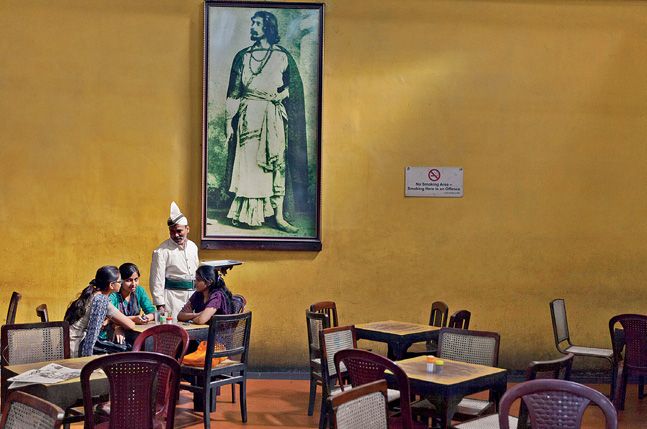
Coffee Break: thoughts on Stuart Freedman's pictures of Indian Coffee Houses

The Palaces of Memory: Tales from the Indian Coffee House is Stuart Freedman's visual journey of urban India.


The Indian Coffee House, Kollam (now closed), 2013

When Stuart Freedman first arrived in Delhi in the mid-90s, it felt overwhelming. "I'd been to Pakistan, I'd been at the siege of Kabul, but India was something else," laughs the British photographer, now a veteran of many visits. "When I needed a break from the relentless push and pull of the city, I'd go to the Coffee House and be quiet. It was a refuge." But it wasn't till about 2010 that he picked up his camera inside one of them. Soon after, on assignments in Jaipur and Kolkata, he ended up photographing the Indian Coffee Houses there. "Then I knew it was a book," says Freedman, in Delhi for the Indian launch of his photo-exhibition and accompanying book, The Palaces of Memory: Tales from the Indian Coffee House (Tasveer/ Dauble, 2017).

If you grew up in urban India before liberalisation, the Coffee House, or at least the idea of it, is likely to have been part of your coming of age. Set up by the British government in the 1930s as a response to the Depression-era decline in coffee exports, the India(n) Coffee House chain did much more than create a local demand for the beverage. Its outposts across India became places where middle-class people met, to drink coffee, yes, but also to discuss politics and poetry and the day's gossip, to meet classmates after class or colleagues after work, or to conduct a romantic rendezvous in a place that offered anonymity but also safety. In short, to do all those things that not many places in the 20th century Indian city yet enabled, and to do so in a public place, inexpensively.

Yet, while the Coffee House experience captured something of modern western urbanity, it also represented India's unabashed, wholehearted claiming of it. Here, we produced our own version of modernity: where the coffee came in white ceramic cups (with saucers) but the kettles were aluminium; where you might cut up a mutton cutlet with a knife and fork but happily eat sambar-vada with your hands. Palaces of Memory does the much-needed job of making us look afresh at these remarkable places in our midst, their unpretentious formica tables and faded Gandhi-Nehru images offering a magical window into a vanished past. As the post-liberalisation city around it grows ever more brash and shiny, the more the Coffee House seems like a holdout: the last surviving outpost of what Amit Chaudhuri's 'Prologue' calls a "deliberately, almost jealously protected austerity".

A waiter serves schoolgirls beneath a portrait of Rabindranath Tagore in the Indian Coffee House, Kolkata, 2013

Freedman's images do not shy away from this plainness, or signs of age: the peeling walls, the fraying pockets of uniforms, the blackened switchboards, table legs balanced in empty Amul cheese tins. But his gaze is affectionate, forgiving, even celebratory. Even a fly sitting in a bowl of sugar seems innocuous, yet another visitor to the Coffee House who hasn't been turned away. "I'm not romantic about India, the nonsense about elephants and maharajas. But there is a romance about what the Coffee Houses allow people to do. You can sit all afternoon with a cup of coffee and no one's going to tell you to leave," Freedman says. "I'm from Hackney, from a working class background. The Coffee House became this kind of translation device for me because I saw the same people there as in the cafes at home."

Of course, Coffee Houses are not all the same. "South Indian ones have much more substantial food," says Freedman. And one Coffee House might cater to different constituencies: retired old men, college students, middle-aged couples or a family on a ritual outing, young lovebirds. But what all these people are likely to have in common is that they are lower middle class.

Men sit and talk in the Indian Coffee House, Baba Kharak Singh Marg, New Delhi, 2010

Freedman is clearly drawn to places that democratise leisure. If England's greasy spoon cafes summon up an era of post-war rationing that he didn't quite witness, his book on another dying British institution, the Eel, Pie and Mash shop, "is really about [his] past" and "that section of London's working class that feels dislocated". He has also photographed the cafes of Cairo "as a way to examine the Egyptian revolution". Does he see Indian Coffee Houses as resisting the neoliberal economy? "Modern cities privatise space," Freedman agrees. "Places where people gather and are not monetised like Starbucks are places where people discuss. And discussion is dangerous to the state. Indira Gandhi knew this; she closed the Coffee House during Emergency, saying it was seditious."

Indian Coffee House, Chandigarh, India, 2013

What also makes the Indian Coffee Houses unique is that they are worker-run. In the 1950s, after the Coffee Board decided to privatise 43 outlets and fired many employees, the workers formed cooperative societies and persuaded the management to let them run the outlets.

Freedman's many superb portraits of waiters and kitchen staff are testament to the wonderful sense of ownership that pervades the Coffee Houses as a result. In one image in Palaces, a frail old man in a dhoti sits with his back to a man in collared shirt and trousers. As they raise their identical cups of coffee to their lips, one has the sense of a world in perfect balance, something sadly missing in the world outside.

20 November 2017

The Art of the State - II

My Mirror column:

Schools, guns and graffiti in two films about the Indian state: When the Woods Bloom and Newton.

(This is the second of a two-part column. The previous column is here.)


I return this week to my discussion of Amit Masurkar's Newton and D. Bijukumar's Kaadu Pookkunna Neram (When the Woods Bloom, WTWB): very different films that deploy strikingly similar motifs to depict a similar subject. In both, an incident of anonymous violence is followed by the uniformed might of the Indian state descending on a Maoist-controlled adivasi area -- centred, in both cases, on a school. 

In the Malayalam film, the policemen have arrived to stay. "Two rooms will be enough for us," pronounces a senior cop, being magnanimous. "There are only four rooms in the school," replies the teacher. "But even if you wanted to take over the whole building, we could not stop you." The fact that the police sit at the top of this ecosystem becomes even clearer when a sleeping cop wakes up and starts hitting two curious children who have sneaked past him to touch some guns. When the teacher objects, he retorts rudely: "You're here to teach children. Don't try to teach cops!" The teacher keeps quiet, but later stops the cops from using the schoolchildren as free labour. Some of the loveliest scenes in Dr. Biju's film involve the tribal children singing.


The songs they sing are clear and sweet, a world away from the raucous film music that the policemen bring with them. "We are the masters of the forest," run the lyrics of one, its dulcet tones belying the sharp irony of the words as they ring out in a forest that no longer seems theirs. In Masurkar's film, where black humour replaces lyrical melancholy, two tribal children are forced to sing songs to entertain the cops. In both WTWB and Newton, local anger can only be expressed in graffiti -- scrawled on the walls of the sole pucca structure for miles around: the school.

But the sentiment of those messages, let alone the irony of their location, does not seem to be reaching the state, which remains intent on widespread repression — which can only produce greater public anger. Early in WTWB, a truckload of cops is unleashed on a village to search for a single 'terrorist'. In the end, when the protagonist (Indrajith) returns to the police post, he is greeted with surprise - and told that that six Adivasis have been jailed for a month on the non-bailable charge of killing him. Newton, where the police have come only for a day, with the ostensibly benign purpose of holding an election, also underlines the casual terror they wield.

In one silently sarcastic sequence, the cops barge into huts, extracting tribute as they rough up people to make them exercise their 'voluntary' right. Poor adivasi India, it seems, is where the state only shows up to replenish its stocks of fresh-brewed liquor and freshly-killed chicken. Newton takes a lighter approach than Biju's film to deliver the same depressing message - the police do not merely implement the law: they are the law. At least while they have the weapons.

This, too, is a motif both films share. WTWB puts the gun in the hands of a woman and a Maoist, letting us see how contingent power is when she taunts the now-unarmed cop: "You're afraid too,without a gun, isn't it?" Newton's climax, too, depends on a gun changing hands - though here we are under no illusion that it will eventually return to those who are licensed to use it. In this utterly skewed world, if you think you can challenge a police officer, you must either be powerful — or a fool. Which is why the long-serving Loknath ji, having observed Newton Kumar's refusal to kowtow to Aatma Singh, sidles up to him to ask after his political connections.

The chatty, diabetic Loknath ji is the excellent Raghuvir Yadav, who began his cinematic career in Pradip Krishen's Massey Sahib as a lower functionary of the colonial state, and now embodies to perfection this lower functionary of the postcolonial state. Both as the youthful Massey and as the middle-aged Loknath ji, Yadav offers up an everyman character whom we laugh at, but also with. And in so laughing, we also laugh at ourselves.

Loknath ji also offers a humorous indictment of the status language and literature have in today's India. An MA in Hindi sahitya who now advises people to focus on English, which he is teaching himself by watching American slasher comedies on his phone, he combines a deadpan cynicism about our times with a hope that he might still catch up.


But in his desire to write a "jombie story" about a police team that enters a jungle in a Maoist area (and never coming out), Loknath ji also gives us a momentary reprieve from realism, a pleasurable dip into the sensational that reminded me of Lalmohan Babu in Satyajit Ray's Feluda stories. Fiction makes other appearances in the film: as indulgence, as entertainment, as a trap. We hear a policeman reading a novel aloud to his mates, a potentially erotic romance about one Ramju. Less innocuously, in the pre-climactic scene, it is by telling the story of the day aloud that Newton realizes that that is what it is: a story he has been sold.

I have not yet watched Dr. Biju's other films, but I was fascinated to learn that none of the characters in his last five films have names. Masurkar and screenwriter Mayank Tewari are clearly equally cognizant of the significance of naming. Their protagonist has already shed the weight of his caste surname. His new first name rids him of the femininity of 'Nutan', while putting him on par with a famous Englishman - and making us instantly think of gravity. At some fundamental level, naming lies at the core of fiction. The fact that Newton can name himself anew is testament to the power of imagination.

Published in Mumbai Mirror, Sun 19 Nov 2017.

The Art of the State

My Mirror column:

What two films might tell us about Maoists, violence and how different the state looks depending on which end of the stick you’ve got. (Part 1 of a two-part column.)


In May this year, at the Habitat Film Festival in Delhi, I saw a Malayalam film called When the Woods Bloom, directed by Bijukumar Damodaran, also called Dr Biju. Having now watched Amit Masurkar’s Newton, I am struck by the extent to which two such different filmmakers, with such widely disparate sensibilities and backgrounds, chose the same motifs to approach their chosen subject: what life is like in those parts of India where Maoists have gained some leverage in their ongoing battles against the state.
What are these motifs? For starters: the jungle, the school, the gun. The action in both films takes place almost entirely inside a forest: in
Newton, the location is Chhattisgarh, in When the Woods Bloom, it is Kerala. In both, an armed posse of policemen arrives at a ‘remote’ jungle outpost where the only sign of human habitation is a school building. The site where the state once marked its presence under the benign sign of education now becomes the location where it stakes its monopoly on power. And power, as Mao Zedong famously said, flows from the barrel of a gun.

But let us begin at the beginning. It seems remarkable to me that both Biju and Masurkar begin their narratives with an incident of anonymous violence. When the Woods Bloom opens with an unidentified group of people overpowering a guard at his post. Newton begins with a candidate called Mangal Netam giving a campaign speech whose vision of adivasi children with “a laptop in their right hand, a mobile phone in their left” inspires wry laughter even among the mixed urban film festival audience I recently watched the film with. Soon after, though, the politician is shot by unidentified assailants, and our disbelief acquires a jagged edge. Our cynicism from the sidelines is now asked to choose a side.


It is in contrast to these anonymous guerrilla warriors that both films first present their picture of an armed, uniformed constabulary. In Dr Biju’s film, we see a busload of policemen on a long journey to their new posting: one watches something on his mobile phone, another falls off to sleep. They are ordinary young men with ordinary desires – and this humanising is crucial when one of them (Indrajith Sukumaran) emerges as our protagonist. Masurkar and his screenwriter Mayank Tewari, too, have an ordinary young man as the pivot of their film — but Newton Kumar is not in uniform and he does not have a gun. He represents the Indian state not by laying claim to its monopoly on violence, but by helping to enable that great participatory ritual by which that state is ideally brought into being: a free, fair election.

But of course, in these less-than-ideal circumstances, the conduct of this basic democratic process threatens constantly to turn undemocratic. For the Maoists, the election is as much a symbol of the Indian state as the army or the police. What the film demonstrates is how violence and suspicion on either side produces a tragic vicious cycle, because Newton and his scanty Election Commission team — including the marvellous Raghuvir Yadav as the long-serving Loknath ji, and Anjali Patil as Malko, the local adivasi BDO — can only carry out their ostensibly peaceable mission under the heavily armed auspices of the Central Reserve Police Force. In one of the film’s quotable lines, “Jhande aur dande se hi toh desh banta hai.


Embodying the state in that militarised avatar is Pankaj Tripathi’s Aatma Singh, in a performance that matches Rajkummar Rao’s superb turn as Newton, move for move. The experienced cop produces a calibrated mix of menace and machismo that is designed to defeat the rookie officer’s seemingly unstoppable zeal. But every rhetorical move Aatma Singh makes is met by Newton with a counter-dose of literalness. So when Aatma says: “Main likh ke deta hoon, koi nahi aayega vote dene [I can write it down for you, no one will come to vote]”, Newton’s response is to take him at his word, holding out a pen and saying, “Sure, write it down.” Later, when Aatma tries to prevent Malko from accompanying them, Newton’s response is once again to keep repeating his rulebook position — “She is a member of the team, she will come with us”.


In When the Woods Bloom, the confrontation between the cop and the suspected Maoist (Rima Kallingal) is based on a set of binaries — state-nonstate, man-woman, civilisation-wilderness, ‘legitimate’ versus ‘illegitimate’ violence – that Biju wishes to turn on its head. Watching that reversal can be powerful. But Newton seems to me to have an edge over Dr Biju’s film because it refuses to deal in binaries at all.

Published in Mumbai Mirror, 12 Nov 2017.

The second part of this piece is here.

9 October 2017

The Securing of Freedom

My Mirror column:

Young women on campuses are waging a war against inequality, most recently seen in the events at BHU. Bina Paul’s documentary tracks the battle in Kerala.

A still from Bina Paul's The Sound of Silence, which confirms the findings of the Samaagati Report on the gender injustices in Kerala's campuses
As with most events in India these days, what you think of last week’s protests at the 100-year-old Banaras Hindu University (BHU) might vary widely based on your age, location and gender, not to mention what sources you get your news from. But I shall quickly summarise the events as I understand them to have unfolded: on 21 September, a student of BHU’s Arts faculty was allegedly harassed by three motorcycle-borne men inside the BHU campus when she was returning to the Triveni Hostel. The student alleged that when she reported the incident to the hostel warden, instead of raising the matter with university authorities, the warden wanted to know why she was out ‘so late’. The incident of molestation and the response of the authorities —callous about the security concerns of its women students while marshalling the force of moral judgement against them — triggered a massive protest three days later.

The women students were calling for better security and better lighting while also protesting the unequal treatment long being meted out to them — from much earlier curfews and lack of WiFi, to the denial of non-vegetarian food in women’s hostels. But the Vice-Chancellor, Girish Chandra Tripathi, instead of recognizing the grievances as legitimate, called in the police to violently disperse the protest, hinted at the involvement of ‘anti-national’ elements and cut off water and power supply to hostels last Sunday. The university was then shut down three days in advance of the scheduled Dussehra vacation.

Some damage-control measures have since kicked in, with a woman being appointed as the university’s first female Proctor, and the possibility being floated that the Vice-Chancellor, who is due to retire in end-November, might be asked to go on leave. An Additional City Magistrate and two of the police officials who led the lathi-charge have been suspended. But an FIR has also been filed against hundreds of unidentified students of BHU.

Meanwhile, the V-C has been recorded asking students why they brought “dishonour to the university” by protesting, and whether they thought it right to “have taken a girl’s honour and gone into the market with it” [“Ek ladki ki izzat bazaar mein leke nikle tum log. Yeh sahi hai?].

It is not surprising to learn that Tripathi is a proud sympathiser of the Rashtriya Swayamsevak Sangh (RSS), a man who when asked by a Youth ki Awaz journalist last year what the university meant by instructing female students to wear ‘appropriate clothing’, responded, “Don’t think like a journalist, think like a father. Think of what ‘appropriate clothes’ would mean to a father.” It does not seem a coincidence, either, that these events are unfolding in Uttar Pradesh, a state in which the discourse of women’s safety has such enormous valence that practically the first measure adopted by Adityanath’s government was to institute ‘anti-Romeo squads’ to ‘save’ women from sexual harassment in public places.

But just a week before things at BHU came to a head, I happened to watch a thoughtful documentary about female students in a state usually perceived to be as different from UP as is possible: Kerala. Directed by Bina Paul, wellknown film editor and long-time curator of the International Film Festival of Kerala, The Sound of Silence is centred on the findings of 2015’s Samaagati Report, on the state of gender issues on college campuses in Kerala. Speaking after a screening in Delhi, Paul said, “My starting point was... how does a place with such high indices... on women’s education... stay so gender-unjust?”

Patriarchy clearly unites left and right, with establishments across the political spectrum using fear and ‘honour’ to police women’s freedoms. In Paul’s film, we meet women students from a variety of Kerala colleges and universities, and again and again we hear of how they are silenced with statements that VC Tripathi would no doubt approve. If a female student wants to go out to buy something at 6pm, she is told “Don’t you know it’s dangerous? Why are you inviting danger?” Boys can roam around their campus until 6 or 8 or even 10pm, but girls will be told to go back into their rooms even at 4.30pm. So why do female students accept unequal status on mixed campuses? Why do they not protest the prison-like conditions of most all-women campuses? Paul interviews a psychologist who offers this depressing insight: “For the girls, since they are used to confined spaces, whether in the family or in public, with little freedom, they don’t find it surprising or different when it happens within the campus. They’re used to it.”

Like our families and communities, the Indian university has long been telling women that they alone must be responsible for their own security: ‘boys will be boys’, so it is girls who must be careful.

As is standard in patriarchal discourse, freedom here is pitted against security: if you want one, the message goes, you better give up on the other.

But of course, as both Paul’s film and BHU women’s experience shows, the curtailment of liberties is no guarantor to safety. As more and more young women realize that they have a right to both, the era of that supposed trade-off might well be coming to a close.


Published in Mumbai Mirror, 2 Oct 2017.