Showing posts with label adaptation. Show all posts

28 May 2021

A child's view of the world through a train ride

This is the sixth column in my ongoing series on trains in Indian cinema. (Periodic reminder for new readers of this blog: I write a weekly column on cinema which appears in TOI Plus, as well as in Bangalore Mirror, Pune Mirror & Mumbai Mirror.)

-- In Gulzar's Kitaab, the railways are a route and a rite of passage for a child trying to find his place in the universe --

There are probably few films in any language that have been titled 'book'. But lest you think a film called Kitaab might be bookish (which in the eyes of many movie-viewers translates to boring), Gulzar's 1977 screen adaptation of Samaresh Basu's story begins in breathless motion. Gusts of black smoke rise into the sky, a train whistles, and the familiar “chooka-chook” of the moving carriage takes over, interspersed with a child's voice. He is making up a chant to match the train's rhythmic sound: Kidhar ja, kidhar ja, kidhar ja? Bhaag chala, bhaag chala, bhaag chala [Where d'you go, where d'you go, where d'you go? Running away, running away, running away].


It is only after this that we see him: Master Raju, ubiquitous and irreplaceable child star of 1970s Hindi cinema, squatting on the train's floor, in the space between two lower berths. Above him, in the upper berths, two children pass a notebook to each other, conducting a silent game of knots and crosses. Even before we know anything of what the film is about, Gulzar has communicated how marvellous train journeys could feel for the middle-class child -- the adults asleep below, while you looked down from the deliciously unsupervised space of the upper berth, the holidays stretching ahead of you. The train journey was a time out of time.

As it turns out, Gulzar is only pointing to that sense of sweet interregnum, secured at both ends by middle-class cushioning, as a contrast. What makes Kitaab memorable is the real-life adventure on which it launches its boy hero – but here, too, the railways are crucial. Bored with school and misunderstood at home, Babla runs away from the city home he shares with his didi (Vidya Sinha) and brother-in-law (in an odd bit of casting, Uttam Kumar!). He gets on the train to go back to his mother in the village. But when shoved out for being ticketless, the 12-year-old suddenly finds himself in the real world he's been so impatient to enter.

In flashback, we see Babla and his best friend Pappu bunking school to wander the city, entranced as much by the street magician as by the halwai making jalebis. Again and again, they try to apprentice themselves to these men, who greet their enthusiasm with mostly indulgent disbelief. On the surface, these scenes evoke laughter: The boys, it seems, will do anything to get out of having to go to school. But the camera's attention to the men's practiced movements and the boys' rapt gazes tell a different story: These artisans are indeed masters of their craft. The children, watching them, grasp that fact instinctively – and any craft so consummately carried out seems worth learning. If classroom education has failed to engage these young minds, Kitaab suggests, it has also not yet infected them with the casteist, classist belief that manual work, no matter how skilled, is unworthy of admiration.

It is people like these that adopt the runaway boy -- the railway engine driver and his assistant, the station's resident midget, and Shreeram Lagoo playing a blind singer of the sort that could once be met on every train in India. Asking very few questions, they simply add him into their lives. The middle class passengers ignore the unclaimed child in their midst, but the engine driver gives him the last of his tiffin, the blind beggar buys him tea and food. The instinctive humanity with which they share what little they have is moving – yet Gulzar doesn't let things turn maudlin. We smile at little things and big ones: The little boy and the dwarf literally sizing each other up; the hackneyed phrases people use for emotions. When someone says “Bechara anaath hai [He's a poor orphan]”, Babla adopts the phrase, trotting it out for a quick dose of sympathy, often to hilarious effect. “Bechara anaath hoon [I'm a poor orphan],” he tells one ticket checker -- just before saying he's headed to meet his mother.
 

Much of the bittersweet pleasure of Kitaab comes from watching the child watch the world go by – and learning from it as he does. And although Babla was curious, observant and sensitive at school and at home, it is the train that offers him a sense of what the world is really like. The network of trains and railway stations is like a pathway through the world, and a microcosm of it. As Babla negotiates his way through this network, he encounters old age and disease, blindness and deformity -- and death. Like a latter-day Siddhartha, the protected middle class boy is confronted with the sight of suffering, and is shaken by it.

Unlike Siddhartha, though, the experience doesn't lead him to renounce the world – but to return to it richer. One could read Kitaab as a cop-out: Issuing a challenge to middle class pieties and normative barriers, but turning back before risk turns to danger. But one can also see it as an expansion of the child's universe, an initiation into life that acknowledges the inevitability of sorrow -- while not undermining the value of the safety net. As the blind train singer puts it, “Gaadi chhutne ka gham mat kariyo, baalak. Station na chhutne paaye [Don't mourn the missed train, child. Just don't let the station get away from you.]”

Published in TOI Plus, and three editions of Mirror -- Pune, Bangalore and Mumbai.

8 May 2021

A lifeline, but also a harbinger of doom

The third column in my series on trains in Indian cinema, for Mirror/TOI Plus:

In the cinema of Bimal Roy, the train is often a site of unfolding tragedy

Fiction necessarily derives its motifs from reality. There’s a reason why the road movie is a thing in Hollywood, while it barely existed in India until quite recently. Trains, on the other hand, have been integral to our cinema as sites of romance, drama and - more often than you might expect – sorrow.

When Sanjay of 27 Down launched himself on an endless train ride to combat his melancholia, he was following in the footsteps of Indian cinema's original tragic romantic hero, Devdas. The original Bengali novel, published by Sarat Chandra Chattopadhyay in 1917, has been adapted for the screen many times. The classic, in my opinion, remains the 1955 Bimal Roy version, starring Dilip Kumar and Suchitra Sen as Devdas and Paro: Childhood friends whose romantic union as adults is prevented by their caste-minded, convention-bound families -- and by their own stubborn, childish miscommunication. Paro anchors herself in the duties of her arranged marriage, while Devdas' anchorlessness is depicted in his constant wandering. We see him sometimes dramatically departing for Calcutta in a horse-drawn carriage, then almost immediately returning. Later, having turned alcoholic, he wanders the village shooting birds with an air gun. Bimal Roy makes elegant cinematic use of several modes of transport: The unending bullock-cart ride at night, or the beautifully conjoined shots where Paro is urged to ascend into her wedding palanquin just as Devdas is being urged to descend from his – at the house of the tawaif, Chandramukhi. But it is the train sequence that is iconic, with our still-youthful but sunken-eyed hero lolling about in his compartment as the train transports him across the country.

Trains possibly work best for Devdas' character because they let him move while having to expend no energy. And he never seems to actually get off the train, though we see the names of stations that mark the country's biggest cities, other than Calcutta, where he started: Delhi, Madras, Bombay, Lahore. (It's interesting that Roy puts Lahore in there, because it marks the setting of his film as before Independence and Partition. It's even more interesting when one watches the 1935 PC Baruah version of Devdas and finds that the train sequence there has a similarly aimless Devdas traversing a slightly different geography: Delhi, Agra, Lucknow, Banaras.)

The spoilt son of a rich zamindar, Devdas naturally travels first class, accompanied by a trusty feudal retainer. Poor old Dharamdas retires to some less comfortable class of compartment by night, leaving Devdas his privacy – but also leaving him vulnerable to being lured back to drink by his thoughtless friend, Chuni Babu. In one of Roy's much-applauded visual juxtapositions, the train's engine is stoked by a shovelful of coal just as Devdas' cycle of self-pity receives fresh alcoholic fuel.

The train appears in many of Bimal Roy's other films. In Do Bigha Zamin (1953), the railway is the link between the city and the village, as it must be. But it is also the site of dramatic meetings and equally dramatic separations. When Shambhu sets out for Calcutta to try and earn money, he discovers his little son has secretly stowed himself away on the train. Later, when Parvati sets out on another train to search for Shambhu, she is separated from her travelling companion Ramu – to tragic effect. Madhumati (1958), which begins with a car journey disrupted by a landslide, ends with a train accident. There are a few tense moments before we see that it is to be the site of a happy reunion.

It is in Naukri (1955) that Roy puts the tragic potential of trains to full use. The film's job-seeking hero Ratan (played by Kishore Kumar, before he was relegated to purely comic roles) tries to keep his spirits up - and there is at least one bit of silly humour on a train ride, where he gets on without knowing the name of the firm that has offered him a job.

But in the city, Ratan finds himself living with a bunch of similarly jobless young men, placed in a section of a lodge called 'Bekar Block'. It is in this dispirited world that we first see the train as a harbinger of doom. Three suicides are attempted in the film, all of them by unemployed young men throwing themselves on the railway tracks. In Naukri, two out of these three young men are saved.

Still, I couldn't help but think of an odd little scene in Do Bigha Zamin, where Shambhu is listening to two men on the train pontificate about how we need to return to India's villages to save our people. “Each and every one will die!” comes a loud voice from behind them. It turns out to be a man selling a pesticide to kill bed bugs. But there's something rather dark about the scene's humour, given how Do Bigha Zamin turns out. Even as they take you closer to something, trains in Bimal Roy's cinema always foretell possible tragedy.

Published in Mirror (2 May 2021) & in TOI Plus (1 May 2021)

4 April 2021

Why our enduring romance with the railways makes for great cinema

My Mumbai Mirror column:

Awtar Krishna Kaul's 27 Down, which won two National Awards in 1973, remains a visually arresting reflection on India's train journeys 


The connection between films and trains dates back to cinema's origins. One of the Lumiere brothers' first films was of a train arriving at the station in La Ciotat, a small French town near Marseilles. Arrival of a Train, shot in 1895, is central to the mythology of the movies. The claim (made in several film histories) is that early audiences leapt from their chairs in alarm as Lumiere's locomotive seemed to race towards them. Even in soundless, jerky black-and-white, the story goes, the power of the moving pictures was such that people – almost -- couldn't tell them apart from life.


In recent times, film historians have cast doubt on this narrative, some pointing to confusion with a later stereoscopic version that Louis Lumiere exhibited in 1934. But what is indubitable is that there was something endlessly watchable about this simplest, single shot of a train. Trains had screen presence.


Both the railways and the cinema arrived in India soon after their invention, swiftly becoming integral to our social and cultural life. So it's no surprise that trains are a fixture in our films: The staging ground, as much for crime and thrills as romance and recreation.


But perhaps the most devoted train film we've ever had is Awtar Krishna Kaul's 1973 feature, 27 Down. Kaul, who had left his diplomat job to study filmmaking in New York, returned to India in 1970 and became part of the Indian New Wave: A spectrum of directors ranging from Basu Chatterjee to Mani Kaul, beginning to make their mark in an era popularly defined by Bobby and Yaadon Ki Baraat. 27 Down was Kaul's first feature, made with the encouragement of Filmfare editor BK Karanjia, who was then chairing the Film Finance Corporation.


Based on a Hindi novel called Atharah Sooraj Ke Paudhe, the film stars a young MK Raina as the ticket-checker protagonist Sanjay, and Rakhee as his girlfriend Shalini. Filmed in atmospheric black and white by cinematographer AK Bir (who had just graduated from FTII at the time and never shot a film before), it won National Awards for Cinematography and Best Hindi Feature -- days after Kaul died tragically in a drowning accident.


The film begins with the familiar drone of the Indian Railways announcer: “Number Sattaaees Down platform number teen se jaane ke liye taiyyar hai”, and is shot very substantially on trains and in stations. Often assembling his shots to accompany a meditative monologue, Kaul's work seems closer to the more experimental end of the New Wave. 27 Down starts off ploddingly, in a self-consciously literary voice: “Phir koi pul hai kya? Shaayad pul hi hai [Is it a bridge again? It's probably a bridge],” Sanjay thinks to himself, lying supine on a berth as the train moves. “It feels like I'm constantly crossing bridges...”. But there are playful moments, too. The song Chhuk chhuk chhuk chalti rail, aao bachchon khelein khel adopts the train's rhythm to create a visual and aural paean to it, with shots of the locomotive moving through tunnels juxtaposed with children lining up to form a train.


Son of an engine driver, Sanjay's life seems to keep circling back to the railways. Born between two stations, as a child he is insatiably curious about trains. He tries to study art in Bombay, but his father urges upon him the stability of a railway ki naukri. As a ticket checker, Sanjay discovers anew his love of trains. He starts to eat and sleep on trains, even when not on duty. Neighbours, landlords, even his father finds his peripatetic existence strange. “Tumhare liye toh train hi ghar ho gayi hai,” his father writes him.


It is on a train that he meets Shalini, who lives alone in a rented room in Kurla and works in the Life Insurance Company of India. It is a railway romance: She takes the train to work, he takes the train as work. When his life plans are again forcibly aborted by his father, Sanjay surrenders himself to the trains again – in metaphor and then in reality.


“I wanted a long path, instead I got these iron roads, where the direction is already decided,” Sanjay muses sadly. A minute later he's grateful for the effortlessness of the journey: “Chalti train hi sahara hai [The moving train is my only support].” But then, there's the sense that he isn't really getting anywhere. “Main guzar jaata hoon, aur jagah khadi reh jaati hain [I move past, and places stay where they are].”


Then he gets on a train to Banaras, looking to beguile himself with women and wine, his beard getting scragglier. The sequence echoes so many tragic Indian heroes, and yet it feels distinct. He looks at an old man on the train, the old man looks intently back at him, and we imagine (wordlessly, like Sanjay) that he is Shalini's long-lost father who may have become a sadhu in Banaras. In a more conventional melodrama, Sanjay's echoing of Shalini's father's escape from an unchosen domesticity would end in discovery, reunion. Here, it ends in a dream of death.


Perhaps what 27 Down's languid melancholy really captures is the duality of the long-distance Indian train ride: You're in a crowd, yet alone; relentlessly moving, but not of your own accord. And yet, the solidity and predictability of India's trains makes them feel like something to believe in. Get on a train, and the country seems to stretch out before you: Distant, but somehow accessible. When Sanjay says, “Mera train aur bheed se vishwas uthh gaya hai [I've lost my faith in crowds and trains]”, we know it's over.


Published in Mumbai Mirror, 4 Apr 2021.

Awtar Krishna Kaul’s 27 Down, which won two National Awards

Read more at:
https://mumbaimirror.indiatimes.com/opinion/columnists/why-our-enduring-romance-with-the-railways-makes-for-great-cinema/articleshow/81893897.cms?utm_source=contentofinterest&utm_medium=text&utm_campaign=cppst

1 February 2021

Darkness and death in the Indian Jungle

My Mumbai Mirror column:

The pitch-black vision of Aravind Adiga's Booker Prize-winning 2008 novel about class finds new audiences with a streaming film adaptation.

The White Tiger, currently the most watched film on a major streaming platform in India, features a protagonist born at the bottom of the country's social pyramid (not counting gender). Balram Halwai belongs to what Aravind Adiga, in the bestselling 2008 novel on which the film is based, calls “the Darkness”. “India is two countries in one: An India of Light, and an India of Darkness,” says Balram in the book, going on to elaborate a geographical basis for the divide, centred on water. Wherever the river Ganga flows, he says, that area is the Darkness – while every place in India that is near the ocean is well-off, in the Light.


Adiga names Balram's village Laxmangarh, and refers to Dhanbad and Gaya as the nearby towns, the places where men from the village go to seek work, or catch trains to cities further away: Calcutta, Delhi. But of course each time Balram speaks of the Darkness, the term conjures up something more than mere location. It encapsulates the desperate poverty that is the norm in a village like Laxmangarh, the entrenched hierarchy that makes sure that the backbreaking labour of men like Balram's father feeds the bellies of men like Ashok's father.


Ashok -- whose car Balram drives, and whose life choices he judges every day, even as he also aspires to them. “Rich men are born with opportunities they can waste,” says Balram scathingly of his master, who does very little about his oft-stated desire to change the future of India. The America-returned son of Laxmangarh's most exploitative landlord (nicknamed the Stork), Ashok is far too good for his own good. He has married his Indian-American girlfriend Pinky, who isn't of his caste, and who might even be Christian -- and his egalitarian ways do not sit well with his position atop the hierarchy. He is constantly trying to prevent Balram from opening doors for him, trying to make him sit next to him on a sofa, and generally experimenting with the radical idea of the servant's humanity.


Two weeks ago in this space, I wrote about another film in which, too, a US-returned Indian employer breaks the rules about how to behave with our servants. The exemplary hope of Rohena Gera's finely wrought narrative is that a man might actually fall in love with his domestic help.


In Ramin Bahrani's cinematic adaptation of his old friend Adiga's novel, the erotic and emotional charge of the master-servant relationship remains beneath the surface. But watching Balram attach himself to Ashok like a faithful puppy -- thrilled to be able to serve him well and distraught when his overtures are rejected -- one has no doubt that the charge exists. When a distraught Pinky abandons ship, Balram and Ashok are thrown back even more upon each other, creating unprecedented closeness – and thus also unprecedented distaste. In one remarkable scene, Balram goes instantaneously from cradling the drunken Ashok to slapping him, with some glee, when he passes out. It's a short journey, it seems, from worriedly trying to revive his master with nimbu pani to sprawling on his couch and drinking his whiskey.


Adiga articulated that strange intimacy well, and Bahrani excels in this section. In Pinky's absence, Balram determines to “be a wife” to his master – which apparently involves not letting him drink, and keeping his spirits up. But then Ashok's elder brother arrives to take charge of him, and brings rejection in his wake. Ashok goes from being grateful for Balram's company to swatting him away. Suddenly the servant's advice is too stupid, his attentions too cloying. A similar fluctuation happens with others, too; whenever an employer needs the servant, he is wooed and flattered, embraced, called a part of the family.


The grateful servant preens, at first. But this is intimacy conducted on one person's terms. And so the servant, powerless though he is, slowly discovers the weapons of the weak. In The White Tiger, Balram goes from being what the coarse-tongued caretaker of the building's netherworld of a basement calls his master's 'faithful dog', to a faithless cheat who realises he must take what he can get. The dehati chuha, the country mouse, learns the ways of the city. But even those petty ways – picking up other paying customers, invoicing fake repairs, siphoning off petrol -- are a fraction of what would be needed to actually bring the servant anywhere near the level of the master.


And so intimacy is corroded by duplicitousness. “Do we loathe our masters behind a facade of love? Or do we love them, behind a facade of loathing?” muses Balram. Adiga/Bahrani's is a much darker vision of cross-class relationships than Rohena Gera's. That's the thing, though – Sir imagines bridging India's vast social gap with love, The White Tiger with crime. For the vast majority of India, both options remain fantasies.


Published in Mumbai Mirror, Sun 31 Jan, 2021.

25 October 2020

The doctor as sufferer

My Mirror column, sixth in my series on films about doctors:

Based on AJ Cronin’s famous 1937 novel The Citadel, Vijay Anand’s medical melodrama Tere Mere Sapne (1971) casts doctors as the ailing ones

Like several of the films I've written about in recent weeks, Vijay Anand’s Tere Mere Sapne (1971) had as its protagonist not a doctor, but the medical profession itself. And thus, perhaps necessarily, several doctors. The director's brother Dev Anand may have supplied the film's star quotient (as the rather unimaginatively named hero Dr Anand), but within the film's opening ten minutes we meet three other doctors. These are the characters that actually give us the lay of the land

First up is Dr Anand's medical batchmate, who delivers the first line of dialogue in the film: “Jise tum aadarsh kehte ho, usse main paagalpan kehta hoon [What you call principle, I call madness].” He suggests establishing a moneymaking practice in the city together, but the idealistic Anand mocks him for being a businessman instead of a doctor - and leaves for a remote mining village. The second doctor we meet is the ageing Dr Prasad (the marvellous Mahesh Kaul), employed by the mining company for 35 years, but now so ill that he hires younger doctors as ‘assistants’ to work in his stead - while his paranoid wife attempts to keep his illness a secret. The third doctor is also interesting: Dr Prasad’s other assistant, one Dr Jagannath Kothari, played by Vijay Anand himself. A gynaecologist with a fancy degree from London, Jagan now spends most of his waking hours drinking himself into a stupor.

What is common to these very different characters – and what eventually comes to drive our hero as well – is money, or the lack of it. The idealists are led by the old Dr Prasad, who has spent a lifetime in the service of poor mine workers, but without being able to realise his dream of improving the medical facilities in the area. The unruly-haired Dr Jagan, meanwhile, is only on his way to middle age, but already embittered by the bureaucratic and other restrictions that kept a young doctor from rising in a socialist India [these are complaints about the system that continued to appear in later films I’ve written about, like Bemisaal (1981) and Ek Doctor Ki Maut (1989)]. Our hero arrives in the village full of reformist zeal, initially even managing to rouse Jagan out of his alcoholic self-pity - but his honesty and hard work are of no avail either in his career, or when he finds himself up in court against a powerful rich man.

Thus the corruption of the system – and we’re talking 50 years ago – is blamed for Dr Anand’s moral decline. Which is how the film leads us back to the first doctor it showed us, the one who has no compunctions about using his qualifications as a way to mint money. In the second half, it is his network of fashionable city doctors catering to the rich and famous that an angry Dev Anand becomes part of. “Aaj tak mere aadarsh hi meri daulat thhe, lekin aaj se daulat hi mera aadarsh ban jayegi [Till today my principles were my wealth, from now on wealth will be my principle],” he announces to his increasingly distressed wife Nisha (Mumtaz).

There are many things that relegate this film to its time: the paternalistic take on mine workers as easily misguided/corrupted; the dismissal of the village midwife as necessarily knowing less about delivering a baby than any doctor – even one not trained in gynaecology; the portrayal of Dr Prasad as the generous, open-hearted idealist at the mercy of a small-minded, penny-pinching wife.

But despite these, within its melodramatic dialogue-baazi, something still rings true. And again, as in Anuradha, which I wrote about last week, it is only a doctor who can manage to get through to another doctor. This is true of the pre-climactic scenes, featuring Dr Anand’s restoration to the milk of human kindness. But Tere Mere Sapne’s most moving scene might be between the ailing Dr Prasad and Jagan, his black sheep doctor employee. “Does such a capable doctor not recognise his own symptoms?” asks Jagan. And when the old man says he does, but has decided to wait for death, Jagan’s response is: “Yeh ek mareez baat kar raha hai, doctor nahi. [This is a patient speaking, not a doctor.]” This exhorting of the doctor to a special status recurs through the film, as for instance when a famous actress (Hema Malini in a fetching part) tells Dev Anand to cheer up because “if a doctor speaks like this, what will the patient do?”

The doctor in Hindi cinema, it seems, must not only carry the god-like mantle of giver of life, but hide his own emotional travails. The mantle is a veil.

Published in Mumbai Mirror, 25 Oct 2020.

6 October 2020

The people versus science

A respected doctor becomes the target of public anger in the uncannily resonant Ganashatru, Satyajit Ray’s 1989 take on the classic Ibsen play An Enemy of the People (1882)


In 1989, the filmmaker Satyajit Ray adapted into Bengali one of Henrik Ibsen’s most famous plays, written a century ago in 1882: An Enemy of the People. The original Norwegian text was about a doctor who discovers bacteria contamination in the public baths for which he is medical officer. When he tries to expose the public health hazard, he finds the spa town's powers-that-be arraigned against him - including the mayor, his own brother.

Ganashatru turns the 19th century Scandinavian town into an imaginary 20th century Indian one, while retaining the dramatic device of having brother oppose brother in public: Dr Ashoke Gupta (Soumitra Chatterjee) is pitted against his younger brother Nishith (Dhritiman Chatterjee, no relation), who is head of the municipality. But the change that makes Ray’s 1989 adaptation feel truly Indian – and uncannily prescient 30 years later – is his replacement of Ibsen’s public baths with a popular temple whose bacteria-filled water is directly consumed by thousands each day – as charanaamrit.

The Norwegian play’s Dr Stockmann finds himself under attack for trying to reveal an unsavoury truth that might cost the town its prosperity. But for the good doctor of Ray’s film, the stakes are even higher. Ibsen’s play pitted a potential health disaster against a public panic - and a righteously superior whistleblower against a corrupt cabal of media and bureaucrats. Ganashatru takes that kernel - of one man trying to tell an unpopular truth to a resistant public - and expands it into a full-blown science versus religion debate.

Except, of course, that there isn’t a debate. Hearing that the doctor has tested water samples for bacteria, the local industrialist Bhargava (who set up the temple, and the private hospital that employs Dr Gupta) shows up with a small vial of temple water. “This charanaamrita, and all charanaamrita, is free from germs,” he pronounces, speaking in English for emphasis in the midst of his Hindi-accented Bangla. “Aapni ki jaanen? Ki tulshi pata-e joler shob dosh kete jaaye? [Do you know? Ki all impurities in water are removed by tulsi patta?] It's a rhetorical question, it seems, because Bhargava has no doubt of the answer. “You won't know this, Dr Gupta,” he sneers at the stunned physician. “But Hindus have known it for thousands of years.”

‘Hindus', apparently against all lab-based evidence, 'know' that the water of Chandipur, and particularly the Gangajal-mixed water that temple devotees drink, “cannot be polluted”, so “Dr Gupta is making a mistake”. The local newspaper, having first commissioned the doctor to write about the lab's report, turns tail when it receives seventeen letters from readers – and a not-so-veiled threat to its existence from Nishith and Bhargava. Publication thus prevented, Dr Gupta plans a public lecture. A local theatre troupe pastes posters around town. A large audience assembles - but so do the turncoat editor and publisher and the poisonous Nishith.

What unfolds seems to shock our protagonist, who keeps saying he is only doing his duty as a doctor, that all he wants is for people to hear the facts so that they can make an informed decision, and that surely 'public opinion' - “janamat” - cannot be determined by editors and politicians in advance, to such an extent that they suppress any opinions they believe will be unpopular. But Dr Ashoke Gupta, if he lived in the India of 2020, would not be shocked. For anyone who lives in today's India, there is something completely commonplace about the independent-spirited doctor first being threatened, sought to be suppressed - and when that fails, discredited. While he tries to speak, his brother takes the microphone and asks if he is a Hindu. Suddenly, instead of water and sewage pipelines, the subject is the doctor not having ever worshipped at the Tripureshwar temple – so that whatever he now says is “against the temple”.

And there we have it, all the tragedy of our real-life present already distilled in this admittedly somewhat theatrical fiction from 1989: that faith takes precedence over science; that facts can be disregarded if they go against faith, especially if the source of those facts is somehow not to your taste; the keenness to preserve the image of the ideal city even at the cost of its actual well-being; the nexus between religion, politics, money and the media – and already, even in the left-ruled small town West Bengal of 1989, the quickness with which the needle of suspicion could turn upon a non-religious man.

But Ray's film is also plagued by his own predilections: he makes the doctor a hero. Unlike Ibsen’s protagonist, whose lack of humility and personal excesses ensure that he ends up fighting his battle alone, Ganashatru's Dr Ashoke Gupta isn't lonely for long. By the film's final scene, he not only has the unequivocal support of his wife and daughter, but of some kind of resistance - led by the “educated young students” of the theatre troupe and an ethical journalist who's left his job to report the farce of the public meeting to all the national papers. Hearing the sound of his name on the lips of the students marching towards his besieged house, Soumitra Chatterjee appears on the verge of tears. Watching the unreal optimism of Ray's 1989 ending in 2020, I felt on the verge of tears myself – but not of joy.

Published in Mumbai Mirror, 4 Oct 2020

13 July 2020

The reel life of MS Sathyu - 1

My Mumbai Mirror column for July 12:

In honour of his 90th birthday on July 6, a look back at some of MS Sathyu's notable contributions to Indian cinema: Garm Hava, Bara and Galige

AK Hangal, Balraj Sahni and Farooque Shaikh in MS Sathyu's Garm Hava (1973)

The director Mysore Srinivas Sathyu turned 90 on July 6. We owe to Sathyu what remains Hindi cinema’s most honest, painful appraisal of the early effects of Partition: the 1973 film Garm Hava, which I have written about in a previous instalment of this column. Born in 1930 in the then princely state of Mysore, MS Sathyu graduated from Bangalore’s Central College and moved to Bombay in 1952. There he became associated with the Indian People’s Theatre Association (IPTA), staging plays like Aakhri Shama (1969) in collaboration with the poet Kaifi Azmi, with the great Balraj Sahni in the lead as Mirza Ghalib. He entered films as an assistant director on Chetan Anand’s Ladakh-set saga of the Sino-Indian War, Haqeeqat (1964).

Eight years later, Sathyu’s feature debut Garm Hava had him working with Sahni and Azmi again. Azmi and Shama Zaidi (Sathyu’s spouse) crafted a brilliant screenplay, based on an unpublished story by Ismat Chughtai. Set in Agra, the film achieves a fine-grained sense of the everyday ways in which amplifying socio-political divisions push a reasonably well-off Muslim family to misfortune. Sahni delivered an unforgettably moving performance as an ageing shoe-manufacturer adamant not to leave for Pakistan, despite the harsh winds that seem intent upon sweeping him away from home. Garm Hava was Sahni’s last film role, and Farooq Shaikh’s first, as Sahni’s son Sikandar. It is  Sikandar's uncertain future – as an unemployed young man, but also as a young Indian Muslim – that the film ends with.

Sathyu, who lives in Bangalore, hasn’t made many more films. A theatreperson at heart, he has spoken in interviews of being branded a political filmmaker after Garm Hava, and of funding remaining an uphill battle. But two of his other features are currently available to view, both in Kannada with English subtitles. Galige (1994) is playing in the Indian cinema section of an online screening platform, and in honour of Sathyu’s ninetieth birthday, the Bangalore International Centre is screening Bara (1980), free to watch until July 16, with an online conversation with Sathyu scheduled for 5pm today, July 12.

Neither Bara nor Galige have the emotional heft of Garm Hava; it is hard to match either the increasingly prescient texture of that narrative, or the subtlety of the performances by Sahni and Shaikh, as also the fine ensemble cast, including Jalal Agha and Gita Siddharth. But both films offer unusual perspectives on Indian politics and society, in very different styles. Bara (The Arid Earth), adapted from a Kannada story by the great UR Ananthamurthy, is about a young IAS officer called Satisha (Anant Nag) whose attempts to improve conditions in his district are constantly obstructed by bureaucratic and political wrangling.
The idealistic hero was not new, but the corruption was laid out in greater depth than most Indian films in 1980. The chief minister turns out to be conducting a behind-the-scenes battle with a minister from the region, and will not declare the district famine-affected for fear that his rival will take credit for relief. The minister, meanwhile, is in cahoots with a corrupt trader called Gangadharswamy, whose blatantly illegal stocks of grain escape police checks even as small-time traders are jailed for ‘smuggling’ one sack of rice. The most fascinating character is Bhimoji, a local advocate-activist-politician who is Gangadharswamy’s bete noire, as well as being Satisha’s (and our) entry point into the realpolitik that actually governs the place he is supposed to run.

In some respects, Sathyu sanitised the character: removing, for instance, Ananthamurthy’s frank reference to Bhimoji’s pimping before becoming a politician. But the film also gave Bhimoji more complexity than Ananthamurthy’s text (available in a 2016 English translation from Oxford University Press). For example, in both the film and the book, Bhimoji decries Gangadharswamy’s land donations as staged, essentially fake handouts to his own supporters – but the film also depicts Bhimoji’s own ‘counter-occupation’ of the donated land as being staged for local journalists.
 
Another interesting aspect of the adaptation touches on cow protection or gau-raksha, whose shadow upon our politics has grown much darker in these forty years. In the story, one Govindappa appears nervously at Satisha’s office to ask him to chair a reception committee to welcome his Guru, who is coming to inaugurate a cow shelter that will save cows from the drought. Sathyu makes an interesting shift: he makes Satisha’s father a temple-building gau-raksha votary, someone who gets farmers to send their drought-starved cattle to him instead of to the butcher. In the film, the father brings the gau-rakshak to Satisha’s office. In a perspicacious change that seems to presage today’s religio-politics, this character, Govind Rao, is announced as “an MSc in chemistry from Banaras Hindu University”, and displays no nervousness – he has already printed Satisha’s name on the invitation, without asking him.

Other departures from the text, though, flatten the film. Ananthamurthy gave Satisha an interesting angsty self-reflexivity: his “instinct for adventure” matched by his worldliness in marrying “into a family which shared a deep concern for the country’s poverty though without ever experiencing hardship itself”. Satisha’s wife Rekha, with her mixed religious elite background, her Miranda House-JNU education and her aesthetic-historical appreciation of the town’s ruins, is something of a type. Shorn of these details, she seems even more stilted in the film, though she does propose that her husband dig bore wells. Ananthamurthy’s Satisha is ambivalent about his own ethical display; he “was aware that the couple’s humanism might seem greater than it was through the magnifying lens of the humble local people”. Sathyu’s Satisha, with no such doubting interior, manages to humble himself before a local. Like a hero.


The first of a two-part column.
 
Published in Mumbai Mirror, 12 July 2020.

11 June 2020

Driven From Home - I

My Mirror column (24 May 2020):

It’s time to revisit Bimal Roy’s 1953 neorealist melodrama, Do Bigha Zamin, which remains one of the earliest and most moving depictions of the urban migrant in Indian cinema


Another poster for Do Bigha Zamin (1953), designed by the artist Chittaprosad
A poster advertising Do Bigha Zamin in the 15 May, 1953 issue of Filmfare contains eight moments from the film etched into memorable black-and-white linocuts by the artist Chittaprosad. Linocut 5, at the centre of the page, foregrounds a young boy, barefoot, a palm held up to his face, as if he's just been slapped. The blank wall to the right is occupied by “Vote For” graffiti, above which is a strategically-placed poster of a gun-toting gangster, captioned “Criminals”. Behind the boy, the Indian city is pared down to its essentials: a mailbox, a lamppost, tall buildings -- and two other children: one polishing shoes under a streetlight, and the other being marched away by a uniformed policeman.

If you have never seen Bimal Roy's era-defining film -- or even if you have -- now is the time to revisit it. Perhaps in this cruel summer of 2020 you will see, as I did, that it is not some timeless tale of a single hard-working farmer stripped of his land by feudal exploitation, but a very particular postcolonial Indian story, in which Shambhu's dispossession is caused much by pre-modern landholding structures as by modern-day legal injustice (perhaps you'll hear the mocking laughter of the lawyers in the courtroom scene, as the non-literate Shambhu's oral calculation of his dues is superseded by the zamindar's duplicitous figures, for which Shambhu's own fingerprints become legal 'evidence'). Perhaps you'll see that this is a film as much about the city as the village, and that while it pinpoints the shortages and shortcuts that already marked the lives of India's urban poor, it is also, like the early cinema of Raj Kapoor, KA Abbas and others, filled with the warmth of nascent urban communities. Perhaps you'll see, like the great Chittaprosad did, that as crucial as the film's adult tragedies are the moral dilemmas of Shambhu's little boy Bachhua (played by Ratan Kumar, a much-favoured child actor of the time, who was soon to be seen polishing shoes again in Prakash Arora's 1954 film Boot Polish, produced by Raj Kapoor). Perhaps you will notice the film's depiction of 1950s Calcutta, with its white colonial buildings gleaming in the sunlight and its neon signs for Kodak and Polar and Castrol and KC Das glittering through the nights, and the poor homeless people who sleep under them – and think about whether the city currently suffering the debilitating effects of Cyclone Amphan is any different.

Bimal Roy, who had begun his career as a camera assistant at Calcutta's New Theatres, moved to Bombay in the early 1950s with a team of talented crew members that included such future stalwarts as Salil Choudhury and Hrishikesh Mukherjee. He had already made his directorial debut in Bengali with Udayer Pathe, which Ashish Rajadhyaksha and Paul Willemen describe in their Encyclopaedia of Indian Cinema as “introducing a new era of post-WW2 romantic-realist melodrama that was to pioneer the integration of the Bengal school with that of De Sica”.

Do Bigha Zamin, Roy's Hindi debut, was crucial to continuing that trajectory, and it is unsurprising that it took him back to Calcutta. The film reveals a very particular constellation of influences, reflective of the time and the people who came together in it. The core idea, of a peasant robbed of his small plot by an avaricious zamindar, came from a Rabindranath Tagore poem in Bengali, called 'Dui Bigha Jomi'. The poem was turned into a short story by Salil Choudhury, which also formed the basis of Satyen Bose's Bangla film called Rickshawala. Choudhury's story was reworked into a 24-page screenplay by Hrishikesh Mukherjee (also credited as Editor and Assistant Director), which became a Hindi film with the assistance of Paul Mahendra's Hindi dialogues.

The IPTA connections were also important here. Launched in 1943, the Indian People's Theatre Association was informally affiliated to the Communist Party of India, and had links with the Progressive Writers Association (PWA). It was a nationwide network composed of travelling musical and theatre groups focused on reclaiming and working with vernacular folk traditions in various parts of the country, particularly Bengal, Telengana, Kerala, and later also Assam, Punjab, Orissa and urban centres like Mumbai. “For a brief period following WW2 and in the early years of independence,” write Rajadhyaksha and Willemen, “virtually the entire cultural intelligentsia was associated with or influenced by IPTA/PWA activities...”. Salil Choudhury was a self-taught composer who had been a peasant activist in Bengal, and began his musical journey scoring for IPTA plays. Bimal Roy's own
Udayer Pathe also drew heavily on IPTA style. Sahni, too, was a regular IPTA actor, and had previously played a peasant in the IPTA-backed film Dharti Ke Lal (1947).

The Tagore poem does not contain the spectre of the factory as the zamindar's reason for land-acquisition. In it, the dispossessed farmer becomes a mendicant's assistant. But the film -- informed as much by Vittorio De Sica's visuals of a father-son duo grappling with the city in Bicycle Thieves as by the Indian left's understanding of the pressures of industrialisation and urbanisation -- turned its protagonist into a rickshaw-puller on the streets of Calcutta. 

The first part of a two-part column. The second part is here.

Published in Mumbai Mirror, 24 May 2020

17 February 2020

An influential girlhood

My Mirror column:

A capacious new film version of Louisa May Alcott’s classic coming-of-age tale will make you identify with the Little Women of the 19th century

Beth, Jo, Megan and Amy in a still from the new Little Women, directed by Greta Gerwig.
In Greta Gerwig’s deliciously satisfying film adaptation of Little Women, the heroine Jo March starts to write a novel about herself and her sisters because she is no longer happy working on her more marketable stories of duels and dungeons. Her sister Beth likes it best of all her writings, but the publisher, a “Mr Dashwood”, is only persuaded to publish the book by the excited curiosity of his daughters.
In real life, though, it was a publisher called Thomas Niles who asked Louisa May Alcott to consider taking a break from producing such sensational thrillers as The Abbot’s Ghost, or Maurice Treherne’s Temptation, and write a “girls’ story”. Alcott’s initial response – perhaps unsurprising for someone whose fictional alter ego was the simultaneously bookish and tomboyish Jo – was an irritable entry in her diary: “Never liked girls, or knew many, except my sisters.” But Louisa May Alcott was a professional writer, practically the sole earning member of a family that had always been cash-strapped. She obliged the publisher, and Little Women was born.
And so we have the remarkable historical fact that a girl who had spent her entire girlhood liking “boys’ games and work and manners” (“I can't get over my disappointment in not being a boy,” Jo March tells her prettier, more feminine elder sister Meg early in the book) became the most widely-read chronicler of female adolescence in the modern English-speaking world. Little Women, first published in 1868, became a literary sensation, and its central figure Jo March became an inspiration to generations of young women – especially young women with artistic aspirations.

“I am sure she has influenced many girls, for she is not like most ‘real’ authors, either dead or inaccessibly famous; nor, like many artists in books, is she set apart by sensitivity or suffering or general superlativity; nor is she, like most authors in novels, male,” pointed out the great writer Ursula Le Guin, calling Jo “as close as a sister and common as grass”.

Gerwig’s screen version, with Saoirse Ronan’s achingly acute Jo at its centre, is powerfully concerned with how the girl who scribbled all night in the attic of her mid-19th century Massachusetts family home became the writer crafting stories for a living in the attic of a Manhattan boarding house. As with all adaptations, Gerwig's reveals her own preoccupations – her previous directorial effort Ladybird, a coming-of-age tale about awakening ambition and desire set in early 21st century California, also starred Ronan as a young woman caught between wanting to be someone and just wanting. “I'm so sorry I wanted more,” Ronan's Ladybird bursts out at her mother in one angry emotional scene. In Little Women, the relationship between Jo and her mother (Laura Dern, somewhat unconvincing as the too-good-to-be-true 'Marmie') is less fraught, but her frustration has a similar ring to it. “I'm so sick of people saying that love is all a woman is fit for!” Ronan's Jo exclaims, asking Dern why the world won't give women's souls and minds their due, rather than just their hearts.

Little Women
 is brilliant at delineating the travails of the single woman trying to make her own path, in a world in which few women have yet done so. Many of the reasons for Jo's false starts as a writer – the mistaking of the market's approval for success, the lack of clarity about what her talents might be good for – are about not having creative models.

But where Gerwig scores is in giving late 21st century viewers a sense of what it was like to be a not-wealthy woman in a 19th century society. Her superlative cast fleshes out all the possible paths: the feisty, opinionated woman who could perhaps live by her wits (but under a male pseudonym); the quiet one with musical talent but not enough confidence to play for anyone but family; the one pretty enough to get to a ball but weak enough to let richer girls give her pet names; the realist who knows that her talents won't be enough to get her the life she wants. Between the drily unpredictable Aunt March (Meryl Streep channelling her inner Maggi Smith marvellously) and the pugnacious Amy (Florence Pugh making it hard to dismiss a character I grew up annoyed with), the film proffers a hard-headed economic context for the age-old romantic fictions written by men. No matter what their talents and abilities, women in Alcott's era were socially barred from improving their finances by almost any means other than marriage. Consequently, marriage may have been a romantic proposition for men, as the brutally frank Amy says to Laurie, but it was an economic decision for women.

Marriage was an economic decision in fiction, too. Alcott never married herself, and her intention was to have Jo stay single (remember, this is the same Jo who proposed that Meg run away from her own wedding). “[B]ut so many enthusiastic young ladies wrote to me clamorously demanding that she should marry Laurie, or somebody, that I didn’t dare refuse & out of perversity went & made a funny match for her,” Alcott wrote to a friend. Alcott paired Jo off with a stout, 40-year-old German professor called Friedrich Bhaer. The new film version has Friedrich stay accented and slightly awkward – but makes him young and handsome. I guess Gerwig decided Jo wanted more – and now she could have it.

Published in Mumbai Mirror, 16 February 2020.

The Art of Dress in Isherwood's Berlin

My Shelf Life column for the website The Voice of Fashion looks at literature through the prism of clothes. 

This month, it's about people living on the edge in a city turning Nazi: Germany at the end of the Weimar era in Christopher Isherwood's much-adapted Goodbye to Berlin.


“I am a camera with its shutter open, quite passive, recording, not thinking. Recording the man shaving at the window opposite and the woman in the kimono washing her hair. Some day, all this will have to be developed, carefully printed, fixed.”

So wrote Christopher Isherwood in 'A Berlin Diary (Autumn 1930)' -- the first of the six interlinked stories that made up his 1935 book Goodbye to Berlin, a brilliant document of a city turning Nazi, a world changing shape before one's eyes.

Isherwood was both stylist and storyteller, gifted with an authorial voice that convinced you that things happened exactly as he wrote them, even as he categorically forbade readers from assuming that his sparkling characters were “libellously exact portraits of living persons”. Whether Sally Bowles and her many friends and lovers ever walked the decadent streets of 1930s Berlin, Isherwood's “camera” kept them running in readers' minds long after. Over the next several decades, as Goodbye to Berlin was adapted first into a play called I Am A Camera, then into a Broadway musical, and later the brilliant 1972 Bob Fosse film Cabaret, they shapeshifted, acquiring new nationalities, sometimes new names and new emotional lives.

Sally Bowles, for instance, went from being the 19-year-old daughter of a Lancashire mill owner who sings at an arty bar called The Lady Windermere to an older American cabaret dancer with daddy issues (the father who's “practically an ambassador” never actually shows up). Sally's rich lover, who in the original story was an American called Clive became, in Bob Fosse's film, a married German called Maximilian. The book's narrator, Chris, became Brian in the film, his relationship with Sally going from platonic to not.

Christopher Isherwood (centre) with the poets WH Auden (left) and Stephen Spender (right)
Among the things that stayed constant, though, was the crucial role of clothes. In what might now be seen as a predictable trait for a gay man, Isherwood paid attention to what people wore. And his characters dressed well for members of a 1930s demimonde. Or perhaps precisely for that reason. So we meet Sally first “in black silk, with a cape over her shoulders and a little cap like a pageboy's stuck jauntily on one side of her head”: befittingly theatrical, aided by cherry lips and emerald green nail polish. Meanwhile Sally and Chris's common friend Fritz Wendel has a “usual coffee party costume” that evokes summer even when it is cold and grey: “thick white yachting sweater and very light blue flannel trousers”.

Clothes are the first external sign of the self in this world – and looking respectable can take you a long way. For Frl. Schroeder, the landlady of Chris's lodging house, that means having her “flowered dressing gown pinned ingeniously together, so that not an inch of bodice or petticoat is to be seen”. For Chris, it is keeping his overcoat on because it hides the stain on his trousers. In Cabaret, Fritz surreptitiously pulls his coat-sleeve down to cover his frayed cuffs.

More than most people, Sally Bowles understands the value of looking fine. She constantly performs an exaggerated femininity – at the club, but also in life. And yet under all the high drama lies a childish make-believe, and you realise that her primary performance is for herself. She paints her toenails because it makes her feel sensual. During one of her frequent break-ups, she and Chris spend a lot of time sitting on benches. People stare at Sally “in her canary yellow beret and shabby fur coat, like the skin of a mangy old dog”, while she only thrills to the thought of “what they'd say if they knew that we two old people were to be the most marvelous novelist and the greatest actress in the world.”

Michael York as the English protagonist Brian with Liza Minnelli as Sally Bowles in Bob Fosse's Cabaret (1972)
When she takes up with Clive, Sally accepts as gifts four pairs of shoes and two hats. And when Clive wants to get Chris a gift, she persuades him that six silk shirts would be better than a gold cigarette case. “Yours are in such a state,” she tells Chris with her usual cheerful brutality. In the book, these items of clothing are all that the two supposed gold-diggers get out of Clive – and 50 marks to be saved towards new nightdresses. The film makes everything more outré. Sally's rich lover Max actually gives the narrator that gold cigarette case – and lends him fancy clothes.

In Isherwood's last piece in the book, an ex-lodger called Fraulein Kost returns to visit the landlady in a fur coat and genuine snakeskin shoes, gaining Frl. Schroeder's grudging but real respect, despite her knowledge of her profession: “Well, well, I bet she earned them!... That's the one kind of business that still goes well, nowadays...”. In the film, it is Sally who acquires a new fur coat from Max – only to have to later sell it for an abortion.

Meanwhile, beyond Isherwood's charmed circle, other people are changing their clothes. Groups of young men in brown shirts and armed men in S.A. black uniforms have begun to attack solitary passers-by perceived as Communists. In one description that should resonate perfectly with present-day India, a young man is lynched and his eye poked out while dozens of people look on, and heavily armed policemen, “hands on their revolver belts...magnificently disregard the whole affair”.

On the eve of his return to England, the winter of 1933, Isherwood hears Frl. Schroeder talking reverently of 'Der Fuhrer' to the porter's wife. She voted communist last November, but she would probably hotly deny it. She is merely acclimatising herself, writes Isherwood, “like an animal which changes its coat for the winter.” Isherwood doesn't say it, but those animals are preparing for a long hibernation.

Published in The Voice of Fashion, 15 February 2020.

15 July 2019

The White Noise of an Urdu Poet

Very happy to report that I started a new column called Shelf Life, down at TVOF. A monthly look at literature through the prism of clothing. Here's the first piece!

In fiction and film, Urdu poets find their distance from the mundane through pristine white, mostly a kurta pyjama. Time perhaps to dye them differently? 


In Anita Desai's magisterial 1984 novel In Custody, which was adapted into a Merchant Ivory film in 1993, a small town college lecturer sets out to interview a great poet. The lecturer, Deven Sharma, teaches Hindi for a living, but dreams his literary dreams in Urdu—and Nur Shahjehanbadi is his idol.
Almost from the beginning, Desai uses clothes to mark the gulf between the two, to show us who they are and sometimes who they are trying to be, but failing. 

When Deven first knocks timorously at his door, Nur is lying there, “like a great bolster laid on a flat low wooden divan”. But even without words, in semi-darkness, the poet exudes a certain charisma, a grand visibility that has something to do with being dressed entirely in white, his “white beard splayed across his chest and his long white fingers clasped across it.” To Deven's awestruck eyes, his size and immobility suggest a marble statue, “large and heavy not on account of obesity or weight, but on account of age and experience."
Nur's all-white kurta-pyjama emerges as a signifier of his distance from the mundane, his separateness from the crowd. When Deven begins to doubt his gaze, Nur reappears “freshly bathed and looking truly poet-like in fresh, starched white muslin clothes, loose and flowing and free...”. He is a vision of purity, but purity in danger of being soiled by the lowly chaos around it. That metaphorical image is one Desai draws out fascinatingly, given that this is a Muslim man being described by a Hindu one: “It was clear to Deven that these louts, these lafangas of the bazaar world—shopkeepers, clerks, bookies and unemployed parasites lived out the fantasy of being poets, artists and bohemians here on Nur’s terrace, in Nur’s company... what was astonishing was that the great poet Nur should be in the centre of it, like a serene white tika on the forehead of a madman.”


It is Deven's hero-worshipping gaze that keeps Nur “poet-like”, even after he soils his clothes. So it should be no surprise that the gaze Deven turns upon his own clothes is one of self-loathing, a tragic combination of economic deprivation and aesthetic despair. His Urdu department colleague Siddiqui Sahib has both the money and the taste for “a fine muslin shirt” to wear to college, Deven's only new shirt is a pale green nylon one from his in-laws. When his wife brought it, “he had tossed it on to the floor in an obligatory fit of temper--the meek are not always mild—saying the colour was one he detested, that the buttons did not match, that the size was too large—how could they have chosen such a cheap garment for their son-in-law?” Now, setting out on what feels like the most important assignment of his life, he feels he has no better option—though Sarla smirks when he asks her for it. 
Om Puri, the superb Deven of the film, gets a better deal. We see him in a Nehru jacket over a khadi kurta-pyjama, and once even a dark sherwani. Ismail Merchant seems to have decided that no Indian literary man—even a mere lecturer with a penchant for Urdu poetry, who keeps announcing self-deprecatingly that he is “only a teacher”—can be clad in the cheap bush-shirts and trousers that Anita Desai wrote.
But how do we understand Merchant's decision? Is there a self-Orientalising gaze here? Of course, the Urdu poets of the late Mughal court wore even finer clothes: Shamsur Rehman Faruqi's The Mirror of Beauty spends pages describing Zauq's mashru tunic and wide pyjamas, or Dagh's five-pointed black cap. But does associating present-day Urdu poets with the imagined uniform of a long-gone Muslim nobility celebrate that historical culture, or is it a form of othering we could really do without now? 
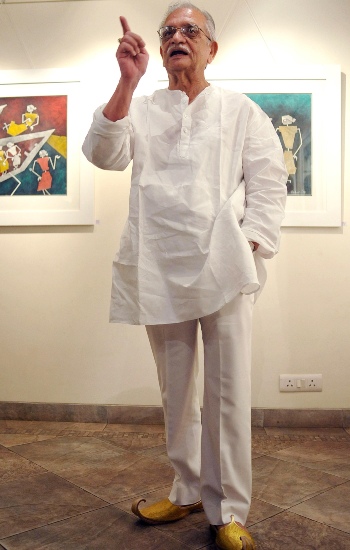
The great film lyricist Gulzar said in a 2017 interview that he has worn white since his college days, and it would “feel false” to wear colour now. But when asked if he feels most himself in a kurta-pyjama, he said he has never worn a pyjama! He wears a Punjabi-Pathani shalwaar on Sundays, of the sort worn in his home-town of Dina in Pakistan, and earlier often wore a dhoti. But what he wears almost all the time is “a regular pair of trousers, with the front crease and everything...” said Gulzar. “It’s just because I’m an Urdu poet that people assume I’m wearing a pyjama with my kurta.”
Photo: AFP PHOTO/STR STRDEL/ AFP

Poet and lyricist Gulzar at an exhibition in Mumbai.
Who is this fictional Urdu poet, who must wear only white, or even only kurta-pyjama? The image may have been truer when In Custody was written, but even the 84-year-old Gulzar has spent a lifetime playing tennis, wearing shorts. The young Urdu poets you might meet at a mushaira in Delhi, at Jashn-e-Rekhta or one of the city's many literary festivals, might be software engineers or tourist guides, TV journalists or government school teachers. They may be “of the bazaar world”, but are no lafangas. And you cannot identify them by their clothes.
Published in The Voice of Fashion, 2 July 2019.