Showing posts with label photomagazines. Show all posts

26 October 2020

The Lives of Others

Watching Rear Window, Alfred Hitchcock's 1954 murder mystery, in a post-COVID world 


“The movies make us into voyeurs. We sit in the dark, watching other people's lives. It is the bargain the cinema strikes with us, although most films are too well-behaved to mention it,” wrote the hugely popular film critic Roger Ebert in his 1999 review of the film Peeping Tom. Michael Powell's film caused great outrage upon its release in 1960, and Ebert speculated — nearly 40 years later — that it was because it broke that unspoken contract between the audience and the filmmaker. By making its protagonist a serial killer who liked to film his victims in the throes of death, Peeping Tom forced viewers to contend with the violence of our own scopophilia, the pleasure we derive from looking.

Six years before Peeping Tom, another British director had made a film about the pleasure of looking, featuring a news photographer instead of a film studio focus-puller. But Alfred Hitchcock was too clever to make his audiences too uncomfortable. The kernel of Rear Window (1954) lay in a 1942 Cornell Woolrich short story called 'It Had To Be Murder', where the temporarily laid-up narrator's view of the windows across from his own leads him to suspect a murder. “I could have constructed a timetable of [my neighbours'] comings and goings, their daily habits and activities. Sure, I suppose it was a little bit like prying, could even have been mistaken for the fevered concentration of a Peeping Tom,” concedes Woolrich's narrator, before quickly denying any intentional voyeurism. “That wasn’t my fault, that wasn’t the idea.”

Hitchcock's hero doesn't get let off so easily. Within the film's first few minutes, his no-nonsense nurse Stella berates him as a 'window shopper' who spends his days looking at newly married couples and “bikini bombshells”. Stella has no doubt that spying on other people is a modern-day evil: “We've become a race of Peeping Toms. They used to poke your eyes out for that sort of thing, with a red-hot poker...” . But Hitchcock, along with his superb screenwriter John Michael Hayes', transforms the original story to make his hero a professional viewer of the world — and his film all about looking.

The Lives of Others Watching Rear Window Alfred Hitchcocks 1954 murder mystery in a postCOVID world

LB Jefferies, better known as Jeff (James Stewart) is a globe-trotting photographer who's fractured his leg on a particularly adventurous shoot. When the film opens, he has been holed up in his New York apartment for five weeks, with nothing better to do than look out of his rear window. While he converts these telling glimpses of his neighbours into stories — and in Hitchcock's unspoken self-referential extension, into cinematic fictions complete with a plot — Jeff himself is never seen. Or at least, he tries his best to ensure that he isn't: wheeling his chair back, keeping his lights off, even hiding at opportune moments. Not really the usual style of a cinematic hero.

There is all sorts of genius in this Hitchcock treatment, starting with the fact that Jeff thinks of himself as being of generally superior intellect to others in his locality. He does have an interest in the outside world, but usually it is reserved for distant places that impinge on his consciousness only in some headline-making way — when his editor calls to propose a trip to Kashmir because the “place is about to go up in flames”, Jeff's excited response is “Didn't I tell you that's the next place to watch?”. His immediate vicinity he thinks of as dull, lulling us into that assumption — and also making us feel a little guilty about the voyeuristic gaze that seeks excitement.

Dullness appears to be a problem both for those outside relationships and those in them. One single female neighbour — Jeff calls her Miss Lonelyheart — often drinks herself to sleep. But her efforts to date are ill-fated, too: we watch one much-awaited young man thrust himself on her as soon as the front door is closed. Another single woman — Stella's 'bikini bombshell', named 'Miss Torso' by our hero — has no shortage of male admirers, but none of them looks worth having. A single male songwriter above Miss Torso seems equally starved for love.

Meanwhile the couples lead lives of sweetly boring domesticity, or else bitter conflict — the sort that can lead to murder. Our hero himself has a girlfriend most men would have killed for, Grace Kelly as a model called Lisa Fremont who appears on the covers of magazines, but he isn't happy either. He thinks she isn't cut out for marriage to someone like him, who spends weeks on the road in rough places. “If she was only ordinary,” Jeff whines to Stella. We're meant to see that Lisa's Park Avenue perfection and high fashionista status is dull as ditchwater to Jeff: once he even asks what her cocktail companion was wearing, only to ruthlessly mock her reply.

Alfred Hitchcock lets Jeff tell many an uncle joke about nagging wives and the sad fate of husbands. But Rear Window can also be seen as undercutting Jeff's rather comfortable narrative: the rough-and-ready adventurer remains tied to his chair till film's end, while the exquisitely-turned-out Lisa does all the mystery-solving legwork, even putting herself at risk. Lisa's physical fearlessness is what finally impresses Jeff — he seems to think he's kindled her sense of adventure. And of course, Jeff's fracture literally bars him from legwork. Even so, his reliance entirely on visual tricks is fascinating: even when the murderer walks into his room, all Jeff can think of as a weapon is a battery-operated flashlight to blind him temporarily. And it's definitely possible to read Rear Window in a way that sees Jeff's immobility as emasculation, and emasculation as marriage — Hitchcock's hero ends the film with both legs in a cast and firmly embedded in traditional coupledom.

Rear Window is a ridiculously apposite watch for a post-COVID world, where travel for travel's sake seems to have gone, well, out the window. For one, Lisa's attitude turns the perfect side-eye upon Jeff's grandstanding travel stories. Other aspects of the film ring even truer in an era in which rising authoritarianism and the ubiquity of social media, combined with pandemic-enforced isolation, is pushing us more and more into the once socially dubious roles of the lurker, the invisible spectator in the dark. On our screens and off them, stalking and surveillance have greater currency than ever before. Stella's “homespun wisdom” — from a 1939 Reader's Digest — seems almost poetic in its appropriateness: “What people ought to do is get outside their own houses and look in for a change.”

Published in Firstpost, 25 Oct 2020

16 October 2018

The Chairman and the Mahatma

Walter Bosshard’s photographs of Gandhi and Mao at the Kiran Nadar Museum of Art offer a provocative contrast between the leaders of different mass movements
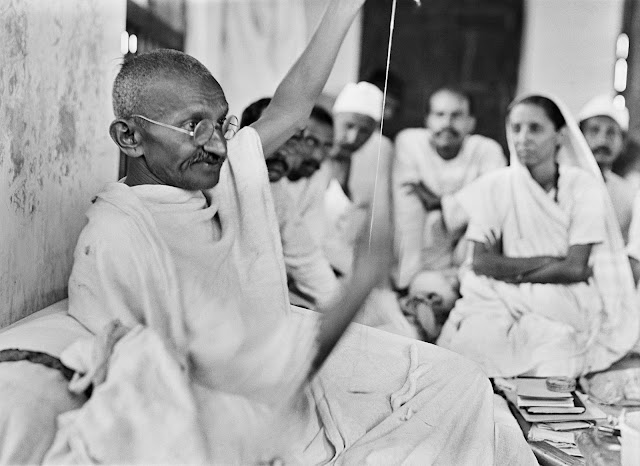
 Gandhi spinning at Dandi, April 2018. (Photo Courtesy: Fotostiftung Schweiz/Archiv fu.r Zeitgeschichte and Kiran Nadar Museum of Art)

Gandhi and Mao are not names often spoken together. So dissimilar do these giants of Asia seem, as men and leaders, that even thinking of them as contemporaries demands an imaginative leap. Luckily, Walter Bosshard met them both, and his pictures live to tell the tale.

Peter Pfrunder, co-curator of 'Envisioning Asia', the first-ever Indian showing of Bosshard's photojournalism, cheekily suggests in his brochure essay that "Bosshard himself could be seen as the link between Gandhi and Mao". Certainly, the 51 photographs and one silent film on show at Delhi's Kiran Nadar Museum of Art (KNMA) make clear that both men "welcomed this foreign photojournalist with open arms", at shaping moments of their careers. Bosshard met Gandhi in 1930 at Dandi, after the Salt March. In a piece of historical serendipity, he also met Mao after a march: in 1938, when he journeyed six days from the provisional capital of Hankou to Yan'an, the closely-guarded 'Red Capital' where Mao had withdrawn after the Long March.
Yan'an City Gate, entrance to China's Red Capital, 1938. (Photo Courtesy: Fotostiftung Schweiz/Archiv fu.r Zeitgeschichte and Kiran Nadar Museum of Art)

Unlike his legendary subjects, Bosshard never marched the length and breadth of a country to mobilise his people. But if we set aside for a moment his position as a white man in an imperialist world, Bosshard's own travels are quite impressive. A Swiss primary school teacher from 1908 to 1912, he studied art history in Zurich and Florence and did military service in Italy during World War I. Bosshard's life after 1919 would be the envy of any experience-hunting millennial: he worked on a plantation in Sumatra, as a gem dealer in East Asia, and as a merchant in India and Thailand. In 1927-28, he was a photographer on a German expedition to Central Asia. By 1930, he had so established himself that the Munich Illustrated Press sent him to India on a 'study trip'. Between February and October, Bosshard travelled over 20,000 km, gathering enough material for his 1931 book, Indien Kampft! (India Fights!).
Preparation at Congress Headquarters for 'Boycott Week', Mumbai 1930 (Photo Courtesy: Fotostiftung Schweiz/Archiv fu.r Zeitgeschichte & KiranNadar Museum of Art

The highlight of Bosshard's India trip, though, was reaching Dandi in time to shoot the coming of Gandhi. With 78 volunteers, Gandhi had walked for 24 days along the coast, crowds joining him to protest the British monopoly on salt. The power of these pictures is still undeniable: hundreds wading into the water to pick up salt; a child walking jauntily off with a cloth bundle of dripping, salty mud. The presence of women is striking. In one great image, Bosshard captures rural women marchers mid-stride, one end of their white saris wound over their heads, the other end hoisted up to reveal their calves. Here is the female Indian form cast for once as a labouring body in political action, unselfconscious and thus, unfetishisable. There are also women leaders: a stoic Mithuben Petit at an anti-alcohol protest in Navsari; Sarojini Naidu, the poet and Congress leader, who had urged Bosshard to visit Gandhi at Dandi, saying "he will have time".

It appears Gandhi did. In Bosshard's images, the 60-year-old fighting the world's most powerful empire appears utterly relaxed: grinning at a satirical The Times of India editorial, spinning, eating onion soup, cackling with uninhibited laughter, shaving. "At this stage of his career in 1930, he is the only world leader who treated the camera like a confidant of his inner circle, to be trusted, silently," co-curator Sinha said in an email interview. "There is a heartwarming naturalness and spontaneity in these pictures. By the time Margaret Bourke-White or Kanu Gandhi were to shoot Gandhi at the charkha or in public meetings, he was much older, much more studied before the camera." In the KNMA brochure essay, Sinha argues that these images also highlight Gandhi's "most pronounced areas of reflection and engagement": his astute grasp of the media, his obsession with diet and the body, spinning the khadi as integral to his idea of swarajya (self-rule). Whether it was the photographer or the Mahatma who determined its elements, Bosshard's pictures established a Gandhi iconography that still holds sway.


1938: Mao in front of the Red Academy (Photo Courtesy: Fotostiftung Schweiz/Archiv fu.r Zeitgeschichte and Kiran Nadar Museum of Art)
The Yan'an images are a stark contrast to the Indian ones. Whether it's a young, serious Mao Zedong standing scrupulously straight before the camera, the cold mountainous expanses through which the Eighth Route Army marches, or simply the short hair, trousers and jackets both men and women wear, Bosshard's 1938 visuals reveal how China and India's paths diverged. "China broke from an older civilisation in a way India did not," says Shilpa Sharma, a PhD scholar in Delhi University's department of Chinese Studies. "Also, Gandhi was responding to a bureaucratic state, where there was law and order. China's many bloody wars meant ahimsa (non-violence) could not have emerged there. Mao standing strong physically in pictures was part of a show of strength needed to win," she adds.
Despite differences, "these were mass leaders who led their illiterate, poor societies out of feudal and colonial oppression," says Hemant Adlakha, who teaches Chinese Studies at the Jawaharlal Nehru University. "There is comparable poverty, a shared idealism, the instruction of followers," says Sinha. "[Both had] a vision for change for their countries."


Nearly 90 years later, both India and China have diverged greatly from these men's visions.

'Envisioning Asia: Gandhi and Mao in the photographs of Walter Bosshard' runs at the Kiran Nadar Museum of Art from 1 to 30 Oct 2018.

3 August 2014

Angry River

In May 2014, I wrote this short text for the photography quarterly PIX. The theme of the issue was Habitat (downloadable for view here) and the images my text accompanied were from a superb series called Life on Water, by the young Bangladeshi photographer, Rasel Chowdhury. My text as well as some of Chowdhury's exceptional images, below.

“It was over twenty years since the river had flooded the island, and at that time no-one had lived there.” So went one of the opening lines of Ruskin Bond's remarkable children's classic, Angry River. As a city child, the book was my first inkling that a river wasn't only what lay below the Howrah Bridge: flat, grey, unmoving. A river could be alive. It could be angry. And it could be beautiful.

Photo: Rasel Chowdhury
Looking at Rasel Chowdhury's images of the 2012 floods in Bangladesh's Kurigram District, it was Angry River I remembered. I thought of Sita, the little girl-woman through whose eyes we watch the river's terrifying transformation. In the morning, the water is muddy instead of green, and her favourite rock has disappeared, “the one on which she often sat dangling her feet... watching the little Chilwa fish swim by.” By noon, the water has oozed its way into the hut, and a horrified Sita climbs into the big peepul tree. But as the water rages around it, “a dragon on the rampage”, the old tree gives up its grip on the earth.

Sita, clinging to the tree, is set afloat on the swirling water. But what is remarkable is that Bond chooses to evoke awe rather than plain fear. His river is an elemental force against which it would be foolish to struggle, but it is also the giver of life. It is the river that gives Sita's grandfather his fish, and the silt it leaves in its wake is where the villagers grow their vegetables – and Sita her mango tree.

Photo: Rasel Chowdhury
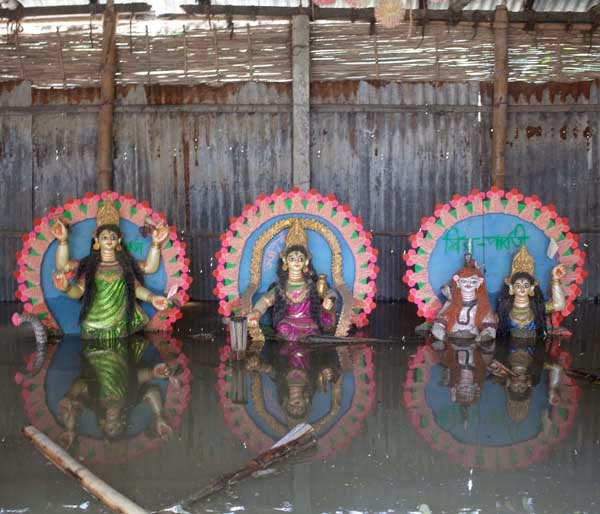
Chowdhury's images, too, have that strange quality of calm. A tubewell in a surging sea makes human efforts look foolish. But people are not fleeing the river's rage. They do not fight the water; they inhabit it. Boys appear to be preparing to fish as they wade through waist-deep water. Women stand stoic, even striking a pose for the photographer. Two men stretch out on the roof of a submerged house.

Photo: Rasel Chowdhury

A horse stands still, and waits. There is a sense that this is temporary. Books wait expectantly in the flooded schoolroom. But what will be, will be. Even the gods seem resigned to an early immersion.

Photo: Rasel Chowdhury
Perhaps, like them, we assume that the river's wrath will recede, and then the world will be reborn.

“We are part of the river,” says the boy who rescues Sita. “We cannot live without it.” 

Published in Pix Quarterly, Volume 10, May 2014.

4 August 2013

Talking Pictures: a report on graphic storytelling

As graphic storytelling gains momentum in the world of Indian English literature, a slew of indie publishers become the champions of a new visual culture.

First published in Elle India, July 2013.


A page from Blaft's Times New Roman and Countrymen
The Obliterary Journal is a compendium of comics, typography and all sorts of visual pleasures, brought out by Blaft in 2012. It opens with a graphic foreword in which a bunch of symbols declare a war on text. “Obliterate literature!” says one angry pictogram. “Down with novels! Long live comics with publications of remarkable variety. And picture books and graffiti and wacky art!” “Alphabets are stupid!” pronounces another annoyed glyph. “Unless you handpaint them with a lot of style...” 

There couldn’t be a better illustration of the exciting new climate for visual storytelling in Indian English publishing than this mock-serious manifesto. Of course, even such a whimsical call-to-arms recognises that books with “lengthy passages of unadorned text” aren’t going away anytime soon. But more and more publishers are beginning to see that there are other ways to tell stories than just through text. There is a realisation that the visual book can often do things that the purely verbal might find difficult. They can bridge the imagined gulf between children and grown-ups, serious and non-serious, and subvert the common perception of the picture book as necessarily lightweight. Conversely, they can leaven even the most serious subjects with a joie de vivre that can only come from images.


Mainstream publishers like Penguin and Harpercollins have used this medium to bring physicality and dynamism to subjects as varied as 
our gated cities, the Mahabharata and the emergency through writer-illustrators like Sarnath Banerjee, Amruta Patil and Vishwajyoti Ghosh. But it is the smaller, independent publishing houses that are really altering the Indian literary landscape. And they are the ones pushing the image to centrestage with publications of remarkable variety. 


Manta Ray (MaRa)


The publishing collective’s self-proclaimed goal is to move away from escapist fantasy and superheroes to tell real stories about young people in India – their target readership. Their first book Hush (2010) told a tale of child sexual abuse in beautifully hand-drawn black-and- white sketched panels. Stark as its subject was, Hush was also striking for sticking absolutely to the suggestion of its title: it used no words. “I didn’t think I had the right to express what the girl is going through. I didn’t want to put words in her mouth,” says Prateek Thomas, one of MaRa’s founders, who wrote the detailed script on which the book is based. “Also, as a writer, I avoid declamation, exposition. I try to keep brevity. I like the art to do the talking.” Their more recent publications – an anthology of four stories called Mixtape and Twelve, a series of 12 character-driven narratives united only by the theme of choice – don’t steer as completely clear of words. But what they do share is Hush’s distinctive quality of not spelling out everything. That puzzle-like effect is deliberate, says Thomas: “not to make it hard on the reader, but to make you pick the book up again... to see things you didn’t see the first time.”

Blaft

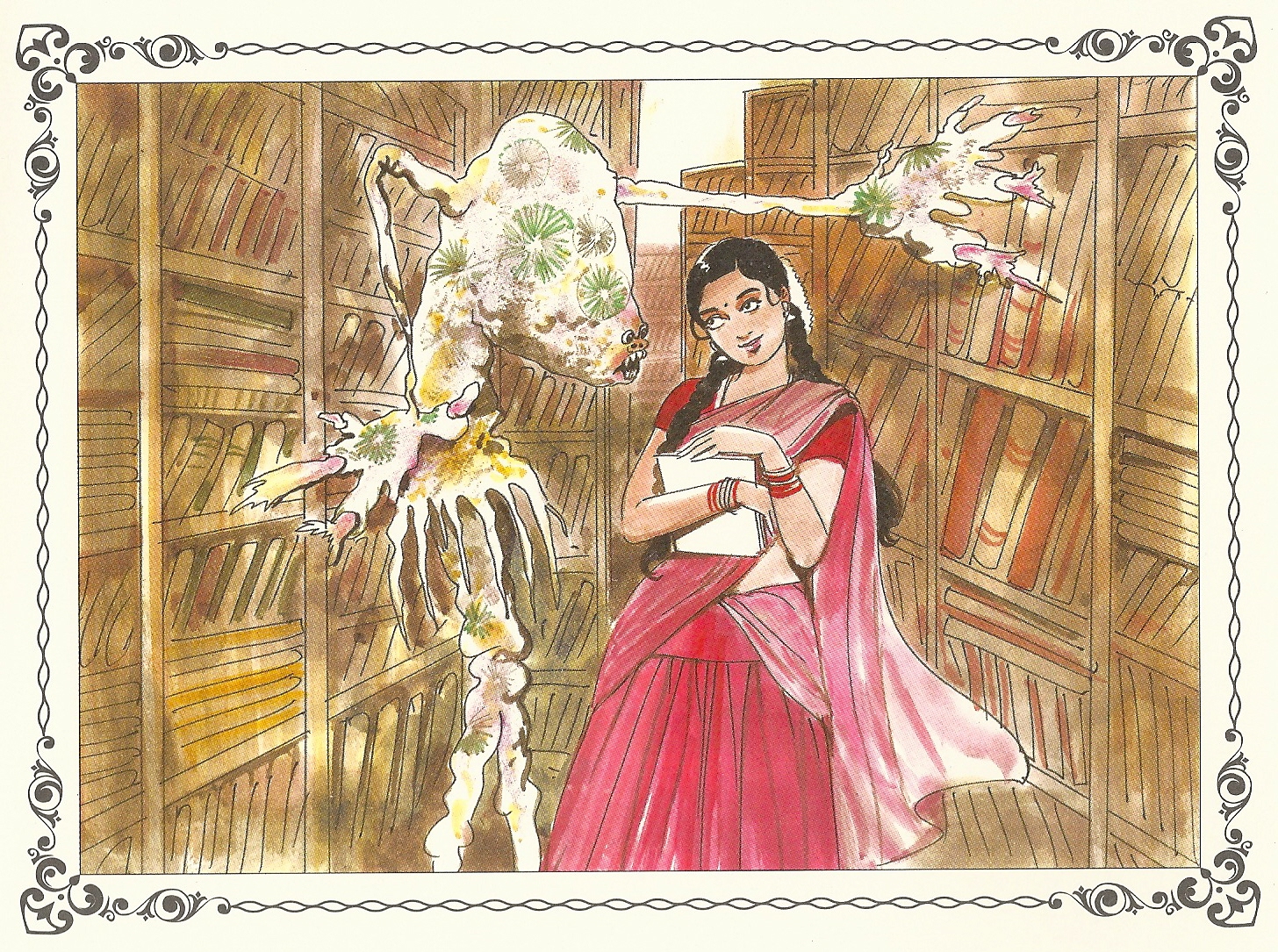
A page from Blaft's Kumari Loves a Monster

For this publisher, the visual is often an end in itself. From tear-out ‘postcard books’ that reproduce Hindi pulp fiction covers (Heroes, Goondas, Vamps and Good Girls [2009]) or juxtapose contemporary newspaper classifieds with retro images from Hindi cinema and Raja Ravi Varma (Times New Roman and Countrymen [2009]), to the tongue-in- cheek, hard-to-explain subversive madness of Kumari Loves a Monster (2010), Blaft revels in the goofy, kitschy, off-the-wall worlds of Indian art. As Blaft founder Rakesh Khanna says, this is art that cannot be packaged either as “tourist coffee-table book [or in] a white cube gallery with wine and cheese”. Their devotion to typography and pulp cover art can sometimes junk narrative preoccupations in favour of a celebratory visual anthropology. 

Tara Books

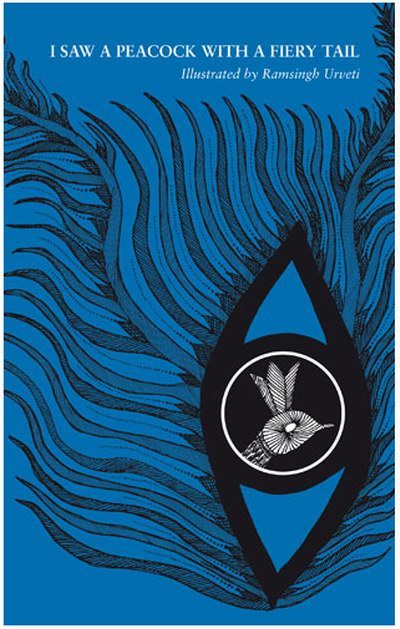
The cover of I Saw a Peacock with a Fiery Tail
A love of Indian visual traditions is also enshrined in the work of Tara Books, whose originary question when they started out in 1998 was, “Can different visual cultures survive in a rapidly homogenising world?” Since then, they have blazed a trail, working with indigenous artists from Madhya Pradesh, Gujarat and Bengal. They adapt artisanal traditions of bookmaking – handmade paper manufacturers, silkscreen printers and hand binders – to produce handmade books on an astounding scale. Tara’s innovative design practice has created playful, stunning books. 

Whether it’s turning the vertical Patua scroll into a horizontal accordion book (The Enduring Ark [2013]), adapting Patua imagery into a Western-style panelled graphic narrative (Samhita Arni and Moyna Chitrakar’s Sita’s Ramayana [2011]), or even matching up the marvellous micros and macros of Gond artist Ram Singh Urveti’s imagination with a 17th- century English trick poem (I Saw a Peacock with a Fiery Tail [2012]) – Tara Books fuse the contemporary with the traditional. Their books travel to the US, the UK, Brazil and Mexico via handmade book collectives and children’s book publishers, reversing the usual flow of visual communication from west to east. “What we take from our immediate visual context, it goes all over the world,” says V Geetha, editorial director at Tara.

Navayana

A page from Bhimayana
Also working with traditional Indian artists is Navayana. Its hard-hitting work on caste and marginalisation includes two visual books – A Gardener in the Wasteland (2011)a cheeky, unstintingly graphic interpretation of Jotiba Phule’s Gulamgiri, and Bhimayana (2011), in which Gond artists Durgabai and Subhash Vyam recreated experiences of untouchability from Bhimrao Ambedkar’s life. The ecology of Gond art is filtered through the individual readings of the Vyams and their textual collaborators, Srividya Natarajan and Navayana founder, S Anand, to create a work that is unique and often profound. Traditional digna floor patterns are used as page dividers instead of panels, the thirsty young Bhim is imagined as a fish, and when Ambedkar finds himself homeless and takes shelter in a park, he becomes the park.

Did you believe that reading takes time, and pictures can be looked at in a jiffy? But images can be more multifarious than text, unfurling new meanings with each reading. “You can spend two minutes with each panel in Bhimayana, or two hours. Or two days,” says Anand.


While one finger constantly hovers on the page down button, these are books that can make us hit pause. The picture speaks, and we cannot help but listen.

2 January 2012

Word Play: a piece on photomagazines

A longish review of the photomagazines Pix and Punctum, published in The Caravan, January 2012. 

Note: The Caravan website has a few selected images, but for more photos go directly to Pix and Punctum.

In a world where we are constantly bombarded with images, the photomagazine makes for an unusual viewing experience. First, from the magazine perspective, there’s the slow, pleasurable realisation that turning the pages only for the pictures — something we do all the time with magazines, whether with concentrated longing for glossy otherness, or as the desultory whiling away of time in the doctor’s waiting room — needn’t be the guilty pleasure it ordinarily is. Here the act of consumption is legitimate, expected, perhaps even imbued with significance. Meanwhile, from the photographic side of things, images placed on the page are experienced very differently from the way they might be if they were placed on a wall, or on a screen. The scale ensures a focused intensity to our viewing—one that remains a private act, shorn of the self-consciousness that often comes over people while walking through a gallery. The structure of a bound volume provides a clear, predetermined order and yet — unlike, say, a slide show — it allows each individual the freedom to turn the pages any which way.

But to me what really makes the photomagazine fascinating is how much of it is given over to words.

A picture may be worth a thousand words, as the old cliché goes, but few words are needed to determine how we look at a picture. Pictures inspire feelings. Words can transform the direction of our thoughts. A single sentence printed beneath a photograph can narrow down the innumerable potential interpretations; a paragraph, or three, placed alongside a disparate set of images can thread them together with astounding ease.

In the series by Tushikur Rahman that opens the second issue (2011) of Punctum, for example, we move from an impossibly close close-up of a single teary eye, red from grief or sleep deprivation or both, to a ghostly figure in a hoodie standing at the end of a tunnel-like corridor, then to an aircraft in a night sky, seen from below, and finally, a posh-looking multistorey building with a scaffolding ladder climbing up one side, so enormously high that it’s dizzying even when viewed from the ground. The images are all striking, even unsettling in their own way. But it is only because the photo essay is labelled ‘Fatalistic Tendency 2003-2006’ that one associates these images with suicide. Take, for example, the young figure in the white hoodie: the image is surreal, their legs seem to melt into the light, he or she could almost be hovering above the ground. But it is really only because the words in the title have guided my brain in the direction of death that I think not of, say, an unhappy childhood memory or an alien descended to earth, but of a sad spirit still wandering the corridors of the living. Or take the building: it is because the stated theme of the essay frames the image so powerfully that I cannot look at the picture without imagining what it would be like to fall from that height.

As someone who deals overwhelmingly in words rather than images, I have often been that person in the museum who arrives in front of a work of art and moves instinctively towards the tiny plaque to the right, relying on the words of some mediator-curator to make sense of what I have come to see, to parse the experience. And I have often also been the person who, realising she does this, consciously tries to stop herself. But really, why should I see the use of words to frame the viewing of an image as some sort of trick, as a dilution of pure experience? Surely if cinema works precisely because it creates a composite of words and images (not to mention sound and movement)—and we consider it no less of an art form—then the insistence that the visual must establish an independent identity, and not ride piggyback on the aural or the verbal, is a ridiculous condition.

So let us abandon the conceit of imagined purity. Pix and Punctum, which engage with contemporary photographic practice in India and across Asia respectively, provide many different ways in which to combine words and images, some more interesting than others. The personal documentation of a project, for example, is an avenue for the photographer to meditate on how the project came to him, or how it changed from the time it was conceived. The curatorial piece, on the other hand, locates the photo essay within the photographer’s body of work, or simply provides one level of interpretation. And finally, there is the seemingly unrelated text—a poem or a story or a short prose piece by a writer not originally part of the photographic project.

Some of the photo essays in Punctum gain immensely from the brief but intimate introductions provided by their creators. For example, some of Hemant Sareen’s photographs of his family’s old home in Noida—‘Suburbia Indica: a House is not a Home’—can seem dully familiar until they are illuminated by his beautifully written account of what it is to live in a house without ever letting it claim you. The melancholia of enforced impermanence, of a sense of isolation both redeemed and echoed by stray cats, emerges much more strongly from Sareen’s images once I knew the specific narrative of entrapment within which they were located: a house in which his family was forced to live for 20 years but which never stopped being provisional. And yet, no words can be as stark or as moving as his picture of an old lady (his mother?) looking up at the night sky, sitting on a cement seat on their terrace, with a cat on an outcrop parallel to her. They are the very picture of isolation, and yet they might also be the very picture of quiet companionship. Even more deeply felt is Thai photographer Lek Kiatsirikajorn’s ‘As Time Goes By’, which, like Sareen’s photo essay, seeks to work through a personal sense of sorrow and a relationship with a familial space. In Kiatsirikajorn’s case, he declares that taking pictures of his aging fruit-vendor parents in their increasingly dilapidated home (to which he has returned after seven years in England) is his attempt to reduce his guilt at having neglected them for so long. And the discovery that he—and the soul he has been searching for—are more intimately tied to them than he realised: “The more I photograph them the more clearly I see myself.”

Of the two journals, Pix seems to be more invested in these creative juxtapositions between image and text, the relationship between word and image so open-ended as to seem slightly surreal: “Am I making up this connection,” you find yourself thinking, “or does it really exist?” My favourites among these (Imaginaries, issue III, 2011) are Ankit Goyal’s ‘The Silent Observer’ and Abhijit Nandi’s ‘The Imaginary “I”’. Goyal’s digital black-and-white images traverse their disparate terrain with a deliberate dreaminess: a woman’s torso submerged in soapy water, fingers poised delicately above her vulva; a male figure framed in a narrow doorway awash with light, but seen from afar, as if through a forest of shadows; a curled-up foetus preserved in a jam jar. If Goyal’s pictures produce a delicate sense of each moment as pregnant with possibility, Delhi-based vascular surgeon and writer Ambarish Satwik’s accompanying text, ‘Kapse-Agarwal’, provides a pulp noirish vision of what that possibility might be: true to Satwik’s particular obsessions, it is a vision full of “wanton and savage slayings”. What is remarkable is that the specificity of Satwik’s somewhat abrupt account—of these rather odd but memorable characters who conduct autopsies at the Maulana Azad Medical College and maintain files on murders in Delhi—does not pin the images down. Abhijit Nandi’s more dramatic pictures, also black–and-white and digital, tap into our horror movie imaginations. However secret your fantasy of violence or madness, these images are an insidious appeal to your inner role-playing self: the surreally lit curtain, the man in silhouette clawing at the window, the hands tied roughly with jute rope (this image feels a little over the top, especially with the apples of evil just out of reach). The scariest of Nandi’s photographs here are of a pair of upturned hands being washed at a basin, one pale and bloodless, the other literally dripping with blood. On Vivek Narayanan’s lovely accompanying poem I will not comment, for a quote from it should suffice to show how much it adds to our experience of these images: “…The scene/ of an unsolved crime, sticking regardless to me,/ waking in this empty room,/ the sunlight through burglar bars,/ the room’s interlocking design.”

But there are also texts here that actually detract from any power the images might have summoned up: a case in point is Rupleena Bose’s utterly vague, ostensibly poetic piece for Adil Hasan’s series ‘The TV’. Hasan’s attempt to bathe the everyday blankness of the television screen in various sorts of ethereal light feels fairly clichéd already, but the pretentious banality of the accompanying words makes everything much worse: “we become prisoners trapped in the ruins where the imagination had been forsaken” or “the secrets of others brings (sic) them together when the evenings draw them apart.”

And there is even the rare text which seems to swamp the images, where the pictures come across as illustrative rather than originary. I speak, for example, of Toru Morimoto’s ‘Remembering the Future’ (Punctum, issue 2, 2011), whose narrative of the aftermath of a recent tsunami in Japan’s coastal northeast region seems to be more or less based on the written word, with the studied photographic portraits of survivors never transcending the roles that have been scripted for them by the reportage.

‘Remembering the Future’—though it does not track the violence of the event as news photography might, but only its less graphic remains—is probably closest to what might be called photojournalism, which Wikipedia defines as photography “that provides a visual account for news events”, in contrast to fine art photography, which (also according to Wikipedia) “refers to photographs that are created in accordance with the creative vision of the photographer as artist”. Pix’s mission statement appears deeply invested in this “creative vision” brief. The editors of the quarterly envisioned it as a magazine that would “seek not only to present photography in temporal, spatial or historical terms, but also in personal, self-conscious and aesthetic ways”. Each issue has a thematic focus: the next one will be Trespass. The theme chosen for the issue under review is Imaginaries: Exploring Photo Art, which editorial contributor Suruchi Dumpawar explains as the “construction of images, where photography practitioners deliberately create and sometimes even fabricate images by using various strategies to convey a sense, meaning or thought, rather than finding visual resonances of their thoughts in the real world”.

Punctum — which is more than 200 pages compared to Pix’s 64 (which, though, has a slightly larger format) — has much less obvious editorialising than Pix, and no stated thematic focus. Its geographical scope is much wider, encompassing photo essays from across Asia, with the stated aim of “offering its readers ‘native’ images of our times ... in the most faithful sense of the word: photographs taken on their own terms by Asian photographers”. Its editors appear to retain an openness towards a wide range of photographic practice, from the stark and unannotated beauty of documentary work like Geric Cruz’s pictures of Sitio Damayan, a community of charcoal makers in Manila, to the Cambodian photographer Samnang Khvay Tay’s quirkily masked portraits of his neighbours in their own homes: a remarkable series of images that reveals much more than it conceals.

In contrast to the oddly affecting gravitas of Samnang’s pictures are the Singaporeans also photographed in their own homes by photographer Sean Lee, who creates often hilarious portraits of family members that depict a sense of humour reminiscent of the goofy madness of Wong Kar-wai’s Chungking Express. A child with fake canines frowns attentively at the camera as her mother looks sombre; the brilliantly deadpan caption reads: ‘Vampire child protects mother’. A man crouched on a tabletop in his boxers bites into an enormous leg of chicken, while his wife holds up a whole raw chicken, her lips quivering on the edge of a smile. ‘Photography as a Comedic Tool’, reads a handwritten headline over the photograph, which is titled ‘The Crazies’.

Perhaps the most remarkable thing about these magazines is that one is transported into the lives of others—in the case of Punctum, often very distant others—viewed at close quarters. The ‘golden age’ of photojournalism, from the 1930s to the 1950s, was characterised by magazines like Life and Picture Post, which built their reputations and acquired readers on the basis of photographs of worlds that readers had never seen and most likely would never see. Perhaps magazines like Pix and Punctum, in their own small ways, will find a way to reassert that enduring power of the image.