Showing posts with label porn. Show all posts

13 January 2021

Drives with a View - III

My Mumbai Mirror column:

Continuing our series on films about cabbies, we look at why Paul Schrader and Martin Scorsese's 1976 creation, Travis Bickle, seems so eerily prescient today

Halfway through Martin Scorsese's 1976 neo-noir classic Taxi Driver, we hear a campaign speech from a US Presidential candidate. “Walt Whitman, the great American poet, said, ‘I am the man, I suffered, I was there’,” intones the fictitious Charles Palantine. “No more will we fight the wars of the few through the hearts of the many....” Palantine's words, like most dialogue in Paul Schrader's much-mythified script, speak to -- as well as for -- the film's cabdriver hero, Robert De Niro in a career-making performance as the disturbed Vietnam veteran Travis Bickle.


Unlike Palantine and Bickle, Whitman was real. His poem 'Heroes' -- appropriately chosen by Schrader – was written in the voice of the soldier-as-everyman. “Agonies are one of my changes of garments./ I do not ask the wounded person how he feels, I myself become the wounded person,/ My hurts turn livid upon me as I lean on a cane and observe...


Other than this, Schrader's script isn't what one might call poetic. Taxi Driver is a New York film through and through, capturing the city in all its brutal, wry, laconic glory. Unlike many taxi drivers previously discussed in this column series, a cab ride with Travis Bickle rarely involves hearing his voice. Much of Scorsese's masterful tension is based on shots of De Niro's drawn, suspicious face framed in the rearview mirror as he listens to his fellow citizens in the seat behind him – and judges them harshly.


As a cab driver, Bickle is the perfect witness to the world around him. But he does not wish to be a mere witness. He sees the city as “an open sewer full of filth and scum”, a mess that needs to be cleaned up. The post-60s and pre-Giuliani New York of the film is riding high on a wave of freely available sex and drugs, and our hero wishes someone would rein it in. He wants to save it from itself. In one memorable scene, the wannabe Presidential candidate rides Bickle's taxi. When Bickle recognises him, he tells Palantine the city's dirt/immorality needs to be “flushed down the toilet” by whoever comes to power.


“Let me tell you something,” Palantine says earlier, “I have learnt more about America from travelling in taxicabs than in all the limos in the country.” The surround-sound of the campaign lets the film unfold against the backdrop of Palantine's catch-all slogan ‘We are the people’. 


Watching Taxi Driver in 2020 feels strangely prescient: Bickle appears as an early representation of a figure that has come to dominate post-Trump American political discourse; the White everyman who thinks of the country as having gone to the dogs and himself as the morally-superior saviour. As Bickle becomes increasingly unhinged, his monologues in the mirror – bookended by the famous “You talking to me?” line – refer to himself as a hero in the making: “a man who would not take it any more... someone who stood up against the filth”.


Travis Bickle is, in fact, a precursor to much else in the American nightmare of the late 20th and early 21st century – a mentally ill man gripped by perpetual insomnia; whose sense of anomie and aimlessness leads him to gun violence. If politicians don't seem to want to 'clean up' society, he'll do it himself. But the subtext of what Bickle thinks needs to be 'fixed' is both racist and male chauvinist (though not uncomplicatedly). Meeting a White passenger who wants to murder the wife cheating on him with a “nigger” is followed by Bickle acquiring weapons – from a preppie, White, gun dealer who chooses Bickle over “a jungle bunny in Harlem” because he only deals “high-quality goods to the right people”. Bickle first uses the gun on a Black man who's amateurishly robbing his local cornershop. In one of the film's grimmest scenes, the unfazed Italian shop-owner waves Bickle off and says he'll take care of it. He then takes an iron rod to the thief's body, shouting “The fifth motherfucker this year!”

Another remarkable subplot reveals Bickle's deeply-conflicted relationship with sex and women. The same man who complains about the city's filth – this is a Central New York full of sex shows and prostitution – takes his pristine, almost prissy, date to watch a faux-instructional Swedish porn film. When she proceeds to shut him out afterwards, his interior monologue becomes bizarre and incel-ish: “I realise now how much she's just like the others, cold and distant. And many people are like that. Women for sure. They're like a union.”


The other subplot about sex is Bickle's violent rescuing of Jodie Foster's underage sex worker – a plotline echoed in Schrader's self-directed film Hardcore (1979), in which a young girl runs away from a religious suburban family to become a porn actress, and goes back home in a strangely unconvincing last scene, like Foster's Iris.


What is truly disturbing about Taxi Driver's end, though, is that he is feted for murder. Violence, when committed against 'immoral' people, it seems, makes you a hero. That once-fictional battlefield seems eerily closer to today's reality.

 Published in Mumbai Mirror, 27 Dec 2020.

8 September 2019

The Spirit of Technologies Past

My Mirror column:

As we hurtle ever faster into a digitised present, some recent films cast an affectionate glance back at the technologies that made us who we are.


Right at the beginning of the recently released 
Shantilal O Projapoti Rohoshyo, director Pratim D Gupta tells us that his film is about a time “when porn was watched on DVD, news was read in print… and films were made for theatres”. Right from its charming children’s detective story title (the Bangla translates as ‘Shantilal and the Butterfly Mystery’), the film lives and breathes a certain gentle nostalgia. But its special focus is an era that existed until quite recently in India, a time that feels like it’s being elbowed out at top speed by technological transformation. What’s interesting is that the nostalgia is itself framed around an earlier era of technology: the newspaper, the cinema, the photograph.
The film’s deadbeat weather reporter protagonist, Shantilal, with his unquenched desire for a “front page story”; the neighbour who hounds him for a free spot in the matrimonial pages of The Sentinel; the DVD shop guy who urges Bertolucci, Bergman and Buñuel upon a customer who’s waiting for his supply of quality Malaysian erotica – all of these look back fondly to a time before the digital conquest of our lives. But the pirated DVD may be the one to focus on: a signifier of an in-between time. Not before computers, but before news stories began to be broken on Twitter timelines, before Shaadi.com, and before the endless glut of internet porn. It is an era that is not in fact that distant – which is perhaps why it feels so surreal that it is already gone.

Shantilal 
brings to the fore a theme that has, in fact, underlain many Indian films in the past five or six years: our memories of an analogue era. Ritesh Batra’s 2013 critical and commercial success, The Lunchbox, used a dabbawala mix-up to deliver a tribute to a fast-disappearing world – the Hindi music cassettes Deshpande Aunty still listens to, the Orient fan around which Deshpande Uncle’s stagnant life revolves, the Yeh Jo Hai Zindagi episodes recorded from Doordarshan that Saajan Fernandes watches endlessly in memory of his wife. (Using the voice of Bharati Achrekar as the never-seen Mrs Deshpande was, of course, the perfect meta-textual reference to Doordarshan, on which she was once such a profoundly familiar face.)


If
 The Lunchbox took a rather melancholy view, Sharat Kataria’s Dum Laga Ke Haisha (2015) was a more enthusiastic, even raunchy tribute to the 1990s, featuring Ayushmann Khurrana as the small-town owner of a cassette shop. Some of the most endearing moments of the film’s post-marital romance between Khurrana and Bhumi Pednekar involved the VCR as a therapeutic sexual aid and the playing of songs as messages on a cassette player.

The audio cassette with songs personally picked out and recorded was, of course, the ultimate 1990s romantic gesture. That was the matrix of a more recent 1990s-set romance, the Yash Raj production
 Meri Pyaari Bindu (2017), also starring Khurrana. In that film, Khurrana plays a Bengali middle class hero (complete with a daaknaam – Bubla), whose largely unrequited love for his neighbour Bindu is tied up with the technology of their adolescence: Ambassador cars, STD-ISD booths, a nascent virtual universe embodied in email addresses such as muqaddarkasikandar1977@hotmail.com.


Video cassettes were crucial to both Nitin Kakkar’s
 Filmistaan and Vishal Bhardwaj’s Haider. Both released in 2014: one set in Pakistan, the other in Kashmir, and both had political messages. Although tonally miles apart, the two films are united by their references to the early Salman Khan films Maine Pyar Kiya and Hum Aapke Hain Koun. Kakkar presents those films, as he does all Hindi cinema, as the great unifier of countries and people divided by Partition. Haider, written by the journalist and author Basharat Peer, adapts Shakespeare’s Hamlet to 1990s Kashmir: a dark and violent place, as searingly sarcastic as it is driven to desperation. In this world, the two Salmans – the original play’s Rosencrantz and Guildenstern turned brilliantly into Bhai fans and lookalikes who run a videocassette shop – initially seem like comic relief. But as the film builds to its necessarily tragic climax, it becomes clear that no amount of grainy re-watching of MPK songs can keep Haider (Shahid Kapoor) from seeing the reality of the Salmans – or keep Kashmir from seeing the reality of India.

To return to Shantilal o Projapoti Rohoshyo: it isn’t just a simple tribute to a past era. The protagonists of Pratim Gupta’s not-quite-mystery live on the cusp of the present, and often display an active reluctance to cross over. Shantilal himself doesn’t have Whatsapp, though he does have a mobile phone. The film star in her prime (Paoli Dam, very effective as Nandita) expresses a nostalgia for autograph seekers in an era of selfies, and keeps a corner of her bedroom as a photographic shrine to her past. But she finds her future threatened by a photograph from that past. Old technologies can inspire nostalgia, but our attachment to them may tell us less about those forms than about ourselves.

Published in Mumbai Mirror, 1 Sep 2019.

24 December 2017

Sex and Sympathy


Why sari-wali-bhabhi and late night show go perfectly together, and other thoughts on sexiness in India, after watching Tumhari Sulu.


Tumhari Sulu is a delightful film, though it contains several different ideas jostling for primacy, and sometimes it seems a pity that it refuses to plump openly for one of them. The first of the themes advertising man Suresh Triveni picks is the gap between the heard and the seen, the imagined and the assumed, the external and the internal. At one level, the narrative focus on voice is a way of undercutting modern consumer culture's unrelenting focus on the visual, on how appealing things look - as well as playing with our idea of what a sexy woman looks like.

The seductive disembodied voice of the radio jockey is the perfect device to make us rethink our painfully circumscribed ideas of what - or who - is sexy. We've already had one depressing cinematic subplot this year about a young man who can't reconcile his actual experience of sexiness with his preconceived notions of what sort of woman could turn him on: in Lipstick Under My Burkha's segment about Ratna Pathak Shah's intimate telephone conversationist, "Rosie". And back in 2011, Shujaat Saudagar directed awonderful two and a half minute short fiction film called A Day in the Life of India (Belle de Jour) which turned on a similar disjuncture between our unimaginative mainstream ideas of sexiness and the multi-hued, unpredictable reality of it. (The short is available on Youtube, and worth looking up, not only because Tumhari Sulu seems to owe it some acknowledgement).

Triveni's script might be seen as a response to a world in which people's potentially varied individual tastes are mainstreamed into predictable singularity by mass advertising. Tumhari Sulu pushes back -- though perhaps not with enough conviction -- against the increasingly ubiquitous vision of the attractive female body peddled by the Indian fashion and entertainment industries. By turning Vidya Balan's middle class housewife, with her ample sari-clad figure and unfashionably plaited hair, into a fantasy woman for the (mostly male) listeners who tune into her late-night radio show, Triveni plays with one of the more visible contradictions inherent in contemporary Indian sexual culture: the fact that while Bollywood and fashion valorise the skinny, fair, straight-haired, urban, Westernised young woman, a huge amount of desi erotica and porn is built upon the sexualisation of the generously endowed, sari-wearing bhabhi figure.


That is the powerful trigger that the radio channel boss, Neha Dhupia's Maria, is drawing on when she comes up with the idea of a programme for Sulu to host: "Sari wali bhabhi, late night show". It is an association that at least every Indian man in the film's audience will have no trouble making. There's no disjuncture there.


And yet the "sari-wali-bhabhi"'s attractiveness can apparently now only be a dirty secret. Everywhere that Vidya Balan's character goes looking for a job, the ostensibly English-speaking, Western-clothes-wearing, thinner and inevitably younger women who give her the once-over are visibly judging her for not being more like them. "Sari-wari nahi chalegi," declares the woman telling Sulu about a low-paying job at the gym. "Kabhi job kiya hai?" asks the reed-thin, shrill receptionist at Radio Wow, looking down her nose.

But while she's too 'behenji' for the gym types, Sulu is too free-spirited for her superior elder sisters. A desperately unlikeable pair, Sulu's sisters stand in for the stultified idea of respectability that holds the middle class in its vicelike grip. The terror of being seen as 'cheap' is deep, and it isn't just men but women who use it to police other women. And judgements fly thick and fast from this end, too - based on what you wear, how late you're out, whom you speak to.

Sulu is that wonderfully identifiable in-between figure, squeezed by both sides, and still effervescently herself. She embodies both the underestimated housewife character that we have started to see on the Hindi film screen from Gauri Shinde's English-Vinglish onwards, and the unapologetically lusty wife with a taste for the good things in life, played by Balan herself in 2013's Ghanchakkar and 2014's Shaadi ke Side Effects, or by Huma Qureishi in Jolly LLB 2.

Watching Balan light up the screen as Sulu, it's blazingly obvious that no-one but she could have conjured up this combination of playfulness and wholesomeness, producing gentle innuendo out of domestic metaphors - and vice versa. In the film's most sugary scene, Sulu gets a call from an elderly gentleman who says she reminds him of his wife. There's some channelling here of Balan's own earlier turn as an RJ, a decade ago, in Lage Raho Munnabhai, where her slightly insufferable goodness was on display in her attachment to an old age home. 

But even apart from this homage to Balan's filmic history, Triveni knows what he's doing. He plays on the use of radio in the cinema (a huge subject which this column has barely touched) by combining the visual and the aural: making sure we see the sympathy-generating figure of the old man heating up his dinner for one, and showing us that Sulu, though she can't see him, has the instinctive femininity to respond to him exactly as she should: with warmth and just a smidgeon of flirtation, but nothing too inappropriately risque. Here the sari-wali-bhabhi shows us that sexuality can't be divorced from one's womanhood as a whole, and that can't be separated from one's humanity. It is a fine model of sexiness with which to leave the cinema.

22 March 2015

Sex and the Single Man

My Mirror column today:

Harshvardhan Kulkarni's indulgent but refreshingly forthright film Hunterrr opens a much-needed window onto the lustful Indian man. But the catch is, where there's a hunter, there must be prey.


Watching Hunterrr made me think about two things. One is sex, which is what the movie proclaims it's about. The other is childhood. (For Hunterrr, they're necessarily connected, but we'll get to that soon enough.)

Let me begin with the childhood part. Hunterrr surprised me with its desire to start its story -- the tale of Mandar Ponkshe, middle class Marathi man in his mid-to-late-30s – in his long-ago childhood. Because the hero's childhood is among the forgotten tropes of Hindi cinema as we once knew it. It has more or less disappeared from our lives, along with identical twins, cabaret dancers and self-sacrificing mothers.

In recent years, I can only think of a few commercial Hindi films that have used the hero's childhood as a device. My favourite of the lot is Dibakar Banerjee's unerringly brilliant Oye Lucky Lucky Oye, where Abhay Deol's adult life of theft and skulduggery is shown as the narrative consequence of a childhood experienced as one of emotional and material lack. The West Delhi childhood sections, with the wonderful Manjot Singh as the young Lucky, set the tone for the film's powerful evocation of Lucky's vulnerability and class resentment.

But more widely watched is Dabanng, with its obvious homage to the angry child of the Bachchan era (even if he grows up to be Salman Khan). Most recently, as I noted in this column, there was Shamitabh, whose deliberately meta-filmi tribute to our national cinema obsession involved a long initial section in which the hero's film-obsession is tracked through childhood and adolescence. (That first half-hour was easily the best part of Shamitabh.) Dhanush seems to attract films with expansive portrayals of adolescence – Raanjhana (2013) also sought to explain his character's grown-up obsession (in that case, with Sonam Kapoor's Zoya) with a long childhood sequence.

Director Harshvardhan Kulkarni also goes to childhood to explain a specific obsession of his hero: sex. But his treatment shares nothing with the Ma-and-melodrama memories that have been the stuff of traditional Hindi cinema childhoods—parents, for instance, barely figure. Instead, it feels akin to the critically-acclaimed realist Marathi cinema of recent years, in which childhood seems to have acquired a rare pride of place. Contemporary Marathi films as different in tone and intent as Vihir, Shala, Baboo Band Baaja, Fandry and Killa have centred on children's relationships with each other, and with the world. Usually rural and small-town in their settings, several of these films seem to draw on their writers' and directors' personal memories of childhood. But in them, children are the primary protagonists; they don't grow up to become the hero and his friends.

So it's interesting to find Kulkarni combining these two cinematic approaches to childhood. Narrated in the voice of Mandar's bada bhai, a plump softie called Dilip who is fondly and forever known as Yusuf, Hunterrr's childhood sections are perhaps its most disarming. The vision of long summer holidays in a village, with the three cousins plunging into ponds and ignoring the weary harangues of grandmothers, is filled out with superbly convincing juvenile pissing competitions and and banter about wives soaping husbands' backs.

In another interlude, we see the young Mandar, having failed to get Agneepath tickets, skulking past the house-full main theatre to a side screen, where he is initiated into the joys of Hawas ki Rani. There's a hilarious classroom scene just after, in which he learns which of his classmates underwent the same rite of passage. But not all of this rampant boyhood sexuality is quite as innocuous. It is apparently no great distance from salivating over Hawas ki Rani to feeling up women in a marketplace.

Whether making a film like Hunterrr, in which it is the hero and not the villain who does such things, must automatically to be viewed as 'problematic', is a question that needs another column— but let me say that not all cinematic depictions of reality need be understood as celebrations of it.

For me, it was actually refreshing to see a fleshed-out, honest portrayal of the lustful Indian man we all know. But while joining the likes of Band Baaja Baaraat and Shuddh Desi Romance in moving happily away from the mammoth hypocrisy in which a sugary 'pure' love used to inhabit an imaginary stratosphere far removed from 'dirty' sex, Hunterrr continues to perpetuate another sort of myth. The women in this film are only interested in sex as a route to love, unless they're married – in which case they seem fabulously hard-nosed about wanting only sex. I have to concede that this doesn't seem all that unbelievable, but one does come away with the feeling that if Kulkarni had even half as much interest in understanding them as he does in Mandar, he might have ended up with least one exception.

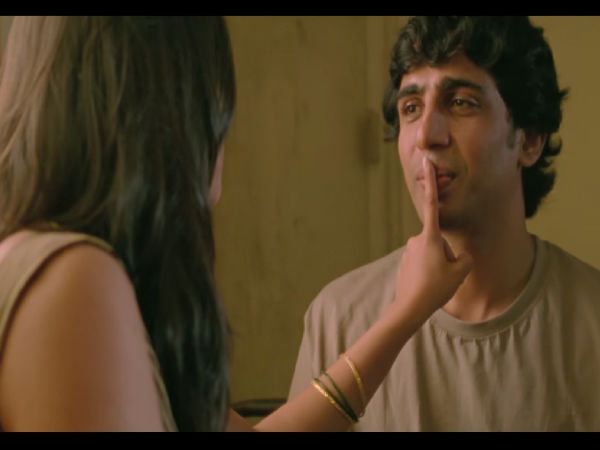
As it stands, what we have is one scene in which the brilliant Radhika Apte, playing the arranged marriage prospect that Mandar has set his heart on, finally learns of his life as a scorer. As Mandar (Gulshan Devaiah, also superb) makes his hesitant confession, Apte's Trupti, with shining eyes, sketches their future life in an open marriage. Mandar can't believe his luck. But then Trupthi turns out to have been testing him, only to reject him out of hand. And then, in one of Hunterrr's unending sleights of hand, the whole conversation turns out to have been in Mandar's imagination.

I'm waiting for the day when we have a Hindi film in which a Trupti can actually imagine that open marriage – not as male fantasy, but her own.

8 February 2014

Picture This: Who is Miss Lovely?

My new film column Picture This will appear every month in the Hindu Business Line's new weekend paper: BLink


Films about sex stars need to show how desire is intertwined with desperation

An early scene in Miss Lovely has Nawazuddin Siddiqui walk into a C-grade film set where some women, dressed in the scanty animal skins and feathers that served ’80s Hindi cinema as ‘tribal costume’, are performing some heavy-breathing dance moves. As Siddiqui’s Sonu looks on, there’s an attempt to make one of them get her kit off. She puts up some muffled resistance. “Madras mein toh saari public ke saamne nangi hui thhi! (In Madras you got naked in front of the whole public!) What’s your problem now?” demands the long-haired man in charge. “That’s why I say these husbands should never be allowed on the set!” Then he switches gear to address the befuddled man standing in the corner: “You! Explain things to your wife.

What is it about the woman in a tribal costume that makes us uncomfortable? Is it her being forced into displaying her nakedness? Is it the way her boss appeals to her husband, showing us that entry into the world of paid work has neither freed her from the surveillance of family, nor failed to create new shackles?

Set on the fringes of the Bombay film industry in the late ’80s, Ashim Ahluwalia’s Miss Lovely follows the fortunes of two brothers — the sleazy, ambitious Vicky and the purist, naive Sonu — who, as the Duggal Cine Combine, produce low-budget horror sex films; films that play surreptitiously in cinemas in lieu of the official feature. There are men in these films, too, but the focus — both for cogs in the wheel like Vicky and the larger sharks he aims to work for — is on the women. “Ladkiyan khoobsoorat honi chahiye, aur besharam bhi (The girls should be beautiful, and also shameless),” as one lascivious distributor puts it.

For a film so self-consciously arthouse in its nuanced recreation of milieu — the art direction, sound and cinematography produce a pitch-perfect sense of ’80s grime — Miss Lovely contains surprisingly tabloid villains. But perhaps these men making innocent young women swill whiskey from cut-glass tumblers fit right into this pre-liberalisation world, where raids are televised on grainy Doordarshan, with commentary about ‘rampant immorality’ that sounds like it’s coming from another planet. Maybe the underbelly of state-sponsored repression is necessarily debauched excess.

But what is more worrying is the way Miss Lovely seems to serve up female victims and vamps for our righteous delectation. The newbie starlet participates gleefully in the unceremonious ouster of the has-been star, and then swiftly progresses along her own trajectory of decline. Meanwhile, the idealised, mysterious Pinky, in whose apparent innocence Sonu places his faith, emerges as the femme fatale.

Is there no way out of this dialectic of innocence and corruption? The industry elicits shamelessness, rewarding women who can produce it with work and sometimes a certain fame — and then turns around and crushes them. They’re damned if they do, and damned if they don’t.

Even empathetic narratives about these women — a bit like older courtesan films — seem to reproduce a moral order in which unapologetic female sexuality (and unapologetic ambition) must receive punishment. The recent Malayalam film Kanyaka Talkies (2012) uses the transformation of a porn movie theatre into a church to make explicit the link between sex and sin. The female protagonist’s desire to be an actress draws her into the porn film industry. An explicit clip finds its way to her hometown; she is forced to leave, not being able to return even to her father’s deathbed. It is hard not to read this as punishment. A more mainstream narrative was The Dirty Picture (2011), which drew on the life of an ’80s actress to make a flashy film that titillated as much as it lectured. A broad-strokes rant about the hypocrisy of a sex-starved society coexisted with the telling of Silk Smitha’s life as inevitable tragedy.

One wishes that these films allowed one to see more of the way desire is intertwined with desperation, ambition with extraction. As the saying goes: the only thing worse than being exploited is not being exploited at all.

A simple exploitation narrative also leaves unasked the question of how women experience the transformative presence of the screen. What is the relationship between the shy girl in The Dirty Picturewho watches incredulously as audiences whistle at her on-screen persona, and that on-screen persona itself, of the heaving bosom and archly bitten lip?

The question of pleasure in the performance of the sexual is a difficult one. And like with much else, beauty lies in the eyes of the beholder. In Ahluwalia’s film, a plain, middle-aged woman walks into a film production office. “Main sexy dance bahut achha karti hoon (I’m great at sexy dance),” she says ingratiatingly, breaking into a set of belly-swishing moves. For many, the scene produced embarrassment, distaste, or pity. But if we do not judge our friends — or ourselves — for posting photos to elicit compliments of hotness on Facebook, should we judge this woman, or anyone else hankering for a screen image? The self-affirmation involved might not be that different.

Published in BLink.