Showing posts with label Japan. Show all posts

6 October 2020

The medical missionary

My Mirror column, the first in a series on films about doctors:

V Shantaram’s 1946 film about the legendary Dr Dwarkanath Kotnis sheds an odd light on the contemporary India-China moment and our pandemic year

2020 has been a year of medical heroism. It might be a good time to remember a heroic doctor from a very different period in the history of India and the world: Dr Dwarkanath Kotnis, whose valiant medical service in Communist China from 1938 to 1942 is still enshrined in that country's public memory. On August 28, even as Chinese and Indian soldiers faced off in a border conflict that remains far from being resolved, it was reported that a statue of Dr Kotnis was to be unveiled outside a medical school in North China named after him: the Shijiazhuang Ke Dihua Medical Science Secondary Specialised School. (‘Ke Dihua’ is Kotnis’s Chinese name.)

Kotnis is not often remembered in contemporary India, but barely four years after his death, his life and work were made the subject of a film by the great Indian director V Shantaram. Free on YouTube as well as available to stream on one subscription-based platform for world cinema, Dr Kotnis Ki Amar Kahani makes for interesting viewing for many reasons.

Released in 1946, a year before independence, Shantaram’s film commemorates Kotnis's as the ideal nationalist life: a life led – and lost – in the service of the nation. As one of the rousing patriotic songs from the film’s rather wonderful lilting soundtrack put it: “Jaan dene ka hi naam hai zindagi (Giving up your life is what living is really about)”. A film called The Immortal Tale of Dr Kotnis was clearly not shying away from either myth-making or propaganda.

What is fascinating to me, though, is that Kotnis’s nationalism is presented as what leads the youthful doctor to another country, where he helped their war effort. Heeding a Congress leader’s call for Indians to come to China’s aid during the Second Sino-Japanese War (Mao Zedong had apparently made such a request of Jawaharlal Nehru), the young graduate from Mumbai’s Seth GS Medical College decided to join a five-member medical mission to China in 1938. Watching Shantaram’s film in 2020, it is impossible not to be struck by the way Indian nationalism in the 1940s could be so naturally folded into an internationalist milieu of cooperation between what were then two poor Asian countries in a still-colonised world. (Some villains do exist: fittingly for a post-Second World War Indian film, it’s the Japanese, who are called ‘shaitan’ but shown as buffoons, in the almost classic tradition of the war movie.)

Scripted by the great KA Abbas, Dr Kotnis opens with the handsome young doctor (played by Shantaram himself) returning from Mumbai to announce to his shocked parents that he has just pledged to serve in China. His ageing father, caught off-guard while proudly displaying the clinic he’d had made for young Dwarka in their hometown of Solapur, has a teary turnaround. It’s a remarkable propagandist scene, where Shantaram and Abbas take the figure of the obedient son and finesse the resonant Indian idea of filial duty into duty to the motherland. The sacrifice is dual, because Dwarka’s father too must give up his ‘budhaape ki laathi’. The Hindi phrase about children as the support of one’s old age is propped up by an actual laathi that Dwarka presents to his father – which falls symbolically from the old man’s hand as his son boards the ship to China. The dramatic foreboding has a reason: the father will die without seeing his son again, and Dwarka will never return.

Shantaram cast himself as Kotnis, and the actress Jayashree – who had become his second wife in 1941 – as Kotnis’s assistant Qing Lan (pronounced Ching Lan), whom he married and had a son with. The relationship between them is tenderly depicted, though it doffs its hat quite obviously to both nationalist propaganda and Hindi film romance. For instance, Qing Lan first meets the good doctor disguised as a boy, and there must be some singing and dancing before love can be declared. But it is striking for a mainstream Indian film in the 1940s to have a foreign, Chinese, heroine, who wears trousers and a shirt all through (except a sweetly comic interlude when she attempts to wear a sari during their wedding) and is as deeply devoted to her work as her husband is to his. It helps that Vasant Desai’s lively, memorable soundtrack is so superbly integrated into the narrative: I loved Jayashree’s ‘Main hoon nanhi nayi dulhan’, though it is clearly not a traditional song sung by Chinese brides, and one of the film’s enduring images for me is the sight of the good doctor watching lovingly as his pregnant Chinese wife sings a rousing song to lead the Red Army to its next destination: “Ghulam nahi tu, josh mein aa / Yeh desh hai tere, hosh mein aa”.

The Chinese-Indian relationship and the internationalist iteration of patriotism apart, the film is remarkable for the way that the medical profession is celebrated. Dr Kotnis’s heroism is no less integral to the national war effort than the Red Army general whose camp he joins – he is captured by the Japanese, endangers his own life to create a vaccine for a plague that breaks out among the Chinese population, and succumbs to epilepsy, but after having saved the general from certain death of his bullet wounds. An internationalist nationalism that talks about saving lives, rather than merely laying down one’s own or killing one's enemies: that's propaganda almost worth having.

Published in Mumbai Mirror, 20 Sep 2020

28 April 2020

Home viewing in times of quarantine

My Mirror column:

Everything I watch these days seems to be speaking to the current moment. One theme that jumps out at me, film upon film, is our relationship to the idea of home


It’s the third week of lockdown in India, and quarantine is having an odd effect on my film viewing. I don't know if it’s me, or the universe conspiring in some strange serendipity, but almost everything I watch these days seems to be speaking to the current moment. One theme that jumps out at me, film upon film, is our relationship to the idea of home. Home is a place where you feel safe – until you don’t. The other day, on a popular streaming platform, I stumbled upon Darren Aronofsky’s much-discussed (and frequently dissed) Mother! (stylised as mother!), a film I had missed when it came out in 2017. In the talky aftermath of the film’s release, Aronofsky went to some lengths to ‘explain’ his spooky, eventually grisly film as a Biblical allegory for the rape and torment of ‘Mother Earth’ by ‘God’, while other characters stand in for Adam, Eve, Cain and Abel.

I have to confess that the Judaeo-Christian analyses baffled me, because I found Mother! entirely intelligible (all right, not entirely!) as a film about domesticity and its dangers. Javier Bardem and Jennifer Lawrence play a couple living in a large and glorious old house. He spends all his time as writers often do, failing to write, while she cooks and cleans and continues the laborious process of restoring the unfinished house. Lawrence is an unbelievable combination of picture-perfect and extremely hands-on: her flowing hair piled into an artfully messy bun as she mixes new shades of wall paint, or conjures up meals that her husband pronounces “perfect” while making polite noises about how she didn’t have to make so many things. The dynamic between them is strained; her obsession with a private paradise is clearly not sparking his creativity. The more she tries to create the perfect space in which the two of them can live happily ever after, the more avidly he tries to invite the outside world in.

The first to arrive is a man who claims to be a great fan of the man’s previous book. Then his wife, his squabbling sons, and then more and more strangers arrive, until the house is overrun. As the ‘guests’ go from admiring and raucous to irresponsible and downright dangerous, the film walks a brilliant tightrope between possible ways in which we might see this. Is the woman overly anxious, closed off and selfish and the man generous, open, free-flowing? Or is he the selfish one, and she the victim? A pandemic that has us all panicking at the idea of strangers in our homes seemed to me to throw Mother! into a whole new light.


Then the night before last, on another streaming platform, I watched a Japanese film called Domains, directed by Natsuka Kusano. The 2019 film is a marvellous formal experiment that likely isn’t for everyone. A mild-mannered policeman reads out the confession of a woman called Aki who has drowned her old friend’s little daughter. From there, we move on to a series of scenes in which three actors – playing the woman, her friend and her friend’s husband – repeatedly rehearse the lines for what might be the film. Except, of course, this is the film.

For some two and a half hours, we almost never leave the bare room in which the actors sit. When we do, what we see is a near-empty city: roads almost free of traffic, a strangely quiet metro.

A more uncanny resonance with our time comes from the characters’ preoccupation with creating a space in which they feel safe. “Nodoka seemed stifled to maintain the comfort of the house. Naoto, on the other hand, treasured his home so much that he seemed to be keeping everyone out except his family,” remembers Aki. The ‘domain' created by the couple and their daughter is, for Aki, a rival to the one she shared with Nodoka in childhood, a magical “kingdom of chairs and sheets” that only the two of them could enter.

The husband, Naoto, on the other hand, feels visibly threatened by Aki’s being so at home with his wife. When he tells Aki to stop coming over because his daughter has caught a fever in her excitement, Aki responds angrily: “So you think I'm some kind of virus, don’t you?”

Naoto regulates everything, from his wife’s smoking to the humidity and temperature of the house. “I do want to feel safe. I need to protect my family,” he says peevishly. And yet, safe is exactly what they are not in the end. Control can backfire, just as much as openness.

Published in Mumbai Mirror, 12 Apr 2020

19 November 2019

Dispatch from Dharamshala – 2

My Mumbai Mirror column:

Films about animals at this year's edition of the Dharamshala International Film Festival had powerful things to say about the state of our humanity
 

The monkey as metaphor: a still from Prateek Vats's film Eeb Allay Ooo

You can never watch all the films at a film festival. What you can do is to make your choices, whether based on frontbencher commitment (read high-intensity googling of film titles) or a more backbencher attitude (what the lady in the loo queue seems excited about) and hope that the darkness of the auditorium will end up illuminating something you haven't quite seen before.
 
One of the things this year's DIFF threw into focus for me was age and ageing. There's no single model of the good life, but observing old people throws up possibilities to aspire to – or guard against. Archana Phadke's stunning documentary portrait of her grandparents and her parents, About Love, is as brutal as it is affectionate, letting us see these long-term relationships as the simultaneous safety nets and shackles they are. The bent, ancient fisherman of Kazuhiro Soda's Inland Sea smiles wryly about how the years can sneak up on you: “I thought I was still 50 or 60, turned out I had turned 90.” 

The other theme that seemed to me to emerge serendipitously from DIFF 2019 was animals. Zooming in on the non-human seemed, in film after film, to be a way of 
opening up the human condition. Sometimes the association felt subtle, like the gleaming night hauls of fish in Inland Sea that the old man disentangles from his net and tosses into the boat's watery hold, so they might live a little longer. The persistent slippery toughness of their bodies, leaping for life even at death's door, struck me as akin to their captor. 

Elsewhere, the weight of the beastly allegory seemed too much for the narrative to bear. The acclaimed Malayali director Lijo Jose Pelissery was at DIFF with his latest, Jallikattu, in which a buffalo due for slaughter runs amok, destroying plantations and shops in its wake. As the village men set off in pursuit, armed with nothing but ropes and their egos, it becomes clear that the film is only ostensibly about the buffalo.  

Pelissery's last two films, Angamaly Diaries and Ee Ma Yau,  demonstrated a talent for richly orchestrated set pieces, but Jallikattu feels more like a runaway display of that ability than a controlled experiment. For most of the film's running time, we watch men with flaming torches tramp through acres of hilly woodland and splash through streams, yelling, leaping, tearing at each other, with increasingly less rational cause. The buffalo seems almost forgotten as long-held internecine rivalries bubble up. The energy of the crowd is both majoritarian and masculine – “We will take it! There are more of us!” The thrill of the hunt, the performative frenzy of competition, the adrenaline and the testosterone – these, Jallikattu drills into us, are what drive humanity at its basest. And somehow, humanity at its most primitive is signified by animality. 

“Even now, with us here, this place belongs to animals,” says a goggle-eyed old man in Jallikattu. The sentiment is echoed at one point in Prateek Vats's stellar feature debut, Eeb Allay Ooo!, when Mahinder the monkey repeller of seven generations declares to the befuddled new recruit Anjani (Shardul Bhardwaj) that he has been asked to help train: “This is the neighbourhood of Raisina, traditionally ruled by monkeys.”  

But neither Pellisery nor Vats seem actually interested in our relationship with the animal world. What Vats's film does brilliantly is to use the monkey as metaphor, creating a multifarious web of associations that traverse the distance between animal and god – but elude the human. The bonnet macaque monkeys of Lutyens' Delhi, as elsewhere in India, have exploded as a population partly because they are worshipped and fed as a form of Hanuman – and as a bit of video footage in the films repeats, “The gods become pests.” 

Combining real locations and non-actors with a sharp script and a core of trained actors, Eeb Allay Ooo! follows the travails of a Bihari migrant who is hired to shoo away monkeys from the national capital's most grandly symbolic architectural corridor. There are several interwoven strands that combine to make this such a scathing indictment of the state of the nation: the humour of a young man's masculinity seemingly pitted against monkeys, the deeply unfair conditions of contractual labour, the absurdity of bureaucratic rules that defeat all of Anjani's innovations on the job. Meanwhile, the performative masculinity of the state at both the lowest level: Anjani's security guard brother-in-law being forced to wield a rifle that he can barely carry – and the highest: the Republic Day parade – emerge as equally farcical. 

It is only when the man pretends to be an animal – in a man-sized monkey costume, in blackface imitation of the lion-tailed macaques of Karnataka's R-Day tableau – that he manages to scatter the monkeys. We watch him wander through the streets, a modern-day Hanuman in his own sad Ramleela

His success is because the monkeys cannot tell the difference between a real langur and a fake one. Mahinder's real death at a mob's hands goes unmourned. Meanwhile, towards the film's end, the real rifle ends up in a costume tailor's shop, its value as limited to the performative as the fake costume. When, in the last scene, the jobless Anjani joins the parade of Hanuman impersonators, we know acche din has made monkeys of us all.

Published in Mumbai Mirror, 17 Nov 2019

13 November 2019

Dispatch from Dharamshala – 1

My Mirror column:

The Dharamshala International Film Festival, now in its eighth year, is still the most intimate, charming setting in which to encounter films and filmmakers in India


I arrived early at DIFF this year, walking up the 20 minutes from McLeod Ganj’s main chowk and making it into the campus of the Tibetan Institute for the Performing Arts (TIPA) just before the first sharp shower of the day. In the main auditorium, Tenzing Sonam and Ritu Sarin, wonderful filmmakers and creators of this extraordinarily delightful film festival in the mountains, were supervising the last-minute arrangements to make sure the eighth edition of the Dharamshala International Film Festival (DIFF) began without a hitch.

The opening ceremony was two hours away, and DIFF’s truly international team of youthful organisers – “Tibetan, French, Punjabi, Bengali, Telugu, Ladakhi, Italian and Malayali!” said Sarin in a Facebook post – were hard at work. At DIFF, details are everything. Two people were pasting black chart paper to reduce reflection from the auditorium balcony, while others made sure the two DIFF banners on either side of the screen were at the same height. The festival trailer and the opening film were test-run, the projection evaluated for sound and stretch and quality of image. Only when all had been approved did Sarin and Sonam make a dash for it, hoping to get a bite to eat (they had missed lunch), change and return to the venue in the 40 minutes left.

It’s my fourth consecutive year at DIFF, and as always, I am warmed not just by the carefully handpicked mix of independent films – shorts and features, documentary and fiction, Indian and international – but by the atmosphere of conversation and camaraderie in which they are screened. Like most film festivals, DIFF is a great place to talk cinema: you will encounter both gushing enthusiasm and agitated criticism over parathas and hot ginger lemon tea in the flag-bedecked courtyard. But there seems something self-selecting about DIFF audiences – the vibe is always more generous and open-ended than nerdy and competitive.

One of the first screenings is Agnes Varda’s last film, an autobiographical, self-evaluative work called Varda by Agnes, the very title evoking the playfulness and joie de vivre that marks much of Varda’s work as a director. Completed in early 2019, a few months before her death, Varda by Agnes allows us to spend two hours in the company of a charming, sensitive filmmaker who was never afraid to embrace her eccentricities. The film opens with Varda seated in a director’s chair, addressing an audience in the grand environs of an opera house. The opera-house-turned-movie-theatre intimidates her: the children of paradise might be up there, she says, laughing and simultaneously bringing in with that one sentence the ghosts of cinemas past – Carné’s delightful 1945 Les Enfant du Paradis, in which the courtesan Garance juggles various loves against the backdrop of the 1830s Paris theatre scene. Like Garance, Carné has an enviable lightness of touch, and so does Varda.

The film has her speak of her love of documentary, of her preferring to explore the nearby and familiar – the bakers and butchers of her Paris neighbourhood, or the murals of Los Angeles where she spent some time – than making “big documentary journeys”. She talks of her love of recycling, something at the heart of her marvellous film The Gleaners And I as well as various artistic projects showcased here, including an arched gate made with old film canisters. “I’ve learnt that recycling brings joy,” she says, because you can preserve things that might otherwise be lost. Then there is her abiding interest in the question of time – from immersion in the everyday art of the baker to the experience of time for her heroine Cleo (in the classic Cleo from 5 to 7) on the nerve-wracking day when she is awaiting the results of a medical test. About Cleo, she says she wanted to bring in both objective time – the universal, fixed clock time that we have no control over – and subjective time: how time actually feels to each of us, an experiential thing that changes all the time.

The passage of time is also integral to the film in a personal sense. Varda made it at the incredible age of 90, and yet age appears in it fleetingly, with that marvellous light touch. There is a moment with footage of her at a protest holding a sign that says “It hurts everywhere”. Varda comments, I could still hold up that sign, it’s still true. She does speak of the experience of turning 80 as paralysing, saying that it felt like a train that was going to crash straight into her. But ten years later, she seems to have made peace with her body.

The question of ageing – the many ways we might age if we set ourselves free to do so – is also at the centre of several other films at the festival this year. The documentary Golden Age, directed by Beat Oswald and Samuel Weniger, is set in an ostentatious retirement home called The Palace, where residents are invited to continue to party into eternity. Kazuhiro Soda’s lovely elegiac documentary Inland Sea takes us into the Japanese seaside village of Ushimado, presenting in a dream-like black and white the real and imagined lives of its many “late-stage elderlies”. RV Ramani’s documentary Oh That’s Bhanu maps the personal and performative life of the 90-something Bhanumathi Rao, once well-known as a dancer and theatre actor. Most radical of all is the superb Aise Hee, the first fiction feature from the writer-director Kislay, in which an old Allahabad housewife responds to the death of her husband by learning to live life anew — thereby rattling everyone around her.

To watch old people live — and to examine their lives — is somehow among the most wonderful things you can do as a young person. Doing so at a film festival is the next best thing to doing so in life.

(The second instalment of this column will appear next wee

Read more at:
https://mumbaimirror.indiatimes.com/opinion/columnists/trisha-gupta/dispatch-from-dharamshala1/articleshow/71988360.cms?utm_source=contentofinterest&utm_medium=text&utm_campaign=cppst
(The second instalment of this column will appear next week.)
(The second instalment of this column will appear next wee

Read more at:
https://mumbaimirror.indiatimes.com/opinion/columnists/trisha-gupta/dispatch-from-dharamshala1/articleshow/71988360.cms?utm_source=contentofinterest&utm_medium=text&utm_campaign=cppst

Published in Mumbai Mirror, 10 Nov 2019.

15 October 2019

The Silk Route Between the Covers

My 'Shelf Life' column for October:

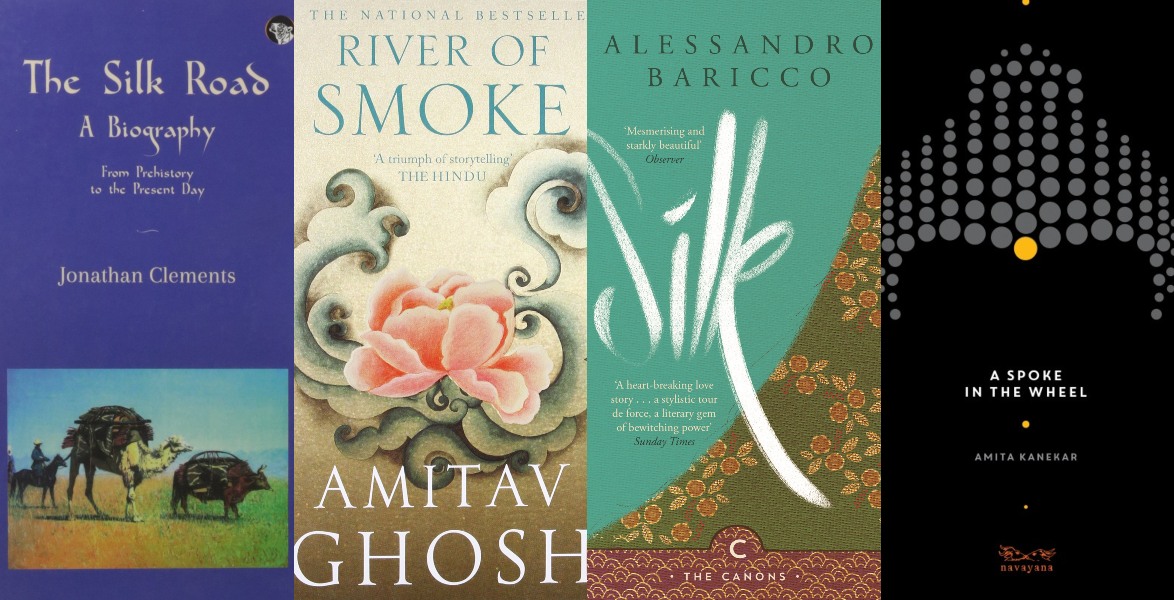
The unreal lustre of silk has long been the stuff of fantasy, in life and in fiction, from Alessandro Baricco’s Silk to Amitav Ghosh's River of Smoke


Cloth has been among the most ubiquitous items of exchange in the history of human civilisation—but silk is the only cloth to have had a trade route named for it. The legendary Silk Road was, of course, neither singular nor physical. It was more a name for a network, a direction in which goods travelled between China and the Mediterranean, with Xi’an and Samarkand as nodes. Jonathan Clements, in his book The Silk Road: A Biography (2016), points out that all manner of objects—gemstones, glass, tulips, spices, slaves—were traded on the route, but the commodity most likely to travel the entire length from East to West, was silk. The reason was its value in the West, but also its portability and durability. 

The moth called Bombyx mori was first cultivated in China, where the first evidence of silk goes as far back as 3000 BC. During the Han dynasty, silk became a form of currency in China. Arriving in the Central Asian steppes and deserts as bribes, gifts, soldiers’ salaries or just in lieu of cash, bolts of silk often carried on westwards, with tribesmen using them as payment for livestock or luxuries. Soon silk began to appear in the ancient Graeco-Roman world (332 BC -395 AD). But it was not common, and the fabric’s marvellous quality of light and shade, of movement, could alarm those who saw it for the first time. As late as 53 BC, Roman soldiers were so unnerved by the sight of the shimmering silken banners carried by the Parthian troops at the Battle of Carrhae that they took to their heels. 

By the 3rd century AD, it had become the cloth of kings. The Roman Emperor Heliogabalus, who reigned 218-222, reportedly wore nothing but silk. In Amita Kanekar’s superb fictional reimagining of the time of Ashoka, A Spoke in the Wheel (2015), all bhikkhus (monk) wear brown robes, as ordained by the Buddha. But those worn by the Thera of the Sanchi Stupa, made from “this amazing cloth from the lands of Chin”, mark him out as the first among equals. 

The Thera’s robes, like the Parthian banners, “looked alive”: “the same saffron-brown colour shimmered in the lamplight, making dark gold and orange pools that continuously changed shape and direction”. By the early centuries AD, Korea, Japan and India had also begun to practise sericulture. Silk appears twice more in Kanekar’s novel, both times more local. Once “pieces of stiff, shiny material” are hidden in a monk’s mattress, inscribed with a message in the Kharosthi script from Taxila. Another time, a conquered people forced to shift south from eastern India sport lengths of rough-textured golden mugga, “woven long ago on home-made bamboo looms and reserved for special occasions – for wild silkworms with their shining cocoons were not to be found in the Vindhyas, Bhima insisted.”

But even as silk earned the favour of the rich and powerful, it scandalised others. The Roman writer Seneca was appalled by the “glass togas” on sale: “I see silken clothes, if one can call them clothes at all, that in no degree afford protection either to the body or to the modesty of the wearer, and clad in which, no woman could honestly swear she is not naked.” 

Centuries later, when the Europeans had started to produce it, the sheen, softness and smooth drape of Eastern silk still retained an erotic charge. In Alessandro Baricco’s novel Silk (1996), translated from the Italian by Ann Goldstein, a 32-year-old French merchant travels to Japan to acquire silkworm eggs that have been spared from the damaging effects of a Pébrine epidemic. It is 1861, and it takes him three months. “How is the end of the world?” asks his associate Baldabiou. “Invisible,” responds Hervé Joncour. 

For his wife Hélène, Joncour brings back a silk tunic that she, “out of modesty, never wore”: “If you held it between your fingers, it was like grasping nothing.” Published in 1997, silk in Baricco’s novel is very much part of an erotic European fantasy of the East—but self-consciously so. In the house of Hara Kei, the Japanese lord who privately agrees to sell him the eggs, he is bathed daily by three old women whose hands are “gnarled, but very tight”, who dry him off with “warm silk cloths”. On his last day there, they are replaced by “the lightness of a silk veil” and unseen hands that caress his skin, “not the old hand of an old woman”. Joncour spends his life in the grip of those hands—never realizing the flesh-and-blood Hélène's rôle in stoking that fantasy.

In Amitav Ghosh's River of Smoke (2011), another mid-19th century merchant travels halfway across the world and brings back silk for his wife. Shireenbai does wear the pale brocaded China silk as a sari, and even the scarlet Jinliang slippers. Like the unhappy Hélène, though, Shireen knows that her opium-trading Parsi husband's heart lies in the East, even when he is in Bombay. 

But unlike Joncour's Japanese memory, the woman Bahram Modi becomes attached to in Canton is the opposite of ethereal. Chi-mei is warm, domestic, comfortable, she wears cotton not silk. She, not Shireen, bears him a son. And even in Bahram’s last pipe-dream, her fingers on his chest are rough and callused—as if to say that this Canton life has always been his real one. 

Silk’s very luxuriousness makes it a permanent figment of the imagination. Reality, it seems, feels rougher.

Published in The Voice of Fashion, 9 Oct 2019.