Showing posts with label Urmi Juvekar. Show all posts

9 August 2021

Do you know who wrote your favourite film?

My TOI Plus/ Mumbai Mirror column for Sun 25 July:

Writers barely get the credit they deserve — a new book on women screenwriters in Bollywood illuminates a hazy corner of the glittering silver screen

Screenwriter Herman J Mankiewicz ('Mank') and director Orson Welles, whose real-life collaboration and battle over writing credit for Citizen Kane is the subject of David Fincher's 2020 film Mank.

“Film is thought of as a director’s medium,” the great Billy Wilder once said, “because the director creates the end product that appears on the screen. It’s that stupid auteur theory again, that the director is the author of the film. But what does the director shoot — the telephone book?”

Wilder, a Jew who managed to escape Nazi Germany for the US in 1933, became famous as the director of Hollywood classics as various as Sunset BoulevardSome Like It Hot and The Apartment. It’s no surprise, though, that he started as a screenwriter, his films forever filled with unforgettable characters and memorable lines.

The full version of the Wilder quote above ends with a sentence that dates him (perhaps even more than his mention of the telephone directory): “Writers became much more important when sound came in, but they’ve had to put up a valiant fight to get the credit they deserve.”

Cinema has now been around for over a century, and the first ‘talking picture’ was The Jazz Singer in 1927 — but most screenwriters still don’t get the credit they deserve, even when the film is a grand success. 
Last year, in a rare reframing of film history, David Fincher — known for directing The Fight ClubZodiacThe Social Network and Gone Girl, himself as much an auteur as Hollywood has ever had — devoted a whole film to a screenwriter who had to fight for credit for what’s often listed as the greatest American movie of all time – Citizen Kane (1941).

Until Fincher’s Mank (2020), most people who had heard of Citizen Kane (CK) saw it as a film ‘made’ by Orson Welles — not ‘written by Herman Mankiewicz’. Of course, Welles will remain a legend, as he should. But at least a larger cross-section of film-goers now know something about the sharp ex-New Yorker who first created the story of a newspaper magnate rising to power by manipulating public opinion during a war.

Within the smaller community of film nerds, the story of how Welles and Mankiewicz came together — and fell apart — in the making of CK has been talked about for much longer. Around CK’s release in 1941, the director and the screenwriter became embroiled in an ugly battle, with Welles eventually giving Mank shared credit for the Oscar-winning screenplay. In 1971, the influential film critic Pauline Kael wrote a 50,000 word essay foregrounding Mankiewicz’s script contribution as much greater than Welles’ — but Kael’s take, too, has since been challenged, drawing on the many drafts of the CK script in the archive.

The relationship between screenwriter and director need not always be this conflicted. The creative collaboration between them is often the bedrock of great filmmaking, with people sometimes establishing working partnerships that last for years. And yet, as film lovers or enthusiasts, we know far too little about the writers responsible even for what we might consider our favourite films.

Scripting Bollywood: Published by Women Unlimited, New Delhi, 2021. 300pp. 
Anubha Yadav’s stellar new book Scripting Bollywood: Candid Conversations with Women Who Write Hindi Cinema (Women Unlimited, 2021) is a great step in the right direction. The lacuna she addresses is two-fold. One, the writer’s job in Indian cinema has been even more invisibilised than in other film industries, for many reasons, discussed at length in my 2011 longform piece "Death by Dialogue". A primary one, as the screenwriter Anjum Rajabali rues (in his Foreword to Yadav’s book) is that” filmmakers as well as audiences in India treated cinema as an extension of pre-existing narrative performing art forms”, like tamasha, sangeet natak and Urdu theatre, so for decades, the best we had by way of a script was the director breaking down the story into incidents and getting dialogue written for the characters. More often than not, Hindi cinema was created on the studio floor, with the writer or writers being drafted into a highly informal set of collaborations, where someone might or might not be credited for ‘story’ and a writer was credited at best for dialogues, often because those had to be written in Hindustani/Hindi, which was often not the director’s mother tongue.

Now add to this already non-formalised working milieu, where the contributions of writers are barely documented, the possibility that that writer is a woman — and imagine how much power or influence she might be able to wield. That is the second reason why Yadav’s book is so important — she addresses a gap in the archive that we have barely begun to sketch the contours of.  

Yadav’s suggestive first chapter draws on new scholarly research as well as doing some independent detective work to open up the historical conversation about the women whose names we do know: Fatma Begum (who was also the mother of India’s first talking star Zubeida), Jaddan Bai (also the mother of Nargis), the utterly fascinating Protima Dasgupta (who collaborated with her sister-in-law Begum Para, making her a star) and the slightly better known Ismat Chughtai (who collaborated with her husband Shahid Latif). All these women performed multiple roles, often creating their own film companies with family members to try and achieve greater creative control.

The rest of Yadav’s book is devoted to long, thoughtful conversations with 14 contemporary female screenwriters, from veterans like Shama Zaidi — associated with such classics as Garm HavaShatranj Ke KhilariUmrao Jaan and a host of Shyam Benegal films — and Kamna Chandra (Prem RogChandni) all the way down to Juhi Chaturvedi (Vicky DonorPikuOctober and Gulabo Sitabo). Collectively, these writers represent the whole gamut of what might be called Hindi cinema, and sometimes extend beyond it — like Zaidi’s work with Satyajit Ray, or the younger writers branching into web series, like Sanyuktha Chawla Shaikh’s work on Delhi Crime, or Devika Bhagat’s on Four More Shots Please.

Almost every interview is studded with insights into not just each individual’s working process, but also the multiple ways in which films get made. Urmi Juvekar talks about the power of listening to the script (after it is written) to give it final shape, while Sooni Taraporewala talks of learning through the process of doing commissioned work (Salaam BombaySuch A Long JourneyAmbedkar).

The nature of each collaboration is different, too — while Zaidi has worked primarily with three filmmakers, Muzaffar Ali, Shyam Benegal and her husband MS Sathyu, Chaturvedi’s work thus far has been with the director Shoojit Sircar. Sabrina Dhawan, who wrote Mira Nair’s Monsoon Wedding, has also been an integral part of many Vishal Bhardwaj films. Reading Dhawan’s account of how she rewrote Vidya Balan’s character Krishna in Ishqiya to be the one that was playing the two men (rather than merely responding to them as in the draft Bhardwaj and Abhishek Chaubey brought her), or Urmi Juvekar’s candid but careful account of working with Dibakar Banerjee for four films before Detective Byomkesh Bakshy! ended their collaboration, even the most sceptical film-goer might start to pay a little more attention to screenwriters.

The story of Mank is instructive about the inevitable push and pull of the writer-director relationship. David Fincher was the one who read Kael’s essay and suggested Mank as a protagonist to his ex-journalist father Jack Fincher. But in a 2020 interview, David described his father’s first draft as “an anti-auteurist take” and “kind of a takedown of Welles”. “What the script really needed to talk about was the notion of enforced collaboration…" Fincher told the interviewer.

A writer is unlikely to get her idea on film without a director, but most directors need a script to work from, too. And so the process of collaboration carries on: complicated, sometimes fraught, but almost always indispensable to the making of cinema.

24 June 2019

Grave New World

My Mirror column

The new webseries Leila is uneven in its language, its storytelling and its politics, but it offers plenty to think about. 

(Second of a two-part column)


In Prayaag Akbar’s 2017 book Leila, which is in English, the use of Hindustani words is limited but specific: the unconscious use of the appellations “Abbu” and “Ammi” nearly gets Riz and his brother Naaz caught as being from ‘the wrong sector’. In the Netflix show, Shalini meets Riz’s parents and calls them Abbu and Ammi – but the subtitles flatten the words into “Dad” and “Mom”. Other world-building coinages by Akbar – the thuggish army of Repeaters, or the hierarchical division of society into Categories 1-5 – are allowed to remain in the show’s English subtitles, but necessarily translated into Hindi in the spoken version, sometimes losing specificity and power – eg “Paltan” for the Repeaters – and sometimes gaining it: “Panchakarmi” has far greater punch than Category 5.


There are other times when the Hindi dialogue is as nuanced as it is possible to be, delineating minute shades of meaning that then amplify the narrative. One instance not present in the book is when Shalini (Huma Qureshi) happens to witness the police raiding a professor’s study. “Yahan toh Sen wali kitaab bhi hai,” one cop announces triumphantly to his senior. 

“Politics? Aap politics sikhaate hain?” the senior cop demands of the professor. “Sikhata nahi, padhaata hoon,” he replies sharply. That almost pedantic distinction, even on the verge of being arrested, fits the character’s academic persona. But that difference between “sikhana” and “padhaana” also makes a subtle point about this anti-intellectual universe, in which politics can only be understood as a skill – not as a subject of study. And as is already becoming true in our present, it is not a skill that the establishment wishes students to have.

There is another funny detail in the scene. The nameplate outside H. No. 1/20, a mid-sized bungalow of the sort that a Delhi University professor might currently occupy, says “Dr. Nakul Chaubey, MA, M.Phil, PhD”. Given that a PhD implies having all the previous degrees, the nameplate’s recitation of degrees might be intended as humour. But it might also be read as signifying a world in which even visitors to an academic’s house are not assumed to know what a PhD is. As many degrees as possible must be listed on an intellectual’s door, and even that listing is not sufficient armour against the barbarians at the gates. As we – and Shalini – watch in silent horror, the knot of heckling protestors shouting “Nakul Chaubey murdabad” swiftly becomes a lynch mob kicking and punching the unarmed white-bearded man, now fallen to the ground.

The targeting of intellectuals in a Hindutva-driven dystopia has appeared in a previous Netflix India original series, Ghoul (2018), whose writer-director Patrick Graham shares writing credits on Leila with Urmi Juvekar and Suhani Kanwar. In Ghoul, that aspect is more frontally addressed: the protagonist Nida Rahim (Radhika Apte) is the daughter of a retired academic called Shahnawaz Rahim (SM Zaheer). Nida is part of an anti-terrorist force, and much of the narrative tension emerges out of the father and daughter’s starkly different positions on the state’s role in citizens’ lives.

The elder Rahim’s criticism of an authoritarian government is seen by his daughter as seditious. Father and daughter are both Muslim, but the daughter has internalised that second-class status as involving a greater need to prove her loyalty to the state.

That idea of a generational shift is also a shaping influence in Leila, which contains several scenes involving the brainwashing of children – and the attempted reformation of adults – by the new state of Aryavarta.

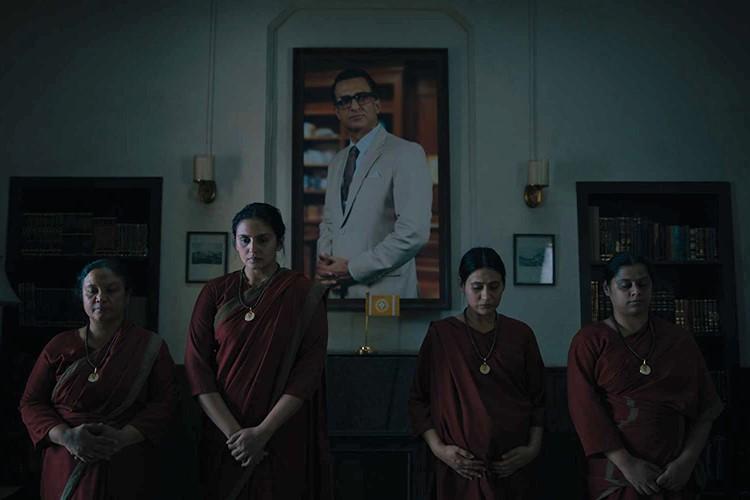
The show’s vision of Aryavarta feels almost programmatic in its symbolic combining of historical Fascism (a two finger ‘Jai Aryavarta’ salute, for instance) with a recognisable version of the Indian present (a leader called Joshiji whose name appears on every broadcast and every poster). Schoolchildren recite “Aryavarta is my mother” while doing martial exercises; babies are addicted to animated videos about Junior Joshi, whose heroic exploits evoke Bal Narendra.

More disturbing is the use, in the episodes directed by Mehta, of variations on existing Hindu rituals – rolling on the floor, for instance, or the marriage of a woman to a dog – as punishments imposed on women who break the rules of Aryavarta. In times like ours, it seems to me more necessary than ever to distinguish our criticism of the socio-political vision of Hindutva from what feels like a too-easy mockery of Hindu practice. To imagine existing religious practices as future forms of social torture is to display a lack of both imagination and empathy.


Leila also occasionally suffers from feeling like an Indian version of The Handmaid’s Tale, the web adaptation of Margaret Atwood’s novel. Akbar’s novel did contain the core idea of a regime that slut-shames and drugs recalcitrant women into submission, but the Netflix version has replaced the workaday dullness of Shalini’s office-cleaning and one-room-kitchen-attached-bath with a dark, shared dormitory for women who must undergo various forms of abasement, including bathing in dirty water, polishing shoes and being guarded by eunuchs. It also seems to adopt wholesale from Atwood the vision of categories of women dressed in different colours who serve different roles in society (the handmaids, the Marthas and the Wives). 

Still, these categories do provide the show’s most fertile ground for self-examination by the class of Indians likely to be watching Leila. I was excited by the show’s foregrounding of what is a more subterranean strain in the novel, the mistress-maid reversal. But the execution of that reversal, crunched into two years instead of the novel’s sixteen, is too quick to be credible. It allows for no interiority on the parts of either mistresses or maids. And if Shalini doesn’t see how her unearned privilege is part of what has led her world to this point, how will we?

Published in Mumbai Mirror, 23 June 2019. (The first part is here.)

Future imperfect

My Mirror column: a two-part series on Leila

The new web series Leila, adapted from Prayaag Akbar’s 2017 novel, imagines a dystopian India that makes for harsh but necessary viewing.


An opinion piece I read recently suggested that comedy is becoming a difficult art to practise in today’s India, as reality becomes ever more ridiculous. The same might be said, I think, of dystopian fiction. As our collective lived experience itself edges away from the rational, it becomes harder to make our irrationalities visible in the mirror of fiction.

The writer who seeks to show us such a mirror must carefully calibrate the distance between an imagined future and the present that we’ve accepted as normal. In his 2017 novel Leila, Prayaag Akbar managed to do that successfully.

The book’s chilling vision of the future was filled with details that felt entirely plausible. Akbar’s world is one where birth determines social status, where mixing is strongly discouraged and the rich have parcelled out urban space amongst themselves, dividing up the city into community-specific neighbourhoods like “the Tamil Brahmin sector, Leuva Patel Residency, Bohra Muslim Zone, Catholic Commons, Kanyakubj Quarters, Sharif Muslimeen Precinct, Maithil Acres, Chitpavan Heights, Syrian Christian Co-op, Kodava Martials”. Linked by a network of “flyroads”, the leafy, peaceful universe of these segregated “high sectors” is enclosed by walls, and a vast air-conditioning system called the Skydome. The poor, known as Slummers, live beyond the walls – in a filthy, treeless world crisscrossed by Outroads, where the air is noxious with gases expelled from the Skydome’s purifiers, and the ground an endless stretch of landfills that often catch fire.

It is in a version of this universe, based on Akbar’s novel, that the new Netflix series Leila unfolds. Like the novel, the show centres on Shalini (a superb Huma Qureshi), who is suddenly hurled from an elite bubble of bungalows, swimming pools and poshly cosmopolitan schools into the margins of the new society that has come into being. “Purity for All” here means purity is all, and those who make the mistake of loving outside their communities must be punished, and schooled into submission. Deepa Mehta, who has directed the series’ first two episodes, told me in an interview that what attracted her to Akbar’s book, and to screenwriter Urmi Juvekar’s reimagining of it for Netflix, was “the journey of a person who is privileged, who has everything, but has it taken away from her in difficult times. It’s not just about looking for her daughter, it’s about looking for her dignity, her own self”.

“Wherever there is a totalitarian regime, women are having a really rough time,” added Mehta. Both for her and Qureshi, Leila’s woman-centric narrative was crucial to its politics. “The problem with a lot of female characters and roles is that you always have to be rescued by someone,” Qureshi said during the same interview. “Even in 2019, I get a lot of scripts in which [women] just have to hang around, look nice, basically support the man who saves the world. Even when the problem concerns women, a guy has to come and empower us. What about us empowering ourselves, finding that inner strength? Shalini offered me that.”

Gender is also at the crux of some changes the series makes from the book. For instance, a little boy called Roop, whom Shalini encounters during her search for her lost daughter, here becomes a little girl. “I’d seen [male children in] Lion and Slumdog Millionaire, and I thought about time, ladkiyan toh honi chahiye. It’s a desire, as a woman, to have an emotional journey to which as many women as possible are contributing,” said Mehta.

Given that a 250-page novel needed to be stretched to create a six-episode series, changes were inevitable. “A book is very different than a film, and a series completely different. That’s not an excuse, it’s the reality of the medium,” Mehta said. Some of the striking additions involve completely new characters, like the labour supervisor Bhanu (Siddharth) or the Dixit family, for whom Shalini goes to work, or the fascinating figure of Rao Saheb (Akash Khurana), who is both a founding figure of the regime and among its more conflicted critics. Other changes are within characters. The book, for instance, starts with Shalini’s husband Riz (Rahul Khanna) screaming at her that she will never find Leila, while on screen he is an almost cloyingly supportive husband, only appearing to compliment or reassure her. That change, perhaps, contributes to Shalini’s rather different self-image, from a kind of self-flagellation for cowardice in the book, to being the woman who begins the series by kicking her attackers and saying over and over, “I’m not afraid of you.”

There is also a textural transformation caused by the fact that the novel is in English, with entirely English dialogue, while the series largely unfolds in Hindi, with some characters switching to English when they would naturally do so, such as Shalini and her husband Riz.

(This column has a second part, which is here.)