Showing posts with label future. Show all posts

28 April 2020

Fictional motherlands, real relationships

My Mirror column:

Some recent fictions illustrate how totalitarianism thrives on turning on real people into mythical enemies – and pitting an attachment to family and friends against the love of an imaginary nation


A still from the 2019 film Jojo Rabbit
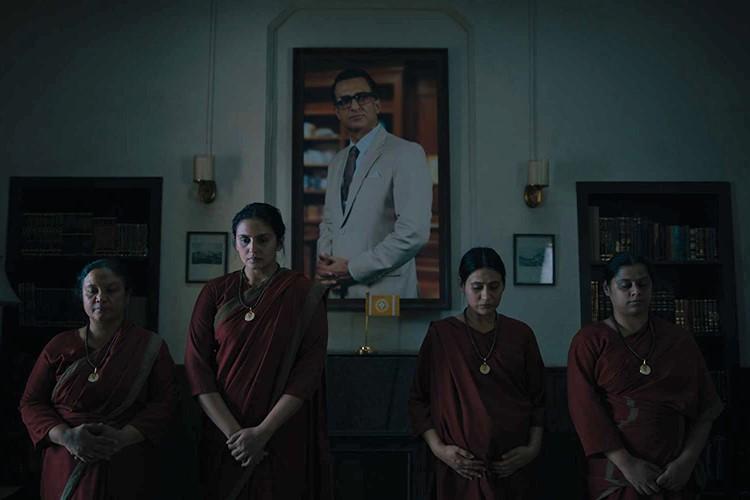
A third of the way through the sadly aborted Leila, the series’ protagonist Shalini (Huma Qureshi) finally manages to trace her lost daughter to a school that looks like a prison. Her fake ID gets her past the gun-toting security-men into a cavernous grey interior, where stiffly-dupatta-ed girls are learning the call-and-response of new nationhood. “Hum kaun hain?” demands the teacher. “Aryavarta ke nanhe sipaahi!” comes the response. As Shalini’s anxious gaze travels along the children and finds Leila’s familiar features, her face uncreases into a joyful smile. Almost unconsciously, her feet begin to move towards the child she thought she might never see again.

But is this really the same child as the one who was abducted from her parents’ arms, only two years before? “My name is not Leila, my name is Vijaya,” the little girl says to a stunned Shalini. She pronounces the words carefully, like she’s learnt them by rote. The scene’s emotional kicker comes when a big car draws up, with a woman in it that Shalini knows well from a previous life, and Vijaya runs to embrace her – this time, with an unrehearsed “Mummy”. But as the finale of Leila makes indubitably clear, that woman is only a placeholder. The entity that has really replaced Shalini is so powerful that there is no way a mere human even try to compete - the nation-state. To quote the slightly dubious gendering chosen by Leila’s makers, “Tum meri maa nahi ho. Aryavarta meri maa hai.

The idea of a nationalism that pits children against their parents is one that has appeared in another Indian webseries, Ghoul, where the ultimate betrayal of a parent is committed by an adult protagonist who has tragically learnt to trust the nation-state over and above family. I was reminded of these shows this week, as I watched Taika Waititi’s 2019 film Jojo Rabbit, currently free to stream, in which a single mother (Scarlett Johansson) has to deal with her only child being indoctrinated by a state she isn't exactly enamoured of.

Instead of a chilling dystopian future, though, Jojo Rabbit takes us on a madcap fantasy ride into the past. Ten-year-old Johannes Betzler is as cuddly a protagonist as you could ask for. He is also an incipient Nazi, who spends a lot of time talking to his imaginary best friend Adolf: a goofball version of Hitler who's alternately sulky and encouraging. Right from the opening sequence, which splices its fictional boy hero's frenzied self-motivation for a Jungvolk training weekend with historical black and white footage of Hitler's screaming youthful fans to the Beatles iconic anthem I Wanna Hold Your Hand, you know this film isn't traditional fare. Jojo's repeated 'Heil Hitlers', getting louder and crazier as he bursts out of his front door and careens in faux-aeroplane mode through his small-town streets, aren’t scary so much as ridiculous. The same could be said of the cast of characters that have assembled to turn the town's little boys into men and little girls into women – the hipflask-swigging Captain K, demoted from active wartime service by the avoidable loss of an eye, and the pudding-faced Fraulein Rahm, who seems a little young to have had “eighteen children for Germany”.

Waititi ups the tenor of ridiculousness even further when it comes to Nazi indoctrination against Jews. The descriptions proffered by the camp leaders, complete with chalk sketches, reminded me of Roald Dahl's checklist for witches in The Witches. Jews look deceptively like human beings, but they have horns under their hair and scales on their bodies and they smell like Brussels sprouts.


But of course, the film's whole point is that Jojo – like the entire brainwashed German nation -- believes in this mythology. So when, in a nice doffing-of-the-hat to Anne Frank, a teenaged Jewish girl turns out to be hiding behind the wall of his dead sister’s room, Jojo is baffled when she doesn’t fit the criteria. In return for keeping her secret, Jojo demands of Elsa (Thomasin McKenzie) a detailed insider's account of Jewishness, taking notes as she speaks. Their evolving relationship lets us walk the tightrope fantasy does, between wish-fulfilment and danger. An illustrated ‘expose’ full of ‘facts' about Jews, fictitious letters from a boyfriend who may or may not exist – these are the flip side of a real world in which Elsa can only survive if she can successfully parade her dead classmate’s papers.But it is in Jojo’s relationship with his mother Rosie that the film's heart lies. Johansson is pitch-perfect as the single mum who can blacken her face and turn into an imaginary ‘Daddy’ to indulge her little boy’s demand for his missing father – but who also refuses to let him avert his eyes from the bodies of ‘traitors’ strung up in the town square. She is happy to let him be part of the masquerade of Nazi boyhood, but draws the line at a real gun. Jojo Rabbit, like Rosie, knows the magical power of fiction, but also knows exactly when reality counts.

24 June 2019

Grave New World

My Mirror column

The new webseries Leila is uneven in its language, its storytelling and its politics, but it offers plenty to think about. 

(Second of a two-part column)


In Prayaag Akbar’s 2017 book Leila, which is in English, the use of Hindustani words is limited but specific: the unconscious use of the appellations “Abbu” and “Ammi” nearly gets Riz and his brother Naaz caught as being from ‘the wrong sector’. In the Netflix show, Shalini meets Riz’s parents and calls them Abbu and Ammi – but the subtitles flatten the words into “Dad” and “Mom”. Other world-building coinages by Akbar – the thuggish army of Repeaters, or the hierarchical division of society into Categories 1-5 – are allowed to remain in the show’s English subtitles, but necessarily translated into Hindi in the spoken version, sometimes losing specificity and power – eg “Paltan” for the Repeaters – and sometimes gaining it: “Panchakarmi” has far greater punch than Category 5.


There are other times when the Hindi dialogue is as nuanced as it is possible to be, delineating minute shades of meaning that then amplify the narrative. One instance not present in the book is when Shalini (Huma Qureshi) happens to witness the police raiding a professor’s study. “Yahan toh Sen wali kitaab bhi hai,” one cop announces triumphantly to his senior. 

“Politics? Aap politics sikhaate hain?” the senior cop demands of the professor. “Sikhata nahi, padhaata hoon,” he replies sharply. That almost pedantic distinction, even on the verge of being arrested, fits the character’s academic persona. But that difference between “sikhana” and “padhaana” also makes a subtle point about this anti-intellectual universe, in which politics can only be understood as a skill – not as a subject of study. And as is already becoming true in our present, it is not a skill that the establishment wishes students to have.

There is another funny detail in the scene. The nameplate outside H. No. 1/20, a mid-sized bungalow of the sort that a Delhi University professor might currently occupy, says “Dr. Nakul Chaubey, MA, M.Phil, PhD”. Given that a PhD implies having all the previous degrees, the nameplate’s recitation of degrees might be intended as humour. But it might also be read as signifying a world in which even visitors to an academic’s house are not assumed to know what a PhD is. As many degrees as possible must be listed on an intellectual’s door, and even that listing is not sufficient armour against the barbarians at the gates. As we – and Shalini – watch in silent horror, the knot of heckling protestors shouting “Nakul Chaubey murdabad” swiftly becomes a lynch mob kicking and punching the unarmed white-bearded man, now fallen to the ground.

The targeting of intellectuals in a Hindutva-driven dystopia has appeared in a previous Netflix India original series, Ghoul (2018), whose writer-director Patrick Graham shares writing credits on Leila with Urmi Juvekar and Suhani Kanwar. In Ghoul, that aspect is more frontally addressed: the protagonist Nida Rahim (Radhika Apte) is the daughter of a retired academic called Shahnawaz Rahim (SM Zaheer). Nida is part of an anti-terrorist force, and much of the narrative tension emerges out of the father and daughter’s starkly different positions on the state’s role in citizens’ lives.

The elder Rahim’s criticism of an authoritarian government is seen by his daughter as seditious. Father and daughter are both Muslim, but the daughter has internalised that second-class status as involving a greater need to prove her loyalty to the state.

That idea of a generational shift is also a shaping influence in Leila, which contains several scenes involving the brainwashing of children – and the attempted reformation of adults – by the new state of Aryavarta.

The show’s vision of Aryavarta feels almost programmatic in its symbolic combining of historical Fascism (a two finger ‘Jai Aryavarta’ salute, for instance) with a recognisable version of the Indian present (a leader called Joshiji whose name appears on every broadcast and every poster). Schoolchildren recite “Aryavarta is my mother” while doing martial exercises; babies are addicted to animated videos about Junior Joshi, whose heroic exploits evoke Bal Narendra.

More disturbing is the use, in the episodes directed by Mehta, of variations on existing Hindu rituals – rolling on the floor, for instance, or the marriage of a woman to a dog – as punishments imposed on women who break the rules of Aryavarta. In times like ours, it seems to me more necessary than ever to distinguish our criticism of the socio-political vision of Hindutva from what feels like a too-easy mockery of Hindu practice. To imagine existing religious practices as future forms of social torture is to display a lack of both imagination and empathy.


Leila also occasionally suffers from feeling like an Indian version of The Handmaid’s Tale, the web adaptation of Margaret Atwood’s novel. Akbar’s novel did contain the core idea of a regime that slut-shames and drugs recalcitrant women into submission, but the Netflix version has replaced the workaday dullness of Shalini’s office-cleaning and one-room-kitchen-attached-bath with a dark, shared dormitory for women who must undergo various forms of abasement, including bathing in dirty water, polishing shoes and being guarded by eunuchs. It also seems to adopt wholesale from Atwood the vision of categories of women dressed in different colours who serve different roles in society (the handmaids, the Marthas and the Wives). 

Still, these categories do provide the show’s most fertile ground for self-examination by the class of Indians likely to be watching Leila. I was excited by the show’s foregrounding of what is a more subterranean strain in the novel, the mistress-maid reversal. But the execution of that reversal, crunched into two years instead of the novel’s sixteen, is too quick to be credible. It allows for no interiority on the parts of either mistresses or maids. And if Shalini doesn’t see how her unearned privilege is part of what has led her world to this point, how will we?

Published in Mumbai Mirror, 23 June 2019. (The first part is here.)

Future imperfect

My Mirror column: a two-part series on Leila

The new web series Leila, adapted from Prayaag Akbar’s 2017 novel, imagines a dystopian India that makes for harsh but necessary viewing.


An opinion piece I read recently suggested that comedy is becoming a difficult art to practise in today’s India, as reality becomes ever more ridiculous. The same might be said, I think, of dystopian fiction. As our collective lived experience itself edges away from the rational, it becomes harder to make our irrationalities visible in the mirror of fiction.

The writer who seeks to show us such a mirror must carefully calibrate the distance between an imagined future and the present that we’ve accepted as normal. In his 2017 novel Leila, Prayaag Akbar managed to do that successfully.

The book’s chilling vision of the future was filled with details that felt entirely plausible. Akbar’s world is one where birth determines social status, where mixing is strongly discouraged and the rich have parcelled out urban space amongst themselves, dividing up the city into community-specific neighbourhoods like “the Tamil Brahmin sector, Leuva Patel Residency, Bohra Muslim Zone, Catholic Commons, Kanyakubj Quarters, Sharif Muslimeen Precinct, Maithil Acres, Chitpavan Heights, Syrian Christian Co-op, Kodava Martials”. Linked by a network of “flyroads”, the leafy, peaceful universe of these segregated “high sectors” is enclosed by walls, and a vast air-conditioning system called the Skydome. The poor, known as Slummers, live beyond the walls – in a filthy, treeless world crisscrossed by Outroads, where the air is noxious with gases expelled from the Skydome’s purifiers, and the ground an endless stretch of landfills that often catch fire.

It is in a version of this universe, based on Akbar’s novel, that the new Netflix series Leila unfolds. Like the novel, the show centres on Shalini (a superb Huma Qureshi), who is suddenly hurled from an elite bubble of bungalows, swimming pools and poshly cosmopolitan schools into the margins of the new society that has come into being. “Purity for All” here means purity is all, and those who make the mistake of loving outside their communities must be punished, and schooled into submission. Deepa Mehta, who has directed the series’ first two episodes, told me in an interview that what attracted her to Akbar’s book, and to screenwriter Urmi Juvekar’s reimagining of it for Netflix, was “the journey of a person who is privileged, who has everything, but has it taken away from her in difficult times. It’s not just about looking for her daughter, it’s about looking for her dignity, her own self”.

“Wherever there is a totalitarian regime, women are having a really rough time,” added Mehta. Both for her and Qureshi, Leila’s woman-centric narrative was crucial to its politics. “The problem with a lot of female characters and roles is that you always have to be rescued by someone,” Qureshi said during the same interview. “Even in 2019, I get a lot of scripts in which [women] just have to hang around, look nice, basically support the man who saves the world. Even when the problem concerns women, a guy has to come and empower us. What about us empowering ourselves, finding that inner strength? Shalini offered me that.”

Gender is also at the crux of some changes the series makes from the book. For instance, a little boy called Roop, whom Shalini encounters during her search for her lost daughter, here becomes a little girl. “I’d seen [male children in] Lion and Slumdog Millionaire, and I thought about time, ladkiyan toh honi chahiye. It’s a desire, as a woman, to have an emotional journey to which as many women as possible are contributing,” said Mehta.

Given that a 250-page novel needed to be stretched to create a six-episode series, changes were inevitable. “A book is very different than a film, and a series completely different. That’s not an excuse, it’s the reality of the medium,” Mehta said. Some of the striking additions involve completely new characters, like the labour supervisor Bhanu (Siddharth) or the Dixit family, for whom Shalini goes to work, or the fascinating figure of Rao Saheb (Akash Khurana), who is both a founding figure of the regime and among its more conflicted critics. Other changes are within characters. The book, for instance, starts with Shalini’s husband Riz (Rahul Khanna) screaming at her that she will never find Leila, while on screen he is an almost cloyingly supportive husband, only appearing to compliment or reassure her. That change, perhaps, contributes to Shalini’s rather different self-image, from a kind of self-flagellation for cowardice in the book, to being the woman who begins the series by kicking her attackers and saying over and over, “I’m not afraid of you.”

There is also a textural transformation caused by the fact that the novel is in English, with entirely English dialogue, while the series largely unfolds in Hindi, with some characters switching to English when they would naturally do so, such as Shalini and her husband Riz.

(This column has a second part, which is here.)

23 May 2017

Book Review: Prayaag Akbar's Leila

The future that 'Leila' presents is already here, and all of us may be responsible. 

This novel is a mirror to our selves and not just a forecast in fictional form.


The most terrifying futures are the ones contained in the present. Like seeds already planted, it’s only a matter of time before the stalks push their way up through the dark, loamy earth, their reality undeniable in bright sunlight. Prayaag Akbar’s debut novel Leila is set in such a future – a future that is, in all but the details, really already here.
The locale is an unnamed city crisscrossed by “flyroads”, from which cars descend only to make their way into gated sectors, protected by unscalable high walls. The sectors are strictly segregated by caste and community: “the Tamil Brahmin Sector, Leuva Patel Residency, Bohra Muslim Zone, Catholic Commons, Kanyakubj Quarters, Sharif Muslimeen Precinct, Maithil Acres, Chitpavan Heights, Syrian Christian Co-op, Kodava Martials...”. This is a world in which all possible divisions of caste, religion and class have been publicly embraced, each “high” identity zealously guarded and physically engraved into the city’s architecture.
Belonging and unbelonging is decided by birth, and mixing is strictly discouraged. All the good schools have been bought up by individual sectors, so that children cannot possibly forge friendships with anyone not like themselves, as they once might have done in a “mixed” school. The sectors are green and leafy, with wide avenues and bungalows “encircled by hillocked lawns”. Above the sector walls rises a Skydome, inside which the air is filtered by purifiers “working day and night”.
Meanwhile, beyond the “high sectors”, outside the walls, and far below the flyroads, lies a desolate world of Outroads, negotiated in buses by Slummers who live in a “noisome meld of human waste and rotting vegetables”, breathing air that is thick with smog, industrial effluent – and what the purifiers draw out. For all those who live in the Slum, entering the high sectors is a privilege, not a right, and is only possible if you have managed to get a job as a maid or driver or gardener in one of the high homes.
This, of course, involves a screening process – “Tip Top Maids (Choose religion, caste, birthplace; Be Safe, Be Tip-Top)”, runs one advertisement – and if you’ve managed to clear that, the queue at the sector gate will still involve a full-body search whose intrusive humiliations have been normalised literally into the everyday.

Sharply, recognisably Indian

If any of that sounds chillingly familiar, well, that’s exactly what Akbar intends.
Like other recent fictional dystopias – think of Margaret Atwood’s work (not so much The Handmaid’s Tale, but the more recent The Heart Goes Last) or the British TV series Black Mirror – Leila conjures up a sinister world in which we have willingly exchanged our freedoms for an imagined security, predictability, convenience, order. Unlike Atwood or Black Mirror, though, this future is not premised so much on a dehumanising extension of the technological present.
There is some technological advancement here – the network of flyroads (“From Singapore, America, everywhere they’re coming to see it. One sector to another, above all the mess,” says one bureaucrat), or the Skydome – but in Akbar’s nightmarish vision, a future India displays just as unimaginative and lazy a take on scientific improvement as it does in the present. We cannot think beyond flyovers and air-conditioners. We cannot summon up the political or civic will to produce clean, well-run cities for everyone, so we carve out enclaves in which the elite need no longer face the horror of the lives of others.
It might include a Nazi-style “Purity for all” two-finger salute, but this world is sharply, recognisably Indian – in its obsessive policing of caste and class boundaries, with women’s bodies as the violent site of that policing, but also in its aesthetics. If the lawn-encircled bungalows bring Lutyens’ Delhi to mind, the monumental city wall called Purity One which encircles the political quarter and where people pray and tuck their prayer petitions in crevices evokes Feroze Shah Kotla. The Repeaters bring to mind the many toxic bands of vigilantes spawned by our increasingly unemployed republic: from the Maharashtra Navanirman Sena to the Bajrang Dal and, most recently, Adityanath’s Hindu Yuva Vahini.

Noose of conformity

The creation of this brutal yet utterly normalised universe was for me the book’s biggest draw. But Akbar’s ambition extends further – he wants us to view this world through the eyes of a character who is both like and unlike himself. Shalini is unlike Akbar because she is a 43-year-old woman. But they share a class background – as will most of Akbar’s Indian readers.
Forcibly parted from her daughter – the eponymous Leila – sixteen years ago, the present-day Shalini seems in a permanent state of limbo, her only sense of a future dependent on finding Leila again. From the dull thud-like marking of Shalini’s lonely days in the isolation of the Tower, Akbar takes us back into the happier time of her childhood and youth.
Shalini’s memories bear all the signs of cosmopolitan poshness – being taken to the Sheraton by her parents, going for piano class, making out with her boyfriend on the school bus. (Even Shalini’s metaphors display her – or is it just Akbar’s? – well-travelled poshness: a child’s fleshy feet have “toes like white tulips”; a boy pops up “like a prairie animal”; rust crumbling off a gate “glitter[s] like sushi roe”.) Cosseted from the outside world, Shalini’s life seems calm – if anodyne.
But when the boyfriend becomes her husband, Riz and Shalini’s private life becomes a threat to public order. Shalini is forced to recognise that their decision marks them out even in their upper class circles: where one by one, “school friends had put aside teenage and college romances, found someone from their own sector when it was time for marriage”. And as the noose of conformity tightens around their world, they find themselves increasingly cut off – even from those who seemed closest. As in Orwell’s 1984 or Atwood’s The Heart Goes Last, when it comes to the crunch, it is each one for herself.

Who’s the victim?

In his book How Fiction Works, critic James Wood argues that literary characters are too often subjected by critics and readers alike to “an iron set of prejudices about what characters are: we should get to ‘know’ them; they should not be ‘stereotypes’; they should have an ‘inside’ as well as an outside, depth as well as surface; they should ‘grow’ and ‘develop’; and they should be nice.” “So,” Wood concludes scathingly, “they should be pretty much like us.”
He goes on to mock a particular critic for suggesting that two particular old male characters were not disapproved of enough for their lecherousness by the writer who had created them. “The idea that we might be able to feel that ‘ick factor’ and simultaneously see life through the eyes of these two ageing and lecherous men, and that this moving out of ourselves into realms beyond our daily experience might be a moral and sympathetic education of its own kind, seems beyond this particular commentator,” writes Wood.
Seeing the world through the eyes of characters who are unlike ourselves is, of course, much of the point of reading fiction. But what if we are led into a fictional universe by a character who seems a lot like us (as Shalini will to most Indian readers of English literary fiction), shown the barbarism of a particular universe through her eyes, and then – after we have begun to identify with her suffering -– suddenly confronted with herflaws? This is perhaps the most remarkable thing Akbar does in this book. He lulls us into believing that we are victims, the besieged – and then by pushing us to see Shalini’s blind spots, he forces us to confront ourselves.

4 February 2016

"I’m too old to do things I don’t enjoy."-- An Interview with Margaret Atwood

I had the privilege of interviewing the writer Margaret Atwood during her recent visit to India.

The published interview, for Vantage, is here.


For anyone interested, a [much] longer version of the conversation is below.

At 76, there are few genres Canadian writer Margaret Atwood has not worked in. Author of seventeen volumes of poetry, eight collections of short fiction, and fifteen novels, she has been shortlisted for the Booker Prize five times, winning once for 
The Blind Assassin in 2000. Atwood was also nominated for the Man Booker International Prize in both 2005 and 2007.
Her work ranges from incisive realist writing to speculative fiction. The writer and critic Trisha Gupta caught up with Atwood on 30 January, a few days after Atwood’s conversation with writer Patrick French at the India Habitat Centre, Delhi. Gupta and Atwood discussed genre, parental approval and the place of realistic fiction in the digital age.
Trisha Gupta: You have a longstanding interest in the environment. Where does it come from?
Margaret Atwood
: I was what they call an early adopter. Because I did grow up in it. My dad was a biologist.

That last story in Moral Disorder, about the backwoods and this Indian gentleman arriving with his tennis racket is true. I think he thought he was going to the English countryside. I was very young at the time, but my mother and my aunts told me about this. And it was during the war, so he must have been from quite a well-to-do family, even to have such an education. He must have been at a Canadian university and spending summer at a research station up in the woods. And those research stations really were up in the woods. Far, far up: no electricity, no tennis court. [laughs]
TG: You've described some of that world in Surfacing, earlier.
MA: Yes. So my parents were conscious very early, of things like pesticides, DDT, things that affected biological populations. They were early Sierra Club, Federation of Ontario naturalists, conservationists, birdwatchers, back in the day when it was thought to be kind of nutty. My brother turned into a biologist…

So I know the plot… It made it easy for me to write a book like
 Oryx and Crake [the first in a post-apocalyptic trilogy that looks at rebuilding the world after a chemical fallout]. Because I can talk the talk. And I knew if I didn’t talk the talk correctly, I was going to get a critique from my brother. He said (switches to a voice lower than her own): “I think you did quite a good job on the sex. But I’m not so sure about the cats.” But science has borne me out since! Turns out that the purring of cats does have a neurologically soothing effect and is akin to the ultrasound that we use to heal bones.

TG: I believe your father wanted you to be a botanist.
MA
: Yes, I was very good at botany. Better than at English, because in English they took half-marks off for spelling mistakes.
TG: Education—especially in India—divides the scientific and the literary or artistic into such starkly separate spheres.
MA
: We divide things in order to teach them. But it’s a false division. People with creative minds are frequently creative across a range: Leonardo da Vinci was a wonderful painter but he was also trying to invent an airplane.
TG: But there seems more and more a sense that you must specialise.
MA
: I think that was true in the twentieth century. We’re now seeing a movement back the other way.

Say, in medicine, once, if you were a toe doctor, toes was all you’d do. Now they’re trying to get back to looking at the whole person. And all of these things have a narrative component.“Tell me your medical history.” It’s a story: “First I felt this lump on my toe, then I got a terrible headache.” The eastern idea that parts of the body are connected with other parts is gaining a lot more credibility now.
TG: You were somewhat scathing about genres in your conversation with Patrick French.
MA
: Genres are useful for bookstores. And for certain kinds of readers who want to read nothing but science fiction, or nothing but fantasy. They know exactly where to go in the bookstore—there’ll be something with a dragon on it, that’s for them. But just like in literary fiction, some books with dragons on them will be of higher quality than others. So you shouldn’t dismiss a book just because it has a dragon on it. Some will have a meditative, philosophical element in addition to the adventure—just like a classical Indian epic poem. But I’ve had people say to me, I never read books by men. Or I never read books by women. Or I never read sci-fi. Or anything that isn’t sci-fi. Why such insecurity? Why not expose yourself to something else? It may not be a good experience, but it’ll be different.
TG: You yourself began by writing poetry.
MA: Actually I began by writing comic books. At seven. Then I wrote a novel. About an ant. It had some narrative problems. But I was an early reader and writer. Nothing else to do in the woods. Also, my brother was a prolific writer at that age. He was older. So of course I imitated him. People say who was your earliest influence, I either say, 'My brother' or 'Beatrix Potter'. 

TG: Have your choices of form been determined by age?
MA: Okay, so when I started in high school, I wrote all the things I presently write, and more. I wrote a newsletter, I wrote fiction, non-fiction – essays, that's what we learnt to do in school – and poetry. In the early days in Canada, it was much easier to get the poetry published. First of all, there were little magazines devoted to it. Second, it was short. In fact, I hand-typeset my first book of poems on a flatbed press. I made the cover out of a lino-block. It was seven poems, we sold them for 50 cents. I wish I'd kept more of them. 

TG: You have some, though?
MA: One. 

TG: How old were you then?
MA: 21.

TG: Did you have a writing community?
MA
: It was small. It was the fifties. You were supposed to be a doctor, a lawyer, in business.
TG: In many ways, we’re still in the fifties, here.
MA
: No, we’re not. You have quite a lively art scene.
TG: But everyone is fighting their parents to get to that.
MA
: That will always be universally true. When I announced at 16 that I was going to be a writer, you could see them blanch. Being them, they bit their tongues and tried to discourage me in indirect ways. My mother said, “If you’re going to be a writer, you’d better learn to spell.”

I said, others will do that for me. But what I really thought – and I really did think this – was you could make quite a lot of money by writing 'True Romance' stories, for 'True Romance' magazines -- with the tear coming out the girl's eye, and in the background, another girl embracing a young man. [Fakes a sniffle] You could tell what the plot was going to be.
My idea was, I’d write those to make a living, and in the evenings, I’d write my cross between Katherine Mansfield and Ernest Hemingway, with some Faulkner thrown in. I tried, but I wasn’t any good at them—you have to believe.

So I thought I’d go to journalism school. Then a second cousin, who was a journalist, said, if you’re a woman you’ll end up writing the fashion pages and the obituaries. I thought, I’ll go to university after all: teach in fall, winter and spring, and write my deathless masterpiece…
TG: …in the summer.
MA
: Yes. After university in Toronto, I was going to run away to France: live in a garret, drink absinthe, be a waitress. I had those ideas. Existentialists, we were in those days. But my college advisor said, quite rightly, you’ll probably get more writing done as a graduate student. So I went to Harvard and became a nineteenth century specialist. You get to read a lot of utopias. They thought everything was going to get better and better. We didn’t get dystopias until the twentieth century.
TG: That’s fascinating. Does that connect to what you said recently, that now isn’t the time for realistic fiction?
MA
: What I said was, it’s hard to write really realistic fiction, unless you pretend that nobody watches TV, or is on the internet. To make it plausible, people would have phones. Things get arranged differently. It’s not as easy as it was when reality was more static.

Even some of the realistic fiction of the past was set in the past – Vanity Fair, or A Tale of Two Cities. So you took a reality that wasn't going to change...
TG: One of my favourites of your books is Alias Grace [a novel about a woman who was jailed for murder, in 19th century Canada]. 
MA: The problem with writing a fiction like that is we know quite a lot, but some things are hard to find out: daily life that everybody took for granted. People tend not to write them in their diaries. 

TG: Do you think that has changed now, with our documenting everything we do?
MA: Except how are we documenting it? Digital information is unstable. You remember floppy discs. I have some, I can't read them. The first novel I wrote on them was The Robber Bride. Four chapters a disk.

Think of Dave Eggers’ 2013 novel, The Circle—is it predictive, or is it of the moment in which he wrote it? It has to be the latter, because there isn’t any “the future.” There’s an infinite number of possible futures, and we don’t know which one we’re going to get. So I say, write plausible fiction. The reader has to believe it.
TG: Is this the key difference between science fiction and speculative fiction?
MA
: Yes, it’s the difference between something that could happen, and something that really couldn’t. Sci-fi, especially sci-fi fantasy—we know it’s not real. It’s another world, not without its excitements and adrenalin bursts, but it’s not going to happen to us tomorrow, or next year, or probably ever. It is a galaxy far, far away—though everybody looks like us, or Carrie Fisher [one of the stars of the Star Wars series of films].
Spec-fic is this world, this planet; it could happen, we’re thinking of it now. [The writer George Orwell’s] 1984, it had already happened. [The writer Aldous Huxley’s] Brave New World, it was happening. My rule for The Handmaid’s Tale [a dystopian novel set in a United States that has become totalitarian Christian theocracy, where women have lost their rights], was that I would not put anything into it that we had not already done.“People say, you’ve got such a twisted, dark imagination.” Actually, it’s not my imagination.
TG: I noticed that you like to use voice as performance. Have you ever been attracted to oral storytelling, being an actor?
MA: Absolutely. One of my first businesses, because I was an entrepreneurial little child, was a puppet show for 5-year-olds' birthday parties. We were 14, 15, 16. We ended up with an agent, we were pretty good! We did the voices, we made the hand-puppets. We did the classics: Hansel and Gretel, The Three Little Pigs, Red Riding Hood. You'll notice that they all involve what little children at that age are fascinated by, which is cannibalism.

I've written a play. I've written an opera libretto. You can go online and see my hockey goalee video. In the seventies, I did a lot of film scripts.

TG: Does the spoken word give you more control than the written word?
MA: Not more. A different kind of control. You can read more about what is it that makes writing different from the other arts in my book called Negotiating with the Dead: A Writer on Writing.

TG: Is the way we live now making writing and reading very different from what it used to be?
MA: There are different platforms. For instance, Wattpad. Young kids, but also other people, are using it to story-share, and disguise their real identities. 

TG: You seem to enjoy Twitter. 
MA: I enjoy it. The rules for Twitter are the same as being the host of a radio station -- or conversation at a party. Some authors are told by their publishers to use Twitter to promote themselves. No, wrong idea: you can use twitter to promote other people. You can invite guests. You can retweet. You can share information. There's humour. 

TG: Is there anything about Twitter that annoys you?
MA: I think other people's experience of Twitter is not the same as mine. It's self-selecting. You attract people interested in your radio station. And they know by now that if they're rude, I'll block them. 

TG: But though you like it, I believe you limit your tweeting time to ten minutes a day. 
MA: That's my story [grins].

TG: So it's not true?
MA: Tweeting time, yes, but the internet is very handy for things that are well-known within a culture. Like I'm reading this [fishes out a copy of Mahasweta Devi's After Kurukshetra, set after the battle of the Mahabharata] – and I had to look up the back story, so I could understand what she was retelling. 

TG: But you don't think the internet has changed us?
MA: The platform does alter how we perceive, but only alters how we perceive within that window. It alters how we narrate. So before the jumpcut in film, you would have to have a paragraph of explanation every time you change the scene. In the 19th century novel, it'd be: 'While Oliver was learning to pick pockets, in another part of the city...'

TG: We assume simultaneity now. 
MA: Yes. It's the meanwhile part. It's what I did with the MaddAddam Trilogy. I have Oryx and Crake and then simultaneously, The Year of the Flood. Then I connect them in the third book. 

TG: Starting out, did you find it difficult to get published because you were a woman?
MA
: No, because I was Canadian. (laughs) There were only a couple of Canadian publishing companies in the 60s. There was also Oxford Canada, and Macmillan Canada, but your chances with them were slim. You could move to the United States and become pseudo-American, or to London. It was a post-colonial time. So we had men and women writers working together on the problem of being Canadian. Young writers started their own publishing companies, some of which are still going, and quite respectable. I was working in publishing, too, the way we did, basically unpaid: looking at each others’ manuscripts, sitting on the board, looking at the slush pile.
TG: Does the Indian publishing industry look different from your last visit, 27 years ago?
MA
: There’s a lot more of it now. The landscape you see now didn’t exist. There weren’t any literary festivals. A lot of new publications have sprung up.
TG: Do you enjoy literature festivals?
MA
: I’m too old to do things I don’t enjoy.
TG: How was the Jaipur Literature Festival?
MA
: Extremely filled with people! 
I think it was a third of a million attendance this time. They have to be congratulated on handling that, they've got a system which more or less works. 
Everybody was extremely pleasant. I think it’s because you’re supposed to be nice to old people. If I were younger, I’d get more aggressive questions. 


TG: And you didn't at JLF?
MA: I got one by a guy that said, well, the women's movement has been a failure. So I said, think of all these things that were once hotly debated, such as are women human beings, should they be allowed to attend university, have jobs. I think we're in the third wave, where the hot button issues are violence, rape and murder. 
 
In the early days, people would say things like: “What makes you think you can write?” Or the radio guy would start off with “I haven’t read your book and I’m not going to. But tell me, in 25 words or less, what’s it about?”

One of my favourites was: “So, 
The Handmaid’s Tale is autobiography.” I said, “No, it’s not. It’s set in the future.” He said, “That’s no excuse.”
TG: Do you think there is resistance from men to reading books written by women?
MA
: Books by young women? Yes. You don’t want a girl that’s smarter than you, if you’re thinking of her as somebody you might date. Middle-aged women? It’s your mom: run away. But Granny? Granny always gave you that cookie nobody else would give you. There’s a lot of pushback in sci-fi and online gaming: those guys are afraid women will come in and tell them they can’t have rape scenes in their video games. I seem to have a pretty large younger male readership for the MaddAddam trilogy. Less for the realistic fiction, but not none. Because I cover quite a large range, my readership has always been wide. Any age, any gender, any country.
TG: The idea that continues to plague us is that the things that women write about most often are seen as “domestic”which is apparently not universal.
MA
: If a man writes a domestic novel about changing a baby: “Hero!!” If a woman writes it: “Why do we have read this shit, baby-diapers-crap?” But a lot more younger men are a lot more participatory in their families. And they seem to enjoy it. You never would have seen that in the 50s.

6 June 2015

Book Review: Red riding hoods

A new book review, for India Today:

Bengal becomes a protectorate of China in Shovon Chowdhury's splendid satire, with its recognisable absurdities stretched to their logical limits


Murder With Bengali Characteristics
By Shovon Chowdhury
Aleph, 204pp, Rs. 395
On the morning after I finished Shovon Chowdhury's second book, I had to run an errand in Delhi's Nehru Place. As I walked through, the stall-owners were setting up their displays of pen drives and mobile phone covers from giant cardboard cartons held together by layers of melting brown sticky tape. I saw a young salesman hawking his wares: "Software, Software! Windows, Windows!" In Asia's largest IT market, the E-Future beckons from every signboard -- if one can just avoid the piles of garbage, the attendant flies and the puddles slowly streaking their way across the vitrified pavements.
It felt like I had just seen the world through Shovon Chowdhury's eyes.
Chowdhury's first book, The Competent Authority (2013), was stunning dystopian fiction, expertly plonking us down in a future so ludicrous and yet so perfectly recognisable as a version of the present that one doesn't know whether to laugh or cry. (One laughs. Crying would be too draining.) It is circa 2033. Having bombed Bombay and large parts of India, the Chinese run Bengal as a protectorate, maintaining friendly relations with the Maoists who control much of what remains of the subcontinent. The police are now openly hireable. The prime minister, a rather recognisable woman "related to a long line of PMs", is the TV-friendly figurehead of the Indian government. But the army and any remaining government functions are actually controlled by an anonymous bureaucrat called the Competent Authority. "It was a temporary arrangement. Normal service would be resumed as soon as reconstruction was complete. But the contractors were very incompetent. He had expected far more progress in the last ten years."
In Chowdhury's post-nuclear New New Delhi, only the hardiest Bungalowpur ladies now risk radiation hazards to hunt for bargains in the once-central shopping hub of the Dead Circle. The privatisation of medical services has reached its acme: the rich now buy their private doctors straight from Slaves R Us, and any new body parts they need from the Bank of Bodies (BoB). In Delhi, the BoB's Medical Military Commandos harvest these from 'donors' in Shanti Nagar, a semi-independent neighbourhood that had "sprung up on the outskirts of the city around 10 years ago, soon after the Chinese nuked New Delhi, after the Dalai Lama was reincarnated on Indian soil and the prime minister had publicly fed the child a small piece of dhokla with peppermint chutney".
Having launched us into this universe with a fabulous plot involving two small boys and the BoB, Chowdhury breezed through 450 pages with ceaseless wry humour, a string of memorable characters, and some remarkably moving episodes of time travel in the opposite direction.
At 200-odd pages, Murder with Bengali Characteristics is much slimmer, and the plot slightly less multi-pronged. It is set in the Bengal Protectorate, where a minor character from the previous book -- mining magnate and Bungalowpur resident Sanjeev Verma -- has arrived for a crucial strategy meeting with his business partner, Agarwal. Like before, this is a world perfectly realised in its details. A hapless Chinese governor rules under the expertly befuddling advice of his executive assistant Ganguly, the Party has returned to power if not hegemony (the influential mass leader Pishi has been put in a mental institution as an opponent of the Party), and Lalbazar Police Station is home to a contingent of Chinese-born police  officers, including our primary protagonist Inspector An Li.
Like Delhi in the previous book, this is a Bengal with its recognisable absurdities stretched to their logical limits. The waiters in Park Street's OlyPub are now in their nineties ("The unions were strong here"); the Party boys miss the old days so much that they have weekly exhibition matches in physical and verbal violence, acting both as themselves and as the late Opposition; and membership of the Calcutta Club continues to play a disproportionate role in influencing public events.
Of course, not everything is logical: most delightfully mad is the vision of Indian IFCL cricketers being pushed to unprecedented levels of fitness by merciless Chinese coaches ("There were rumours of the death penalty for failure"); the ancient ex-Party boss Bijli Bose being "regenerated from some DNA found on a whiskey glass"; and an episode involving a talking cat.
I have to confess that while I enjoyed this book thoroughly, I found myself less than moved by its central narrative premise. This might be for the terribly prosaic reason that the hard-boiled detective at its heart is rather too hard-boiled, and dare I say it, impermeably Chinese.
Chowdhury's scathing humour, though, has lost none of its bite. Here is Agarwal, admiring Ganguly in a silent stream-of-consciousness: "Such judgment. They didn't manufacture officers like him any more. Most of them were very low quality people. All they wanted was flats, premium SUVs and American passports for their children. The Chinese ruling classes were very similar. It was true what his guru-ji said. They were all becoming one." This is a brilliant writer who can transport us to an effortlessly imagined future and make it a mirror for the present we can't bear to look in the face. I'm waiting for the next Delhi instalment.

Published in India Today.