Showing posts with label Dalit writing. Show all posts

3 July 2016

Book Review: Eighty eight ways to read Tamil literature, one story at a time

A book review published in Scroll


Neil Gaiman once described short stories as “journeys you can make to the far side of the universe and still be back in time for dinner.” The Tamil Story: Through the Times, Through the Tides, translated from the Tamil by Subashree Krishnaswamy and edited by Dilip Kumar, is a whopping collection of stories: capacious enough to work as a mode of immersive slow travel, or as 88 little trips into as many Tamil worlds.
Kumar and Krishnaswamy have worked hard to produce a volume that offers up variety alongside a sense of historical context that is all-too-rare in Indian publishing, especially for literature in translation. So while it's fun to dip in and out of the book's different literary registers and locations, I was glad to be able to look up the writer of a story I particularly enjoyed in the Bio Notes.
And once you've read a bunch of stories, Dilip Kumar's Foreword helps place the writers within his brief history of the Tamil short story: from the earliest experimenters of the first two decades of the twentieth century, to the writers who made their name with the journal Manikodi in the 1930s – Mauni, Pudumaippittan, Ku Pa Rajagopalan – through the sharper, more cynical post-independence decades, and into the 1990s, when Dalit writing began to emerge as a distinct voice.
Across space and time
The stories assembled here range as widely as possible across time and space and milieu. So for instance, there are striking depictions of rural settings, past and present. I found Ki Rajnarayan's humorous 1969 tale The Chair, about how a household acquires their first-ever chair and finds that the whole village has a use for it, full of thoroughly enjoyable detail – the sub-judge who starts everything off by visiting in “suit-boot” rather than coming “like one of us, in a veshti and shirt”, or the grandmother who keeps pressing her own stretched legs.
Na Muthuswamy's Ghee Stain (2004) is starkly different in tone, couched as an artful address to the present-day reader, who is assumed not to be able to visualise – and yet urged to understand – the rural world being described. The whole text feels like a paean to that remembered life – the houses with their courtyards, the screens of coconut fronds, the line of sight from the outer pial to the interior of the kitchen – before the ending disrupts the nostalgic mood entirely.
The city, too, features often, starting early on. The 1921 story Subbayan, for instance, harks back to Victoria Park / Singara Park / Rani Park as the site of a great fire in 1876. Pudumaippittan's The Great Graveyard (1941) is a devastatingly caustic take on urban poverty, describing the Mount Road round-tana as a “good place to die”. There is representation both of the multicultural life of Madras – the Anglo-Indian community in Faraway Land comes across as deeply rooted in this Tamil landscape – and of Tamilians in other places, ranging from Mexico to Bombay.
One of my favourite urban stories in the collection is The Sound of Footsteps, a taut and surprising 1971 story about a working woman whose worries are wifely: “Would he have eaten? She had left only after cooking. She had asked him to eat if it got too late. He would of course be worried... He would be peeping out from the balcony.” The city isn't named, but the protagonist traverses what appears to be a Delhi geography, taking a bus from Gol Market to “Motibhagh I” and walking along an unlit Ring Road.
Themes that return
Certain recurring themes are exactly the ones you might expect from a collection of Tamil writing: caste, electoral politics and the cinema. Reading these stories makes it apparent that caste consciousness hasn't gone anywhere, only acquired altered forms and new spaces for expression. Among the earliest iterations of caste here is in the story Kannan's Grand Mission, in which five women are returning from their bath in the river with “dots of kumkumam on the foreheads of their glowing Brahmin faces” when they meet “untouchables” and abuse them for not stepping aside. Lest this 1925 tale and Ghee Stain fool us into thinking that the pollution-purity aspect of caste is buried in some distant past, the editor includes two razor-sharp contemporary stories – Bama's The Judgement (2003) and Sivakami's A Long Train Journey (1999), in both of which a world with all the accoutrements of modernity – trains, municipal water supply, public schools – is shown up as riven by caste feeling.
In another story from 1977, Jeyanthan's Bonds of the Daytime, a caste feud rocks a government Panchayat office. More devastatingly, caste enters insidiously into the most intimate of spheres, becoming a way for a woman to taunt her husband.
Caste has always lain just beneath the surface of Indian politics, and the stories here are no exception. Nanjil Nadan's story Vote Grabbers is a deliciously sarcastic 1981 account of the partitioning of electoral constituencies to ensure the victory of certain communities: “Anyway, in the constituency, despite dinning in from Standard Five...that this is a secular, egalitarian republic, no one other than a Velaalan who belonged to the Marumakkal community could ever win here. Not even Mahatma Gandhi.” The figure of Mahatma Gandhi appears more literally in Saarvaagan's droll Flag Hoisting in Chinnoor – as a bust “imported from Italy for five hundred rupees”, on which kumkumam must be smeared before every speech.
I also really enjoyed Daily: A Pandian Express, a lovely telling of the day in the life of a political fixer – a man from Madurai who is now 'our man in Madras' for a steady stream of favour-seekers from his hometown.
The cinema hall was clearly the temple of the Tamil twentieth century. It appears as a place of refuge, but also of dramatic action. If Prapanchan's In a Town, Two Men lays out his urban geography in terms of the non-stop sprouting of cinema halls, The Story of Saroja starts its bathos-filled tale with the birth of a baby in the cinema.
The fictional pull of cinema also appears. In the rather odd The First Cheque Arrives, a couple stage a 'murder' to test if the story is convincing enough to bag a film contract. Ashokamitran's affecting Tiger Artiste is a very different take on film's fictional universe: seeing it from the unglamorous perspective of stuntmen and junior artistes, but still managing to imbue the idea of performance with magicality.
Other stories could be transposed easily from Tamil Nadu to elsewhere in India: like several portraits of marriages, from youthful newness (Timepass) to jaded argumentativeness (In Search of Truth). Kumudhini's The Passing of a Day casts an affectionate glance at a whole universe by tracking an old lady who could be considered a busybody or an indispensable pillar of the community. Two stories that deal with animals and their relationship to human life – Dhavamani, in which a woman loses her treasured cow because of a neglectful family, or Shards, about a man who shoes bulls’ hooves for a living – could have been written by Premchand. The familial cruelties administered to poor old Naagu Paati for continuing to have a taste for food – i.e., life – in Journey reminded me of Sarbajaya's sharp-tongued responses to the withered old Pishi in Pather Panchali.
The translation strategy
Subashree Krishnaswamy's translation pays a great deal of attention to language, especially to the figures of speech that bring a world to life. In Journey, for instance, the younger women who taunt Nagu Paati never fail to use the symbolism of food: “to pour ire into my stomach”, “my belly is burning”, “everyone is going, and you are still sitting digesting all this”. As the translator points out in a Note at the start of the book, they have given “a free rein to Indian English”.
This worked well for me in the dialogue, even when it was clear that the characters are speaking in Tamil. So in In a Town, Two Men we find: “What, 'pa, Gopalu, you've completely forgotten, is it?” or in Busting of Bravado: “From then I'm listening, next time, next time... This fellow is a great leader it seems.” In the superbly told The Opposite End by SA Kandasamy, about a physical education teacher with a reputation for temper, we get: “What, saar, you are talking like this and all...” and “Why, saar, all this unnecessary quarrel?”
But much of the time this Tamil English enters into the telling of the tale, spilling over from the dialogue into the narration. For instance, in the same story, we have, “Vasudevan had accused that the brother hadn't shown the correct account”. Or in Faraway Land, we get “They both were neighbours”. In Scribe, “A doubt suddenly appeared: would he ask money for writing?”, or in Their Separate Ways, “Very fair she was, almost bloodless.” Or in Vote-Grabbers: “Eight to ten open carts and three fully-covered ones. Besides all these, to go around a crane-white Ambassador car.” This is something of an experiment in translation. To find out if it works to immerse you further in the Tamil universe, or occasionally brings you up short, you'll need to read the book yourself.

Published in Scroll, 2nd July 2016.

4 August 2013

Talking Pictures: a report on graphic storytelling

As graphic storytelling gains momentum in the world of Indian English literature, a slew of indie publishers become the champions of a new visual culture.

First published in Elle India, July 2013.


A page from Blaft's Times New Roman and Countrymen
The Obliterary Journal is a compendium of comics, typography and all sorts of visual pleasures, brought out by Blaft in 2012. It opens with a graphic foreword in which a bunch of symbols declare a war on text. “Obliterate literature!” says one angry pictogram. “Down with novels! Long live comics with publications of remarkable variety. And picture books and graffiti and wacky art!” “Alphabets are stupid!” pronounces another annoyed glyph. “Unless you handpaint them with a lot of style...” 

There couldn’t be a better illustration of the exciting new climate for visual storytelling in Indian English publishing than this mock-serious manifesto. Of course, even such a whimsical call-to-arms recognises that books with “lengthy passages of unadorned text” aren’t going away anytime soon. But more and more publishers are beginning to see that there are other ways to tell stories than just through text. There is a realisation that the visual book can often do things that the purely verbal might find difficult. They can bridge the imagined gulf between children and grown-ups, serious and non-serious, and subvert the common perception of the picture book as necessarily lightweight. Conversely, they can leaven even the most serious subjects with a joie de vivre that can only come from images.


Mainstream publishers like Penguin and Harpercollins have used this medium to bring physicality and dynamism to subjects as varied as 
our gated cities, the Mahabharata and the emergency through writer-illustrators like Sarnath Banerjee, Amruta Patil and Vishwajyoti Ghosh. But it is the smaller, independent publishing houses that are really altering the Indian literary landscape. And they are the ones pushing the image to centrestage with publications of remarkable variety. 


Manta Ray (MaRa)


The publishing collective’s self-proclaimed goal is to move away from escapist fantasy and superheroes to tell real stories about young people in India – their target readership. Their first book Hush (2010) told a tale of child sexual abuse in beautifully hand-drawn black-and- white sketched panels. Stark as its subject was, Hush was also striking for sticking absolutely to the suggestion of its title: it used no words. “I didn’t think I had the right to express what the girl is going through. I didn’t want to put words in her mouth,” says Prateek Thomas, one of MaRa’s founders, who wrote the detailed script on which the book is based. “Also, as a writer, I avoid declamation, exposition. I try to keep brevity. I like the art to do the talking.” Their more recent publications – an anthology of four stories called Mixtape and Twelve, a series of 12 character-driven narratives united only by the theme of choice – don’t steer as completely clear of words. But what they do share is Hush’s distinctive quality of not spelling out everything. That puzzle-like effect is deliberate, says Thomas: “not to make it hard on the reader, but to make you pick the book up again... to see things you didn’t see the first time.”

Blaft

A page from Blaft's Kumari Loves a Monster

For this publisher, the visual is often an end in itself. From tear-out ‘postcard books’ that reproduce Hindi pulp fiction covers (Heroes, Goondas, Vamps and Good Girls [2009]) or juxtapose contemporary newspaper classifieds with retro images from Hindi cinema and Raja Ravi Varma (Times New Roman and Countrymen [2009]), to the tongue-in- cheek, hard-to-explain subversive madness of Kumari Loves a Monster (2010), Blaft revels in the goofy, kitschy, off-the-wall worlds of Indian art. As Blaft founder Rakesh Khanna says, this is art that cannot be packaged either as “tourist coffee-table book [or in] a white cube gallery with wine and cheese”. Their devotion to typography and pulp cover art can sometimes junk narrative preoccupations in favour of a celebratory visual anthropology. 

Tara Books

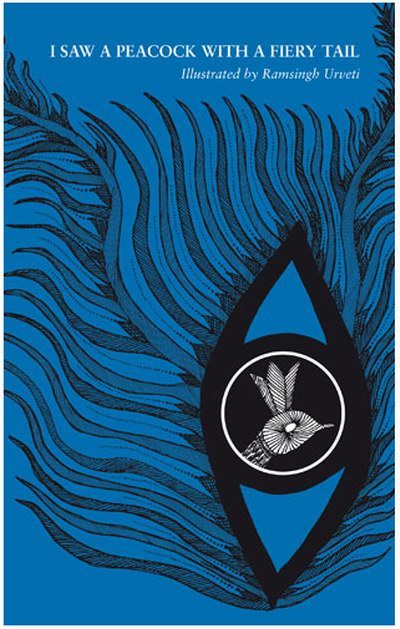
The cover of I Saw a Peacock with a Fiery Tail
A love of Indian visual traditions is also enshrined in the work of Tara Books, whose originary question when they started out in 1998 was, “Can different visual cultures survive in a rapidly homogenising world?” Since then, they have blazed a trail, working with indigenous artists from Madhya Pradesh, Gujarat and Bengal. They adapt artisanal traditions of bookmaking – handmade paper manufacturers, silkscreen printers and hand binders – to produce handmade books on an astounding scale. Tara’s innovative design practice has created playful, stunning books. 

Whether it’s turning the vertical Patua scroll into a horizontal accordion book (The Enduring Ark [2013]), adapting Patua imagery into a Western-style panelled graphic narrative (Samhita Arni and Moyna Chitrakar’s Sita’s Ramayana [2011]), or even matching up the marvellous micros and macros of Gond artist Ram Singh Urveti’s imagination with a 17th- century English trick poem (I Saw a Peacock with a Fiery Tail [2012]) – Tara Books fuse the contemporary with the traditional. Their books travel to the US, the UK, Brazil and Mexico via handmade book collectives and children’s book publishers, reversing the usual flow of visual communication from west to east. “What we take from our immediate visual context, it goes all over the world,” says V Geetha, editorial director at Tara.

Navayana

A page from Bhimayana
Also working with traditional Indian artists is Navayana. Its hard-hitting work on caste and marginalisation includes two visual books – A Gardener in the Wasteland (2011)a cheeky, unstintingly graphic interpretation of Jotiba Phule’s Gulamgiri, and Bhimayana (2011), in which Gond artists Durgabai and Subhash Vyam recreated experiences of untouchability from Bhimrao Ambedkar’s life. The ecology of Gond art is filtered through the individual readings of the Vyams and their textual collaborators, Srividya Natarajan and Navayana founder, S Anand, to create a work that is unique and often profound. Traditional digna floor patterns are used as page dividers instead of panels, the thirsty young Bhim is imagined as a fish, and when Ambedkar finds himself homeless and takes shelter in a park, he becomes the park.

Did you believe that reading takes time, and pictures can be looked at in a jiffy? But images can be more multifarious than text, unfurling new meanings with each reading. “You can spend two minutes with each panel in Bhimayana, or two hours. Or two days,” says Anand.


While one finger constantly hovers on the page down button, these are books that can make us hit pause. The picture speaks, and we cannot help but listen.

7 February 2010

The Dalit Deliberations

TRISHA GUPTA traces the Dalit thread at the Jaipur Literature festival

In a festival where discussions often hovered in the most rarefied literary realms, the Dalit literature panels served as a useful and necessary corrective. Going back to the basics of the written word, the opening session pointed out the inherently privileged position of the writer in India. If Kancha Ilaiah (author of the seminal Why I Am Not a Hindu, 1995) stressed that writing on the subcontinent had long been the preserve of the upper castes, Hindi Dalit writer Om Prakash Valmiki wondered aloud why there are still disgruntled rumblings about the idea of a Dalit literature when such categories as Vedic literature or Marxist literature are taken for granted. Earlier mainly poetry or autobiography, and thus seen as being limited by its “confessional” mode, Dalit literature has now expanded into fiction and criticism. Academic Christophe Jaffrelot suggested at one panel that Dalit autobiography, like Lakshman Gaikwad’s hard-hitting Uchalya, had provided an answer to Gayatri Spivak’s question ‘can the subaltern speak?’ Meanwhile, newer work, represented at Jaipur by Ajay Navaria and P Sivakami alongside Valmiki and Gaikwad, showed that Dalit writing — while still clinging to the power of rhetoric — is ready, too, to embrace a variety of literary aesthetics.

From Tehelka Magazine, Vol 7, Issue 05, Dated February 06, 2010

‘Can Labour Pain Be Illustrated Better By A Man?’

I met P. Sivakami at the Jaipur Literature Festival, 2010. 


Author of four acclaimed Tamil novels — including The Grip of Change (published in English translation in 2006) — dealing with Dalit socio-political concerns, P. Sivakami, 52, is also active in politics. She took voluntary retirement from the IAS to join the BSP, but has recently left to launch her own political party. 

Excerpts from an interview:

How and when did you start writing?

I started writing when I was a student. I used to enter essay competitions in school and my teacher encouraged me to write for the Christian magazine, it had a very local circulation. I was growing up in a small town called Parambulur. Later when I came to college, I started getting exposed to foreign writers. Usually Russian books, because they used to be sold for one or two rupees. That’s how I acquired a liking for fiction.

Then there was an intercollegiate short story writing competition, and I won a prize at the state level. The story was published in a magazine called Dinamani Kadir, and I received a lot of letters. The story was about a shepherd boy and his daily timetable, so they started asking me, are you a shepherd yourself? What is your solution for his problems? Somehow this triggered lots of questions about what literature is, why am I writing about what I am, and so on. Instead of inspiring me, this arrested my spontaneous writing. I continued to write, but didn’t publish. I concentrated on academics. I got a gold medal in my MA History. Then I took the IAS exams. I thought it is socially well-laced, and paying well, so why not? I got through. Only after that I started wondering, have I had truly become what I want to become? All the while, I had been thinking of myself as a writer. Reading and writing gives me a lot of pleasure. So then I started writing again, short stories.

I couldn’t find a publisher for the first collection. A friend of mine came forward to publish it and I gave him some money, but he never returned it. The book was lying in the press – all I got were a few copies. The book never reached the public.

All this was while you were employed as an IAS officer?

I wrote the first book under a pseudonym because I didn’t want to reveal who I was. The second book I wrote under my own name, but I didn’t want to use my being an IAS officer to sell it. So I gave it to one of my friends and asked him to sell it if he can, without revealing my identity. The first publisher he approached said the language is very colloquial, not up to literary standards, and they refused to publish it. Subsequently my friend took it to Madurai where his friend ran a publishing house. After two years, when it was finally published, it hit the roof. Many people read it and discussed it. The left movement took the book to villages and organized meetings discussing it. It centred around a Dalit village leader called Muthu, with another character called Gowri, who is a college girl. It was about the caste structure in the villages of Tamil Nadu, how the backward classes and Dalits should come together and fight the system, as well as exploitation by power brokers within the community, Dalit patriarchy and so on. Since then, I have had no trouble in publishing my books!

When did you first begin to think of yourself as a Dalit writer?
It was not an identity I claimed, it was an identity thrust upon me after my novel was published. Initially I was not happy to be labelled as such. But then I thought, I am trying to expose issues within the community but to bring to the notice of the outside world the oppression of Dalits, and the change that has to come. So why not accept it?

Is the term Dalit commonly used in Tamil Nadu? In the context of Tamil Nadu’s own long history of anti-caste politics…
The term Dalit is used, very much. It has been gaining ground since the 80s.
Before Ambedkar, even, we a lot of people struggling against caste in Tamil Nadu. Ayuddhadas Pandita set up the Adi Dravida Mahajanasabha, in parallel to the Madras Mahajanasabha. He argued with them: we will support you against the British if you agree to three demands: temple entry, separate schools for Adi Dravida children, and distribution of land to Adi Dravidas. The Hindu Mahajanasabha agreed to the latter two, but not the first. The land recommendation was raised by the erstwhile British collector of Chingalpet. On his request, the papers were eventually signed, but the land was not actually given. So Pandita took it up. Later, parallel to Ambedkar, we had figures like Nettamalai Srinivasan who refused to shake hands with the British queen, saying I am a Paraiah by caste, thereby sensitizing the world that there is such a community.

The Periyar movement started off as the Palla-Paraiah movement. It integrated most of the agendas of the Dalits, but it did not materialise them.

Could you tell us about the Dalit literary sphere in Tamil Nadu?
After the centenary celebrations of Ambedkar, particularly, the Dalit concept has become very vibrant. Now we have at least a hundred prominent writers from different Dalit communities and three journals for Dalit writing: Dalit Murasu, Bodhi, Dalit, Adi Tamil. I’ve edited one magazine myself, for almost 15 years. It’s called Puthiya Kodangi: Puthiya means ‘new’ and Kodangi is an instrument that is played to drive away the evil spirit. So here caste is symbolically the evil spirit. These magazines have limited circulation. Their main preoccupation is to deconstruct existing institutions, including literature. Though mine is the only primarily literary magazine, our literature is not only for aesthetics and celebration of identity. So I started off with a literary focus, but soon decided to include discussion on political and social issues.

Maybe because I was editing a literary magazine, deconstructing and criticizing, there was great resistance in translating my work into English. Nobody came forward to translate my books.

So it’s quite a contestatory sphere?
Yes, yes. For example, some people argue that if only Dalits can write Dalit literature, it should be children writing children’s literature. The argument came from leftists, so I said, should workers’ literature be written by capitalists? Also, I said, if you agree that labour pain can be illustrated better by a man than a woman, then we can agree to this argument.

Even among Dalits, there is a lot of difference of opinion. One Professor Raj Gautama argued that Dalit literature should be satire. He wrote a story about a grieved worker who is angry with the customer in a canteen spitting in the coffee and serving it to him. I said, this is silly! If you have a problem with the person, if you have the guts, you can encounter him directly.

What are called the weapons of the weak…
Exactly. Like I said, this is not Dalit empowerment.

It’s not hatred that keeps me away from them, it’s lack of strength in their arguments. So by day, I strengthen myself by conducting camps for Dalits, adivasis, women, expanding myself to transgenders. We should strengthen our bastion – though it’s not enmity or anything. Dalithood, as Ambedkar said, is the socio-economic and political situation of being victimised by Brahminical realities. So anybody who is marginalised by Brahminism can be part of the Dalit fold.

Do you believe that non-Dalits should not write about Dalits?
See, nobody can stop people writing about others. But the perspective is different. And that difference will get exhibited when you publish your writing, and then if there is criticism, you should be open to criticism. That is how we grow. If you always justify yourself and there is always reprobation, then we cannot move forward.

What kind of an experience have you had at the Jaipur Literature Festival?
I was glad to be here, to meet Laxman Gaekwad whose autobiography I admire, and Sister Jesme who is so popular, and Christophe Jaffrelot. I also got to meet new writers like Mridula Koshy, and even got to hear Chetan Bhagat!

We are moving towards a collective writers’ forum where we can address the issue of caste. Each person I have seen here is trying to be an agent of change in their own way, but together we can do better.

From Tehelka Magazine, Vol 7, Issue 05, Dated February 06, 2010