Showing posts with label Prayaag Akbar. Show all posts

24 June 2019

Grave New World

My Mirror column

The new webseries Leila is uneven in its language, its storytelling and its politics, but it offers plenty to think about. 

(Second of a two-part column)


In Prayaag Akbar’s 2017 book Leila, which is in English, the use of Hindustani words is limited but specific: the unconscious use of the appellations “Abbu” and “Ammi” nearly gets Riz and his brother Naaz caught as being from ‘the wrong sector’. In the Netflix show, Shalini meets Riz’s parents and calls them Abbu and Ammi – but the subtitles flatten the words into “Dad” and “Mom”. Other world-building coinages by Akbar – the thuggish army of Repeaters, or the hierarchical division of society into Categories 1-5 – are allowed to remain in the show’s English subtitles, but necessarily translated into Hindi in the spoken version, sometimes losing specificity and power – eg “Paltan” for the Repeaters – and sometimes gaining it: “Panchakarmi” has far greater punch than Category 5.


There are other times when the Hindi dialogue is as nuanced as it is possible to be, delineating minute shades of meaning that then amplify the narrative. One instance not present in the book is when Shalini (Huma Qureshi) happens to witness the police raiding a professor’s study. “Yahan toh Sen wali kitaab bhi hai,” one cop announces triumphantly to his senior. 

“Politics? Aap politics sikhaate hain?” the senior cop demands of the professor. “Sikhata nahi, padhaata hoon,” he replies sharply. That almost pedantic distinction, even on the verge of being arrested, fits the character’s academic persona. But that difference between “sikhana” and “padhaana” also makes a subtle point about this anti-intellectual universe, in which politics can only be understood as a skill – not as a subject of study. And as is already becoming true in our present, it is not a skill that the establishment wishes students to have.

There is another funny detail in the scene. The nameplate outside H. No. 1/20, a mid-sized bungalow of the sort that a Delhi University professor might currently occupy, says “Dr. Nakul Chaubey, MA, M.Phil, PhD”. Given that a PhD implies having all the previous degrees, the nameplate’s recitation of degrees might be intended as humour. But it might also be read as signifying a world in which even visitors to an academic’s house are not assumed to know what a PhD is. As many degrees as possible must be listed on an intellectual’s door, and even that listing is not sufficient armour against the barbarians at the gates. As we – and Shalini – watch in silent horror, the knot of heckling protestors shouting “Nakul Chaubey murdabad” swiftly becomes a lynch mob kicking and punching the unarmed white-bearded man, now fallen to the ground.

The targeting of intellectuals in a Hindutva-driven dystopia has appeared in a previous Netflix India original series, Ghoul (2018), whose writer-director Patrick Graham shares writing credits on Leila with Urmi Juvekar and Suhani Kanwar. In Ghoul, that aspect is more frontally addressed: the protagonist Nida Rahim (Radhika Apte) is the daughter of a retired academic called Shahnawaz Rahim (SM Zaheer). Nida is part of an anti-terrorist force, and much of the narrative tension emerges out of the father and daughter’s starkly different positions on the state’s role in citizens’ lives.

The elder Rahim’s criticism of an authoritarian government is seen by his daughter as seditious. Father and daughter are both Muslim, but the daughter has internalised that second-class status as involving a greater need to prove her loyalty to the state.

That idea of a generational shift is also a shaping influence in Leila, which contains several scenes involving the brainwashing of children – and the attempted reformation of adults – by the new state of Aryavarta.

The show’s vision of Aryavarta feels almost programmatic in its symbolic combining of historical Fascism (a two finger ‘Jai Aryavarta’ salute, for instance) with a recognisable version of the Indian present (a leader called Joshiji whose name appears on every broadcast and every poster). Schoolchildren recite “Aryavarta is my mother” while doing martial exercises; babies are addicted to animated videos about Junior Joshi, whose heroic exploits evoke Bal Narendra.

More disturbing is the use, in the episodes directed by Mehta, of variations on existing Hindu rituals – rolling on the floor, for instance, or the marriage of a woman to a dog – as punishments imposed on women who break the rules of Aryavarta. In times like ours, it seems to me more necessary than ever to distinguish our criticism of the socio-political vision of Hindutva from what feels like a too-easy mockery of Hindu practice. To imagine existing religious practices as future forms of social torture is to display a lack of both imagination and empathy.
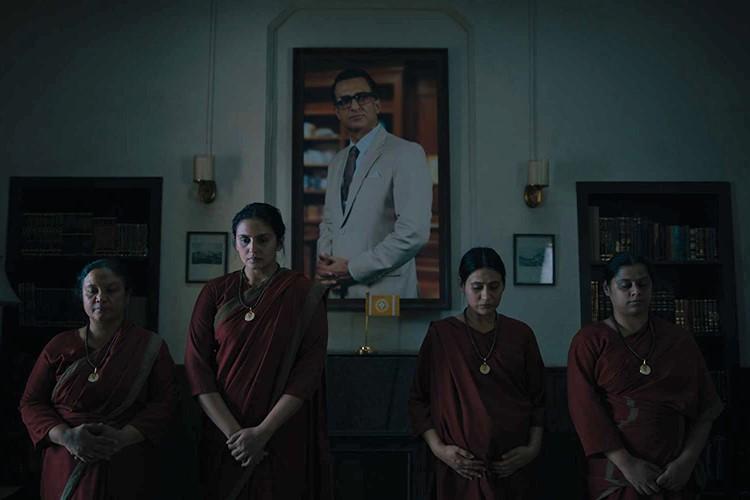

Leila also occasionally suffers from feeling like an Indian version of The Handmaid’s Tale, the web adaptation of Margaret Atwood’s novel. Akbar’s novel did contain the core idea of a regime that slut-shames and drugs recalcitrant women into submission, but the Netflix version has replaced the workaday dullness of Shalini’s office-cleaning and one-room-kitchen-attached-bath with a dark, shared dormitory for women who must undergo various forms of abasement, including bathing in dirty water, polishing shoes and being guarded by eunuchs. It also seems to adopt wholesale from Atwood the vision of categories of women dressed in different colours who serve different roles in society (the handmaids, the Marthas and the Wives). 

Still, these categories do provide the show’s most fertile ground for self-examination by the class of Indians likely to be watching Leila. I was excited by the show’s foregrounding of what is a more subterranean strain in the novel, the mistress-maid reversal. But the execution of that reversal, crunched into two years instead of the novel’s sixteen, is too quick to be credible. It allows for no interiority on the parts of either mistresses or maids. And if Shalini doesn’t see how her unearned privilege is part of what has led her world to this point, how will we?

Published in Mumbai Mirror, 23 June 2019. (The first part is here.)

Future imperfect

My Mirror column: a two-part series on Leila

The new web series Leila, adapted from Prayaag Akbar’s 2017 novel, imagines a dystopian India that makes for harsh but necessary viewing.


An opinion piece I read recently suggested that comedy is becoming a difficult art to practise in today’s India, as reality becomes ever more ridiculous. The same might be said, I think, of dystopian fiction. As our collective lived experience itself edges away from the rational, it becomes harder to make our irrationalities visible in the mirror of fiction.

The writer who seeks to show us such a mirror must carefully calibrate the distance between an imagined future and the present that we’ve accepted as normal. In his 2017 novel Leila, Prayaag Akbar managed to do that successfully.

The book’s chilling vision of the future was filled with details that felt entirely plausible. Akbar’s world is one where birth determines social status, where mixing is strongly discouraged and the rich have parcelled out urban space amongst themselves, dividing up the city into community-specific neighbourhoods like “the Tamil Brahmin sector, Leuva Patel Residency, Bohra Muslim Zone, Catholic Commons, Kanyakubj Quarters, Sharif Muslimeen Precinct, Maithil Acres, Chitpavan Heights, Syrian Christian Co-op, Kodava Martials”. Linked by a network of “flyroads”, the leafy, peaceful universe of these segregated “high sectors” is enclosed by walls, and a vast air-conditioning system called the Skydome. The poor, known as Slummers, live beyond the walls – in a filthy, treeless world crisscrossed by Outroads, where the air is noxious with gases expelled from the Skydome’s purifiers, and the ground an endless stretch of landfills that often catch fire.

It is in a version of this universe, based on Akbar’s novel, that the new Netflix series Leila unfolds. Like the novel, the show centres on Shalini (a superb Huma Qureshi), who is suddenly hurled from an elite bubble of bungalows, swimming pools and poshly cosmopolitan schools into the margins of the new society that has come into being. “Purity for All” here means purity is all, and those who make the mistake of loving outside their communities must be punished, and schooled into submission. Deepa Mehta, who has directed the series’ first two episodes, told me in an interview that what attracted her to Akbar’s book, and to screenwriter Urmi Juvekar’s reimagining of it for Netflix, was “the journey of a person who is privileged, who has everything, but has it taken away from her in difficult times. It’s not just about looking for her daughter, it’s about looking for her dignity, her own self”.

“Wherever there is a totalitarian regime, women are having a really rough time,” added Mehta. Both for her and Qureshi, Leila’s woman-centric narrative was crucial to its politics. “The problem with a lot of female characters and roles is that you always have to be rescued by someone,” Qureshi said during the same interview. “Even in 2019, I get a lot of scripts in which [women] just have to hang around, look nice, basically support the man who saves the world. Even when the problem concerns women, a guy has to come and empower us. What about us empowering ourselves, finding that inner strength? Shalini offered me that.”

Gender is also at the crux of some changes the series makes from the book. For instance, a little boy called Roop, whom Shalini encounters during her search for her lost daughter, here becomes a little girl. “I’d seen [male children in] Lion and Slumdog Millionaire, and I thought about time, ladkiyan toh honi chahiye. It’s a desire, as a woman, to have an emotional journey to which as many women as possible are contributing,” said Mehta.

Given that a 250-page novel needed to be stretched to create a six-episode series, changes were inevitable. “A book is very different than a film, and a series completely different. That’s not an excuse, it’s the reality of the medium,” Mehta said. Some of the striking additions involve completely new characters, like the labour supervisor Bhanu (Siddharth) or the Dixit family, for whom Shalini goes to work, or the fascinating figure of Rao Saheb (Akash Khurana), who is both a founding figure of the regime and among its more conflicted critics. Other changes are within characters. The book, for instance, starts with Shalini’s husband Riz (Rahul Khanna) screaming at her that she will never find Leila, while on screen he is an almost cloyingly supportive husband, only appearing to compliment or reassure her. That change, perhaps, contributes to Shalini’s rather different self-image, from a kind of self-flagellation for cowardice in the book, to being the woman who begins the series by kicking her attackers and saying over and over, “I’m not afraid of you.”

There is also a textural transformation caused by the fact that the novel is in English, with entirely English dialogue, while the series largely unfolds in Hindi, with some characters switching to English when they would naturally do so, such as Shalini and her husband Riz.

(This column has a second part, which is here.)

23 May 2017

Book Review: Prayaag Akbar's Leila

The future that 'Leila' presents is already here, and all of us may be responsible. 

This novel is a mirror to our selves and not just a forecast in fictional form.


The most terrifying futures are the ones contained in the present. Like seeds already planted, it’s only a matter of time before the stalks push their way up through the dark, loamy earth, their reality undeniable in bright sunlight. Prayaag Akbar’s debut novel Leila is set in such a future – a future that is, in all but the details, really already here.
The locale is an unnamed city crisscrossed by “flyroads”, from which cars descend only to make their way into gated sectors, protected by unscalable high walls. The sectors are strictly segregated by caste and community: “the Tamil Brahmin Sector, Leuva Patel Residency, Bohra Muslim Zone, Catholic Commons, Kanyakubj Quarters, Sharif Muslimeen Precinct, Maithil Acres, Chitpavan Heights, Syrian Christian Co-op, Kodava Martials...”. This is a world in which all possible divisions of caste, religion and class have been publicly embraced, each “high” identity zealously guarded and physically engraved into the city’s architecture.
Belonging and unbelonging is decided by birth, and mixing is strictly discouraged. All the good schools have been bought up by individual sectors, so that children cannot possibly forge friendships with anyone not like themselves, as they once might have done in a “mixed” school. The sectors are green and leafy, with wide avenues and bungalows “encircled by hillocked lawns”. Above the sector walls rises a Skydome, inside which the air is filtered by purifiers “working day and night”.
Meanwhile, beyond the “high sectors”, outside the walls, and far below the flyroads, lies a desolate world of Outroads, negotiated in buses by Slummers who live in a “noisome meld of human waste and rotting vegetables”, breathing air that is thick with smog, industrial effluent – and what the purifiers draw out. For all those who live in the Slum, entering the high sectors is a privilege, not a right, and is only possible if you have managed to get a job as a maid or driver or gardener in one of the high homes.
This, of course, involves a screening process – “Tip Top Maids (Choose religion, caste, birthplace; Be Safe, Be Tip-Top)”, runs one advertisement – and if you’ve managed to clear that, the queue at the sector gate will still involve a full-body search whose intrusive humiliations have been normalised literally into the everyday.

Sharply, recognisably Indian

If any of that sounds chillingly familiar, well, that’s exactly what Akbar intends.
Like other recent fictional dystopias – think of Margaret Atwood’s work (not so much The Handmaid’s Tale, but the more recent The Heart Goes Last) or the British TV series Black Mirror – Leila conjures up a sinister world in which we have willingly exchanged our freedoms for an imagined security, predictability, convenience, order. Unlike Atwood or Black Mirror, though, this future is not premised so much on a dehumanising extension of the technological present.
There is some technological advancement here – the network of flyroads (“From Singapore, America, everywhere they’re coming to see it. One sector to another, above all the mess,” says one bureaucrat), or the Skydome – but in Akbar’s nightmarish vision, a future India displays just as unimaginative and lazy a take on scientific improvement as it does in the present. We cannot think beyond flyovers and air-conditioners. We cannot summon up the political or civic will to produce clean, well-run cities for everyone, so we carve out enclaves in which the elite need no longer face the horror of the lives of others.
It might include a Nazi-style “Purity for all” two-finger salute, but this world is sharply, recognisably Indian – in its obsessive policing of caste and class boundaries, with women’s bodies as the violent site of that policing, but also in its aesthetics. If the lawn-encircled bungalows bring Lutyens’ Delhi to mind, the monumental city wall called Purity One which encircles the political quarter and where people pray and tuck their prayer petitions in crevices evokes Feroze Shah Kotla. The Repeaters bring to mind the many toxic bands of vigilantes spawned by our increasingly unemployed republic: from the Maharashtra Navanirman Sena to the Bajrang Dal and, most recently, Adityanath’s Hindu Yuva Vahini.

Noose of conformity

The creation of this brutal yet utterly normalised universe was for me the book’s biggest draw. But Akbar’s ambition extends further – he wants us to view this world through the eyes of a character who is both like and unlike himself. Shalini is unlike Akbar because she is a 43-year-old woman. But they share a class background – as will most of Akbar’s Indian readers.
Forcibly parted from her daughter – the eponymous Leila – sixteen years ago, the present-day Shalini seems in a permanent state of limbo, her only sense of a future dependent on finding Leila again. From the dull thud-like marking of Shalini’s lonely days in the isolation of the Tower, Akbar takes us back into the happier time of her childhood and youth.
Shalini’s memories bear all the signs of cosmopolitan poshness – being taken to the Sheraton by her parents, going for piano class, making out with her boyfriend on the school bus. (Even Shalini’s metaphors display her – or is it just Akbar’s? – well-travelled poshness: a child’s fleshy feet have “toes like white tulips”; a boy pops up “like a prairie animal”; rust crumbling off a gate “glitter[s] like sushi roe”.) Cosseted from the outside world, Shalini’s life seems calm – if anodyne.
But when the boyfriend becomes her husband, Riz and Shalini’s private life becomes a threat to public order. Shalini is forced to recognise that their decision marks them out even in their upper class circles: where one by one, “school friends had put aside teenage and college romances, found someone from their own sector when it was time for marriage”. And as the noose of conformity tightens around their world, they find themselves increasingly cut off – even from those who seemed closest. As in Orwell’s 1984 or Atwood’s The Heart Goes Last, when it comes to the crunch, it is each one for herself.

Who’s the victim?

In his book How Fiction Works, critic James Wood argues that literary characters are too often subjected by critics and readers alike to “an iron set of prejudices about what characters are: we should get to ‘know’ them; they should not be ‘stereotypes’; they should have an ‘inside’ as well as an outside, depth as well as surface; they should ‘grow’ and ‘develop’; and they should be nice.” “So,” Wood concludes scathingly, “they should be pretty much like us.”
He goes on to mock a particular critic for suggesting that two particular old male characters were not disapproved of enough for their lecherousness by the writer who had created them. “The idea that we might be able to feel that ‘ick factor’ and simultaneously see life through the eyes of these two ageing and lecherous men, and that this moving out of ourselves into realms beyond our daily experience might be a moral and sympathetic education of its own kind, seems beyond this particular commentator,” writes Wood.
Seeing the world through the eyes of characters who are unlike ourselves is, of course, much of the point of reading fiction. But what if we are led into a fictional universe by a character who seems a lot like us (as Shalini will to most Indian readers of English literary fiction), shown the barbarism of a particular universe through her eyes, and then – after we have begun to identify with her suffering -– suddenly confronted with herflaws? This is perhaps the most remarkable thing Akbar does in this book. He lulls us into believing that we are victims, the besieged – and then by pushing us to see Shalini’s blind spots, he forces us to confront ourselves.