Showing posts with label food and drink. Show all posts

23 November 2020

In Vino Veritas -- II

My Mirror column:

In Sanal Kumar Sasidharan's An Off-Day Game (2015), a drunken day unmasks a society intoxicated with its own sense of power.

Four men gather for a day of drinking in Sanal Kumar Sasidharan's harrowing An Off-Day Game (Ozhivudivasathe Kali, 2015).

Last week's column on The Mosquito Philosophy was about what truths might emerge when a group of men get together to drink. This week, too, my subject is a film about an all-male drinking session – An Off-Day Game (Ozhivudivasathe Kali) directed by Sanal Kumar Sasidharan. Sasidharan is best known outside Kerala for his internationally award-winning film Sexy Durga (2017); An Off-Day Game won him the 2015 Kerala State Film Award for Best Film and is currently streaming on two platforms.

and is currently streaming on two platforms.

Read more at:
https://mumbaimirror.indiatimes.com/opinion/columnists/trisha-gupta/in-vino-veritas-ii/articleshow/79345533.cms??utm_source=contentofinterest&utm_medium=text&utm_campaign=cppst

The film is adapted from Unni R's Malayalam short story 'Holiday Fun', available in J Devika's wonderful English translation as part of the collection One Hell of a Lover (Westland 2019). Barely nine pages long, Unni's tale begins with a reference to Boccaccio's 14th century Italian classic in which seven women and three men gather in a remote villa to escape the plague-stricken city of Florence - an interesting aside in a pandemic year. “They were like refugees from the plague in The Decameron,” writes Unni. “Only, they were escaping the monotony of work, the four of them... gathered in Room No 70 of Nandavanam Lodge, that Sunday, as usual, around a bottle of liquor.”

Unlike Unni, though, Sasidharan does not launch straight into the action. Instead, as he would do two years later in Sexy Durga, he begins his film with a semi-documentary prelude: footage from a real-life by-election in Kerala, where we see red Communist flags challenged by a rising wave of saffron BJP ones. We also see a Kathakali dance performance as part of the election campaign: this is a state where art and politics are allowed to cross-fertilise each other. It is from the assembled crowd at a rally that the camera first picks out two of our protagonists, following them as they join the other two at a little bend in a stream: a picturesque spot for daytime drinking. Another man driving by is tempted to join them, and a plan is made for another drunken assignation on Election Day.

The electoral backdrop serves Sasidharan well, allowing the film to fit in both India's official dry day rules, that bar the sale of liquor on polling days, and the simultaneously ubiquitous unofficial fact that liquor changes hands during almost all Indian elections: as a bribe, or more categorically in exchange for votes. It also works beautifully as a way of working up to the conversations between his characters – and to the 'game' of the film's title, in which four players pick chits labelled 'King', “Minister', 'Police' and 'Thief', and the one who's picked 'Police' must then guess who the 'Thief' is.

But plenty happens before the game unfolds. Unni's story has an early paragraph laying out the quality of the men's weekends in Nandavanam Lodge: “The usual criticism of the government, the rant about bedroom squabbles, the description of the body of the young girl one brushed against in the street or on the bus...”. Among Sasidharan's achievements is the way he takes this bare-bones description and gives it flesh, adding dialogue, characters and subplots that make his film into the terrific, terrifying slow-burn watch that it is. There is no woman actually present in Unni's scenario, for instance -- but Geetha in An Off-Day Game is crucial. Right from the moment that the men arrive at the lodge, she is the cynosure of all eyes, and not in a good way. She tries her hardest to just do her job: preparing a meal for her boss's visitors. But being the sole woman in a remote location with an increasingly drunken group of men, as we will see, isn't quite conducive to just doing one's job.

The relationship of each character to their 'job' is, at a deeper level altogether, the subject of Sasidharan's film. Much before the 'game' plots each man into a 'professional' role, the film has begun the perspicacious process of observing how even within a circle of friends, every man is supremely conscious of social status – his own and that of the others. “The kind of places this Brahmin fellow digs out,” says one man as they approach the lodge. “He always howls when he sees the jungle,” says another. What may have felt like gentle ribbing turns darker and darker as the film proceeds, especially as everyone presses first the woman and then Dasa into unwanted tasks. “You need me to pluck a jackfruit and now kill a rooster,” says Dasa.

As befitting a film set in Kerala, politics is the matrix of all things – the idea of democracy, for instance, is the context for a sharp argument about the man-woman relationship, and an anecdotal history of Emergency for a discussion of the 'duties' of citizens: “the cops did cops' job, the scavengers did scavengers' job, the army men did army jobs...”. Caste, or its modern-day version, serves an authoritarian society perfectly: no-one is meant to challenge their socially-ordained roles.

Some of Sasidharan's long scenes are pure genius, and the long takes and the stunning forest soundscape create an atmosphere of menace that is unerring in both its sense of beauty and danger.

The 'game' may feel a little contrived, but the conversational fluidity the film achieves is astounding. Under the influence of alcohol, everything is laid bare. In vino veritas.

This is the second part of a two-part column. The first part is here.

Published in Mumbai Mirror, 22 Nov 2020.


In vino veritas – I

My Mirror column:

Jayaprakash Radhakrishnan’s deceptively simple film The Mosquito Philosophy (2019) leaves you asking, who really are the suckers?

A drinking session becomes a place for revelations in The Mosquito Philosophy (2019).

About ten minutes into Jayaprakash Radhakrishnan's sort-of-mumblecore Tamil film The Mosquito Philosophy (2019), a man complains to his friend that the liquor shop overcharged him, but no-one in the crowd supported his case against the cheating shopkeeper. “Do they have no self-respect or guts?” Suresh mutters. “Well, it is to gain self-respect and guts that we drink!” laughs his friend JP (played by Radhakrishnan himself). “Don't expect anything from the men in a liquor shop until they're high!”

It feels like a throwaway line, just a bit of humour. But as we get deeper into the nightlong drinking session that is the film's chosen milieu, we are made to realise that alcohol does serve that purpose, among others. In fact, The Mosquito Philosophy feels almost inspired by that old Latin proverb, In vino veritas - In wine, there is truth. As an English poet called Abraham Fraunce put it as far back in 1592: “Wine moderately taken maketh men joyfull; he is also naked; for, in vino veritas: drunkards tell all, and sometimes more then all.”

The four men have met because Suresh has some news that deserves a celebration. The only single one in their group, he’s finally decided to get married. But he is just a little cagey about telling his friends, and it soon becomes clear why: he has sworn for years that he would only have a love marriage. Now, at forty, he has made a decision to accept an arranged marriage prospect. It's all to make his mother happy, he insists – and then it turns out that the girl chosen by his mother is fifteen years his junior.

What makes the film successful is its quality of creeping up on you, rather than bombarding you with the things it wants you to think about. The predictable wife jokes at the start ease the viewer gently into a familiar middle class Indian milieu dominated by them. “Oh don't worry, no wife thinks her husband's friends can ever be a good influence,” says JP, and over the course of the film, each man in turn gets mocked for being afraid of his spouse. “Suresh, that's life after marriage,” the friends say to the soon-to-be-married man when one of them rushes back home to eat because his wife hasn't given him permission to be out for dinner.

JP seems the best adjusted of the men with respect to his wife – she is in and out of the room while his friends drink, and even joins in the conversation occasionally. But he has also asked his friends over for a drinking session without first checking with her - if he asks her first, he chuckles to Suresh, she is likely to refuse. Again, it's a throwaway moment – but it finds a larger echo when we hear over the course of the evening that JP followed his wife around for nine months before she agreed to marry him. What he describes as a college romance, a drunken Suresh now points out, could well be understood as stalking – JP simple didn't take no for an answer.

Is there is something worrying about a world in which husbands must ask their wives' "permission" to go have a drink or hang out with their friends? Yes, but there is also something worrying about a world in which a twenty-four-year old woman finds herself in the position of accepting an arranged marriage with a not-particularly-attractive man over fifteen years her senior. There is something particularly sad about the fact that a man who isn't even married already feels put upon, not excited, when his fiance calls him to make weekend plans. 

"Truth is like fire, it glows and burns," Suresh quotes the artist Gustav Klimt as having once said. The scalding truth of this society is that men and women continue to look at each other as separate species, each brought up to perceive the other as a creature that needs to be tricked into captivity -- not lived with in mutually defined freedom. It is no coincidence that even the alcoholic haze that lets home truths be spoken is closed off to one gender. 

(The first part of a two-part column. The second part is here.)

Published in Mumbai Mirror, 15 Nov 2020.

28 June 2020

The smells of others

My Mirror column:

Nicholas Kharkongor's Delhi-set dramedy Axone traces some of the fault lines that mark the urban Indian melting pot.


Growing up between cultures, I learnt long ago that smell was most people’s strongest, most intimate sense – and thus the one that lent itself most easily to kneejerk reactions, especially with relation to food. Members of my family’s staunchly vegetarian side, North Indian Jains of the not-even-egg variety, have sat me down as a child to tell me how difficult they found it to keep their own food down while having their nostrils assailed by the fried fish smells wafting down from a tenant’s house.

Nicholas Kharkongor’s film Axone, recently released on an online platform, is named for the strong-smelling fermented soya bean paste that forms a necessary ingredient in many traditional northeastern dishes. Often spelled akhuni, axone has a distinctive smell that you can’t ignore – which makes it a useful metaphorical marker of difference. And differences that cannot be ignored make for a strange but potent cocktail of attraction and repulsion.

That mixture of attraction and repulsion appears sharply in the film, in the alternately lascivious and judgemental gaze that Delhi folk turn upon the young northeasterners in their midst – being judged by the women for wearing ‘Western’ clothes and having boyfriends, while being the object of the men’s unsolicited attentions. But that attraction and repulsion also plays out, perhaps unintendedly, in Axone’s own cinematic form. The film plays out the food/smell motif against a tenant-landlord scenario in one of those urban villages in Delhi that thrum with the sounds of many languages, focusing on a group of friends from the Northeast who have to make an akhuni-flavoured pork curry for a last-minute wedding feast. That food-and-wedding narrative, though, feels like a mere sweetener, an attractive hook on which to hang a script full of bitter – abeit necessary – pills. Kharkongor's central concern is the racism, sexual predatoriness and aggression that migrants from the Northeast are forced to suffer in Delhi (and most other Indian cities). But what he does is to take that disturbing narrative and plonk it down in a Delhi-set middle class comedy that has become a Bollywood subgenre from Do Dooni Chaar and Vicky Donor to Queen to Badhaai Ho.

So alongside the central group of friends, we get a fairly detailed glimpse of the landlord's family: the hard-nosed landlady (Dolly Ahluwalia doing a version of her alcohol-swigging Punjabi grandmother from Vicky Donor), her layabout son-in-law (Vinay Pathak) and her overenthusiastic grandson, the curly-haired Shiv (Rohan Joshi). Shiv's multiple machinations and largely well-meaning mistakes form some of the film's warmer bits of comedy, but his father and grandmother's characters feel derivative and ungrounded. Still, there is something to be said for the fact that the homogenous lower-middle-class Punjabi milieu, a staple of so many previous Delhi films, has finally been extended to a whistle-stop tour of the very real admixture of so many Delhi neighbourhoods like Humayunpur, where locals rent out parts of their properties to people from across India and beyond.

Axone gently impresses upon us that everyone judges each other, using community and skin colour and language to make easy categorisations. If the Hindi-speaking landlords claim not to be able to tell northeastern faces apart, or remember their names, then the Nepali girl, too, can't get her head around her African neighbour's name – and the African neighbour, in turn, makes an assumption about her based on her looks. And the whole group of northeastern friends keep their distance from the landlord’s son, whose interest in them is very much a curious fascination with the coolness their clothes, their English-speaking-ness, their music represent for him.

Kharkongor’s real sympathies, though, lie with Chanbi, Upasana, Zorem and Bendang (played by Lin Laishram, Sayani Gupta, Tenzing Dalha and Lanuakum Ao), each of whom is dealing with their own troubles. Even here, however, his script constantly points out how their relationships with each other, and with themselves, are inflected by the politics of identity and belonging. These include some small observations that shape the plot – like the perceived difference between being Nepali and being northeastern, and other observations that don’t quite go the distance – like the fake American accent or the Bollywood lyrics that are needed to get by in a world in which those languages have bigger markets. But whether it be the northeastern man who feels emasculated by racist North Indian violence, or the northeastern woman exhausted by nonstop sexual slurs and harassment, Axone brings home the trauma and injustice of the migrant northeastern experience as perhaps no Hindi film has before.

Published in Mumbai Mirror, 21 Jun 2020.

7 August 2018

Home is where the hearth is

My Mirror column:

Carrying on from last week: how the chef film appeals to our corniest instincts, bringing fathers and sons together while serving up bite-sized doses of life philosophy.


The chef movie has emerged as a popular cinematic lens on family and fatherhood. Last week, while watching Jon Favreau’s 2014 film Chef alongside Raja Krishna Menon’s 2017 Hindi remake of it, I thought about the fact that while male chefs might have achieved near-acceptability in the West, in the Indian middle-class setting, there is still a great deal of resistance to men choosing to cook for a living.


Menon’s adaptation tries to take this fact on board, supplementing Favreau’s nuclear father-son equation with a third generational angle that’s much more fraught with social censure. Saif Ali Khan’s Roshan Kalra, we are told, became a chef entirely against his father’s wishes. Running away from his Old Delhi home at fifteen, he went first to Amritsar — where he scraped together a living as a boy-of-all-work in a local eatery — and then to the US, where he rose to become a well-known chef at an Indian restaurant.

Roshan’s attempt to reconnect with his son Ary (Svar Kamble) also becomes a way to rebuild his own relationship with his estranged Bauji. It isn’t a bad idea per se, and Indian theatre doyen Ram Gopal Bajaj is a fascinating choice of actor to play Roshan’s embittered, lonely father. But though Roshan is supposed to be introducing Ary to the chhole bhature he grew up on, he seems as much of a tourist in 
Chandni Chowk as his son — while Bajaj’s prickly isolation hits a much deeper, harsher note than the rest of the film.


No such tonal disjuncture afflicts the similar return-to-roots narrative of Anwar Rasheed’s Ustad Hotel. A popular Malayalam drama from 2012, the film starred Dulquer Salmaan as its hero Faizi. As with Roshan in Chef, Faizi’s choice of career is not what his father Abdul (Siddique) wants for him. Having paid for Faizi’s expensive Swiss education, Abdul is shocked to learn that his only son and heir has trained not in hotel management but as a chef. Humiliated and deprived by his father of the passport he needs to take up his foreign job as a chef, Faizi goes off to stay with his grandfather Karim (Thilakan) who runs a small but famed biryani joint in Calicut.

Ustad Hotel is wonderfully comfortable with its orthodox, often patriarchal Kerala Muslim setting, in which for instance, the birth of three daughters in the effort to produce a son incites wry laughter, not external condemnation. That comfort in its own skin extends into the film’s grasp of its social milieu, which ups the believability of the father-son battle. Rather than being a simple gendered rejection of cooking as a woman’s job, it turns out that Abdul’s angst comes from his own biography. Having grown up a cook’s son, he is now a self-made businessman. The perceived social stigma of his father’s profession is not yet a distant memory — and his son’s decision seems to mock his struggle.

And yet, becoming a chef in a fancy foreign restaurant has a certain cachet. But in all these films, from Favreau’s to Menon’s to Ustad Hotel, the lure of that position threatens to distance the protagonist not just from his roots but from the very purpose of cooking: giving people joy.

That tussle between the imaginary high-status job and the down-home eatery is also at the centre of another chef-centred film featuring a father and son conflict: David Kaplan’s 2010 indie drama Today’s Special. If Faizi in Ustad Hotel finds himself waging a war against a five-star hotel to keep his grandfather’s eatery from closing down, Samir in Today’s Special becomes unexpectedly attached to his father’s dowdy old Indian restaurant in Queens.

Today’s Special isn’t a great or even a good film. But despite a by-the-numbers romance and exaggerated gesture-laden performances from the supporting cast, it’s hard to resist the charm of food-as-philosophy. Corny as it is, this is what makes both Ustad Hotel and Today’s Special so watchable. The grandfather-grandson pair in Ustad Hotel find their match in Samir’s chance encounter with a flamboyant New York cabbie called Akbar. Akbar (Naseeruddin Shah thoroughly enjoying himself) converts the over-cautious Samir (Aasif Mandvi) to spontaneous cooking with the aid of lines like “A man who measures life never knows his own measure”. And again, in both these films, snobbery is decried and labour applauded as experience. If Samir finds himself making deliveries by bicycle, grandfather Karim turns young Faizi’s ‘book knowledge’ on its head, gently but firmly nudging him to work at every level of the business, from cleaning tables to carrying rice sacks.
It isn’t as if our heroes don’t resist. A tense Samir once snaps at Akbar, “I’m a chef. I don’t need to learn how to cook from a cab driver.” But he returns quickly, shamefaced, just like Faizi in the rice bag scene. In these times of prioritising poshness, these films are lovely lessons in dressing it down.

Published in Mumbai Mirror, 5 Aug 2018.

Feeding the soul


Food seems to bring out feelings. So perhaps it isn’t surprising that films about chefs are films about family and fatherhood. The first of a multi-part column.


Sometime in 2011, an award-winning Italian photographer called Alessio Mamo decided to travel through Uttar Pradesh and Madhya Pradesh, taking pictures for what he called The Hunger Project.
Last Sunday, when Mamo’s pictures showed up on the World Press Photo’s Instagram page, they were met with outrage. Here were real poor, underfed people, posing before tables laden with fake food. Mamo’s explanation — that he meant to make “western people think, in a provocative way, about the waste of food” — does not excuse his bizarre insensitivity. The attempt to shock by displaying malnourished Indian bodies has led to allegations of ‘poverty porn’. But the more widespread anger is triggered by the fakeness of the food. Making hungry people dream of lavish meals with no intention of actually satisfying that longing seems deliberately cruel.

Thinking about the controversy made me think about how deeply food is wound up with our emotions. Hunger is the purest physical sensation, but it is also the strongest metaphor for a sense of deprivation -- just as the act of feeding someone is often a stand-in for love and care. Almost all over the world, almost all of the time, it is women who do that cooking and feeding. Meals are the most crucial part of the invisible, unpaid labour that keeps the household going. But of course cooking can only get its moment in the sun once it is taken out of the domestic arena, and when men who wouldn’t lift a finger in their own kitchen are willing to lay claim to it as a terrain.

Worldwide, as well as in India, any celebrated chef is invariably a man. Yet a man’s association with cooking isn’t something we can take for granted. It remains something that demands thinking through, making a big deal about. Further, being associated with a traditionally ‘feminine’ activity seems to push restaurant kitchen culture in the direction of an overcompensatory machismo.

So it’s interesting to find that films about chefs are so often about finding a balance between what's often understood as masculine and feminine, between worldly ambition and the nurturing of family. Jon Favreau’s 2014 film Chef, for instance, centres around a well-known Los Angeles chef called Carl (played by Favreau himself), whose public meltdown in response to a nasty review goes viral on Twitter. Having lost his job, he ends up on an unanticipated trip to Miami with his ex-wife and ten-year-old son Percy — and finds himself starting anew by opening a food truck.

Many elements of the plot aren’t new: the road trip, the father-and-son bonding, a man trying to reinvent himself after a midlife crisis. But putting food and cooking at the centre of this cinematic journey allows Favreau to wax gently philosophical about what we really need to nourish our souls. The battle between Carl and his restaurant owner boss Riva (Dustin Hoffman) speaks of how catering to a known market can kill all creativity, making you feel distant even from a job you love in theory. The road trip is another classic trope in a world of deadening capitalist routine – moving into unfamiliar surroundings to re-familiarise yourself with your feelings.


It’s in rejigging the beat-up old truck, though, that the film really hits its stride. There is something here about actual physical labour, about father and son working side by side, that feels wonderfully real. What’s nice is that it isn’t just about being able to summon up strength — something that might be seen as the displayable test of masculinity. Here, instead, we have a forty-year-old man initiating his ten-year-old son into a thoughtful work ethic. Clearing out the old doesn’t always mean acquiring shiny new stuff, Carl suggests to Percy: it can often mean the slow and laborious process of saving what can still be used, and the drudgery of actually cleaning it. The unglamorous stuff needs to be done, even if it’s not what goes into the social media pictures.


Favreau’s film was officially remade last year in India by Raja Krishna Menon, starring 
Saif Ali Khan in Favreau’s role. Rather than the overweight Carl, who has a hilariously deadpan verbal contest with his father-in-law about who’s dropped more pounds recently, Saif’s Roshan Kalra is super-fit — but with anger issues, expressed in actually punching a customer in the US restaurant where he works. His return to India is spearheaded by losing his job as well as adesire to see his son Ary, who lives with Roshan’s estranged wife Radha in Kochi.


That seems believable. What doesn’t is the food truck — especially Menon’s attempt to relocate the father-son bonding over work into an Indian upper middle-class scenario. The ethic of dignity of labour is practically impossible to translate into a world in which all cooking and cleaning around a child like Ary is done by servants.


In Favreau’s film, the labour we see – even under Hollywood conditions and with the fetishising of such things as the chef’s knife – feels undoubtedly like work. In Menon’s film, neither father nor son can make us believe that it is anything but play.

(To be continued next week)

31 March 2018

Roads to Recognition

My Mirror column:

The deceptively quiet The First Lap takes you on a journey into Korean society. But as with the best films, you might end up meeting yourself.


I often think of films as a way of travelling. A well-crafted film set in a place I’ve never been to has long seemed to me the next best thing to visiting it. As the lights dim in the hall, so does the everyday world around you, until it’s only you and the world on screen. Even better if the film sends its characters on a physical journey; then your mind automatically piggybacks on their experience.

Watching Kim Dae-hwan’s quietly observed Korean feature The First Lap (2017) at the ongoing Habitat Film Festival in Delhi on Friday, I was struck by how much a handheld aesthetic could enhance this sense of vicarious travelling. Ji-young and Su-hyeon live together in a Seoul apartment. As the film begins, they are lying under the covers, contemplating the potential adoption of a cat. Then Ji-young says it’s two weeks late for her period, and a tense silence ensues. The rest of the film unfolds over the next few days, as the couple decide to make two longish trips: driving first to the home of Ji-Young’s parents, and then to the village on the coast where Su-hyeon’s family runs a sashimi eatery.

These journeys involve long sequences on the highway, shot from inside a car. The First Lap is all long takes and realistic silences, with practically no background music. The couple are traversing long distances, and yet we see very little of the country, on these roads. Instead, the film captures perfectly the closed atmosphere inside the car, with the entire focus of both people being on the GPS signal and whether they’ve missed the right exit off the highway. The metaphors are thankfully never underscored, but if I had to put a description to it, I’d say the journey conveys the sense of being stuck as well as in limbo – which could very well describe the couple’s relationship.

Ji-Young works in a broadcasting company, while Su-hyoen is an art teacher vaguely contemplating graduate school. In their early 30s, they’ve been living together six years and seem so stable as to be boring. But the shift from imagining owning a cat together to having a baby seems to throw them into a turmoil that feels worse because it’s largely unspoken. As Su-hyoen’s friend says to him about the need to theorise his paintings, “The work is important, but the words are more important. How you describe it affects everything.”

That anxiety about definitions is certainly on Ji-Young’s mother’s mind – and here the film shows us how travelling takes you full circle. The scene where she brings the rare family meal to a truly awkward halt, by insisting that Ji-Young and Su-hyoen should stop “wasting their time” and get married, will bring many Indian viewers back to their own lives. “Why don’t you behave like other girls and give me a grandchild to show off? I have nothing,” she says, sounding petulant. Then, met by an implacable silence all round, defensive: “Have I said something wrong? I always become the villain.”

Ji-Young’s family seems better-off – her mother works in real estate, they live in a modern house and eat around a Western-style dining table. But it is Su-hyoen’s mother who takes her son’s girlfriend aside to tell her to try living together before any decisions about marriage. “Marriage, it’s nothing more than having to put up with a person for years and years… If you’ve tried it and are ready to do it for the rest of your life, then do it.” And also, chillingly, “Hell is closer than you think.”

The scenes to do with food are among the crucial ways in which one is transported to Korea, with all kinds of talk about the filleting of fish, sweet and sour pork and shochu going down like honey. Yet here too, one is struck by the similarities with a traditional Indian home: the women do all the cooking and serving and pouring, even when Su-hyoen’s mother assumes a working woman might not cook much. The men eat silently and drink till they’re raucous. The women eat later, in the kitchen.

The gendered division of labour is quite clear beyond the home, too. When Su-hyoen has to change a punctured tire in a snowstorm, all Ji-Young can do is brush snow ineffectually off his collar.

It is among the few physical gestures of intimacy between the couple, and characteristically non-intense. Even when Ji-Young sobs, or tells Su-hyoen she’s really scared, he seems unable to summon up anything more than an ineffectual pat on the shoulder, or an unsatisfying sideways hug and a selfie. I waited for Ji-Young to fling her arms around her boyfriend and insist on a real hug. That it never happened felt excruciating, and yet entirely recognizable from our own context of physically non-demonstrative relationships. That’s the thing about true travel; it brings you back home.

19 March 2018

Coffee Break: thoughts on Stuart Freedman's pictures of Indian Coffee Houses

The Palaces of Memory: Tales from the Indian Coffee House is Stuart Freedman's visual journey of urban India.


The Indian Coffee House, Kollam (now closed), 2013

When Stuart Freedman first arrived in Delhi in the mid-90s, it felt overwhelming. "I'd been to Pakistan, I'd been at the siege of Kabul, but India was something else," laughs the British photographer, now a veteran of many visits. "When I needed a break from the relentless push and pull of the city, I'd go to the Coffee House and be quiet. It was a refuge." But it wasn't till about 2010 that he picked up his camera inside one of them. Soon after, on assignments in Jaipur and Kolkata, he ended up photographing the Indian Coffee Houses there. "Then I knew it was a book," says Freedman, in Delhi for the Indian launch of his photo-exhibition and accompanying book, The Palaces of Memory: Tales from the Indian Coffee House (Tasveer/ Dauble, 2017).

If you grew up in urban India before liberalisation, the Coffee House, or at least the idea of it, is likely to have been part of your coming of age. Set up by the British government in the 1930s as a response to the Depression-era decline in coffee exports, the India(n) Coffee House chain did much more than create a local demand for the beverage. Its outposts across India became places where middle-class people met, to drink coffee, yes, but also to discuss politics and poetry and the day's gossip, to meet classmates after class or colleagues after work, or to conduct a romantic rendezvous in a place that offered anonymity but also safety. In short, to do all those things that not many places in the 20th century Indian city yet enabled, and to do so in a public place, inexpensively.

Yet, while the Coffee House experience captured something of modern western urbanity, it also represented India's unabashed, wholehearted claiming of it. Here, we produced our own version of modernity: where the coffee came in white ceramic cups (with saucers) but the kettles were aluminium; where you might cut up a mutton cutlet with a knife and fork but happily eat sambar-vada with your hands. Palaces of Memory does the much-needed job of making us look afresh at these remarkable places in our midst, their unpretentious formica tables and faded Gandhi-Nehru images offering a magical window into a vanished past. As the post-liberalisation city around it grows ever more brash and shiny, the more the Coffee House seems like a holdout: the last surviving outpost of what Amit Chaudhuri's 'Prologue' calls a "deliberately, almost jealously protected austerity".

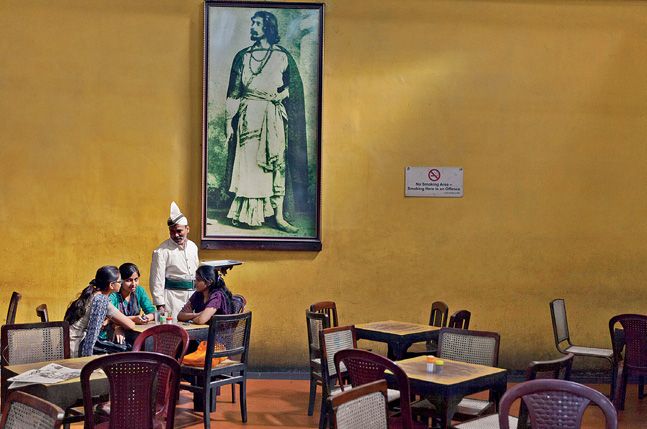
A waiter serves schoolgirls beneath a portrait of Rabindranath Tagore in the Indian Coffee House, Kolkata, 2013

Freedman's images do not shy away from this plainness, or signs of age: the peeling walls, the fraying pockets of uniforms, the blackened switchboards, table legs balanced in empty Amul cheese tins. But his gaze is affectionate, forgiving, even celebratory. Even a fly sitting in a bowl of sugar seems innocuous, yet another visitor to the Coffee House who hasn't been turned away. "I'm not romantic about India, the nonsense about elephants and maharajas. But there is a romance about what the Coffee Houses allow people to do. You can sit all afternoon with a cup of coffee and no one's going to tell you to leave," Freedman says. "I'm from Hackney, from a working class background. The Coffee House became this kind of translation device for me because I saw the same people there as in the cafes at home."

Of course, Coffee Houses are not all the same. "South Indian ones have much more substantial food," says Freedman. And one Coffee House might cater to different constituencies: retired old men, college students, middle-aged couples or a family on a ritual outing, young lovebirds. But what all these people are likely to have in common is that they are lower middle class.

Men sit and talk in the Indian Coffee House, Baba Kharak Singh Marg, New Delhi, 2010

Freedman is clearly drawn to places that democratise leisure. If England's greasy spoon cafes summon up an era of post-war rationing that he didn't quite witness, his book on another dying British institution, the Eel, Pie and Mash shop, "is really about [his] past" and "that section of London's working class that feels dislocated". He has also photographed the cafes of Cairo "as a way to examine the Egyptian revolution". Does he see Indian Coffee Houses as resisting the neoliberal economy? "Modern cities privatise space," Freedman agrees. "Places where people gather and are not monetised like Starbucks are places where people discuss. And discussion is dangerous to the state. Indira Gandhi knew this; she closed the Coffee House during Emergency, saying it was seditious."

Indian Coffee House, Chandigarh, India, 2013

What also makes the Indian Coffee Houses unique is that they are worker-run. In the 1950s, after the Coffee Board decided to privatise 43 outlets and fired many employees, the workers formed cooperative societies and persuaded the management to let them run the outlets.

Freedman's many superb portraits of waiters and kitchen staff are testament to the wonderful sense of ownership that pervades the Coffee Houses as a result. In one image in Palaces, a frail old man in a dhoti sits with his back to a man in collared shirt and trousers. As they raise their identical cups of coffee to their lips, one has the sense of a world in perfect balance, something sadly missing in the world outside.

11 April 2017

Death in Banaras

My Mirror column:

Shubhashish Bhutiani's Mukti Bhawan treats a potentially grand theme with a sensibility that is both gentle and droll.


Anyone who has been to Banaras has encountered death. There is no other place in India, likely in the world, where death is thus placed centre stage. That primacy is mapped geographically onto the city: the smoking pyres of Manikarnika Ghat occupy a central chunk of the city’s riverfront. But even if the visitor isn’t hovering purposefully around Manikarnika, not a day passes in Banaras without seeing a corpse being carried off to its final resting place, held aloft by a set of briskly striding mourners chanting Ram Nam Satya Hai (‘God’s name is truth’).

Death in Banaras is both ubiquitous and part of life, because every day new people arrive in the city, hoping that their lives will end there. To die in Kaashi, Hindus have long believed, is the best death possible, because it frees the soul from the cycle of life and rebirth. As the saying goes, Kaashyaam maranam muktih – ‘Death in Kaashi is Liberation’.


As the scholar Diana L Eck points out in her brilliant book Banaras: City of Light, there are several categories of people who want to die in Banaras. There are the hundreds of yogis and renouncers who practice their austerities here. There are the thousands of ordinary people who come for Kaashivasa (“to live in Kaashi”), retirees of both genders and many widows, settling down in neighbourhoods associated with different regions: the Bengalis in Bangali Tola, the Maharashtrians near Rama Ghat and Panchaganga Ghat, the Tamilians around Hanuman Ghat, and so on. And finally there are those ill or very old people who arrive in the nick of time, for what is called Kaashi Laabh: the Benefit of Kaashi. For them there are hospices like Kaashi Laabh Mukti Bhawan, where guests may stay only fifteen days – if they haven’t managed to check out of this world into the next by then, they must vacate. The attitude to death in Banaras, then, is both otherworldly and stunningly practical. Death in other places is something that arrives unannounced, to be staved off as long as possible. Not in Kaashi. “Death, which elsewhere is feared, here is welcomed as a long-expected guest,” writes Eck. It is this remarkable philosophical reversal that Shubhashish Bhutiani puts at the centre of his directorial debut, Mukti Bhawan.

Bhutiani’s script revolves around a 70-something man (Lalit Behl, last seen in his real-life son Kanu Behl’s film Titli) who decides one morning that he is ready to die, and insists that his son Rajiv (Adil Hussain) take leave from work to accompany him to Banaras and check into Mukti Bhawan. The film isn’t really interested in plot, or even particularly in the social or religious underpinnings I’ve just mentioned. What it sets out to do – and for the most part, achieves – is to capture the drollness of it all, and the strange sort of power that an outer world can exert on our inner one.

The film’s other focus is relationships – the husband and wife may squabble, but they also seem to recognise that the squabbling binds them. The old man who is crotchety and inflexible with his son is charming and supportive with his granddaughter. She reciprocates his trust – when he asks, before leaving home, if she will come to see him, she jokes, “Kahan? Banaras? Ya...?” raising her eyes upwards to heaven. In the taxi on the way there, the old man admonishes the driver for driving rashly: “Banaras pahunchne se pehle hi kahin oopar mat pahuncha dena.

With moments like this, even before we arrive in Banaras, Bhutiani establishes a tone that is somehow warm without being mawkish, funny without ridiculing. It is a supremely rare tone in Indian cinema, especially when the context is religious and the subject is death. We have seen death in Banaras powerfully on the Indian screen before, in very different registers. In Masaan, we saw it at its most unexpected, the cruel and unnecessary deaths of a young man and ayoung woman. In Satyajit Ray’s Aparajito, perhaps its most famous instance, Harihar collapses and dies suddenly on the ghats, and the camera cuts to a flock of birds taking off into a darkening sky. Mukti Bhawan does something very different, refusing drama and the assumed ‘gravity’ of death in favour of a slow dawning of recognition.

That recognition, the film suggests, is as much about this world as the next. To die at peace, one must first fully embrace life. And so Daya’s demands for the preoccupied Rajiv’s attention might also be a way of making him focus on the here and now: salt in the food, milk in the morning. Preparing to leave the body involves first consciously cultivating it: yoga, kapaal bhaati, massage, but also through what it ingests (Daya toys with a fruit diet), or watching how it behaves on bhaang. In a superb late scene, we see how making oneself laugh and clap can alter one’s emotional state: it’s about making the body work on the mind, rather than vice versa.

My only real quarrel with the film is that Bhutiani’s too-serene frames of the river and ghats, with the city’s sounds overlaid with Tajdar Junaid’s meditative soundtrack, made me miss the raucous, full-blooded chaos I remember as Banaras. But then these are cities of the mind, and who knows: the experience of Mukti Bhawan may alter my next trip.

Published in Mumbai Mirror, 9 April 2017.


14 November 2016

Bombay Continental

(A piece for Mumbai Mirror's 'Relative Value' section, as Gaylord Restaurant turns 60.)

It may be hard to digest for die-hard Bombaywallas, but the credit for what might be one of the city’s most iconic eateries goes to a Delhi-based family.


On November 16 this year, when Gaylord restaurant in Churchgate turns 60, Sunil Lamba and his sons, Dhruv and Divij, will have flown in from Delhi to play hosts at the birthday party. Gaylord is the sprightliest of sexagenarians: unafraid to flaunt its age, and yet wearing the years lightly.

Established in 1956 by the late Pishori Lal Lamba along with his friend and brother-in-law Iqbal Ghai, Gaylord was the second offering from the partnership that had already given India the Kwality brand. “My grandfather and his brother-in-law were living in a crowded dwelling with 20 people in Connaught Place. They had no background in food,” says Divij, “To make ends meet, they started a little outlet selling chips and eggs to people that came out of Regal Cinema (in Delhi).” From that single cornerstone of British working-class cuisine, the Ghai-Lambas (as they were known until they split in 1978) graduated to a more varied menu. The first Kwality Restaurant came up in the same spot as the shop, and was also where the duo first began selling ice-cream (often whole bricks of Cassatta and Tutti-Frutti) to Delhi’s population of American GIs: private soldiers in the US army stationed in Delhi during World War II, whose non-fighting duties afforded them both time and money for the pleasures of 1940s India.

The Gaylord brand was launched in Connaught Place in 1952, followed by Churchgate in 1956. It was pitched a notch higher than Kwality in style and expensiveness. “It was almost 5 to 6,000 square feet, it had that grandeur,” remembers Sunil. In both cities, it swiftly became the place to be seen for the sophisticated Indian diner, and it was only a short step to the creation of a Gaylord’s in London. The London branch served only the Indian menu, but its huge popular cachet — with visitors ranging from Peter Sellers to Ravi Shankar to George Harrison — soon produced an international Gaylord network, with outposts as far-flung as Trinidad and Kobe. “They didn't want us to invest money — which in those license raj days was impossible anyway. Just the name. And the recipes. And our chefs were sent,” says Sunil.

In Gaylord’s heyday, there weren’t many fine dining options. “So Gaylord was the gathering place for people in politics, business, arts and film, and for family events, the arranging of marriages, and so on. Also, it was a breakfast, lunch, teatime and dinner-time place, plus a nightclub — all bundled up in one,” says Divij, who handles the company’s Bread & More chain of bakeries.

“Nowadays, in the daytime, people probably don’t want to spend more than 300-400 rupees,” Sunil points out. “And there is also this idea of not eating rich food, especially in the day.” The Bake Shop, started about two decades ago, is the attraction for a younger crowd, but innovation in the direction of healthier, cafe-style dishes is essential, even with Gaylord’s loyal customers. “We go through our menu every year, remove nonsellers, and add on new innovative dishes,” says Dhruv, who handles Gaylord Mumbai in conjunction with its longtime Mumbai-based staff – CEO, AN Malhotra and General Manager, Noel D’Souza.

But Gaylord’s list of most popular dishes is still topped by the Butter Chicken (“North Indian food is less easily available in Mumbai than in Delhi; a lot of our Parsi customers come for that,” says Sunil). Continental classics like the Chicken Chasseur (chicken in a demi-glace sauce with mushrooms and green pepper, which happens to be Sunil’s staple order), the Pomfret Meuniere (a fillet of pomfret with lemon butter sauce, which is Divij’s favourite) and the Roast Lamb (serves with mint sauce and potatoes) also retain their loyal customers. Unlike many others of its ilk, Gaylord proudly retains its cream-based sauces (like the Chicken Cecilia), its baked cheese dishes (like the Lobster Thermidor, beloved of the legendary columnist Busybee) and the Chicken a la Kiev — whose delicious sinfulness has meant its unceremonious removal from more timid 21st century menus. Dhruv is currently excited about the 60 Year Nostalgia Menu, with popular favourites from the last six decades, including a Tawa Kheema Kaleji and a Banana Split that takes us right back to the GI era.

“We’re also launching a special 60 year label for Gaylord wine — a tie-up with Fratelli,” Dhruv says. “When the restaurant began in 1956, we didn’t serve liquor. It was only in the 70s that we could get alcohol licenses,” remembers Sunil, who returned from Cornell in 1974 and married his Bombaybred wife soon thereafter. “I didn't know this!” exclaims Divij, who trained as a sommelier alongside an early career in public policy. “Imagine all these people dancing to the Spanish band without alcohol. Conversing over coffee and patties! It’s amazing that an era like that existed.”

The cosmopolitan clientele to which Gaylord originally catered was an Indian elite that had come of age in a colonial moment, plus a generous sprinkling of foreigners who frequented what was then Bombay. “[Gaylord] was always this mix of Indian and Continental. Earlier there was also Chinese on the menu,” says Sunil, whose own youthful tastes ran to East Asian food (and who was later involved with the company’s Chopsticks brand). The restaurant’s Continental menu was meant to recreate colonial club food: in Divij’s words, “what the British would have had in gymkhanas all over India, stuff that reminded them of home, yet adapted to the local cuisine.”

Now, the company’s catering business (overseen by Dhruv) runs the kitchens of several old-style clubs: the Delhi Gymkhana, the Vasant Vihar Club and the naval officers’ clubs. The subcontinent has come full-circle.

Published in Mumbai Mirror, 13 Nov 2016.

18 November 2015

Double the Silliness: on watching Prem Ratan Dhan Payo

My column for Mumbai Mirror last Sunday: 

Sooraj Barjatya's ‘Prem Ratan Dhan Payo’ gives us all the things Hindi movies have always wanted from a true blue double role. And from a Salman Khan film.
   

A couple of days before I watched Prem Ratan Dhan Payo, the flipping of channels landed me in the middle of a 1972 hit called Raja Jani. In it, Dharmendra is an alcoholic called Raja who is pretending to be a rajkumar, partly so that he can convince the ageing rajmata (Durga Khote) that Hema Malini, a girl called Shanno, whom he picked up from the street, is actually her long-lost granddaughter, the princess Ratna. Since Shanno – unbeknownst even to herself – actually is Ratna, there is no double role here. But much of the fun of Raja Jani lies in watching Hema Malini go from being a feisty, foul-mouthed street performer with a dagger ever at the ready, to the self-possessed Rajkumari Ratna, of bejewelled robes and regal bearing.

The double role in Hindi cinema invariably involves two very different personality types – Ram Aur Shyam, Seeta Aur Geeta, Chaalbaaz – allowing the hero or heroine to exhibit their acting chops. But adding an imposter angle to the double role usually allows for another kind of viewing pleasure – the masquerade of class. It isn't only Hindi films that revel in such transformations, of course. Mark Twain's The Prince and The Pauper, published in 1881, was about just such a temporary switch, and Audrey Hepburn wooed her way into hearts by playing this double act one at a time – in Roman Holiday (1953), she was a princess disguised as a commoner, and in My Fair Lady (1964), she was a Cockney flower girl schooled into poise.

But Hindi films have a particular set of tropes in this regard. The person being replaced is always powerful – a member of royalty or a mafia don – and usually a taciturn, distant type, while the person stepping in is always moonphat and slightly stupid, with a golden heart. We also like to make the masquerading imposter an actual performer: Shanno in Raja Jani was a street dancer; Amitabh in the original Don sang for his supper; even Ranvir Shorey in Mithya (Rajat Kapur's savvy spin on Don) was a struggling actor.

Prem Ratan gives us all of these – there's a solid double role (with two Salmans, no less), a solid imposter narrative (with a kingdom and a rajkumari at stake), and a solid class angle, with the rich Salman a prince and the poor Salman a Ramlila performer from Ayodhya. Sooraj Barjatya is of course keen to play on all things Salman. So the film is crafted to fit his ‘Prem’ persona, that particular combination of heart and brawn with not too much brain that dates back as far as Barjatya's own Maine Pyaar Kiya (1989), and which was crucial to other huge Salman-Sooraj hits like Hum Aapke Hain Kaun and Hum Saath Saath Hain. It is also helpfully up-to-date with his more recent hit Bajrangi Bhaijaan – if he played a Hanuman bhakt in that, he is a Ram bhakt here. The wonderfully subversive nalli-nihari song of Kabir Khan's film is here replaced by a song in praise of barfi and sundry other mithai. Barjatya's vegetarianism runs so deep that even when the impostor Salman fries up some real food on the sly, what his “secret dhaba” serves up is Veg Korma, Tandoori Chhola and Butter Bhindi.

Salman, I must grant, is supremely entertaining – both as the new-age yuvraj who plugs his headphones in and falls asleep in his horse-drawn carriage so as to be catapulted off a cliff and out of the movie for the most part, and as the actor-imposter who takes it upon himself to woo back everyone the real yuvraj has managed to alienate over the years, including the tragically mistreated half-sisters (Swara Bhaskar and Aashika Bhatia), the misguided younger brother (Neil Nitin Mukesh), and even the miffed fiance (Sonam Kapoor).

As for the film, it is exactly what you expect from Sooraj Barjatya – a generously weepy dose of family love, combined with natkhat-Naarad style humour (think jokes about the yuvraj skinny-dipping as a child) and a super-coy heroine. The chemistry is what can be expected under the circumstances, suffice it to say that Barjatya trots out again the old MPK trope of the short dress worn in secret for the lover, and he murders Mughal-e-Azam by having Sonam lay herself down on a bed of flowers and demand that Salman write on her back with a feather.

The raajkumari is a spectacularly fluffy creature, but with a heart of gold, as Barjatya heroines are wont to be. The fact that this heart of gold consists in her descending – literally from a helicopter – to dole out relief supplies to ‘her’ people, is something I can barely describe with a straight face, but then this is clearly how the noble rich behave. There are moments of stunning misogyny, as when the philandering late maharaja is cast as a victim of his squabbling wives: “Auraton ke jhagdon ne jaise maharaj ka dil hi tod diya”. But from an actor-filmmaker team whose interviews are all about every family needing a patriarch, I expected nothing more. So in fact, I ended up being surprised when the swabhimani step-sisters are offered their share of the kingdom (of course, they do not accept), and even more surprised by the final scene, when the heroine isn’t packed off with the wrong Salman. But replay that scene in your head again, and you will hear the word ‘gift’ very loudly indeed.

But all this somehow seemed quite by the way while I was watching the film. I watched Prem Ratan for the crazed camera angles, the secret fort passages with flickering flames, the fencing maharajas and collapsing sheesh mahals. Barjatya's dialogue makes heavy weather of childhood, but he does manage to provide something like a return to it.

Published in Mumbai Mirror, 15 Nov 2015

15 June 2015

Post Facto: Wake up and smell the fish: perfume and plebeian stinks

My Sunday Guardian column this month:


"When he regained consciousness, the first thing that hit Ali was the smell of fish. Rich, pungent and briny — with a hint of decay. This was not the mild, innocent fish that was tandooried every evening by his neighbourhood kebab vendor. This was formidable fish, fish that boldly declared its presence, fish that, once consumed, would stamp itself on you at the cellular level and define your character in strange, unpredictable ways. This was fish whose odour could transform, cleanse and purify you."

That’s a passage from Shovon Chowdhury’s superbly funny 2013 novel, The Competent AuthorityDescribing a smell is a great way to transport the reader. It’s even better when you have a time-travelling protagonist just coming to, in a place he doesn’t recognise. We’re forced to think on our feet, like Ali. We inhale the very air he’s breathing, until the smell reveals where we are. Of course, it’s Calcutta.

Smell really is about time-travel. Most people will have had the uncanny experience of entering a place for the first time and having their nostrils assailed by a deep, distinctive sense of familiarity. A trace of some remembered scent is often all that’s needed to throw one into another space, another time. The whiff of mothballs in a long-closed cupboard, the steamy smell of starched clothes being ironed, the damp Cuticura scent of a swimming pool changing-room — these are smells that can propel me with unstoppable force into my own Calcutta childhood.

Eventually, though, those are mild smells. Let us return to fish, which is the very definition of odorousness — to many people, not in a good way. The very expression “smelling fishy” suggests dubiousness, odd though it is that the phrase comes to us from an island whose biggest culinary export to the world is fish and chips. But then fish-eating doesn’t necessarily acclimatise people to the smell of fish. In his 1950s travelogue Aakhiri Chattan Tak, recently translated as To the Farthest Rock, the Hindi writer Mohan Rakesh returns to Mumbai after a mere two-year gap, and is confused by “the overpowering smell of fish”. As Vir Sanghvi recently wrote in an accusatory column, North Indians seem to want to eat fish without the taste and smell of it.

Some of this aversion to strong smells is directly proportional to the degree of our post-liberalisation poshness. Even in Mumbai, where Sanghvi would agree with Rakesh that “the smell of fish was never very far away” some decades back, fish-buying has now become a “plastic-wrapped affair”. And when Sanghvi applauds the Bengali man for treating fish-buying as a sacred ritual, one can only wonder how long this proud act of baajaar will hold out against gentrification’s olfactory dictates.

I was surprised that Sanghvi didn’t mention the Malayalis, the other grand fish-eating, fish-inhaling community in the country. I sometimes think of Malayalis and Bengalis as engaged in a silent fish-eating contest, one which occasionally breaks out into fervent arguments about sea fish versus river fish. Then comes the invariable question of frying fish before putting it in a curry, and both sides decide there’s no point talking. Cue return to the silent contest. (In case you’re wondering, other fish-eaters — Maharashtra, Kashmir, Assam, and so on — are barred from competing.)

Anyway. I recently watched a Malayalam play called Matthi, where the sharp smell of fish was key to innovative stagecraft. The LTG Auditorium in Delhi was redolent of sardines when we took our seats. “Yes, the name of this small, cheap and popular fish is Matthi. A poor fish. Not to chide you, but some things have to be said to make people understand,” said the supertitles. As in Seema Pahwa’s wonderful one-woman show Saag Meat, the eponymous item was cooked on stage, and offered to the audience afterwards. Although wrecked by an inchoate politics that bundled a maudlin working class nostalgia with anti-outsider prejudice, the play managed to make the tang of matthi a stand-in for the life of the poor. “Don’t wash off the smell using soap,” one character urged the other. “Some smells remain even after us,” said another man.

Some smells certainly do. The writer Mrinal Pande has often spoken of how the lack of ventilation in the old-style Pahari houses of her childhood gave rise to a specialised vocabulary of smell. There was a word for the stench of burnt cloth, a word for the lingering odour of urine, and so on.

But if some smells are hard to get rid of, we have also spent millennia producing substances that can transform how we smell. In Delhi this January, the historian Emma Flatt spoke on the multifarious perfume palette of the medieval Deccan. According to the Itr-I-Nauras-Shahi, a remarkable treatise on perfumery written for legendary Bijapur sultan Ibrahim Adil Shah, it was “incumbent that all created beings, particularly the followers of the Prophet, use perfumes and share them with one another.” Deccani poetry suggests that floral smells, like rose and jasmine, were prized, as were animal compounds like musk and amber. Paan was highly approved: bad breath didn’t just indicate lack of etiquette, but of social status. Of course, as Flatt pointed out, perfumes and unguents were—and are—a luxury. But if poorer people smell stronger, it’s not because they can’t afford perfumes. It’s because work means sweat, and they don’t have the luxury of spending their summers in fragrant khus-cooled (or air-dried) chambers. And so, to the many privileges of the rich, is added that of smelling better than the poor. And coining phrases like “the great unwashed”.