Showing posts with label adivasis. Show all posts

28 June 2021

Saving the tiger and wildlife will take more than a few Shernis

My TOI Plus column:

The man-animal conflict in India is a complex, burgeoning problem, and one that is left unaddressed both by our national forest policy and by our mainstream politics
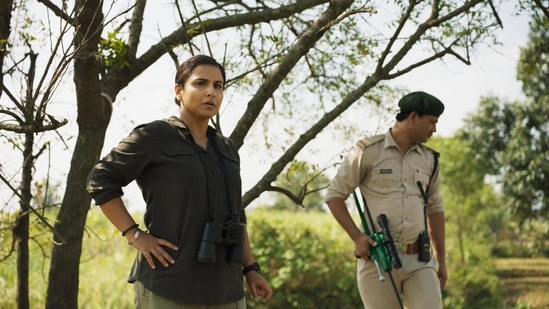
 

https://images.hindustantimes.com/img/2021/06/17/550x309/vidya_balan_sherni_1623932168804_1623932179349.jpg
Vidya Balan plays an ethical Indian forest service officer in Sherni (2021)

Amit Masurkar's new film Sherni has some things in common with his award-winning 2017 film Newton -- the central Indian jungle setting, the town-bred government official working against the odds in an unfamiliar setting, and unlikely collaborations among people striving towards something larger than themselves. The plot in one sentence: When a tigress named T2 starts to attack villagers in the vicinity of a Protected Forest area, an idealistic new forest officer named Vidya Vincent (Vidya Balan) struggles to prevent more human deaths, while also keeping her thoughtless, corrupt bosses from letting a self-appointed hunting hero kill the tigress.

Where Newton tackled the state of Indian democracy with pitch-dark humour and a sometimes-manic edge, Sherni approaches the tragic impasse of environmental conservation with enthusiastic sincerity, tempered by something akin to haplessness.

Perhaps that is inevitable, given that the man-animal conflict in India is a complex, burgeoning problem, and one whose roots are left unaddressed both by our national forest policy and by our mainstream politics.

To try and summarise a complicated history: India spent the first 25 years after Independence wooing parties of tiger-hunting foreign tourists, getting them to pay for the privilege of what sahibs and maharajas had always done. A 1964 New York Times article reported 15 government-approved jungle camps (up from only three in 1954) that organised these expensive shikar holidays, complete with “clean, tasty Western-style food” and liquor. “It is estimated that 3,000 tigers roam the forests, and they are multiplying fast enough to support the present shooting rate of about 300 a year,” the NYT declared.

That proved catastrophically untrue, and in 1972, the government did an about-turn. According to a 2017 article by the Kumaon-based butterfly expert Peter Smetacek, a group of hunters and naturalists had petitioned for a three-year break from tiger hunting to let populations recover, but in response Indira Gandhi's government promulgated the Wildlife Protection Act, under which hunting of any species was banned permanently.

Smetacek, like some others, has questioned the wisdom of this wholesale outlawing of hunting. For one, it made it illegal for farmers to protect their hard-earned crops from incursions by wild boar, monkeys, porcupines, nilgai, bears or birds without permission from a forest officer, pitting locals against the animal world they had cohabited with, while leaving them at the mercy of a corrupt state.

Also, if hunting was strictly regulated instead of being banned, allowing permit-based hunting of animals whose populations were growing too large, we would actually have records of animal populations besides the tiger -- and in fact be able to track and respond better to their declining numbers. That suggestion, outlandish and violent as it may sound to those who of us brought up in a sanitised modernity alienated from the ways of the wild, may be just the starting point we need to rethink the simplistic, often counterproductive legal regimes that have failed in practice to protect our forests.

Few Indian films before Sherni have engaged with this difficult terrain. In Anay Tarnekar's brilliant 2016 short The Kill, a poor adivasi man's deep, reverential knowledge of the jungle and the tiger goes from being a useless, non-monetisable asset to the only thing he can sell – but at a terrible cost.

In 1994, Sai Paranjpye made the sweet, well-intentioned, Chipko-inspired feature Papeeha, where her daughter Winnie Paranjpye played an anthropologist representing the tribal perspective on living in and off and with the forest, cast alongside a forest officer hero (Milind Gunaji) and a series of corrupt forest officer villains who run clandestine logging businesses.

A year earlier, in 1993, Pradip Krishen had made a film called Electric Moon (scripted by his then-partner Arundhati Roy), which takes a more sideways, ironic look at the situation. The film's central protagonists are a family of fading Indian royals who run a wildlife resort catering to foreign tourists, selling tiger hunting as an Orientalist fantasy, while responding to the new Hindi-speaking forest officer (Naseeruddin Shah) with snobbish class outrage. The humour is spot-on, as is the context: many Indian princely families who had once pursued hunting, often in forests that were part of their own territories, did indeed make this transition to being conservationists. It was a mixed metamorphosis that allowed them to retain their privileged relationship to the wild -- sometimes speaking legitimately from a place of knowledge, and sometimes just bending the rules for themselves.

The other film Sherni made me think of is Bhuvan Shome, Mrinal Sen's 1969 New Wave classic. Sen's film isn't intended as a realist comment on anything, certainly not on Indian wildlife policy. Yet, at its centre, is a man on a hunting expedition, who ends up not killing a single duck – and handing over the single one he brings down to a young girl he has become fond of.

Utpal Dutt sets out to hunt birds in Mrinal Sen's New Wave classic, Bhuvan Shome (1969)

Further, Sen's marvellous lightness of touch achieves much more than what that narrative outline suggests. Utpal Dutt, acting the grand hunter with his sola topi and rifle, is actually a tragicomic figure. The anglicised Bengali bureaucrat out of his depth in the Gujarati rural desert landscape represents not just bureaucratic mechanisation and urban dessication, but also a State totally disconnected from ordinary people's lives.

The low-level chai-paani bribes that Bhuvan Shome so sternly polices, and Mrinal Sen treats with comic indulgence, are still not the primary enemy. Nor is the biggest enemy the still-surviving big game hunter, who is given a little too much play in Sherni, perhaps understandably because a film needs a villain.

The problem is that out-of-touch State. Under cover of 'development', that State now cuts secret deals to give away our rivers and mines and forests to big men. It postures as a protector, but its grand diktats only cut off the deep, pre-modern, symbiotic relationships on which our forests managed to thrive for generations -- leaving both people and nature vulnerable to the worst kind of short-sighted profit motive. We cannot conserve our wildlife – or any heritage, actually – if we continue to treat those who live beside it as errant, trespassing children, rather than as dignified, proud, well-paid stakeholders.

Humans and animals have lived together before. We could do so again. But the task needs both intellect and courage.

Published in TOI Plus, Sun 27 Jun, 2021

4 June 2021

How Benegal turned an '80s train ride into a journey of self-discoveries

For my weekly column in Mirror/TOI Plus, the seventh piece in a series on trains in Indian cinema: 

Shyam Benegal's thought-provoking television series Yatra gave the Indian Railways a stellar role, as the thread that stitches the country together


Yatra
, the 15-episode series telecast on Doordarshan in 1986, may be the most dedicated depiction of the Indian train journey on screen. Directed by Shyam Benegal, the profoundly memorable show was based on a screenplay by his longtime screenwriter Shama Zaidi and theatre director and playwright Sunil Shanbag. It was sponsored by the Indian Railways, which gave Benegal the use of a 10-bogey train for the 50-day shoot.

Benegal decided to have the show unfold – consecutively -- on two of the longest journeys you could make by rail in India at the time: On the Himsagar Express, which ran from Kanyakumari, at the southernmost tip of India, to Jammu in the north; and the Tripura Express, which ran from west to east, from Jaisalmer to Guwahati. We begin the journey with the Himsagar Express, in Kanyakumari, where Lance Naik Gopalan Nair -- Om Puri playing a Malayali armyman posted in Jammu -- misses his train. Gopalan and his wife's frenetic taxi ride to catch up with the train at the next station (and when they miss it there, the next one) is one of many delightful narratorial devices in Yatra -- among other things, enabling Benegal's brilliant cinematographer Jehangir Chowdhury to shoot the train from the outside.


Inside, on the moving train, we meet a cast of characters as varied as the country -- many of them revealing to us an aspect of the country's troubles, small or large. The telling is gentle, but the stories are powerful. An old Marathi couple who have just lost their daughter to dowry murder find themselves taking care of a young Punjabi woman (a marvellous Neena Gupta) who is escaping ill-treatment by her mother-in-law and trying to get to her natal home in Jalandhar before she delivers a baby. A theatre troupe that has just lost a crucial actor to Bombay is trying to get the play back on track before getting to Delhi for a performance scheduled at the National School of Drama. An ageing, unwell Hindu ascetic is being accompanied to Jammu by his devoted disciple (played by the wonderful Mohan Gokhale) because he wants to see the Himalayas one last time. A Muslim husband who has been wanting his doctor wife to give up her medical practice finds himself unexpectedly affected by helping her deliver a baby.

As a child of the 1980s, I remember being entranced by Yatra, recognising its difference from the cinematic content around me without being able to name that difference. The beautifully-captured train journey allows you to travel vicariously through the country. And many of the things that Benegal brought into the narrative were not things that found space in mainstream, popular culture. As the train moves from the Andhra region towards the jungles of Madhya Pradesh, for instance, we are introduced to an activist for minimum wages for adivasi labourers who has attracted the ire of landlords in Nellore district. Now a whisteblower on the run, Venugopal is taking some documents to Delhi – but there's a bunch of goons who know he is on the train. Even to a child who knew nothing of the world, it was somehow clear that these goons – perfectly ordinary looking, mostly unspeaking, not particularly large or muscular – were more dangerous than the henchmen the villain sent out in Hindi cinema. Even today, it is chilling to watch the scene where Venugopal gets dragged out of the train while everyone else is distracted by a theft.

There is a lovely unpredictability to Yatra's narrative, however, in which such moments of gravity and fear can segue into humour and joy – and sometimes the opposite. And as often happens when you spend some time together, people you might have dismissed at first glance begin to seem human, vulnerable, perhaps even worthy of admiration. Benegal achieves some of this empathy through Om Puri's Gopalan, who serves as a conscientious but opinionated narrator. Thus the ailing swamiji, whom Gopalan thinks is all talk, turns out to have once fought in Subhash Bose's Indian National Army. The theatre troupe, whom the Armyman dismisses as having no serious work, is actually the only group of people who are working throughout the train ride. Their frazzled stage manager (the dependably superb Harish Patel) seems like a drunken buffoon who can't possibly be coached to act – but after an accident brings him to his senses, the whole compartment watches him transform into Ashwatthama.


But as in life, so on the Indian Railways: Everyone has their own journey to complete. The characters get on the train, learn something of each other's lives, and then part when their destinations arrive. Yet something meaningful is often forged in that fortuitous intersection of time and space. A young man heading to a job interview becomes besotted by a pretty young co-passenger, wooing her silently in the presence of her oblivious parents while making up verbose dream sequences with her in his head. The Marathi couple are so clearly taking care of the pregnant Neena Gupta that the railway doctor and others constantly mistake them for her parents. Later, Om Puri's Gopalan, trying to follow up with the railway authorities on the disappeared Venugopal, is asked the same question. “Aapke koi rishtedaar thhe?” Puri pauses, and his silence contains multitudes. “No,” he responds quietly. “We only met on the train.”

Published in Mumbai, Bangalore and Pune Mirror/TOI Plus, 30/29 May 2021.

20 November 2017

The Art of the State - II

My Mirror column:

Schools, guns and graffiti in two films about the Indian state: When the Woods Bloom and Newton.

(This is the second of a two-part column. The previous column is here.)


I return this week to my discussion of Amit Masurkar's Newton and D. Bijukumar's Kaadu Pookkunna Neram (When the Woods Bloom, WTWB): very different films that deploy strikingly similar motifs to depict a similar subject. In both, an incident of anonymous violence is followed by the uniformed might of the Indian state descending on a Maoist-controlled adivasi area -- centred, in both cases, on a school. 

In the Malayalam film, the policemen have arrived to stay. "Two rooms will be enough for us," pronounces a senior cop, being magnanimous. "There are only four rooms in the school," replies the teacher. "But even if you wanted to take over the whole building, we could not stop you." The fact that the police sit at the top of this ecosystem becomes even clearer when a sleeping cop wakes up and starts hitting two curious children who have sneaked past him to touch some guns. When the teacher objects, he retorts rudely: "You're here to teach children. Don't try to teach cops!" The teacher keeps quiet, but later stops the cops from using the schoolchildren as free labour. Some of the loveliest scenes in Dr. Biju's film involve the tribal children singing.


The songs they sing are clear and sweet, a world away from the raucous film music that the policemen bring with them. "We are the masters of the forest," run the lyrics of one, its dulcet tones belying the sharp irony of the words as they ring out in a forest that no longer seems theirs. In Masurkar's film, where black humour replaces lyrical melancholy, two tribal children are forced to sing songs to entertain the cops. In both WTWB and Newton, local anger can only be expressed in graffiti -- scrawled on the walls of the sole pucca structure for miles around: the school.

But the sentiment of those messages, let alone the irony of their location, does not seem to be reaching the state, which remains intent on widespread repression — which can only produce greater public anger. Early in WTWB, a truckload of cops is unleashed on a village to search for a single 'terrorist'. In the end, when the protagonist (Indrajith) returns to the police post, he is greeted with surprise - and told that that six Adivasis have been jailed for a month on the non-bailable charge of killing him. Newton, where the police have come only for a day, with the ostensibly benign purpose of holding an election, also underlines the casual terror they wield.

In one silently sarcastic sequence, the cops barge into huts, extracting tribute as they rough up people to make them exercise their 'voluntary' right. Poor adivasi India, it seems, is where the state only shows up to replenish its stocks of fresh-brewed liquor and freshly-killed chicken. Newton takes a lighter approach than Biju's film to deliver the same depressing message - the police do not merely implement the law: they are the law. At least while they have the weapons.

This, too, is a motif both films share. WTWB puts the gun in the hands of a woman and a Maoist, letting us see how contingent power is when she taunts the now-unarmed cop: "You're afraid too,without a gun, isn't it?" Newton's climax, too, depends on a gun changing hands - though here we are under no illusion that it will eventually return to those who are licensed to use it. In this utterly skewed world, if you think you can challenge a police officer, you must either be powerful — or a fool. Which is why the long-serving Loknath ji, having observed Newton Kumar's refusal to kowtow to Aatma Singh, sidles up to him to ask after his political connections.

The chatty, diabetic Loknath ji is the excellent Raghuvir Yadav, who began his cinematic career in Pradip Krishen's Massey Sahib as a lower functionary of the colonial state, and now embodies to perfection this lower functionary of the postcolonial state. Both as the youthful Massey and as the middle-aged Loknath ji, Yadav offers up an everyman character whom we laugh at, but also with. And in so laughing, we also laugh at ourselves.

Loknath ji also offers a humorous indictment of the status language and literature have in today's India. An MA in Hindi sahitya who now advises people to focus on English, which he is teaching himself by watching American slasher comedies on his phone, he combines a deadpan cynicism about our times with a hope that he might still catch up.


But in his desire to write a "jombie story" about a police team that enters a jungle in a Maoist area (and never coming out), Loknath ji also gives us a momentary reprieve from realism, a pleasurable dip into the sensational that reminded me of Lalmohan Babu in Satyajit Ray's Feluda stories. Fiction makes other appearances in the film: as indulgence, as entertainment, as a trap. We hear a policeman reading a novel aloud to his mates, a potentially erotic romance about one Ramju. Less innocuously, in the pre-climactic scene, it is by telling the story of the day aloud that Newton realizes that that is what it is: a story he has been sold.

I have not yet watched Dr. Biju's other films, but I was fascinated to learn that none of the characters in his last five films have names. Masurkar and screenwriter Mayank Tewari are clearly equally cognizant of the significance of naming. Their protagonist has already shed the weight of his caste surname. His new first name rids him of the femininity of 'Nutan', while putting him on par with a famous Englishman - and making us instantly think of gravity. At some fundamental level, naming lies at the core of fiction. The fact that Newton can name himself anew is testament to the power of imagination.

Published in Mumbai Mirror, Sun 19 Nov 2017.

The Art of the State

My Mirror column:

What two films might tell us about Maoists, violence and how different the state looks depending on which end of the stick you’ve got. (Part 1 of a two-part column.)


In May this year, at the Habitat Film Festival in Delhi, I saw a Malayalam film called When the Woods Bloom, directed by Bijukumar Damodaran, also called Dr Biju. Having now watched Amit Masurkar’s Newton, I am struck by the extent to which two such different filmmakers, with such widely disparate sensibilities and backgrounds, chose the same motifs to approach their chosen subject: what life is like in those parts of India where Maoists have gained some leverage in their ongoing battles against the state.
What are these motifs? For starters: the jungle, the school, the gun. The action in both films takes place almost entirely inside a forest: in
Newton, the location is Chhattisgarh, in When the Woods Bloom, it is Kerala. In both, an armed posse of policemen arrives at a ‘remote’ jungle outpost where the only sign of human habitation is a school building. The site where the state once marked its presence under the benign sign of education now becomes the location where it stakes its monopoly on power. And power, as Mao Zedong famously said, flows from the barrel of a gun.

But let us begin at the beginning. It seems remarkable to me that both Biju and Masurkar begin their narratives with an incident of anonymous violence. When the Woods Bloom opens with an unidentified group of people overpowering a guard at his post. Newton begins with a candidate called Mangal Netam giving a campaign speech whose vision of adivasi children with “a laptop in their right hand, a mobile phone in their left” inspires wry laughter even among the mixed urban film festival audience I recently watched the film with. Soon after, though, the politician is shot by unidentified assailants, and our disbelief acquires a jagged edge. Our cynicism from the sidelines is now asked to choose a side.


It is in contrast to these anonymous guerrilla warriors that both films first present their picture of an armed, uniformed constabulary. In Dr Biju’s film, we see a busload of policemen on a long journey to their new posting: one watches something on his mobile phone, another falls off to sleep. They are ordinary young men with ordinary desires – and this humanising is crucial when one of them (Indrajith Sukumaran) emerges as our protagonist. Masurkar and his screenwriter Mayank Tewari, too, have an ordinary young man as the pivot of their film — but Newton Kumar is not in uniform and he does not have a gun. He represents the Indian state not by laying claim to its monopoly on violence, but by helping to enable that great participatory ritual by which that state is ideally brought into being: a free, fair election.

But of course, in these less-than-ideal circumstances, the conduct of this basic democratic process threatens constantly to turn undemocratic. For the Maoists, the election is as much a symbol of the Indian state as the army or the police. What the film demonstrates is how violence and suspicion on either side produces a tragic vicious cycle, because Newton and his scanty Election Commission team — including the marvellous Raghuvir Yadav as the long-serving Loknath ji, and Anjali Patil as Malko, the local adivasi BDO — can only carry out their ostensibly peaceable mission under the heavily armed auspices of the Central Reserve Police Force. In one of the film’s quotable lines, “Jhande aur dande se hi toh desh banta hai.


Embodying the state in that militarised avatar is Pankaj Tripathi’s Aatma Singh, in a performance that matches Rajkummar Rao’s superb turn as Newton, move for move. The experienced cop produces a calibrated mix of menace and machismo that is designed to defeat the rookie officer’s seemingly unstoppable zeal. But every rhetorical move Aatma Singh makes is met by Newton with a counter-dose of literalness. So when Aatma says: “Main likh ke deta hoon, koi nahi aayega vote dene [I can write it down for you, no one will come to vote]”, Newton’s response is to take him at his word, holding out a pen and saying, “Sure, write it down.” Later, when Aatma tries to prevent Malko from accompanying them, Newton’s response is once again to keep repeating his rulebook position — “She is a member of the team, she will come with us”.


In When the Woods Bloom, the confrontation between the cop and the suspected Maoist (Rima Kallingal) is based on a set of binaries — state-nonstate, man-woman, civilisation-wilderness, ‘legitimate’ versus ‘illegitimate’ violence – that Biju wishes to turn on its head. Watching that reversal can be powerful. But Newton seems to me to have an edge over Dr Biju’s film because it refuses to deal in binaries at all.

Published in Mumbai Mirror, 12 Nov 2017.

The second part of this piece is here.

14 August 2008

Is IT a bird? Witchcraft and the Computer Course

An essay I wrote in January 2002, some months after finishing a Social Anthropology degree at Cambridge, and in the immediate wake of a visit to Ganesh Devy's then-nascent Tejgarh Tribal Academy in Gujarat. 

The Azande of Sudan, immortalised by EE Evans-Pritchard in that wonderfully unselfconscious, "The-Tagawawa-are-my-best-friends" way that anthropologists still had in 1937, lived in a world in which witchcraft was all pervasive. Witches could be men or women, and had the hereditarily-acquired power to do harm to a person or his family, psychically. Those who suffered misfortune could try and find out who was responsible by consulting one of several oracles. The most common oracle was a chicken, who was fed a reasonable quantity of poison called benge and given the name of a possible witch. The truth or falsehood of the accusation was then established by whether the fowl lived or died.

The tribal world, if at all such a gross generalization is possible, is populated with a host of spirits and forces that are capable of having a powerful influence upon human beings. Some are usually associated with seriously deleterious effects on mind and body, while others might be rather more beneficial in their impact. In no way do I mean to suggest that only tribal people believe in ghosts and spirits, but it so happens that I recently spent a few days discussing these things with some adivasi students in Gujarat, and time and again in those conversations I found myself making, with a passion that I never realised I could invoke in the service of modern science, a case for rationality, (as opposed to belief in the ojha's powers or jhaadh-phoonk techniques).

I had gone to explore the possibilities of working with a Baroda-based organisation that has set up a first-of-its-kind Diploma in Tribal Studies. It's a two-year course, with a theoretical and a practical side to it. The idea is for adivasi students to be trained in development survey work in villages and introduced to some development jargon - so that the classroom is the constant site of discussions in which terms like Needs-Based Approach, BPL Families (Below Poverty Line families), Microcredit Mandli and so on, are bounced back and forth with as much faith and vigour as in any self-respecting TISS project report. The other parallel motivation is to provide exposure to viewpoints and theoretical perspectives that the students may not have had a chance to engage with before.

Already, at the academy, ideas for the preservation of traditional Rathwa medicine jostle with government schemes which rest upon doling out large quantities of additional vitamins and minerals in tablet form each month. There is a tradition of Pithora wall painting in the region, which the Artists' Cooperative is trying to preserve. The three-day ritual performance which culminates in the creation of Baba Pithoro might, they have realised, be a difficult thing to market. So they sell large expanses of cellophane-protected muslin, stretched taut on wooden frames. Caught behind the cellophane, whole forests teem with life. Peacocks and mynahs and raucous green parrots fly above the horses of Indralok, scarlet and green, their hooves kicking up the dust. To me, though, they seem constrained. In a way that they didn't on their mud wall in Malaaja village. But these seem like unsolvable dilemmas, and I decide to leave them alone for the moment.

Then the next day, fifteen young men -- graduates in Gujarati and sociology and economics, who have lessons in basic linguistics and computers, and have set up committees to deal with sickle-cell anaemia patients -- started talking to me about bhoots and prets who carry off children and daayans who bewitch families. One speaks of the ojha who cured him of an undiagnosed "weakness", another of a local Rathwa tribal ritual specialist, the badhwo - in the same breath as the 'modern' medical system: injections, haemoglobin counts, hospitalisation. And suddenly, I find myself shifting -- slowly, but surely, from the supposedly value-neutral anthropological position -- to that of the scientific, anti-superstition rationalist. The process alarms me slightly.

So when I come home, I find myself turning the pages of notes I wrote as part of a long-ago course on the anthropology of knowledge. Anthropology, right from its early Fraserian avatar, has been interested in what it saw as 'irrational' beliefs and practices: the world of gods and demons, magic and witchcraft.

{Often, the domain that the anthropologist describes as magic or witchcraft does not exist as a category in the minds of those who practice them. Evans-Pritchard makes clear, for example, that Zande magic, though it may be systematic, is not theorised or systematised by the Azande themselves. If the category is of the anthropologist's making, then there must be anthropological criteria that make certain practices or beliefs magical. Behaviour which seems not to be effective in the realisation of its apparent goal, or a belief in powers or beings whose existence is not substantial, can be classified as magical. Already, we have stepped beyond mere observation of behaviour into defining what its goals might or might not be.}

Three kinds of explanations have tended to emerge for such beliefs and practices. There have been those who categorise magic as ineffectual behaviour, based on mistaken or illogical belief systems: the so-called intellectualists (Fraser, Tylor, etc). The problem with a strong form of this position is that those who practice witchcraft also perform tasks that involve fairly complex abstract reasoning: the same 'primitive' who believes in voodoo also builds real houses, using techniques that are fairly complicated.

Then there are the symbolists - who provide an 'expressive' explanation of magical practices. As Peter Winch argued with regard to the Azande, the oracular revelation is not a matter of intellectual interest, but a tool which is used to decide how to act. Therefore, the question of refutation or confirmation does not arise. Winch's question is: does someone who presses the notion of witchcraft to its logical conclusion (and finds inconsistencies) necessarily act more rationally than the Azande (who do not)?

He argues that something can only appear 'rational' or 'irrational' to someone in terms of his understanding of what is and is not rational. Winch, in effect, suggests that Zande magical rites and practices express an attitude to human life, and a recognition that life is subject to contingencies, rather than an attempt to control these. This position has been taken also by others who draw a contrast between scientific explanation and magical analogy: the former can be judged true or false, the latter only legitimate or 'felicitous' - or not.

But does a strong form of relativism, a la Winch, tell us anything about rationality? If magic is an expressive ritual -- like kicking a chair when one is angry -- then belief, at least in the propositional sense needing rational approval, is not germane to the explanation of ritual/magic action. Yet, rationality is measured with respect to beliefs, coherence, consistency of thought and so on. Magic may have expressive and performative elements, but if it has any claims to an impact in the material world, then can it be considered a different type of thought from say, science?

Critics of the strong relativist position, like Robin Horton, point out that such an assumption of 'difference' would prevent anthropologists from making a studied culture intelligible to their own at all. Horton argues that western anthropologists, afraid to be seen as 'inegalitarian' or racist, have insisted therefore that much of what seems like theoretical thought in non-western cultures is actually thought of quite a different genre, with goals quite different from those of explanation, prediction and control.

Horton's argument is that science and magic are not so far apart. The opposition between them is not that between common sense and mystical thought. In fact, both explain the world in terms of underlying uniform laws. Both are forms of theory used to explain what common sense cannot: action at a distance. Magic is not used as a substitute for a theory of natural causation, but works as an explanation for particularity -- 'why did my son fall ill? In Evans-Pritchard's terms, beliefs about witchcraft and magic form a closed system - 'a web of belief' which insulates those who lived in it from anomaly. Thus, apparent falsifications - a mistaken prediction or an ineffective cure -- can be explained by bad materials, fraudulent practitioners, broken taboos or occult interference. Such 'secondary elaborations' help to preserve the truth of magic.

Horton argues that scientists, too, practice secondary elaboration in their explanations, citing bad apparatus or otherwise imperfect conditions as reasons for anomalies, or tagging caveats onto their theories to make them fit the evidence better.

Horton's conclusion: that it is wrong to think of magical thought as anything less than scientific. What is not scientific, or strictly rational, in magical thought is the fear of abandoning theory - the'closed predicament' in Popperian terms. Whereas magical thought and practice is hedged round with taboo, and believers react with fear when it is questioned, Horton argues that scientific thought is constantly actively challenged: a continuous critical monitoring of theory takes place.

But I do not know if 'science', when it appears as a solar lantern in an adivasi village in Gujarat, or even in the computer centre in Tejgarh Tribal Academy, is indicative of, or subjected to, a greater degree of critical questioning, than say, the spirits of the badhwo's dream-world or the bhagat priest's cure for jaundice. There is really not much difference in the faith that the badhwo asks the adivasi to place in his ritual incantations, and the faith we would rather he places in say, the power of two yellow tablets a day to keep him from fainting in the fields at noon.

Regardless of the particular effects of each, the point I am trying to make is this: seen from the point of view of the woman in Malaaja village, the workings of both processes -- traditional medicine and modern science - are equally hidden from view. And offered to her in quite the same way, from above, to be accepted unquestioningly.

All over India, and all over the world, perhaps, there is this sudden great desire to learn computers. In these days of IT, the computer course, from Bareilly to Belgaum, has come to represent a hotline to information that is knowledge that is power -- and of course, money. 'Computer course' : most potent symbol of the modern age, of science, of technological advancement - the word is almost magic.

There will be computers, too, in Malaaja. But having access to the tools of modern science does not change how people think. The astronomer who believes in Vishnu's creation of the world, the state trading associations which perform yagnas to ensure that stock prices will rise, all of us who read the Sunday newspaper horoscopes and feel that slight sense of apprehension -- or happy anticipation -- perhaps none of us subscribe to a single, coherent belief system. People often have views that are inconsistent with other views that they themselves hold -- and they may argue for different views at different times.

What then makes my belief in Bejan Daruwalla's predictions for heartbreak this week, or whatever, different from Veereshbhai's belief in the ghost who is the cause of his household's misfortune? Is it just that I have more choices, greater access to a greater variety of preventions and cures? Perhaps what is crucial is that we do not merely dole out the bounties of science, but attempt to spread that elusive thing -- its spirit. The spirit of critical enquiry, to which both the badhwo and the sarkari dawakhana must be subjected, so that one is not merely substituted by the other.

Published on the website 'digitaltalkies.com', January-February 2002.