Showing posts with label Anurag Kashyap. Show all posts

8 January 2020

The ghosts among us

My Mumbai Mirror column:

A new anthology film about the supernatural is a mixed bag, but it does try to point Hindi film horror in consciously critical directions.

A still from Dibakar Banerjee's segment in the new anthology film Ghost Stories.
After first coming together to pay homage to the cinema in Bombay Talkies (2013), and the self-explanatorily titled Lust Stories (2018), the once-unlikely foursome of Zoya Akhtar, Anurag Kashyap, Dibakar Banerjee and Karan Johar are back with a new anthology film: Ghost Stories.

The films vary widely, not just in setting and tone, but in quality. Anurag Kashyap's contribution, starring an awkwardly gangly sari-clad Sobhita Dhulipala as a woman who is both an expectant mother and a surrogate maternal figure to her little nephew, didn't work for me at all (spoilers ahead) despite the effectiveness of the scowling child. The possibility of an uncanny relationship between external visual depictions and real-life transformations – think everything from Oscar Wilde's The Picture of Dorian Gray to MR James 1904 classic ghost story 'The Mezzotint' – has always fascinated me, and it is of course also the basis of certain long-held ideas of magic, such as voodoo. So Kashyap's use of the child's drawing, his repeated scratching-out, and his apparently innate sense of his own power, was for me the most gripping part of the story. But the film stirs in all sorts of other elements – nightmares, superstitions, silent men, shouting mothers, half-human states, crows' eggs, and a whole room full of creepy dolls. If all these ingredients were meant to be a recipe for chills, the dilution leaves us baffled and lukewarm.

Zoya Akhtar's film wins big by casting the brilliant Surekha Sikri as a bedridden old lady attended on by a lackadaisical young replacement nurse (Jahnvi Kapoor). As always with Akhtar's films (including her segment about a maid and her master in Lust Stories), there is an attentiveness to space: the multiple empty rooms that the youthful Sameera dashes through with a token agarbatti, the echoing sound of children's laughter from the stairwell when she answers the doorbell to find no-one there. It's a talent particularly useful in crafting fear, if Akhtar were interested. But she isn't, not really.

What she seems keen on is a juxtaposition of youth and age, sharpness and shutdown– and things aren't as simple as they seem. Sameera's briskness as she cleans up Mrs. Malik is matched by her frequent distractedness. Mrs. Malik, meanwhile, drifts in and out of consciousness, but recites from Wordsworth's apposite 'Intimations of Immortality' with tinny perfection: “Turn wheresoe'er I may,/ By night or day./ The things which I have seen I now can see no more.” And knows more about the fruitlessness of waiting for someone than Sameera can.

Genre fiction and film – especially of the scary variety – has long been a vehicle for social commentary. The man-made monster at the centre of the still-popular Frankenstein – a book first published anonymously by a ridiculously young Mary Shelley in 1818 – is an early (and eerily prescient) warning against technological intervention in human life. Twentieth century horror, especially the zombie movie, has been powerfully shaped by George Romero's cult classic The Night of the Living Dead (1968), the first of his triad of 'Dead' films: Dawn of the Dead, set in a shopping mall, and Day of the Dead (1985). Romero onwards, the slow-moving, cannibalistic zombie – a creature whose bite turns the bitten person into a zombie herself -- has more often than not been a powerful metaphor for the horrific things that ail society: racial prejudice, consumerism, militarism, classism. That tradition continues down to Jordan Peele's Us (2019).

Karan Johar's film isn't scary, despite his newly-married heroine walking us endlessly through the candle-lit expanse of her husband's family mansion (going for a cross between K3G and Trikaal) in search of a ghostly grandmother. The only effective presence is that of the forbidding housekeeper Shanti, who guards Dadi's room in a manner clearly inspired by Mrs. Danvers' guarding of Rebecca's in the Du Maurier novel (and Hitchcock film). Johar has moments that invite critical examination: such as the friend who declares the family as “totally legit” based on “community mein izzat” and “thriving business”, forcing us to think about how such an aura of social legitimacy survives the violence pushed under the floorboards. (But you'd do better to watch Parasites.)

There is, happily, a zombie film in the quartet. It is Dibakar Banerjee's, and perhaps unsurprisingly, it is the sharpest of the four – politically, but also in filmmaking terms. Sukant Goel plays a bored, exhausted sarkari official who arrives in a remote village to report on a government school – to find a ravaged, half-burnt settlement where the only living humans appear to be two children. The zombies from the bigger village have eaten everyone from the smaller village, and will eat everyone except those who turn on their own kind. If you speak up, you attract the attention of the creatures. If you join the feasting, you will save your skin – but be blinded for life. Watch it -- and try not to be blind.

1 January 2019

My Movies of the Year - I

My Mirror column:

A year-end list of the films I most enjoyed in 2018, in no particular order. The first of a two-part column. 


The season of lists is upon us, and so here I am with mine. But a caveat before I begin: this is not, repeat not, a list of the best films of 2018. I cannot make that claim, simply because there are too many 2018 releases I haven't yet watched – in Hindi, in English, in the many Indian languages, and in countries across the world. Instead, if you will all indulge me at the end of a taxing year, here is a list of films that -- in my eyes -- did their bit to redeem 2018.
Let me begin with the Hindi films, in no particular order.

Mukkabaaz:
Anurag Kashyap began the year with a bang, giving us a zingy film about an aspiring boxer where all the real drama takes place outside the ring. The last time Kashyap used the poor-boxer-as-underdog-hero trope, Ranbir Kapoor's performance bit the dust along with the massive misguided missile that was its vehicle, Bombay Velvet. This time, the superb Vineet Kumar Singh (who is also the originator of the script) makes the sad-eyed struggler at the film's heart as credible as the desperate New India that surrounds him. Singh's performance as Shravan is more than matched by Jimmy Sheirgill's masterful turn as a casteist coach. Backed by a brilliant, addictive soundtrack, Kashyap crafts the caste and communal politics of Bareilly into a cinematic universe that is equal parts depressing dysfunction and joyful subversion.


Raazi: Meghna Gulzar's nailbiting thriller, based on the real-life tale of a Kashmiri Muslim woman who married into a Pakistani army family expressly to scout out state secrets, was also the most marvellously subversive Hindi film in ages, playing around with popular assumptions about gender, religion and nationalism at so profound a level that you barely know you're being played. The doll-like Alia Bhatt as a spying dulhan who sweetly smiles her way into the innermost circles of the military establishment is a masterstroke, playing not just on the anxieties of the India-Pakistan relationship but the familial anxieties around the otherness of all bahus in all sasurals. Raazi also gives us a rare burka-clad heroine who needs no saving (unlike say, the two Muslim female characters in the otherwise praiseworthy Lipstick Under My Burkha, or the award-winning 2016 short film Leeches), and a rare India-Pakistan romance that is based on mutual respect for each other's patriotism. 


Mulk: Anubhav Sinha's response to the growing representation of India's Muslims as the enemy within is a moving portrait of a middle class Banaras family that's vilified and harassed after one of its members turns out to have perpetrated a terrorist attack. Rishi Kapoor, one of those lucky male stars to get his best roles after 50, is wonderful as the portly, bearded, devout Murad Ali Mohammad, who is suddenly reduced from the respected neighbourhood Vakeel Sahab to a man in the dock as a member of a hated community. Less feted but crucial to the film's sense of tragedy is Manoj Pahwa's superb portrayal of Murad's younger brother Bilal: a not-so-clever man whose absence of judgement can appear, in a courtroom and a country arraigned against him, as the presence of guilt. Mulk etches the ordinary mixedness of both mohalla and family with warmth and lightness, but its extended courtroom sequences are a bit overwrought. But given the bigotry tearing us apart, this is the bludgeoning we need.


Stree:
 Director Amar Kaushik and scriptwriters Raj Nidimoru and Krishna DK (themselves directors, of Shor in the City fame) have crafted a rare creature: a Hindi genre film that subverts gender stereotypes while being clever enough to never be preachy. Stuffed with great comic turns (of which Rajkummar Rao's ladies tailor hero and Pankaj Tripathi's local faux-historian are the highlights), Stree combines the chills and thrills of a small town ghost story with effortless humour. Kaushik doesn't shy away from laughter in any direction, embracing both situational goofiness and the perfectly positioned political joke: a line about the ghost being able to identify people by their Aadhar cards, or the cameo by Vijay Raaz in which we're told that the Emergency has never ended.

Andhadhun:
Sriram Raghavan returns to the screen with another film that proves his irreplaceability to contemporary Hindi cinema. The film's principal ingredients suggest a chef who's having a lot of fun: an attractive blind pianist, a fading Hindi film hero playing a version of himself, Tabu doing a brilliant riff on a character she has played before – Lady Macbeth. The performances are pitch-perfect for a film that is meant to keep us guessing: Ayushmann Khurrana is sympathetic but suave; the magisterial Tabu is somehow both controlled and manic. Add a sweet old woman who may not be that sweet, a nosy Parsi neighbour who gets her just deserts, and an even more nosy child who... let me not give it away – and you get a deliciously dark confection, with Raghavan's usual bonus layers for film buffs.

Badhaai Ho: Amit Ravindernath Sharma's film is a fine new addition to several growing genres: middle class comedies, Delhi films -- and most crucially, family films that want to talk about deep, dark, once-considered-top-secret topics, eg. sex, while making us giggle. Ayushmann Khurrrana as the son of a Northern Railways TT and Sanya Malhotra as his posh girlfriend are cute together, but Neena Gupta and Gajraj Rao walk away with the honours for the warmest, most winsome couple of Hindi cinema this year.

(To be continued next week)

17 July 2018

Crimetime Mumbai, Adapted

My Mirror column:

With new series Sacred Games, Anurag Kashyap and Vikramaditya Motwane turn Vikram Chandra’s sprawling novel into an atmospheric but filmi crime thriller.


Watching a filmed version of a book one knows well is always a little unsettling, and more often than not, unsatisfying. No matter how detailed a writer’s descriptions might be, the places and people in them are not realised in your head the way they are when you see a film, play or television show.


When you read, there is always space between the words for your own images. And because the imaging — and imagining — is up to you, some characters or scenes might leap off the page more than others. And they’ll be different ones for different readers.


A book, you might say, leaves you alone with the story. But when the same story unfolds on screen, you watch it through the eyes of a team of people — the scriptwriters, the director, the musicians, the art directors. An entire technical team comes together to produce their vision of the story. The faces have been picked, and voices, accents, gaits, clothes, houses and street views have all been finessed into finality. The images are what they are: there is no space between them for your own imaginings.


And so, on Friday, as I prepared to watch the new Netflix series Sacred Games, my mind kept going back to Vikram Chandra’s magisterial 900-page novel from 2006, from which the show is adapted. As a reader who’s loved the book for a decade, I have lived with my own mental pictures of its central characters: an on-edge Sikh cop called Sartaj Singh and a self-aggrandising gangster called Ganesh Gaitonde. Watching Anurag Kashyap and Vikramaditya Motwane set forth their version of Chandra’s vision is interesting, but it’s going to take me some time to accept a turbaned Saif Ali Khan as Sartaj, or a mad-eyed, UP-accented Nawazuddin Siddiqui as the Marathi Gaitonde.


There are other reasons for my inability to go along instantly with Kashyap and Motwane’s fully realised world. Things get sliced off when a book —especially a sprawling, multi-headed hydra of a book like Chandra’s — needs to be fitted into a format like Netflix. It’s an unavoidable, perhaps even admirable surgical procedure; but the loss of detail can feel painful.


So, for instance, the series begins with the same memorable image as the book: a white Pomeranian dog flying out of a window, ending its life as a splatter on the ground near a group of convent schoolgirls waiting for a bus. But in the book, we know that the Pomeranian is called Fluffy, that “the man who had swung Fluffy around his head by one leg” from a fifth-floor window into the void was a Mr Mahesh Pandey of Mirage Textiles, that Mrs Kamala Pandey, from whose hands Sartaj extracts a knife with expert calm, talked of herself as Fluffy’s ‘Mummy’, and that there was “remarkably little blood”. In the Netflix series, an unnamed dog falls from a high-rise apartment, with the classic pool of blood around its sad little white body.


What was, in Chandra’s narrative, an introduction not just to the life and work of inspector Sartaj Singh and his assistant, constable Katekar, but to the violence that splices Mumbai’s domestic interiors to its streets, ends up here as a mere visual flourish.


The show’s first season is eight episodes, each roughly an hour long, and there are obviously things that would have to go as the screws tightened around Chandra’s baggy monster of a book. But the Sacred Games reader arriving at the TV series must deal not only with subtractions but additions. Writers Varun Grover, Vasant Nath and Smita Singh have clearly immersed themselves in the book’s universe, but even from the two episodes I’ve seen, it’s apparent that they’ve also made crucial changes.


With Sartaj, for instance. The book’s Sartaj Singh has his moments of bleakness: “He was past forty, a divorced police inspector with middling professional prospects... He looked into his future and saw that he would not achieve as much as his own father, and much less than the redoubtable Parulkar.” But Chandra’s Sartaj remains a handsome man who has once appeared on a magazine cover, is the object of flirtatious ribbing from bar dancers, and mothering and potential setting-up from his senior officers’ wives. He also receives benevolent patronage from his boss Parulkar, who at a press conference early on refers to him proudly as his “most daring officer”.


In the series, by contrast, Sartaj is a man who has let himself go. His relationship with Parulkar is far from benevolent. This Parulkar — played with more than a hint of cruelty by the superb Neeraj Kabi — mocks Sartaj to his face for his insistence on honesty, his refusal to cooperate in turning fictional encounters into facts. Behind Sartaj’s back, he dismisses him as a “low-performing officer” with a weight problem and a dependence on anti-anxiety pills.


Sartaj’s supporting cast of colleagues is replaced by a nasty crew that can’t wait to see him down. For example, the book’s friendly Majid Khan, who invited Sartaj over for kheema cooked by “your bhabhi”, becomes, in the series, a snarling younger man with a penchant for punches. Gaitonde, meanwhile, acquires a remote rural childhood with apoor priest for a father and a mother who’s having an affair. These are filmi touches — a hero seems more heroic if he’s alone against the world, the villain can always do with a tragic backstory of deprivation. Among literary Indian English writers, Chandra is perhaps already the most steeped in moviedom, so none of this feels jarring, yet. But whether the upped filmi quotient will stand Sacred Games in good stead remains to be seen.


Published in Mumbai Mirror, 8 July 2018.

Lust, with much caution

My Mirror column:

A film compendium of four tales promises to unbutton our lustful selves on the Hindi screen, but remains tied up in all sorts of knots.


There’s something a trifle odd about Lust Stories. The film, which premiered on Netflix on June 15, is made up of four stand-alone segments by four different directors — but all united in pursuit of a single theme. The directors are the same as in 2013’s Bombay TalkiesAnurag KashyapKaran JoharDibakar Banerjee and Zoya Akhtar. There, the unifying theme across segments was the power of cinema. Here, ostensibly, it’s lust.


But here’s the thing: it’s not clear to me that these four tales are really about lust at all. Sex, maybe. 
Sexual satisfactionsexual deprivation, sexual confusion, sexual jealousy — all of these are dealt with. And while these might seem to be spin-offs of lust, they do not in themselves constitute it. Whether unabashed or guilt-ridden, lust is a full-bodied, carnal thing. But there is very little sense here of that experience, of coveting and deriving sexual pleasure from another person’s body.


The first segment, directed by Anurag Kashyap, stars Radhika Apte as a married college lecturer called Kalindi, who drunkenly hooks up with her student Tejas (Aakash Thosar, the hero of Sairat) and cannot quite handle the ramifications of the act. Kalindi starts by assuming that the younger, less English-speaking and less sexually experienced Tejas will become besotted with her. But as things begin to pan out rather differently, she gets embroiled in a tangled web not quite of her own weaving.


Apte’s on-the-verge performance is fun to watch: her believable air of manic excess lifts the segment above what otherwise might have felt like a mockery of a character. But we never get the vibe of lust from Tejas and Kalindi, or from Kashyap’s direction. It seems as if both have ticked the mental boxes marked ‘adventure’, ‘older woman’, and ‘younger man’ without the relationship producing the slightest bit of on-screen frisson. There’s only social awkwardness, confused power play and avery predictable jealousy that assumes, if anything, romantic form rather than sexual: the feeling of betrayal comes from having had the same song played to another potential lover.

The second segment is a finely wrought one and Zoya Akhtar’s opening sequence does come close to a portrait of mutual lustfulness. The master and the maid we meet mid-coitus look exhilarated. In that moment of pleasure at least, the hierarchies of who must serve and who must be serviced are apparently transcended. Bhumi Pednekar’s superb Sudha is neither put-upon nor coy, and to be lusted after by her upper middle class employer gives her a little licence, social leeway she would not otherwise have. But the intimacy of lust has clear limits, Akhtar seems to suggest, as she delivers Sudha and us, within just a few minutes, from the edge of an illusory domestic fantasy back into the ‘real world’ of marital alliances — where lust is trained to toe the line of social and economic order. What we experience with any degree of depth is not Sudha’s (or her employer Ajit’s) desire, but its erasure into an almost inevitable sense of melancholy.


The third segment, directed by Dibakar Banerjee, deals in another kind of socially censured attraction, that between a man and his best friend’s wife. Again, though, the scenario Banerjee sets up is by no means one of frenetic, passionate or even zestful attraction. In fact, when we meet Reena (Manisha Koirala in a perfectly cast and perfectly pitched performance) and Sudhir (Jaideep Ahlawat), the vibe between them is so comfortable as to make them seem like a long-time couple. They have tea together in a lawn, they lie in bed reading and chatting without any sign of sexual frisson — so much so that when it turns out they’re having an affair, it’s a surprise.


I’m not suggesting that lustful sex must be signposted as something unadulterated by other emotions, separate from loving sex, but surely what Banerjee’s film is concerned with is the breakdown of a marital relationship and the need for emotional intimacy and connection as much as to be physically desired? Both the times that we see sex here, there are tears in one person’s eyes. This is scarcely lustful sex. It might be comfort sex or pity sex, or even intense emotional sex, which is fine. But why then suggest we’re watching a film about lust?


The last segment, directed by Karan Johar, changes the tone of the film. From the realist, often sombre relationship dramas created by the other three directors, Johar transports us into his universe of campy, comic excess. But he addresses the question of lust more directly. An all-girls’ school serves as the setting for a romp with a programmatic message about female pleasure. His characters are ridiculous but entertaining. There’s Neha Dhupia as the cleavage-revealing, divorcee sex goddess teacher (slyly named Rekha); 
Kiara Advani as Megha, her younger colleague, a virginal-looking bride with non-virginal desires she is keen to fulfil; and Vicky Kaushal as her besotted and good-looking but hopelessly bad-in-bed husband.


Looking at the hilariously performative, uber-vocal female masturbation scene(s) in Johar’s segment and earlier in
Veere di Wedding, it looks like broad comedy is the register in which Bollywood has decided to present us with the female orgasm. That’s a good enough place to start. It might, however, be a bit of a tragic joke that so many of these lustful heterosexual women are lusting after vibrators — not men.


Published in Mumbai Mirror, 1 July 2018.

15 January 2018

Heart of darkness


With Mukkabaaz, Anurag Kashyap has gone where many might fear to tread, crafting a picture of present day North India whose zingy energy doesn't quite hide its depressing core.


The marvellous Jimmy Shergill as Bhagwan Das Mishra in Mukkabaaz
It would be a mistake to go into Mukkabaaz expecting a sports film. The hero might be desperate to win a boxing championship, but his real battles are not in the ring. For the talented small fish trying to make his way up from the bottom, the entire Indian food chain seems to consist of big fish that want to be fed – or they'll gobble him up. Director Anurag Kashyap seems so keen for us to understand this that he makes his Shravan Kumar pretty much invincible as a boxer: the self-proclaimed Mike Tyson of Uttar Pradesh knows he can beat all his opponents – and after a while, so do we.

So while the film's many boxing scenes are painstakingly crafted: taut, grimy, often gripping, all the drama in Mukkabaaz lies outside them. And the stage for it to unfold are the bylanes of Bareilly: a town that seems to have truly arrived in the country's cinematic imagination, with Kashyap close on the heels of 2017's Bareilly ki Barfi and Babumoshai Bandookbaaz. With Mukkabaaz the fictive possibilities of the contemporary UP small town are exploited in the best way -- by hewing as close to the headlines as its characters' realities will allow, and then digging underneath them for unvarnished truths that aren't seen as fit to print.


Much of the unprintable is spoken by the man who can only be called the film's villain: the superb Jimmy Shergill as the boxing-coach-cum-bahubali who plays God in this universe, acting under the deliberate name of Bhagwan Das Mishra. And much of it revolves around caste. “Sauda toh kar nahi rahe,” says Bhagwan in one scene. “Brahmin hain, aadesh dete hain. [I'm not making a deal here. I'm a Brahmin, I give orders.]” At another crucial juncture, he proposes that Shravan drinks his urine, calling it “amrit”.

Elsewhere, he humiliates a rival coach (Ravi Kissen, doing justice to a rare interesting role) with the pointed question “Sanjay Kumar what? Brahman ho, Kshatriya ho, Kayastha ho, kya?” And when Kumar straightforwardly states his caste as “That fourth jaat that you're unable to even name: Harijan”, Bhagwan makes sure to rub his face in it by calling for a separate water container for the Dalit. Shergill's menacing gaze through rose-tinted spectacles in this scene is a remarkable visual touch: the English metaphor for a too-optimistic view of the world is turned on its head.


Certainly this is not an optimistic film. It almost makes us believe that it is, by handing us an old-style unreconstructed love-at-first-sight narrative between a sad-eyed struggling hero we can root for – the brilliant Vineet Kumar Singh, who is also the originator of the script – as well as a heroine whose muteness thankfully doesn't ever prevent her from having her say (Zoya Hussain, also superb). That illusion is aided by conducting us through their courtship and Shravan's career with Kashyap's usual dizzying energy, with much of the action cut to an immersive, subversive soundtrack and clap-worthy lines crafted out of the everyday wit that the North Indian town uses to cope with its dysfunction. 
This must be the only film in which boxing moves have appeared on screen marvellously in tandem with hiphop at one point and the murkis in a gentle, almost Hindustani classical song at another. But this is an adrenalin high, not meant to be sustainable. This is a world that is, after all, controlled by Bhagwan, who is, in some ways, another version of the petty, power-hungry sarkaari sports official who unmystifyingly recurs in Indian films about sporting underdogs: think of Girish Kulkarni's character in Dangal, or Zakir Hussain's devious Dev in 2016's Saala Khadoos.

But the reason why Jimmy Shergill's Bhagwan seems more frightening than those men is that he represents the dark heart of the New India – which is unfortunately just an emboldened, lawless version of the old.

In an era when a film like Padmavat(i), with what appears to be its overt celebration of 'Rajput' valour and barely-disguised vilification of the meateating Muslim as uncivilised, somehow manages to be identified with courageous filmmaking, Kashyap's fearlessness makes one want to cheer. Mukkabaaz's fictional depiction of how gau-raksha and the spectre of beef are used to shut down inconvenient voices is both chilling and entirely credible. There is also another long-drawn sequence in which caste plays an overt role, and here it is an OBC character – a Yadav, to be precise – who decides to rub Shravan's nose in the dirt because he thinks he is Rajput. Kashyap's script leaves a deliberate loophole on the question of Shravan's 'real' caste.

Whatever one one thinks of this script decision, or of the fact that the Yadav character's attempt at caste payback earns him only nasty humiliation, Mukkabaaz deals with our darkest selves, head on. 

This is a world where the most soaring dreams must be dreamt without recourse to the rules of justice or fair play. Dysfunction is assumed, and incorporated into plans. Whether it is expressed in a don harassing a family by sending a henchman to keep cutting off their (permanent) illegal electricity connection (the “katiya” that was at the centre of the documentary Katiyabaaz), or in strategizing how to defeat an opponent whom one knows full well is on steroids but cannot report because the system will not listen, Mukkabaaz depicts a world beyond the hope of law. And in this world, to win can mean losing.

Published in Mumbai Mirror, 13 Jan 2018.

1 August 2016

Everything is Illuminated

This week's Mirror column:

Are there more stoners on the Hindi film screen? A short history of filmi drugs, from old-fashioned to uber-cool  

Nawazuddin Siddiqui's Faisal in GoW is one of Anurag Kashyap's many pot-smoking protagonists
Earlier this year, we had much brouhaha about showing drug use on screen, in the context of Abhishek Chaubey's Udta Punjab. Producer Anurag Kashyap came out swinging against the CBFC, and when Udta Punjab finally released (with just one cut), many people, including myself, noted that its tragic portrait of drug-addled youth and a corrupt state couldn't possibly be seen as encouraging drugs.

The week after Udta, Kashyap released another film, this one directed by himself. Raman Raghav 2.0 was publicised as a portrait of a serial killer. Which it is. But it is equally a portrait of a killer cop, played by Masaan actor Vicky Kaushal. And drugs are crucial to Raghav's character: driving his violence, while also providing a crutch that helps him live with its effects. The introductory nightclub sequence, cut to Varun Grover's marvelous lyrical wordplay about qatl-e-aam, has a psychedelic quality that could rival any of Udta's blazingly coked-up scenes. And unlike in Udta, these scenes in RR2.0 aren't swaddled in a thick layer of anti-drugs messaging. But no-one batted an eyelid.

Not that I wanted them to. Kaushal's coke-fuelled murderous cop can't possibly be perceived a dangerous role model. But there is no doubt that this is a different sort of character from the sort that Hindi movies used to allow in the drug-consuming department.

Through the '70s and '80s,
drugs were what the villain's evil empire was built on, along with illicit daru and adulterated dawai. An occasional hero might take on a drug cartel, sometimes for a personal reason: Charas (1976) had Dharmendra falling for Hema Malini's hapless drug mule; Janbaaz (1986) had Feroz Khan avenging the drugged death of his girlfriend (Sridevi); the sparky Jalwa (1987) had Naseeruddin Shah as a cop fighting brown sugar traffickers after his younger brother died injecting it.

Very few Hindi films had protagonists who used drugs. If they did, you knew they had to die for their sins: the
hippie Janice/Jasbir of Hare Rama Hare Krishna (1971), icon of cool though Zeenat Aman and 'Dum Maro Dum' made her, had to commit suicide for shame. That strand of moral comeuppance is still around: think of Madhur Bhandarkar's Fashion (2008), in which Kangana Ranaut's reigning supermodel Shonali loses her job and later her life to her addiction, although heroine Meghna (Priyanka Chopra) is allowed to reform herself. And as late as 2011, we had a film like Dum Maro Dum rejigging the old Hindi film villain, with Aditya Pancholi as the white-suited Lorsa Biscuita, whose benevolent industrialist is a front for secret druglord.
Abhay Deol in Kashyap's Dev D (2009) drowns his sorrows in drink and drugs
More recently, though, marijuana-smokers have begun to appear on the Hindi film screen. Anurag Kashyap might have heralded the change, with dopehead heroes as dissimilar as Abhay Deol's Dev D and Nawazuddin Siddiqui's Faisal (in Gangs of Wasseypur 2). He also possibly gave us Hindi cinema's first female smoker-up: Jesse Randhawa's sari-wearing college lecturer in Gulaal, who lights up while laughing about her “bahut buri aadat”.


The new comfort-level with stoners has opened up space for a film like Go Goa Gone, a silly but funny comedy in which a Goa rave produces an outbreak of zombies. Even in a film as harrowing as Udta, the relaxing effect of drugs is allowed a moment: a syringe planted in Diljit Dosanjh's neck brings down his guard enough to voice his feelings to Kareena Kapoor. But the good-drug vs bad-drug line remains zealously guarded. Kashyap himself seems to recognize more serious drug use as part of a dark, dystopic inner world: in his unreleased first film Paanch (2003), for instance, to which the teenage-gang-gone-wrong in Bejoy Nambiar's Shaitan (2011) paid homage. Even last week's shallow and annoying M Cream, which centres on four rich Delhi brats setting out for the hills in search of a legendary hash—and ostensibly finding themselves, crafts its single moment of drama around Imaad Shah's charsi hero Figaro preventing his silly friend Maggie from shooting up.

The idea of marijuana as harmless and happy-making is making its way into the cool new family film: Shandaar turns not eating meat on Tuesdays into an extended gag involving magic mushrooms, while Kapoor and Sons has a grandfather (Rishi Kapoor) sharing a joint with his warring grandsons.
Jesse Randhawa as Anuja in Gulaal (2009) may have been Hindi cinema's first female pot-smoker
But any conversation about drug consumption in Hindi films should really include the narcotic that Indian civilization has sanctioned since time immemorial: bhang. Unlike cannabis rolled into cigarettes, whose popularity comes via a firang route, bhang is made by grinding cannabis leaves into paste and eaten (see Shrilal Shukla's classic novel Raag Darbaari for a paean to the process). Sometimes mixed into sweets (or milky thandai on Holi), bhang is not just socially licensed but ritually encouraged. And while they may be new to dope-smoking, our films have always treated bhang as a gentle inducement to hilarity. think of Rajesh Khanna and Mumtaz singing Jai Jai Shiv Shankar as they careen down temple steps, or Amitabh Bachchan breaking into the rambunctious Khaike Paan Banaraswala in Don, or my all-time favourite: the bhang pakodas in Angoor which make Aruna Irani amorously giggly and Deven Verma imagine a toad to accompany his rendition of Preetam Aan Milo.


Unfortunately, barring 2012's charming Luv Shuv Tey Chicken Khurana (in which the family in question isn't exactly 'cool', but the script's use of cannabis undeniably is), bhang seems to have exited the Hindi film universe. Maybe the cool people think it's too old-fashoned. Around the 2011 release of Don 2, Shah Rukh Khan was asked if he enjoys bhang on Holi. “Apart from smoking,” said SRK, “aur koi buri aadat abhi tak nahi hai mujh mein.” As someone who is a fan of its entirely legal (and smokeless) joys, I must confess to being devastated. 


26 June 2016

The Copycat Criminal

Today's Mirror column:

Raman Raghav 2.0 is a breathtaking portrait of a serial killer. But it is also an incisive, disturbing perspective on violence. 


Whether in his still-unreleased Paanch, about a band of friends who turn killers, or 2014's Ugly, in which a child becomes a pawn in a game of one-upmanship between adults, or the more familiar power struggles of Gangs of Wasseypur, the psychology of amorality has always been Anurag Kashyap's predominant interest. Raman Raghav 2.0 might be the tautest, most mature exploration of that interest. This is particularly admirable because the subject is a serial killer, someone without any rational reason to commit the crimes he does. Unlike in an Ugly or GoW, violence here cannot be explained as a means to an end. It is sui generis, and its own reward. 


And yet violence is also - like all human traits - something we learn by mimicking others. Kashyap and writer Vasan Bala make that imitative impulse central to their brilliant script, in more ways than one. The fictional protagonist—played with pitch-perfect, chilling ordinariness by Nawazuddin Siddiqui—is not the notorious 1960s serial killer, but a murderer in the present who decides to model himself on him. Like the filmmakers, he is fascinated by the figure of Raman Raghav. Some of this sense of kinship may or may not be triggered by his own given name, which may or not be Ramanna. But the man who first surrenders at the police station gives his name as Sindhi Dalwai, telling the confused cops that that was Raman Raghav's real name, and now it is his. Raman was in wireless communication with God, he says, killing whoever God tells him to. As for himself, he's a little more advanced: he's God's CCTV camera. 

But Ramanna's copying of Raman is only the first form this mimicry of violence takes. [This isn't a review, and there are spoilers ahead, so if you plan on seeing the film, you might want to stop reading now and come back afterwards.] Much more terrifying is the mirroring between the serial killer and the policeman, Raman and Raghav. "I'm like a Yamraaj ka doot [an agent of the God of Death], ridding the world of people," says Siddiqui's Ramanna to Vicky Kaushal's cocaine-fuelled Raghavan. "Is maamle mein hum same to same huye [In this respect we're exactly the same]." The impunity and arbitrariness with which the police murder people in India is a public secret (the devastating Tamil film Visaaranai is a recent filmic reminder). But that fact has perhaps never received a more sinister, personalised reflection in fiction than Raman Raghav 2.0. 

Ramanna and Raghavan may seem poles apart to start with, but as the film progresses you see their similarities: their vulnerability and the violence that disguises it, their salaciousness about women they are close to. Kashyap adds other signifiers of mimicry, as ordinary as they are masterful. For instance, in accordance with his self-declared persona, Siddiqui keeps circling his fingers around his eyes (it is a gesture familiar from a very different sort of Hindi film thriller: Pran used it as informer Michael D'Souza in the 1974 Majboor). If Ramanna is constantly putting on imaginary spectacles, Raghavan never takes his real ones off. If Ramanna's ek-tak gaze never misses anything, his eyes lighting up in the dark, Raghavan's is always shielded from the light. It is no coincidence that the last purchase Ramanna makes is a pair of secondhand sunglasses. 

Barring a couple of exceptions, Kashyap provides few clues to why this man kills those he does. But what the film suggests, emphatically, is that he only kills those he knows he can. In what might be one of its most breathtakingly filmed scenes, a homeless, starving Ramanna, having just escaped from days of illegal police confinement, discovers a little hutment almost hidden by greenery. A woman is cooking rotis on an open-air chulha, handing one to a little child. Siddiqui's hungry gaze follows them first, and then he picks up a stone and does the same. But where he had imagined a solitary woman, there is a whole circle of men, eating silently, sitting on their haunches. As he almost trips backward and makes a run for it, one thinks of how effortlessly the scene has suggested his animality: the cat whose mewing first draws his attention, the leafy wildness of the surroundings, the silent padded feet on which he approaches his victim, and his fleet-footed departure from a sense of self-preservation when he realizes he is outnumbered. 

Violence is an elemental display of strength, Kashyap seems to be saying: a way of expressing one's advantage over those who cannot fight back: the unarmed, older or physically weaker, the drunk, the fast asleep. It can, once the brain has contorted itself thus, give the powerless man a strange sense of power, no matter how ephemeral. And sometimes that power is infectious enough to be a warped kind of sexy. 

But it is not only serial killers who experience that high. Perhaps the film's most devastating insight comes from Raghavan's scene with his father (the superb Vipin Sharma). The cocky young cop, whom we have so far only seen bossing over his team and bullying his lover (a very interesting Sobhita Dhulipala) takes only a few seconds in his father's hectoring company to be reduced to an errant child. And then, like a confused actor who's suddenly remembered his role, he turns the tables. It is as if the only communication between them is fear—and here, too, the son mirrors the father. As with Raman and Raghav, the copy outdoes the original. 

Bala and Kashyap have produced an unforgettable character, a man whose madness is unique-—and yet also located him on a continuum. That makes RR 2.0's exploration of violence more frightening than any serial killer film I've ever seen.

Published in Mumbai Mirror, 26 June 2016.

21 September 2015

Crime and Entertainment: Meeruthiya Gangsters

My Mirror column yesterday: 

Zeishan Qadri, who co-wrote Gangs of Wasseypur, makes an interesting directorial debut with small-time crime in another small-town setting. This time, it's Meerut.


Zeishan Qadri's Meeruthiya Gangsters wears its desi-ness on its sleeve, just as the debutante director does his feeling of kinship with mentor Anurag Kashyap, with whom he co-wrote Gangs of Wasseypur (and played a character called Definite). Like the GoW poster, which broke with the now-dominant practice of producing Hindi film posters in Roman font by having 'Wasseypur' appear in Devanagari, here 'Meeruthiya' is written in Devanagari.

Qadri also shares with Kashyap an abiding interest in the world of crime, and like him, much of his interest lies in bringing a very specific locale to the Hindi movie screen. If GoW produced a memorable fictional version of the coal mining and small-town mafia of Bihar and Jharkhand, Meeruthiya Gangsters is keen to capture the particular world of low-level crime on the fringes of Meerut.

In between, Qadri wrote the Kangana Ranaut starrer Revolver Rani (2014), also a gangster film. It tried hard to be 'different' by making its protagonist a sexually aggressive woman—that, too, in the Bhind-Morena badlands of Madhya Pradesh. But Qadri's vision of a man-hunting, brass-bodiced female gangster-politician didn't quite translate into believability, and Sai Kabir's uneven direction took us on a depressingly bumpy ride.

In contrast, with Meeruthiya Gangsters, which he has both written and directed, Qadri largely succeeds in laying out a credible world, complete with pitch-perfect dialogue. His film may have no moral centre, but he manages to achieve a texture quite different from that of Kashyap's in GoW: something quieter, less epic, less sprawling and infinitely droller.

The film's sociological setting is a halfway-house world that feels like the orphaned child of post-liberalisation India—neither rural in the old way, nor quite successfully urban. The plot centres on a group of young Meerut men, caught between the gaping holes of a meagre education and the imagined heights of an aspirational new lifestyle, who are intent upon getting ahead any which way. Qadri seems to know these characters inside-out, and as he takes us through their lives—from carjackings at gunpoint on the highway to doing pretend-presentations for corporate jobs—their seemingly jagged leaps begin to cohere into a depressing whole.

So it makes complete sense that that the gang's hideout is a shed somewhere in an expanse of fields—and it also makes sense that the well adjacent to the shed serves, at least once, as an improvised substitute for a plunge pool, in which they might squat on a hot day with bottles of beer. These are people who are usually to be found sipping chai in dhabas and eating golgappas on the street, and yet they seem to think nothing of spending lakhs of rupees at a time in some swanky new mall. This world has appeared before on screen, but with far less acuity, in Pravin Dabas's Sahi Dhande Galat Bande (2011), set in the similar rurban terrain of Outer Delhi.

Meeruthiya Gangsters
 stars no well-known faces, other than Sanjay Mishra and Brijendra Kala (both impeccable as always, if a little under-used). But it has a stellar ensemble cast. Jaideep Ahlawat as the self-appointed gang dada Nikhil, Jatin Sarna as the blond-dyed Sanjay Foreigner, Shadaab Kamal (who made a superb debut in Ajay Bahl's 2013 BA Pass) as the hotheaded, slightly crazed Sunny, talented Punjabi theatre actor Vansh Bhardwaj as Gagan, Nusrat Bharucha (Aakash Vani, Pyaar ka Punchnama) as Mansi all make a mark, and in a film crammed with minor characters, there is practically no-one who strikes a false note.

The film's tone is set by its male friendships, which in this world (as perhaps elsewhere) seem to combine bumptious irreverence with occasional bursts of unspoken sentimentality. Some of the men have girlfriends, who are referred to within the group as “settings”--and whenever the girlfriend in question is present, as “bhabhi”. These constant transitions, from nudge-nudge wink-wink to almost respectful familial, are so seamless as to start feeling almost unremarkable by the time you're halfway through. Yet they are revealing of how entirely masculine the film's world is.

We never really see any older women – mothers or aunts or even elder sisters. But the girlfriends are fascinating. Whether it's Nusrat Bharucha's Mansi, who works in a glitzy corporate outfit called Spice Route and has as few compunctions about plotting kidnappings as the men, or Sanjay Foreigner's “setting”, the salwar-kameez clad Mamta who thinks nothing of slapping her boyfriend in public, Qadri's attempt seems to be to show us a new breed of young women: glossy, sharp and as hard as nails.

They may turn out to be less nice than we – or the men – would like. But the film does seem to suggest they're the way they are because they must claw their way up, in a place so uniformly patriarchal that the fact isn't even worth mentioning – let alone protesting. Mansi, for instance, works in an office where male bosses think it perfectly normal to walk by singing suggestive songs, make remarks about her boyfriends, and finally openly solicit sexual favours. Mamta successfully elopes with Sanjay Foreigner, but is later prevented from marrying him by the standard North Indian police trick of declaring her na-balig, a minor.

Qadri deals with this (very real) milieu with dry humour. And he manages to make you smile. At one point in the film, a minor female character called Pooja, who is helping the gang bribe her bosses, notices one of the men peering down her shirt. She barely bats an eyelid. “Mujhe pata hai tu kya dekh raha hai. La Senza 36 B. Acchi hai na?” She ought to be a role model. 

Published in Mumbai Mirror, Sep 20, 2015.

18 May 2015

All That Glitters

My Mumbai Mirror column yesterday:

As flamboyant and luxurious as the Art Deco era it's set in, Bombay Velvet ends up being all shine and little soul.


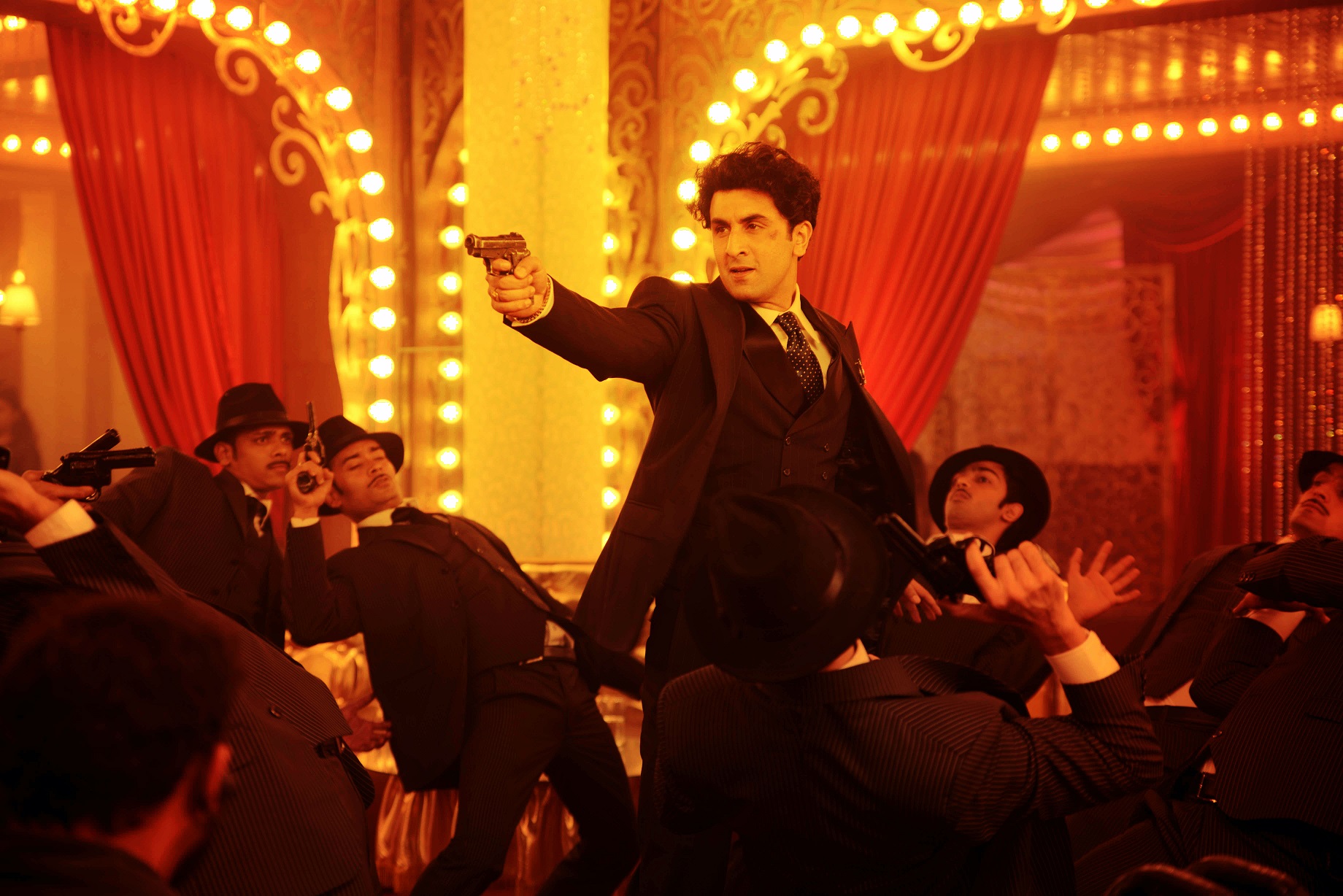
A little boy comes to Bombay, his mother earns a living as a sex worker, he becomes a small-time crook. Then his mother runs away with his ill-begotten stroke of luck (gold biscuits, no less), and he decides to become a big-time crook. The steep rise of the local hoodlum unfolds against the backdrop of the spectacular growth of the city itself, and is clearly meant to echo it. Like Ranbir Kapoor's Johnny Balraj, we're shown a Bombay that thinks it can do better -- be larger, get grander, become what The Roaring Twenties (the James Cagney film referenced here) would call a "big shot". 


With Bombay Velvet, director Anurag Kashyap, too, has made the big filmi film he wanted to make, complete with old-movie childhoods for the hero, heroine and hero's best friend. But sadly, neither this, nor the spectacular visual recreation of 60s Bombay (on an immaculate set in Sri Lanka), nor the sensational jazzy soundtrack, can make this film the epic it wants to be. 


The primary problem is that the characters do not compute. When we first see our hero, he's a cute little boy with an uncanny resemblance to Ranbir Kapoor, shyly, slyly watching another little boy do the dirty: deliberately bumping into a rich man walking past, so as to swipe his wallet. By the time we see them next, roles seem to have been reversed - shy little Balraj has become the mop-haired, ambitious, stop-at-nothing Ranbir Kapoor, while the expert pickpocket Chiman has become his silent sidekick. We never learn quite why Chiman has lost his panache and signed it over to Balraj. The heroine, meanwhile, makes her entry as a little Goan girl with a golden voice. We skate too smoothly over Rosie's journey from singing in church to sleeping in a rich man's bed, and even more quickly over her escape to Bombay, where she works glumly in a beauty parlour by day and sings Geeta Dutt songs -- even more glumly -- in a bar by night. 


And then everything changes again, faster and more inexplicably than before: Balraj fails at a robbery and acquires an unexpected Parsi benefactor, a man called Kaizad Khambatta who is a bootlegger, real estate shark and tabloid editor rolled into one -- Karan Johar, playing himself with a fake touch of evil. Balraj is quite literally picked up from the Bombay streets and thrown up to an enviable position at the city's Art Deco acme. Anointed Johnny, he becomes the manager of a nightclub that is the emblematic centre of everything that 60s Bombay is: Bombay Velvet, a stunningly re-imagined version of the city's real-life Eros Cinema. Meanwhile our nightingale has acquired a Parsi benefactor, too. Jamshed Mistry is Khambatta's oldest rival, and he, too, runs a newspaper. And sure enough, Rosie, too, gets a position as singer at Bombay Velvet. 


So our hero and heroine are ostensibly all grown up, the stage is set for their epic love story - but they seem like they're just play-acting. Other than a single song picturisation ("Dhadaam-dhadaam"), Anushka Sharma's performance as Rosie has neither oomph nor dard nor Goan-ness. There is more 60s sexiness in Raveena Tandon's minute-long appearance as Rosie's nightclub replacement than there is in Sharma's acres of silken costumes. 


As for Ranbir, he imbues Johnny with hotheaded angst, but we never quite get why Johnny's so angry, either with the world or with Khambatta. We're told he willingly gets his face beaten in every night in the boxing ring, even when he's got a job managing the fanciest club in town. But we never really see why. This is a hitman with many murders to his name, pathologically violent - and yet his fights with his girlfriend are almost childish, with none of the brute force one imagines. And to paint this character as a victim, as the film wants to, would take much more doing. Sharma and Kapoor are talented actors, but they clearly don't yet have it in them to transcend themselves. Satyadeep Mishra, playing Chiman, is perhaps the one actor with a major role to convincingly inhabit it. 


But if the depth of the performances is too little, the spread of the canvas is too wide. Like Dibakar Banerjee in the recent Detective Byomkesh Bakshy!, Kashyap and his team of writers (including the historian Gyan Prakash, whose non-fiction book Mumbai Fables is the seedbed of this film) clearly have no dearth of detail. This is Prohibition-era Bombay, where Indians can't get a drink unless they're with a foreigner. It is also Art Deco Bombay, when the young and chic (like Rosie) are moving into multi-storeyed buildings that line the city's seafront. It's the last stage of Back Bay Reclamation, new commercial buildings are being planned, the government is in cahoots with builders and tabloid magnates against mill-workers and union leaders. The film is punctuated with fake tabloid headlines interspersed with real news, and what plot there is revolves around photographs - a 'revealing' advertisement, a blackmail photo that stays secret, and another that gets splashed on the front page. But in trying to capture multiple urban worlds - leisure, commerce, media, politics, crime - the film loses its grip on all of them. 


Bombay Velvet could have been a big shot. But it misfired.