Showing posts with label children's books. Show all posts

10 April 2016

The Strength of the Pack

Today's Mumbai Mirror column

A sparkling new adaptation of The Jungle Book is a chance to take a fresh look at Kipling.


The latest version of The Jungle Book hit Indian screens on April 8, a week ahead of the US. The fact that we get first dibs on the film, however, is about the only concession to 'Indian-ness' here. (I'm not counting the fact that the only actor on screen is a 12-year-old Indian-origin New Yorker called Neel Sethi.) 

Perhaps my brain has been permanently warped by The Jungle Book I grew up on (a lovely hardback with Disney images), but it seems to me a bit absurd to expect Indian-ness from something originally written by a white man in 1895, filmed in English as early as 1942 (by Alexander Korda), and successfully Disney-fied in 1967. 

What we think of when we think of The Jungle Book is Mowgli, a thin brown boy making the forest his own, accompanied by Baloo the bear and Bagheera the panther. But Kipling's Jungle Book was actually several tales, first published serially in newspapers, and only some featured Mowgli. And even those didn't necessarily follow from each other: they had to be stitched into a single narrative. 

In some ways, it was the films that did this work. Korda spent most of his dramatic energy on Mowgli's ambivalent relationship to human society - in Kipling's memorable phrase, the "man-village". It was Walt Disney who created The Jungle Book most of the world now knows: the tale of Mowgli's battle with Shere Khan the tiger, encounters with the Bandar-log and Kaa the snake providing adventurous sidelights. 

Jon Favreau's version, in glorious live action 3D, remains largely faithful to the 1967 Disney film, though it darkens the tone and ups the pace considerably. It is Shere Khan who bookends this version, snarling and sneering to terrifying effect in the voice of Idris Elba, and asking the question that is at some level, at the moral centre of the Jungle Book: "How many lives is a man-cub worth?" Favreau gives the angry, embittered man-eater of the previous film a sharper identity as a tyrant, a power-hungry creature who wraps his unlawful activities in a cloak of hypocrisy and violence: "You did not respond to reason, so now you will know fear." 

On the other hand— not driving Mowgli out of the jungle but trapping him into self-doubt—is Kaa the snake: "Don't you know what you are?" 

And what is Mowgli - this creature who cannot ever be a wolf, no matter how much he tries, but who is too free, too wild to inhabit the world of men?

The idea of a feral child has long fascinated us. Romulus and Remus, mythical founders of Rome, were raised by a she-wolf, and famous cases of wolf-men have been the subject of films by European auteurs like Truffaut and Herzog. 

The appeal of Kipling's tale is that it reverses the perspective to that of the jungle: so not wolf-child, but man-cub. Instead of a return to human society, Kipling imagines what it would be like to be taught the ways of the wilderness. And what has made his text persuasive for generations of children is the richness of his conviction that the wilderness has ways. The Law of the Jungle seems, if anything, more clear, more just, and infinitely more navigable than the changeable codes of human societies. The idea of a Water Truce that would allow all animals to access the river in dry season, or the resounding call to togetherness in "The strength of the pack is the wolf, and the strength of the wolf is the pack": these explain why The Jungle Book's evocation of loyalty, honesty and codes of honour were a huge influence on Robert Baden-Powell, who founded the Boy Scouts. 

Sure, Kipling was a British imperialist in whose eyes there was no possible equivalence between brown people and white ones. But our response to that doesn't have to be a bar on reading him. It's much more profitable to read him critically but carefully, to read him and marvel at his ear for language, and his eye for the Indian world he grew up in. For one thing, he could often be funny. Here he is talking about small boys in Indian villages being sent out to graze the herds: "The very cattle that would trample a white man to death allow themselves to be banged and bullied and shouted at by children that hardly come up to their noses." And here he is making a snarky comparison between human dispute settlement and the jungle version: "One of the beauties of Jungle Law is that punishment settles all scores. There is no nagging afterward." 

If we are to insist on mapping the Jungle Book onto Kipling's real-life surroundings, then the "man-village" would have to be the British, and the jungle representative of Indians. But then we would need to account for the fact that Kipling's man-village, although armed with the ultimate weapon ("the red flower", i.e. fire), is prone to fear and exaggeration. It is the jungle folk who are heroes - not just because they live simply and keep their word, but because they are able to take a man-cub in.

Regardless of whether it challenges or confirms colonial stereotypes, much of the power of the Jungle Book lies in Mowgli's learning how he can belong to the jungle, yet not fear the things that come naturally to him as a man. What Mowgli offers, eventually, is a model of accepting the different parts of oneself.

Published in Mumbai Mirror, 10 April 2016.

5 May 2015

Speaking in Tongues

My Mirror column for 3 May, 2015: 

Why are we so resistant to subtitled films, instead of pouring our efforts into improving their quality and reach?


Mani Ratnam's film, O Kadhal Kanmani, was released in Delhi with subtitles.
Most people, when asked if they read translated books, are likely to say no. Yet, anyone who grew up reading in English has probably read Hans Christian Andersen (originally Danish) and the Brothers Grimm (originally German). They're quite likely to know Heidi and The Swiss Family Robinson - both Swiss-German classics, one from 1880, the other 1812 - not to mention Alexandre Dumas's The Three Musketeers (serialised 1844), and Antoine de Saint-Exupery's The Little Prince (1943), both from French. And The Adventures of Pinocchio, first published in Italian in 1883. And those who grew up in 1980s India are certain to have encountered books from the USSR (hands up, everyone who knows Dunno and his friends, or Baba Yaga the witch and Vasilisa the Beautiful!). 

And these are just the most obvious examples. Given how much of what we read as children was translated, how have we managed, as adults, to nurse a grudge against translated books? Who came up with the depressing notion that they're somehow "good for us" (read: no fun)? It's not an easy question, and there could be many answers. Maybe children are, despite appearances, more open to the unfamiliar than adults? Maybe children's books have less dense description, or simply less text, so translations are easier? 


Whatever the reason for most people's reluctance, it carries over to movies. Most people greet with utter shock the idea of watching a film in a language they don't speak. Or at least think of it as enormously hard work (repeat: no fun). Last month, two perfectly sensible, widely-read people responded to my recommendation of Court with a dubious "But it's in Marathi, no? Accha, it's subtitled?" Also last month, a Tamil gentleman seated next to us during a screening of O Kadhal Kanmani practically fell out of his chair upon learning that we did not speak Tamil. But that was precisely why I was so glad when Mani Ratnam's latest film, which my Twitter and Facebook couldn't seem to stop discussing, released in Delhi with subtitles: how often I've missed a big Tamil release because Delhi theatres ran an unsubtitled version. 


So yes, I don't watch a film if I have no way of knowing what the characters say. In that sense, I totally disagree with someone like Rakeysh Omprakash Mehra, who once dismissed my question about the impact of English on the making of Hindi cinema by declaring that cinema "transcends language". I think language matters in cinema, just as it does in life. But just as in life, while you might not want to live forever in a place where you don't know the language, surely you can't let that stop you from travelling to new places? I've always been an anti-dubber (I hate the weird sense of cultural overlay: the invariably overdone intonations, the mismatched accents - perhaps this is how some people think of translation). But I'm a subtitled film fan. 


I see subtitles as giving me access to a world I wouldn't otherwise enter - but like a polite, well-spoken guide, providing commentary unobtrusively, not drowning out the voices of the locals. If you know the original language, of course, subtitles will always be unsatisfying: like my Tamil-speaking friend who spent the interval telling me how OKK's subtitles were doing no justice to the romantic banter. And because subtitling is often done on a tight budget, many films eat up their characters' words, like that lazy interpreter who speaks one sentence to the speaker's four. (Even the otherwise exemplarily subtitled Court labelled some perfectly intelligible policewomen talking in Hindi as "Indistinct Chatter".) 


The writer and filmmaker Nasreen Munni Kabir, veteran subtitler of some 600 Hindi films (into English and French), is one of the few who've managed to not just specialise in subtitling but be credited for it. She told me that BBC's Channel Four, with which she works, re-subtitles every Hindi film it screens, because the existing ones are usually so dreadful. Another sort of creative response to bad subtitles is that of Bollywood blogger Beth Watkins, who runs a joyously crowdsourced tumblr called "Paagal Subtitles": recent prizewinning entries include "According to the post-modem report" (Holiday, 2014) and "I am surrounded by duckheads" (Mardaani, 2014). 


Watch enough subtitled films and you will swiftly acquire the art of reading while also taking in the image. The only time I'm distracted by subtitles is when I don't need them, or they're in a language I don't know. But there can be unexpected pay-offs: two episodes' worth of House of Cards with French subtitles taught me more conversational French than a semester at Alliance Francaise. 


Of course, as with anything language-related in India, there's the usual elephant in the room: subtitles are only ever provided in English. I have never seen subtitles in any other Indian language -- whether it be for regional language cinema on Doordarshan (or more recently, on Lok Sabha TV), any film festival screening from Kolkata to Trivandrum, or the rare commercial release with subtitles, like OKK or Court, or the much-discussed subtitling of the "Urdu-heavy" Dedh Ishqiya in cities like Bangalore. Although I've long been pleasantly surprised by the varied audience at the International Film Festival of Kerala (and was appalled at Adoor Gopalakrishnan's desire to screen IFFK registrants for knowledge of English), Kerala's level of English-literateness does not extend to most of India. I cannot but agree with film critic Mihir Pandya's long standing suggestion that the government should fund the subtitling of all National Award-winning films each year, into all major languages. That would be a start. How else, really, will we ever listen to each other, outside the tiny echo-chamber of English?

26 October 2014

Picture This: A Different Beast

My latest column for BLink, the Hindu Business Line's Saturday paper: 

Only recently did I see a film that brings the terrible pathology of war home to us through eyes that I have never before considered — those of an animal.

This year marks 100 years since World War I began. There have been several great films made about the Great War, as it was called, until it was superseded (in the worst possible way) by World War II. Some of the most famous of these place us terrifyingly in the midst of battle: All Quiet on the Western Front (1930), or Stanley Kubrick’s withering Paths of Glory (1957). Others, like August Renoir’s humanist masterpiece La Grand Illusion (1937), are set away from the frontlines, in a POW camp. The 2001 film A Very Long Engagement provided the rare perspective of a woman: she does not go to war, but must wait endlessly for one who does.
It was only recently though, that I saw a film that brings the terrible pathology of war home to us through eyes that I have never before considered — those of an animal. War Horse (2011) is adapted by Steven Spielberg from British writer Michael Morpurgo’s 1982 novel for children, into an epic film, whose staging of one marvellous set piece after another somehow rings true. Like the most famous book ever written about horses, Anna Sewell’s still-bestselling 1877 classic Black Beauty, Morpurgo’s book is written in the voice of Joey, the thoroughbred chestnut stallion at its centre. Spielberg’s film does not have the horse speak, but Joey is certainly the unifying element in a cinematic journey that takes him (and us) from the open moors of Devon to the killing fields of France and Germany.
Bought in a stubborn moment of whimsy by a near-penniless farmer called Narracott, Joey starts out as the proud possession of Narracott’s son Albert. In an early scene of man-animal connection that would move the stoniest heart, the teenaged Albert manages to coax the “fancy” young horse into ploughing a field that’s more stone than earth. But this near-magical ploughing is not nearly enough to end their run of bad luck, and the elder Narracott ends up selling Joey to a soldier (Morpurgo has spoken of how he was inspired by an old man he met in a pub who had worked with horses in the Devon Yeomanry regiment, and another who remembered Devon villagers selling horses to army men).
It is through Joey’s eyes and ears that we catch our first glimpse of an army camp, and the windswept madness of the first cavalry charge at Salisbury Plain. Watching him sail into battle with his new owner, the youthful Captain Nicholls, it is suddenly clear that no soldier can charge if his horse doesn’t want to. There must be an uncanny unity between horse and man. Spielberg’s staging of the battle scenes is enormously powerful, conveying the carnage of war without being gory, often simply by showing us how the harmony between man and animal is continually broken and renewed. We do not see Captain Nicholls die, but we see a riderless Joey flying over the cannon fire into German hands, and we know.
In the German camp, Joey and Topthorn, his jet-black companion from the British side, are adopted by two teenage brothers, who on being ordered to separate, decide to desert. In one of the movie’s most affecting scenes, the brothers are found and shot; we watch their time run out from behind the slowly turning blades of a windmill. Having watched Joey refuse to be separated from Topthorn, one cannot help but think of the poor dead boys as young colts, who were only trying to stay together. And as the film progresses, and you watch the horses turned into cannon fodder as much as the men in trenches, further forms of equivalence emerge between man and beast. The war is an insatiable ogre that demands fresh meat, both human and animal.
In a magisterial 1977 essay called ‘Why Look at Animals’, the critic John Berger pointed out that animals were not just man’s first companions, but also our first symbols, our first metaphors. As the anthropologist Claude Levi-Strauss famously explained, the human practice of using animals as totemic symbols for different tribes emerged because the visible differences between animal species made them “good to think with”. Berger cites Homer’s Iliad, one of the earliest human texts we have, as full of examples where human qualities are evoked through comparisons with animals: “Menelaus bestrode his body like a fretful mother cow standing over the first calf she has brought into the world.” Or “He was like a mountain lion who believes in his own strength...”
One could multiply examples. Think of the many yoga asanas derived from the postures of birds and beasts — bhujangasana, cobra pose; marjariasana, cat pose; vyaghrasana, tiger pose; bakasana, crane pose; kakasana, crow pose — the list is endless. Or American Indian names, that emerged in a world where the only references were natural, giving us ‘Bear making dust’, ‘Wild dove’, ‘Salmon whose head rises above water’ or ‘Coyote with long ears flapping’.
Today anthropomorphism may feel embarrassing, but that awkwardness arises from the fact that we no longer live with animals. The post-industrial world is a world shorn of animals, barring the purely spectacular domain of the zoo or the fetishised domesticity of pets. To watch War Horse is to enter, however briefly, into a world where an animal’s face could still hold up a mirror to the human condition.

3 August 2014

Angry River

In May 2014, I wrote this short text for the photography quarterly PIX. The theme of the issue was Habitat (downloadable for view here) and the images my text accompanied were from a superb series called Life on Water, by the young Bangladeshi photographer, Rasel Chowdhury. My text as well as some of Chowdhury's exceptional images, below.

“It was over twenty years since the river had flooded the island, and at that time no-one had lived there.” So went one of the opening lines of Ruskin Bond's remarkable children's classic, Angry River. As a city child, the book was my first inkling that a river wasn't only what lay below the Howrah Bridge: flat, grey, unmoving. A river could be alive. It could be angry. And it could be beautiful.

Photo: Rasel Chowdhury
Looking at Rasel Chowdhury's images of the 2012 floods in Bangladesh's Kurigram District, it was Angry River I remembered. I thought of Sita, the little girl-woman through whose eyes we watch the river's terrifying transformation. In the morning, the water is muddy instead of green, and her favourite rock has disappeared, “the one on which she often sat dangling her feet... watching the little Chilwa fish swim by.” By noon, the water has oozed its way into the hut, and a horrified Sita climbs into the big peepul tree. But as the water rages around it, “a dragon on the rampage”, the old tree gives up its grip on the earth.

Sita, clinging to the tree, is set afloat on the swirling water. But what is remarkable is that Bond chooses to evoke awe rather than plain fear. His river is an elemental force against which it would be foolish to struggle, but it is also the giver of life. It is the river that gives Sita's grandfather his fish, and the silt it leaves in its wake is where the villagers grow their vegetables – and Sita her mango tree.

Photo: Rasel Chowdhury
Chowdhury's images, too, have that strange quality of calm. A tubewell in a surging sea makes human efforts look foolish. But people are not fleeing the river's rage. They do not fight the water; they inhabit it. Boys appear to be preparing to fish as they wade through waist-deep water. Women stand stoic, even striking a pose for the photographer. Two men stretch out on the roof of a submerged house.

Photo: Rasel Chowdhury

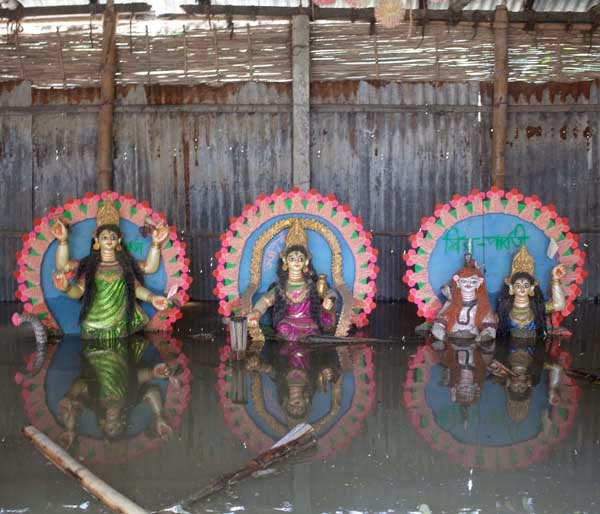
A horse stands still, and waits. There is a sense that this is temporary. Books wait expectantly in the flooded schoolroom. But what will be, will be. Even the gods seem resigned to an early immersion.

Photo: Rasel Chowdhury
Perhaps, like them, we assume that the river's wrath will recede, and then the world will be reborn.

“We are part of the river,” says the boy who rescues Sita. “We cannot live without it.” 

Published in Pix Quarterly, Volume 10, May 2014.

16 February 2010

The Quiet Riot: Dibakar Banerjee profile

The middle class loves Dibakar Banerjee’s films. If only they knew that this is unrequited passion.


The first thing Richa Puranesh, Dibakar Banerjee’s wife of eleven years, remembers about him is his introductory line: “Hi, I’m Dibakar. I’m going to make films.” They were both in advertising then, and Richa remembers saying, “Right. Television commercials…?” To which Dibakar responded, with an air both casually explanatory and utterly certain, “No, films. The kind that Satyajit Ray makes.” Sitting in his 18th floor Parel apartment some fifteen years later, Dibakar Banerjee, highly-feted director of two of the most layered, thoughtful Hindi films of the last decade, Khosla ka Ghosla (2006) and Oye Lucky! Lucky Oye! (2008), laughs an embarrassed laugh.

It is tempting, especially when you know what happens in the end, to create an epic back- story. But Dibakar Banerjee is not the man to take the easy way out in any narrative, least of all an autobiographical one. He denies emphatically the self-confidence of that anecdote. “It sounds very glamorous, very determined. But nothing could be further from the truth,” he says. In a recent blog post, he has bluntly refused the romance of the struggle: “No one had it easier than me… I didn’t sleep on the platforms in Bombay, didn’t cart around my dog-eared script to various stars fresh out of make up in Juhu. I didn’t even call a producer. All I had were some silly ideas and a lot of arrogance...”

Dibakar’s story does start out quietly: a bright Bengali boy growing up in Delhi’s New Rohtak Road. It was an insular upbringing, in the way that a Bengali middle class upbringing can be, especially when your classmates are the North Indian children of West Delhi businessmen. The rest of the world is money-minded (“don’t play with them”), you’re told, while being drilled in what writer Amitav Ghosh once called “the jungle-craft of gentility”: the barely-hidden hysteria about academic success. Because “it would take just a couple of failed examinations” to end up over there, on the street. Dibakar was the model child: he topped his class, he won interschool quizzes, he learnt the tabla. But things didn’t stay smooth long. “In Class XI, his principal called me and said, Mr. Banerjee, Dibakar has failed in all subjects!” The stunned father swiftly put his son through a rigorous tuition routine, and Dibakar managed a 74% in Class XII. He also signed up for Agarwal Tuitions for the joint engineering entrance examinations and trotted off, several mornings after his Boards, to take the tests.

But secretly, he had applied to study Visual Communication at the National Institute of Design (NID), and once he made it, managed to persuade his befuddled parents to let him go. It was a few days after Dibakar had left for Ahmedabad that the engineering entrance results arrived. A friend happened to call his mother, who expressed her puzzlement that her son had gone off to this strange design thing when he’d got an A in every entrance test. “Aunty, A ka matlab hai absent,” the friend said, laughing. Dibakar hadn’t attended a single exam.

“He said nothing, but always did exactly what he wanted,” says his mother. She laughs now about finding an NID entrance form that asked: “Do you obey your parents?” and Dibakar’s response, in big bold letters: “NO”. But neither she, nor his father, were amused when, two and half years after having insisted on going there, Dibakar dropped out of NID. “My parents were pretty shocked. In achiever Bengali families, you do academically well. You don’t get chucked out and come back home,” says Dibakar wryly. His father somewhat shamefacedly admits to taunting his son as he sat around at their Ashok Vihar home, silent and bespectacled, seeming to do absolutely nothing: Since he was so clever, since he’d decided that he had nothing left to learn, what was he going to become: a Rabindranath or a Satyajit?

It took seven months before Dibakar found a job, as a trainee with a corporate film and AV maker called Sam Mathew. “Within one year, he was drawing 20,000 rupees,” says his father. Dibakar became first a copywriter, then a Creative Group Head for Contract Delhi, a subsidiary of ad major JW Thompson. It was at this time, around 1992, that he met Jaideep Sahni. Jaideep was brought in as the head of a competitor group, but Dibakar and he hit it off from day one, brainstorming on campaigns “across the partition”, physical and metaphorical. “We soon formed a firm alliance against the rest of the world,” laughs Dibakar. In 1997, both left the company, within months of each other. Dibakar started an ad film company called Watermark with two ex-NID friends, while Jaideep moved to Mumbai to work with Ram Gopal Varma on the script of Pyar Tune Kya Kiya, Jungle and later Company. “I used to miss him a lot. I’d call and say ki tu hamare saath aake kaam kyon nahi karta yaar?,” says Dibakar.

What happened eventually was the opposite. In 2002, Jaideep, ostensibly fresh from the success of Company but in fact increasingly unsure about whether the industry would ever allow him to write the kind of films he wanted to, called Dibakar. Savita Raj of Tandav Films, “essentially a Delhi-based ad agency”, wanted to produce a film about generation gap. Would he direct? Dibakar jumped at it, but it took four years of hard work and harder waiting (the grilling, tightly-budgeted, 45-day shoot was the easy part) before Khosla ka Ghosla saw the light of day. UTV finally decided they’d take it – on a second viewing that Boman Irani might have had something to do with – and from there on, things were smooth sailing. UTV even decided to co-produce Dibakar’s next project, Oye Lucky! Lucky Oye!

People who’ve watched both Dibakar’s films are often at a loss to reconcile them. Khosla’s deep identification with a middle class, with being “decent people”, seems irrevocably at odds with Oye Lucky’s merciless indictment of the hypocrisy of that very class. Dibakar himself is clear-eyed about what each film is doing. “The only thing patently false about Khosla is its climax – but that’s what also made it the darling of the middle class,” he says carefully. He describes an alternative ending, where the Khoslas, having failed to get back their plot from the swindling Khurana, join their son Cherry in the US visa queue. Jaideep remembers being “extremely attracted” to that ending, but ultimately persuaded Dibakar that no one was going to come and watch a film which didn’t give them something to hold on to.

The ‘born-again Hrishikesh Mukherjee’ tag is something Dibakar threw off with Oye Lucky, where a thief is betrayed by a respectable, smooth-talking doctor. He takes savage delight in having subverted the attempt to slot him as a clean, family entertainment sort of guy. “You’re a good filmmaker, you stay in the multiplex where good audiences with good taste come. The rabble can watch the Bollywood extravaganzas,” he says in a cutting imitation of our arbiters of taste. It’s clear that Oye Lucky’s darkly comic vein runs much deeper than the gentle laughter of Khosla. “He used to write Bengali verse, chhora. It was funny, but always satirical,” says his sister Mallika, eight years older. She recalls a poem he wrote as a ten-year-old about a zamindar whom no food can satisfy. The poem ended with the chilling phrase, “Shob theke bhalo khete goriber rokto” (What’s most delicious is the blood of the poor). [Dibakar later corrects this fond sisterly account, saying the line wasn't one he wrote himself but one he took from a renowned Bengali poet.]

It comes as no surprise to see that acerbic gaze directed at his own audience. “I know that many who like Oye Lucky actually laugh at the characters, not with them,” says Dibakar sharply. He himself may have an OSIAN’s audience in splits with his rendering of a Delhi Jat accent versus a Meerut accent, but as Richa Chadda (Dolly in Oye Lucky) puts it, “his characters never come from a space of mimicry.” Everyone has a context, a reason for being. The foul-mouthed Dolly who dances for a living but keeps a Tuesday vrat is as searingly observed as her sister Sonal, who won’t touch stolen money (or Dolly when she’s drunk), but quietly accepts her burglar boyfriend’s gifts.

Dibakar’s vivid eye and ear for worlds beyond his own owe much to the Bengali childhood mentioned earlier. It may have been insular in some ways, but it was also richly eclectic, immersed in a post-Nehruvian cultural universe. His mother, a municipal school music teacher and Hindustani vocalist, turned on Vividh Bharati’s Lok Sangeet every afternoon (planting the seed of Oye Lucky’s stunning folk music track, for which Dibakar wrote magnificent lyrics in Punjabi). Daily family music sessions embraced everything from Rabindrasangeet and classical to folk and film songs. The same omnivorousness extended to films (everything on Doordarshan, from Aan Milo Sajna to Jean Cocteau) and books: devouring the Hindi Champak and Nandan alongside the Bengali Shuktara and the racy pulp his grandmother borrowed from Bangiya Sansad Library. At fourteen, he made a storyboard of Bibhutibhushan’s adventure classic Chander Pahar (Mountain of the Moon) – in English translation. Dibakar remembers the linguistic shift to English as propelled by a quest for “higher knowledge”: looking up Brahms and calculus in the school library’s Encyclopaedia Brittanica. NID opened up a world “five times as big”, introducing him to rock and blues, history and anthropology, American Cinematographer, Bladerunner and Istvan Szabo. By the time Jaideep Sahni met him, “Dibakar had seen every film ever made.”

For someone so rooted in place and time, Dibakar is surprisingly unwistful about his move to Mumbai. “Delhi is about communities, stereotypes, mentalities. Bombay is about work, money, living spaces: pure lebensraum. It has an urban politic I’m excited by. And in any case, Delhi is a depressing place for a filmmaker to be.” As always, Dibakar’s grasp of the essentials is acute, unsentimental. He is matter-of-fact even about being nostalgic. “My kind of filmmaking depends on local detail to intensify the drama. Though if you psycho-analyse me, you might find I make films to capture what is gone,” he muses. He wants to make the films he does, but he doesn’t want to lose money on them. So he plans his budgets and runs an office that makes ad films on the side. And just when you think you’ve pinned him to down to a genre or locale, he ups and moves on to something else.

The edgy, digitally shot, Love Sex aur Dhokha, to be released this March, promises a raw, unapologetic take on love in the time of the media. LSD’s three interwoven tales, involving a suicidal sting journalist, a security camera company executive and a film institute student, reveal a world where desire is no longer pure or intimate, tinged as it is with exhibitionism on the one hand and voyeurism on the other. And yet these are love stories. Like the man – and unlike so many of his cool contemporaries – his films manage to be both riotous and thoughtful. As always with Dibakar Banerjee, cynicism is layered generously with humour, the humour layered with love, and so on until the circuit closes. One wouldn’t have it any other way.

From Tehelka Magazine, Vol 7, Issue 07, Dated February 20, 2010