Showing posts with label Salman Khan. Show all posts

13 December 2019

The Catholic Dress: Bombay to Goa and Back

My Shelf Life column for TVOF:
 

The dress-wearing Catholic girl was an object of Indian male fantasy, but as Jane Borges’ Bombay Balchão makes clear, the reality was more complex than the stereotype


At the beginning of her just-published debut novel Bombay Balchão, the Mumbai-based journalist Jane Borges sets us down in the Catholic neighbourhood of Cavel on Christmas Eve 1945. Before we hear the midnight mass, we hear of Karen Coutinho, whose tailor Francis (“from John D'Souza and Sons”) has made her “a long yellow silk gown, which swept the road as she walked to church”, and of her husband Alfred, who is glad that his wife’s gold lace mantilla covers her “heavily powdered face and the crimson lips she had painted with cheap lipstick”. And we hear, almost simultaneously, of the Hindus on Dr D' Lima Street who “sneakily peered from the gaps between the iron rods of their windows, gawking at the dressy Christian women”. 

Borges doesn't dwell on her wartime setting, but a 2017 piece on 'aunty chic' by Cheryl-Ann Coutto published on Scroll points out that knee-length skirts were a wartime trend for economic reasons. “There was rationing, food coupons, there was less food, less cloth and so the hemlines too were shortish,” an 80-year-old Elettra Gomes tells Coutto. “Then after the war ended, Christian Dior came out with calf-length swirling full skirts and tiny cinched waists [this lavish, ultra-feminine aesthetic... became known as the New Look]”.

But even if the length of Karen Coutinho's gown could have been seen as a legitimate post-war luxury, Bombay Balchão makes it clear that she was up against other forms of moral censure: such as the local Hindu patriarch accusing Christians of having “sold their souls to the gori chamdi” (white skin) by dressing like Europeans--at a time when the Gandhian campaign for Khadi was at its acme.
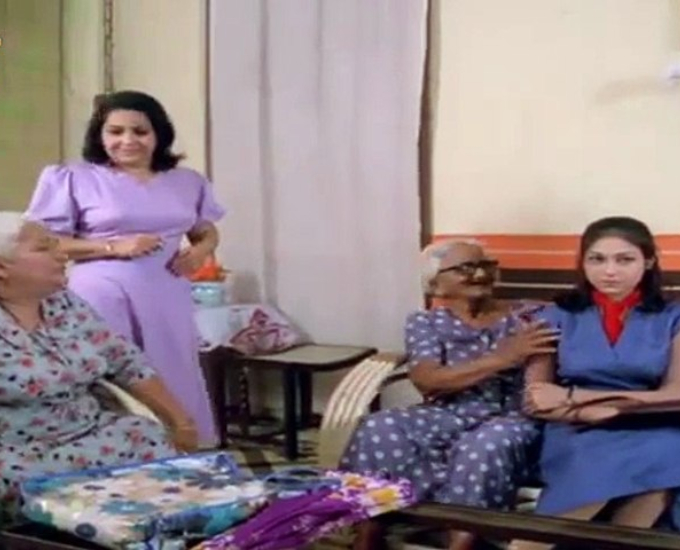
A still from the film Baaton Baaton Mein.

The real source of censure, however, lay far deeper than nationalism or economy. Bombay's Catholic women – whether the East Indians, as the original Catholic inhabitants of Bombay and Salcette called themselves, or the Goans who came to the city later–were invariably marked by the wearing of dresses. 
 
By exposing the legs to view, and simply by fitting around the female upper body, the dress seems to have sparked the sexual imaginations of generations of Indian men whose own wives and daughters were never without the protective drape of the pallu or the dupatta. Borges writes, “In the darkness, numbed by furious lovemaking, (the Hindu man) would latch on to his wife's waist, and in between suckling her breasts ask if she would wear one of those dresses, just for him. She would agree coyly, but as an afterthought dredge up the same feeling her husband had exposed in front of the family when he saw the Christian women strut on the roads.” That particular Hindu male fantasy made its way firmly into Hindi cinema via such depictions of Catholic girlhood as Raj Kapoor's Bobby and Basu Chatterjee's Baaton Baaton Mein, and lasted well into the 1980s, when Salman Khan made that 'secret' dress-wearing request of his long-haired, 'traditionally Indian' heroine Bhagyashree in the epoch-defining Maine Pyar Kiya (1989).

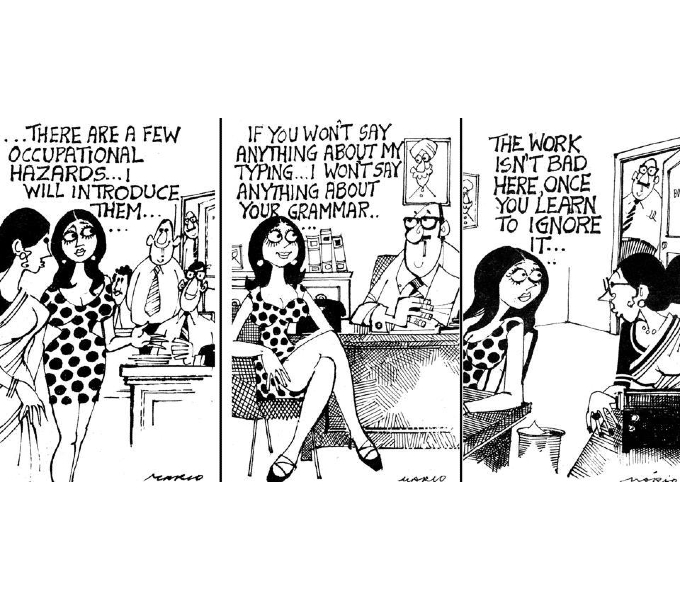
“For repressed Maharashtrians and Indians like me, Jesus Christ, this was where heaven began!” declared the late Kiran Nagarkar in Paromita Vohra's charming short film Where’s Sandra?, which addresses the precise question of what the office-going Bandra girl represented to the rest of the city. One of the real 'Sandras from Bandra' that Vohra tracks down makes the crucial point that the Christian girl was the object of Indian male fantasy also because women from most other urban Indian communities weren't allowed to go out to work. The Christian secretary in the form-fitting dress became embedded in the collective Indian psyche, with even such pillars of the Goan community as cartoonist Mario Miranda essentially reinforcing the stereotype with his polka-dotted Miss Fonseca.
The dress-wearing Goan Christian secretary was immortalised by cartoonist Mario Miranda in the busty figure of Miss Fonseca.

Of course, the stereotype of the Christian girl as open in her morals didn't quite fit the facts. Bombay Balchao is full of Catholic boys bemoaning their fate while the Catholic girls they're dating scratch them for trying to sneak a kiss. In Vohra's film, too, the late poet and professor Eunice D'Souza argues with efficiency that the Christian family and school-going milieu could be as orthodox as the non-Christian ones, policing female sexuality with just as much middle class paranoia. Dress-wearing was no marker of (im)morality. 

Not all Christians wore dresses, either. For instance, the Portuguese insistence “that converts adapt to the European style of dressing” led to such innovations as the pano bhaju, which Borges calls a “middle ground” created by orthodox Brahmin women. Now 'traditional' when dancing to sad Konkani love songs called mando, this particular Goan Christian outfit consists of a sarong-like lower garment (pano), worn with a loose gold-embroidered blouse (bhaju) and a stole called the tuvalo. The hybridity is India at its best: the pano draws on the South Indian lungi/mundu/veshti, the bhaju is Portuguese, while the gold thread work owes something to the Mughals. 

One of the pleasures of Borges' book is its mini-ethnography of Bombay's different Christian communities. The Goans and East Indians express disdain for the Mangaloreans as calculating, not so comfortable with English, not good dancers or good at Western music. The Mangaloreans, meanwhile, saw the Goan absorption of Westernised mores as a cop-out, too easy a surrender to their colonial masters. Mangalorean rebelliousness, not surprisingly, was expressed most vividly in their women's clothes: the community may have converted to Christianity, but the women still wore their heavily embroidered sarees and jasmine venis (floral garlands) in their buns – rather than floral dresses and bouffants.

Beyond Bombay, too, the dress-clad Christian working girl was the focus of Hindu male anxiety: think of the Anglo-Indian Edith, who becomes the heroine Arati's office colleague and then friend in Satyajit Ray's Mahanagar. For the two Calcutta women, lipstick marks a bond between them. For the Hindu husband waiting edgily at home, the same lipstick becomes emblematic of the 'corruption' of his wife. Clearly, as non-Christian women ventured tentatively into the workforce, the dress-wearing Christian girl was now a terrible threat. For on what women wear, as always, the whole burden of civilisation comes to rest. 

Thankfully, as Vohra suggests, Sandra the stereotypical good-time girl doesn't have a reason to exist anymore. Because we all a have a bit of Sandra in us now. Something to think about each time you wear a dress – and can even let the camera see you in it, unlike Bhagyashree.


12 June 2019

Mr. Bharat in Bandra

My Mirror column:
Watching the new Salman Khan film at Galaxy Cinema makes the national feel local, and vice versa.

The crowd outside Galaxy Cinema, Mumbai (Photo by Trisha Gupta)
As an outsider who writes about Hindi films, a visit to Mumbai always makes me think: is it Mumbai that created Bollywood, or is it Bollywood that makes the city what it is? The answer is, of course, both. Not only is the history of the city entwined with the film industry to which it lends its name, so is its geography.

Arriving a day after Eid, I found myself in the midst of extended festive revelry in Bandra: an actual Eid Mela, but also a large Muslim family crowd out by the seafront. When I remarked on the late night crowd, my Bandra friend pointed around the corner, and said, as Mumbai people do, “Salman’s house is just here,” with that wonderful first-name intimacy that is directly proportional to a star’s stardom.

Going to see Salman Khan emerge onto his balcony is an Eid pilgrimage specific to Mumbai: A combination of filmi fandom and religious festivity now written into urban space. At one remove from that is going to Gaiety-Galaxy to watch a new Salman Khan film release. I decided it was time for Bharat.

The energy outside G7 Multiplex, as the old Bandra cinema is now officially known, was palpable. Several people posed in front of the poster. There were many women in large family groups, but the multiple all-male groups ahead of me led the man doing the manual frisking to reach for my hips on autopilot. It was only when his older colleague yelled that the errant checker realised: Cargo pants do not make a man.

When I bought my ticket online, there were just nine seats left. At the cinema, it was clear that many tickets ‘sold’ hadn't yet reached their final owners. Two middle-aged men, sweaty in shirtsleeves, were advertising their wares: “Bhaaarat, Bhaaarat, Bhaaarat.” The balcony was half-empty, but the cheers that greeted the entry of the 70-year-old Bharat were still loud enough to drown out the dialogue. By the interval, the hall had filled.

Mumbai may be where the popular screen idea of India is created, but the milieu in which that quintessentially Indian hero operates is still North India, and increasingly often, Delhi. Bharat, too, opens with a grand top shot of the Red Fort, and moves into a very stagey Old Delhi, specifically a shop called Hind Ration Stores. Once owned by Bharat’s bua and phuphaji (Ayesha Raza Mishra and Kumud Mishra, fine actors both wasted here), it now belongs to our 70-year-old hero, who is adamant about hanging on to it in the face of redevelopment sharks trying to buy him out. By the end, he lets it go.

Bharat’s reason for clinging to the store – and later, letting it go – is the crux of the film’s emotional narrative. Adapted from 2014’s massive Korean hit Ode to My Father, Ali Abbas Zafar’s film is a sort of Forrest Gump-lite that takes us from 1947 Lahore into present-day Delhi using a voiceover that feels like Historical Highlights for the (Post-)Millennial Viewer. The death of Nehru (turned into a lame Salman joke) segues into a period of high unemployment, allowing for long detours that send Bharat and his best friend Vilayati Khan into an unnamed oil-rich Gulf country and the Merchant Navy. These attempts to connect with the Indian expatriate worker have our hero battling white racism on one hand and conquering the hearts of black sea pirates on the other. We even get to liberalisation, for which, happily and almost surprisingly in our current political climate, Manmohan Singh not only gets credit but is declared a national hero – as are Sachin Tendulkar and, in rather generous spirit, Shah Rukh Khan.

It's interesting how often Salman Khan films seem to engage with national borders and wars, from spy romances like Ek Tha Tiger and Tiger Zinda Hai to Tubelight, which featured the Indo-China war, to Indo-Pak dramas like Bajrangi Bhaijaan. The sole affecting parts of Bharat, too, involve Partition, which forever separates the child Bharat from his father and little sister. It's to enable that lost father (Jackie Shroff in a guest appearance) to return that Hind Ration Stores must continue to exist.

Towards the end of Bharat, we get a televised cross-border unification of families devised by Katrina Kaif's character, who's gone from being a Salma Sultan stand-in on “Desh Darshan” to "creative head" at Zee TV. Despite the corny fakeness of the TV show-within-the-film, the real memories of subcontinental audiences make sure we get teary.

At one point, Bharat drops a bit of global-style Indian wisdom: Any world problem can be sorted with baat-cheetpyaar and Hindi film songs. Perhaps I'm pessimistic, but as I watched the rows of sad-faced citizens of India and Pakistan on the film's imaginary TV show, holding Hindi and Urdu placards naming long-lost family members, all I could think was that neither side can any longer read the other's script.

Still, if the hero of a top-grossing Hindi film in 2019 manages to leave the ghost of Partition behind, maybe there's hope for the rest of us.

5 January 2017

Men on the Ropes

My Mirror column

Dangal grapples with wrestling’s tradition of masculinity — and Indianness.


On the simplest level, the tale told in Dangal is an inspiring, heartfelt one — of women entering an arena traditionally reserved for men and not just surviving but making a mark. The two young women whose journey the film tracks — Gita Phogat and Babita Kumari — are a beacon not just of bodily discipline, but of the struggle against mindsets. Their lives are a window through which we catch a glimpse of a possible new world: the world as it might look if girls in North India were treated the same as boys.

At another level, though, Nitesh Tiwari’s film (not unlike Ali Abbas Zafar’s Salman-Khan-starrer Sultan earlier this year) is a carefully calibrated engagement with masculinity, femininity and nationalism (not necessarily in that order). And it is no coincidence, it seems to me, that the chosen site of that engagement is wrestling.

With links to royal patronage and feudal elite sponsorship, writes the anthropologist Joseph S. Alter in his study of wrestling culture in North India, wrestling has a long history in this part of the world. And although wrestlers earn prize money at the regional, state and national levels, it is not the professional sporting academies but the informal local akharas — public institutions often run on gifts, neighbourhood chanda collection and charitable donations — that feed the widespread popular interest in wrestling.

Both the wrestling films I am speaking of have taken on board the sport’s in-between, possibly ambivalent status —as something local and deep-rooted and organically Indian, but also tragically undervalued by the very national custodians of sport who should be propping it up. In both the fictional (Sultan) and non-fictional (Dangal) narrative, of course, the assumption is that this indigenous sporting tradition will finally acquire value by being showcased on the world stage.

Onwards to masculinity. “Wrestling in India (pahalwani) is a sport engaged in exclusively by men who are extremely concerned with the nature of their masculinity,” writes Alter. Any woman who has ever tried to enter an akhara (a gymnasium in which pahalwans practice) knows that it is well-nigh impossible to be allowed in, even just to watch. Just last July, at a small but reputed akhara in Shivajinagar in Bangalore, I was curtly told to stand outside, while my male companion — as much of an outsider there as I was — traipsed happily in. (Dangal’s titling images of real-life young wrestlers — large, serious-faced boys in langots — are thus a rare equal-opportunity sight.)

The point, however, is that keeping women out of the akhara is not just a regular form of gender injustice; it is entwined with traditional beliefs that have shaped wrestling in the subcontinent. This is a culture of masculine excess, simultaneously bombastic and threatened, driven by an obsession with celibacy, disciplined self-control and the retention of semen — all only achievable by steering clear of the poisonous temptations represented by women. As one old pahalwan says to Aamir Khan’s Mahavir Singh Phogat when he seeks training at the akhara for his daughters, “Is umar mein paap karvaayega ke?” 
The ideological links with certain traditions of Hindu asceticism should be clear. 

Less obvious — but more fascinating — is how wrestling is seen by its practitioners as a form of self-perfection in the service of the nation, and the way that self-construction might connect to Gandhi’s pushing of the celibacy ideal as part of nation-building.

So it should not surprise us that in what is arguably the most bombastically hypernationalist year independent India has yet seen, the Hindi film industry has given us not one but two films about wrestling. What’s interesting is that both Sultan and Dangal chose to engage with the figure of the female wrestler, rather a rare species in real life. In both, the women bear the burden of their father’s ambitions — and they come out shining, so long as they keep their sexuality at bay.

In Sultan, the educated daughter (Anushka Sharma) returns to the village to represent her father’s akhara and increase its status; she does very well in her appointed task, until love, marriage, and an ill-timed pregnancy comes in the way of her winning a world title. In Dangal’s retelling of the Phogat sisters’ lives, it is their ex-wrestler father Mahavir who makes the decision for them. Among the most emotive scenes in the film’s first half is the way the girls are coaxed and coached out of girly-ness. In what feels like a radical role reversal for a man who is otherwise a standard-issue rural Haryanvi father with traditional expectations for women, Mahavir practically forces his daughters to wear shirts and shorts, wakes them up at five every morning for a gruelling fitness routine, and in a gutwrenching scene, has the barber chop off their hair.

The plot of Dangal’s second half, in fact, turns on Gita’s becoming distracted from her appointed purpose in the world — wrestling — by relaxing into the ordinary femininity that was wrested from her as a child. Growing her hair, watching romantic Bollywood films, and generally acquiring a consciousness of herself as a woman is apparently enough to make her lose her edge as a wrestler.

Perhaps it would be incorrect to call Dangal a defense of celibacy, but certainly its deep suspicion of femininity owes something to wrestling’s particular history of (un)sexuality.


Published in Mumbai Mirror, 25 Dec 2016.

17 July 2016

Wrestling with shadows

My Mirror column:

Sultan is a vehicle crafted for the Salman Khan persona. Our responses to it will be inescapably shaped by that.

A still from Sultan, starring Anushka Sharma and Salman Khan
There's a moment in Sultan when Salman Khan, as the film's eponymous prize wrestler Sultan Ali Khan, after a series of spectacularly bare-faced product-placements doubling up as fictional advertisements, faces the camera and pronounces that he's done enough: “Pehelwan hoon, actor nahi. [I'm a wrestler, not an actor]” It's a scene only Salman Khan can pull off – highlighting his brawny image in the guise of self-deprecation; cocking a snook at critics who might dare suggest that acting isn't his strongest suit, while laughing all the way to the bank.

Ali Abbas Zafar's film about a celebrated wrestler's fall and rise has provided Khan with yet another opportunity to play a variation on his own myth. Given the “bachcha hai, maaf kar do” remarks that greet the 50-year-old superstar's every real-life crime and misdemeanour, the film's presentation of Salman's character -- as hot-headed but pure of heart, eminently fallible but eventually forgiveable, channelling emotion into violence -- feels rather too close for comfort.

Sultan is the prototype of the childish man, whom we must not just absolve but actually applaud for his childishness: “Mera pyaar pakka hai, jaise tera bachpana saccha hai (My love is strong, just as your childishness is true),” says Sultan's estranged wife Aarfa (an impressive Anushka Sharma) as she accepts him back.

Aarfa, on paper, is a textbook 'women's empowerment' character: a sharp talker with impressive wrestling moves and more impressive ambitions. The only daughter of the village pehelwan (Kumud Mishra), Aarfa gets an education in Delhi, but returns to carry on her father's legacy, to represent his Jaanbaaz Akhara to the world. And even as Sultan remains stuck at the standard-issue combination of stalking and relentless hopefulness that is apparently to be accepted as the Indian male's repertoire of wooing tactics, Aarfa departs from the Hindi film heroine's usual imagined response. No coy surrender for her. What we get instead is an impassioned speech about how falling in love with someone is based on admiring them in some way -- and Sultan's clowning doesn't quite cut it. There is a subtext here about love between equals. And yet the film steers clear of making its man-wrestling heroine ever wrestle its hero.

Because this is a film that has carefully calibrated how far it wants to travel up this path. So Aarfa's perfectly justified pronouncement is treated by Sultan as an insult -- and a challenge. It is what incites him to become a wrestler. But while his unprecedented success earns him Aarfa's admiration and love, his return gift to her is an unplanned pregnancy which puts an end to her World Championship dreams. Hindi film viewers have seen pregnancy come in the way of a female athlete's career before, in the biopic Mary Kom. But unlike there, or the recent Ki and Ka, flawed as both films were, Ali Abbas Zafar's narrative has no interest in its heroine's response. So caught up is it with Sultan's point of view that Aarfa isn't given even a single line through which we might imagine how it might feel to crush her ambitions underfoot on her husband's victory march. It is to Anushka Sharma's credit that she manages to make her teary smile (as she watches her husband celebrate the impending arrival) radiate something more complicated than joy.

And of course, it can't be motherhood that she has any ambivalence about, so the film creates a way for her to be the stubborn match to Sultan while also displaying her womanliness. It is not that Aarfa isn't a believable character, sadly, she is. So I suppose my frustration must be explained by Sultan's response to a journalist who asks why his wife left him: “Lugaiyan paida hi ladaai karne ke liye hoti hain.”

The second half of Sultan, which drops the inane gags for a succession of dramatic wrestling matches, is much more watchable than the first, though it does lay on the Salman body-building and sacrifice stuff a bit thick. But then that's true of the film as a whole. For instance, the recurring trope of Sultan as turning himself into a saand, a bull who cannot be broken. Those words are actually used to describe him by his coach (a believably cynical Randeep Hooda). The theme is underlined by the portrayal of Sultan as a man who achieves the impossible twice, out of stubbornness – or to put it exactly, bull-headedness. But what's interesting is how the visual imagery reiterates this idea of Sultan as a bull: not wild, but a strong beast of burden. Sultan's first attempt to train himself involves strapping himself to a wooden plough and dragging it through the fields; later he pulls a tractor, and a cart.

There's some heavily-underlined dialogue about the kisaan and the pehelwaan to add to this. And a dose of present-day patriotism is thrown in, with Parikshit Sahni's mild criticism of his English-speaking son's generation for thinking everything imported is cool. The son-of-the-soil as the underdog who trumps the firangs (white and black, though the final defending champion is of course, white) is a crowdpleasing theme if ever there was one – though of course his desi wrestling style only becomes a buzzword when he's forced to abandon its rules for a televised freestyle contest. As Zafar manages to make his Haryanvi Muslim protagonist say at a moment when he seems at a loss for words: 'Bharat mata ki jai'.  

Published in Mumbai Mirror, 17 July 2016.

18 November 2015

Double the Silliness: on watching Prem Ratan Dhan Payo

My column for Mumbai Mirror last Sunday: 

Sooraj Barjatya's ‘Prem Ratan Dhan Payo’ gives us all the things Hindi movies have always wanted from a true blue double role. And from a Salman Khan film.
   

A couple of days before I watched Prem Ratan Dhan Payo, the flipping of channels landed me in the middle of a 1972 hit called Raja Jani. In it, Dharmendra is an alcoholic called Raja who is pretending to be a rajkumar, partly so that he can convince the ageing rajmata (Durga Khote) that Hema Malini, a girl called Shanno, whom he picked up from the street, is actually her long-lost granddaughter, the princess Ratna. Since Shanno – unbeknownst even to herself – actually is Ratna, there is no double role here. But much of the fun of Raja Jani lies in watching Hema Malini go from being a feisty, foul-mouthed street performer with a dagger ever at the ready, to the self-possessed Rajkumari Ratna, of bejewelled robes and regal bearing.

The double role in Hindi cinema invariably involves two very different personality types – Ram Aur Shyam, Seeta Aur Geeta, Chaalbaaz – allowing the hero or heroine to exhibit their acting chops. But adding an imposter angle to the double role usually allows for another kind of viewing pleasure – the masquerade of class. It isn't only Hindi films that revel in such transformations, of course. Mark Twain's The Prince and The Pauper, published in 1881, was about just such a temporary switch, and Audrey Hepburn wooed her way into hearts by playing this double act one at a time – in Roman Holiday (1953), she was a princess disguised as a commoner, and in My Fair Lady (1964), she was a Cockney flower girl schooled into poise.

But Hindi films have a particular set of tropes in this regard. The person being replaced is always powerful – a member of royalty or a mafia don – and usually a taciturn, distant type, while the person stepping in is always moonphat and slightly stupid, with a golden heart. We also like to make the masquerading imposter an actual performer: Shanno in Raja Jani was a street dancer; Amitabh in the original Don sang for his supper; even Ranvir Shorey in Mithya (Rajat Kapur's savvy spin on Don) was a struggling actor.

Prem Ratan gives us all of these – there's a solid double role (with two Salmans, no less), a solid imposter narrative (with a kingdom and a rajkumari at stake), and a solid class angle, with the rich Salman a prince and the poor Salman a Ramlila performer from Ayodhya. Sooraj Barjatya is of course keen to play on all things Salman. So the film is crafted to fit his ‘Prem’ persona, that particular combination of heart and brawn with not too much brain that dates back as far as Barjatya's own Maine Pyaar Kiya (1989), and which was crucial to other huge Salman-Sooraj hits like Hum Aapke Hain Kaun and Hum Saath Saath Hain. It is also helpfully up-to-date with his more recent hit Bajrangi Bhaijaan – if he played a Hanuman bhakt in that, he is a Ram bhakt here. The wonderfully subversive nalli-nihari song of Kabir Khan's film is here replaced by a song in praise of barfi and sundry other mithai. Barjatya's vegetarianism runs so deep that even when the impostor Salman fries up some real food on the sly, what his “secret dhaba” serves up is Veg Korma, Tandoori Chhola and Butter Bhindi.

Salman, I must grant, is supremely entertaining – both as the new-age yuvraj who plugs his headphones in and falls asleep in his horse-drawn carriage so as to be catapulted off a cliff and out of the movie for the most part, and as the actor-imposter who takes it upon himself to woo back everyone the real yuvraj has managed to alienate over the years, including the tragically mistreated half-sisters (Swara Bhaskar and Aashika Bhatia), the misguided younger brother (Neil Nitin Mukesh), and even the miffed fiance (Sonam Kapoor).

As for the film, it is exactly what you expect from Sooraj Barjatya – a generously weepy dose of family love, combined with natkhat-Naarad style humour (think jokes about the yuvraj skinny-dipping as a child) and a super-coy heroine. The chemistry is what can be expected under the circumstances, suffice it to say that Barjatya trots out again the old MPK trope of the short dress worn in secret for the lover, and he murders Mughal-e-Azam by having Sonam lay herself down on a bed of flowers and demand that Salman write on her back with a feather.

The raajkumari is a spectacularly fluffy creature, but with a heart of gold, as Barjatya heroines are wont to be. The fact that this heart of gold consists in her descending – literally from a helicopter – to dole out relief supplies to ‘her’ people, is something I can barely describe with a straight face, but then this is clearly how the noble rich behave. There are moments of stunning misogyny, as when the philandering late maharaja is cast as a victim of his squabbling wives: “Auraton ke jhagdon ne jaise maharaj ka dil hi tod diya”. But from an actor-filmmaker team whose interviews are all about every family needing a patriarch, I expected nothing more. So in fact, I ended up being surprised when the swabhimani step-sisters are offered their share of the kingdom (of course, they do not accept), and even more surprised by the final scene, when the heroine isn’t packed off with the wrong Salman. But replay that scene in your head again, and you will hear the word ‘gift’ very loudly indeed.

But all this somehow seemed quite by the way while I was watching the film. I watched Prem Ratan for the crazed camera angles, the secret fort passages with flickering flames, the fencing maharajas and collapsing sheesh mahals. Barjatya's dialogue makes heavy weather of childhood, but he does manage to provide something like a return to it.

Published in Mumbai Mirror, 15 Nov 2015

30 August 2015

The Fantasy of Phantom

My Mirror column this morning: 

Why Kabir Khan's journey from Bajrangi Bhaijaan to Phantom isn't the massive about-turn everyone's claiming it is.

Saif Ali Khan heading to a 'Haaris Saeed' rally in a still from Phantom
Kabir Khan has released two films in 2015: Bajrangi Bhaijaan (BB) and now Phantom, adapted from S Hussain Zaidi's novel Mumbai Avengers. BB drew on Salman Khan's role as Bhai to a country of young men to create a pure-hearted if somewhat mule-like hero, who could now perform that elder-brother function cinematically in relation to a mute Pakistani girl-child. (A 2014 documentary about Salman Khan fans and imitators was called Being Bhaijaan.) Not particularly interested in (or adept at) characterisation, Phantom is a pacey thriller, with Saif Ali Khan as a man on a secret mission to kill off the engineers of 26/11.

If BB's projection of a people-to-people Indo-Pak love affair caters to one kind of pervasive Indian fantasy, Phantom gratifies a collective desire of a very different sort. As our avenging hero Saif declares to Haaris Saeed (the film's token alteration of Hafiz Saeed's name) as he prepares to pump the last bullet into him: "Kya chahti hai India? India chahti hai insaf!".


I would argue that BB is a clever film, with an astute sense of how to deliver winning cuteness and melodrama with one hand, while doling out some sly jokes with the other (eg. Nawazuddin Siddiqui asking Salman: "Do Bajrang Bali's powers also work in Pakistan?") But even many who dismissed the film as simplistic grudgingly approved what they saw as its humanitarian message: I have heard BB proposed as a model means of cultural communication with Pakistan even in the India International Centre Auditorium. These voices are however now turning on Kabir Khan for having made an "anti-Pakistan" film that apparently 'undoes' all the good he may have done before.


But it seems to me that BB and Phantom are entirely of a piece. Both have a second half and a climax set in Pakistan. Both have an Indian hero who gets to Pakistan with only the support and knowledge of a female love-interest (though Kareena in BB stays stuck at home, Katrina in Phantom gets to participate). Each hero also has a secret mission, whose justness is so self-evident that several Pakistani citizens come to his aid. Yes, Phantom's hero is on a much more murderous mission than BB's, but I think it would be a mistake to see it as simply anti-Pakistani— unless you make no separation between the Pakistani state establishment, Pakistani militant organisations, and the Pakistani people. It might be more accurate — and fertile — to think of Phantom as an Indian nationalist film, which takes the position that the illegal vigilante murder of a few men is a much lesser evil -- from the perspective of both the Indian and Pakistani public — than the continuance of mass acts of terror, or the other possible alternative: full-fledged war. And it seems to me that the very fact that Hafiz Saeed — a man ostensibly in state custody— could get this film banned in Pakistan, says something undeniable about his power and access.

But to return to
Phantom's specific marshalling of nationalist tropes. First, there's the army. Director Kabir Khan turns the retired Lt General of Zaidi's novel into Daniyal Khan: also ex-Indian- army. But rather than being gracefully retired with military honours, our youthful hero is a man wrongfully shamed and dishonourably dismissed — and willing, therefore, to go to any length to win back the respect he once received from his jawaans (who clearly stand in here for the country at large, especially its non-Muslim majority). So second, there's the Muslim. This figure of the wronged good Muslim who must fight to regain his honour is a trope unfortunately familiar to Hindi film viewers: think of Chak De India's Kabir Khan (Shah Rukh Khan's screen name, not our film's director) and My Name is Khan's Rizwan Khan (also played by SRK).


If the quest for "khoyi hui izzat" (lost honour) is the stated motor for Daniyal Khan, it is also what the film presents as the driving force behind the Indian secret mission: to make amends for the 'beizzati' and 'laachaari' India is said to have collectively experienced during the events of 26/11, when as the film puts it, 10 "jaahil, ganwaar" (uncivilised, rustic) young men put an entire nation to shame. And yet, as new RAW recruit Samit Mishra (played with his usual perfect economy by Mohammad Zeeshan Ayyub) says frustratedly to his boss Roy (the Bangla cinema staple Sabyasachi Chakrabarty, nicely cast here), "Yeh log kucch bhi karein, hum log toh kucch bhi nahin karte. Sirf cricket khelna bandh kar dete hain."


Both Ayyub's character and the stuttering Indian convict that Daniyal encounters in the Chicago prison are conduits for audience desire. When LeT-confederate David Coleman Headley's co-prisoner expresses a desire to do away with him, or Ayyub jumps up with a gleam in his eye upon hearing news of another successful 'accidental' death, they speak vicariously to our bloodlust. But at least those couched as national enemies are not another nation. If cinema's greatest power is its ability to approximate reality, the screen is also the magical space for that which cannot be made real. The unfolding of a collective fantasy is an eerie form of wish fulfilment. Phantom may not be a Zero Dark Thirty, but it is certainly a guide to what Ashis Nandy memorably termed the secret politics of our desires.

Read more: a link to my review of Kabir Khan's 2012 film Ek Tha Tiger, from the time I used to be film critic for Firstpost. My Mirror column on Bajrangi Bhaijaan is here, and here's my take on another film that took on our collective desire for vengeance for 26/11.

9 August 2015

Not Losing Our Religion

My Mirror column today: 

The success of 'Bajrangi Bhaijaan' is a testament to our faith — in uncomplicated national myths, and in miracles.


It might seem up-to-the-minute, with a song about selfies and a narrative arc involving YouTube (courtesy Nawazuddin Siddiqui, doing a brilliant reprising of his Peepli Live turn as a TV news stringer). But Bajrangi Bhaijaan is a masterclass in old-style Hindi movie melodrama: slightly stupid golden-hearted hero, ridiculously winsome little mute girl, and that lost-child-of-unknown-religion plot that we warm to subliminally, from watching all those Manmohan Desai movies. At least one important political commentator has written a ridiculous piece that professes to expose the film's "unreal" aspects and then attacks it for a premise it does not profess (that India and Pakistan are the same). 

If you went into this film seeking "realistic" depictions of society or state on either side of the border - or of how the border itself operates - well, you might as well stop reading now. What Kabir Khan's film does - and does with some aplomb - is to produce an Indo-Pak narrative that speaks simultaneously to the worst and the best in both our countries. It does this by stripping down to the bare essentials - and weaving around them a film with enough broad-strokes to keep the laziest viewer in on things, and yet with enough sly detail to surprise you if you're falling asleep. 

The essentials, to make things even easier, are presented to us as binaries: India, Pakistan; Hindu, Muslim; veg, non-veg; saviour, spy; good, evil. None of these binaries is as clear-cut as the film makes out. But this simplistic mapping of the world - made a little more believable by being presented through the eyes of a man we're told isn't the brightest, but is "dil ka saaf" - makes possible an equally simple unravelling of kattar positions. 

So Indianness is represented by Hinduness, which is represented by the Hanuman-bhakt son of an ex-shaakha-pramukh (the second time this year that we've had a Hindi film hero shown trying to toe the RSS line and not quite succeeding - the first was Ayushmann Khurana in the wonderful Dum Laga Ke Haisha). Pavan Kumar Chaturvedi, affectionately known as Bajrangi after his favourite god, is Brahmin, vegetarian, asexual and generally vice-less, and Salman Khan plays him as a combination of goodness and stupidity that brings to mind a long list of anaari Hindi film heroes (think Ishwar). Meanwhile Pakistan is represented by a Kashmiri family in which the father has fought in the Pakistani army, but the grandfather remembers being taken to Delhi's Nizamuddin Dargah as a child. The family's devout Muslimness does not preclude a belief in Sufi shrines - it is a visit to a dargah that precipitates the child getting lost and being found, and even the discovery of her religious identity. 

The binary most clearly enunciated - and clearly dealt with - is the veg/non-veg one. The same smell, of meat cooking, that makes Pavan sniff suspiciously is so attractive to little Shahida that she follows it to the "Mohammedan" neighbours' house - and is happily being fed when Pavan discovers her. He drags her away, but what's fabulous is what happens next: an outing where Pavan can eat veg food, and the child can eat her fill of meat. The infectious Chicken song, couched as a tribute to "Chaudhary Dhaba" - "Aadha hai non-veg, Aur veg hai aadha, Spasht kijiye, kya hai iraada" - is as good a philosophical position as you can find on how to live successfully with others. There's some good-humoured mockery of upper-caste purity-pollution notions -"Thodi biryani bukhari, Thodi phir nalli nihari, Le aao aaj dharam bhrasht ho jaaye", followed by a funny but firm admonishment to those who might marshal culinary choices into divisive politics - "Sabhi ek plate mein adjust ho jaaye," go Mayur Puri's wonderful lyrics. 

The matter of the child's fair skin, too, is dealt with in this good-humoured way: showing up the ridiculousness of people's community-based stereotypes, but without being snide about it. Pavan's assumption that she must be Brahmin is based, he says, on how "gori" she is. When she reveals her meat-eating side, he decides she can't be Brahmin (never heard of Kashmir Pandits, or Bengalis, has he?). So, thinks Mr Genius, she must be Kshatriya: they're fair, and legit non-vegetarians. 

There are several themes which Bajrangi Bhaijaan shares with another recent film about an Indo-Pak encounter, Nitin Kakkar's Filmistaan (2014). One is cricket, another is the border. It's interesting how similar the Bajrangi scene of the child celebrating the Pakistani cricket win is to Filmistaan's scene of Sunny's joy at the Indian victory: both the spontaneous joy, and the irrational, violent anger it evokes in those of the other country. 

The border we see several times, and each time in a different register. First up is the bureaucratic border, policed by firm but human officials, who try to help but cannot bend the law. Next is the military border, manned by men with guns - but undercut by men making money. And last is the border as pure metaphor: a geographical point at which people gather to see themselves mirrored in the eyes of those on the other side. 

In fact, it is only in this respect that the film suggests that Indians and Pakistanis are alike- as human beings. Otherwise, Pavan's arrival in and journey through Pakistan is almost a version of PK's in an alien universe: an isolated desert landing, early encounters with unsympathetic, disbelieving residents, and a series of culture shocks involving religion and cross-dressing. What makes the film work, in fact, is its deliberate, almost mythical magnification of our differences - and a mythically pure human connection forged across them. Let's not think too much about Pakistan being represented as helplessly bezubaan, while India is the moonhphat saviour.

22 December 2012

Film Review: In Dabangg 2, Salman stuck to old tics, Fevicol se

My review of Dabangg 2, published in Firstpost.

Everyone in India knows at least one little brat whose every antic is deemed cho-chweet by his doting parents and grandparents, no matter how pointless or ridiculous or annoying it might seem to the rest of the world. Salman Khan is that brat writ large.
And for some reason, a disproportionately large section of the Hindi cinema-going audience has taken it upon themselves to play his adoring family. They clap if he so much as stands up, they thrill to his unsophisticated dance moves, they giggle with abandon when he makes silly faces. In the face of such a loyal loving khaandaan, who could possibly summon up the courage to suggest that the brat isn’t really that cute?
Who will risk death-by-comments by suggesting that while the floppy-haired boy-lover of Maine Pyaar Kiya vintage might have been reasonably thought of as attractive, with more than a whiff of vulnerability, it is hard to feel the same way about the nudge-nudge wink-wink persona of the thick-necked, thick-skinned 47-year old of Dabangg 2, whose tears seem like they had to be squeezed out of him with a wringer?
Dabangg 2  manages to  give the audience the good time that it seeks, in an idiom and humour that is staunchly located in Eastern UP
Not me. Instead, let me speculate about what the figure of Chulbul Pandey does for Salman Khan. The first thing to note is that he doesn’t quite sleepwalk through this particular role as he did through a Bodyguard or aReady (and consequently, that we don’t either). Perhaps those are just particularly lazy films—films where rather than creating a character for Salman Khan to play, there’s simply a kind of Salman-shaped hole in the middle of the film, which he knows he can fill by wriggling into it any which way. The only recent Salman Khan film where there was something like a role written for him was Ek Tha Tiger, where the presence of Katrina Kaif seemed to bring out a tenderly romantic side of Salman that no one had seen for years.
In Dabangg 2, it certainly isn’t love that makes the world go round. Chulbul Pandey’s idea of romantic love—more or less in line with the recent Khiladi 786’s idea of marriage as a union of earners and spenders—is letting his wife buy a shiny new sari with his money. “Hum aa gaye hain. Loot macha lo,” says our hero with generous swagger.
Abhinav Kashyap’s masterstroke with Dabangg (2010) was to create in Chulbul Pandey the kind of hero we’ve been used to seeing from the beginning of Hindi cinema up, until the 1980s—a hero with a past. Like practically every Amitabh Bachchan character in the 70s and 80s, Chulbul Pandey’s anger and rebelliousness was explained not solely by his adult life but by the traumas of his childhood. Having watched the child Chulbul’s complex relationship with his mother (Dimple Kapadia), and his consequent anger at his stepfather (Vinod Khanna) and stepbrother (Arbaaz Khan) gave the adult Chulbul’s violent rages and sentimental outbursts something like depth, an emotional quotient higher than a merely professional present would have done.

Sadly, the current film – a sequel crafted not by Abhinav Kashyap, but by Arbaaz Khan, who is Salman Khan’s brother – is left only with the present.
Chulbul Pandey, having finally made peace with his father and brother, has moved to Kanpur, and is now a happily married husband and expectant father. The villain of the previous film, Chedi Singh (Sonu Sood), has been replaced by a new bad man, Bachcha Bhaiya (Prakash Raj), who comes with two younger brothers called Chunni and Genda. (Deepak Dobriyal’s Genda must be singled out here as providing his characteristic touches of brilliance to the oft-repeated role of the lecherous small-town goon. His lines are good and he delivers them even better: witness the careful calibration between menace and patronisingness in “Arrey Aunty, maar kahan rahein hain, abhi toh hum batiya rahein hain”.) And Pandey has a new boss: the wonderful Manoj Pahwa biting greedily into a rare meaty role as the gluttonous SP Anand Mathur.
Despite this surface change of locale and introduction of new characters, there’s nothing new or unpredictable about Dabangg 2. The earlier film had set a fresh benchmark, creating the fearless cop whose status as hero was not compromised but in fact cemented as identifiable by his happily unabashed bribe-taking. This one carries on in that now-glorious tradition of “ab itni seva karte hain toh thoda mewa toh kha hi sakte hain”.
Dabangg 2 is a sort of sequel-lite: banking more or less entirely on its audience’s enjoyment in the return of an already established character, with both they and he happy to revel in his already established tics.
What Dabangg 2 does manage to do is to give that audience the good time that it seeks, in an idiom and humour that is staunchly located in Eastern UP. For instance, I thoroughly enjoyed the songs: the recycling of the familiar in a Gilori bina chatni kaise bani, the sweetness of Tore naina bade dagabaaz re and the beautiful brash hybridity of Chipka le saiyan Fevicol se.
Kareena Kapoor’s plushness in Fevicol se seems even more of a mismatch for the hoarse and unsophisticated pleasures of Mamta Sharma’s voice than Malaika’s was for Munni – but perhaps it’s the kind of deliberate mismatch that plays to different desires simultaneously.
Sonakshi Sinha, being the wife, only gets to display her gleaming fleshy back, while remaining otherwise fully clothed in saris and full-sleeved blouses. But in this universe, in which it is deemed perfectly natural for two brothers, both happily married, to celebrate by going to a kotha together, it’s a pretty remarkable thing that the wife gets to match steps with a kothewali at all.

This is a film that knows and reflects its world. And while it isn’t out to change it by any means, it wants to make sure the image in the mirror is the nicest possible.

17 August 2012

Film Review: Ek Tha Romance


My review of Ek Tha Tiger, on Firstpost:

First, the good things: Ek Tha Tiger is the least annoying Salman Khan movie in ages. Coming after the ceaseless assaults on the senses that were Bodyguard and Ready, Salman’s performance in Ek Tha Tiger feels almost subtle. There are no bordering-on-obscene dance moves, no grotesque family members, and – believe it or not – only a single scene where he takes his shirt off.

Salman plays a RAW agent, which in the Ek Tha Tiger universe means that fans can have the pleasure of watching him perform stunts in various exciting locations, from Afghanistan to Dublin to Havana. Some of these action sequences are rather fun. The film opens, for instance, with a slow-mo Salman ridding the earth of a traitorous colleague, followed by a rather enjoyable chase through cobbled Afghan streets – director Kabir Khan, who made several documentaries in Afghanistan before making his feature debut with Kabul Express, knows how to exploit this locale.

After much catapulting from rooftops and tobogganing backwards down a flight of stone steps with a gun in each hand, Salman does a noton ki baarish with the late colleague’s ill-gotten gains, creating a nicely choreographed quasi-riot through which he can then escape.

We get the bare bones of Tiger’s home life, but it’s nicely done. The introductory scene placing him in his Delhi neighbourhood is most enjoyable: women of all ages failing to tear their eyes away from the mysterious bachelor who reappears after long absences to stand at his front door in his banian and take milk from the doodhwala. The scene with his boss Shenoy (Girish Karnad) is also a fine one, even if it hinges on some predictable farz-versus-mohabbat lines. Karnad at least has not gone the sleepwalking way of Naseeruddin Shah (Maximum) and manages to bring a bit of spark to his scenes.

The real surprise of this film is that Salman actually has a romance track that isn’t played as broad comedy or tacky trophy-wife acquisition. It may be slightly silly (witness bad jokes about Zee and Doordarshan), but it has moments of real tenderness that one would have thought Salman had forgotten how to deliver. If this return to romance has something to do with the fact that the object of his affection is played by real-life ex Katrina Kaif – well, more power to her.

Katrina is an asset to the film – as British Asian student Zoya, she not only achieves the gigantic feat of making Salman Khan appear ‘in love’, she manages to look absolutely glorious without looking synthetic. She is also about a hundred times better at action than the last desi heroine I watched try her hand at a spy thriller – Kareena Kapoor in Agent Vinod.

That brings me to the inevitable comparison between the two films, and here Ek Tha Tiger comes off rather badly. As a spy thriller, Agent Vinod was infinitely cleverer. Sriram Raghavan, too, used an implausible spy story to take us on an unapologetically colourful ride around the world – but every exotic set piece had a place in the plot. If Raghavan took us to St. Petersburg, there was an actual Russian villain and the heroine performing a dance number to distract him; if the Moroccan sequence began with Prem Chopra killing off his pet camel, there was a reason why we saw him do it; and conversely, if the director felt like giving us an old-style double mujra, we found ourselves at a glittering Karachi wedding.

In contrast, Ek Tha Tiger, though not badly shot, saunters through its locations like a contented tourist, rarely making any effort to create plotlines or characters specific to place. Even when it does – like casting Roshan Seth as a crabby old Indian scientist who lives and works in Dublin – the script gives him almost nothing to do. Ranveer Shorey, as Tiger’s colleague Gopi, is yet another instance of a marvelous actor given fairly little to chew on.

If Ek Tha Tiger is meant to be a spy thriller, it’s a disappointingly soft-boiled one. There is precisely one twist – one involving Katrina Kaif that you can see coming from a mile away – after which the film becomes an increasingly soppy, ever more unbelievable romantic saga, occasionally punctuated by fights in foreign locales.
Perhaps this should not surprise us, for this is an Aditya Chopra story, and romance must rule. And perhaps — as the box office failure of Agent Vinod and the record-breaking success of Ek Tha Tiger forces us to conclude – even when making spy thrillers, we just prefer soppy Indo-Pak romances to cleverly plotted scripts with a twinkle in their eye.

5 June 2011

Cinemascope: Ready, Kung Fu Panda 2

My Sunday Guardian film review column this week.


Standard Salman fare, if that’s what you want

READY
Director: Anees Bazmee
Starring: Salman Khan, Asin, Arya Babbar, Paresh Rawal, Mahesh Manjrekar, Akhilendra Mishra, Puneet Issar, Manoj Joshi, Sudesh Lehri, Manoj Pahwa

**

As a Hindi movie-goer of the 2000s, you might have been lulled into nostalgia for a time when villains had bizarre hairstyles, wore outrageously flashy clothes and mouthed menacing dialogues of the "Isse jaldi coma se bahar lao, doctor, nahi toh main tumhe coma mein daal doonga" variety. Or perhaps you've been yearning for the Hum Aapke Hain Kaun style family, with saccharine-sweet chachis, 'naughty' nephew and fluffy white dog? Either way, have no fear, Ready is here.

Anees Bazmee's film is ostensibly about a rich, beefy and jobless young man who's trying to stave off an irritating girl sent by his family Guruji to be his future wife when he discovers that she's (a) not sent by Guruji, and (b) escaping an arranged marriage. Since it has been established in the opening scene that Prem spends his spare time (i.e. all of it) helping unwilling brides flee arranged marriages, this is just his thing. So he saves her from Bizarre Hairstyled Villain No. 1. Then, needless to say, love happens. By which we mean Salman and Asin get to sing a forgettable song while traipsing around Buddhist temples, in Bangkok supposedly (but Sri Lanka, actually). Then he gets to the real work of reforming Asin's villainous mamas. With the aid of their unsuspecting accountant (Paresh Rawal), the baddies are first lured by lucre, and then, when they least expect it, subjected to deep-down lessons in family values by Salman's dad: be nice to your elders and do let your wives eat dinner before you, because "women's worlds begin and end with us, and so we really must take care of them". And so the old-style baddies (of jhoothi shaan, boorish manners and bad hair) are transformed successfully into a version of Salman's own HAHK-style khaandaan. Whether this is an improvement you must judge for yourself.

But all this is just by the way. What Ready is really about is Salman Khan – with or without shirt, with or without spectacles, with or without almost-obscene-dance moves. If you think you'll enjoy watching Salman dine out on playing Salman, go for it.

--------------------------------------------------------------------------------


Buddhist philosophy & Panda kicks in 3D


KUNG FU PANDA 2
Director: Jennifer Yuh Nelson
Starring: (voices of) Jack Black, Angelina Jolie, Dustin Hoffman

***1/2

2008's runaway hit, Kung Fu Panda, was about a slacker of a panda called Po who is unexpectedly picked to learn Kung Fu in fulfilment of an ancient prophesy, and then – even more unexpectedly – called upon to defend his world from the evil snow leopard, Tai Lung. Kung Fu Panda 2, released last week, has Po enlisted to battle a new villain, Shen, the white peacock, all flourish and metallic claws, who is out to conquer China – and wipe out Kung Fu – with the aid of his new invention, gunpowder.

In a kind of Kamsa-Krishna style plot twist, Shen also happens to have been the one who wiped out all the pandas in the region (including Po's biological parents) several years ago, when it was foretold that he would be defeated by a black-and-white warrior.

So in the best sort of epic tradition, Po is fighting simultaneously for Kung Fu, for China – and for himself. It seems a hard task for a genial, roly-poly panda who still seems to trundle along rather than run and admits that "stealth mode" is not his strong suit. But as his teacher Master Shifu (voiced splendidly by Dustin Hoffman) says to him early on: "Remember, dragon warrior, anything is possible, when you have inner peace."

Finding inner peace, it turns out, in Po's case, lies in finding out who one is – but also in realising that it's what one makes of oneself that matters. "The cup you choose to fill has no bottom," says the soothsayer to the ever-peaceless Shen. The film is chock-full of such philosophical nuggets, mostly delivered with panache. A proper Buddhist does not seek to harm an opponent, but just redirects unwanted violence back to its initiator, says Shaolin Kung Fu teaching, and it's fun to see this implemented literally, when Po swings Shen's cannon balls right back at him.

But the most profound pleasure of Kung Fu Panda 2 is in its stunningly visualised 3D universe. From snowy mountain passes and waterfalls to the smoky depths of ancient cities, it is a landscape that owes much to Chinese art.

19 October 2008

Film Review: Hello


Grim Greeter

The Take
FILM » HELLO
DIRECTOR » ATUL AGNIHOTRI
STARRING » SALMAN KHAN, AMRITA ARORA, SHARMAN JOSHI, GUL PANAG, ISHA KOPPIKAR


MY ENTHUSIASM for India’s first call-centre rom-com was quite high until I learnt Salman Khan was in it. In my book, Salman Khan stopped being cute a long time ago. Pretty much after Maine Pyaar Kiya. Since then, the tears have gotten faker, the one-liners lamer. The Prem persona has become a sad parody of itself. So it seemed like a good thing that Hello opened with Khan descending godlike to earth in a helicopter. As he strode onto stage, purposefully bare-chested as always, to sing, “Bang-bang zamana bole boom-boom-boom,” I thought, great — it can only get better from here, right?

Wrong. Chetan Bhagat’s lines are lamer than anything Khan’s scriptwriters ever wrote. Often, he’s too lazy to even translate: “Great news aur grating news mein farak hota hai.” And, in predictable book-to-movie fashion, people keep verbalising stuff we should see: Amrita Arora’s shrewish mother-in-law is described four times, but the one time we see her, she’s wasted.

Any efforts by the actors to redeem their cardboard characters are doomed by their supremely unconvincing locale. A dimly-lit hall with six desks does not a call-centre make. While an office empty of people does enable our protagonists to have loud private conversations mid-corridor, there’s no getting away from the bad-sitcom-movingweirdly- into-haunted-house feel — appropriate for a film where the supernatural is represented by a squeaky-voiced red devil (Sharman Joshi’s Bad Me) and the most disappointing God in cinematic history.

A potentially non-judgmental take on a generation of independent young women is diluted. The career-minded Isha (Isha Koppikar) gets her comeuppance, while Gul Panag’s Priyanka, radically shown having consensual sex with her boyfriend (Joshi), is derided as starting a “nari mukti andolan” when she urges a mistreated bahu (Arora) to confront her in-laws. When she proposes to Joshi on bended knee, calling herself a “cold insensitive b***h”, he responds, “Self-assessment achhi hai.” Then there are the anti-goraisms. The formula is 35=10: a 35-year-old American is mentally the same as a 10-year-old Indian. (The formula’s truth is proved by showing us Americans who’ve screwed the top off an oven to fit a large dish) It’s hard to laugh at this sort of racist patriotism-lite, but Hello’s final answer to First World supremacy is so ludicrous that I promise you’ll be rolling in the aisles.

From Tehelka Magazine, Vol 5, Issue 42, Dated Oct 25, 2008