Showing posts with label 1960s. Show all posts

3 November 2019

The seventh satyagrahi

My Mirror column:

A look back at KA Abbas’s Saat Hindustani (1969), in the 50th year of its release, must begin with its most famous participant


On October 11, 1942, in the city then called Allahabad, a child was born to a Hindi poet and his wife. The Quit India movement, launched by Gandhi with his ‘Do or Die’ speech on August 8, was in full swing. Despite the immediate arrest of the Congress leadership, mass protests took place all over the country. These were not always successfully non-violent: police stations, railway stations, railway and telegraph lines and other symbols of colonial government were attacked. The British cracked down, making some 100,000 arrests and killing hundreds of civilians. Born into that mood of national revolt, the boy was named Inquilab: revolution.

The story goes that it was another Hindi poet, Sumitrananandan Pant, who later suggested the name Amitabh. And Dr Harivansh Rai ‘Bachchan’ decided that his poetic pseudonym – not the family name of Srivastava – would be his children’s last name. On November 7, 1969, the 27-year-old Amitabh Bachchan made his screen debut, in a film about another nationalist revolt: Saat Hindustani.

Saat Hindustani, scripted and directed by the indefatigable KA Abbas, is by no means a great film. Abbas was a great screenwriter, responsible for much of Raj Kapoor’s seminal work from Shree 420 and Awara to Mera Naam Joker and Bobby, as well as such diverse scripts as Jagte Raho and  Achanak, a film on the Nanavati case, which Gulzar directed. But his own direction could leave something to be desired, even in such fascinating projects as Gyara Hazaar Ladkiyan (1962), dedicated to urban working women, or Bambai Raat Ki Baahon Mein (1967), in which an aam aadmi journalist tries to hold out against corruption. Saat Hindustani is more ham-handed than these. And yet, like all Abbas’s films, it has a certain inexorable honesty, unusual in his time and our own.

The film is about the liberation of Goa from Portuguese rule. The plot contrivances are almost silly: a young woman called Maria, admitting herself for a heart surgery, insists the doctor wait a week. She makes a nurse write telegrams to six men, each from a different community and part of the country, urging them to come to Goa. As she dictates each of their addresses from memory, we cut to each man in the present, and then from each man’s memory into their collective past: the month and a half they spent together on a mission. The bulk of the film involves six men crossing into Portuguese-controlled Goan territory where, together with Maria, they hope to hoist the Indian flag at various places, inviting possible arrest and torture.

Akira Kurosawa’s Seven Samurai are here turned into seven satyagrahis. Their modus operandi is non-violent resistance, and their ideology is nationalism (actual footage of a Nehru speech appears). Abbas’s casting, too, was crucial to his Hindustani project: as he later described it, he “wanted to prove... that there was no particular Hindu or Muslim, Tamilian, Maharashtrian or Bengali ethnic type”. To that end, he would transform “the smart and sophisticated and versatile Jalal Agha into the Maharashtrian powada singer”. His assistant “Madhukar, who hails from Meerut, would be a Tamilian; Sharma (Brahmin by caste) would also undergo a similar transformation; and Utpal Dutt, the cigar-chewing admiral, would be the tractor-driving Punjabi farmer” called Joginder. The Malayalam hero Madhu, fresh from the national success of Chemmeen, played “the sensitive Bengali” – a Mohun Bagan Club football player called Subodh. The Goan Christian Maria was played by Shahnaz Vahanvaty.

The two characters left to cast were a Hindi fanatic and an Urdu fanatic respectively. “Jalal one day brought with him his friend Anwar Ali (brother of the comedian Mehmood), in whose eyes I saw the Jana Sanghi fanaticism. So I decided to make him the Swayam Sevak who hates Urdu and speaks jaw-breaking Hindi,” wrote Abbas in an essay collected in the posthumous volume Bread Beauty Revolution.

The final character was an Urdu wallah, a man who when we meet him in the present, is getting his associate Mr Sinha to read out a letter from his son because he cannot read Devanagri. He was to be a poet from Bihar – whom Abbas named Anwar Ali – and who, he decided, “had to be thin, also corresponding to the thin image of my friend, the late Asrarul Haque ‘Majaz’”.

When a young man was recommended for the role, Abbas apparently looked at his photograph and asked that the fellow come and see him in person. “On the third day, punctually at 6 pm, a tall young man arrived who looked taller because of the churidar pajama and Jawahar jacket that he was wearing.”

After being told the story, he first asked after the Punjabi’s role. But then, told of Abbas’s cross-casting policy, he grew excited and said he would like the Muslim role “specially because he is under a cloud of suspicion” that is only removed at the end.

It was after offering him the standard fee of five thousand rupees that Abbas realised that the young man had actually arrived from Calcutta, and had apparently resigned his job to do so. “I was astonished. ‘You mean to say that you resigned a job of sixteen hundred rupees a month, just on the chance of getting this role! Suppose we can’t give the role to you?’ He said, ‘One has to take such chances’ with such conviction that I said, ‘The role is yours.’”

(To be continued next week.)

Published in Mumbai Mirror, 20 Oct 2019.

7 May 2019

The sense of an ending

My Mirror column:

In honour of Satyajit Ray's 98
th birthday last week, here's a look back at one of his least-watched but loveliest films: Kanchenjungha (1962).


Born on May 2, 1921, Satyajit Ray burst upon the scene with Pather Panchali in 1955. But his first original screenplay was for Kanchenjungha (1962). Apparently written by Ray in ten days at Darjeeling's Windamere Hotel, Kanchenjungha is a glancing, elliptical sort of film. I remember first watching it as a pre-teen and coming away unsure of what had just unfolded. Like the elusive snow-capped Himalayan peak for which it is named, Kanchenjungha does not reveal itself at first glance.

What action there is in it is hedged around with conversation. Quite often, conversation is the action. And yet this is simultaneously a film full of moments of quiet, of letting the visual speak.

A lot of that visuality comes from the setting: the still-colonial hill station of Darjeeling, where a well-off Bengali family is on the last day of their vacation. We learn from the suited, cigar-smoking patriarch Indranath that they have been there seventeen days — a time that speaks both of the length of holidays in the 1960s, and of the leisure this family enjoys. 

But the mood is not leisurely. What there is instead is a sense of expectation, of things preparing to come to a head. The ornithologist uncle is searching for an as-yet-unseen bird; a suitor has hunted down a particular flower; the patriarch is eager for an unobstructed glimpse of the peak to round off the holiday properly. The sole grandchild, too, wants to wrench what she can from her last day in the hills. “I'm going to take many, many rounds [on the pony],” she announces. Even the little girl, otherwise oblivious of adult business, senses that time is running out. A highly eligible bachelor called Mr Banerjee is expected that day to propose to the family's younger daughter, Monisha. (It is part of Ray's brilliant detailing that no-one ever refers to Banerjee by his first name. N Viswanathan's character remains, despite all his sophistication, a hazy, distant outline – while his intended bride is so identified with her nickname, Moni, that another character in the film has to imagine her full name.)

Nineteen-year-old Moni is still at university, but her father Indranath has approved Banerjee, and since no one ever challenges Indranath, everyone assumes that the marriage will be fixed by day's end. Ray uses this prospect of wedding bells to cast into relief the lives of the other two couples: Monisha's parents Indranath and Labonyo, and her elder sister and brother-in-law Anima and Sankar. The older couple's relationship is a case of male obliviousness, even in the face of clear disquiet. Indranath asks his wife for her opinion, but it is clear that her only possible role is to support his decision. Labonyo (played by Karuna Banerjee, famously cast by Ray as Apu and Durga's mother Sarbajaya) has lived long enough with her husband to know when silence is the only option. With a man who is used to getting even smiles on demand, perhaps her best one. She sings her heart out, but cannot speak it.

At one level, this is a film about the hidden costs of arranged marriages – most often paid by women, but often also by men. Sankar is the example that the film offers of this: a man who feels that fate has dealt him an unlucky hand, a wife who doesn't love him. One of the earliest lines spoken in the film is Sankar's unsolicited advice to Moni: to not marry without love, and the film keeps us, till the end, on that path of possibility.
And yet, this is still Ray: he will not reject the social contract wholesale, even as he holds it up for us to peruse, gently suggesting that there might be some holes in the fabric. “Are you suggesting that all marital partnerships must be based on an exact match of qualities and interests between a man and a woman?” asks Banerjee pedantically. “No, that would be absurd,” snaps Moni, using the English word.

At a more profound level, though, Kanchenjungha is about being true to the self even when it seems foolhardy, about courage and independence of spirit pitted against the pragmatic and secure option. And that courage, interestingly, enters the narrative from a most unlikely source: an impoverished young man who has been introduced to Indranath and who almost snags a job offer from him before his self-esteem gets in the way. “Aren't you unemployed?” demands the haughtily insensitive big man. “No,” Ashok finds himself saying. “What do you do?” “I give tuitions.” “How much does that fetch you?” “Fifty rupees a month.” “Don't you need more than that? “I do.” “And how do you propose to get it?” “By my own efforts,” says Ashok, and turns away from the stumped older man.

One of the film’s most memorable moments comes just a little later, when Ashok, having come upon Monisha on a winding hill path, marvels at his refusal of her father’s patronage. Perhaps it is these misty mountains, these amazing tall trees, the grandness of all this, which made me feel like a giant, he muses. “As if I was special. As if I could do anything at all... If it had been in Calcutta, I wouldn’t have had the courage.” 

There could be no greater tribute to the Bengali’s love of the mountains.

Published in Mumbai Mirror, 5 May 2019.

26 November 2016

How to Act the Part

My Mirror column last week:

A theatrical riff on Shammi Kapoor inspires thoughts on moustaches, masculinity and performing the self.


My first Shammi Kapoor moment was watching Dil Deke Dekho on video in my nani's house in Calcutta and prancing around for weeks with the title song emblazoned on my heart: “Pooccho pooccho pooccho parwaane se zara, dheere dheere jalne mein kaisa hai maza...” Even at age 10, I knew immediately that I preferred this rose-tinted hero (and this music and this general mahaul) to whatever was then on offer by way of Hindi movie masculinity (mainly Anil Kapoor, with lashings of Jackie and Sunny).

Recently, watching the Patchwork Ensemble's sly, delightful play The Gentlemen's Club [aka Tape] brought that childish Shammi-love back to me. The 70-minute play, written by Vikram Phukan, sets us down in a fictitious Mumbai, a just-slightly-altered universe in which there are drag clubs with long-running acts — and the reigning king of the city's drag kings is a woman called Roxanne, who's spent practically all her life defining and refining her Shammi-inspired stage persona called Shamsher.

Pooja Sarup's magnificent rendition of the role alternately contains and peels back the layers that constitute her particular character. So sometimes we just see Shammi, sometimes Shamsher, sometimes Roxanne — and sometimes the whole shebang, meaning Pooja playing Roxanne playing Shamsher playing Shammi. 


The layers are as tightly wound as those of the duct tape that binds her recalcitrant breasts into submission — but Sarup can make you conscious of them at will. And so even as the play's infectious enthusiasm has you giggling and singing along and irresistibly tapping your feet, it is impossible to not also think in a Judith-Butler-inflected way about how gender is a constant performance – for each and every one of us, not just Shammi Kapoor.


But there is also something specific about Shammi's masculinity and persona — and the play, without ever going heavy on the 'research', taps right into the heart of it. As the son of Prithviraj and the younger brother of Raj, by the mid-1950s, young Shamsherraj Kapoor had spent many years and as many as seventeen flop films trying and failing to distinguish himself from his illustrious family. Akshay Manwani, in a recent book on Nasir Husain's cinema, points us to the rather tragicomic fact that Shammi's early status as a Poor-Man's-Raj-Kapoor was remarked upon not just by his reviewers and audiences, but actually within the space of his films: Shashikala in Jeewan Jyoti (1953) says to Shammi's character: “Haaye, ab toh moocchen bhi nikal aayi hain. Oh ho jaise bilkul Raj Kapoor. [Haaye, now you've grown a moustache as well. Oh ho, just like Raj Kapoor.”

Manwani doesn't quite make the connection, but when he tells us that Shammi's pencil moustache had been the crux of his unwilling public identification as Raj's younger brother, and that the immensely successful new persona crafted for him by Nasir Husain in 
Tumsa Nahi Dekha (1957) involved getting rid of the moustache, it all begins to come together. Because of course Shammi Kapoor needed to shed the moustache in order to shed the well-defined aura of an older masculinity — including but not limited to a virile, serious, intense Kapoor masculinity — so as to be able to embody the new. The exaggerated wooing and deliberate effrontery, the cocked eyebrow, the full lips and swoon-inducing banter were all integral to a new kind of romantic hero—a man who might sometimes seem to be trying too hard, but was having a rollicking good time doing it.

The connection with Elvis Presley has been made before, and Manwani adds to this historical context by informing us that Husain (who was initially saddled with Shammi by his producer S. Mukherjee, and wasn't quite convinced of his talents) specifically told Shammi to observe Presley's style, though not to consciously copy it. The Presley inspiration was also half-consciously articulated by Shammi's roles as a Western-style musician in several films: 
Dil Deke Dekho, Teesri Manzil and Chinatown. (By way of personal anecdote, it seems significant that while in college in early 1960s Calcutta, my father had a close friend who modelled himself on Shammi, while my mother's best [female] friend was besotted with Presley. The zeitgeist included both.)

There is another remarkable thing I learnt from The Gentlemen's Club: a year before he transitioned to his new frothy, excessive, almost-drag masculine persona, Shammi Kapoor starred with his wife Geeta Bali in a film. It was called Rangeen Raatein (literally 'colourful nights'), 1956, directed by Kidar Sharma. Geeta Bali was a bigger star than he was, and in fact Husain was far keener on her accepting a role in 
Tumsa Nahi Dekha than her then-ill-fated husband. But what the play throws at us is much more subtle than some Abhimaan type husband-wife competition: it is that Geeta Bali's role in Rangeen Raatein was as a man.


Puja Sarup as Shammi, alias Shamsher, alias Roxanne in the superb play The Gentlemen's Club
In a memorable moment in The Gentlemen's Club, Roxanne/Shamsher tells, for the umpteenth time, the story of how her Shammi act first emerged not from her own desire to play him, but as a suggestion from a particularly flamboyant drag queen whose nazaakat she admired. "It's what I tell people, you know: I didn't choose Shammi, Shammi chose me."
The real-life Shammi Kapoor, too, spent the rest of his career playing the frenetic, impish, Westernised character that he had been inserted into by Nasir Hussain. Is there a lesson here about lives and selves and performance? Perhaps. Perhaps none of us can really choose our own parts. All we can do, though, is act the hell out of them.


Published in Mumbai Mirror, 20th Nov 2016.

14 November 2016

Bombay Continental

(A piece for Mumbai Mirror's 'Relative Value' section, as Gaylord Restaurant turns 60.)

It may be hard to digest for die-hard Bombaywallas, but the credit for what might be one of the city’s most iconic eateries goes to a Delhi-based family.


On November 16 this year, when Gaylord restaurant in Churchgate turns 60, Sunil Lamba and his sons, Dhruv and Divij, will have flown in from Delhi to play hosts at the birthday party. Gaylord is the sprightliest of sexagenarians: unafraid to flaunt its age, and yet wearing the years lightly.

Established in 1956 by the late Pishori Lal Lamba along with his friend and brother-in-law Iqbal Ghai, Gaylord was the second offering from the partnership that had already given India the Kwality brand. “My grandfather and his brother-in-law were living in a crowded dwelling with 20 people in Connaught Place. They had no background in food,” says Divij, “To make ends meet, they started a little outlet selling chips and eggs to people that came out of Regal Cinema (in Delhi).” From that single cornerstone of British working-class cuisine, the Ghai-Lambas (as they were known until they split in 1978) graduated to a more varied menu. The first Kwality Restaurant came up in the same spot as the shop, and was also where the duo first began selling ice-cream (often whole bricks of Cassatta and Tutti-Frutti) to Delhi’s population of American GIs: private soldiers in the US army stationed in Delhi during World War II, whose non-fighting duties afforded them both time and money for the pleasures of 1940s India.

The Gaylord brand was launched in Connaught Place in 1952, followed by Churchgate in 1956. It was pitched a notch higher than Kwality in style and expensiveness. “It was almost 5 to 6,000 square feet, it had that grandeur,” remembers Sunil. In both cities, it swiftly became the place to be seen for the sophisticated Indian diner, and it was only a short step to the creation of a Gaylord’s in London. The London branch served only the Indian menu, but its huge popular cachet — with visitors ranging from Peter Sellers to Ravi Shankar to George Harrison — soon produced an international Gaylord network, with outposts as far-flung as Trinidad and Kobe. “They didn't want us to invest money — which in those license raj days was impossible anyway. Just the name. And the recipes. And our chefs were sent,” says Sunil.

In Gaylord’s heyday, there weren’t many fine dining options. “So Gaylord was the gathering place for people in politics, business, arts and film, and for family events, the arranging of marriages, and so on. Also, it was a breakfast, lunch, teatime and dinner-time place, plus a nightclub — all bundled up in one,” says Divij, who handles the company’s Bread & More chain of bakeries.

“Nowadays, in the daytime, people probably don’t want to spend more than 300-400 rupees,” Sunil points out. “And there is also this idea of not eating rich food, especially in the day.” The Bake Shop, started about two decades ago, is the attraction for a younger crowd, but innovation in the direction of healthier, cafe-style dishes is essential, even with Gaylord’s loyal customers. “We go through our menu every year, remove nonsellers, and add on new innovative dishes,” says Dhruv, who handles Gaylord Mumbai in conjunction with its longtime Mumbai-based staff – CEO, AN Malhotra and General Manager, Noel D’Souza.

But Gaylord’s list of most popular dishes is still topped by the Butter Chicken (“North Indian food is less easily available in Mumbai than in Delhi; a lot of our Parsi customers come for that,” says Sunil). Continental classics like the Chicken Chasseur (chicken in a demi-glace sauce with mushrooms and green pepper, which happens to be Sunil’s staple order), the Pomfret Meuniere (a fillet of pomfret with lemon butter sauce, which is Divij’s favourite) and the Roast Lamb (serves with mint sauce and potatoes) also retain their loyal customers. Unlike many others of its ilk, Gaylord proudly retains its cream-based sauces (like the Chicken Cecilia), its baked cheese dishes (like the Lobster Thermidor, beloved of the legendary columnist Busybee) and the Chicken a la Kiev — whose delicious sinfulness has meant its unceremonious removal from more timid 21st century menus. Dhruv is currently excited about the 60 Year Nostalgia Menu, with popular favourites from the last six decades, including a Tawa Kheema Kaleji and a Banana Split that takes us right back to the GI era.

“We’re also launching a special 60 year label for Gaylord wine — a tie-up with Fratelli,” Dhruv says. “When the restaurant began in 1956, we didn’t serve liquor. It was only in the 70s that we could get alcohol licenses,” remembers Sunil, who returned from Cornell in 1974 and married his Bombaybred wife soon thereafter. “I didn't know this!” exclaims Divij, who trained as a sommelier alongside an early career in public policy. “Imagine all these people dancing to the Spanish band without alcohol. Conversing over coffee and patties! It’s amazing that an era like that existed.”

The cosmopolitan clientele to which Gaylord originally catered was an Indian elite that had come of age in a colonial moment, plus a generous sprinkling of foreigners who frequented what was then Bombay. “[Gaylord] was always this mix of Indian and Continental. Earlier there was also Chinese on the menu,” says Sunil, whose own youthful tastes ran to East Asian food (and who was later involved with the company’s Chopsticks brand). The restaurant’s Continental menu was meant to recreate colonial club food: in Divij’s words, “what the British would have had in gymkhanas all over India, stuff that reminded them of home, yet adapted to the local cuisine.”

Now, the company’s catering business (overseen by Dhruv) runs the kitchens of several old-style clubs: the Delhi Gymkhana, the Vasant Vihar Club and the naval officers’ clubs. The subcontinent has come full-circle.

Published in Mumbai Mirror, 13 Nov 2016.

Found in Adaptation

My Mirror column: 

Sometimes what makes a narrative gripping is not what you don’t know, but what you do.

Basil Dearden's All Night Long (1962) is a finely calibrated adaptation of Othello 

A few weeks ago in these pages, I wrote about the Ramayana as ur-text, looking at how the filmmaker Altaf Majid combined documentation and enactment to explore the possibilities of the Karbi version of the epic. If the Karbi telling, Sabin Alun, meaning 'the song of Sabin' (Surpanakha), allowed new insight into the Ramayana, Majid's staging of parts of it — with modern-day actors playing a modern-day Karbi version of Ram, Lakshman, Sita and Ravan — was yet another glimpse into the inner life of the text.

Stories are strange things. The element of surprise we so value in the modern-day narrative is often the very thing that is missing from repeated renditions of any ur-text — and yet we are absolutely gripped by the story. Knowing what will happen liberates us from the tense prediction of plot. It means that we watch for the how, rather than for the what or when of it. Apart from all our traditional performances — Kathakali, Yakshagana, Ramleela, Alha-Udal — we, in India did this for years with mainstream Hindi cinema (even as smartalecky Anglophone folk felt superior by ‘predicting’ what would happen in films that were essentially variations on the same story, once you knew the genre).

Last month, at the India International Centre's annual cultural festival, cinematic variations on another sort of ur-text were screened: the plays of William Shakespeare. At one level, adapting King Lear or Macbeth could be perceived as being different from adapting the Ramayana or the Odyssey because the original text exists only in one accepted final form, and thus departures from it are more rigidly circumscribed – or at least must be more obviously authorly. Sometimes close adaptations, especially those that decide to use Shakespeare's own words, can seem to lack newness. Among the films I watched at the IIC was a Roman Polanski-directed 1971 Macbeth, which seemed to me to stick very close to the grain of Shakespeare's play in terms of the language, the approximation of milieu and the emotional register — the craven ambition and bloody intrigue and high dudgeon of it.

Reading about the film later, though, I discovered that Polanski had started work on the film soon after the Manson family's murder of his then wife Sharon Tate and several of their friends in Polanski's Beverley Hills home in August 1969, and that Pauline Kael, among other film critics, believed that the murder of Macduff's family in the film was a deliberately lurid take on that. The scenes with the witches, too, though they seemed to me exactly the sort of subversive outcasts that I imagined when I first read the Macbeth story in high school, might be seen as hallucinatory in a way that might easily be read as born of the psychedelic 1960s as likely lived by the filmmaker and his crew.


The IIC also screened Kurosawa's unfailingly chilling Throne of Blood version of Macbeth, and Grigory Kozintsev's 1964 Russian version of Hamlet, whose grand, craggy grey cliffs and general sense of desolation remain with me though I watched it nearly two decades ago. But the most unusual and interesting film of the lot was Basil Dearden's All Night Long (1962): Othello set in a 1960s London that is all rain-streaked streets and jazz, with Delia 'Desdemona' Lane being a white jazz singer who has abandoned the stage for a marriage to the loving but broodily possessive Aurelius Rex (the Moorish Othello here can actually be played by a Black actor, Paul Harris – rather than, say, 1951's Orson Welles in blackface).

Lest you imagine something smoky and seductive, let me say that this is a very British film in some ways – barring Johnny's (Iago) white-hot rage at the end, the characters project a strange wholesomeness even when they are devastated: something that can only be explained by the national stereotype of emotional reserve.

But Dearden has several other things going for him. Setting the film in that time and place allows him to delve into such twentieth-century inventions as psychoanalysis, or a very early instance of exploring recording technology as a falsifying mechanism that masquerades perfectly as truth. Dearden has the lazy English self-mockery of the moment down pat: a baffled young woman arrives at the cavernous Warehouse and asks why it's all the way out here. Comes the reply: “Haven't you heard, honey? Jazz is noisy. You can't have it in Mayfair.” There is also the beautifully lit double-level set of the jazz club, with its winding central staircase for melancholy romance, and closeted back terraces for secret intrigue and pot-smoking. Political correctness isn't a problem: “Jazz is appreciated by three groups: Negroes, adolescents and intellectuals,” runs one dialogue.


The film's biggest freebie is Dave Brubeck and Charlie Mingus appearing and playing themselves. With such atmosphere for the asking, it's amazing how tensely we still wait for the plot to unfold. It's definitely the how, not the what that matters.


Published in Mumbai Mirror, 13 Nov 2016.

3 September 2016

Above the Law

My Mumbai Mirror column last Sunday:

Oonche Log, a 1965 National Award winner, is a fascinating take on conflicting views of justice and punishment.


Hindi films, whatever else they may or may not be, have always been an ideological barometer of the section of the country that watched them. I have written, in previous columns, about the gradual disappearance of certain tropes once integral to the Hindi cinema universe. One of these is the faithful family retainer, an old domestic servant who could stand in for the nurturing mother, as well as sometimes offering ethical counsel in lieu of a father. Another such Hindi film fixture was the idea of duty - "farz" - as the defining trait of the good man. The hero could be as attractive and fun-loving as he wanted, a talented student or professional, admired for his wooing or fighting skills—but what really set him apart from the non-hero was his sense of responsibility: to parents and siblings, to the heroine, as well as to society and the nation at large.

Recently I stumbled upon a film that not just contained both these tropes, but did more with them than most: Phani Majumdar's Oonche Log. The film, which released in August 1965, caused barely a blip at the box office, but it won a National Award for Second Best Hindi Feature Film (the top prize that year went to Manoj Kumar's Shaheed).

Oonche Log is a rare film in several respects. The first striking fact is that it has no heroine. The focus is on a family, but one composed of men. The father - a retired army major who lost his sight in action - is played rather superbly by Ashok Kumar, with his particular combination of discipline and warmth setting the tenor of both the household and the film. Major Chandrakant has two sons—the elder Shrikant (played by Raaj Kumar) is a police officer, while the younger Rajnikant (played by Feroz Khan) is still a student. In the absence of a wife or mother, the home is affectionately tended to by Jumman Miyan: a short, bow-legged old servant who cleans, cooks and packs suitcases while simultaneously keeping up a steady stream of comic relief.

Chandrakant has strong views on things, and is deeply cognizant of both his rights and duties as a father: he is a proud, affectionate, even indulgent father, but expects his sons to live up to his high standards of honesty and obedience. But the concept of duty for Chandrakant is not merely filial: the seriousness with which professional responsibility is taken in the household is made apparent from the very beginning, when Chandrakant and Shrikant seem to be playing a sort of family game. We learn that when in uniform, they call each other "Major" and "Officer" respectively, and the son is allowed to interrogate the father. The vardi - as in a whole host of Hindi films - here works literally as a device to alter the relationships between family members.

The happy-go-lucky Rajnikant seems to be following the family tradition - he is a prize-winning NCC cadet - but it soon becomes clear that the vardi in his case serves more as mask than second skin. A smiling photograph of Feroz Khan, resplendent in his NCC uniform, ironically becomes a form of identification for his misdeeds.

This is a film about crimes and misdemeanours, and it pits two notions of justice against each other. The major and his elder son are very close, but their ideas of ethical punishment sit wide apart. Chandrakant may be a nationalist with a deep loyalty to the Indian state, but he is at heart a feudal patriarch. The most remarkable illustration of his belief system is provided by a sequence in which he decides that Jumman Miyan has insulted a guest, and must be punished: with three strokes of the Major's whip! There is an innate hierarchy here, and yet it is undercut by a personal code of equality. Chandrakant has no doubt that he has the right to administer punishment to his servant - and yet he does so on behalf of a friend whom Jumman takes lightly because he sees him as the Major's social inferior.

Meanwhile Shrikant comes to Jumman's defense, telling his father he has no right to do what he did, and suggesting forms of punishment that would be legitimate within a contractual relationship: docking the servant's pay, or even firing him. The major is not convinced. But later he feels guilty, and hands Jumman a compensatory fifty rupee tip.

As the film draws to a close, the same question arises again in a different context - can one's personal code of honour take precedence over the law? It is the exact question that animates not just our cinema, but the real-life court cases that have gripped us as a society: think of the Nanavati case, which I wrote about a couple of weeks ago in the context of the recently released Rustom. Oonche Log's overt answer - and its last scene - seems to hand the baton to Inspector Shrikant: "Zyaati usoolon pe duniya kaayam nahi ho sakti [The world cannot rest on each man's personal principles]". And yet, as in so many Hindi films over so many decades, it is Major Chandrakant's position that the audience is invited to admire. The law is an ass.


Published in Mumbai Mirror, Aug 28, 2016.

8 May 2016

The hero and the human

My BL Ink column on 7 May, 2016:
A Satyajit Ray classic that turned 50 this week, Nayak seems to come from a universe that is unrecognisably distant from the one which creates films like Fan

Satyajit Ray’s film Nayak (The Hero) turned 50 yesterday. Released on May 6, 1966, it was an unusual one for Ray in several respects. For one thing, it was only his second original film script (although he had been directing for over a decade by then). For another, it featured the contemporary Bengali matinee idol Uttam Kumar, whom Ray had never worked with before, and who represented the sort of cinema of which Ray quite clearly saw himself as the antithesis.
But of course it made perfect sense — pragmatic as well as cinematic — to cast a superstar in the role of a superstar. Nayak centres on 24 hours in the life of Arindam Mukherjee, a hugely popular film star who is — somewhat grudgingly — on his way from Calcutta to Delhi to collect a National Award. What is remarkable — and risks making the film unbelievable today — is that Arindam makes this journey by train, and entirely without an entourage.
That this premise was a trifle contrived even in 1966 is made clear by the film’s initial scenes, when the star’s agent-cum-secretary points out that he’s left it too late to get a seat on the plane, or a reserved private coupé on the train. But putting the dapper, jaded Arindam on a long train ride allows Ray the perfect situation in which to combine his three stated objectives: scrutinising the life of a film star, looking into the behaviour of fans, and making a film about a train journey.
Right from the start though, it is clear that we are in a universe almost unrecognisably distant from the one which creates a film like Fan. Arindam’s arrival on the train causes a flutter of excitement, but he is not mobbed. He shares a compartment with a family, sits in the dining car by himself, ruffles a little girl’s hair. The India of 1966 contains neither swarming paparazzi nor phone-flourishing selfie-seekers. The train’s upper-middle-class clientele does contain some Arindam fans — though Ray, with seemingly irrepressible snideness, makes clear that this is a part that can only be played by children or somewhat foolish women. These may make the occasional autograph request, but on the whole the star is left to conduct his business — under their curious gazes.
The thing about Nayak that appears truly unimaginable in 2016, however, is the number of passengers who treat Arindam and his world with disdain. Their reasons for abjuring cinema combine the moral with the aesthetic. One doddering old gent, whom even the film star recognises from his name as “the one who writes letters to The Statesman”, loses no opportunity to lecture him on the immorality of actors and alcohol (especially since they go together). Another successful boxwallah type turns up his nose at the sort of person he must share space with — admittedly, upon having read the news of Arindam getting into a brawl at a party. (These old men reminded me of a story about my Nana, who spent a whole plane ride in the ’60s wondering why the gentleman next to him seemed miffed when he cordially asked him what he did. It was Rajendra Kumar.)
Even without the moral censure, there is a pervasive sense in Nayak that films — at least popular Indian films — are not art, not serious or, at any rate, not worthy pursuits for the intelligent person. And the film star, despite his fame and riches, recognises his suspect status when asked for an interview by the non-gushing Miss Sengupta (Sharmila Tagore, her seriousness signalled by her spectacles), he is quick to assume that she doesn’t enjoy Bengali films. And she is quick to retort: “Bastabikatar ektu abhaab (A slight lack of reality).”
It isn’t just realism, however, that can cure film actors of what ails them. In one of Nayak’s rather heavy-handed flashbacks, a youthful Arindam grapples with his mentor Shankar da’s resistance to the very idea of film acting. The theatre, says Shankar da, is where an actor has a real audience; in a film, he is but a puppet in the hands of the director. This notion of the film star as a puppet appeared just a few years later in another film made by a Bengali — Hrishikesh Mukherjee’s Guddi (1970). There, it was Dharmendra who played himself, and Utpal Dutt (as the film-struck Jaya Bhaduri’s psychologist uncle) who offered a long exposition of how little the ‘hero’ actually participated in the heroics on screen.
The humanising of the hero — which is also part of the point of Guddi — is, in Nayak, both more intimate and more brutal. It plays out, at one level, as the classic romance narrative: the emotionally repressed hero suddenly finding a girl he can speak to freely. And superimposing that narrative onto a star-journalist interaction is an astute form of cinematic wish-fulfilment. Tagore’s character first buttonholes Arindam both out of curiosity and for professional gain. She runs a women’s magazine called Adhunika, which ordinarily doesn’t feature cinema, but an interview with Arindam, she knows, would be a big hit. But the more clearly she sees Arindam’s feet of clay, the less she is inclined to expose him.
Watching Nayak today, the film seems a little let down by its most dramatic bits — Arindam’s dreams (or rather nightmares) are too literal and too stagey at the same time, and his recounting of errors seems harsher than necessary. But it remains a striking portrait. Not so much of the star or the fan, but of that hazy figure we may have lost to history: the Non-Fan.
Published in the Hindu Business Line, 7 May 2016.

18 May 2015

All That Glitters

My Mumbai Mirror column yesterday:

As flamboyant and luxurious as the Art Deco era it's set in, Bombay Velvet ends up being all shine and little soul.


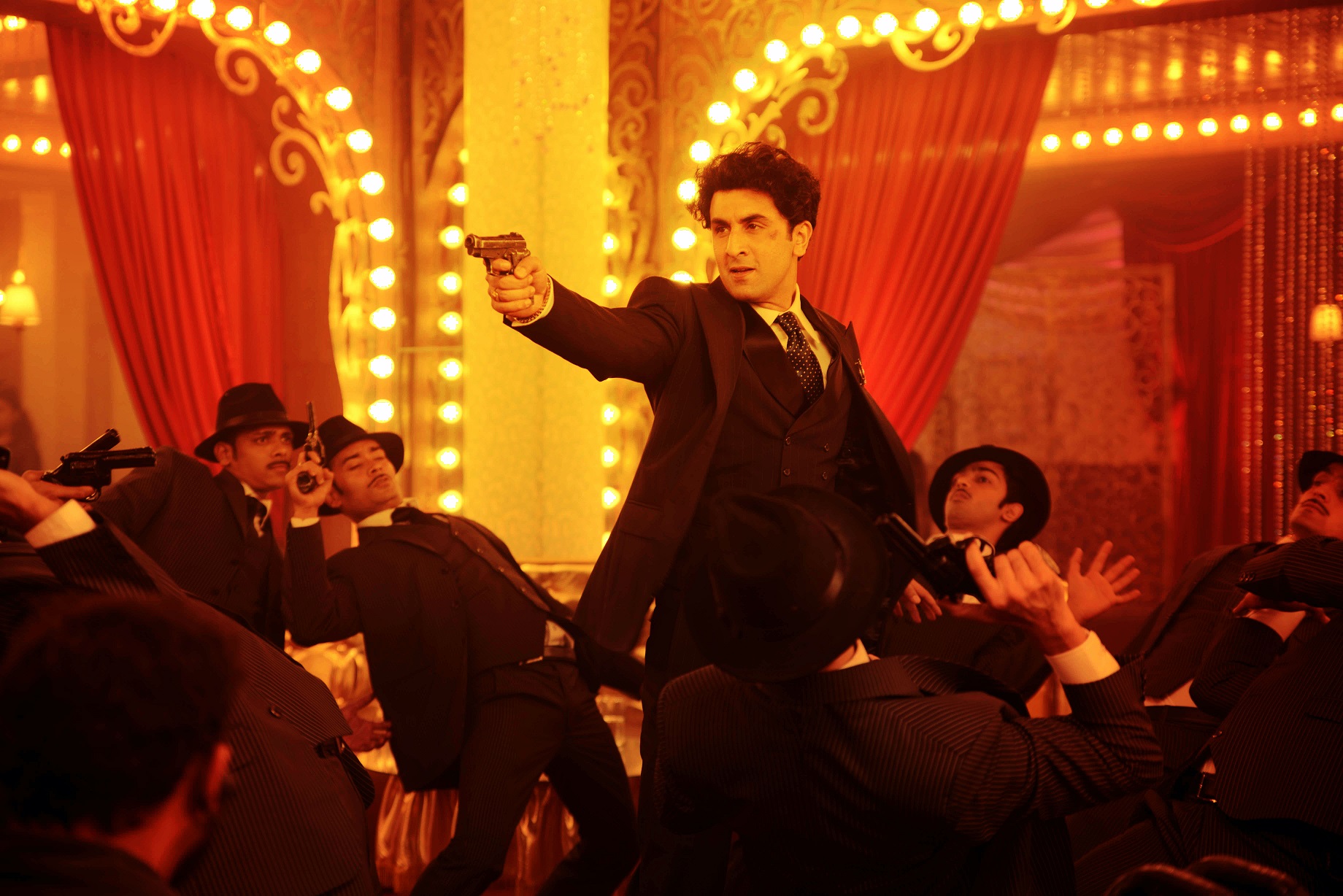
A little boy comes to Bombay, his mother earns a living as a sex worker, he becomes a small-time crook. Then his mother runs away with his ill-begotten stroke of luck (gold biscuits, no less), and he decides to become a big-time crook. The steep rise of the local hoodlum unfolds against the backdrop of the spectacular growth of the city itself, and is clearly meant to echo it. Like Ranbir Kapoor's Johnny Balraj, we're shown a Bombay that thinks it can do better -- be larger, get grander, become what The Roaring Twenties (the James Cagney film referenced here) would call a "big shot". 


With Bombay Velvet, director Anurag Kashyap, too, has made the big filmi film he wanted to make, complete with old-movie childhoods for the hero, heroine and hero's best friend. But sadly, neither this, nor the spectacular visual recreation of 60s Bombay (on an immaculate set in Sri Lanka), nor the sensational jazzy soundtrack, can make this film the epic it wants to be. 


The primary problem is that the characters do not compute. When we first see our hero, he's a cute little boy with an uncanny resemblance to Ranbir Kapoor, shyly, slyly watching another little boy do the dirty: deliberately bumping into a rich man walking past, so as to swipe his wallet. By the time we see them next, roles seem to have been reversed - shy little Balraj has become the mop-haired, ambitious, stop-at-nothing Ranbir Kapoor, while the expert pickpocket Chiman has become his silent sidekick. We never learn quite why Chiman has lost his panache and signed it over to Balraj. The heroine, meanwhile, makes her entry as a little Goan girl with a golden voice. We skate too smoothly over Rosie's journey from singing in church to sleeping in a rich man's bed, and even more quickly over her escape to Bombay, where she works glumly in a beauty parlour by day and sings Geeta Dutt songs -- even more glumly -- in a bar by night. 


And then everything changes again, faster and more inexplicably than before: Balraj fails at a robbery and acquires an unexpected Parsi benefactor, a man called Kaizad Khambatta who is a bootlegger, real estate shark and tabloid editor rolled into one -- Karan Johar, playing himself with a fake touch of evil. Balraj is quite literally picked up from the Bombay streets and thrown up to an enviable position at the city's Art Deco acme. Anointed Johnny, he becomes the manager of a nightclub that is the emblematic centre of everything that 60s Bombay is: Bombay Velvet, a stunningly re-imagined version of the city's real-life Eros Cinema. Meanwhile our nightingale has acquired a Parsi benefactor, too. Jamshed Mistry is Khambatta's oldest rival, and he, too, runs a newspaper. And sure enough, Rosie, too, gets a position as singer at Bombay Velvet. 


So our hero and heroine are ostensibly all grown up, the stage is set for their epic love story - but they seem like they're just play-acting. Other than a single song picturisation ("Dhadaam-dhadaam"), Anushka Sharma's performance as Rosie has neither oomph nor dard nor Goan-ness. There is more 60s sexiness in Raveena Tandon's minute-long appearance as Rosie's nightclub replacement than there is in Sharma's acres of silken costumes. 


As for Ranbir, he imbues Johnny with hotheaded angst, but we never quite get why Johnny's so angry, either with the world or with Khambatta. We're told he willingly gets his face beaten in every night in the boxing ring, even when he's got a job managing the fanciest club in town. But we never really see why. This is a hitman with many murders to his name, pathologically violent - and yet his fights with his girlfriend are almost childish, with none of the brute force one imagines. And to paint this character as a victim, as the film wants to, would take much more doing. Sharma and Kapoor are talented actors, but they clearly don't yet have it in them to transcend themselves. Satyadeep Mishra, playing Chiman, is perhaps the one actor with a major role to convincingly inhabit it. 


But if the depth of the performances is too little, the spread of the canvas is too wide. Like Dibakar Banerjee in the recent Detective Byomkesh Bakshy!, Kashyap and his team of writers (including the historian Gyan Prakash, whose non-fiction book Mumbai Fables is the seedbed of this film) clearly have no dearth of detail. This is Prohibition-era Bombay, where Indians can't get a drink unless they're with a foreigner. It is also Art Deco Bombay, when the young and chic (like Rosie) are moving into multi-storeyed buildings that line the city's seafront. It's the last stage of Back Bay Reclamation, new commercial buildings are being planned, the government is in cahoots with builders and tabloid magnates against mill-workers and union leaders. The film is punctuated with fake tabloid headlines interspersed with real news, and what plot there is revolves around photographs - a 'revealing' advertisement, a blackmail photo that stays secret, and another that gets splashed on the front page. But in trying to capture multiple urban worlds - leisure, commerce, media, politics, crime - the film loses its grip on all of them. 


Bombay Velvet could have been a big shot. But it misfired.

16 October 2012

An Insider's View: Richard Bartholomew's writings on Indian art

Richard Bartholomew, as a compilation of his writings reveals, was an art critic who didn’t let his friendships with the top artists of his time suppress his voice


(Written for Open magazine)


A Burmese émigré who had arrived in India in 1942, Richard Bartholomew entered the literary-cultural scene when studying English literature at St Stephen’s College, and then as a teacher of English at Delhi’s Modern School from 1951 to 1958. A poet and a photographer himself, he started writing and publishing as an art critic in 1955. From the late 1950s until his tragic and sudden death from a stroke in 1985, Bartholomew’s was the most important critical voice on the Delhi art scene, and he among the most important art critics in India. From 1977 till 1985, he took on, in addition, the onerous task of institution building as secretary of the Lalit Kala Akademi.

And yet, until 2009, when his son Pablo Bartholomew, himself a photographer, put his photographs together in a show and a book called The Critic’s Eye, Richard Bartholomew’s was not a name I knew. The Art Critic, self-published by Pablo after a difficult, muddled, often painful process that ended up taking 27 years (and which he gives partial voice to in a remarkably honest afterword), finally brings to a contemporary readership a definitive collection of Richard Bartholomew’s critical writings. Voluminous at roughly 200,000 words (edited down from the original 300,000), this is an ‘art book’ like no other.

Opinionated, often provocative, but always thoughtful, Bartholomew’s writing has the rare virtue of combining the survey and the 
longue durée with a marvellous immediacy, giving the present-day reader a privileged sense of modern Indian art ‘as it happened’.

The liveliness of his prose is also based on his ability to straddle worlds: while treating art with all the seriousness of a national mission, he constantly strives to translate what is essentially high culture into something that ordinary people—middle and upper middle-class readers of The Indian Express or The Times of India or Thought magazine—ought to be able to connect with, enjoy, and even if possible own. Sample: ‘The best thing about… ‘Graphic Workshop 1974’, organized in Baroda, is that each print has been brought out in a small edition of 50… [enabling work to be priced] at Rs 50 which is the price of a whiskey bottle or a cotton sari.’

It is a sensibility that can only have come from a critic who was on familiar, if not intimate, terms with many players in the art world—and yet wrote about it not for the coffee-table book or the rarefied academic volume but for the educated layperson. And also, perhaps, only from an art world still un-feted (and un-buffeted) by the market; Richard’s writing, writes Geeta Kapur, ‘matured on a typewriter in modest dwellings that neighboured the artists’ equally modest studio-apartments’.

Bartholomew himself saw his role with fierce clarity. ‘The critic who wishes to be articulate must be prepared to discuss reviews with artists; he must be at home in the artist’s studio and he must be an integral part of the art movement. If there is no art movement, he must try to foster one,’ he wrote in 
Cultural Forum in 1959. ‘It is imperative that he should have the respect of three institutions: (1) the public; (2) the artist; (3) the editor. This triple test disqualifies many for the vocation of criticism, for criticism is a supreme test of integrity.’

The book provides ample evidence that Richard held himself to these standards. He was close to several of the painters he wrote about—Ram Kumar, whom Richard and his wife Rati (then Batra) befriended at St Stephen’s College; Kanwal Krishna, having taught alongside him at Modern School (where Geeta Kapur first encountered the two of them as teachers and whose art room Krishna ‘treated for all the world like an artist’s atelier and evening hub’), and his wife, the artist and printmaker Devyani Krishna; A Ramachandran, who remembers Richard and Rati arriving at his barsati door to invite him and wife for dinner at their place, also in Jangpura; MF Husain; and Satish Gujral. And yet these are artists whose work received Richard’s most scrupulous honesty. Sample three statements on Husain’s paintings: in 1961 Richard can write, ‘As my acquaintance with Husain grows I begin to marvel at his virtuosity. Husain is a careless painter often; he is a facile painter sometimes; but Husain is a painter with a carefully selected repertoire, always.’ In 1965, he can write, ‘The 23 Husain drawings in this exhibition are good drawing-room pieces.’ And in a long essay on Husain published in a 1972 volume, he can make the following marvellous observation: ‘Men put so much energy into words, even if they do not believe all that is said. Husain puts that energy into paint.’


The integrity that Bartholomew brought to his work drew reactions in kind from the artists themselves. Here is Richard writing about Satish Gujral: ‘And when I criticised him for the want of finesse and conviction in the lettering and the slogans of his terracotta pieces of 1969-70, he had the heart and the good sense to take it in his stride, though it hurt. “A man doesn’t do what he has succeeded in doing all the time,” [he said].’


He draws analogies and references from far afield, from literature and poetry most of all, but also in vivid prose, from the natural and cultural environment of his adoptive country. Here he is on Raza’s Indian palette: ‘His colours are those of the Banaras brocade, the Gujarati manuscript, the blazing intensity of the Indian summer with its glory of the gulmohur and the laburnum.’ Reading Richard’s writing, in fact, one has not the slightest sense of the outsider’s trepidation, or desire not to offend.

On the contrary, one is pleasantly surprised by the forthright way in which he broaches, for instance, such presumably sensitive subjects as Bengali dominance. In a 1959 piece called ‘Art in the Shadow of Official Patronage’, he took the Lalit Kala Akademi to task for several things, including its institution of a tripartite division of art submissions for a prize into ‘oriental, academic-realistic, and modern’. ‘Manifestly this is a move to provide sanction to the decadent and dying Bengal School, for which Mr Barada Ukil, the Secretary, and Mr DP Roy Chowdhury, the Chairman, must necessarily have much sentimental attachment… it is pertinent to point out that three centres of art instruction in this country are being managed by Bengali artists, by Mr BC Sanyal in Delhi, Mr Bishwanath Mukerji in Hyderabad, and by Mr Chintamani Kar in Calcutta. The Curator of the National Gallery of Modern Art, Mr Pradosh Das Gupta, is also a Bengali. For better or for worse, there is the influence of Bengalis at the top official places in Indian art today. The general ambivalence, therefore, is understandable.’

And yet, there is no slanderous gossip here, no personal slurs. What there is is a deep-rooted, not always rational, distaste for the ‘nostalgia’ and ‘romanticism’ of the Bengal School. But even this avowed critical disdain for nostalgia and romanticism is never allowed to swamp his instinctively positive response to a body of work. About Amrita Sher-Gil, for example, he writes with empathy rather than dismissal: ‘The pensively stanced figures of the countryside in a Sher-Gil painting breathe a romanticism that is born of the regret that these things were passing away.’


It is impossible to do justice to this vast volume in a short review. But suffice it to say that Bartholomew is attentive to the smallest detail in a work of art, writing passionately about colour and light and form, the stroke that creates the hunch of a back—while never shying away from the big picture questions that you almost rarely hear asked anymore: Is modern Indian art merely imitative of Western art? What does its Indianness consist of? What is the role of State patronage? You may or may not agree with his answers, but it is more than sufficient pleasure to discover so fine an interlocutor—and one you did not know existed.

Published in Open magazine, 20 Oct 2012.

18 July 2012

Madan Mahatta’s pictures are a history of Delhi’s present

My Sunday Guardian column this week, inspired partly by this fabulous exhibition at PhotoInk Gallery in Delhi. 

To look at Madan Mahatta's photographs of Delhi's architecture, taken between the late '50s and the mid-'80s, is to have a new eye open up in your mind. Emerging into the city from the quiet of the gallery, you become suddenly attentive to the forms of buildings: the angle of a staircase, light falling into a courtyard and an unnoticed dome on a building you've passed a hundred times. To have seen Mahatta's magnificent black and white images is to have implanted in your mind the ability to look at a familiar outline and see it as something fresh and new. It is, in effect, to be able to travel back in time.

Mahatta's family started the famous Mahatta Photographic Studio in Connaught Place in 1948. He returned from studies in England in 1954 and started work here, photographing the buildings being created in Delhi by a new generation of architects: literally, the building of Indian modernity. Like Mahatta, several had returned from training abroad. Habib Rahman and Achyut Kanvinde had studied under Walter Gropius of the Bauhaus School at Harvard and MIT, while Joseph Allen Stein had worked with Richard Neutra, and was inspired by Frank Lloyd Wright and Eliel Saarinen.
The new modernist vocabulary — the boldly dramatic geometrical forms, rough stone and poured concrete that characterised Raj Rewal's Hall of Nations, J.K. Chowdhury's IIT Delhi or Kuldip Singh's NDMC headquarters — was in stark contrast to the existing architecture of British New Delhi. Mahatta's photographs may create the illusion that 'Delhi Modern' was the dominant style of its era, but in fact it contended with, and responded to, what was present. And what was present was embroiled in debate — architectural debates that arose out of our colonial past that are still not completely dead.
The monumental classicism of Lutyens' and Baker's Delhi nodded to pre-colonial Indian styles. Some have suggested that these nods were rather cursory, that Lutyens' chhajjas — overhanging cornices along the side of a building, or over a door or window, and chhatris, decorative pavilions placed on a roof — were not based on existing Indian models, but instead reinterpreted them in an abstract, classicised idiom. By avoiding both the 'Hindu' and 'Moghul' elements of the colonial Indo-Saracenic style and modelling the roof of the Viceroy's House on the dome of the Sanchi Stupa, Lutyens thought he had gained neutral ground — Buddhism had no adherents in Victorian India. But, historian Thomas Metcalf argues this lack of connection to the present was precisely what made Lutyens' architecture a dead-end: "Confined within the classical traditions of European imperialism, it led, inevitably, nowhere."
Whatever the hopes of an anti-colonial historiography, official architecture in Delhi in the '50s and '60s had not emerged from Lutyens' shadow. The central dome of the Supreme Court (1958) was a simplified version of Rashtrapati Bhavan, and the major CPWD buildings built between 1955 and 1965 — Krishi Bhavan, Udyog Bhavan, Rail Bhavan — all had simplified domes, chhajjas and chhattris, grafted into classical style buildings.
The new modernists found them ridiculous: "Rahman and Stein made jokes about the new Supreme Court building coming up," writes photographer Ram Rahman (who is curator of the Mahatta show and the son of Habib Rahman). But for Lutyens acolytes like contemporary British curator Paul Waite, these structures were evidence that the wish to graft together Eastern and Western forms to create an indigenous architecture for India remained even after independence. For Waite, it is the coming of International Modernism that is cause for lament: "It did not matter if Le Corbusier was designing in Chandigarh, Paris or Morocco – it would be cement, high rise and without reference to any previous architectural traditions of the country. Architecture had to be the same the world over."
Ram Rahman believes exactly the opposite. For him, "What this generation of architects did was to develop a vocabulary of modernist practice suited to Indian conditions and connected to the ethos of the time". Stein, he reminds us, has spoken of how the spirit of Gandhi, still prevalent in the '50s, "meshed perfectly with the 'less-is-more' slogan of Modernism".
So is there really a 'Delhi Modern'? Do the cement and ceramic jalis of Stein's Lodi Estate or Rahman's Rabindra Bhavan make them 'indigenous'? Is indigeneity necessary? The debate is a fascinating one, and potentially endless. One way to resolve what one thinks is to begin to look more carefully at the buildings that surround us. Looking at Mahatta's image of the Shri Ram Centre, halfway through construction, it is impossible not to think of it as a spaceship that has recently landed, barely avoiding the elegant arcades of Connaught Place. And yet it is impossible to conceive of the Mandi House area today without the Shri Ram Centre. The alienating quality in the photograph has been erased by time and familiarity; even its once-harsh exterior seems softened by the presence of the little café.
Perhaps, despite all its conceits, any architecture is eventually dwarfed by those who use it. As it should be.
Published as my Post Facto column in the Sunday Guardian, July 2012.

20 November 2011

Book Review: The Best of Quest

This selection of articles from Quest, a socio-political and literary Indian magazine from the 1950s and 60s, offers perspectives that are still relevant today

The Best Of Quest
Edited by Laeeq Futehally, Achal Prabhala, Arshia Sattar
Tranquebar Press
pp 694, Rs. 695


"To organize a new union between our political ideas and our imagination – in all our cultural purview there is no work more necessary," wrote the American critic Lionel Trilling in 1946, in an essay called 'The Function of the Little Magazine'. Trilling's words were originally written in praise of the Partisan Review, a political and literary journal which began life as an organ of the American Communist Party but broke away after Stalin's rise to power, going on to complete a long and influential innings (1934-2003), with contributors ranging from Hannah Arendt and George Orwell to Susan Sontag and Philip Roth. But they seem oddly and equally suited to a journal that emerged from the other side of the political spectrum, at the other end of the world.

Titled Quest ("a quarterly of inquiry, criticism and ideas"), it was a journal started in Bombay in 1954. Laeeq Futehally, its Literary Editor, describes it as the outcome of a post-World War II resolution by a bunch of intellectuals that "never again should the minds of men be enslaved by evil ideologies and rigid "isms"." The Congress for Cultural Freedom, founded in Berlin in 1950, was devoted, in Futehally's words, to "the task of creating a worldwide ambience of respect for free thought and speech". Chapters soon emerged in other countries, many with magazines. Poet Stephen Spender agreed to edit Encounter in the UK. The Indian Committee for Cultural Freedom (ICCF) emerged in 1950, and in 1954, Minoo Masani (one of India's first advocates of liberalism) founded Quest, with poet and critic Nissim Ezekiel as editor.

The Best of Quest is a selection of essays, poetry and fiction from Quest's remarkable life of 20-odd years: a life brought to a close by a refusal to bow to Mrs. Gandhi's Emergency diktat that it be submitted for review before publication. Edited by Futehally, Arshia Sattar and Achal Prabhala, the volume gives us a sampling of what was clearly a superbly eclectic body of writing, united only by Ezekiel's injunction that it must be "by Indians for Indians" – a difficult condition, as Futehally points out, in "those days [when] we still glamourised anything foreign, including writers".

The poetry section offers delights both expected ("To force the pace and never to be still/ Is not the way of those observing birds/ Or women. The best poets wait for words," writes Ezekiel) and unexpected (a 1975 poem called 'Dasara' by the well-known academic Tejaswini Niranjana, who only finished her BA in 1979). The fiction section features Keki Daruwalla and Kiran Nagarkar, as well as translations of Kamleshwar and Premendra Mitra (the latter a Bengali classic called 'Telenapota Abishkar' which – the editors should really be telling us this – was made into a haunting Hindi film called Khandhar by Mrinal Sen). My personal favourite here is Arun Joshi's story 'The Gherao': deceptively straightforward and terribly moving.

But the form that really characterises Quest is the long, opinionated essay, with writers of all stripes taking on socio-cultural, political or literary subjects with idiosyncratic ease. Some of these would never get commissioned today – they are not 'topical'. But Claude Alvarez's scathing account of the "fabrication of a new religion" by Aurobindo and his companion Mira (the Mother) and the murky politics of the Ashram's takeover of Pondicherry's White Town, or Roderick Neill's sustained, almost scholarly comparison between sadhus and hippies ("In as much as they all represent channels for social deviants and adventurous individualists...the sadhu sects of India are bodies of 'drop outs'"), for example, deal with things that are very much a presence in contemporary India, and offer a perspective that can still surprise us.

On the other hand, an exchange like the one between Jyotirmoy Datta ('On Caged Chaffinches and Polyglot Parrots') and P. Lal ('Indian Writing in English: A Reply to Jyotirmoy Datta') makes one simultaneously laugh and sigh at how the same debate can carry on for half a century: is it "natural" for Indian writers to write in English, or are their reasons for doing so merely "expedient, even artistically dishonest"? Khushwant Singh provides a different sort of glimmer of recognition, despite the fact that the Delhi he describes has been almost entirely transformed in the 44 years since he wrote: "If you move in the right circles in the Capital, you need not cook any food in your house. It can be one continuous round of lunch, cocktail and dinner parties."

These occasional chuckleworthy moments apart, however, Quest comes across as largely focused on important and high-minded subjects: 'Persistence of the Caste System', 'Reflections on the Chinese invasion', 'The Concept of Justice and Personal Law in India'. "Quest was so far above popular culture and so disdainful in its indifference to the strange and bizarre events of everyday India that it needed at least one regular column that did some lampooning," the poet Dilip Chitre writes in a postscript, explaining why he felt the need to complement his 'serious pieces' on Indira Gandhi or Nirad C. Chaudhuri (written under his own name) with the irreverent pieces he wrote under the pseudonym 'D.'. D.'s columns ranged from a self-described "barbaric comparison" of Raj Kapoor's "chocolate-box love story" Bobby with Satyajit Ray's "saccharinous famine" in Ashani Sanket – where Ashani Sanket is found wanting because it does not even entertain the masses – to the argument that the sexiness of Hindi film heroines depended on their plumpness, "which goes to strengthen one's suspicion that more than one kind of starvation accounts for the female star's appeal in the Hindi cinema".

Some advertisements from the pages of Quest magazine

The editors must be thanked for bringing us a volume of scintillating – if sometimes verbose – writing from an era that seems enormously distant in some ways and not quite over in others. They have provided for those who want the dope on Quest being indirectly funded by the CIA (apparently it was, but the editors didn't know that) and offered much joy by reproducing advertisements from the pages of the original Quest. (Sample: 'When Sol has done his worst/ And really got you down/ Turn on a RALLIFAN and be/ The coolest man in town") But I have one complaint, which is that they have provided no introductions to the essays. There is not even a list of contributors, so that one will forever have to keep guessing about the identity of the wonderful Hamdi Bey who tells us that George Orwell thought of himself as "civilised" as opposed to Kipling who was "coarse", and wondering whether the author of 'The Gherao' is the same Arun Joshi who wrote the marvellous The Strange Case of Billy Biswas. Such a brilliant act of excavation, and an uncurated display?

Published in the Sunday Guardian, 20 Nov 2011.