Showing posts with label Iranian films. Show all posts

13 January 2021

Drives with a view - II

My Mirror column:

Two Iranian films -  Jafar Panahi's 2015 Taxi Tehran and Abbas Kiarostami's 2002 Ten - use the taxi ride as a space for confession, comment and confrontation.

Early in Jafar Panahi’s 2015 Iranian docufiction Taxi Tehran, two passengers in a taxi get into an argument about the death penalty. “If they hang two people, the others would see,” says the man in favour. The woman argues against, saying that people mustn’t be hanged for such minor crimes committed out of need. “After China, we have the most executions in the world,” she points out. The more coherently the woman argues, though, the more rudely the man jeers at her. “You don't know jackshit,” he says at one point, accusing her of living in a world of fiction because she is a teacher – someone who he thinks reads too many books and spends her days with children.

Children in post-revolutionary Iranian cinema, of course, have been the chosen carriers of filmic truth – especially in Panahi’s own film career, right from his 1995 debut The White Balloon and his 1997 feature The Mirror (which shares with Taxi Tehran the docufiction device of having an actor engage in conversations with real people). Taxi Tehran also contains a precociously sharp child – the director’s niece, who films everything on her mobile camera. Between showing us the articulate female passenger and the whipsmart little girl, it’s more than clear that Panahi intends us to laugh at the man’s words.

But the car is, in Taxi Tehran, very much a space of dialogue; a place where unusual exchanges can take place. Taxi Tehran was the third film Panahi shot illegally after the Iranian state banned him from making films, and it won him the Silver Bear at the 2015 Berlin Film Festival. In the film Panahi turns his vehicle into a faux-taxi, picking up strangers, family members and acquaintances from all over the city and dropping them off at their destinations. Except we learn soon enough that some of these exchanges are staged – and in the finest Panahi tradition, it’s often difficult to say which ones.

The film is strewn with references to the ubiquity of the camera in our lives. From the niece who wants to make a film in a month and has already recorded a real-life crisis in the lives of some acquaintances, to the neighbour who brings Panahi footage from a security camera to describe something terrible that happened to him, to the state placing a political prisoner's visiting mother in a room with cameras, life seems increasingly something that unfolds on screen rather than off it.

But Taxi Tehran feels like an update on an older Iranian film which was also set entirely inside a car driven by one person – Abbas Kiarostami's Ten (2002). In the unforgettable first segment of that Palm d'Or-nominated film, a young boy shouts at his divorced mother for a long length of time as she drives him through the city. We don’t see the driver – played by the actress Mania Akbari – for the first few minutes, instead experiencing the claustrophobia inside the car build with the child’s terrifyingly adult remarks. “That makes three sentences and they’re all rubbish,” he shouts, or “I can't live with you because you are a selfish woman,” or “You'll never know how to talk and you’ll never be anything” - all of which make it seem like he is ventriloquising his father, from whom she has got a divorce. The boy constantly instructs his mother to “say it calmly” or “don't shout in the street”, while himself plugging his ears against her voice and yelling louder to drown her out.

Like in Taxi Tehran and in the two films about taxis that I discussed last week (World Taxi and Night on Earth), the car in Ten is an unspoken site of confession. Or sometimes, a refuge. When the driver’s seven-year-old complains that she starts talking as soon as they get in the car, she retorts unselfconsciously that there’s no privacy at home – the home she shares with the new husband she's so happy to have acquired.

Driving around the city seems to allow for long, frank exchanges, even with women passengers she doesn't know well. A sex worker whose face we never see insists that wives are also in a kind of trade with their husbands. “You’re the wholesalers, we’re the retailers,” she scoffs. Another woman who has lost a fiancĂ© to a rival contender talks of another kind of exchange, the one we conduct with God. “Before, praying seemed ridiculous,” she says softly. “I used to say, you pray to force God to give you things.” But both she and the car’s driver now find themselves deriving a semblance of peace from their visits to a mausoleum.

If the content of Ten’s conversations reveals a society politically and legally skewed against woman, the form, too, has something to offer. Male drivers often block Akbari’s path, she has to keep demanding right of way. So there’s some quiet courage to be drawn from the penultimate segment in which her young son returns, and inquires about first and fifth gears. If he thinks his mother can teach him about driving, perhaps that’s not a bad start.

Published in Mumbai Mirror, 13 Dec 2020.

10 November 2020

Dharamshala International Film Festival 2020: From Pearl of the Desert to Yalda, five must-watch picks

Late to put this piece I wrote for Firstpost up on the blog, this year's online edition of DIFF is over. But these five films are totally worth looking out for.

Dharamshala International Film Festival 2020: From Pearl of the Desert to Yalda, five must-watch picks
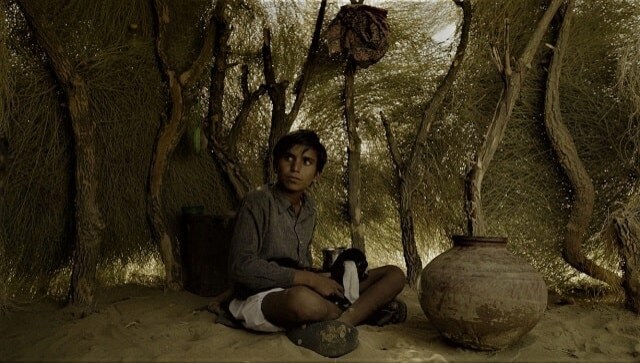
Still from Pushpendra Singh's wonderful film Pearl of the Desert, 2019, about a Manganiar boy musician called Moti

The Dharamshala International Film Festival went online this year, making its thoughtfully curated mix of features, documentaries and short films available to anyone in India with a screen and an internet connection, offering both season tickets and a daily Binge pass. Sunday, 8 November, is the last day of this year's festival. I've picked out five unusual films worth the price of admission:

Pearl of the Desert, 2019

Documentary | Rajasthani | 1 hour 22 mins

A boy is walking home with a group of other boys, all wearing that familiar dull blue shirt that is the uniform of countless government schools across India. Suddenly he falls behind, telling the rest to go ahead. “You do this every day!” complains another boy in the group. But they carry on, and the boy settles himself on a crooked tree trunk and begins to sing. As the rich, rugged notes emerge from his throat, the desert seems to spring to life. In case the sound doesn't thrill you, the filmmaker catches a black buck leaping up at the sound of Moti's voice. Then another. Animals seem to respond to the beauty of Moti's music, evoking mythical depictions of cattle gathering to listen to the flute-playing Krishna.

It is the sort of coded, powerfully cinematic image that makes Pushpendra Singh's hybrid documentary on the Manganiars such a layered, resonant piece of filmmaking. Time and again the film reminds us, without a word, that we live in a country of remarkable admixture: a country in which Muslim musicians have for centuries been the appointed bards to the upper caste Hindus of the Thar Desert.

It is something to listen to these men singing the praises of their Hindu patrons: enumerating the heroic exploits of their ancestors, laying out their genealogies, mourning the departure of their daughters — all in words profoundly redolent of the desert. If one song describes the carriage of the camel, another pays tribute to the dusky beauty of the lover in the courtyard, while one particularly stunning verse asks the stubborn lover to come back home, saying, “I have written you a carnival, at least now return”.

Whether the occasion is a birth or a marriage or any other celebration, the Manganiars are always called upon. They sing songs to the goddesses their patrons worship, and they also sing songs to the pirs of the Thar desert. The film closes with a group of Manganiar men harvesting cluster beans, singing in joyful unison a song that invokes Allah. In one of the film's reenacted scenes, Moti's grandfather is asked to relate the community's history — he connects them with Parashuram, with stories about asking for necklaces (maangan, haar), and their name to the Sanskrit word “mangal”, meaning auspicious.

Whenever the increasingly misguided votaries of Hinduism insist that their vengeful politics of purity is the only defense of Indian tradition, it is worthwhile bringing up the Manganiars — for this, too, is our tradition. One we must now fight to keep alive.

Dharamshala International Film Festival 2020 From Pearl of the Desert to Yalda five mustwatch picks
Still from the delightful Gaza Mon Amour, 2020

Gaza Mon Amour, 2020

Fiction Feature | Arabic | 1 hour 27 mins

Set in the small, densely populated Palestinian territory of Gaza, this film about an ageing fisherman who decides he has had enough of singledom is a quiet delight just for the stellar performances by Salim Daw as the externally crotchety but secretly romantic Issa and Hiam Abbas as the serious-faced widowed seamstress whom Issa finally gathers the courage to court after a naked ancient statue lands in his fishing net — that feels like a sign. Atmospherics are provided by the rundown location, where checkpoints, power cuts and bombings are the norm — as is the fact that many of the younger people want to escape to Europe even via the dangerous illegal route. Directed by Tarzan Nasser and Arab Nasser, this gently comic romance comes to DIFF after a premiere at this year's Venice Film Festival and the NETPAC award for best Asian film at Toronto.

Dharamshala International Film Festival 2020 From Pearl of the Desert to Yalda five mustwatch picks
Still from the documentary Influence, 2020, a film about the dangerous directions in which advertising and PR have taken us

Influence, 2020

Documentary | English | 1 hour 45 mins

Tim Bell was a British advertising man who went from being part of the founding team of Saatchi & Saatchi to Margaret Thatcher's campaign manager, his “Labour's Not Working” hoardings held responsible, among other things, for the decimation of the British Labour Party in that election. Diana Neille and Richard Polak's ambitious documentary portrait of Bell unpacks the rise and fall of a morally dubious man who created and ran the world's most influential political consultancy for decades. Bell Pottinger's clients ranged from the Chilean dictator Pinochet to South African Presidents FW De Klerk and Jacob Zuma. He was hired by the Pentagon to create a flood of propaganda videos in post-Saddam Iraq and by the Gupta Brothers to stir up racial violence in South Africa using hired bots to tweet and post on #whitemonopolycapital.

The film's watchability is aided by its incorporation of an interview with an aged Bell, who died in the summer of 2019 — perhaps precisely because Bell gives away so little, even as he has supposedly decided to tell his story. But its true impact lies in using Bell's life to trace the transformation that characterises our era perhaps more than any other: the dangerous transformation of advertising and marketing from an “art form into a science — and in many respects, into a workable weapon”. Those words belong to Nigel Oakes, an ex-Saatchi & Saatchi man now infamous as the founder of the SCL group, the parent company for Cambridge Analytica. The untrammelled rise of “strategic communication”, alongside social media, is the story of our times, altering political outcomes across the globe for several decades, and now scarily part of our present in India. In Oakes' words, what was once “just democracy” is now a “controlled democracy, maybe available to the highest bidder.”

Dharamshala International Film Festival 2020 From Pearl of the Desert to Yalda five mustwatch picks
Still from the gripping Yalda, 2019: Iranian realities filtered through the drama of a reality TV show

Yalda, 2019

Fiction Feature | Farsi | 1 hour 39 mins

Winner of the World Cinema Grand Jury Prize (Dramatic) at the Sundance Film Festival this February, Massoud Bakhshi's film Yalda, A Night for Forgiveness is a gripping drama that manages to reveal a great deal about the contradictions and hypocrisies of present-day Iran. The film unfolds on the set of a TV show called 'Joy of Forgiveness', during which a woman convicted for killing her husband might receive a pardon from her husband's daughter — and thus be saved from the death penalty.

Bakhshi based his fictitious show on a real show called Mah-e-Asal that aired daily on Iranian television during the month of Ramadan from 2007 to 2018, and does wonders by alternating between the scripted reality we see on TV and the real drama taking place off-camera. The story of why the 20-something Maryam Komijani married her late father's 65-year-old employer and became pregnant with his child brings into view not how skewed Iranian law is against women — the permissibility of 'temporary marriage', the greater claims of sons over family property — but also the deep fault lines of class in Iranian society. Dominant social morality and the law may see Maryam a certain way, but it is hard to look away from the alternative picture the film shows us.

Ghar Ka Pata, 2020

Documentary | Hindi, Kashmiri, English | 1 hour 7 mins

The filmmaker's search for the home she left at six is the basis of a personal essay about a very political place. Madhulika Jalali's family home was a traditional house in the neighbourhood of Rainawari in Srinagar, among the areas in the city that was home to the Kashmiri Pandit community. Like thousands of other Pandit families, Jalali's Hindu parents found themselves forced to leave the valley by the events of the early 1990s, when militancy in Kashmir took a dangerously communal turn. Like the others, they were never to return. The film makes this tragic political-communal context visible through a very personal keyhole. As if to compensate for her own lack of memory, Jalali tries to find an image of the house she can't see in her mind. When her own family albums are exhausted, the search leads her to cousins and relatives — and eventually to Srinagar.

Dharamshala International Film Festival 2020 From Pearl of the Desert to Yalda five mustwatch picks
Poster for Madhulika Jalali's moving personal documentary Ghar Ka Pata, 2020

The film splices these journeys with Jalali's two elder sisters reminiscing, about the house but also about the traumatic nights leading up to their departure, when proclamations of violence made from the neighbourhood mosques made their father dig out his hunting rifle — but eventually take his close Muslim friend's advice to leave.

Her parents, like most adults Jalali speaks to, remain reticent. But those who were younger then, seem happy to speak. Jalai's sisters talk about how happy and peaceful their childhoods had been in the Srinagar of the1980s: the fruit trees in their garden, the snow they used to try to make into ice cream, the neighbourhood shop from which they bought dahi, the walking route they'd try to take home to get their hands on any festive meetha chaawal being distributed. But even within this gently nostalgic past, one can see the inevitable seeds of the future. In one remarkable anecdote, one of the sisters recalls how in those months that Doordarshan telecast Ramanand Sagar's version of the Ramayana, Hindu and Muslim children alike used to come out onto the streets of their neighbourhood with homemade bows and arrows, taking aim with a "Jai Shree Ram".

Jalali doesn't dwell on it, or on anything really. Her film has a lightness that sometimes feels surprising. Is sorrow filtered through time and distance and forgetting still sorrow? Perhaps the answer is, sometimes.

Published on Firstpost, 8 Nov 2020.

7 November 2016

Brown Girls in the Ring

My Mirror column:

An Iranian documentary and an Indian short trace the journeys of tough young Muslim women


A still from the short film Leeches (2016), set in the Muslim neighbourhoods of Hyderabad's old city
A still from the Iranian film Sonita (2015), about a teenaged Afghan refugee becoming a rapper
One of the particular pleasures of film festivals is the unexpected juxtaposition of cinematic worlds. Films from different parts of the globe, made on very dissimilar budgets, with strikingly different visual languages, can sometimes seem to speak directly to each other.

This is what happened with two of the several films I watched today in the crisp mountain air of McLeodganj, Himachal Pradesh, where the documentary filmmakers Ritu Sarin and Tenzing Sonam have created what might currently be the finest small-scale film festival in India: the Dharamshala International Film Festival (DIFF).

Both films are directed by women and happen to be about young Muslim women. The first is a taut, pacy 27-minute-fiction called Leeches, directed by the New York-raised and Tisch-trained Payal Sethi. The film opens in a hotel lobby where an old lady is awaiting the arrival of some big man. A photo album is unfolded before him: an array of young female faces, many with headscarves. It might have been an audition, but for the shiftiness and urgency with which it is conducted. A few scenes later, we find that a teenaged girl called Zainab has been promised in `marriage' to an old man, in exchange for 50,000 rupees. Luckily for Zainab, her elder sister, Raisa, decides to turn protector, and the rest of Sethi's film proceeds to tell the harrowing -- and sadly, entirely improbable --tale of how she achieves her goal.


The second film is called Sonita, which is also the name of its 14-year-old heroine. I use the word `heroine' deliberately, for although Rokhsareh Ghaem Maghami's 91-minute-film is a documentary, the sharp, sassy Afghan teenager at its centre is definitely the star of her own life. Maghami, who is Iranian, first discovers Sonita Alizadeh as a young Afghan refugee working as a cleaner in an Iranian refugee centre. Sonita lives in one room-poverty with her younger sister and a niece, but she dreams of being a rapper - her fantasy identity is `Sonita Jackson', the imaginary offspring of Michael Jackson and Rihanna, into whose concert images she carefully cuts and pastes her face.

But the real reason Sonita is a star is that she doesn't just dream: she writes and performs fiery, exhilarating rap songs, with vivid Farsi lyrics that speak directly to her situation as a young woman who wants much more than the fate her culture thinks is her due. For Sonita -- like Zainab in Leeches -- must surmount the real threat of being married off in exchange for a tidy sum of money.


It is striking that in both cinematic scenarios -- the fictional one in Hyderabad and the non-fictional one in Teheran/Herat -- it is the girls' mothers who are intent on selling them off, driven apparently by financial need. Zainab and Raisa's fictional mother seems particularly awful; the unfeelingness with which she pushes her own child towards an inevitably traumatic violent encounter does not seem explainable by mere poverty. Sonita's real-life mother seems unfeeling, too -- but the film offers us a clue to that unfeelingness, via her resigned belief in a 'tradition' in which an older man acquiring a virgin bride is seen as the way things are. At one point, Sonita points to a faded black and white family photo, and says matter-of-factly: "My mother was so young when she married my father that she called him 'uncle'."

These are extremely watchable films, and crowd-pleasers to boot. But if I may sound another cautionary note: in both cases, the filmmakers are women a little older than their protagonists, and belong to a culture that is clearly distinguishable from theirs. Sethi, with a Punjabi-Hindu family name and a New York background, inhabits a world very different from the poverty-stricken Muslim homes of Hyderabad's old city that she seeks to depict here. Maghami is Iranian, but chooses to focus her feminist attention on Afghan practices -- rather than the more nuanced gender imbalances that afflict Iranian society. In 1994, the critical theorist Gayatri Spivak red-flagged the all-too-common phenomenon of white men saving brown women from brown men. We have seemingly only travelled a little way away from there.


Published in Mumbai Mirror, 6th Nov 2016.

15 March 2015

Things I learned at the Asian Women’s Festival

Why should gender be a factor in our viewing any form of art? My report on the IAWRT's Asian Women's Film Festival, for Yahoo Originals
(Click on the hyperlink for images.)
A week before this year's edition, the 11th edition, of their Asian Women's Festival, the International Association of Women in Radio and Television (IAWRT) showed three short films at the South Asian University, whose campus in New Delhi's Chanakyapuri houses a mix of students and faculty from the various South Asian Association for Regional Cooperation (SAARC) countries. One was an observational film about an Afghan family of carpet weavers, another an exquisite Indian animation called Journey to Nagaland. The third was called Two Women and a Camera, a documentary shot by a pair of radio jockeys in the Pakistani town of Mardan, in Khyber-Pakhtunkhwa province. The two young women, Madiha and Nazish, are the first female presenters on their FM radio channel, Radio Burraq.
The film offers a conversational, perhaps deceptively sunny take on their lives: they chat, they go to work, they cut birthday cakes, they laugh about a man calling to demand a Pashto song in the middle of an Urdu program. But things are not quite as rosy as they seem. We meet a video shop owner who describes how the Taliban first threatened them with anonymous letters, and then burst a bomb near their row of shops. We visit the Gajju Khan Bazar, where “shopkeepers consider it their duty to call out to every woman who walks through”. (SAU's female students laughed in recognition, and then watched gravely as not one of the women in the market agreed to come on camera.) Several times, we see Madiha dress with great care, her long open hair flowing down her back as she puts on her lipstick and eyeshadow, before covering up with the white chadar she must drape over her head and upper body when outside the house. “Take a thick one,” advises her mother on one such occasion. “You know what kind of people they are where we're going.”

The film's last scene shows the girls walking with the video camera when they encounter a large crowd on the street. They pause, but for barely an instant. Then they gather their wits and their courage, and walk right through the mass of men. It is a dare, of sorts, but also a kind of strategy. The camera turns into a weapon, one that allows these young women to shed the defensive strategy for an aggressive one. The crowd parts for them, like the Red Sea for Moses. The camera captures not the women walking, but the men's gazes on them, transfixed but somewhat baffled.

* * *
It is now a truism that the camera changes our relationship with the world, with each other. But I came away from the Pakistani film with the distinct feeling that wielding a camera is somehow a more primal experience for women. It can change our relationship with the spaces in which we live and work, making us somehow more sure-footed in the everyday. If you have a camera, you have a reason to loiter. If you've grown used to being the object of the gaze, film-making offers a way to reflect the world back at itself.


The Asian Women's Film Festival, held at the India International Centre (IIC) in Delhi every March, is a celebration of women with cameras. Organized by the Indian chapter of the IAWRT, the festival began in 2005 under the IIC-Asia project, envisioned by two cultural doyennes, Kapila Vatsyayan and the late Jai Chandiram. Why did an organization named for radio and television get involved in starting a film festival? “Jai herself and some of the other Indian IAWRT members were greatly interested in films, and felt it was a great idea to celebrate Women's Day with a film festival,” explained filmmaker Anupama Srinivasan, who has been festival director for the last three years, along with Uma Tanuku as co-director. What began as a two-day festival of mostly Indian documentaries is now a vibrant three-day affair which shows films of any duration, any genre, any theme: animation, documentary, short fiction, feature fiction and what was, in this year's edition, dubbed 'experimental'. In 2010, there was a focus on films from Japan, in 2013, from Iran, and in 2014, from Sri Lanka. Though India still has the largest number of entries, countries represented this year included China, Bangladesh, Hong Kong, Israel, Myanmar, and Afghanistan, apart from Japan and Iran. “There is no other Asian Women's Film Festival in the world as far as I know. The idea is that there is much in common between experiences in Asian countries, and [this offers] a platform where these can be shared. And now we 'show' sound works as well, thereby questioning what a film is,” says Srinivasan, speaking of the 'Soundphiles' package initiated in 2014. 
But while the camera might alter women's experience of the world, the question remains: do women alter our experience of the camera? Is there anything specific about films made by women? Why should gender be a factor in our thinking about/viewing any form of art? Anupama Chandra, film editor and IAWRT member, argues for a simple reason. “Because gender does exist – just like the caste system. To say that it doesn't is to deny its realities. If thousands of women had not become artists, political writers or philosophers, a massive part of human experience would be still underground – neither expressed, nor acknowledged.” 

Couldn't the films at this festival have been made by men? “Of course,” says Chandra, “If the men were feminists.” As Chandra points out, the films shown are not necessarily polemical or radically political, but they represent a wide range of feminist philosophy and a recognition of feminist political issues. “So there might be deeply thoughtful films about the problems of old age, or a first person account of bringing up three small children while trying to survive as a filmmaker (Ryu Mi-rye’s 
My Sweet Baby, at IAWRT two years ago), or natural outrage at the suicides of cotton farmers in India (Kavita Bahl's Cotton For My Shroud, also shown two years ago).”
I might add to Chandra's list: a children's film marvellously sensitive to the frailties of adults and the enchantments of place (Batul Mukhtiar's Kaphal, shown this year to a rapt audience of schoolchildren), a stunning rhythmic envisioning of the life of the saltmakers of Kutch, from the dancerly unison in which the whole family shuffles their feet through the salt pans, to the steady chug-chug-chug of the pump (Farida Pacha's My Name is Salt, shown this year), a 'long take' in which one ranting, distraught doctor reveals the faultlines between state institutions and the poor (Priya Sen's Noon Day Dispensary), or a quietly brilliant film set in a school for the blind, using deliberate blurriness, bright lights and the power of sound to evoke the children's world (Koi Dekhne Wala Hai? by Shilpi Saluja).

“We are not aiming to show films about so-called women's issues. There are no thematic restrictions in the festival,” says Srinivasan. “I found that liberating.” Rather than the predictability that might have crept in if the festival were “about women”, the free choice of subjects makes for a wonderful variety and opennness. Apart from the multiple genres, lengths and languages, I was struck by the number of student films and first films that were included – a package of five films from the Yangon Film School, Myanmar, two Israeli diploma films, one film by a graduate from the Satyajit Ray Film and Television Institute (SRFTI) in Kolkata, and at least three by alumni of the recently initiated documentary filmmaking course at the Sri Aurobindo Centre for Arts and Communication (SACAC). What is perhaps even more remarkable is that none of these were segregated into a section for students or first-time work. In fact one of the Israeli student films – 
Good Stuff by Neta Braun, an exceptionally well-acted, harrowing piece of short fiction which begins with a woman coming to in the toilet of a nightclub – opened the festival. Another, Maine Dilli Nahi Dekha – a gently humorous 19-minute documentary by Humaira Bilkis, a SACAC diploma student from Bangladesh – was part of the closing program.

That absence of hierarchy is central to the festival's relaxed vibe. Screenings are non-competitive, and almost every film is followed by a great deal of conversation and questioning from an engaged audience that consists of students, filmmakers, journalists and members of the general public. “As all the organizers are filmmakers, we keep the films and the filmmakers at the centre of it; so no dignitaries, politicians, corporates, event managers. We are also a very small core team, so end up doing multiple tasks; no time or scope for hierarchies. When I went to pick up [Iranian filmmaker] Sahar Salahshoor from the airport, she was amazed!” says Srinivasan.

There is certainly something different about the perspective women bring, a comfort with the personal, familial and intimate that alters even 'masculine' subjects. Mithila Hegde's SRFTI film on the 105-year-old classical musician Rashid Khan, for instance, approaches the matter of his deformed hands quietly, by showing his daughter feeding him. We laugh as she tricks him into a final mouthful, the way one might with a child. And we are forced to think again about the reversals of age when Khan Saheb talks about how he “cooked and cleaned and washed dishes” for fifteen years, after his wife died early. Mya Darli Aung's 
Share, a student film about the monks of Chaung Daung Monastery in Myanmar, tracks their daily routine, placing at the film's center not their prayers or studies, but the slow cooking in a single pot of whatever food items they received as alms. “Very often the topics that women choose are ones dismissed as being tuchcha (low-level) by male filmmakers, yet they are the stuff of life, the life that women work very hard to sustain,” says Chandra.


The festival also offers a clear sense that women filmmakers, being at the margins, get to the marginal stories first. “It would be so boring if everything was like a lead essay in a famous international journal. Where would the fun of it all be without irreverent bloggers, tweeters and so on?” Chandra laughs. Srinivasan offers another example. “I used to run the Iranian Film Club in Delhi in the early 2000s. Based on that I had an idea of Iran and Iranian cinema. In 2013, I curated the IAWRT section on Iranian films and got to see works only by women: many documentaries, animation, short fiction and some feature fiction. The films were very different in form and content from the ones I had seen before, which were mostly made by male filmmakers, and all feature fiction. For me this was fascinating. Even within alternative cinema, I had been exposed to only one part of it before, the 'mainstream' part.”


Both this year's Iranian films were documentaries, and both were magnificent, astutely crafted pieces of filmmaking. Paris-based Sanaz Azari's 
I for Iran uses her learning of the Persian alphabet as a device through which to enter Iran's contemporary history. The history of Iran's present is also interwoven with the lives of filmmakers in the much more autobiographical Profession: Documentarist. Using old family photos, grainy home videos, and footage that ranges from video games to concert recordings of once hugely popular women singers like Gougoush and Sousan, the film's seven directors shape their childhood memories and contemporary working lives into a thoroughly arresting vision of what it is like to produce cinema in a country where women can no longer sing. As RJ Madiha said, in a different film, in a different country, “Yahan par aisa kaha jaata hai ki aavaaz par bhi parda hona chahiye.”    

“It's the way women look at things. There's very little grandiose posturing – at least none that I've noticed, not too much obsession with auteur-ism, and no fear or mistrust of interiority, while being rigorously intellectual at the same time, as artists and thinkers,” argues Chandra. Certainly it was striking how often films at IAWRT exhibit a comfort with speaking in one's own voice, rather than feeling compelled to speak from what might be considered a 'neutral', up-high position. This tendency showed itself most strongly in this year's many self-reflexive documentaries – Maine Dilli Nahin DekhaProfession: Documentarist, Kyoko Miyake's Beyond the Wave, Zhang Mengqui's moving meditation on local memory in her village in Self Portrait: Building a Bridge at 47Km, Shabnam Sukhdev's The Last Adieu, about her legendary filmmaker father S Sukhdev and her relationship with his memory, and Radhika Fatania's funny but entirely serious account of her family's reaction to her filmmaking in her SACAC diploma film, Raah.

“Why is self-reflexivity much more common in women's work than men's?” asks Srinivasan. Why, indeed? I don't know, but the question seems worth asking. What I do know is that self-questioning always makes for affecting cinema.

Published by Yahoo Originals.

8 December 2014

Post Facto -- Unforeseen effects: Why I love film festivals

My Sunday Guardian column (written after IFFI 2014):
Queuers, conferrers and posers: Outside the INOX complex, at the 2014 IFFI in Goa.
It's hard to describe the lure of a film festival to people who've never done one. And yes, it is something you do. Like a drug. I'd never quite thought about it before I started to write this column, but clearly my subconscious has known all along — I often call myself a film festival junkie.

A film festival isn't somewhere you show up for an evening because you're bored, or something to which you make an obligatory social visit, politely applauding the efforts of the organisers. No, you plan for it in advance, having taken leave from work and from all social responsibility. Sure, you meet people, but the bright light of day soon begins to feel like something to scurry away from. It's in the velvety darkness, as the screen flickers to life, that you do, too. And as you go from one darkened theatre to another, cinema seeps into your veins.

In close to two decades of film-festivalling, I've often been asked how I can possibly absorb five films a day, or even four. Don't they start to bleed into each other? Don't I zone out by the third film, or fall asleep in the fourth? Doesn't every [worthwhile] film I watch make me want to pause for the day and analyse it, instead of rushing to grab a quick lunch and hurtling into the next film? In short, these people want to know, isn't the film festival the very antithesis of the ideal film-watching experience?

The answer to most of these questions is yes, of course, sometimes. Sometimes I zone out, sometimes I decide a particular film is the one to take a nap in, sometimes all I remember from a hectic festival day is a single climactic scene. But the films you remember are ones that have managed to stand out in a sea of images. And anyway, does the leisurely, sit-down, one-film-at-a-time mode really give a film its due? Of course films need free time — but doesn't the multiplex visit, with its absurdly powerful popcorn-and-soda ritual, muffle every film we watch with the unvoiced expectation of sameness? The film festival might seem frenzied, but it rescues film from the domesticated tedium of packaged leisure — by turning it into something a little like work.

And by juxtaposing all kinds of narratives, from all kinds of places, it reinstates some of the unruliness and unpredictability of cinema. Where else but at an international film festival could I go from watching a Russian postman on his rounds of a sleepy lake-edge settlement (
The Postman's White Nights), to experiencing the joys and sorrows of a group of sightless Chinese masseurs (Blind Massage), and then on to Iran in the 1990s, waiting endlessly with a mother whose son never came back from the Iran-Iraq War (Track 143)?

Of course, I understand that there is such a thing as a festival film. Capitalism being the sophisticated thing it is, it has built the so-called "niche" into the market. If you've ever looked up films on the internet to decide what you're watching at a festival, you've read those 
Variety and Hollywood Reporter reviews with their pithy summing up of the film's chances. Here's one such evaluation of a Greek film I fell in love with at this year's IFFI: "It should appeal to festivals and distributors with a mainstream or more female-oriented sensibility as well as broadcasters of classy European fare." 

This film, called
 Mikra Anglia (Little England), is an atmospheric period piece set in (and shot on) the craggy island of Andros. The plot centres on two sisters who fall in love — unwittingly — with the same man. But this is no generic love triangle: after a point, we barely see the man. And then he dies (somewhere off-screen), and it is his death that tears the sisters' lives asunder. If this is a women's picture, it is so in the most gloriously literal way: Andros in the 1930s and '40s is almost entirely female, because most men are sailors, out at sea, sometimes at war, while the women hold the fort at home — often for most of their lives.


A festival can paint a portrait of a country you've never been to. The other Greek film I saw this year, for instance, would seem to have nothing at all in common with 
Mikra Anglia. Set in present-day Athens, Xenia is about two brothers who dream of winning a national musical talent search. The film uses their marginal status — poor, orphaned, half-Albanian, one of them queer — to highlight the fascist, racist intolerance of contemporary Greece: in one early scene, we hear street thugs harassing some unseen people with the line: "This is not your Bollywood".

But placing 
Xenia next to Mikra Angliaone sees a country that remains recognizable in many ways — a place where family still counts for a great deal, where high drama is normal. Watching random films back-to-back can make you see patterns — a Chinese murder mystery and a Turkish romantic thriller emerge as unlikely partners in neo-noir; you begin to notice how often filmmakers in cold countries use snow and ice to create a sense of emotional desolation.

In a world of torrents downloadable at will, the film festival is no longer about enabling access. Choices, in fact, are limited by the programming. But what you end up watching at a festival can create unintended, powerful effects. It's as close as one can get to fate.
Published in the Sunday Guardian, 7th Dec 2014.