Showing posts with label Anita Desai. Show all posts

15 July 2019

The White Noise of an Urdu Poet

Very happy to report that I started a new column called Shelf Life, down at TVOF. A monthly look at literature through the prism of clothing. Here's the first piece!

In fiction and film, Urdu poets find their distance from the mundane through pristine white, mostly a kurta pyjama. Time perhaps to dye them differently? 
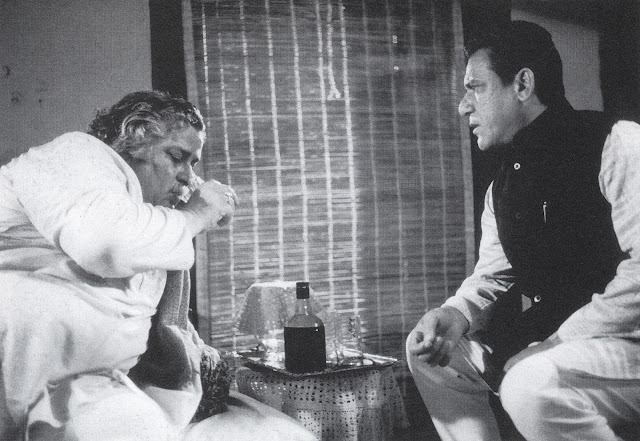


In Anita Desai's magisterial 1984 novel In Custody, which was adapted into a Merchant Ivory film in 1993, a small town college lecturer sets out to interview a great poet. The lecturer, Deven Sharma, teaches Hindi for a living, but dreams his literary dreams in Urdu—and Nur Shahjehanbadi is his idol.
Almost from the beginning, Desai uses clothes to mark the gulf between the two, to show us who they are and sometimes who they are trying to be, but failing. 

When Deven first knocks timorously at his door, Nur is lying there, “like a great bolster laid on a flat low wooden divan”. But even without words, in semi-darkness, the poet exudes a certain charisma, a grand visibility that has something to do with being dressed entirely in white, his “white beard splayed across his chest and his long white fingers clasped across it.” To Deven's awestruck eyes, his size and immobility suggest a marble statue, “large and heavy not on account of obesity or weight, but on account of age and experience."
Nur's all-white kurta-pyjama emerges as a signifier of his distance from the mundane, his separateness from the crowd. When Deven begins to doubt his gaze, Nur reappears “freshly bathed and looking truly poet-like in fresh, starched white muslin clothes, loose and flowing and free...”. He is a vision of purity, but purity in danger of being soiled by the lowly chaos around it. That metaphorical image is one Desai draws out fascinatingly, given that this is a Muslim man being described by a Hindu one: “It was clear to Deven that these louts, these lafangas of the bazaar world—shopkeepers, clerks, bookies and unemployed parasites lived out the fantasy of being poets, artists and bohemians here on Nur’s terrace, in Nur’s company... what was astonishing was that the great poet Nur should be in the centre of it, like a serene white tika on the forehead of a madman.”


It is Deven's hero-worshipping gaze that keeps Nur “poet-like”, even after he soils his clothes. So it should be no surprise that the gaze Deven turns upon his own clothes is one of self-loathing, a tragic combination of economic deprivation and aesthetic despair. His Urdu department colleague Siddiqui Sahib has both the money and the taste for “a fine muslin shirt” to wear to college, Deven's only new shirt is a pale green nylon one from his in-laws. When his wife brought it, “he had tossed it on to the floor in an obligatory fit of temper--the meek are not always mild—saying the colour was one he detested, that the buttons did not match, that the size was too large—how could they have chosen such a cheap garment for their son-in-law?” Now, setting out on what feels like the most important assignment of his life, he feels he has no better option—though Sarla smirks when he asks her for it. 
Om Puri, the superb Deven of the film, gets a better deal. We see him in a Nehru jacket over a khadi kurta-pyjama, and once even a dark sherwani. Ismail Merchant seems to have decided that no Indian literary man—even a mere lecturer with a penchant for Urdu poetry, who keeps announcing self-deprecatingly that he is “only a teacher”—can be clad in the cheap bush-shirts and trousers that Anita Desai wrote.
But how do we understand Merchant's decision? Is there a self-Orientalising gaze here? Of course, the Urdu poets of the late Mughal court wore even finer clothes: Shamsur Rehman Faruqi's The Mirror of Beauty spends pages describing Zauq's mashru tunic and wide pyjamas, or Dagh's five-pointed black cap. But does associating present-day Urdu poets with the imagined uniform of a long-gone Muslim nobility celebrate that historical culture, or is it a form of othering we could really do without now? 
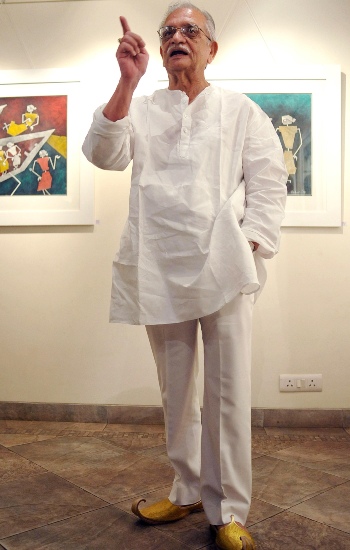
The great film lyricist Gulzar said in a 2017 interview that he has worn white since his college days, and it would “feel false” to wear colour now. But when asked if he feels most himself in a kurta-pyjama, he said he has never worn a pyjama! He wears a Punjabi-Pathani shalwaar on Sundays, of the sort worn in his home-town of Dina in Pakistan, and earlier often wore a dhoti. But what he wears almost all the time is “a regular pair of trousers, with the front crease and everything...” said Gulzar. “It’s just because I’m an Urdu poet that people assume I’m wearing a pyjama with my kurta.”
Photo: AFP PHOTO/STR STRDEL/ AFP

Poet and lyricist Gulzar at an exhibition in Mumbai.
Who is this fictional Urdu poet, who must wear only white, or even only kurta-pyjama? The image may have been truer when In Custody was written, but even the 84-year-old Gulzar has spent a lifetime playing tennis, wearing shorts. The young Urdu poets you might meet at a mushaira in Delhi, at Jashn-e-Rekhta or one of the city's many literary festivals, might be software engineers or tourist guides, TV journalists or government school teachers. They may be “of the bazaar world”, but are no lafangas. And you cannot identify them by their clothes.
Published in The Voice of Fashion, 2 July 2019.

22 April 2019

Prisons of the Mind


At 25, Ismail Merchant's In Custody (Muhafiz) remains a striking vision of poetry amidst pettiness, as well as a memorable tale about Urdu and Hindi.  


In 1984, Anita Desai was nominated for the Booker Prize for a novel called In Custody. It was a marvellous book about a shaggy old poet called Nur, whose last days we observe through the eyes of a college lecturer called Deven. Desai wrote her story in crystalline English, but the world she captured was that of the death throes of Urdu – as witnessed by a teacher of Hindi.

A decade later, the novel was made into a film by Ismail Merchant, starring Om Puri as the nervous, embattled Deven, and Shashi Kapoor – who had been a Merchant Ivory favourite from The Householder (1963) through ShakespearewallahBombay Talkie and Heat and Dust (1983) – as the teetering but still somehow charismatic Nur.


Interestingly, Desai agreed to adapt her book for the screen, collaborating with Shahrukh Husain, to whom we owe the fluid Urdu/Hindustani/Hindi in which Desai's imagined universe is translated back to life. Desai, the daughter of a German mother and a Bengali father who had been to school and college in Delhi, had set her novel between the hubbub of Old Delhi and the dusty provincialism of the fictional Mirpore, a trading town not far from Delhi. The film kept the poet's locational moniker “Nur Shahjehanabadi”, but transposed him (and the hole-in-the-wall magazine office run by Deven's friend Murad, which is angling for an interview with him) from the gullies of Shahjahanbad to Bhopal.


It was probably a practical decision, and certainly a more visually pleasing one. The circuitous route to Nur's house no longer went past “the reeking heart of the bazaar”, “evil-smelling shops” or the “lane lined with nothing but gutters”, but into a picturesque part of Bhopal. And the cinematic version of the haveli has a certain charm, despite the dysfunctional lives lived in it. The downstairs is presided over by the poet’s first wife, the perfect Sushma Seth, who spends her days supervising the fine chopping of onions and the utaaroing of nazar, while the upstairs is the preserve of the younger second wife, the complex, high-strung aspiring poetess Imtiaz Begum (Shabana Azmi).


Deven arrives with a very different vision of the life poetic than the one he finds being led by Nur. The film distils Desai's sharp-edged observations into something quite brilliant. An admirer of Nur's verse, Deven initially sees the great poet as trapped: when he seeks to escape the petty domestic squabbles of his household, his escape is limited to a circle of lowbrow sycophants. The delicacy of Nur's poetic imagination, it seems to Deven, cannot be nurtured by the coarseness that surrounds him. There is clearly an echo of recognition here – Deven, too, has aspirations to poetry, which he still writes – in Urdu. He feels defeated by having been tied to the mundane: the teaching job – in Hindi – that pays his bills but forces him to suffer the sly, mocking glances of students for whom romance tends more to dark glasses and motorbikes than literature; the harried, put-upon wife who does not understand poetry or the desire for it; the little son whose abilities seem too ordinary and unliterary to attract Deven's attention.


But Desai is not so one-sided as to allow even her favoured protagonists to get away with such easy self-delusion. The film incorporates these layers beautifully into the performances. We watch Deven's petulant, unnecessarily bossy behaviour with his wife Sarla (a superb Neena Gupta, who responds with the perfect balance between silent reproach and jaded complaints). We observe Nur’s own flaws: his indiscipline, his indulgence of the senses, his addiction to the excesses of alcohol and rich Mughlai cooking and late hours kept in the company of flatterers whose crude verse is so obviously no match for the quality of his. If coarseness there is, it is as much of Nur's making. And if the women are insecure, jealous, petty even when they have some ambition, In Custody is astute enough to show us that they cannot really be blamed: the limits of their imaginations are the limits of what their civilisation has allowed them.


The book went into much greater detail about the politics of Hindi and Urdu, with the poet often mocking Deven's employment in a Hindi department: “Forgotten your Urdu? Forgotten my verse? Perhaps it is better if you go back to your college and teach your students the stories of Prem Chand, the poems of Pant and Nirala. Safe, simple Hindi language, safe comfortable ideas of cow worship and caste and the romance of Krishna,” he derides Deven, in a line that seems bizarrely blind now. There are complaints about the Congress having placed Hindi and the Hindiwallahs atop the literary establishment, while Urdu is imprisoned in “those cemeteries they call universities”. Thirty-five, even 25 years ago, the fictional Nur and his bazaar hangers-on – largely Muslim, young, unsophisticated of taste and insecure of income – could still mock a Hindu lecturer of Hindi who had come to pay his respects to Urdu. If Nur stood for the decrepitude and self-delusion of Urdu, Hindi was represented by the innocuous wannabe poet Deven. That equation has changed, perhaps forever.

6 September 2011

Book Review: Anita Desai's The Artist of Disappearance


Anita Desai returns to a territory and time she is familiar with, one that her quiet prose brings to vivid life


Anita Desai's most recent book comprises three novellas – 'The Museum of Final Journeys', 'Translator Translated', and 'The Artist of Disappearance'. All three return, in revealing ways, to worlds Desai has explored before, and to characters whose predicaments will seem familiar to a reader of Desai's earlier novels.

From Clear Light of Day and Fasting, Feasting, first of all, comes a preoccupation with old houses in decline, houses that should be comfortable anchors for those who inhabit them but seem more like millstones. Once-grand rooms fall into decay, gardens become overgrown, parents grow old performing the rituals of gentility that they have spent their youth cultivating, and even the children seem to grow into stunted adults, as if embalmed forever into the stultified lives bequeathed to them. Ravi and the house on the hill in 'The Artist of Disappearance' make one think of the resentful, resigned Bim, stuck in the house on Bela Road with her memories of a magnificent childhood, or the unhappily single Uma in Fasting, Feasting, whose slightest excursion into the excitement of the world beyond, even a restaurant outing, becomes the focus of scandalised outrage. And in 'The Museum of Final Journeys', the house as mummified past, so familiar from Clear Light, has truly become a museum.


These are sahabi worlds, where appearances must be kept up. Meals, however meagre, are meant to be laid out on the dining table by servants. And servants should be liveried. In Fasting, Feasting, when the married daughter Aruna brings her in-laws to visit her parental home, she is distraught to find that the family driver no longer seems to wear a uniform. In 'The Museum of Final Journeys', the driver who "announces officiously" that he has brought the new officer-sahib is described as wearing "a uniform of sorts, khaki, with lettering in red over the shirt pocket that gave him the right". While the chowkidar of the circuit house, because he is barefoot and wears no uniform, must "somehow establish... his authority" by holding his back very straight.

The matter of uniforms reveals Desai's sharp eye for the deeply hierarchical mode in which much of Indian life still thrives, where the basis of authority is often the performance of superiority. The young Indian bureaucrat on his first remote posting may feel timorous on the inside, but he knows as well as anyone that to show any signs of fear or anxiety would mean social death. At the start of 'The Museum of Final Journeys', our protagonist spends a terrible night, tossing and turning under the ineffective mosquito net, assailed by doubt: "Should I quit now before I became known as a failure and a disgrace? Could I appeal to anyone for help, some mentor, or possibly my father, retired now from this very service, his honour and pride intact like an iron rod he had swallowed?" Within a few months, the same person has begun to snap at people with the requisite air of impatient superiority: "I had acquired this habitual manner of speech to those in an inferior position – servants, petitioners, supplicants; I found it was expected of me, it went with the job."

Prema, the protagonist of the second novella here, does not have a house to tie her down, but she is akin to Bim and Uma in other ways – she is the bloodless spinster, the sexually inexperienced woman who tries, with varying degrees of success, to sublimate her desires in work. But even more than them, Prema's predicament in 'Translator Translated' echoes that of Deven from In Custody: the thankless college lecturer who seeks to escape the desert of the real by turning her/himself into a kind of worker ant in the service of great literature. Deven's excessive pleasure and involvement in the work of the poet Nur is matched by Prema's in the writing of Suvarna Devi – as is the befuddlement when the great artist figure they have built up turns out to be normal, human, frail and familial. In Nur's case, the familial is near-grotesque; in Suvarna Devi's, merely boring. But what is really at the heart of both narratives is the quickly inflated sense of importance that Deven and Prema acquire from their association with these literary figures – and how easily and cruelly their delusions of grandeur are crushed.

Desai is nothing if not a careful observer, and so it seems to me that without specifying it, she has elected to return to the India she knows best – an earlier time, where lecturers get typists to do fair copies of their manuscripts and even enterprising tea shop owners do not yet have televisions. As always, the joy of these stories lies in the detail. To those who have never read Desai, this collection is an evocative entry into her oeuvre. To those who have, well – the pleasure is in the return.

The Artist Of Disappearance
Random House India
Pages: 199 Rs. 350


Published in the Sunday Guardian.

25 August 2008

Living Image: Old Delhi in literature

An essay for Time Out Delhi, on changing literary depictions of Shahjahanbad over the last century:
Photograph by Abhinandita Mathur
“Anything about which one knows that one soon will not have it around becomes an image,” wrote Walter Benjamin. While Shahjahanbad is nowhere near disappearing from the face of the earth, the death of its spirit has been much lamented in twentieth century writing, and there is no doubt that much of the throbbing, pulsating life that coursed through the city’s veins at the start of the century no longer exists, except in memory.

The creation of New Delhi in 1931 relegated Shahjahan’s once-magnificent city to the status of “Old” Delhi, which came to be perceived increasingly through the developmental lenses of “congestion” and sanitation rather than as an organic settlement with its own vision of what a city is. But even as political power and cultural patronage moved bag and baggage to New Delhi’s tree-lined avenues, the bustling galis and kuchas of the walled city – and the quieter bungalows of the Civil Lines – became for many a writer, a window into a “more authentic” Delhi.

Among the earliest twentieth century literary attempts to document the disappearing life of the walled city was Ahmed Ali’s Twilight in Delhi (1940). Set in the period 1911-1919, Twilight draws on a fund of memory to fill out a portrait of life in Delhi in loving ethnographic detail: the pigeon-flyers and the kite-fighters, the kababchis and the kulfi-sellers, the beggars and the healers, the poets and the qawwals. It is a love song to a dying world – a world that may have been feudal, flawed and untenable, but whose ideals one still cherished, whose purity one admired, and whose once-incandescent beauty was not easily forgotten.

Certainly, for someone who helped found the Progressive Writers’ Movement, Ali displays very little enthusiasm for the transformations of modernity. Instead, we read of the “grating noise” of trams, of engine smoke blackening the evening sky, of Chandni Chowk being disfigured by the demolition of the central causeway and the cutting down of shade-giving peepal trees, and most painful of all, the death of the old culture: “The richness of life had been looted and despoiled by the foreigners, and vulgarity and cheapness had taken its place. That relation which had existed between society and its poets and members was destroyed”.

Glimpses of a similarly conflicted relationship with a once-glorious but colonised past and a decolonized but forever corrupted, inauthentic, present appear in Anita Desai’s Clear Light of Day (1980). Moving between a 1970s present and a 1940s past, Desai’s allusions to “Old Delhi decadence” conjure up a contrasting vision of New Delhi as a place “where things happen”. But Desai allows for no easy choices. Hyder Ali and Raja, who represent Old Delhi, with their poetic flourishes and delusions of grandeur, are treated with as much ambivalence (“verses that… had thrilled her then with their Persian glamour”) as the diplomat Bakul’s smug efficiency (“smoothed” by “the bland oil of self-confidence”).

Desai’s Old Delhi, interestingly, is not the walled city but the Civil Lines, a European enclave of sprawling colonial bungalows to which upper-class Indian families started moving in the 1910s and 1920s. The Civil Lines of Clear Light, however, is a much lonelier place than the one remembered by Sheila Dhar (Raga’n Josh: Stories from a Musical Life, 1995), whose barrister grandfather spearheaded just such a move of her Mathur Kayastha extended family, from “the congested lanes of Chailpuri in the old city” to the “spacious and elegant” houses whose new Anglicized lifestyle awed relatives visiting from the walled city. “It was noted with envy and admiration that breakfast in these households consisted of eggs, toast and jam, instead of vegetable bhujia with paratha, and that even the women had begun to use spoons, though only little ones, to eat.”

And yet, for all the billiards, bridge and Scotch whisky that had replaced chess, ganjifa and keora sharbat, Dhar’s sparkling memoir of her 1940s childhood reveals many connections to an older style of Delhi life. The ustads who first taught Dhar classical music came from the walled city – Mohan Baba from Neel Katra, Bundu Khan from Suiwalan – and family outings were planned as if from Sheher – “walks by the Jamuna, trips to the Qudsia Gardens, picnics at Okhla in the mango season”.

By the 1950s, however, the separation between the old city and the new was complete. Madhusudan, the narrator of Mohan Rakesh’s seminal 1961 novel, Andhere Band Kamre (translated as Lingering Shadows [1993]), rents a room in Qassabpura, but spends his waking hours in Connaught Place, wondering whether he will ever live in the style of his friends Harbans and Nilima, in their Hanuman Road bungalow “with paintings on the walls”. For Thakurain, his landlady, Connaught Place is a distant “outing” – she excitedly remembers having gone there once, “on Independence Day with Thakur Saheb.”

In one of the book’s most devastating scenes, Madhusudan writes a newspaper feature on “the streets of Delhi” whose mention of Qassabpura’s dilapidated houses results in the Municipal Committee threatening to pull down Thakurain’s home. Old Delhi was no longer about poetry and music, or even delusions of grandeur – it was a dirty, congested, “breeding ground for epidemics”, full of houses of “the sort that should be condemned!” Rakesh’s novel coincided with the 1962 Delhi Master Plan’s schemes for “decongesting” Shahjahanbad and its declaration as a notified slum.

Even nostalgia, if it existed, now served as an excuse for demolition. Jagmohan followed up his Rebuilding Shahjahanbad (1975) with his infamous attempt to “clear” sections of the old city during the Emergency. It was not until the 1990s, with William Dalrymple’s City of Djinns (1993) and Krishna Sobti’s magisterial Dil-o-Danish (1993) that Old Delhi began its slow return journey to being a site of history and romance, leading to an increasing interest in it as “heritage”.

It remains to be seen what writers in the 21st century will make of a city that must now negotiate a path between preserving havelis and thriving trade, a path that will hopefully allow for both cycle-rickshaws and the Metro.

Published in Time Out Delhi Vol 2 Issue 4 (Jan 25 - Feb 7, 2008)